
 RN (1907) Battlecruisers: HMS Invincible, Indomitable, Inflexible
The Invincible class were the world’s first battlecruisers. A rare breed, since it was only tried by four nations, UK, Germany, Japan and the US (attempted, the converted to CVs). The way that lead to them was as fascinating as for the Dreadnought, and also entirely due to Sr. Admiral John Arbuthnot Fisher’s ideas. He wanted a monocaliber intermediate that can replace the armoured cruiser, and it did. This was for many authors the inspiration leading ultimately to a last evolution in the interwar, the “fast battleships”. But what about the nerdy details of the Incinvible class and their career ?
_British_Battleship.jpg)
HMS Invincible in 1914.
Introduction: The world’s first battlecruisers
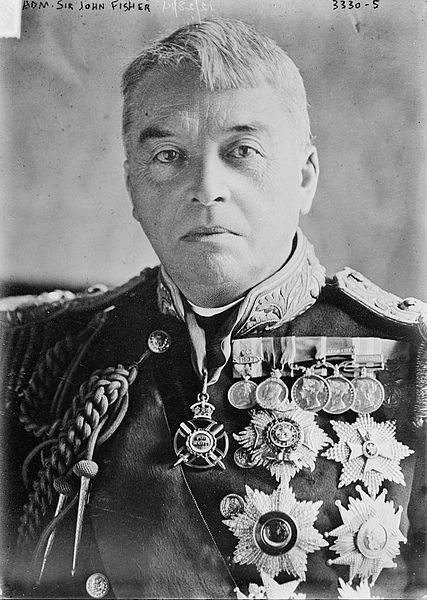 Cruisers, naturally faster than more ponderous battleships, went to be seen like the “tip of the sword”, compared to heavy cavalry in a conventional battlefield. The Dreadnought’s origins were in part influenced by concepts for a new type of armoured cruiser, such as the one developed by Italian engineer Cuniberti. After the Dreadnought, the continuity in Royal Navy capital ship programme saw each new class of battleship mirrored by a new class of armoured cruisers, like the Minotaur compared to Nelson. So it could not be otherwise with the new Dreadnoughts.

Prior to the order to building HMS Dreadnought already, discussions went well underway between Admiral Fisher and Royal engineers notably about recent demonstration of the Russo-Japanese War, and he rallied to his views the rest of the Admiralty. For him, speed was the determining factor, as actual battleships were too slow. A future example proving the point was the Greco-Turkish war of 1912 under Pavlos Kountouriotis. At the battle of Elli and Lemnos, speed was a decisive factor for the armoured cruiser Averoff to win. Earlier in the past and also well known by the admiralty the battle of Yalu, part of the 1st Sino-Japanese war, showed the latter winning against a large Beiyang fleet with armoured cruisers by the virtue of speed and manoeuver, over slowed cruisers and two ironclads.
Some saw these reports and thought that speed whereas not a true “active” protection, enabled a kind of tactic already practiced by frigates of the classic era (“fight the weak, flee the strong”) also applicable to commerce raiding in general, but rather a way to “choose the engagement” and impose its own tempo on the enemy, own the battle rather than submit to the events. However the way armoured cruisers, the ultimate evolution of the cruiser born from designs of the 1870s evolved into a dual role, commerce raiding independent actions while also be capable to join a battle line, already showed the way for an evolution aside the newly developed monocaliber concept.
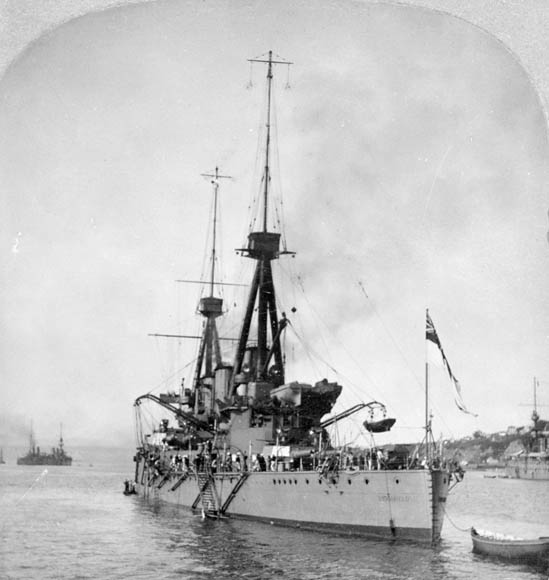
HMS Indomitable at Quebec Tercentenary.
It is on these premises that was created the concept of “battlecruiser” to break with the continuity with previous armoured cruisers. Because unlike the latter, these new ships were given the same powerful all-big guns artillery, but in return traded protection for speed as protection (at least on British ships) was still comparable to a cruiser (150 to 200mm). Their great speed made them best suited for “armed reconnaissance” missions. This tradeoff in protection became quite popular in navy staffs around the world, but this theory only came to its ultimate moment of truth at the Battle of Jutland.
Only three countries will have the opportunity to build battlecruisers, which were fewer in number than battleships. The British will launch sixteen (the last, HMS Hood, being launched in 1920), The Germans had seven, and the Japanese four. France programmed some in the Durant-Viel 1912 programme to be delivered in 1916, and the Americans planned a class of five to be launched in 1920. After the Treaty of Washington, this type of vessel was very much dropped but the “speed as a protection” illusion still prevailed as shown with the 1930s Washington treaty compliant “tin-clad cruisers”. At the start of World war II, only three battlecruisers were in service (with the British Navy), the others being converted as aircraft carriers of as fast battleships (like the Kongo class). They have been indeed rendered obsolete by new fast battleships, and combat aviation.
Development and construction of the class
Development (1904)
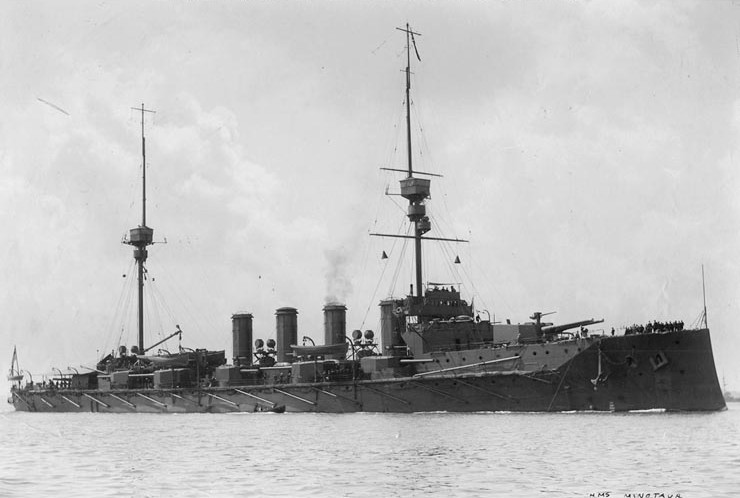 After Admiral Fisher was appointed First Sea Lord on 20 October 1904, he pushed through the Board of Admiralty by early December a decision for the next armoured cruiser class, planned in 1903 already to succeed to the Minotaur class (first laid down 2 January 1905) to be armed, instead of two twin 10-in guns and ten single 7.5 in guns, with a monocaliber battery of 12-inch (305 mm) guns (presumably in twin and single turrets), and with a speed no less than 25.5 knots (47.2 km/h; 29.3 mph) compared to 23 knots (43 km/h; 26 mph) on the next Minotaur.
Various proposals studied revolving around the machinery and main artillery positions
Shortly afterwards, he setup the “Committee on Designs” to try to write up requirements for these and other future ships. It nominally independent but mostly validated decisions already made, as well as deflecting criticism off Fisher and the Board of Admiralty, not able to consider options, especially as those were already decided upon by the Admiralty. Fisher appointed all of the members of this Committee, and took its Presidency nevertheless. There were several meetings. In the last one, on 22 February 1905, it agreed on the outline design of a fast armoured cruiser matching what Fisher’s needed. It was approved by the Board of Admiralty on 16 March with only minor changes.
Notably the reduction in the anti-torpedo boat armament, from twenty to eighteen 12-pdr guns. But what Fisher obtained, wa to go from a configuration a la Minotaur with four wings turrets with 12-in guns, in addition fo fore and aft twin turrets, four twin turrets, the two amidship being stagerred like the contemporary Colossus class dreadnoughts. It was seen indeed that the bulk and weight of a turret for a single gunw as a lack of space. A three single turret with such large guns on the wings was also a technical nightmare, only doable with 10-in guns, but in the end, the final configuration was the one that made the most sense.
In fact, the new Invincible class were still formally known and referred in documentation as “armoured cruisers” until 1911, when redesignated “battlecruisers” by an Admiralty order of 24 November due to their many differences with earlier type and avoid confusion. Unofficially, other designations were used such as the logical “cruiser-battleship”, “dreadnought cruiser” and “battle-cruiser” before it was settled on a simpler form of the latter. Albeit less indicative of their nature, at least they touched on their prospective role: Fighting with battleships or in a battle, yet not in a battle line but as its own inedependent entity. The early raids of German Battlecruisers in 1914 and the way battlecruisers operated on both sides showed the way they could excel at, provoke the enemy and detach a force that could be dealt with, after being lured out on the main support of battleship laying behind. This was the scenario that played out in several battles, including at Jurtland. Battlecruisers were part of the battle plan but operated far from the main body, as a vanguard.
Construction
The Three Invincible were laid down respectively in Fairfield, Clydebank and Elswick, from February to April 1906, launched in early 1907 and completed in June 1908 (Indomitable), October 1908 (Inflexible) and March 1909 (Invincible). Final plans revealed vessels that were not elongated clones of the Dreadnought, but rather armoured battleships with heavy artillery. They shared the same turrets (although the armour was made lighter) but had one less turret, so now eight 12-in guns instead of ten on a regular dreadnought. In addition, these turrets were disposed en échelon much like Colossus and Neptune. Theoretically, this provision allowed a full Broadside, although their shooting angle was limited, and six guns only in pursuit or retreat.

The design of these ships took time, as their construction. They were also 50% more expensive than the previous Minotaur class, but perfectly fulfilled initial specifications and obtained excellent trials results. Critics came later, and concerned the whole battlecruiser type. Confusion was maintained in the admiralty as they had heavy artillery, were named like battleships, and included from the outset in battle lines together whith battleships, while their true role was more of a classic cruiser: Waging war on trade and hunting smaller vessels. They had been designed to perform both.
Design
Hull and general Outlook

Cutaway of the Invincible, by Tony Bryan (Osprey New Vanguard #126 British Battlecruisers 1914–1918).
The Invincibles class were larger than the previous armoured cruiser and predecessors of the Minotaur class with an overall length of 567 ft (173 m), a larger beam of 78.5 ft (23.9 m), and while being draftier at 30 ft (9.1 m) at deep load. To compare, the Minotaur class measured 519 ft x 74.5 ft x 26 ft (158,2 x 22,7 x 7,92 m). Yet, as we see there, the beam went from 74.5 to 78.5 ft, so just 4 feet, while the lenght was comparatively stretched out further, resulting in a better hull ratio at 7.3:1 versus 7:1, making the best of the more powerful machinery.
They also displaced as a result 17,250 long tons (17,530 t) standard or on light load and 20,420 long tons (20,750 t) at deep load, so nearly 3,000 long tons (3,050 t) more than the former cruisers.

Profiles from the blueprints.com
As for the design, it was dictated largely by the position of the turrets and very different from the Minotaur class. There were some similarities notably seen from above for the hull lines with a max beam reached at the level of the two amidship turrets, partly resting on sponsons. To maximize their arc of fire fore and aft (not not cross fire) so to have three barrels in chase and retreat at all time as well as in broadside, superstrctures were in two islands like for the Colossus, the forward island behind “A’ turret and comprising the main bridge and tripod mainmast with its searchlight platforms and spotting top, then the two main fore funnels, a few boats and cranes to service them (plus secondary guns distributed there).
Then came the great amidship void, on which were placed the two turrets with a limited echelon and pointing for “P” port forward, “Q” starboard pointing aft and also placed further aft. Then came the rear island, smaller, yet still with the aft tripod and its spotting top, with its leg embracing the aft funnel, in which were truncated the remaining boilers, smaller than the two forward. The hulls had a ram, three main anchors, forward, two starboard, one port, two smaller on deck aft, four propellers, three steam cutters, one whaler, two yawls, two dinghies and two other smaller boats. The bridge was tall and narrow, placed atop the conning tower, itself relatively small in diameter and well clear of “A” turret by a full deck. Above the narrow enclosed bridge for the helmsman was an open bridge oberhanging awell above and supported by struts with observation scopes and spyglass, covered by canvas, offering an excellent view short of the spotting top above as it was level with the top of the funnels well behind. Smoke interference was taken in account and mostly did not interfered much in operations.

A nice 3D rendition with texturing from warthunder.
On the island were also placed the largest boats, serviced by a single boom crane. The structure started where the forecastle ended, unlike on the Minotaur class, where it ended when the first secondary turrets started to give them a forward arc. The same aft structure also ended in a typical triangular shape seen from above to allow “X” turret the maximum fire arc on some angles in broadside. Another peculiar aspect was the way the two island structures ended in the innner section where the two amidship turrets were. The forward island mirrored the asymetric cut of the fore wall of the aft island in order to maximize the fire arc of their respective turrets.
Powerplant
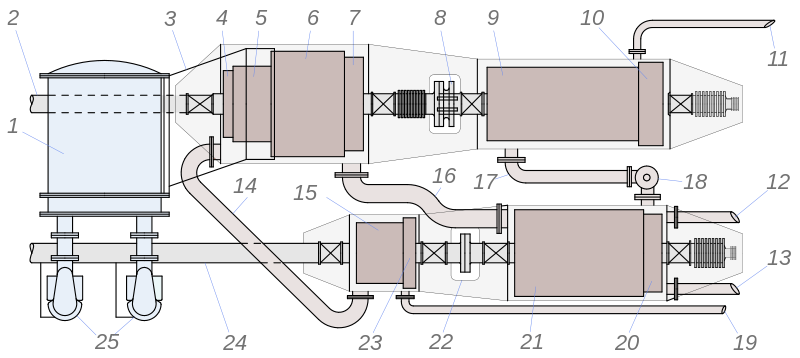
Scheme of HMS Invincible’s starboard engine room with the high and low pressure turbines side by side.
Their propulsion was a must at that time, comprising 31 boilers. They were designed to reach 25.5 knots, more than average armoured cruisers stuck at 20-21 knots.
Its development was not a smooth straight line however. Early in the design process the “Committee on Designs” wanted to stick to traditional reciprocating vertical triple-expansion steam engines (VTE), but discussions and the weight of Fisher eventually leaned in favor instead of Parsons steam turbines as this adopted for Dreadnought, because they required fewer boilers for the same amount of power, a crucial point to save inner space, as well as were easier to protect from damage, being more compact than reciprocating engines, kept below the waterline and earlier to surround by bulkheads while being lighter and more reliable.
So direct-drive turbines were adopted, with still one significant drawback: At relatively high speed which they worked better with small-diameter, fine-pitch propellers with a large blade area and this was not great for manoeuvrability at low speeds. Parsons suggested to fit more powerful astern turbines on all four shafts to increase manoeuvrability, by simply reversing as needed. This was true, but the strain and wear of the turbines was also greatet, and it was taken as a measure of emergency.
The additional solution which appeared in these discussions was to used twin balanced rudders, behind each inner shaft, unlike a single central rudder like on earlier ships. This increased effectiveness of the rudder and decreased turning circle in comparison notably to the previous Armoured cruisers. That was the solution adopted. Both rudders were rounded and close together.

The Invincibles ended with two paired sets of Parsons turbines (LP/HP) housed in separate engine-rooms. Each set thus was a combination of a high-pressure ahead, and astern turbine driving an outboard shaft, low-pressure ahead and astern turbine driving the inner shafts for cruising, but in addition a cruising turbine waso coupled to each inner shaft. In practice this was seldom use and mostly left disconnected. Each shaft ended on a 3 bladed propeller 11 feet (3.4 m) in diameter, identical for all four.
As for the 31 Yarrow (Invincible and Inflexible) or Babcock & Wilcox (Indomitable) large-tube boilers, they were located in four boiler rooms, with exhausts truncated in a way the first three ended in twp main funnels forward and the last one in a single smaller funnel aft.
These Parsons steam turbines were rated for 41,000 shaft horsepower (31,000 kW). On trials in 1908 they registered at 47,000 shp (35,000 kW). This traduced by trials speed over 26 knots (48.2 km/h; 29.9 mph) for a designed speed of 25 knots (46.3 km/h; 28.8 mph). There was a 3 days run where they also averaged 25.3 knots (46.9 km/h; 29.1 mph) in the North Atlantic by August 1908, not a mean feat in these rough seas. The way the hull was made also made them less “wet” tha previous armoured cruisers and better to cope with bad weather. They were also average walkers, but responsible at the helm and due to their moderate metacentric height, had a previsible, gentle roll making them good firing platforms.
As for the range, they wee capable of carrying no less than 3,000 long tons (3,050 t) of coal, with 725 long tons (737 t) of fuel oil in tanks to be sprayed on coal to increase the burn rate. At full fuel capacity, the range was thus of 3,090 nautical miles (5,720 km; 3,560 mi) at 10 knots (19 km/h; 12 mph) cruise speed. This was however criticized as to compare, HMS Dreadnough and her successors were caopable of 6,620 nmi (12,260 km; 7,620 mi) also at 10 knots (19 km/h; 12 mph), so double. Bu the higher speed and high consumption of the Invincible meat they were “short legged” for prolongated fleet operations, something that will haunt all British battlecruisers.
Protection
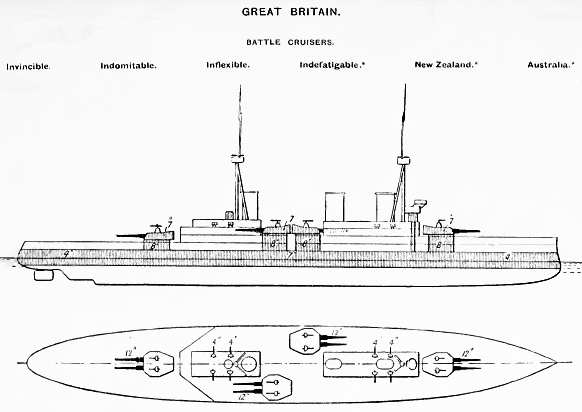
The armour scheme was closer to Dreadnought whereas being lighter to save weight and increase speed, just able to deal with 8 inches or even 10 inches calibers if lucky. KC (Krupp Cemented Process) armour was used throughout, unless otherwise mentioned. They were not designed to go head to head with any battleship, not even their own kind.
Waterline belt: 6 inches (152 mm) amidships (Dreadnought 11 inches (279 mm)), tapered to 4 inches fore. No protection aft of “X” turret.
Bulkheads: 6-inch trabsverse barbette X closing the armoured citadel.
Gun turrets+ barbettes: 7 in (178 mm). Roofs 3 in (76 mm) Krupp non-cemented armour.
Main deck: 1 in (25 mm) base barbettes, crown rear CT. 2-in (51 mm) crown forward CT.
Lower deck armour: 1.5 in (38 mm) flat, 2-in slope, except aft X turret: 2.5 in (64 mm) over steering gear.
Forward conning tower: 10 in (254 mm), rear 7 in (178 mm).
Rear conning tower: 6 inches, roof, floor KNC 2 in.
Communication tubes: 3 in (76 mm) KNC.
Signal tower (aft CT): 3 in KNC.
Torpedo bulkheads: Mild steel 2.5-in abreast the magazines/shell rooms.
Armament
It was made “monocaliber” so instead of the Minotaurs’s 10-in, 7.5-in, and 3-in guns plus TTs, they went for 12-in and not true secondary casemate guns but instead a lighter caliber intermediate between a 3-in and a 6-in, the 4-in (102mm) QF better able to deal with torpedo boats but weak in apeer to peer engagement indeed. This however greatly streamlined the armament. The guns were mostly unprotected unlike the main 12-in, and located over the deck to not be subjected to water spray, located in the fore and aft sutructures offering some protection, as well as over the turret’s roofs and on upper decks.
12-inch (305 mm) Mk X
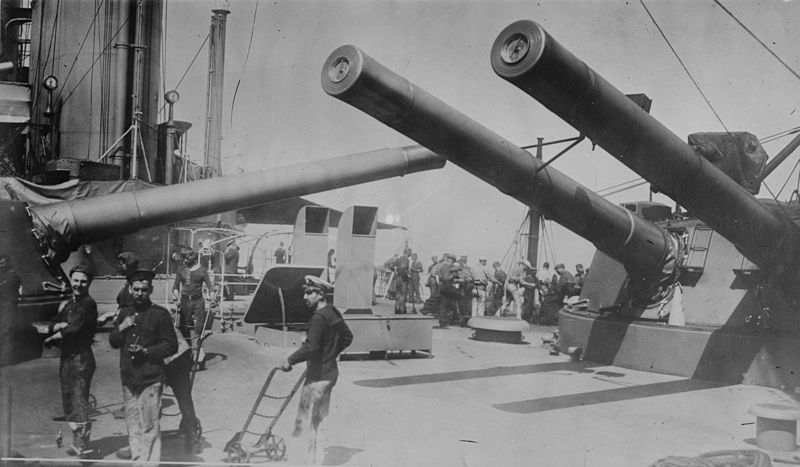
Each ships had four twin turrets (named “A”, “P”, “Q”, “X” from stem to stern) for a total of eight BL 12-inch (305 mm) Mk X Vickers Armstrong Elwick guns. The turrets were hydraulically powered Mark BVIII modes similar to the Dreadnought and Colossus, except for Invincible which muwed two BIX and two BX, electrically driven turrets. Two as seen above A and X were in the centreline axis fore and aft, and the remained P and Q located in echelon between the second and third funnels. ‘P’ was on the port side facing forward, ‘Q’ on the starboard side facing aft or rearwards. ‘P’ and ‘Q’ were with the first forward of ‘Q’, so both could fire in a limited arc starboard and port. Same guns also as those mounted in HMS Dreadnought, Lord Nelson class and the Bellerophon class.
Specs:
Shell: 850-pound (390 kg)
Muzzle velocity: 2,746 ft/s (837 m/s);
Rate of fire: 2 rounds per minute
Elevation: −3° 13.5° (16° after mod World War I) range 20,435 yd (18,686 m) with 4crh shells.
Storage: 880 rounds carried in all in wartime, 110 shells per gun.
4-inch (102 mm) QF Mk I
 The secondary armament initially was originally eighteen quick-firing (QF) 12-pounder (3 in (76 mm)) guns. However on firing trials against the old HMS Skate in 1906 showed the “12-pounder” had little stopping power. It required way too much hit to prevent it to close to range and fire torpedoes. It was decided to replace them by sixteen (two less) 4-inch (102 mm) QF Mk I and III guns early in construction. They were placed in the superstructure, turret roofs, all in open mounts.
Remaining guns were enclosed in casemates fore and aft, with shields, mor useful against the weather than enemy action. Maximum depression was 10°, max. elevation was 20°. They fired 31-pound (14 kg) shhells at 2,335–2,370 ft/s (712–722 m/s) at 20° elevation for a range of 9,600 yd (8,800 m) with the Common “pointed shells” (AP).
Torpedo Tubes
All three sisters carried the same five 18-inch (450 mm) submerged torpedo tubes, two on each side, one in the stern for fourteen torpedoes carried. Whithead Mark I. As a footnote they were also given seven Maxim 7,62 MGs that could mounted on pintles and used for boarding parties. It is unknown if they had saluting guns, most likely they used blank rounds with the regular 4-in guns.
On board Aviation
By 1918, the last two Invincibles carried a Sopwith Pup and Sopwith 1½ Strutter on flying-off ramps on ‘P’ and ‘Q’ turrets amidships. Each platform had a canvas hangar to protect the aircraft from the weather. They were placed high enough not to be affected much by seawater spray.
Fire Control
Using the same 12-inches as on the first Dreadnought enabled the possibility of using the same fire control system as well. Their spotting on the fore and main masts were used to control the main guns. Each had a 9-foot (2.7 m) Barr and Stroud rangefinder. Its data was passed on a Dumaresq mechanical computer for a solution and was electrically transmitted to Vickers range clocks in the Transmitting Station beneath each spotting top. The data was converted into range and deflection, sent to the guns, graphically recorded on a plotting table to be used by the gunnery officer for predicting the target’s path. Each gun turret had a transmission equipment and the transmitting Stations as well as spotting tops could be connected in many combination. HMS Hero tried this in 1907 but revealed vulnerability to gunfire. As a backup, “A” turret after her 1911 and 1914 refits by a 9-foot rangefinder on its roof and later refined to control the entire main armament.
Next was the development of the Dreyer Fire Control Table, combining the role of the Dumaresq and range clock. The Mk I was fitted to the Invincibles in 1915–16. Next was the director firing system, combining a fire control director mounted high, electrically providing gun data to the turrets via pointer. This allowed to fired the guns simultaneously, helping spotting shell splashes and negating the adverse effects of roll and dispersion. Invincible was the first battlecruiser so fitted in April-August 1914, but as the war broke out it was still not fully working when she took part in the Falkland Islands battle in November. Indomitable and Inflexible had theirs in May 1916, before Jutland.
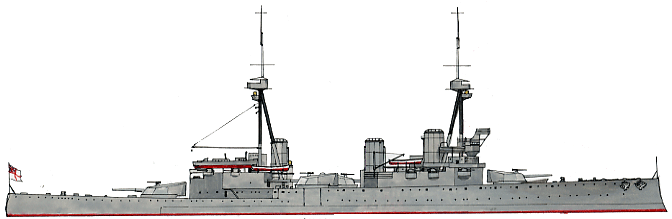
Illustration of the Invincible in 1914.
Invincible class specifications |
|
| Displacement | 17,250 long tons (17,530 t) normal, 20,420 long tons (20,750 t) deep load |
| Dimensions | 567 ft x 78 ft 6 in x 30 ft (172,8 x 22,1 x 8 m) |
| Propulsion | 4 screws, 4 Parsons turbines, 31 Babcock & Wilcox/Yarrow boilers, 41,000 hp (31,000 Kw) |
| Speed | 25-25.5 knots (46 km/h; 29 mph) |
| Range | 3,090 nmi (5,720 km) at 10 knots (19 km/h; 12 mph) |
| Armament | 2×2 12-in(305mm)/45 Mark 10, 16x 4-in/40(102mm) QF Mk.I, 5x TT 533 mm (Sub, 14) |
| Armor | Belt 150, Battery 180, Barbettes 180, turrets 180, blockhaus 250, deck 65 mm |
| Crew | 784 |
Evolution and Modifications
Some subsequent changes affected their appearance during service. During 1914–1915 the turret-roof secondary guns were transferred to the superstructure and the total number of guns was reduced to twelve. All had their fore funnels raised, and canvas protections added to their light artillery on the turrets roofs, and in 1914, their torpedo nets were removed and a new firing control system was added. Later in the war they anti-aircraft 76 mm ordnance, then their upper masts were removed, and platforms added on the “A” turret for airplanes. Following the experience of Jutland in May 1916, protection was also improved.
The secondary 4-in QF guns were replaced by twelve 4-inch BL MK IX guns on CPI mountings, just on Inflexible in 1917. (-10° +30°, 31-pound shells at 2,642 ft/s (805 m/s).
Indomitable received twelve 4-inch BL MK VII guns on PVI mountings also in 1917 (-7° +15°, 31-pound shells at 2,821 ft/s (860 m/s) range of 11,400 yd (10,400 m), 6–8 rpm). She received an additional gun in April 1917 on an anti-aircraft mount MK II high-angle for 60°. It used reduced propellant charge for 2,400 ft/s (730 m/s).
Anti-aircraft guns fitted first were the QF three-pounder (1.9-inch (47 mm)) Hotchkiss on high-angle Mk Ic mounting (60°) on Invincible and Indomitable from November 1914 to August 1917.It These fired 3.3-pound (1.5 kg) shells at 1,927 ft/s (587 m/s).
They also all three received a single QF 3-inch 20 cwt AA gun high-angle MKII mount aft of the superstructure. (12.5-pound (5.7 kg) shell at 2,604 ft/s (794 m/s)).
General Evaluation
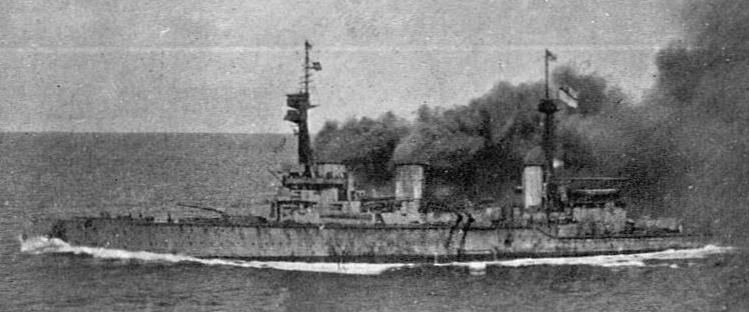
HMS Invincible at the battle of Falklands Islands
Invincible suffered from a collision with submarine C13 in 1913. At the time of the declaration of war, she was in Queenstown, to prevent German raids. Then participated in the Battle of the Bay of Helgoland, then was detached with the Indomitable to the Falklands under the command of Commodore Sturdee, taking part in the Second Battle of the Falklands in November 1914, avenging the destruction of Sir Cradock’s squadron and destroying Scharnhorst and Gneisenau, the best ships of the German Pacific squadron. After a brief overhaul at Gibraltar the Invincible was detached to Rosyth, joining other sister ships to from the 3rd Battlecruiser Squadron. In May 1916 she was training at Scapa Flow, taking part in major firing exercises, soon before the legendary Battle of Jutland.
Flagship of Admiral Horace Hood, the Invincible engaged light cruisers scouts Pillau and Wiesbaden, putting them out of action, then crossed swords with battlecruiser Lützow, inflicting her severe damages. But soon the Derfflinger replicated and hit the Invincible 5 times, the last round blewing up her side turret, causing a dramatic cordite fed fire of accumulated dust in the cluster well. The flash detonated itself and a huge explosion ensured, breaking hull in two. She sank quickly, carrying with her almost all her crew in the deep.
HMS Indomitable interrupted tests to carry the Prince of Wales to Montreal, and served also in the Home Fleet. She was transferred with the Invincible in the Mediterranean, undergoing some changes in Malta in June 1914. Both ships participated in August to the hunt for Souchon’s squadron, SMS Goeben and Breslau, escaping from Port Said. Later on she took part in the Dardanelles Campaign. She was then returned to Rosyth, but participated in January 1915 to the Battle of Dogger Bank, badly mauling SMS Blücher, finished off by HMS Queen Mary.
She also managed to destroy a Zeppelin with two main guns shots at maximum elevation, a rare, near-impossible feat. She towed HMS Lion out of harm at Rosyth, severely damaged as well. Soon after, she herself caught fire, rapidly mastered after a short. After a brief overhaul, she took part in the Battle of Jutland, fired on Derfflinger, Seydlitz and damaging also the battleship Pommern. She spent the rest of her career detached at 2nd battlesquadron until 1919, until placed into reserve and paid off, broken up in 1922.
HMS Inflexible sustained damage during test firing because of the explosion of a coal barge. She was flagship of Sir Edward Seymour at New York, late 1909. In 1911, she collided with Bellerophon, was repaired, then posted in the Mediterranean, flagship of the Admiral Milne, as headquarters of the Fleet. He hunted down the Goeben and Breslau in the hours following the declaration of war, and after an overhaul was sent to the Falklands, destroying the Von Spee’s squadron.
In 1915, sent in the Mediterranean, she replaced Indefatigable, bombarding Turkish forts of the Dardanelles. She suffered several hits, losing two 305 mm guns on 18 March and hit by a mine the day after, forcing her to resume the fight and be towed for repairs in Malta. Back in Rosyth, she participated in the Battle of Jutland, without suffering damage. Then she long inactive, participation in the short “Battle of May Island” in February 1918. She was placed in reserve in 1920 and broken two years later.
Active career
 HMS Invincible

Invincible at the Spithead review in 1909, just commissioned
While still fitting out, Invincible was rammed by the Swedish collier Oden, which lost control. The result was buckling beams and frames as well as five bottom plates to be replaced. This delayed completion on 16 March 1909. Two days later she left the Tyne to Portsmouth to be commissioned in great regalia, yet on the way, she collided with the brigantine Mary Ann, her captain decided to not move until the lifeboat John Birch arrived from Yarmouth to take the brigantine in tow.
She was commissioned with the 1st Cruiser Squadron, Home Fleet, on 20 March 1909 taking part in manoeuvres in April and June 1909, and the Spithead Review of 12 June 1909, then Fleet Review off Southend on 2 July. A refit between 17 August and 17 January 1910 helped solving her turret electrical systems, but they kept being unsatisfactory. It was attempted again in 1911, so ultimately decision was made to convert the turrets to hydraulic power, delaying her deployment with the Mediterranean Fleet in August 1913. On 17 March 1913, she collided with the submarine C34, which after enquiry appeared as the fault of the latter. Back home for Xmas 1913, a major refit notably get her hydraulic power for her turrets. It was time.
Her major overhaul started in March 1914 but was stopped on 4 August and she was formally recommissioned, albeit the yard was adamant she needed another week for her turret. So in between she became the first battlecruiser fitted with the brand new fire-control director, however she was badly needed, and the work was never completed. She carried the system but it remained inoperable. Instead she was pressed on by 12 August, hosting the colors of Rear-Admiral Sir Archibald Gordon Moore, 2nd Battlecruiser Squadron, and ordered to the Humber with HMS New Zealand, to support operations in the Broad Fourteens.
Her first action was under Admiral Beatty at the Battle of Heligoland Bight, 28 August. Initially planned as distant support of British cruisers and destroyers, they turned south at 11:35 as British light forces failed to disengage on schedule with the risk of seeing German capital ships closing on the mouth of the Jade estuary. Arethusa was crippled by Strassburg and Cöln so Beatty decided to prey on them at 12:37. Strassburg managed to evade but Cöln remained visible and was battered into oblivion. Next Beatty focused on Ariadne which appeared directly to his front, she was blasted to smitherines in three salvos from just 6,000 yards (5.5 km)). At 13:10, Beatty turned north and gave the signal to retire. Invincible, still trailing, sent 18 rounds on Cöln but misses, she was finished off by two salvos from Lion.
The next chapter was on the other side of the Ocean: The South Atlantic. The West Indies Squadron of Rear-Admiral Christopher Cradock was indeed destroyed on the Pacific side, off Coronel, Chile, by the German East Asia Squadron from Vice-Admiral Graf Maximilian von Spee, on 1 November. The Admiralty wanted the squadron, likely to recoal in the Falklands and either prey on Brtish interests in the South Pacific, prey on the African west coast, or attempt to return to Germany. Whatever the case, the destruction of Cradock’s squadron needed to be avenged, that was a meatter of honor for the Royal Navy. So under Vice-Admiral Sir Doveton Sturdee, a new squadron was constituted with Invincible as flagship and her sister Inflexible, departing on 11 November, meeting up with several other cruisers under Rear Admiral Stoddard at Abrolhos Rocks off Brazil (26th), the cruisers partly recoaling, and they headed for Port Stanley, Falklands, arriving on the morning of 7 December.
Spee in between took the decision to destroy the radio station at Port Stanley and clear off the harbour with SMS Gneisenau and Nürnberg on 8 December. They were reported by shore lookouts by HMS Canopus, a pre-dreadnought that could not accomany Cradock previously given her speed, still present in the harbour. At 07:30, she had been deliberately grounded in Stanley Harbour to defend the town and wireless station, but was not ordered to replicate until 07:45. Sturdee was in Port Stanley but knew he badly needed coaling. Cornwall and Bristol were also in need of repairs. The armed merchant cruiser Macedonian was patolling the outer harbour entrance and the armoured cruiser Kent was anchored in the outer harbour to relieve the Macedonian at 08:00. When Canopus’s main guns started barking at 09:20 they stunned the Germans, and Gneisenau, Nürnbeg had to stop operations and returned to Spee’s main force.
Sturdee only sortied at 09:50, seeing the retreating Germans to the southwest. Both battlecruisers only made 5 knots (9.3 km/h; 5.8 mph) while Spee’s ships all had fouled bottoms and could do 20 knots (37 km/h; 23 mph). Leipzig lagged behind, and when both battlecruiser rose speed, Inflexible soon entered range and opened fire from 17,500 yards (16,000 m) at 12:55. Leipzig dodged both battlecruise’s volleys at 13,000 yards (12,000 m). At 13:20, Spee ordered his squadron to separate. The light cruisers went southwest, his armoured cruisers turned north to cover their retreat, meaning he would have to take on both battlecruisers. It was like the test all wanted to see, two generations of “cruisers” sharing the same philosophy, the old ones versus the new ones. The two Scharnhorst were the last of their breed in Germany and arguably among the fiercest armoured cruisers in the Kaiserliches Marine. But their eight 210 mm (half in turrets, half in casemates) were no match for the eight 12-in or 305 mm guns of the Battlecruisers, plus the latter were faster.
The battlecruisers opened fire at 13:30 scored a first hit at 13:44 (Scharnhorst hit Invincible) albeit it bounced on her belt armour, specifically designed to resist that types of rounds. Both sides gunned each other for half an hour before Sturdee opened up the distance to just out-range the Germans to no harm for himself. However since fire control issues were still unresolved, accuracy remained very poor. The Germans only also scored four 210 mm hits. Smoke from the guns and funnels on the British side was an issue as they were upwind of the Germans and “A” turret in Invincible to top it off, jammed at 13:42 and out of action for 30 minutes.
Spee then turned south to disengage and managed to reach 17,000 yards (16,000 m) but his course was spotted and the British gave chase at 24 knots (44 km/h; 28 mph) so after 40 minutes they caught them up at 15,000 yards (14 km) and opened fire. 8 minutes later, Spee turned east in order to give them battle, deliberately closing the range to bear not only his 210 but also his 15 cm (5.9 in) guns into play. His calculus was to target their superstructures. He was successful in that and at 15:00 hos 15cm opened fire at maximum elevation. The smoke remained a problem but hits were scored on both sides and German shells tended to be duds or only boucing off armoured areas. Gneisenau’s starboard engine room was hit and stopped. Sturdee ordered at 15:15 to cross their own wakes to gain the windward advantage while Spee turned to the northwest as he wanted to cross their T, but it was to bear Scharnhorst’s undamaged starboard. Both Scharnhorst and Gneisenau were then hit regularly until Scharnhorst ceased fire at 16:00 and capsized at 16:17 (no survivors). Gneisenau was battered for another hour and a half down to 4,000 yards (3,700 m) and amazingly continued to fire back until 16:47, having no ammunition left. Sturdee was ready to order Cease fire at 17:15 when the German cruiser made a last shot. The shelling was thus resumed until 17:50. Gneisenau captain order to set up scuttle charged at 17:40 and ordered to abandon ship, but she slowly capsized at 18:00. 176 men were rescued. The remainder, not spotted freeze to death. In all Invincible spent 513 shells and was hit 22 times. She had two bow compartments flooded, and a coal bunker so she took a 15° list for a time and she had one killed and five wounded total, shared between the two battecruisers.
She made temporary repairs at Port Stanley and sailed for Gibraltar to be drydocked, over a month. Her fore funnel was then raised by 15 feet (4.6 m) and she returned home on 15 February 1915 back to the Grand Fleet. On 21 February she was assigned to the 3rd Battlecruiser Squadron and refitted between 25 April and 12 May while Rear-Admiral Horace Hood made her his flagship.
The 1st and 3rd BCS sailed after the raid on Yarmouth and Lowestoft (24–25 April 1916) but never spotted the aggressors. Back home she was rammed by the patrol yacht Goissa at 23:07 and had too slow down at 12 knots (22 km/h; 14 mph) with flooding, hauled out of line and sailed to Rosyth for repairs until 22 May 1916.
At the end of May her unit was assigned to the Grand Fleet for gunnery practice and on 30 May, with Admiral Beatty’s battlecruisers she was prepared for a sortie to meet the expected German High Seas Fleet. Admiral Hood took his three battlecruisers ahead and at 14:30, Invincible intercepted a radio message from Galatea, vanguard to Beatty’s Force, reporting enemy cruisers. He interpreted this as an attempt to escape through the Skagerrak and ordered battle stations and 22 kn (41 km/h) at 15:11, then East-Southeast to cut off them. 20 later, Invincible intercepted a message from Beatty reporting five enemy battlecruisers and he was engaing them on the south-easterly course. At 16:06, Hood ordered full speed south-southeast to reach Beatty. At 16:56, without spottoing anything he asked Beatty for precisions, never obtained any.
He remained on course until 17:40, despatching Chester to investigate gunfire flashes far away. Chester spotted Hipper’s 2nd scouting group, four light cruisers and was badly damaged before Hood arrived. At 17:53, Invincible opened fire on Wiesbaden. The katter retired after firing torpedoes at 18:00 and tried to reach the mist. Invincible hit Wiesbaden in her engine room while Inflexible hit Pillau. Next they spotted Regensburg and 31 destroyers (2nd and 9th Flotillas, 12th Half-Flotilla) which attacked the battecruisers one after the others. The light cruiser Canterbury leading five destroyers was drove off, leaving Hood alone. They soon saw an array of 12 torpedoes coming their way, and HMS Shark was soon pummelled by gunfire. The battlecruisers were still broadside to the oncoming torpedoes, Invincible turned north, but Inflexible and Indomitable turned south and dodged them. One passed underneath Inflexible without detonating. Invincible was hard rudder but her helm jammed and she stoped to fix the problem, quickly done. She reformed her squadron while heading west.
At 18:21, Beatty and the Grand Fleet converging on Hood. He turned south to lead Beatty’s battlecruisers while Hipper’s battlecruisers now spotted them from 9,000 yards (8.2 km/5.1 mi) and Hood in return immediately opened fire. The first straddled were Lützow and Derfflinger. Indomitable hit Derfflinger thrice, Seydlitz once, Lützowtook 10 hits from Lion, Inflexible and Invincible. Invincible focused to hit her below the waterline forwar, dooming her. At 18:30 Invincible was suddenly ficused on by Lützow and Derfflinger, making three salvoes each and she was hit apparently in a magazing and sank in 90 seconds. This started probably at “Q” turret with a shell penetrating in front, blew off the roof, detonated the midships magazines. She was cut in half, with the explosion igniting “A” and “X” magazines as it was common practice to leave the blast doors open to make ammunition supply easier and quicker. In all, she went down with 1026 officers and men including Rear-Admiral Hood. 6 men were picked up by HMS Badger. Nearly all were in the fore-control top of the foremast, including gunnery officer Hubert E. Dannreuther and another from the rangefinder atop “Q” turret, projected out by the explosion, and miraculously surviving the impact at sea. The scenario was confirmed.
HMS Indomitable
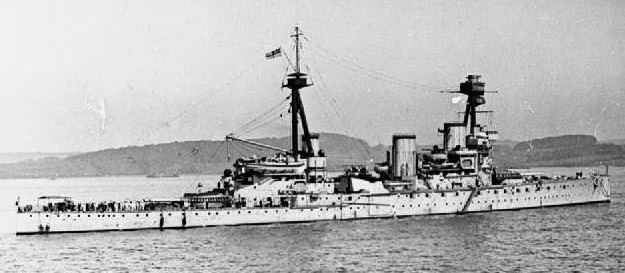
HMS Indomitable was ordered in the 1906 Naval Programme and laid down at Fairfield Shipbuilding and Engineering Company, Govan on 1 March 1906, Launched on 16 March 1907 and commissioned on 25 June 1908. But before she was fully complete she was ordered to carry the Prince of Wales to Canada, Quebecn for the Tercentenary celebration. While back on light (no ammo and limited supplies just for the crossing) she topped a bit more 25 knots, almost equalling the Atlantic crossing 25.08 knots record of RMS Lusitania. On 10 August she was back at berth for final completion. She then entered the Nore Division, Home Fleet on 28 October, 1st Cruiser Squadron (CS) from March 1909 then flagship Rear-Admiral S. Colville on 26 July. She was refitted several times and transferred to the Mediterranean on 27 August 1913 to enter the 2nd Battlecruiser Squadron (BCS) wit hher sister Invincible.
She had a collision in Stokes Bay with the minelayer C4 on 17 March 1913. She was in refit in Malta when the July crisis urged it completion.
With HMS Indefatigable under Admiral Sir Archibald Berkeley Milne she was sent in advance of the signalled German Battlecruiser SMS Goeben and the light cruiser Breslau on the morning of 4 August 1914 (The UK were barely hours away from a declaration of war). The Mediterranean Squadron’s vessels under command of Admiral Wilhelm Souchon were heading east after a cursory bombardment of the French Algerian port of Philippeville, mostly a faint. Milne was ordered to just shadow the Germans heading back to Messina to get coal. However the British Battlecruiser had boilers issues and could not maintain speed, so the the Garmans broke contact and reached Messina. Afterwards, the respect of Italian neutrality urged the British to stay outside a six-mile (10 km) limit from the Italian coast, so they could not make the passage of the Strait of Messina. Instead Milne rushed to the northern exit of the Strait, expected the Germans to break out westwards and have a go on French convoys. In backup, the light cruiser Gloucester was posted at the southern exit. Indomitable was then sent to recoal at Bizerte.
Instead the Germans exited Messina on 6 August and headed east, towards Constantinople, trailed by Gloucester. Milne only by 8 August set sail for Cape Matapan at 12 knots and received an incorrect signal from the Admiralty of a war with Austria until it was countermanded so Milne went to the Otranto passage south to the Adriatic and missed the occasion to engage the Battlecruiser. On 9 August Milne ws at last ordered to “chase Goeben which had passed Cape Matapan on the 7th steering north-east.” Milne doubt the Germans for the Dardanelles as Turkey was still neutral at this point, and instead was stationed in the Aegean and remained inblockade of the Dardanelles until recalled home on 18 August, but instead she was countermanded. In Between Souchon’s squadron took the head of the Turkish Ottoman Navy and the latter Empire declared war on Russia, its old enemy, and by consequence later, Britain and France.
On 3 November 1914, Churchill wanted an attack on the Dardanelles in support of Russia, even though there was . Indomitable, Indefatigable were joined by the French pre-dreadnought battleships Suffren and Vérité. This was a porobing attack on the fortifications and it was deceptively encouraging as after 20 min. a single shell struck Sedd el Bahr’s magazine, which blew up, at the tip of the Gallipoli peninsula. This conducted the Turks to strengthen their defences and lay more mine fields. There was still no formal declaration of war, only acted on the 5th. Indomitable was recalled home to join the 2nd BCS.
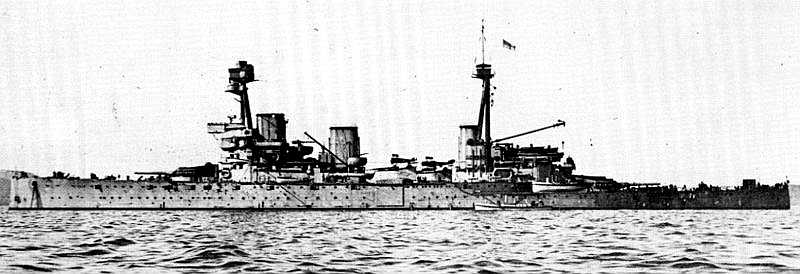
HMS Indomitable
On 23 January 1915 Admiral Franz von Hipper’s battlecruisers sortied off the Dogger Bank for hunting British fishing boats and destroy all ships there to collect intelligence. In between Room 40 already decoded messages and a force was sent out in interception, the battlecruisers of Admiral Beatty including Indomitable. Long stopry short during the chase, Indomitable managed to exceed 26 knots (48 km/h; 30 mph) Beatty signalling “Well done, Indomitable”. Still, she gradually fell behind and was ordered to finish off SMS Blücher already heavily damaged and down to 17 knots (31 km/h; 20 mph), steering gear jammed. However deu to a mishaps from Beatty’s flag lieutenant in signaling the flagship, HMS Lion, lost her radio, they all turned away from Hipper and engaged Blücher. Indomitable fired 134 shells at her until she sank at 12:07 and was ordered to tow Lion back to port (engine knocked out) at 7–10 knots (13–19 km/h; 8.1–11.5 mph).
She was transferred to the 3rd Battlecruiser Squadron in February 1915 after repairs due to an electrical fire. Both the 1st and 3rd BCS sortied after the raid on Yarmouth and Lowestoft on 24–By late May 1916, the 3rd BCS sailed with the Grand Fleet for gunnery practice and on 30 May, was sent to intercept the Germans after decoded messages of a sortie in force.
Galatea soon reported two enemy cruisers. See above for details. Long story short at 17:53 Invincible opened fire on Wiesbaden and her sisters joined in. They also engaged Regensburg but had to evade torpedo launches by three German DD flotillas. Hood’s light cruiser Canterbury and the five destroyers were in the midst of this and HMS Shark sank by gunfire. Invincible turned north, Inflexible and Indomitable turned to face the torpedoes and they missed. The squadron reformed heading west and received a signal that Beatty and the Grand Fleet converging on him so her turned south to lead Beatty’s own battlecruisers. Hipper’s battlecruisers were then spotted and the three sister resumed fire. Indomitable hit Derfflinger thrice, Seydlitz once, Lützow by the others. Then Invincible was clearly visible to Hipper’s gunners and was blasted at short range, she sank her in 90 seconds after a magazine detonation. Inflexible and Indomitable remained with Beatty and there was another brief engagement in the pidst and dark from 10,000 yards (9,100 m) away as the sun was setting at 20:19. Indomitable hit Seydlitz until the pre-dreadnought battleships of Rear Admiral Mauve appeared and were hit before disengaing in the gloom. That was Indomitable ‘s last battle.
The loss of three battlecruisers reorganised all BCs into two squadrons, Inflexible and Indomitable in the 2nd BCS. The remainde rof the war was bleak, with routine patrolling, a refit in August 1916 (additional armour over her magazine and turret roofs and AA) then two flying off ramps over the midships by early 1918. In 1919 she was sent ti the Reserve Fleet, paid off in March 1920, sold for scrap on 1 December 1921.
HMS Inflexible

HMS Inflexible in the Falklands.
HMS Inlexible was ordered in 1905 from John Brown & Company, Clyde, laid down on 5 February 1906, launched on 26 June 1907 and commissioned on 20 October 1908. She was initially assigned to the Nore Division, British Home Fleet. She was a temporary flagship of Admiral of the Fleet Sir Edward Hobart Seymour while in New York at the Hudson–Fulton Celebration in September 1909. On 26 May 1911, she collided with Bellerophon and had her bow. She was refitted in October–November 1911, and her fore funnel was raised by 6 feet (1.8 m) like her sisters later to reduce smoke interference with the bridge.
She was in the Mediterranean Fleet with Indefatigable under Admiral Sir Archibald Berkeley Milne when taking part in the Goeben and Breslau run from 4 August 1914. See above. After being shadowed, as the British and German Empire were not yet at war, ships were posted at both ended of the Strait of Messina and Indomitable was sent to recoal at Bizerte. On 6 August Souchon’s ships unexpectedly headed east and to Constantinople trailed by HMS Gloucester. Miscommunications about a possible escape, to Pola led Milne to the Adriatic and then the Aegean, remaining to blockade the Dardanelles, until ordered home on 18 August.
Next, news of Rear Admiral Christopher Cradock’s squadron destroyed at Coronel by the German East Asia Squadron mastered by Admiral Graf von Spee prompted the Admiralty to send Admiral Sir Doveton Sturdee at the head of Invincible as flagship, and Inflexible. They departed on 11 November, met Rear Admiral Stoddard at Abrolhos Rocks off Brazil on the 26th, and reached Port Stanley on 7 December. Spee was spotted approaching at 07:30, while Canopus was not informed and Sturdee not expecting an engagement and coaling, with Cornwall and the Bristol having their engines repaired. The AMC Macedonian in the outer harbor and Kent anchored nearby were to relieve the Macedonian and informed Canopus, which guns started barking at 09:20 causing a schock. Spee renounced bombarding the wireless station.
Sturdee left harbour at last on 09:50, but the Invincibles, fresh out of dry dock could catch Spee, and soon spotted Leipzig, lagging behind the others first by Inflexible and then Invincible until the range fell to 13,000 yards (12,000 m). At 13:20, Spee ordered to separate leaving his light cruisers a chance to take refuge in Patagonia in the southwest while his armoured cruisers turn north east to cover their retreat and face the battlecruisers. They opened fire at 13:30 and soon hit Invincible, the range went back and forth while British gunnery was very poor (four hits out of 210 rounds fired) due to smoke from the guns and funnels while being downwind.
Around 15:00 Spee saw this was futile to try to escape and at the contrary closed to bring the range down enough to use his secondary artillery and destroy the British fire control and bridges in practicable. By manpeuvering Sturdee at 15:15 gain the windward advantage while pee turned to the northwest but the dual was a carnage on the German size and Scharnhorst capsized at 16:17 with no survivors. Gneisenau managed to survive another hour and a half, pummelled down to 4,000 yards (3,700 m) before beng ordered to Cease fire at 17:15, running out of ammunition. Still she was shelled until 17:50, and capsized at 18:00 with 176 men rescued. Inflexible fired 661 12-inch shells in that engagement and was only hit three times with 1 killed and 5 wounded. A clear cut victory albeit not really against their peers. It showed anyway the superiority of the Battlecruiser over armoured cruisers as registered in the history books.
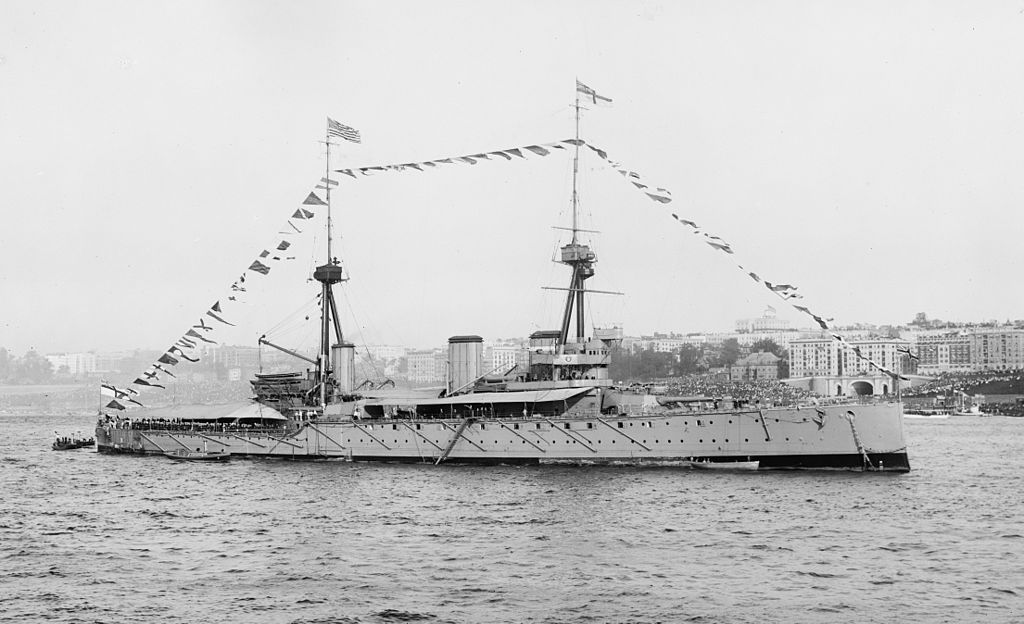
HMS Inflexible at New York, 1909.
After the Battle of the Falklands, Inflexible was repaired and refitted at Gibraltar. She was ordered to the Dardanelles on 24 January 1915 relieving Indefatigable as flagship of the Mediterranean Fleet. She shelled Turkish fortifications on 19 February, as the Battle of Gallipoli statted as well on 15 March, with little results. On 18 March, she needed to silence the batteries so that the minefields could be swept. But she was hit several times, notably taking a 15 cm (5.9 in) howitzer shell which disabled her left gun in “P” amidships and a 105 mm (4.1 in) shell destroyed the yard above the foretop, killing or wounded observers. Another heavy shell hit 6 feet (1.8 m) below the waterline but dished in the side plating. A 240 mm (9.4 in) shell hit the foremast close to the flying bridge and destroyed the navigator’s sea cabin. All cables and voice pipes in the foremast to the fire control director were severed. Smoke from the fire choked the wounded. The captain decided he had enough and ordered to withdraw into the wind to deal with the fire and returned to reengage the forts but was hit again, still with little effect. While manoeuvering later in Eren Keui Bay, a 100 kg (220 lb) mine blew a hole in her starboard bow, flooding the forward torpedo compartment and drowned 39 men. He ordered her to beached at the island of Bozcaada (Tenedos) after taking 1,600 long tons (1,600 t) of seawater. A cofferdam was installed over the 30-by-26-foot (9.1 m × 7.9 m) hole so she can sail to Malta, escorted by HMS Canopus and Talbot on 6 April. But underway her cofferdam became loose in heavy weather so she was towed stern-first by Canopus for six hours until repairs were done. She remained in Malta until early June and departed for home, arrived on 19 June to join the 3rd Battlecruiser Squadron, Grand Fleet under H.L.A. Hood.
By late May she took part in gunnery practice. On 30 May she followed Admiral Hood in interception of the Hochseeflotte and at 14:30, Invincible (glag) intercepted a radio message from Galatea (Beatty) reporting spotting vanguard cruisers. The squadron went to 22 knots at 15:11 while steered East-Southeast to cut off them but he was informed of five enemy battlecruisers sighted by Beatty, however there was a communication breakdown and at 16:56, nobody in sight.
At 17:40, gunfire was spotted where his vanguard, HMS Chester, was dispatched to investigate, just straddled by Hipper’s 2nd Scouting Group, badly damaged. Hood arrived and drive the cruisers away. At 17:53, they opened fire on Wiesbaden. Inflexible hit Pillau once. However the 2nd Scouting Group also comprised Regensburg leading 31 destroyers and they made torpedo attacks in succession. Hood’s light cruiser Canterbury and five destroyers drve them off but the battlecruisers still had to dodge the torpedoes, after Shark was damaged. Inflexible and Indomitable turned south to present their narrowest profile and they missed, one going under Inflexible.
At 18:21, Beatty and the Grand Fleet converged on him, so Hood turned to lead Beatty’s battlecruisers and meet Hipper’s battlecruisers from 9,000 yards (8.2 km). The sisters syarted to fire on the flagship Lützow, as well as Derfflinger. Lützow was hit by Inflexible but at 18:30, Invincible was blasted by gunfire and detonated, sinking with Hood. Inflexible and Indomitable stayed with Beatty until the end of the battle with fleeting exchanges from 10,000 yards (9.1 km) at 8:19PM notably Inflexible fired on Seydlitz and they stumbled upon on Rear Admiral Mauve’s pre-dreanoughts (“5 minutes ships”) but obscurity and bad weather won the day.
After the loss of Invincible, Queen Mary and Indefatigable, Inflexible and Indomitable were impressed in the 2nd BCS but saw little action apart routine patrolling. The only event was when she wa smissed by two torpedoes fired by U-65 during on 19 August 1916, astern. On 1 February 1918, she collided with HMS K22 off the Isle of May (the infamous “battle of May”) leading to the loss of two K steam-powered K-class submarines and serious damage to three others. A cruiser was also to be repaired and it cost the RN 104 submariners. She was fitted with two flying off ramps in 1918 and on 21 November was present at Scapa Flow for the surrender of the Hochseeflotte. She was paid off in Reserve by January 1919, decommissioned on 31 March 1920 and if Chile considered purchasing her, the sale never materialise. She was sold for scrap on 1 December 1921 in Germany from 1922.
Links/src
Books
Conway’s all the world fighting ships 1921-1947.
Links
dreadnoughtproject.org
worldwar1.co.uk/
Invincible class on wikipedia
On dreadnought project.org
https://commons.wikimedia.org/wiki/Category:Invincible_class_battlecruiser
Gallery
Video
Model Kits
scalemates.com/
modelshipgallery.com