
 Armada Imperial do Brasil 1822-1889
In the 1870s, Brazil was an Empire, and its Navy was the world’s fifth. For several decades led by notably by legendary Admiral Cochrane and others, and several wars, the Brazilian Navy helped secured independence and grew through the tumultuous 19th Century as the uncontested leading navy in the Americas. Its size went down in the 1880s when quality replaced quantity, with impressive ships like the Riachuelo class ironclads, that shook the US Congress into the creation of the “new navy”. In 2022 the Brazilian navy celebrated its centennial, and the long existence of the Armada Imperial do Brasil from the independence to 1889 is an important era for its foundation and traditions to this day.
Introduction: The Imperial Navy
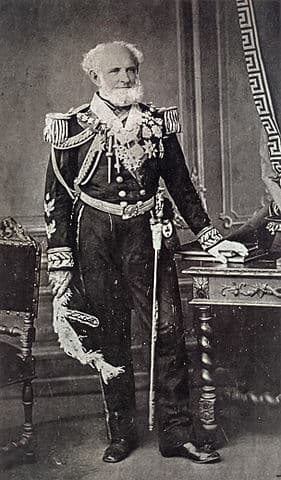 In the 19th century, the Brazilian Navy played a pivotal role in the nation’s political, economic, and military history, particularly as Brazil transitioned from a Portuguese colony to an independent empire and eventually into a republic. The first period was the Independence and Nation Formation in (1822–1830s), creating its own navy from the remnants of the Portuguese Royal Navy stationed there after the transfer of the Portuguese Court to Rio de Janeiro in 1808. When Brazil declared independence from Portugal in 1822, the Marinha became instrumental in securing the country’s coastline and suppressing pro-Portuguese uprisings in provinces like Bahia, Maranhão, and Pará. It was also led by famous officers such Thomas Cochrane, instrumental in defeating Portuguese forces.

The Pedro I ship that took part in the Brazilian War of Independence.
During the consolidation of the Empire in the 1830s–1850s, the Navy was critical in maintaining territorial integrity, in the Regency Period (1831–1840) and internal conflicts such as the Cabanagem and Farroupilha Revolts. It also played a role in safeguarding the Empire’s vast coastline and shipping lanes against piracy and foreign threats.
 For what we are concerned, the Navy was modernize enough to face the Paraguayan War (1864–1870) as the Navy’s most significant engagement in the 19th century. The Brazilian Navy was pivotal in defeating Paraguayan forces on rivers like the Paraguay and Paraná, enabling advances into Paraguayan territory.

Brazilian Navy and Argentine Navy in the naval battle of Punta Colares.
The Battle of Riachuelo (1865) remained a decisive naval engagement where the Brazilian fleet, under Admiral Francisco Manoel Barroso, secured control of critical waterways. It cemented its place dear to the core of today’s Marihna, an history well known by all sailors.
There was later a phase of modernization and Growth from the 1870s to 1890, acquiring ironclads, steamships, and other advanced vessels from Europe, shifting from wooden sailing vessel to steam-powered iron-hulled warships.

Ironclad Brazil 1864
The Republican Transition in 1889 saw the Navy supporting the proclamation of the Brazilian Republic in 1889, transitioning from its monarchic roots to a new republican government. Technological Shifts occurred even before the Paraguayan War but after it, the Marinha starting incorporating modern ironclads and turreted warships, following global trends and discard its last Sailing Frigates for Steam Corvettes and Gunboats to patrol rivers and coastal areas as well as a high seas battle fleet with the Ironclads already deployed during the Paraguayan War, and those after, such as the 1883-85 Riachuleo and Aquidaban which prompted the United States to enquire about its naval relevance after the gradual declined of the “old navy”.
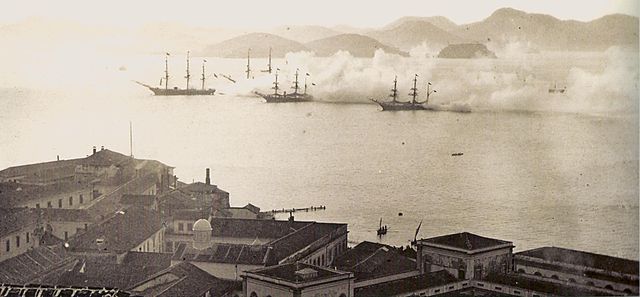
Training of the fleet in 1870
Naval Brazilian Bases were established in Rio de Janeiro, Salvador, and Pernambuco, commanding key points on the coastline and covering its strategic needs.
Brazil however faced challenges of manpower, struggling with recruitment and training, and for a while, relying heavily on foreign officers and sailors, particularly from Britain. The other issue was political instability with Frequent civil wars and political upheavals which hindered consistent investment and reforms. And there was the question of Budget Constraints as the Navy often competed with the Army for funding, especially during economic downturns.
This was, in a nutshell, the essentials of the Brazilian Imperial Navy.
The Imperial Brazilian Navy or Brazilian Portuguese: Armada Nacional, “Armada Imperial” in that era, was created at the time of the independence of the Empire of Brazil from the United Kingdom of Portugal, Brazil and the Algarves, in existence from 1822 and 1889 as there was a vacancy in the constitutional monarchy. However, ships, staff, organizations and doctrines were transferred from the Portuguese Royal Family in 1808. Some members were also native-born Brazilians and others were Portuguese which adhered to the cause of separation, as well as German and Irish mercenaries. Under Emperor Pedro II this Navy was greatly expanded and became certainly the most powerful in the Americas.
The core was created in 1822 to fight and to expel Portuguese troops dispersed by the territory. The transfer of the Portuguese monarchy to Brazil in 1808 in the Napoleonic wars went with the structure, personnel and ships of the Portuguese Navy which ended as the core of the Imperial Navy. Establishments previously created by King John were incorporated, as well as the Department of Navy, Headquarters, Intendancy, Accounting Department, Arsenal and Shipyards, Academy of Navy Guards, Naval Hospital, Auditorship, Supreme Military Council, powder plant among others. The initial contingent was formed by Brazilians, Portuguese joining the independence and foreign mercenaries, led by Brazilian-born Captain Luís da Cunha Moreira as first minister of the Navy from 28 October.
Under Articles 102 and 148 of the Constitution, they were subordonated to the emperor as CIC, aided by ministers of the War and Navy with the PM (prime minister) exercising oversight in practice. The ministers of War and Navy were civilians, on a base inspired by the British parliamentary or Anglo-American system in that the Armed Forces observed “unrestricted obedience” to the civilian government while maintaining distance from political decisions, something very modern and somewhat unusual for South America.
The first role of the Brazilian Impreial Navu was to protect the long Atlantic coastline against foreign attack. Military personnel were still allowed to run for and serve in political office while remaining on active duty however, but they did that at a purely private level, not representing the Army or the Navy, and expected instead to serve the interests of the city and province that elected them.
First Era (1822–1831)
British naval officer Lord Thomas Alexander Cochrane (a super-celebrity of the time, maverick and outcast of the RN, inspiring late many fictions) became commander of the Navy as “First Admiral”. The fleet at the time had a single ship of the line, four frigates, and smaller ships, 38 in all. The Secretary of Treasury Martim Francisco Ribeiro de Andrada created a national subscription in order to mobilize capital to increase it, with popular contributions from all over Brazil. Even Emperor Pedro I acquired a merchant brig at his own expense, renamed “Caboclo”, donated to the State. The navy patrolled the north and south coasts, where it had initiually a decisive role in the independence.
After the suppression of the revolt in Pernambuco in 1824 and prior to the Cisplatine War, the Imperial navy increased in size and strength to reach 96 modern warships of various types, representing over 690 cannons at sea. The Navy blocked the estuary of the Río de la Plata and blockaded the United Provinces of the Río de la Plata (ie Argentina) cutting off Cisplatine rebels. Several minir naval battles occurred between Brazilian and Argentines, until the defeat of an Argentine flotilla of two corvettes, five brigs and one barque near the Island of Santiago in 1827 (Battle of Santiago). When Pedro I abdicated in 1831, he left a powerful navy with two ships of the line; ten frigates and many corvettes, steamships, and sailing vessels for total of at least 80 warships in peacetime.
War of the Independence
The action of the navy was essential during the war of independence to prevent the arrival of new Portuguese troops. Both sides saw Portuguese warships spread across the country, in poor condition for many, as instruments for the insurgents for military victory. By early 1822, the Portuguese navy controlled a ship of the line, two frigates, four corvettes, two brigs, and four warships all in Brazilian waters. But they were mostly in disrepair. Their hulls were basically abandoned in Brazil and were rotten, of little value. The Brazilian agent in London, Felisberto Caldeira Brant, Marquis of Barbacena was ordered to acquire warships fully equipped, manned on credit. No vendor was willing to take the risks however, so there was an initial public offering, with the new Emperor personally signing for 350 of them, inspiring others to do the same. The new government rose enough funds to purchase a fleet.
Arranging crews was another issues as there were not that many former officers and Portuguese sailors volunteering to serve and swearing loyalty to this new Navy, with financing already not secured. This loyalty was under suspicion fro the start. So the government, at great expanse, found a solution by hiring British and other foreign officers to fill out the ranks.
Thomas Cochrane led this international patchwork and could not prevent sabotages by Portuguese-born men in the naval crews. In 1823 there was an epuration and reform in which all Portuguese members were replaced by native-born Brazilians and ranks completed by freed slaves, pardoned prisoners plus British and American mercenaries. The navy cleared the coast of Portuguese presence, isolating the remaining Portuguese land troops. By the end of 1823, the last Portuguese ships were chased off across the Atlantic, nearly as far as the shores of Portugal.
Cisplatine War
The Cisplatine War between Empire of Brazil and the United Provinces of the Río de la Plata (Future Argentina) erupted for the control of the territory of Uruguay. An indurgency led by Fructuoso Rivera and Juan Antonio Lavalleja, supported by the Argentinians, carried out a resistance against Brazilian rule 1825. A Congress of delegates from all over the Banda Oriental met in La Florida, declared independence from Brazil, while reaffirming its allegiance to the United Provinces of the Río de la Plata. Brazil declared war on the United Provinces and Brazilian Emperor Pedro I ordered his fleet to blockade the River Plate as well as Buenos Aires and Montevideo. The Argentine fleet moved south to Ensenada and then the Carmen de Patagones, Atlantic Ocean. The Brazilian fleet tried to take Carmen de Patagones in 1827 and tighten its blockade but Brazilian troops were repelled by local civilians. The Navy supported many smaller clashes including the naval Battles of Juncal and Monte Santiago.
It came at a high cost for both sides and started to worry the United Kingdom, which imported a lot of goods, inclusing some vital for the RN at the time, so the latter pressed the two belligerent to engage in peace negotiations, in Rio de Janeiro. Under British and French mediation, both parties eventually signed the 1828 Treaty of Montevideo, acknowledging the independence of the Cisplatina as “Eastern Republic of Uruguay” (later Uruguay).
Eastern Naval Division
The East Naval Division or Naval Division of the African Coast Divisão Naval na Costa d’África/Divisão Naval do Leste) was established in 1827 in the Angolan province of Cabinda, occupying the ports of Ambriz, Cabinda and Molembo with the objective of providing Brazilian ships to enforce the 1815 treaty with British Empire about the slave trade. It was disbanded in 1830, mission accompished.
Regency Era (1831–1840)
During the turbulent years of the regency, the Arsenal, Navy department, and Naval Jail were improved. The Imperial Mariner Corps made of volunteers was created. Steam navigation was generalized from 1831. The Navy fought a number of revolts of the regency, supporting landings and enforcing blockades at Cabanagem, Ragamuffin War, Sabinada, Balaiadaand others.
As Emperor Pedro II reached legal age and assumed his constitutional prerogatives in 1840, the Imperial Navy was 90 warships strong with six modern frigates (The two ships of the line were in such sorry state they had been reduced to utility hulks), seven corvettes, two barque-schooners, six brigs, eight brig-schooners, 16 gunboats, 12 schooners, seven armed brigantine-schooners, six steam barques, three transport ships, two armed luggers, two cutters and thirteen larger boats.
Second reign (1831–1889)
Pedro II eighted for 58 years, an all this time, the Brazilian Imperial Navy achieved its greatest strength, reching the top five most powerful navies in the world. It was superior even to the Portuguese Navy, the young US Navy, and comparable to the Spanish Armada, with the French and British Royal Navy still above. Several additional establishments were improved and created and the Navy obtained soon its first ironclad ships in the 1860s, then adopted the torpedo from 1870. Brazil modernized the fleet by acquiring ships from Britaina and France, but also constructed others locally thanks to pre-existing solid infrstructures left by the Portuguese and expanded, modernized. All old smoothbore cannons were replaced by rifled barrels, being recycled int fortifications.

Port of Humaita
The Arsenals and naval bases were equipped with new workshops. Ships were now constructed in the Arsenal of the Navy in Rio de Janeiro, but also at Salvador, Recife, Santos, Niterói and Pelotas. Its duties were still the same as before, mostly dealing with local revolts in the absence of a war.
The State Secretary as well as the Accounting Department of the Navy, Headquarters of the Navy, Naval Academy were also reorganized and improved. The ports administrations were better equipped. The Imperial Mariner Corps was regularized, professionalized, with the Marine Corps created to replace the Naval Artillery. The Service of Assistance for Invalids was created and several technical schools for sailors and craftsmen.
Platine War

Battle of Punta Colares, 1865
The Platine region started with anarchy caused by the despotic Rosas and his desire to subdue Bolívia, Uruguay and Paraguay. This forced Brazil to intervene in what became the Platine War. The Imperial Navy squadron arrived with 17 warships including a ship of the line, 10 corvettes and six steamships under veteran John Pascoe Grenfell. It went through the Argentine line of defence at Tonelero Pass under heavy fire, transporting troops and supporting their landing. The Imperial Navy mobilized its fleet of 59 vessels in 1851, notably 36 armed sailing ships, 10 armed steamships, seven unarmed sailing ships, six sailing transports whoch rotated until Victory was obtained.
The Imperial Navy consolidated its supremacy in South America with a de facto hegemony from nothern Brazil ti the Rio de La Plata. The greatest strenght was reached in 1840 with 90 ships, but a gruaual modernization and retirement of older hulls led to a dip at 40 ships in 1864 but it bounced back to a top at 94 ships in 1870. However intense modernization across the board led to a new dip in 1889 at 60 ship. However this comprised modern ironclads and large, costier steam frigates.
In 1864 the navy fought in the Uruguayan War and then the Paraguayan War repelling the Paraguayan Navy at the Battle of Riachuelo. Afterwards it gained no less than 20 ironclads and six riverine monitors. 9,177 navy personnel was involved in these five years. Brazilian naval constructors (Napoleão Level, Trajano de Carvalho and João Cândido Brasil) planned new concepts enabling the Arsenals to retain a competitiveness of global level. Damaged ships were repaired and improveed along the way. In 1870, the Imperial Brazilian Navy with its 94 modern warships was without doubts the fifth most powerful in the world.

Paraguayan War
The navy took a primary role by blocking Paraguayan access to the Plata basin, preventing communications outside, and after the initial Paraguayan advance, the imperial navy sailed up the paraná and Paraguay rivers to contained it under heavy gunfire. On 11 June 1865 the naval Battle of Riachuelo was a turning point. Under Admiral Francisco Manoel Barroso da Silva it destroyed the Paraguayan navy, preventing the latter from permanently occupying Argentine territory.
The tactic used won the battle with little losses. The Paraguayan wooden ships were no match to the Brazilian ironclads, showing this costly modernaztion effort paid dividends. The war ended in favor of the Triple Alliance between Brazil, Argentina and Uruguay and gave control to the Brazilians of the Río de la Plata basin up to the entrance to Paraguay.

Next was the Battle of Paso de Mercedes enabling the allies through the River Parana. From 1866 several local victories, like the capture of the Paraguayan battery at Curupayti and of Curuzu by the ironclads, Bahia, Barroso, Lima Barros, Rio de Janeiro and Brasil secured progress in the campaign. However Rio de Janeiro hit two mines and sank with commander Américo Brasílio Silvado and 50 sailors. “Rio de Janeiro” was sunk by a “torpedo”, of such types also used in the recent US civil wars on rivers. This the only ironclad sunk during the war. Still, the Imperial Army land support in September enabling to take the fort.
1868 saw a famous riverine warfare operation by the same six Brazilian ironclads, dashing past under the guns of the Fortress of Humaitá on the Paraguay River. Neutral observers considered this feat nearly impossible. This was to stop the Paraguayans resupplying the fortress by river and this was a brillant coup after 4 years of an exhaustive war. This was done on 19 February 1868, restoring the reputation of the Brazilian navy and the Empire. The capital Asunción was thus evacuated. Some authors considered it the true turning point of the war. The fortress was captured on 25 July.
Modernization and Latter Years (1870-89)

During the 1870s, the Brazilian Government strengthened the navy due to a possible war with Argentina over the Paraguayan question. A modern gunboat and corvettes were acquired in 1873, then an ironclad and a monitor in 1874, two cruisers and another monitor in 1875 and this effort went on in the 1880s. Rio de Janeiro, Bahia, Pernambuco, Pará and Mato Grosso provided dozens of smaller warships and the modernization was topped by the purchase of four torpedo boats.
On 30 November 1883, the Practical School of Torpedoes was created with a workshop devoted to bui, maintain and repair torpedoes in the Arsenal of Rio de Janeiro. This was the first in the Americas. There four steam gunboats and one schooner with iron and steel hulls built there as well, the first constructed in Brazil. The Imperial Armada then gained a crucial asset or rather a pair of these, with the acquisition of the ironclads Riachuelo and Aquidabã both with torpedo launchers in 1884 and 1885, rausing concerns in the US congress, in additon to Argentina. Both camed from Britain, and considered state-of-the-art by experts from Europe. Thuis enabled the Imperial Brazilian Navy to retain its position.

By 1889, the navy had “only” 60 warships, but with the quality over quantity gap, it was still the 5th or 6th most powerful in the world still, even compared to Italy, Spain, Germany or Russia. In fact when launched in 1885, Aquidabã was considered one of the most powerful warships in the world.
In the last cabinet of the monarchic regime, Minister of the Navy Admiral José da Costa Azevedo, Baron of Ladário, left this reorganization and modernization process unfinished. The coup that ended the monarchy in 1889 was not well accepted by the Navy which remained loyal to the former regime. Imperial Mariners were attacked when they trying to support the imprisoned Emperor in the City Palace. The Marquis of Tamandaré begged Pedro II to allow him to fight back the coup but the Emperor refused to prevent a bloodbath.
Tamandaré was later imprisoned by order of Floriano Peixoto. The Baron of Ladário remained in contact with the exiled Imperial Family hoping to restore the monarchy, and was ostracized by the new republican government. Admiral Saldanha da Gama led the Revolt of the Armada als to restore the Empire, rallying other monarchists in the Federalist Revolution. All attempts at restoration were crushed. High-ranking Naval Monarchist officers were imprisoned, banished or executed by firing squad as their subordinates in a mass epuration of the Naval staff.
This change of regime contributed to a new arms rivalty, with long-held suspicion of disloyalty from the Navy despite the epuration of its corps. This led also to a distrust and disaffection from the general public, and ultimately lack of budhets, casting a long shadow over an arguably shining era of the Brazilian Navy, one of the largest in the world.
The Navy would bounced again however in parallel to a rapid rearmament and rivalry of Chile and Argentina. With the acquisition of the Rio de Jaineiro class dreadnoughts, built soon after HMS Dreadnought herself, led to a new naval arms race, dominated once more b Brazil, see the Brazilian Navy in WWI for more.
Summary

Until the Paraguaian War (1830-1864)
- Barrozo class (1864)
- Brasil (1864)
- Tamandare (1865)
- Lima Barros (1865)
- Rio de Janeiro (1865)
- Silvado (1866)
- Mariz E Barros class (1866)
- Carbal class (1866)
- Wooden Corvette Nitcheroy (1862)
- Wooden Corvette Vital de oliveira (1867)
After the Paraguaian War (1870-89)
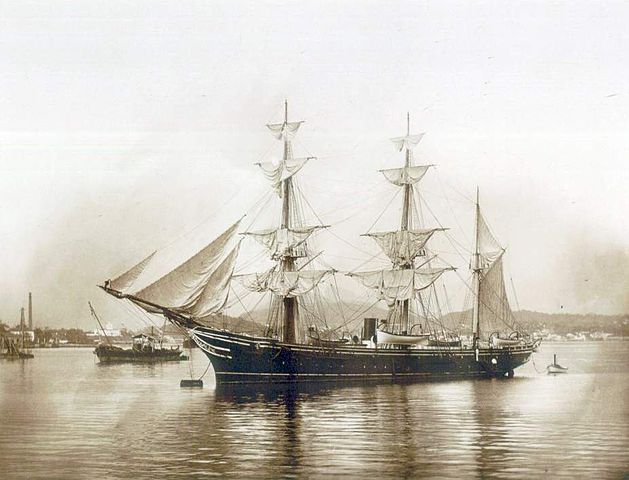
1884 Cruiser Imperial Marinheiro
- Siete de Setembro class (1874)
- Javary class coast defence turret ships (1874)
- Riachuleo class (1883)
- Wooden sloop Trajano (1873)
- Wooden corvette Guanabara (1877)
- Wooden sloop Panahyba (1878)
- Iron Sloop Primeiro de Marco (1881)
- Composite Corvette Almirante Barrozo (1882)
- Frigate Imperial Marinheiro (1884)
Towards 1900
- Marsh. Deodoro class coat defence battleships (1898)
- Minas Geraes class dreanoughts (1908)
- Cruiser Benjamin Constant (1890)
- Cruiser Alm. Tamandaré (1890)
- Cruiser Republica (1892)
- Cruiser Almirante Barrozo (1892)
- Torpedo Gunboat Inhanduay (1892)
- Torpedo Gunboat Tamayo (1898)
- Brazilian Torpedo Boats (1879-1893)
The 1864 Brazilian Navy
 Mariz e Barros class Ironclads (1864/66)

Mariz e Barros-class ironclads—armored corvettes linked to the same era of naval shipbuilding and the conflict of the Paraguayan War. Originally ordered by Paraguay in 1864, these two wooden-iron central-battery armored corvettes were sold to Brazil after Paraguay defaulted on payments.
Specs:
Displacement: approximately 1,196–1,353 long tons (1,215–1,375 t), Length: about 191 ft (58.2 m), Beam: 36 ft (11.0 m), Draft: 8.2–9.5 ft (2.5–2.9 m)
Propulsion: two steam engines, two shafts, total ~600 ihp, achieving around 9 knots
Crew: 125 officers and enlisted men
Armament: Mariz e Barros: two 120-lb Whitworth rifled muzzle-loaders + two 68-lb smoothbores
Herval: Four 120-lb Whitworth guns
Armor: wrought-iron belt—76 mm (3 in) at ends to 114 mm (4.5 in) amidships
They Served during the Paraguayan War (1864–70), participating in key engagements like Curupaití and the Passage of Humaitá
Mariz e Barros was decommissioned in 1897; Herval (Osório, the Marquess of Herval) was converted into a floating battery later.
Ironclad Brasil (1864)

The Brasil was a central-battery armored corvette, ordered on 5 January 1864 and constructed in France by Forges et Chantiers de la Méditerranée at La Seyne-sur-Mer. Her Keel was laid in 1864, she was launched on 23 December 1864, and commissioned into service on 2 March 1865.
Specs:
Length: 63.41 m; Beam: 10.75 m; Draft: 3.81 m; Displacement: 1,518 t
Powered by a single-expansion steam engine, rated at 250 nominal horsepower, driving a single four-bladed propeller. During trials, she reached a top speed of 11.7 knots—surpassing her designed speed of 10.5 knots. She also featured three-masted sailing rig, with around 550 m² of sail area, making her a hybrid sail-steam vessel
Armed with four 70-pounder Whitworth rifled muzzle-loading guns and four 68-pounder smoothbore guns.
Armor consisted of a full wrought-iron waterline belt ranging from 114 mm amidships to 90 mm at the ends, backed by 230 mm of wood. The casemate boasted 102 mm of iron armor over the same wooden backing.

“Brasil” played a strategic role during the War of the Triple Alliance (1864–1870), where Brazil, Argentina, and Uruguay were allied against Paraguay. After her frontline service, by around 1890, she was converted into a floating battery, marking the end of her career as an active warship.
Ironclad Tamandare (1865)

Built at the Arsenal de Marinha da Corte in Rio de Janeiro, Tamandaré was laid down 31 May 1865, launched 21 June 1865, and completed 16 September 1865, at a cost of £40,506.
It was Brazil’s first domestically-built ironclad, featuring a composite design with a wooden hull reinforced by iron plating as per engineer Napoleão Level’s plans.

Specs:
Displacement: approximately 742 tons (normal load), rising to 845 tons at deep load. Dimensions: Length 51.36 m, Beam 9.19 m, Draft 2.44 m.
Propulsion: Powered by a single steam engine with two boilers, providing 273 ihp over a single shaft; it also sported a schooner rig for sailing, speed around 8 knots.
Armament & Armor: 1 × 70-pounder Whitworth rifled muzzle-loading gun, 3 × 68-pounder smoothbore guns, 2 × 12-pounder smoothbore guns
Armor: Hull composed of three layers of wood (each ~203 mm thick), protected by an iron waterline belt (51–102 mm thick).
The casemate featured 102 mm of iron armor on all sides, backed by 609 mm of wood and capped with 102 mm of peroba hardwood.
Deck and casemate roof armored with 12.7 mm of wrought iron.
She entered service during the Paraguayan War, participating in major engagements such as bombarding fortified positions along the Paraná and Paraguay Rivers, supporting army operations.
She notably took part in the Passage of Humaitá (February 1868), where she sustained significant damage but continued to serve. Also involved in bombarding Asunción, and, along with Alagoas, destroyed the artillery batteries at Timbó on 23 March 1869.
Post-war, she was reassigned to the Mato Grosso Flotilla, based in Ladário. Decommissioned on 18 April 1879 and subsequently scrapped.
Ironclad Lima Barros (1865)
Originally ordered by Paraguay in 1864 under the name Belona, the ship was sold to Brazil when Paraguay couldn’t complete payment. It was built by Laird Brothers in Birkenhead, UK.
Laid down in 1864, launched on 21 December 1865, and completed on 3 April 1866.
Specs:
Displacement: 1,705 long tons (1,732 t). Length (bp): 200 ft 2 in (61 m); Beam: 38 ft 2 in (11.6 m); Draft: 12 ft 8 in (3.9 m).
Powered by two horizontal trunk steam engines driving two propeller shafts, delivering a combined output of ~2,100 ihp—enabling a top speed of around 12 knots.
Rigged as a barque with three pole masts and a bowsprit for sail assistance.
Armed with four 120-pounder Whitworth rifled muzzle-loading guns, mounted in two twin-gun turrets.
Featured a complete wrought-iron waterline belt, from 4.5 in amidships to 3 in at the bow and stern. The gun turrets were also armored with 4.5 in plating.
Operated by approximately 170 officers and enlisted men.
Namesake: Honored Midshipman Francisco José de Lima Barros, killed at the Battle of Riachuelo in 1865.
Participated actively in the Paraguayan War (1864–1870), including successful runs past enemy fortifications during the Passage of Curupayty.
Took part in the Battle of Curuzú (1–3 September 1866), along with Brazil, Barroso, and others, bombarding Paraguayan positions.
In the Assault on Cabral and Lima Barros (2 March 1868), the ship endured a surprise canoe-borne Paraguayan attack and successfully repelled it alongside Cabral.
Officially stricken from the naval register on 8 May 1894, and ultimately scrapped in 1905.
More to come in the next update.
The 1880 Brazilian Navy
Siete de Setembro class (1874)

The Sete de Setembro was an armored frigate (often described as a casemate ironclad) conceived during Brazil’s 1867 naval expansion program. It was intended for service during the Paraguayan War, but construction delays—particularly around armament decisions—pushed completion to 1874, rendering it practically obsolete by then. Built at the Arsenal de Marinha da Corte in Rio de Janeiro, she featured a composite wooden hull reinforced with iron framing, combining structural economy with armored protection.
Specs: 73.4 x 14.2 x 3.81 m, 2,174 metric tons, crew 185, 2 shafts compound engines, 4 boilers, 2,000 ihp, 12 knots.
Wrought iron belt and casemate (both 114 mm thick), with a 12.7 mm (0.5 in) armored deck, armed with 4x 300-pdr Whitworth muzzle-loading rifled guns in a casemate with pivot, 2-pounder gun and several machine guns Nordenfelt or Hotchkiss, casemate and forward deck.
Laid down on 8 January 1868, launched on 16 May 1874 she was commissioned on 4 July 1874, being par tof the Esquadra de Evoluções around 1884–85, but poor maneuverability and limited protection led to her reclassification in 1879 as a floating battery. She took part in the Revolta da Armada of 1893–94, captured by rebels, stationed as guard post near Armação Beach, recaptured on 16 December 1893 but caught fire and sank and for long a navigational hazard in Guanabara Bay until refloated in 1897 and BU.
Javary class coast defence turret ships (1874)

The Javary class, comprising the Javary and her sister ship Solimões, were armored turret monitors ordered by the Imperial Brazilian Navy and constructed in France between 1874 and 1875, at the Forges et Chantiers de la Méditerranée shipyards in Le Havre and La Seyne. They were envisioned as highly capable vessels, “perfect machines for both sea and river warfare.” However, their low freeboard and poor seafaring qualities limited them to operations close to shore and within sheltered waters (like Guanabara Bay), where they functioned more like mobile floating fortifications than true ships.
Specs: Displacement 3,700t, 73 x 17.7 x 3.75 m. Armor: Midships & gun casemates 300–304 mm, Bow & stern: 177–180 mm, Deck: 76 mm, CT 100–101 mm.
Powered by 2 Steam engines 2,500 hp on two shafts, 11 knots. Two twin turrets, 4× 254 mm Whitworth guns, 2 × 37 mm Nordenfelt, 2 machine guns, crew 135.
They arrived in Brazil around 1875–1876, assigned to the Esquadra de Evoluções and were considered heavily armored and armed for their time but suffered from poor maneuverability and inability to operate in open seas. They took part in the Revolta da Armada of 1893–94, Javary being heavily engaged in combat, defending positions in Guanabara Bay until struck and fatally damaged by coastal artillery from São João—and and sank on 22 November 1893. Solimões sank earlier, around 19 May 1892, under uncertain circumstances.
Wooden sloop Trajano (1873)

Designed by naval engineer Trajano Augusto de Carvalho (and made famous for her “carena Trajano” featuring a U-shaped underwater hull cross section, patented internationally), the vessel was built at the Arsenal de Marinha da Corte in Rio de Janeiro. Her keel was laid on 27 May 1872, and she was launched on 12 July 1873, in both instances with Emperor Pedro II in attendance. She was commissioned into the Imperial Brazilian Navy shortly thereafter, on 17 July 1873 and named in honor of her designer, Trajano Augusto de Carvalho, a pioneering figure in naval architecture
The construction called for Mixed—wood, iron and steel.
Specs: Displacement 1,392–1,414 tonnes, 200 ft (61 m) x 31 ft (9.4 m) x 15 ft (4.6 m). Combined steam and sail, machinery from John Penn & Sons 2,400 ihp, 12 knots.
Armed with three 70-pdr Whitworth guns and unspecified-caliber weapons. In April 1876 she escorted the vessel carrying Emperor Pedro II’s family in an official visit to the United States and returned from Lisbon escorting the monitor Javary. In 1884, she joined the Esquadra de Evoluções. In the Revolta da Armada she was seized by rebel forces, renamed Toneleiros, and participated actively by bombarding government positions in Rio de Janeiro. She remained in service until 11 April 1906, formally decommissioned.
Wooden corvette Guanabara (1877)

The wooden corvette Guanabara was constructed at the Arsenal de Marinha in Rio de Janeiro and launched around 1877, reflecting Brazil’s ongoing naval modernization in the late Imperial era. She formed part of a series of wooden corvettes and sloops produced in that period, including Trajano (1873), Parnahyba (1878), and others, all designed to bolster coastal and regional naval capabilities. According to naval listings, she was described as a wooden corvette with no significant modernization before being scrapped in 1905. If related to “Guanabara (1879)” she was wooden-hulled, fully rigged screw corvette from Rio de Janeiro Arsenal, displacing approx. 1,914 t for 61 x 12.6 x 5.41 m, powered by a single shaft steam engine fed by rectangular boilers (394 t of coal) for c3,000 hp and 13 knots. Armed with 9 × 127 mm (70-pounder) Whitworth MLR, 2 × 9-pounder muzzle-loaders, 1 spar torpedo, crew 287. Detailed service records are scarce. She was discarded or scrapped around 1905.
Wooden sloop Panrahyba (1878)
The Parnaíba (also spelled “Parnahyba”) was a wooden-hulled, barque-rigged screw sloop built at the Arsenal de Marinha in Rio de Janeiro. She was launched on 18 March 1878 and completed the same year and later in her career, reclassified as a second-rate cruiser. Specs: 742 tonnes, 52.5 x 8.92 x 3.48 m, One HSE engine, single shaft 900 hp, 11.5 knots, 130 tonnes of coal.
Armed with 6 × 127 mm (70-pdr) Whitworth MLR, crew 149.
Iron Sloop Primeiro de Marco (1881)

The Iron Sloop Primeiro de Março was a mixed construction (presumably combining iron framing with wooden elements) warship built at the Arsenal de Marinha in Rio de Janeiro, completed in 1881
Its name commemorates March 1, 1870, the date marking the end of the Paraguayan War—a notable historical reference reflected in its naming. Commissioned into the Brazilian Navy on July 13, 1882. Deployed initially with the Naval Division of the South on December 25, 1882, and later assigned to the Naval Division of the North in 1883, sailing to Corumbá. On August 19, 1884, the ship joined the prestigious Esquadra de Evoluções—a tactical naval squadron formed by the most advanced vessels of the fleet, with a goal to develop naval tactics and coordination
By 1890, she had been repurposed as a training ship (“Navio-Escola”). In 1917, the vessel was decommissioned, transferred to Lloyd Brasileiro, and continued to serve as a training platform for merchant navy cadets under the name Venceslau Brás
Confirmed as an “iron sloop”, the ship appears to have been part of a class of screw-driven sloops, used by the Brazilian Navy around that period
According to external sources, it was originally classified as a sloop but later re-rated as a second-rate cruiser
Composite Corvette Almirante Barrozo (1882)

The Almirante Barroso was built at the Rio de Janeiro Navy Arsenal with iron produced by the Fábrica de Ipanema, under designs by naval engineer João Cândido Brasil and machinery by Manoel J. Alves Barbosa. Her keel was laid on 1 March 1880, and it was launched on 17 April 1882, in a ceremony attended by Emperor Dom Pedro II and other dignitaries
The cost of construction was approximately 790:000$000 réis (some sources state 1.4 billion réis, likely including later outfitting and commissioning costs)
Classified as a mixed-construction cruiser (casco of wood and steel), styled as a sail-rigged corvette with steam propulsion
Displacement: about 2,050 tons; Length: roughly 71.25 m; Beam: 10.97 m; Draft: ~5.10 m
Propulsion: Mixed—steam engines delivering ~2,200 hp plus full sailing rig of around 1,625 m² of sail
Speed: approximately 12–13 knots
Armament & Crew: Equipped with six 70-caliber Whitworth guns (installed in barbettes), plus 4 × 25 mm Nordenfelt and 6 × 11 mm Nordenfelt machine guns; later reportedly enhanced with a Kropatschek portable system. Complement numbered around 285 officers and enlisted personnel
The ship represented Brazil’s industrial and naval modernization of the late 19th century. She joined the Squadron of Evolutions in 1884 and undertook an extensive world voyage, culminating in a 301-day circumnavigation that ended in Rio de Janeiro in 1890. During the political turmoil surrounding the end of the Brazilian monarchy in 1889, the Imperial Prince August Leopold was onboard during part of the voyage. The ship was ultimately wrecked on 21 May 1893, grounding on a coral reef in the Red Sea near the Straits of Gubal. Rescue attempts, including aid from HMS Dolphin, were unsuccessful. In recent years, diving teams have located a wreck resembling the Almirante Barroso near Ras Gubal at depths of 62–73 meters; although the identity is not confirmed, measurements and position correspond closely with historical records.
Frigate Imperial Marinheiro (1884)

The Imperial Marinheiro was the second warship to bear this name in the Brazilian Navy, honoring the naval personnel of the empire. Built in Ponta d’Areia shipyards, Niterói (Rio de Janeiro), under the supervision of First Lieutenant João Cândido Brasil. Keel laid on 11 August 1882, launched on 20 June 1883, and formally commissioned (Armament Display) on 26 November 1884, receiving the hull number 17.
Technical Specifications:
Displacement: around 726 tons, Length overall: 65.12 m, between perpendiculars: 50.63 m, Beam: approximately 8.46 m, Depth: 4.27 m, Draft at bow: 3.05 m, at stern: 3.35 m
Construction: wooden hull reinforced with iron — a composite layout typical of transitional naval designs
Propulsion: triple-expansion steam engine producing 750 hp, complemented by full sailing rig (brig-style, three masts) — a hybrid setup providing versatility at sea
Speed: approximately 10–11 knots
Armament: equipped with seven of the 32-caliber cannons and four machine guns
Crew: about 142 officers and enlisted men
Service Life & Fate: Served with the Imperial Brazilian Navy from late 1884 until her tragic end in 1887. In September 1887, while on a hydrographic mission to map hazards near Abrolhos and the Marajó bank, the ship ran aground close to the mouth of the Rio Doce near Regência (Espírito Santo) during the night of 7 September. Dramatic rescue operations followed: Despite dangerous conditions and shark-infested waters, 128 crew members were saved — credited to Captain-Lieutenant João Carlos da Fonseca Pereira Pinto and local fishermen such as Bernardo José dos Santos; however, 14 lives were lost, including an officer and a sailor. Officially decommissioned following the incident — the ship could not be salvaged.
The 1890 Brazilian Navy

Aquidaba in 1892-94, as colorized by irootoko Jr. The two ironclads shook up the lethargy of US Naval programs. Indeed for a time, the Brazilian Navy was the most powerful fleet in the Western Hemisphere. It was the world’s fifth in 1870 as well.
For the full article, click on the title.
Marshal Deodoro class coat defence battleships (1898)

The Deodoro class comprised two coastal defense ships, Marshal Deodoro and Floriano, designed and built in France by Société Nouvelle des Forges et Chantiers de la Méditerranée in La Seyne during the late 1890s. Originally named Ypiranga, the ship was renamed Marshal Deodoro (in honor of Brazil’s first president, Deodoro da Fonseca) before launching on 18 June 1898; it entered service around 1900
Displacement: 3,162 tons standard
Dimensions: Length 81.5 m, Beam 14.4 m, Draught 4.19 m
Propulsion: Two triple-expansion steam engines, eight Lagrafel d’Allest boilers, producing 3,400 ihp and achieving speeds up to 15 knots
Belt: 350 mm at top, tapering to 150 mm amidships and 100 mm at ends, Deck: 45 mm, Turret fronts: 220 mm, Casemates: 75 mm.
Armament: 2× 9.2-inch (234 mm) Armstrong fore and aft turrets, 4× 4.7-inch (120 mm) Armstrong, 6× 6-pounder (57 mm) Hotchkiss, 2x Torpedo tubes 450 mm, howitzers for shore bombardment.
Crew: ~200 personnel
Operational History Highlights: Marshal Deodoro and Floriano served as Brazil’s most modern armored vessels until the arrival of the Minas Geraes–class dreadnoughts in 1910
In 1910, Deodoro was one of several ships involved in the Revolt of the Lash—a mutiny sparked by abusive conditions, especially among Afro-Brazilian sailors
In 1912, both ships underwent modernization, including boiler and armament updates. During World War I, Deodoro served on neutrality patrols along Brazil’s northern coast, acting as flagship for the detachment. In 1924, Brazil sold Marshal Deodoro to the Mexican Navy, where it was renamed Anáhuac. The sale funded the purchase of an Italian submarine, Humaitá.
As for Anáhuac, she served primarily as a training vessel until being scrapped in 1938. Meanwhile, Floriano was scrapped around 1936.
Cruiser Benjamin Constant (1892)

Benjamin Constant was built in 1891–1892 as a unique protected cruiser specifically designed as a naval training ship for the Brazilian Navy, first of its kind and designed from scratch for this role. it was built in France, Constructed by Société Nouvelle des Forges et Chantiers de la Méditerranée at La Seyne. Keel laid on 18 November 1891, launched 11 October/November 1892, and commissioned around April–May 1894. Training Voyages included early trips along Brazil’s coast (Bahia, Pará, Trindade Island) to reaffirm sovereignty. Extensive cruises to Europe, the USA, and a global circumnavigation in 1908, covering ports from Uruguay and Peru to Asia and back via Europe. She carried the crew of the battleship Minas Geraes to Newcastle in 1909, represented Brazil at Mexico’s independence centennial in 1910. In 1913, she aided in resupplying Rocas Atoll lighthouse and continued training cruises through the Caribbean and Europe. Her Active Service went from 1894 to 1926 as training ship and afterwards as school headquarters; removed from active service on 22 February 1926 until her hull was badly damaged by fire in 1938. She was dismantled in 1949.
Sailors dubbed her “Garça Branca” (“White Heron”) and “Beijoca” (“Smack” or “Little Kiss”) due to her white paint and elegant design.
Specs:
Displacement: Approx. 2,311 t empty and 2,750 t fully loaded
Dimensions: 73.9 m in length, 13.7 m beam, and 5.7 m draught
Propulsion: Triple-expansion engine (~2,800 ihp), speed 14 knots, with some sources citing up to 15 knots.
Armament (later configuration): 4× 150 mm (6″) Armstrong, 8× 120 mm Armstrong, 4× 57 mm Nordenfelt, 6 × 25 mm Nordenfelt, 4 × 17 mm machine guns, 4 × torpedo launchers (450 mm)
Armor: Deck plating: 30–50 mm thick. Conning tower: about 80 mm. Wooden hull sheathed in copper and steel.

First modern protected cruiser built in Brazil. Almirante Tamandaré was a major leap forward in local warship construction—being, largest warship ever built in Brazil, conceived by naval engineer João Cândido Brasil, overseen by Ministers João Florentino Meira de Vasconcelos, later by naval officers including the Baron of Jaceguai, constructed at the Arsenal de Marinha in Rio de Janeiro. The project began around 1884, with the keel laid that year. She was launched on 20 March 1890, and completed in 1893
The cost totaled 3,700,000 réis. However, Brazil’s inexperience with large steel warships led to design and workmanship difficulties, making the vessel notoriously unreliable and plagued with navigational and structural problems
Specs:
Displacement 3,938 long tons (standard), 4,537 t fully loaded
Dimensions: 95.9 m overall length, 14.43 m beam, 6.02 m draft
Propulsion: Two HTE triple-expansion steam engines, powered by seven coal-fired boilers, delivering up to 7,500 hp; top speed 17 knots
Armament: 10 × 152 mm (6-in) Armstrong QF guns; 2 × 120 mm guns; 10 × 47 mm Hotchkiss guns; plus additional machine guns and torpedo tubes (though implementation of some is uncertain)
Armor: Deck 40 mm; casemates 76 mm; conning tower 51 mm
Crew: Approximately 400 personnel.
Initially fitted with three masts and barque rigging to save coal, later removed in favor of military masts.
Read More

Officers of the Imperial Armada. Sentados, principle Dom Augusto (a esq.) and Almirante Eduardo Wandenkolk (center), c.1889.
Rodrigues de Oliveira, Marcelo (2010). «Divisão Naval do Leste: A Marinha Imperial na Costa da África» (PDF).
MAIA, Prado. A Marinha de Guerra do Brasil na Colônia e no Império. 2 ed. Rio de Janeiro: Cátedra, 1975
JANOTTI, Maria de Lourdes Mônaco. Os Subversivos da República. São Paulo: Brasiliense, 1986
DORATIOTO, Francisco. Maldita Guerra: Nova história da Guerra do Paraguai. São Paulo: Companhia das Letras, 2002
Brazilian Imperial Navy Ironclads 1864-1874. In WARSHIP Vol. 1999-2000.Conway Maritime Press. by George A. Gratz
MAIA, Prado. A Marinha de Guerra do Brasil na Colônia e no Império. 2 ed. Rio de Janeiro: Cátedra, 1975
JANOTTI, Maria de Lourdes Mônaco. Os Subversivos da República. São Paulo: Brasiliense, 1986
DORATIOTO, Francisco. Maldita Guerra: Nova história da Guerra do Paraguai. São Paulo: Companhia das Letras, 2002
CALMON, Pedro. História de D. Pedro II. J. Olympio, 1975
JANOTTI, Maria de Lourdes Mônaco. Os Subversivos da República. São Paulo: Brasiliense, 1986
https://pt.wikipedia.org/wiki/Esquadra_de_Evolu%C3%A7%C3%B5es
https://en.wikipedia.org/wiki/Imperial_Brazilian_Navy
https://pt.wikipedia.org/wiki/Armada_Imperial_Brasileira
https://www.al.sp.gov.br/noticia/?id=354589
https://civilwartalk.com/threads/what-about-the-other-french-designed-ironclad.122918/
https://www.camara.leg.br/internet/infdoc/conteudo/colecoes/legislacao/Legimp-F_98.pdf
https://web.archive.org/web/20220618141046/https://www.revistanavigator.com.br/navig11/art/N11_art2.pdf