
 Japanese Self Defence Naval Force – Guided Missile destroyer (1965-1995)
DG 163 or JDS Amatsukaze, was the first Japanese missile destroyer. Due to her limited size, no Terrier or Talos systems were implemented, but rather the light Tartar, and later the Standard missile system (which derived from the Tartar). This was also later completed by a RUR-5 ASROC system with Mk.112 octuple launcher (post 1967) which proved in the future far more versatile. This combination was quite unique, and the size of the ship was adapted to it by almost double the displacement of the 1950s destroyers generation. So emphasis was still put on AAW/ASW capabilities, and from there, the JMSDF would alternate between AAW destroyers, ASW escorts (smaller) and large ASW destroyers (helicopter DDs). Proper ASuW capabilities (anti-ship) arrived from the Hatsusuki class (1980) first with harpoon missiles.

DDG 163 Amatsukaze was built at Mitsubishi shipyards in Nagasaki. She was laid down on 29.11.1962, launched 5.10.1963 and completed on 15.02.1965, and modernized just two years afterwards. After a career without notable incident, she was discarded in 1995 and latter scrapped. Her anchor and propeller had been preserved since the ship was significant: She opened a brand-new branch of modern missile warships for the JMSDF, a prolific lineage as we will see in the next posts.
Development
In November 1957, during a meeting between CNO Arleigh Burke and Admiral Hiroshi Nagasawa, Chief of Staff of the Maritime Self-Defense Force during a visit to Japan, the JMSDF was approached by the USN to built locally (and use) the Tartar system, a cutting-edge surface-to-air missile not yet deployed by the U.S. Navy. This was part of a plan by the US Government to deploy more of these long range SAM to face Soviet bombers in the Pacific. In response, the JMSDF began a study to create its first Tartar-equipped ship, a clear leap forward in capabilities. Eventually such development was approved by the diet, and by August 1958, a study team was sent to the United States at the facility where the Tartar was researched. In 1959, these studies were formalized by the Maritime Staff Office, with a prototype Tartar-equipped ship budgeted for the fiscal year 1960. A single ship was to be constructed to operate this weapon system and test the waters, before more guided missile ships for the JMSDF.

The initial basic design started from the previous Akizuki-class destroyers, on a standard displacement of 2,600 tons. However, a survey by the United States revealed this size was not sufficient to guarantee stability due to the weight of the complete Tartar system, not only the launcher but the large and bulky reloading system and missile storage below decks. The ship needed extra beam, extra length and a fuller hull for extra buoyancy. After several design revisions, a first plan with a new standard displacement raised to 3,050 tons for an engine output of 60,000 horsepower was finalized in the summer of 1962. The budget included funding for increased construction costs, but these developments significantly delayed construction, which started by November 1962 instead of the originally scheduled October 1961. She was eventually commissioned on February 15, 1965 instead of August 1963 and due to a turbulent political situation, the initial plan avoided using the “G” (for guided missiles) and instead referred to the ship as a “DDC” (Distance Destroyer).
Design
Hull and general arrangements


Rendition in 1965 (top) and 1995 (below) before decommission, Skywave kit
The design was initially modelled after the Akizuki-class as said above but revised to integrate a new design approach for the hull construction inspired by the much smaller ASW frigates of the Isuzu-class (34DE), scheduled one year earlier. Those resulted in a larger internal volume than previous ships. Amatsukaze’ design was essentially an enlarged version of the 34DE, featuring a high-freeboard with a wave-breaking deck and two full-length decks. This design was so successful it was repeated on all subsequent destroyers of the JMSDF. In addition, the foredeck was given a strong shear to further improve sea keeping and as a by-product living spaces per officer were increased slightly to 2.5 square meters. This made these ships the most comfortable, with improved workability compared to the 34DE. The adoption of a full air-conditioning system, a first for the JMSDF and used at first for NBC protection and cooling electronic equipment, but useful when deployed in Southern or Northern waters.
The superstructure was divided into a forward and aft “island” a bit like contemporary US destroyer designs, with a forward bridge integrated with the funnel and mast, and a large three-story structure accommodating the CIC, including the Tartar’s command and control section. The navigation bridge was more functional than the classic enclosed type with wings from the 34DE, and became the standard for latter designs of destroyers. The air defence command post was located forward of flag deck at the top, not buried below the waterline though, so more exposed. The entire aft superstructure was devoted to the Tartar system, including the whole below deck system, integrating the long and heavy reloading system.
The Amatsukaze still retained standard safety configurations, with two 7.9-meter motorboats and one 7-meter cutter. The motorboats were mounted starboard on the aft structure, the cutter on the port side, the remaining motorboat housed in a port motorboat hangar, hull aft end to protect them from the missile blast, but this configuration was found unpractical and never repeated.
Powerplant
The machinery was originally planned to a repeat of the first Akizuki-class. However, due to the need of an increased power output according to her larger size and to feed extra sensors and electronics, it was planned a 30,000 horsepower steam turbine set, but based on steam at the same pressure as before, 40 kgf/cm² (570 lbf/in²) and temperature 450 °C (842 °F)). There were efforts to increase pressure and temperature and after a redesign, steam production was increased to 120 tons/hour. The engine layout was also based on Akizuki-class. Amatsukaze needed a set of IHI/GE reaction steam turbines, so a joint venture between Ishikawajima and General Electric as these were the most powerful ever manufactured in Japan. The boilers were modified for extra steam production, and also from Ishikawajima (IHI) but of the FWD2 water tube type, only two with double entry, exhausting in two funnels. As the result with 60,000 shp (45 MW), she reached 33 knots (38 mph; 61 km/h) making her the fastest Japanese-built postwar destroyer, a record unbroken to this day (in WW2, 42 knots were reached by Shimakaze in 1942).
To meet the large power requirements of the Tartar system, in addition to her machinery, Amatsukaze was given a set of two 1,000 kVA (800 kW) steam turbine-driven generators feeding her main generators, plus two 250 kVA (200 kW) diesel-driven generators for the berthing system, and a diesel-driven generator as backup emergency, of the same power. A single diesel-driven generator was insufficient to power the Tartar system for maintenance and training, however, and there were concerns about running two generators in parallel, resulting in unstable voltage and adversely affect the system. The ship was sent to the US for a Special Qualification Test (SQT) in Long Beach (California) showing it was possible to run the main engines at all times to supply extra power, both at sea and at rest, a significant lesson in the importance of power supply for these new complex system. The next destroyer designs would be provided with extra output for this reason.
Armament
Amatsukaze was planned as the DDG variant of the Akizuki class, basically a traditional gun-armed anti-aircraft destroyer. She had both at first the missile control system of the Tartar system. But since the latter proved to be larger than expected, her design was completely modified, notably with an extended hull, and shelter cover design based on the Isuzu class. She also had improved steam turbines, and the RIM-24B Improved Tartar was replaced by the SM-1.
This meant for this class, the classic 127 mm (5 in) artillery was omitted for good and traditional 21-in TTs, two Mk.2 over-the-side launchers later replaced by lateral, smaller triple banks Mk32 firing acoustic ASW torpedoes. The electronic suite was also quite extensive and brand new, supported by lattice masts. The bridge superstructure was also larger and squarish, and the hull flush deck (no more forecastle). The two twin 3-in mounts were forward, “B” super firing, the two TT banks either sides of it, the ASROC in between the two superstructures islands, and the Standard SM-1 occupying all the rear section, including the two guiding missile control systems allowing to track and follow two missiles to their targets. Many publications thought because of her clean appearance and roomy after section, she was capable of housing a helicopter, but she only had a helipad. Both the Mk32 and SPS-52 were additions resulting from her 1967 modernization.
RIM-24 Tartar
The destroyer conception revolved around the installation of a Tartar system, similar to the one used for the Charles F. Adams class guided missile destroyers, which the was developing almost in parallel. The core of the system was a single Mk.13 mod. 0 launcher on the aft deck. Two Mk. 74 missile fire control systems (GMFCS) were installed to guide them in a single-channel beam-riding configuration, complete with two AN/SPG-51B fire control radars aft of the second funnel.
Tartar RIM-24A Specs:
Mass: 1,200 lb (540 kg)[1]
Dimensions: 186 in (470 cm) x 13.5 in (34 cm)
Warhead: 130 lb (59 kg) continuous-rod
Engine: Dual thrust, Solid-fuel rocket with solid Rocket Fuel
Operational range: 8.7 nmi (16.1 km; 10.0 mi)
Flight ceiling: 50,000 ft (15 km)
Top speed: Mach 1.8
Main Guns
Initially, it was planned to install the new US 54-caliber 127mm single rapid-fire gun (Mk. 42 5-inch gun) as the Adams-class as main armament, but this was abandoned due to raising costs imposing compromises. Indeed, construction costs started to soar due to the new technologies that were developed. Ultimately, a compromise was made, two 3-in/50 (76mm) twin rapid-fire guns made in Japan as the Type 57 were installed in A and B positions forward, and two Mk. 63 gun fire control systems on the bridge’s roof installed for them. This combination became standard equipment for first-generation defence-generation destroyers.
ASW Suite
The anti-submarine weapons repeated the Ayanami-class configuration, already obsolete in 1965:
-Hedgehog Mk.15 anti-submarine mortars
-Mk.2 short-range torpedo launchers for the Mk.32 short-range torpedoes.
Amatsukaze was later upgraded on this chapter.
Electronics
The Tartar system depending on detection of a main sensor, the AN/SPS-39 3D radar, mounted on a lattice mast forward of the second funnel.
There was a complementary long-range air search radar, the AN/SPS-29 mounted on a lattice mast forward of the first funnel.
Both formed an integrated system with direct electrical connections, a significant breakthrough compared to other weapon systems at the time, operated manually and via intercom.
Featured such cutting-edge technology and requiring delicate handling had the crew nicknaming the ship “Tar-sama” (Lord Tar) with both respect and sarcasm.
The Tartar guidance depended on two AN/SPG-51B fire control radars and the data managed by two Mk.74 missile fire control systems.
The Mk. 63 gun fire control system were installed forward to assist the two 76 mm DP guns.
The sonar system was the same as the Akizuki-class, AN/SQS-4A search sonar in the bow chin and retractable AN/SQR-8 depth-measuring sonar.
Major Reconstruction
The electronics suite was also modified heavily, following the armament.
Initially, there was a 3D radar AN/SPS-39, later replaced by the AN/SPS-52. The GFCS Mk.63 mod.14 was later replaced by an FCS-2-21D, a Sonar (passive search) AN/SQS-4 later replaced by the AN/SPS-52 and active sonar AN/SQR-8 later replaced by the AN/SQS-23. The EW (Electronic Warfare) suite comprised the NOLR-1B (intercept) radar, replaced in the 1980s by a combination of NOLR-6B radar (intercept), OLR-9B missile warning system and OLT-3 jammer. Because of this, the ship stayed relevant until the mid-1990s.
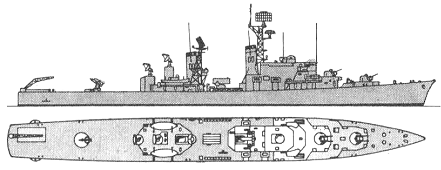
Amatsukaze, 2 views (src navypedia)
⚙ specifications as completed |
|
| Displacement | 3,050 long tons (3,099 t) standard, 4,000 long tons (4,064 t) full load |
| Dimensions | 131 x 13.4 x 4.2 m (429 ft 9 in x 44 ft x 13 ft 9 in) |
| Propulsion | 2 shafts Ishikawajima/GE geared turbines, 2 Ishikawajima FWD2 boilers, 60,000 bhp |
| Speed | 33 knots (38 mph; 61 km/h) |
| Range | 900t oil, 7000 nm at 18 kts (12,965 km or 8,000 miles) |
| Armament | Mk13 SAM (10 MR-1), 2×2 3in/50 AA, 1×8 ASROC, 2 hedgehogs, 2 y-guns, 2×3 324mm Mk32 ASW TTs |
| Active Protection | NOLR-1B, NOLR-6B/OLR-9B, OLT-3 jammer |
| Sensors | Radars OPS-17, SPS-29, SPS-52, SPG-51, SPG-34, Sonar SQS-34, SQS-23 |
| Air Group | 1 Helicopter, no hangar |
| Crew | 290 officers and men |
Amatukaze in service
 JDS Amatsukaze was laid down on November 29, 1962 at Mitsubishi Heavy Industries in Nagasaki, number 2303. This 3,000-ton destroyer had been planned for fiscal year 1960 under the First Defence Program. She was launched on October 5, 1963, commissioned on February 15, 1965, assigned to the 1st Escort Flotilla under direct command and stationed in Yokosuka. For 11 years, until JDS Tachikaze was commissioned, she remained the only missile ship of Japan, a “treasured vessel.” Furthermore, due to the fact she underwent multiple modifications and modernization unusual for the JMSDF, she remained active for an unprecedented 30 years, until the end of the Cold War and beyond.
From June 14 to October 9, 1965, she was sent to Long Beach for her Tartar System Qualification Testing (SQT). Her first upgrade series were 1967-1968 and concerned her Anti-Submarine Warfare (ASW) suite. She had a new sonar suite with the AN/SQS-4A search sonar and AN/SQR-8 depth-measuring sonar for a multimode AN/SQS-23 to look for SSNs. The weaponry saw the Mk.2 short-range torpedo launchers replaced with Type 68 triple short-range torpedo tubes (standard US 324 mm) and more importantly, the installation of an ASROC 8-tube launcher planned from the start and installed amidship, putting her to the same level as the Charles F. Adams.
Next was her first Tartar System Upgrade between 1969 and 1972 in which her 3D radar was replaced with the AN/SPS-39A and the aft mast changed to a derrick for extra support. The fire control radar was replaced with the AN/SPG-51C, in order to support the newly developed Standard Missile Type 1 (RIM-66A SM-1A), adding anti-surface warfare capabilities to the ship. Accordingly, a second Standard Qualification Test (SQT) was conducted at Long Beach in 1972.

JDS Shikinami and JDS Amatsukaze anchored behind.
The upgrade saw her from August 2 to September 26, 1969, deployed in the United States to conduct anti-aircraft missile launch training and other exercises. From July 14 to September 26, 1972, she was deployed to Long Beach as seen above for Standard SM-1 equipment certification tests and Tartar launcher modifications.
Nothing to note in 1973-76.
She then had a second Tartar System Upgrade from 1977 to 1978 to make the launcher fully compatible with the RIM-66B SM-1MR, whereas the SM-1 series received full-scale production in Japan. The GMFCS computer was upgraded as well. Initially an analog Mk.118 it was replaced by the digital Mk.152, and the fire control radar replaced, resulting in partial digitalization. However, the weapons control system and missile launchers remained analog, causing some mishaps. Amatsukaze therefore went through another Special Qualification Test (SQT) at Long Beach from December 18, 1978 to March 20, 1979.
From January 25, 1980, she was still deployed to the US and from February 26 to March 18, took part in the Japanese Navy’s very first “Rim of the Pacific” Exercise (RIMPAC 80) with Hiei and eight P-2J patrol aircraft. She entered the US aircraft carrier Constellation’s Task Force (Task Force Blue) and successfully completed all four tests surface-to-air engagements. She also engaged and “destroyed” fictitiously the SSN USS Sargo, which approached in an attempt to launch a second attack on Constellation, already “damaged” by air attack from the carrier Melbourne, earning high praise as the best ship in the task force and for RIMPAC 80. She was back to Japan on April 2. On March 27, 1981, she was assigned to the newly created 61st Escort Squadron, 1st Escort Flotilla, along with Asakaze commissioned the same day.
She then had a major Electronic Equipment Upgrade in 1982-1983 conducted to replace her Gunfire Control System (GFCS) with a new, and domestically produced Type 81 Fire Control System, Type 2-21D (FCS-2-21D). This combined the manned 76 mm naval guns with an unmanned GFCS, creating a semi-virtual artillery system unparalleled in the JMSDF. She received a new aircraft detection systems, and the electric warfare system NOLR-6Bs, OLR-9B missile warning systems, combined with Mk 36 SRBOCs (decoy launchers). In 1984, an OLT-3 electronic countermeasure system (ECM) was also added. This brought her to the same level as the Hatsuyuki-class (52DD).
On March 27, 1986, she joined the 3rd Escort Flotilla under direct command, home-ported to Maizuru.
On March 23, 1988, she entered the 63rd Escort Squadron formed under the 3rd Escort Flotilla, along with Shimakaze commissioned on the same day.
On July 1-31, she trained off Guam with Haruna, Mochizuki, and Nagatsuki. During a routine maintenance in 1990 she had a SUPERBIRD satellite communications system installed.
From July 1 to 31, 1992, she took part in training sorties off the Philippines with IDS Setoyuki, Asayuki, and Mineyuki.

Amatsukaze in the 1980s
She was eventually stricken on November 29, 1995 after 30 years and 9 months service, 764,314 nautical miles (approximately 1.4 million km) crossed, 62,999.53 hours at sea, nineteen large JMSDF exercises, four joint exercises, nine fleet reviews. She was expended as target off the coast of Wakasa Bay by new anti-ship missiles. Her port propeller was salvaged and is now exposed at the Yokosuka Training Center, starboard propeller at Yokosuka Air Base, main anchor at Maizuru Air Base, only relics of an historic ship for Japan, which was never preserved despite some attempts to do so.
Read More/Src
Books
Hull (Hardware of JMSDF destroyers)”. Ships of the World (in Japanese) (742). Kaijin-sha: 100–105. June 2011.
Yasuo Abe (June 2011). “2. Propulsion system (Hardware of JMSDF destroyers)”. Ships of the World (in Japanese) (742). Kaijin-sha: 106–111.
Keiichi Nogi [in Japanese] (March 2010). “1. Missiles (Shipboard weapons of JMSDF 1952-2010)”. Ships of the World (in Japanese) (721). Kaijin-sha: 82–87.
Heihachiro Fujiki (August 2007). “A history of JMSDF’s missile destroyers”. Ships of the World (in Japanese) (678). Kaijinn-sha: 98–103.
Conway’s all the world’s fighting ships 1947-95
Links
ja.wikipedia.org/wiki/ amatsukaze
web.archive.org navypedia.org amatsukaze65.htm
seaforces.org/ JDS-Amatsukaze as built and in 1977
Videos
Model Kits
on scalemates.com: Nichimo 1:200, Pit-Road and Model Factory Kyu-Kyu Shiki 1:700