

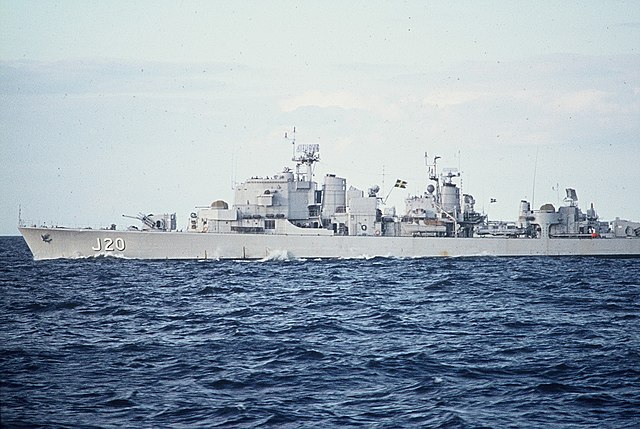
 Swedish Navy 1958-82 HSwMS Östergötland, Södermanland, Gästrikland, Hälsingland (J20 to J23)).
The last Swedish Destroyers:
The Östergötland class were a class of “light” (as sometimes designated) destroyers built for the Swedish Navy in 1956-59, smaller and less capable than the Halland class and active for most of the Cold War, until decommissioned in 1982. The class were the last destroyers built by Sweden and notably took part in a number of incidents and confrontations involving Soviet incursions into Swedish waters, specially from the late 1970s and early 1980s, such as the infamous “Whiskey on the rocks” in 1981.
Development
The Östergötland-class destroyer consisted of four ships built in 1956–1959 to replace three interwar destroyers now approaching the age limit in the Swedish Navy and to be decommissioned and scrapped. This class was largely based on the earlier Öland-class, using the same hull among other things. They were also, the first Swedish destroyers to be built in sections, later assembled at their respective naval yards.
In 1951, an inquiry looked for the future expansion of the fleet. The old (1933) cruiser HMS Gotland was now approaching decommission, as were two interwar destroyers. Since cruisers had proven to be too large and expensive in peacetime service, it was decided that three ships (HMS Gotland, HMS Tre Kronor and HMS Göta Lejon) would be replaced by four destroyers. The possibility of expanding the Halland class with four more ships was also investigated. Since funds would only be enough for three such ships, and the requirement for four was insisted on, it was decided to return to the Öland class design instead. However, this proved to be only moderately successful, as these hulls were too small for the new and expanded equipment that the Östergötland class received, leading to stability issues which limited their service life and precluded any upgrade.
All three major shipyards, Eriksbergs Mekaniska Verkstads AB, Götaverken and Kockums, were selected to build these. Negotiations eventually led to a master design at Götaverken, which also built two, Östergötland and Gästrikland. Eriksberg built Södermanland, and Hälsingland as well, but she was instead completed by Kockums. The design was completed in 1952 and the order was placed in March 1953. For the first time, it was advised to lower the costs, to use WW2 mass construction techniques, like those used for the Liberty ships, and built them in sections in local workshops inland (which politically had the advantage of better distributing jobs and raise public awareness, and rally a wider funding support). Then, they were assembled at their respective shipyards. For a first, it needed a few tweaking, but in the end, this was not worth the hassle: Construction time was indeed restricted to two years versus four years for the previous Halland class, but it was not suited for only four ships, but a larger class, like MTBs, to be really profitable.
Design of the class

Hull and general design
The östergötland class displaced 2,150 tons standard for 2,600 tons full load, and a length of 112 m (367 ft 5 in), a beam of 11.2 m (36 ft 9 in) and a draft of 3.7 m (12 ft 2 in).
The final displacement of 2,600 tons, unlike the 2,000 tons initially planned, was due to design revisions for a heavier equipment carried compared to previous ships, and a superstructure built of steel, unlike the Öland class, made in light metal alloy. This was fireproof, but gave a top weight penalty. The centre of gravity was impacted and stability deteriorated, so it was necessary to curtail the superstructure existing on the Halland class. Indeed on the previous class, the structure allowed the crew to proceed from the bridge to the stern while kept inside all the time, not forced to go outside, and advantage for NBC protection and in winter. To increase manoeuvrability, the stern design was altered, and they were given a twin rudder arrangement. The stern shape was also modified later in their career. It was completely flat transom as completed in 1958-59, and became a rounded transom later in the 1960s. Their sensors were mounted on two short masts and the bridge layout included an open deck.
Powerplant

The östergötland machinery comprised two oil-fired Babcock & Wilcox boilers, feeding steam at 32 bar pressure to two de Laval steam turbines, which in turn drove three bladed fixed pitch bronze propellers. The output was 47,000 shaft horsepower (35,000 kW), for a top speed of 35 knots (65 km/h). Range was 3,000 nmi (6,000 km) at 20 knots (37 km/h) based on 330 tonnes of fuel oil. The machinery layout was the same as that of the previous Halland class: A boiler room was located at the front, with a room steam turbine behind, both separated by bulkheads. Longitudinal bulkheads also separated these from the hull, as the other group was located aft of the first, so one after the others in a longitudinal axis, explaining the two funnels far apart. The advantage over a side by side arrangement was a better protection on both sides if the hull was punctured or flooded. Before the Halland class, both turbine rooms were located aft of the boiler area, making the machinery more vulnerable to shelling with just a single lucky hit.
Armament

The class’s main armament consisted of four 12 cm m/44 guns mounted in two twin turrets, one forward, one in the stern. For anti-aircraft defence, seven 40 mm m/48 E automatic guns mounts were installed. Östergötland and Södermanland had seven, but Gästrikland and Hälsingland had five initially. They lacked the 57mm intermediate AA of their predecessors mostly due to top weight limitations. The torpedo armament consisted of six 53 cm with Torped m/30 models placed in two triple torpedo tubes. However, due to poor stability, the forward torpedo tubes were removed during a modernization in 1963–1967 while the aft one was expanded to six tubes. For ASW, they carried the m/51 rocket launcher and two depth charge launchers m/44. During a modernization in 1963–1967, three of the anti-aircraft guns were removed and replaced with a low-altitude platform and director for the “Robot 07” system, Swedish name for the British Sea Cat (see later).
Bofors 120mm/50 M42

They had two fully automatic twin 12 cm m/50 guns in turrets fore and aft, more advanced than those on the öland class (12 cm/50 (4.7″) M/44 Model 1942). They were initially aimed from a central fire control, later replaced with a new artillery radar connected to the main radar. These guns were of a new type with more automation for a rate of fire of up to 40 rpm versus 10 rpm for the M42 of the öland class.
⚙ specifications Bofors 12 cm/50 M50
Full turret and mount weight 67,000 kg (148,000 lb).
Barrel length L/50 including breach, for 120 millimetres (4.7 in) cal.
Shell: 120 × 835 mm R 23.35 – 23.5 kg
Action: Automatic extraction with integrated autoloader
Elevation/traverse: -9°/+85° at 25°/s and 360° at 22°/s
Rate of fire: 2 × 42 rounds/min
Muzzle velocity: 835–850 m/s (2,740–2,790 ft/s)
Bofors 40mm/70 M48

Same system, as for the öland and Halland class, but not in pairs but single mounts. Two on the upper deck superfiring forward, three aft superfiring over the aft 120mm turret as standard. The Bofors M/48 fired an AB 40 mm L/60 HE-T weighting 2.05 lbs. (0.93 kg) full, complete round 17.60 in (44.7 cm) and about 0.661 lbs. (0.300 kg) propellant for the HE 4.63 lbs. (2.1 kg) which carried 0.150 lbs. (0.068 kg) TNT for the HE-T 7a.
Muzzle velocity was 2,789 fps (850 mps), with a barrel life between 9,600 and 10,000 Rounds. Bofors produced 11 Naval guns for the Swedish Royal Navy, 61 for export prewar and in wartime 320+ guns for the Swedish Royal Navy alone, 38 postwar, production ended in 1954. Some of the twin water-cooled mounting had integral 1.25 m or 2.0 m Hazemeyer rangefinders.
Torpedo Tubes: Torped 61
Two triple banks in 1958-59 as completed, and after 1965, a single sextuple bank. Initially, the first TT bank was located forward of the aft funnel above a structure like on the US Fletcher and follow-up classes. After it was removed, the boars were relocated from above the bulwarks to the former structure. Initially “B” torpedo tubes banks was located also in a top structure like “A” to allow the crew crossing all the length while staying inside, but it was lowered by one deck to cut weight.
The Torped 61 was a 1,8t, 7 m long, 533 mm calibre model with a 300 kg HE warhead with proximity fuse.
Powered by Alcohol and HTP (piston engine) at 50kts over 20 km, wire guided with controlled homing. It remained the destroyer’s antiship guarantee for their career, but had a limited ASW role.
305mm M51 Squid ASWRL
Same system as the RN Squid three barrel 12-inches system. Ammunition weight 177 kg (of which 94 kg minol). Muzzle velocity 13.3 m/s (sinking speed). Effective range 250 meters
Maximum depth 274 meters (greatest explosion depth). It was located at the stern deck aft.
Robot 07
 The Swedish Name for the British Seacat SAM system, developed to replace the Bofors on a one-to-one basis on the same mount. Autonomous system, with the added advantage to use the same radar guidance as the Bofors. Each launcher hold four missiles. With a mass of 68 kg (150 lb) for 1.48 m (58 in) long, 0.22 m (8.7 in) in diameter and a wingspan of 0.70 m (28 in).
Each carried a 40 lb (18 kg) continuous-rod warhead with proximity fuse. It was powered by a 2 stage motor for a range between 500–5,000 m (1,600–16,400 ft) or more at Mach 0.8, guided CLOS by and radio link, steered by control surfaces. They replaced three Bofors mount on all ships when fitted in the 1960s one by one.

Mines
The ships had rails on the aft deck, like the Halland class, enough for 58 mines which went into special cutout poop chutes, to be dropped lower, avoiding adverse effect of the transom stern’s turbulences. No data on the model, in research.
Sensors
Saturn Air Warning and Navigation Radar: No data, in research.
M45 Radar: Fire control radars located fore and aft, used to direct the 120 mm main gun and Bofors fire, no data, in research.
M44 Radars: Used to guide the SeaCat SAM. Installed in 1965 on Gästrikland, 1967 on Södermanland, 1968 on Hälsingland and 1971 on Östergötland.
Sonar: Assumed to be the same type used on the Halland class, to guide the triple Bofors Squid ASWRL. It was housed in a retractable dome under the bow. Its placement ensured it was disturbed by the destroyer’s own propeller. But it lost its relevance above 20 knots.
⚙ specifications |
|
| Displacement | 2,150 tons standard, 2,600 tons full load |
| Dimensions | 112 x 11.2 x 3.7m (367 ft 5 in x 36 ft 9 in x 12 ft 2 in) |
| Propulsion | 2 shaft geared turbines, 2 boilers, 47,000 hp (35,000 kW) |
| Speed | 35 kn (65 km/h) |
| Range | 3,000 nmi (6,000 km) at 20 knots (37 km/h) |
| Armament | 2×2 120 mm m/44, 7× Bofors 40 mm AA m/48, 1×6 533 mm TT, Squid ASWRL, +Seacat SAM* |
| Sensors | Saturn, M45 radars, sonar. |
| Crew | 244 |
*Locally called Robot 07. They replaced three 40 mm mounts and were designed as such in the RN.
Career of the Östergötland-class
During their service, they composed a destroyer flotilla of two Östergötland-class led by a Halland-class destroyer and six torpedo boats. They took part in a number of incidents and confrontations involving Soviet incursions into Swedish waters during the late 1970s and early 1980s, most notably the Whiskey on the rocks incident in 1981.
 HSwMS Östergötland (J20)

 HSwMS Östergötland was laid down at Götaverken, Göteborg (Gothenburg) and launched on 8 May 1956. Trials began in late 1957, and she was delivered to the Navy on 3 March 1958.
In 1961, the fleet’s flagship HMS Älvsnabben (M01) underwent an overhaul, and Östergötland was sent in a long cruise with HMS Öland (J16). The voyage took her worldwide, from 21 January 1961, to the Isle of Wight, on 25 January, Portsmouth, on 26 January, Lisbon on 2 February, Barcelona on 9 February, she crossed the strait of Gibraltar and reach Toulon on 14 February, then La Spezia on 19 February, and back to Gibraltar on 25 February, Casablanca on 3 March, Le Havre on 12 March and back to Gothenburg on the 23th.
No more career details. Östergötland was decommissioned on 1 July 1982, sold in 1985 for scrap in Spain.
HSwMS Södermanland (J21)

 HSwMS Södermanland as laid down at Eriksberg, Göteborg. Södermanland, unlike her sister ship Hälsingland, saw the hull built at Eriksbergs Mekaniska Verkstad, with completion and fitting out done by Kockums Mekaniska Verkstads AB due likely to a work share agreement. Trials started in March 1958, and she was delivered to the Navy on 27 June.
No career details found yet. She was decommissioned on 1 July 1982 and sold in 1985 for scrapping in Spain.
HSwMS Gästrikland (J22)

 HSwMS Gästrikland was laid down at Götaverken, Göteborg, and was launched on 6 June 1956. Trials started in 1958, and on 14 January 1959 she was delivered to the Navy.
Gästrikland was the last of the Östergötland-class destroyers to be commissioned, and was still part of the training flotilla in the late 1970s. No more career data. She was decommissioned on 1 July 1982, after which the turrets were removed and transferred to the Övre Norrland military area, intended to be used in fortifications. However, they were never used and were later scrapped. After decommissioning, the hull was used as a target ship before being sold for scrapping in Britain in 1991.
HSwMS Hälsingland (J23)

 HSwMS Hälsingland was laid down at Eriksberg, Göteborg. Her hull was built at Eriksbergs, Gothenburg, after which it was towed to Malmö for outfitting and completion at Kockums. She was launched on 14 January 1957 and after trials she was delivered to the Navy on 17 June 1959. No more details on her career (yet). She was decommissioned on 1 July 1982, after which the turrets were removed and transferred to the Övre Norrland military area, intended to be installed on fortifications, but were never used and instead, later scrapped. After decommissioning, the hull was used by FOA for explosive tests, before being sold for scrapping in Karlskrona.
Read More/Src

M/S Prinsessan Birgitta at Stadsgårdskajen in Stockholm. The destroyers Halland and Östergötland on Saltsjön, and a mine ship (Älvsborg?) at Kapellholmen.
Books
Gardiner, Robert and Stephen Chumbley. Conway’s All The World’s Fighting Ships 1947–1995. Annapolis, Maryland, USA, 1995.
Borgenstam, Curt; Insulander, Per; Kaudern, Gösta (1989), Jagare : med svenska flottans jagare under 80 år (2:a), Karlskrona: Västra Frölunda CB Marinlitteratur.
von Hofsten, Gustav; Waernberg, Jan (2003), Örlogsfartyg: Svenska maskindrivna fartyg under tretungad flagg (1:a), Karlskrona: Svenskt Militärhistoriskt Bibliotek.
Links
https://www.navypedia.org/ships/sweden/sw_dd_ostergotland.htm
https://sv.wikipedia.org/wiki/%C3%96sterg%C3%B6tland-klass
https://en.wikipedia.org/wiki/%C3%96sterg%C3%B6tland-class_destroyer