
 Oceanic Transport Submersibles & Blockade Runners (1942-43).
12 planned, 2 completed: Remo, Romolo (comp. July 1943).
The Romolo (or R class) class were 12 planned blockade runner transport submarines, but only 2 were completed, Remo and Romolo (Remus and Romulus), both lost 1943. They were among the most radical designs produced by Italy and a desperate attempt to resupply isolated garrisons, notably in North Africa, but also carry rare goods to and from Japan, a role for which several previous Italian submarines were modified. At 2560t underwater they were among the largest produced by Italy, with a range of 12,000 nm and 600t of cargo but with a much reduced armament.

Laid down in 1942-43, these were the last and largest of Italy’s ocean-going submarines. Designed by Cavallini and Tosi, they were specifically intended to transport special cargoes, such as rubber, to and from Japan. They had a carrying capacity of 600t and mounted only a token armament. As they were not required as attack vessels, the machinery was of comparatively low power, providing sufficient but not spectacular speeds.
Endurance was 12,000nm at 9kts/90nm at 4kts. Only Remo and Romolo were completed, both were lost within days of each other and only a few weeks after entering service. The former was torpedoed by the British submarine United in the Gulf of Taranto and the latter bombed by aircraft off Augusta. R3 and R4 were delivered incomplete to the Navy on 14.11.46 and the construction of RS and R6 was suspended on 8.1.44, R7-R12 were seized by the Germans and renumbered UIT 4,5,6,1,2 and 3 respectively. UIT 4—6 were sunk in air raids on Monfalcone while fitting out and the remainder were scuttled at the end of the w: All six were salvaged in 1946 and broken up 1947-48 except R11 and R12 were converted to floating oil depots.
Design of the R class
Development
By early 1943, half-way in the Second World War, Italy and Germany realized that the war would drag on, and no quick victory was no longer possible. The fundamental problem became to obtain resources and specific materials for the military industry, that cannot be procured other than by sea routes. The only axis member capable of providing such necessary materials in 1942 was Japan, which by then had extended its control as far as Singapore.
The only means of transport capable of navigating between Italy and Singapore across thousands of miles of Allied-controlled seas were submarine. However, all wartime submarines, both U-Boote and Italian ones, with the notable exception of the Admiral-class, lacked sufficient range and more acutely, significant space to carry the goods. In 1942 already, Italian submarines carried vital supplies to isolated garrisons in North Africa and started to be modified for these tasks, so there were already some guidelines if a dedicate transport submarine needed to be built.
By the spring 1943, some wartime submarines from Betasom, the Bordeaux Base, were also modified to carry 150 tons of materials, that could not exceed due to their inherent design, for these missions, significantly limiting their wartime capacity. They departed Bordeaux while being stern-heavy, so much so that if they had to make a rapid dive, they would have had to do so in reverse.
To address this problem more effectively, Italian Navy commissioned engineer Virginio Cavallini designed a submarine capable of carrying at least 600 tons of supplies with a new ballast system that could alleviate balance in a more efficient way. The result was the largest submarine ever built in Italy, displacing 2,000 tons surfaced. These design was submitted to Supermarina’s staff as well as to Karl Dönitz, which also suggested the idea. Twelve were ordered in what became the “R” class, six to Taranto, three in Muggiano, three in Monfalcone. They were to be built in utmost emergency, mobilizing all available workforce and resources and indeed, despite their technical novelty, they also ended as the fastest built Italian submarines ever. These were equipped with four holds located amidships, each with heavy-duty hatches and removable loading masts to unload at any place in an autonomous way, rather than requiring port facilities.
Construction and Names
REMO Tosi 28.3.1943 Sunk 15.7.43
ROMOLO Tosi 21.3.1943 Sunk 18.7.43
R3 Tosi 7.9.1946 BU 1947
R4 Tosi 30.9.1946 BUc1947
R5 Tosi BU on slip
R6 Tosi BU on slip
R7 CRDA, 21.10.1943 Sunk 25.5.44 Monfalcone
R8 CRDA, 28.12.1943 Sunk 20.4.44 Monfalcone
R9 CRDA, 27.2.1944 Sunk 16.3.45 Monfalcone
R10 OTO, Muggiano 12.7.1944 Scuttled 24.4.45
R11 OTO, Muggiano 6.8.1944 Scuttled 24.4.45
R12 OTO, Muggiano 29.9.1944 Scuttled 24.4.45
The names to be given to the remainder of the class is unknown.
Hull and general layout
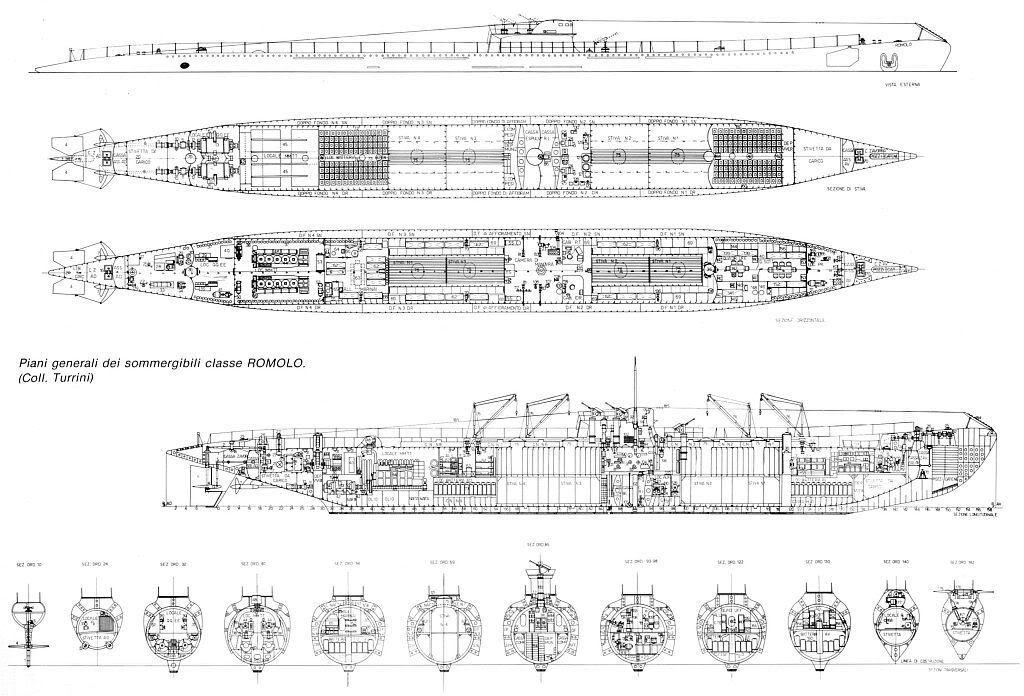
See the profiles and technical cutaway internals from Turrini coll. on betasom.it. Here: Hosted on photobucket
The R-class were very peculiar and unlike anything else designed in Italy so far: They were the largest Italian submarines ever built, displacing 2,155 metric tons (2,121 long tons) surfaced and 2,560 metric tons (2,520 long tons) submerged for an overall length of 86.5 meters (283 ft 10 in), a beam of 7.86 meters (25 ft 9 in) and draft of 5.34 meters (17 ft 6 in), much greater than for the Cagni class.
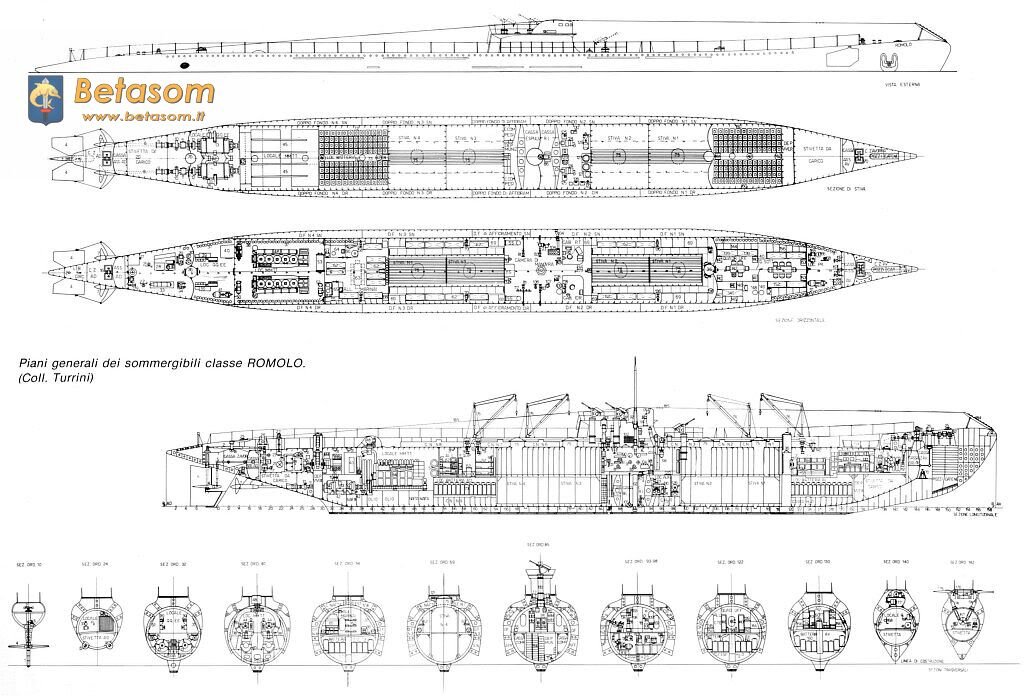
Their total cargo capacity was 600 tonnes (591 long tons), as seen above, spread between four holds amidships, in front of the engines compartments.
The design was reminiscent in some ways to the German Type XIV “milk cows” but at the same time, took as a base a Cagni class hull, which was beamier and fuller, with all internals rearranges to maximize internal space. Going from 150 to 600t was indeed a challenge. It was however still a ridiculous cargo capacity given what both axis members needed, to compare with a regular merchant freighter having 2/3 of its displacement as a payload, versus only 1/3 for these. The crews of the Romolo and Remo consisted of 7 officers and 56 petty officers, officers, and sailors.
They also adopted the German style conning tower, standardized on all the latest Italian submarines, albeit still in that case initially featuring on plans a Italian style covered helm forward. It was modified on an U-Boote style at completion. To maximize internal space, the hull had a bulky shape, with a constant beam for 2/3 of her length. The internal arrangements not only pushed back the engines far aft, but the batteries were located in a rear and forward compartments. There was also a jettisonable keel, and two diving planes forward. The freeboard was also relatively, unusually high and features a double row of water scoops to submerge faster. Diving time was still slow, however.
Powerplant
When surfaced, the R-class boats used their two 1,300-brake-horsepower (969 kW) diesel engines each mated on their own propeller shaft, Tosi models for 2600 hp total. When submerged, each was driven by two 450-horsepower (336 kW) electric motor (Marelli, extra data not found) for 900 hp total. They could reach 13-14 knots (24 km/h; 15 mph), surfaced due to their bulk, versus 17 knots for the Cagni class, as large but nimbler. But surface speed was unimportant in that case, and larger engines would have ate up extra space.
They still were capable of 6 knots (11 km/h; 6.9 mph) underwater, versus 8.5 knots on the Cagni class. But the extra space saved by sacrificing speed was to have large oil tanks, for an unprecedented surface range of 12,000 nautical miles (22,000 km; 14,000 mi) at 6.5 knots (17 km/h; 10 mph), versus 13,500 nmi (25,000 km; 15,500 mi) for the admiral class. When submerged, this fell to 110 nmi (200 km; 130 mi) at 3.5 knots (6.5 km/h; 4.0 mph), versus 107 nautical miles (198 km or 123 miles) at 3 knots. So the Romolo performed better in that case.
Armament of the Romolo class
It was there, but almost an afterthought in case of a bad encounter. The had neither deck guns nor 533 mm torpedoes tubes, being down to just two 17.7 inches or 450mm torpedo tubes, one in the bow and stern for internal reloading, but it’s not sure if they even had spares. It was also not for all boats. Romolo was indeed fitted with those, and without reload. The deck were clear of any obstruction, and thus their gained in stability. AA protection was down to three 20 mm Breda AA guns in single mounts in a triangle pattern on their conning tower.
AA: Breda Mod. 31

The anti-aircraft defence counted on three single Breda M1931 13.2 mm L/76 heavy machine guns, placed aft of the conning tower. Each mount weighed 695 kg, but ensured an elevation of -10° to 90°. They fired 125 g unitary rounds, with a muzzle velocity of 790 m/s, maximum range of 6,000 meters and effective range of 2,000 meters. Their rate of fire was 500 rounds/min, so 2000 rounds when both twin mounts fired in concert, however.
2x 450 mm (21 inches) torpedoes
The 45 cm (17.7″) W 200/450 x 5.75 Siluranti were unique to the Cagni and Romolo class submersibles. Derived from an airborne model, the Si 200/400, they were longer, as the former could either be 5.46m or 5.36m. The W200 were 5.75 meters long (18 ft. 10.5 in). They weighted probably above 2,200 lbs. (1000 kg) and carried a 441 lbs. (200 kg) warhead, like the airborne models. To compare, the 450 mm used by Torpedo Boats and MAS boats had the same, but they were lighter and shorter.
Performance wise, the W200 used a classic Wet-heater to power them to 3,300 yards (3,000 m) at 44 knots or 8,750 yards (8,000 m) at 30 knots, better settings than other models. It was developed by Whitehead-Fiume. The model could be fired by other submarines as the company also provided cradle-like fittings which enable them to be fired from 533 mm tubes as well.
As for the numbers carried, it went from 38 as initially planned, down to 36 for realistic combat operations and compromises. Still, that was enormous, but the management is unknown. On average that means two reloads per tubes, so possibly 6 aft and 16 forward not counting those preloaded in the tubes. One can imagine that when these were absent, as well as all the associated gear, a considerable room was available to store any payloads.
⚙ specifications |
|
| Displacement | 2,220 tons surfaced, 2,616 submerged |
| Dimensions | 87 x 7.8 x 6.13 m () |
| Propulsion | 2 shaft Tosia diesels 2,600 hp, 2× Marelli electric motors 900 hp |
| Speed | 14 knots surfaced, 6.5 knots submerged |
| Range | 12,000 nmi (25,000 km; 15,500 mi) at 9 knots (17 km/h; 10 mph) |
| Armament | 2× 450 mm TTs (bow, stern), 3× 13.2 mm Breda AA |
| Test depth | 90 m (300 ft)+ |
| Crew | 63 |
Romolo class Career

An R-Class submarine damaged by Allied air raids at Monfalcone
Only two boats were delivered of the twelve ordered, Romolo and Remo from Taranto. And both were sunk on their first mission. None of the others (R. 3 to R. 12, remaining unnamed, probably named after Roman figures as well) were completed. More specifically, these were the following:
R. 3, R. 4 (both on March 1, 1943) and R. 5, and R. 6 (both on March 25, 1943) were laid down in the Taranto shipyards. The first two were launched on September 7 and 30, 1946, respectively, and then scrapped. The same fate befell R. 5 and R. 6, which were never even launched.
The three submarines from Monfalcone were R. 7, R. 8, and R. 9, all laid down on 1 March 1943. Construction was maintained after their capture by the Germans following the armistice of September. R. 7 and R. 9 were launched on 31 October 1943 under their supervision, while R. 8 was launched on 28 December of the same year. They remained incomplete and were all sunk on 25 May 1944, scrapped in 1946.
In La Spezia, the first laid down, on 24 February 1943, was R. 10, followed on 10 March by R. 11 and finally by R. 12 on 13 May.
R. 10 was the only submarine in the class except Romolo and Remo to have been launched before the armistice on 13 July 1943, while R. 11 and R. 12 were launched by the Germans on 6 July and 29 September 1944 respectively. The first two were dismantled in 1947 (R. 11 was sunk on 24 April 1945 and later refloated, BU), R. 12 was renamed U. IT. 3 for the Kriesgmarine but also sunk in La Spezia when the war closed to an end. Refloated, she was used as a fuel depot GR. 553 until BU in Ortona in 1973. Hr conning tower was preserved for years in Ortona and left at a depot of the Italian State Railways, until restored and moved to the Gaeta seafront as a “National Monument to the Submariner”.
Romolo (1943)
Romolo was laid down at Tosi shipyards on 21 July 1942, launched on 21 March 1943 and commissioned on 19 June. Trials and crew training were abbreviated due to her pressing need, a transport mission from Sardinia. She left Taranto for Naples on the afternoon of July 15, 1943 under command of Lieutenant Cdr. Alberto Crepas. The Allies were aware of these submarines to be used as special strategic transports to Japan and planned a route to be ambushed or attacked by air after gathering intelligence on her movements, preparing plans to eliminate both Remo and Romolo. Romolo disappeared ‘without a trace’ in her first mission, and her fate was only known postwar.
It was established that a Royal Air Force aircraft attacked “a large submarine” with five bombs around 3:20 a.m. on July 18, southeast of Cape Spartivento. This happened about 15 miles off the Calabrian coast. He described the “unknown submarine’s AA fire, observed the lack of deck gun, and saw some of the bombs hit her aft of her conning tower, probably exploding in one hold.
She did not sink immediately, and remained stationary for about twenty minutes until spotted again around 4:50 a.m., sailing slowly towards the coast probably to be beached, seeing with a trail of fuel, and yet she sank about an hour later.
Given the calm seas and the short distance from the shore, she sank only due to her sustained damage, as there would not have been ample time for the crew to abandon her and swim to shore. But there were no survivors. It was established as likely she was destroyed by an internal ammunition explosion and/or possibly due to leaking hydrogen from the batteries, shook by the initial explosions. Commander Alberto Crepas, 6 other officers, 53 petty officers and sailors went down under 1,450 meters, where the wreck was rediscovered not far from the place indicated as the sinking of Romolo by the attacking aircraft at 37°50′ N and 16°18′. The ship despatched her found a large ferrous mass corresponding to her wreck, but no dive was made to conform her identity and be more categoric on her exact fate.
Remo (1943)
Remo was laid down on September 5, 1942, launched on March 28, 1943 and commissioned on June 19, 1943. Her commissioning, testing, and crew training were shortened due to her urgent need to transport metals from Sardinia. At 9:30 on July 15, 1943, she departed Taranto under command of Lieutenant Salvatore Vassallo, bound for Naples. The Allies were concerned about these submarines and their use to carry special weaponry developed in Germany to Japan, and put their intelligence network to work. Remo’s path was known, and an air attack prepared, as well as submarines posted in ambush along the way. At 6:30 PM the same day she departed, she fell on her first ambusher, HMS United sighted her surfaced, fired four torpedoes. One hit her and probably broke her pressure hull. The pressure also probably broke her internal bulkheads, and she sank within minutes. However, Commander Vassallo and two other men were in the conn. when it happened and jumped overboard. As for the rest of the crew below deck, only Sergeant Dario Cortopassi managed to exit the hatch. Five officers and 50 petty officers and enlisted men went down with Remo on her first and last mission, after a single day of navigation.
Read More/Src

Books
Giorgio Giorgerini, Uomini sul fondo. Storia del sommergibilismo italiano dalle origini a oggi, Mondadori, 2002
Bagnasco, Erminio (1977) Submarines of World War Two London, Cassell & Co
Brice, Martin (1981) Axis Blockade Runners of World War II Annapolis, NIP
Kafka, Roger & Pepperburg, Roy L. (1946) Warships of the World Cornell Maritime Press
Taylor, J.C. (1966) German Warships of World War II Doubleday & Company
Willmott, H.P. (2009) The Last Century of Sea Power: From Port Arthur to Chanak, 1894-1922 Indiana University Press
Links
sommergibili.com romolo.htm
betasom.it/ risolto-il-mistero-di-romolo
betasom.it/ classe-r-1942
naviearmatori.net
marina.difesa.it Monumento Naz Sommergibilista
web.archive.org regiamarina.net
it.wikipedia.org Classe_R
en.wikipedia.org Italian_R-class_submarine
Model Kits
None, found one ? Feel free to signal it below.
3D
None found