
 Frigates: Baleares, Andalucia, Cataluna, Asturias, Extremadura F71-75 (1968-2009)
Spanish Day !
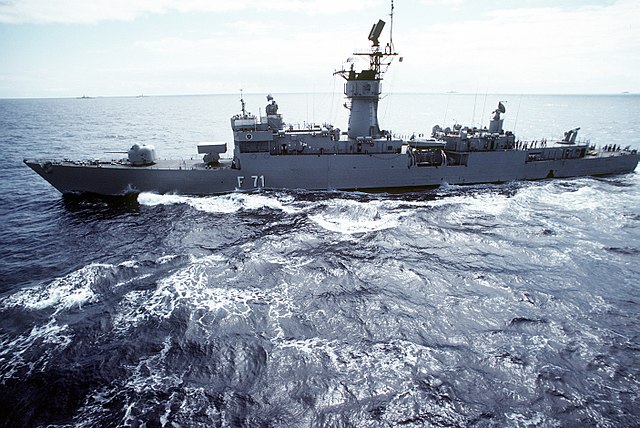
The renewal of the Spanish fleet, from Franco’s inheritance to the modern force we known today, went though an important step, the Balears class Frigates. They marke as reset of Spanish shipyard’s expertise with a modified version of the American Knox-class frigates. Albeit very close in appearance, they had many differences like the replacement of ASW helicopter facilities by a medium-range surface-to-air missile system and associated radars. The constructed went on between 1968 and 1976, the first entering service 1973, forming the 31 Escort Squadron based at Ferrol, the backbone of the Armada’s operations in the 1980s, but also until the 2000s as these five ships were modernized several times to keep relevance. They were replaced by the AEGIS-fitted Álvaro de Bazán-class frigates.
Development
The Armada’s landscape in 1966 was not pretty. The surface fleet comprised essentially prewar designs completed post-WW2 after a rocky development, redesigns and rearmaments, such as the Liniers class (1946), Oquendo class (1956) and the Audaz class later reclassified as frigates (1955). Spain wanted in 1965 to update its fleet and the government entered into negotiations with the United Kingdom for the acquisition of four Leander-class frigates, whereas similar negotiation took place with the USA, for which relations were better, to acquire the ex-Independence class USS Cabot, which was eventually acquired in 1967. The need to protect it urged the acquisition of modern ships, but negotiations failed with the British Government, worried about dealing with the unpopular Spanish government.
However, under MDAP provisions from the US despite hostility from the European Community, pragmatism over anti-communism saw the Armada started exercises with NATO as external partner, familiarizing with its procedures and tactics, and the Armada now had the means of its extension thanks to increase in wealth, Spain becoming the world’s second-fastest-growing economy just behind Japan, the “Spanish Miracle”.
So the USN took the initiative to propose to the Armada a loan under MDAP funding of USS Cabot, in the mothballs since 1958. The idea was to lead Spain to contribute its share of naval air operations against Soviet submarines in the Atlantic and Mediterranean. On 17 November 1964 an agreement to acquire five Knox-class frigates was signed in replacement for the Leander class frigates initially planned, in anticipation of the acquisition of USS Cabot, which later became Dédalo, modernized and acquired in 1967.
In between on 31 March 1966, a technical support agreement was reached between Spain and the US with the idea that hulls and machinery would be built in Spain, at Ferrol, and the more complex weapons and sensors would come from the United States, with a fitting out in the US. The superstructures were built at Alicante, the boilers and distilling machinery and propellers at Cádiz. US engineers from Todd, Seattle came to Spain to assist Bazan in Ferrol.

It must be said that the swap from the Leander to the Knox was important. The Leander class were good ships but relatively small and their core design dated back from the 1950s whereas the Knox class were the latest in terms of ASW Frigate in the US, a large ship tailored for the Atlantic and Pacific. The lead ship, USS Knox was laid down as FF-1052 at Todd, Seattle in 5 October 1965 and so just planned and ordered when the deal was signed in November 1964. There was some risk associated, notably since the Knox class, were almost twice as large as the Leanders at 3,020 long tons/4,065 long tons full load with a crew of 227 versus 250-260, making the latter cramped in comparison. The construction cost was covered by MDAP funds for the greatest part, so the Armada had merely to fund the maintenance and pay the wages of its crews.
The paradox was that decisions were taken early on to degrade the ASW capabilities of these ships by removing the helicopter (which was part of the Leander class as well) for a powerful SAM system that existed only for limited self-defence (Sea Sparrow) in the original design, making versatile surface combatants, instead of pure ASW vessels. A choice to escort the new Dédalo carrier and took on, other tasks before the withdrawal of legacy ships, such as the cruiser Canarias as flagship, and its escorts, the Liniers and Audaz class destroyers. The Baleares were in all but name, substitute escort destroyers of the Armada. Five ships were voted to be built at Bazan, Ferrol, laid down in 1968-71 and launched 1970-72, commissioned in 1973-76. They appeared to be successful and useful design, better suite to integrate NATO and symbolic of a strong rapprochement with the USA in terms of technology and standards. They benefited from many modernizations to stay relevant after the end of the Cold War and when retired in 2004-2009 they outlived their forebears, the original Knox, by a decade, as the latter were retired in the early 1990s. This successful partnership with the US was repeated for the 1984 Santa Maria class Frigates (1984), over the next O.H. Perry class.
Design of the class

Plans of the Knox class were taken, but modified to be adapted to Spanish desiderata, with the replacement of the aft flight deck and helicopter as well as the short-range Sea Sparrow defence system for the medium-range Standard (SM-1) surface-to-air missile (SAM). ASW capabilities were now limited to Mark 46 torpedoes in single tube launchers and RuR-5 ASROC. The artillery comprised the same Mk.42 5-inch/54 main gun, but was completed by two 20 mm Meroka CIWS and the anti-ship missile capability by two quad M141 Harpoon launchers. Overall, a pretty well-rounded design, and the lack of helicopter was seen not as a problem as this cover would be provided by the Dédalo they escorted to hunt down Soviet subs in the Atlantic.
Hull and general design

The Knox and Baleares were almost identical. The final tonnage however was greater than the regular Knox due to the weight of the Standard SM-1 SAM and its reload system and storage, at 4,177t full load versus 4,065 long tons (4,130 t) full load for the Knox as built. This tonnage will increase with further modernizations.
The Baleares were a bit shorter at 133.6 m (438 ft 4 in) in overall lenght versus 438 ft (134 m), for a greater beam at 14.3 m (46 ft 11 in) versus 46 ft 9 in (14.25 m) and also greater Draught at 7.8 m (25 ft 7 in) versus 24 ft 9 in (7.54 m). The hull was shaped the same, as the superstructure, with details such as the characteristic “mack” (integrated funnel and mast) amidship, a visual signature of the Knox. The hull was flush deck, ending with a bulwark at the stem and a transom stern aft. With further modifications, the displacement would jump to 3,350 t (3,300 long tons) and draught to 7.8 m (25 ft 7 in) with the hull sonar. The final crew amounted to 256, comprising 15 officers, a bit more than the Knox as initially planned.
Powerplant
It was the same as the Knox class, with a single Westinghouse geared turbine fed by two Combustion Engineering V2M boilers for a total output of 26,000 kilowatts (35,000 shp). The boilers worked at a pressure of 84.4 kg/cm2 (1,200 psi) at 510 °C (950 °F). To speed was 28 knots (52 km/h; 32 mph) versus 27 kn (50 km/h; 31 mph) on the Knox. There was the capacity to carry 750 metric tons (740 long tons; 830 short tons) of fuel oil for a range of 4,500 nautical miles (8,300 km; 5,200 mi) at 20 knots (37 km/h; 23 mph), like the Knox class.
Armament
Mk 42 5-inch/54 gun
These are coupled with the AN/SPG-53 gun fire control radar. These guns are capable of 40 rpm, muzzle velocity 2,650 ft/s (807.7 m/s) range 25,909 yd (23,691.2 m), Ceiling 51,600 ft (15,727.7 m). The ideal dual-purpose weapon up to that point. In Vietnam, these were routinely used for coastal bombardment with pinpoint accuracy. More.
Mark 16 RUR-5 ASROC
They were fitted with an eight-round ASROC launcher between the 5-inch (127 mm) gun and the bridge. The system was introduced in 1961. It was the go-to missile ASW system in service up to this day. The octuple launcher can be reloaded twice. The system was introduced in 1961, just as the class was completed. It was the go-to missile ASW system in service up to this day. The octuple launcher can be reloaded twice.
Missile Weight 1,073 pounds (487 kg), dimensions 14.75 ft (4.50 m) x 16.6 inches (420 mm), Wingspan 26+7⁄8 inches (680 mm).
Propulsion: Solid propellant rocket motor, Subsonic, range 6 mi (9.7 km)
Carries a Mark 46 torpedo, 96.8 Ibs PBXN-103 high explosive.
More
SM-1 Standard SAM
The SM-1 standard was operational in 1968. It replaced the Tartar, using the same launcher and Fire Control System.
Weight 562 kg, Dimensions 4.22 m x 0.34 m x wp 1.07 m
Propulsion: Solid propellant rocket motor, Aerojet MK 27 Mod 4 dual thrust to Mach 2 and range 32 km
Guidance: Semi-active radar homing: Conical scan passive radar
Ceiling 19.8 km.
Payload MK 51 warhead 62 kg Continuous rod.
Mk 141 for 8 Harpoon (From 1988 onwards)
The Baleares, unlike the regular Knox class, had two quad canister launchers installed on the roof of the rear structure, close to the SM-1 launcher.
The RGM/UGM-84A or Block I was subsonic, sea-skimming, over-the-horizon, using Midcourse inertial navigation with active radar homing in the terminal phase; sea-skimming profile (radar altimeter) and selectable terminal modes (pop-up or sea-skimming depending on variant/mission).
It was powered by a Teledyne/CAE J402 turbojet sustainer (plus a solid booster for ship/sub launched versions). Typical maximum cruise speed around Mach 0.8–0.85.
Diameter 34.3 cm (13.5 in) x 4.6 m with booster and 540–690 kg (1,200–1,520 lb).
Warhead: 220–225 kg (488 lb) WDU-18/B HE.
Range RGM/UGM-84A with booster 60–77 nmi (110–140 km).
Mark 46 torpedoes
Four single tube launchers instea dof the usual triple bank. Same acoustic torpedoes used by the ASROC launcher.
The Mark 46 is a dependable short range acoustic model, a beast of burden of the 1960s.
Diameter: 12.75 in (324 mm) x 102.4 in (≈8.5 ft) in tube-launch configuration, Weight 508–518 lb (230 kg).
Warhead: 96–100 lb (≈44–45 kg) high-explosive (PBXN-103 or similar).
Propulsion: Otto fuel II monopropellant powering a two-speed reciprocating external-combustion engine.
Speed: commonly cited 40 knots (final run 45 knots reported).
Range: Around 8,000 yd (official), up to 11,000–12,000 yd (reported depending on speed profile and source).
Operating depth: 1,200 ft plus capability depending on Mod.
Guidance: active or passive/active acoustic homing with search patterns (snake/circle searches) and counter-countermeasure improvements on later Mods.
20 mm Meroka CIWS (From 1988 onwards)

The Meroka (MeRoKa) is a Spanish close-in weapon system (CIWS) using twelve 20-mm Oerlikon L/120 guns arranged in two staggered rows of six barrels for a dense spread against incoming missiles, aircraft and small surface threats. It was developed by FABA/Bazán for the Spanish Navy and fitted when ready on the Baleares class, the first to use it. The two mountes were located abaft the mack on either side.
The Meroka fires groups/salvos from multiple single-barrel guns with the barrels skewed to widen the lethal cone. The firing sequence (timed salvoes) both spreads shot and limits recoil.
Fire control is by radar (originally an off-mount unit; definitive fit typically the Lockheed PVS-2 “Sharpshooter” I-band radar) with optronic/IR trackers on later fits for jamming resilience. Acquisition range is quoted at roughly 4–5 km; first impact is around 1.5 km and assured destruction cited at 0.5 km in many sources.
The 12 × Oerlikon 20 mm/120 had a cyclic combined rate of 1,440 rounds/min (all barrels combined), typically fires two salvoes/sec.
The ammunition magazine contains 720 rounds (60 rounds/barrel).
Effective range (APDS-T) is 1.5–2 km (practical terminal effectiveness much shorter 0.5 km).
Muzzle velocity: 1,290 m/s. Elevation −15° to +85°, 360° traverse. Weight of system 4.5 t (varies by mount/configuration).
On the long run, the fixed-barrel salvo design and legacy sensors make it less effective against high-speed modern anti-ship missiles and saturated attacks compared with modern radar-guided Gatling CIWS (e.g., Phalanx) or missile-based point defenses.
Modernizations
The first major update was in 1988 for Asturias, 1989 for Extremadura and Cataluña, 1990 for Baleares and 1991 for Andalucía:
Their SPS-52A, Pathfinder radar, SQS-23 sonar, WLR-1 ECM suite were replaced by the SPS-52B, Decca 1226, RAN-12L/X, 2x VPS-2 radars, DE1160C sonar, Deneb Mk 1500/1600 ECM suite, four Mk 36 SRBOC decoy RL, SLQ-25 Nixie torpedo decoy, and the Tritan-1 CCS. Armament-wise, they were fitted with two quad Harpoon SSM (8 RGM-84C), and two 20mm/120 Meroka Mod. 2, plus two 12.7mm/90 HMG.
By the mid-1990s all lost two torpedo tubes.
Sensors
AN/SPS-52B air search radar

3-dimensional (3-D) long-range air-search radar, providing range, bearing, and altitude of air targets for early warning and engagement control (feeding systems like NTDS and missile directors). Band: E/F-band (approximately 2.9–3.1 GHz — part of the S-band). Stacked planar array with electronic elevation scanning and mechanical azimuth rotation
Antenna rotation 6 rpm, instrumented range 250 nmi (460 km) max, Altitude 80,000 ft (24 km)
Beam steering Mechanical in azimuth, electronic in elevation (frequency-scanned). Display output 3-D target plots (range, bearing, altitude) to ship’s combat data system
Power output 2 MW peak (nominal figure; varies slightly by mod), accuracy Range 150 yd; bearing 0.5°; altitude 2,000 ft typical.
RAN-12L/X air search radar
The RAN-12 L/X is an Italian naval radar system developed by Selex Sistemi Integrati (now part of Leonardo). It operates in both L-band and X-band, providing dual-frequency air and surface surveillance capabilities. Frequency Bands: L-band and X-band
Antenna Type: Dual-frequency radar with a divided reflector; the lower half is solid for L-band, and the upper half is mesh for X-band.
Antenna Stabilization: Stabilized in roll and pitch. Scan Rate: Typically 15 or 30 rpm. Detection Range Air Targets up to 250 km, surface Targets up to 60 km.
Altitude up to 10,000 meters. Pulse Repetition Frequency (PRF): 900 pulses per second. Pulse Width 0.4 microseconds.
Antenna Dimensions 4.3 meters in length 0.7 meters in height for 900 kg.
Peak power of 140 kW, Gain Approximately 28 dB. Beamwidth: 1.5° × 17° (coverage to 60° elevation).
Phased coded burst pulse, frequency-agile transmitter, and separate IFF antenna.
AN/SPS-10F surface search radar
The US AN/SPS-10 series is a 2-D surface search radar used for detecting ships, small boats, and low-flying aircraft, provides onoy range and bearing, no altitude, for navigation, target acquisition, and collision avoidance. Frequency Band X-band (9 GHz), Peak Power 150 kW, Slotted waveguide planar array, rotating mechanically at 24–30 rpm.
Detection Range small vessels 20–30 nmi, large ships 50–70 nmi, accuracy 50–100 yd.
Beamwidth 2.5° horizontal. Weight 1,000–1,200 lb (450–550 kg) including radome and mount, +20° elevation, 115V AC, 400 Hz.
DE1160LF sonar
The US Raytheon DE 1160LF sonar is a low-frequency active/passive sonar system designed for naval surface combatants, including frigates, destroyers, and aircraft carriers. It offers both hull-mounted and variable-depth configurations, providing comprehensive anti-submarine warfare (ASW) capabilities (classified).
Dual-Functionality: Operates in both active and passive modes, enabling both echo ranging and panoramic surveillance. Utilizes low-frequency signals, enhancing long-range detection capabilities, especially in deep waters. Also installed on the Italian aircraft carrier Giuseppe Garibaldi.
AN/SQS-35(v) variable depth sonar system
The US AN/SQS-35(V) is a Variable Depth Sonar (VDS) system developed by the U.S. Navy, designed to detect submarines operating beneath the thermocline, a layer of water where temperature gradients can impede sonar performance. Frequency 13 kHz, optimized for high-resolution detection. Operating Modes: Active (search and attack) and passive (listening).
Deployment Depth: Capable of operating at depths up to 180 meters. The towed array has a height of 1.6 meters and a diameter of 4.8 meters.
Beam Configuration: Equipped with 12 preformed RDT (Receiver-Determined Time) beams, 30 kW range 12,000 yards (approximately 11 km).
It is mechanically retracted and stowed within the ship’s stern when not in use.
AN/SPG-53 Mk 68 gun fire control system
Classic Cold‑War era naval gun director and radar combo for 5‑inch dual‑purpose gun. It combines a manned stabilized director, analog gun computer, AN/SPG‑53 X‑band fire‑control radar for accurate range-bearing and tracking data against surface and aerial targets. The Mark 68 director is manned, stabilized and housing sights, controls and the radar on top; operators could manually control or let the system track/engage.
The AN/SPG‑53 radar is an X‑band fire‑control radar mounted atop the director (conical‑scan tracking).
The Gun computer (Mark 47 originally, later upgrades) is analog/electro‑mechanical solver that calculated ballistic solutions, stabilized gun orders for ship motion and environmental factors.
The radar works on X‑band (approx. 8–10 GHz) with a parabolic dish 60 in (≈1.5 m) diameter antenna and conical‑scan steering.
Peak power 250 kW (varies by subvariant).
Active Protection
Ceselsa Deneb/Canopus
Ceselsa Deneb and Ceselsa Canopus are Spanish shipboard electronic‑warfare systems supplied under Spanish industrial programmes:
Deneb is reported as an ESM / signal‑intercept / direction‑finding system.
Canopus is reported as the ECM / active jamming element paired with Deneb in many Spanish fits.
Deneb (ESM) continuously monitors RF emissions, detects and classifies radar and comms signals, measures bearing/frequency/PRF and provides threat warning and cueing to the combat system.
Canopus (ECM) generates active countermeasures (noise, deceptive transmissions or comms jamming) to degrade or confuse hostile radars and missiles, coordinated with decoy launchers and the ship’s EW console. These two work together as a classical ESM→ECM pair: detect & characterise (Deneb) → respond/jam (Canopus).
Installed on the Baleares‑class frigates and later classes.
CESELSA (Spanish electronics house; took part in national EW programs alongside INISEL/Thomson/Indra/ENSA) with Deneb/Canopus placed the Spanish naval‑electronics ecosystem on the map. Public technical detail is scarce and still classified.
Mk36 SBROC decoy launchers (From 1988 onwards)
Mk 36 SRBOC (Super‑Rapid Bloom Offboard Countermeasures). Ship‑mounted short‑range decoy/chaff and flare launcher used to defeat radar‑ and infrared‑guided anti‑ship missiles by creating false targets and clutter.
Two Mk 137 launcher with six fixed 130 mm mortar tubes each arranged in two staggered rows (different mounts fitted depending on Mod). Tubes fire disposable cartridges (ballistic chaff or IR flares) at ~75 m/s to create clouds or flares away from the ship.
Include Mk 158 master/bridge launcher controls and Mk 160 power supply units (440 VAC shipboard input; emergency battery backup available). Launch commands may be manual or automatic when coupled to an EW suite (e.g., AN/SLQ‑32).
Common cartridges and decoys: Chaff/RF decoys: Mk 182 Mod 1/2, Mk 214 Sea Gnat, Mk 216 Sea Gnat distraction, Super Chaffstar, Super LOROC (long‑range offboard chaff), Super Gemini hybrid RF/IR. IR decoys/flares: Mk 186 TORCH, Mk 245 GIANT, Super Hiram III/IV.

Comparisons between the Knox and Baleares
⚙ specifications |
|
| Displacement | 3,350 t standard, 4,177 t full load |
| Dimensions | 133.6 x 14.3 x 7.8m (438 ft 4 in x 46 ft 11 in x 25 ft 7 in) |
| Propulsion | 1 shaft Westinghouse steam turbine, 2 V2M boilers 26,000 kW (35,000 shp) |
| Speed | 28 knots (52 km/h; 32 mph) |
| Range | 4,500 nmi (8,300 km; 5,200 mi) at 20 kn (37 km/h; 23 mph) |
| Armament | Mk 16 RUR-5 ASROC, Mk 42 5-inch/54; 4x Mark 46 TTs, 2×4 Mk 141 Harpoon, Standard SAM launcher (16), 2× 20 mm Meroka CIWS |
| Active Protection | Ceselsa Deneb/Canopus, Mk36 SBROC decoy launchers |
| Sensors | AN/SPS-52B ASR, RAN-12L/X ASR, AN/SPS-10F SSR, DE1160LF sonar, AN/SQS-35(v) VDS, AN/SPG-53 Mk 68 FCR |
| Crew | 256 |
Career of the Baleares class
Baleares F-71

Baleares was laid down on 31 October 1968 and launched on 20 August 1970, commissioned into service on 24 September 1973. After being commissioned, she was assigned to the 31st Escort Squadron, gradually joined by her other four sisters, Andalucía, Cataluña, Asturias, and Extremadura. In June 1996, she took part in the Tapón ’96 maneuvers with Príncipe de Asturias, Santa María, Numancia, and Delfín, as well as the USS Grayling and USS Conolly, and Greek destroyer Formion. After this she headed for the Baltic, and on July 28, 1996, took part in a naval parade held in Saint Petersburg, with from Russia, Canada, US, Great Britain, France, Italy, Finland, the Netherlands, Germany, and India to commemorate the 300th anniversary of the creation of the First Russian Fleet.
During the incident off Perejil Island, she relieved the frigates assigned to cover the escort of the Príncipe de Asturias. Later, she relieved the frigate Numancia in Ceuta and carried out maneuvers in the Alboran Sea. With the oil spill caused by the Prestige, frigate personnel boarded the tanker to search for documentation, and prevented other single-hull tankers from approaching the coast of Galicia.
She took part in other operations such as the maritime embargo against former Yugoslavia, and Operation Enduring Freedom.
A year before her retirement, she undertook a cruise at several Spanish cities. In September 2004, she was decommissioned from the Spanish Navy, after 31 years of service on March 31, 2005, presided over by Admiral Sebastián Zaragoza, Chief of the Naval Staff, who commanded once this frigate. In 31 years of service, she sailed a total of 622,000 nautical miles.
After her decommissioning, there were attempts to create a theme park in Calviá for divers, and sunk the frigate as part as an artificial reef, but ultimately the Ministry of Defense refused to have her towed to the Balearic Islands in 2013. The City Council of Calviá (Mallorca) managed to received still finances to make her the centerpiece of a theme park for divers.
On July 4, 2013, she was placed in auction for scrapping at a base price of €350,075. She was awarded in August 2014 to the Canary Islands company Actuaciones Navales Las Palmas, and she was scrapped at MetalShips & Docks shipyard in Vigo.
Andalucia F-72

Andalucia was laid down at Bazan, Ferrol NyD on 2 July 1969, launched March 30, 1971 and Commissioned May 23, 1974. After entering service, she achieved in Guantanamo the highest operational qualification in the history of that center, 96 out of 100, and 100% in missile firing with a direct impact on Roosevelt Roads (Puerto Rico). Miguel Carpintero and Fernando Gallo were members of that first crew and obtained the title of “All Time Record Holder”. She was the first Spanish ship to join a NATO group on May 17, 1990.
She took part in the blockade of former Yugoslavia, detaining several ships to enforce the UN-declared blockade.
In July 1999, a corporal disappeared while at sea, and it was suspected that he may have been murdered.
In 2001 she took patr alongside the submarines Tonina and Mistral plus a P-3B Orion from the Spanish Air Force in the NATO anti-submarine warfare exercise “Dogfish 2001” held in the Ionian Sea, east of Sicily. After the oil spill caused by the oil tanker Prestige she carried out surveillance and supervision duties in the Spanish EEZ of 200 miles in the area of Finisterre.
After 30 years of service, she was decommissioned on December 15, 2005, later sunk as a naval target in the waters of the Canary Islands with live fire (Sinex-08) as part of military exercises held in late 2008.

Cataluna F-73

Like the others she was laid down at Bazan-Ferrol shipyard on 20 August 1970, launched on 3 November 1971 and commissioned on 16 January 1975. She was assigned to the 31st Escort Squadron, gradually joined by the remaining frigates of her class. She undertook a training cruise to Norfolk and Puerto Rico. She received her battle flag in Barcelona on March 22, 1975, at a ceremony presided over by Prince Juan Carlos de Borbón and sponsored by Princess Sofía of Greece and Denmark.
In June 1979, she participated with Extremadura and several destroyers ad a submarine to the “Mar Santander” maneuvers, after which she returned to Ferrol on June 13.
On May 31, 1990, while based in Ferrol, three people died on board when the fire-fighting system in the bow locker accidentally exploded.
In 1992, she carried the Olympic torch from the port of Piraeus in Athens to Ampurias, and from there transferred to Barcelona as Spain organized the Olympic Games that year.
On January 8, 1993, she left Ferrol to relieve Andalucía in Brindisi as part of the the embargo against former Yugoslavia. Until April 1, she diverted fifteen ships, visited twenty-four, and interrogated 748, until relieved by Baleares. In all she was deployed four times in the Adriatic as part of the operation.
In November 2002, she was present during the sinking of the oil tanker Prestige and took part in the surveillance of the EEZ tracking own other single-hulled tankers.
On June 6, 2003, she left Ferrol heading for Cádiz, to take part in the NEO Tapón 03 maneuvers for what would be her farewell cruise, stopped at Cartagena, Tarragona and Barcelona. The city council of San Feliu de Guíxols wanted to appropriate her for the future Cousteau-Planeta Océano museum space on the marine world but the initiative was never financed. She was decommissioned in June 2004. Admiral Sebastián Zaragoza Soto, Chief of the Navy presented her battle flag to the Generalitat of Catalonia, no displayed at the Maritime Museum in Barcelona.
In 2007, she was sunk as a target ship in the 2007 SINEX maneuvers by an F-17 Mod. 2 homing torpedo launched by the submarine Siroco (S-72) in Canary Islands waters.
Asturias F-74

Asturias was laid down at Bazan, Ferrol on 30 March 1971, launched on 13 March 1972 and commissioned on 2 December 1975. From November 1978, she joined the Dédalo escort group, and notably the ARDEX-78 exercises, comprising a, amphibious assault on Carboneras beach. By January 1980, she escorted by the destroyer Almirante Valdés, transporting the remains of Alfonso XIII from Rome to Cartagena. In 1987, she escorted the carrier Principe of Asturias, Felipe de Borbón y Grecia, while training midshipmen.
She was the first ship of the Spanish Navy to join a permanent NATO naval force between May and July 1990.
In 1991, she patrolled the Red Sea after the first Gulf War.
From 1993, she took part in the maritime embargo operations on Serbia and Montenegro.
In 1998, she was the first Spanish ship to participate in the the Kosovo War campaign, patrolling the Adriatic Sea. Asturias carried out a STANAVFORLANT mission next, from Lisbon and took part in the STANAVFORMED.
In 2003, she took part in Operation Active Endeavour, escorting ships in the Strait of Gibraltar.
In April 2005, she took part in the ‘Ninfa 2005’ exercises with the French frigate Germinal (F 735) (Floreal class), Portuguese NRP Alvares Cabral (F 331) (MEKO, Vasco da Gama class) and NRP Sacadura Cabral (F 483), João Belo class.
Since the boiler explosion of Extremadura (F-75) in December 2005, killing a first corporal and sailor, she remained on restricted duty, still part of the 31st Escort Squadron along with the modern Álvaro de Bazán-class frigates until retired in 2009 and finally decommissioned on June 30, 2009. In all, she crossed 565,399 miles in 3,835 days at sea in three decades.
Several cities expressed interest to have her achored as a museum, and an association, the friends of the sea and former members of the crew formed a Facebook group to support such initiative. On January 29, 2010, the constituent assembly of the Asturias Frigate Museum Association was held. But she was still the property of the MoD and by 2016 she was finally auctioned for sale. She was awarded together with Extremadura to the Lorquí (Murcia) company Desguaces París for 1.5 million Euros, and later scrapped in Turkey.

Asturias in escort of the Prince de Asturias battle group, with USS Scott (DDG-995) among others.
Extremadura F75

Extremadura was laid down at Bazan on 3 November 1971, lmaunched on 21 November 1972 and commissioned on 10 November 1976. On January 11, 1978, she sailed from Cartagena with the Lepanto-class destroyers Almirante Valdés and Lepanto (Lepanto Class) to Barcelona to take part in the opening of the International Boat Show. On August 9, 1978, she took part in anti-submarine exercises off Cartagena with the destroyers Lepanto, Roger de Lauria, Dédalo, and the U.S. submarine USS Shark (SSN-591). In October she took part in the Spanish-French FARON-78 maneuvers, in which she was the spanish flagship. In November, she joined the Dédalo escort group, for the ARDEX-78 exercises, staging notably an amphibious assault on Carboneras beach. In June 1979, she joined Cataluña (F-73), destroyers and submarines for the “Mar Santander” maneuvers, after which she was back in Ferrol on June 13. Next she departed in escort Dédalo for a visit of Bilbao in 1981 during maneuvers.
From September 14 to November 4, 1990, Extremadura joined NAVOCFORMED (NATO Mediterranean Naval Force). From July 1992, she took part in the Adriatic blockade of ex-Yugoslavia, from the Strait of Otranto, with UN-mandated missions preventing weapons smuggling to the belligerents. From July 25, she took part in maritime traffic control missions. Between February and April 1997, she participated in maneuvers in the waters of the Gulf of Cádiz, launching surface-to-air missiles.
On January 2, 2002, while integrated into NATO’s Standing Group in the Atlantic, she rescued the merchant ship Aydin Kaptain which adrift 35 miles off the island of Crete, carrying 254 illegal immigrants. During the rescue operations, a first corporal was injured aboard by the ummigrants and evacuated to a hospital in Crete, diagnosed with mild head trauma. This rescue earned the ship the “Galician Journalism of the Month award” in October while back in Ferrol. After the oil tanker Prestige disaster, she was sent to Extremadura to patrol the waters of the Spanish Exclusive Economic Zone off Finisterre, intercepting Bahamas-flagged tankers Teekay Foam and Byzantio bound for Gibraltar, both with single hulls.
She later took part in the combined UNITAS exercise in Argentina by 2003. In December she hosted the Prince of Asturias on board, while showcasing a resplenishment at sea off Ferrol from the supply ship Patiño.
In December 2005, an explosion in the boiler room caused the death of a first corporal and a sailor. Responsibility was dicussed in courts for a decade afterwards. After this, she saw little activity and was decommissioned in September 2006. There was a project initiated by the Navy Veterans Association wit the Extremadura Frigate Foundation to convert her into a museum ship and locate her in Santander. The Navy confirmed the transfer of the ship, still awaiting her final destination but finances failed to materialized and by 2016, the Navy decoded to have her auctioned for scrapping. She was awarded together with Asturias to the Lorquí company Desguaces París for 1.5 million Euros, and later scrapped in Turkey.
Gallery
Read More/Src
Books
Gardiner, Robert; Chumbley, Stephen, eds. (1995). Conway’s All the World’s Fighting Ships 1947–1995.
Couhat, Jean Labayle, ed. (1976). Combat Fleets of the World 1976/77: Their Ships, Aircraft, and Armament. NIP
Prézelin, Bernard, ed. (1990). The Naval Institute Guide to Combat Fleets of the World 1990/1991: Their Ships, Aircraft and Armament. NIP
Saunders, Stephen, ed. (2004). Jane’s Fighting Ships 2004–2005 (107 ed.). Alexandria, Virginia: Jane’s Information Group Inc.
Saunders, Stephen, ed. (2009). Jane’s Fighting Ships 2009–2010 (112 ed.). Alexandria, Virginia: Jane’s Information Group Inc.
Moore, John, ed. (1979). Jane’s Fighting Ships 1979–80. London: Jane’s Yearbooks.
Links
https://www.navypedia.org/ships/spain/sp_es_baleares.htm
https://es.wikipedia.org/wiki/Clase_Baleares
https://en.wikipedia.org/wiki/Baleares-class_frigate
https://commons.wikimedia.org/wiki/Category:Baleares_class_frigates
https://en.wikipedia.org/wiki/Knox-class_frigate
https://weaponsystems.net/system/588-Baleares+class
https://www.worldnavalships.com/baleares_class.htm
https://www.seaforces.org/marint/Spanish-Navy/Frigate/Baleares-class.htm
https://shipshub.com/ships/1561-2.html
https://laststandonzombieisland.com/tag/baleares-class-frigate/
https://www.globalsecurity.org/military/world/europe/baleares.htm
https://www.abc.es/espana/abci-armada-adelanta-baja-fragata-extremadura-y-limita-asturias-200606270300-1422194160758_noticia.html
https://www.revistanaval.com/noticias/4-2006-09-15-baja-armada-fragata-f75-extremadura
https://www.revistanaval.com/noticias/4-2005-12-19-explosion-fragata-extremadura/n
https://www.facebook.com/groups/1216058135233165/posts/2575998985905733/
https://www.lavozdegalicia.es/noticia/galicia/2008/04/14/brigada-dice-tiempo-habian-detectado-problemas-maquinas/0003_6731710.htm
https://www.laverdad.es/murcia/201606/18/desguaces-paris-tiene-propia-20160618003220-v.html
Model Kits
Knox & Baleares Class, Modelling Full Ahead. Fran Romero. Modelships Monographic Series Nr. 1
3D
None found