
 Royal Navy Emergency Destroyer (built 1940-42)
Q class: Queenborough, Quadrant, Quail, Quality, Quentin, Quiberon, Quickmatch, Quilliam
R class: Rotherham, Racehorse, Raider, Rapid, Redoubt, Relentless, Rocket, Roebuck

HMS Rapid (H53), standard War Emergency Programme, 4th flotilla.
In a nutshell, Q and R were sixteen War Emergency Programme destroyers ordered by the Royal Navy as the 3rd (1939) and 4th (1940) Emergency Flotilla. They were supposeds to replace previous 1939-40 losses, replaced old V-W class destroyers and be used as convoy escorts. Three Q-class were transferred to the Royal Australian Navy and never served with the RN, and two more handed over in 1945. Both the Q and R class were roughly similar, larger than the O and P but with an homogeneous armament. They shared the same battery of trusted 4.7 in Mark 9 guns on a new HA mount and quad Torpedo tube banks. The R class only differed by being slightly heavier and having a more powerful ASW armament. They were all built withing two years and commissioned between April 1942 (Quentin) and Rocket (August 1943). Not all were sold to other navies postwar or scrapped: The majority were converted into the Type 15 frigate conversions for many more year of service until the mid-1960s. HMS Roebuck was quite unique, being launched prematurely due to an air raid at Scotts shipyard and her incomplete hulk hit, sank, and laying there for nine months before being salvaged and completed.
Development

RN Admiral transferred on a tyrolian line between D17 and BB-63, showing the details of the bridge.
The Q and R were the 2nd emergency program destroyers, filling two more emergency flotillas when ordered in 1940. They were essentally a repeat of the 4.7 inch O class that went back to this classic antiship configuration rather than the O-P classes which most were armed with dual purpose 4-in guns for an assumed dual role of AA/AS escorts. They would be followed by the S and T, respectively the 5th and 6th emergency flotillas, also around 1700 tonnes and carrying the same unifiorm A/S armament of 4.7 inches (120 mm) main guns and strong torpedo tubes armament. One reason for this empahsis on 4.7 in guns was their availability. They had been mass produced and were the cheapest light guns in inventory at the time from Armstrong, that the 4-in QF Mk.V (102 mm L/45) on single mounts HA Mk.III were not that great for AA defence and lacked punch to fire on surfaced U-Boats. On that chapter, the 4.7-in guns with their new HA mount and reworked gun shield now had enough elevation to deal with mid-to-low-flying aircraft and were much more deadly against surfaced U-Boats caught mostly by night entering the convoys. Their HE shells were almost twice as much powerful than the 4-in shells.

HMAS Quiberon
So two groups of eight ships, named after Q and R names (most were named by Churchill himself) were built with a relatively similar armament, and quasi-repeats of the O-P classes, at least as far as the hull desing and superstructure were concerned. The homogeneous armament was mostly due to their new high-angle mounts fitted with a new tall shield design that did not require them to lose a set of torpedo tubes for an extra single 4-in AA mount, keeping their A/S armament intact for any bad encounter, something that in 1940 when they were designed, reassured the RN. By 1942 when they were completed, their emphasis was rather on AA.
Design of the Q/R class

HMS Roebuck’s bridge view
This time, unlike the previous O-P class there will not be a clear distinction as differences were minimal. They will be seen together here. The Q/R class were indentical to to the O class essentially and much smaller than the J-class. Thee were wartime emergency repeats, a good way to produce a design without delays. The plans were signed by the admiralty and needed to be carefully followed to the letter by all shipyards contracted. The main change compared to the previous design was in the new gun mounts for the latest iteration of the 4.7 gun. They aslo needed to replace vintage V-W destroyers so they repeated their baseline four mounts, eight TTs pattern. Still, dimensions and displacement are a little increased for additional fuel stowage (thus extra range). It was originally planed to mount a single 4-in QF HA Mark II AA gun in place of the second TT bank initially but this was cancelled before completion notablky due to shortages and other considerations.
The arrangement of officer cabins on the “R” class differed from the “Q” by using the new Hunt class escorts configuration by being moved from stern to the bow, below superstructure. This was an internal yet very important change to a multi-secular tradition in the Royal Navy. For the first time, officers were close to the action, quicker on deck. Cabins also had all an intercom so that any officers not on watch includin g the XO and CO could be called to the bridge at a moment notice, a frequent occurence in intense convoy escort, “seven days of dread”.

On Board the Battleship HMS Warspite. 3 July 1943, in the Sicilian Narrows, En Route From Gibraltar To Alexandria. HMS WARSPITE oiling the destroyer RAIDER during the passage through the Sicilian Narrows.
The Q and R were built at the following yards:
For once, Thornycroft was not contracted, neither Vickers and Palmers. Note that most ships went to the RAN at completion. The orders were on December 1939 and April 1940 respectively. Work was delayed however until the autumn 1940 due to shipyards congestion, repairing ships damaged during Norwegian and French campaigns, notably the ones cited above. Newcomers like White, Camell Laird and Palmers were free and they were introduced to this new emergency design. All of course were used to build destroyers.
John Brown: Racehorse, Redoubt, Relentless, Rotherham
Swan Hunter: Quality (RAN 10/1945), Queenborough (RAN 10/1945)
Hawthorne Leslie: Quilliam, Quadrant (RAN 10/1943), Quail, Quilliam
Scotts: Rocket, Roebuck
White, Cowes: Quentin, Quiberon (RAN 7/1942), Quickmatch (RAN 9/1942)
Cammell Laird: Raider, Rapid
Swan Hunter: Quality (RAN 10/1945), Queenborough (RAN 10/1945)
Hull and general design

CC plans of the next S class. A true plan for the Q class could be found on hms-wager.org (direct link)
The new Q class displaced 1705 tonnes standard and the R class 1725 tonnes standard (versus 1,640 tons/1,666 tonnes and 1,690 tons (1,717 tonnes) standard on the previous O/P class) with a fully loaded displacement of 2,425 tonnes for the Q and 2,480 tonnes for the R class (versus 2,250 tons/2,286 tonnes full load on the O-P). That was quite an increas of about 60 tons, but not yet a return of the massive and costier J/K class. The dimensions were about the same with just a slight increase, and they were still way shorter thazn the K/K. They went from 345 ft (105 m) overall for the O-P to 358.25 ft (109.2 m) overall, with a larger beam as well to 35.75 ft (10.9 m) versus 35 ft (10.7 m). Draught was also deeper at 9.5 ft (2.9 m) versus 9 ft (2.7 m).
The general hull outlook was overall similar, with the same forward sloped deck, same forecastle bow flare for better seakeeping and moderately heavy 4.7 in mounts favored seakeeping. They almost never “ploughed” forward but in excpetionally heavy seas and their deck stayed relatively wet. Plus the new 4.7 in gun’s tall shield had a better protection against sea spray. They also shared the same general superstructure design as for the O/P. They kept the same racy profile with a semi-clipper bow style, rounded bow, near-constant beam.
The single funnel was raked, placed just at the break of the forecastle, the bridge was of the same wedge standard designed back in the late 1930s. The two TT banks were placed aft amidship with an intermeduate platform hosting a searchlight, small mast (to which was flown the main battle pennant), and to which were attached the radio cables. On either side were located the Vickers quad HMGs. The single 40 mm pompom was located on a bandstand immediately aft of the funnel. Normal Complement was 176 officers and ratings, like for the O-P classes, but the two leaders had an extra staff crew with the flotilla captain(D) plus extra accomodations for a crew of 217. Otherwise, the leaders were just the same as regular destroyers in their own class. Their successors, the S-T class only introduced the Mark XXII mounting for the QF Mark IX 4.7 in guns as main difference.
The extra space for more fuel was also was a bonanza for the crews, as accomodations remained about the same except for the relocated officers living space close to the bridge. By the way, the R class had better accomodations as flotilla leaders with up to 237 men versus 225 on the Q class. As for the relocated officers accomodations, thuis also facilitated the change of watchkeepers in inclement weather as the main deck of a destroyer would often be entirely awash in heavy seas, and catwalks were not fitted to connect fore and aft until the V class ordered in 1941.
Powerplant

Propulsion was essentially a repeat of the J/K/N and O/P class, with two shaft and 3-bladed bronze, fixed-pitch propellers driven by Parsons geared steam turbines, fed in turn by the high pressure, high temperature steam produced from two large Admiralty three-drum water-tube boilers. Total output stayed at 40,000 shp, like their successors the S-T classes. This procured the Q/R class a top speed in excess of 36 knots (67 km/h) -some sources 36.75 knots-. Some reached 37.5 knots (69.5 kph) on sea trials. In regular service, 35 knots was the norm. Range was the main gain from the design improvement, it went from 3,850 nmi at 20 knots cruise speed (capacity 472 tonnes) to 4,675 nmi (8,658 km) at 20 knots (37 km/h) based on an oil storage ported to 588 tonnes, a substantial imporvements allowed by the beamier, deeper hull.
Armament

The “baseline” armament was the same for the Q and R classes, and repeated the O-class second batch (Offa sub-class) with four QF 4.7-inch (120-mm) Mk IX main guns. The main difference was that instead of the previous single mounts CP Mk.XVIII with box-like masks only capable of a low elevation for A/S work, they had the new, reworked single mounts CP Mk.XVIII with new new tall shield design that opened extra elevation. Still, that did not made them dual purpose by any stretch of the imagination. Plus the fire direction was only setup for higher elevation on a moderately fast moving target, not true AA fire.
In addition to these, the torpedo armament remained exactly the same, with both banks kept (no sacrifice for extra AA) and their AA armament which alternated on the previous O/P class between a set of six QF 20 mm Oerlikon, single mount P Mk.III and QF 2 pdr Mk.VIII (40 mm L/39), quad mount Mk.VII when the 4-in/45 QF Mk.V was not installed was not fixed with a Bofors quad and six Oerlikons. It was now both for the Q/R class and remained identical between the two. Some additions were made in wartime.
The greatest difference between the Q and R were the ASW armament, as the Q had up to three DC throwers and three DC racks for up to 45 depth charges, whereas the R class had now four DC throwers, still two racks, but up to 70 depth charges.
BL 4.7 inches/45 QF Mark IX

The prototype was mounted on HMS Mackay. It was installed onn the A through I, O and Q through W destroyer classes as well as the ex-Brazilian (H class) and ex-Turkish (I class). The Mark XII were the twun mounts unique to the J/K/N. They had a wide and roomy gun shield, albeit the rear was open to the elements and enemy fire. It was much lighter than the twin mounts. These were able of a 40° elevation indeed but the shield was reworked as said and better suited for high elevations. The the Q class had the option of having their ‘Y’ gun to be removed, for additional depth charges and projectors, or even minesweeps to be installed.
Specifications 4.7-in/45 QF Mark IX
Gun weight 2.963 – 2.984 tons (3,011 – 3,032 kg), 220.62 in (5.604 m), bore 212.6 in (5.400 m).
Rate Of Fire on the CPXXII single Mounting was 10 – 12 rounds per minute with trained gunners.
Shell: HE 50 lbs. (22.68 kg) or SAP 15 in (38 cm), same weight.
Muzzle Velocity 2,650 fps (808 mps). Typically these destoryers carried 200 SAP rounds and 50 HE rounds plus 50 star shell per ship.
2-pdr/39 Pompom QF Mk VIII

Mark VIII Introduction (1915–1930s): The QF 2-pdr Mk VIII became the Royal Navy’s standard heavy machine cannon for shipboard anti-aircraft defence during the inter-war years.
Specs:
Shell: 2 lb. (980 g) or 1.8 lb. (820 g) HV
Performances: 115 rpm fully automatic at 2,040 ft/s (622 m/s) or 2400 ft/s (732 m/s) for HV
Effective Range: 3,800 yards (3,475 m) or 5,000 yards (4,572 m) HV, Ceiling HV: 13,300 feet (3,960 m)
20mm QF single mount P Mk.III Oerlikon
The baseline AA gun installed thorghough RN ships from 1942 onwards. It was licenced built both in UK and the US with few modifications, albeit some simplifications. All had single shields. Positions were as follows:
21-inches torpedo tubes

Two quadruple torpedo tubes banks aft amidships, placed on a deck top plaform, reloadable thanks to cranes. These destroyers like their predecessors used the Mark IX. The Mark IX design started in 1928. It was first deployed in 1930, and the design being considerably improved until 1939. The Mark IX was a larger and longer-range Mark VIII essentially. It kept for propulsion a very similar four-cylinder radial kerosene-air burner-cycle propulsion system and replaced the Mark VII in most RN ships in WW2. The main version used from 1940 was the Mark IX**, first issued to J- and K-class destroyers in 1939.
In 1943 it was decided to further improve the Mark IX** by lengthening it by 12 inches (30.5 cm), and the weapon mass limit to 4,000 lb (1,800 kg), up to the capacity of torpedo tubes and ships under construction. Nitromethane-augmented propulsion was considered, but its implementation required too many alterations to be practical. The Mark IX*** took up the extra space by enlarging the warhead to 930 lb (420 kg) of Torpex. Sources diverged on their deployment but they only arrived by the end of the war in 1945, by which time the enlarged warhead became unnecessary. But the Mark IX** remained in service throughout the 1960-70s.
Specs 21 inches Mark IX** (1939)
Weight: 3,732 lb (1,693 kg)
Length: 286.5 in (7.28 m)
Explosive Charge: 810 lb (370 kg) Torpex
Range and Speed settings: 11,000 yd (10,000 m) at 41 kn (76 km/h), 15,000 yd (14,000 m) at 35 kn (65 km/h)
Power: Wet-heater
Depth Charges

Mark VII depth charge thrower being reloaded.
The usual set comprised from two to four Mark II Depth Charges Throwers (DCT) aft on the poop deck, facing either side, and one to two Depth Charge Racks (DCR) at the stern. Each carried five charges but they were railing to the aft superstructure for a total storage of 40 more DCs. Reload was made by hand, using winches, always a dangerous task with a rolling deck washed by waves. These depht charges were of the standard British type, meaning it was the Mark VII: In entered service in 1939, weighted 420 lbs. (191 kg) and carried a 290 lbs. (132 kg) TNT with a sink Rate or Terminal Velocity of 9.9 fps (3.0 mps) with a max setting at 300 feet (91 m) later 500 feet (182 m).
It’s possible they were later upgraded to the the Mark X (1944) and the Mark X*. The X** was not introduced in service in 1945 despite its great depth (down to 1,500 feet (457 m)). Squid and Hedgehog made them obsolete. There are doubts also if the Mark VII Heavy studied from 1940 and proper to depth charge launchers were used aboard, outside experimentally. Weighting 420 lbs. (191 kg) with a 290 lbs. (130 kg) TNT charge, they had a sink rate/terminal velocity of 16.8 fps (5.1 mps) and a 300 feet (91 m) max setting, helped with a 150 lbs. (68 kg) cast-iron weight attached. The idea was to reach the U-Boat faster, and it was claimed it could split open a 0.875 inch (22 mm) hull at 20 feet (6.1 m), or force to surface at 12 m or more. The game changer was a minol charge (1942) for better results, with a 30% increase.
Fire control: Fuze Keeping Clock HA Fire Control Computer
 The Fuze Keeping Clock (FKC) was a simplified version of the High Angle Control System analogue fire control computer. The FKC MkII was installed first on the 1938 Tribal class, later variants on destroyers such as the J/K, L/M, and O/P and likely Q/R which still had the Fuze Keeping Clock HA Fire Control Computer. The FKC MkII was a non-tachymetric anti-aircraft fire control computer, able to accurately engage targets flying at 250 knots (460 km/h; 290 mph). The Mk V Fuze setting tray was combined with a 4 in (102 mm) anti-aircraft (A/A) round and the fuze timing data was received via electrical signals from the FKC, displayed on a dial. The operator matched these settings on the tray’s own dial, adjusting the clockwork in the A/A warhead to the calculated flight time.
Sensors
The Q/R dropped the Type 271 and 286/86P radars for the more modern 285 and 290. The sonar remained however the same compared to the O/P class.
Type 285 radar
The Type 285 was a fire-control radar, same generation of centimetric radars, transforming naval gunnery and air defense in WW2.
It was used for High-Angle (HA) anti-aircraft directors and installed on the batches armed with 4-in/45 HA mounts as main armament, plus the ones swapping a TT bank for a single mount. It was deployed just as the O-P class were completed. This was an integral part of the High-Angle Control System (HACS), notably combioned with the Fuze Keeping Clock system, being fitted on new destroyers from mid-1941 onward, retrofitted to existing destroyers when possible. Frq 600 MHz, power 25 kw, range 18,000 yd (16,000 m), ceiling 15,000 ft (4,600 m) accuracy 150 yd (140 m). Later variants enable tracking targets at 500 knots (930 km/h; 580 mph), combined with Gyro Rate Units for tachometric capabilities, greatly improving ranging and accuracy.
Type 290 radar
The Type 290 was an Aerial outfit with a Peak power of 100 kW, 214 MHz frequency and 1,400mm wavelength. In service as a metric target indication set, replacement for Type 286.
Sonar Type 144
From 1943, range 2500 yards (2300 meters) to 3000 yards (2700 meters), integrated into the fire control and coupled with Hedgehog. 1st with bearing recorder, automatic scanning, turning 5 degrees after each ping, often coupled with the Type 147 “Sword” depth finding sonar with a beam steerable vertically. Also coupled with the Q attachment reducing the under hull blind spot. 60° deep vertical beam, trained with the main Type 144 transducer.
Wartime Modifications
-Surviving ships had their single 20 mm Oerlikon guns in the bridge wings replaced by hydraulically operated Mark V twin mounts.
-HMS Rotherham, Raider and Rocket had the Oerlikons and searchlight amidships replaced by four single QF 40 mm Bofors.
-The searchlight later returned but depth charge stowage was reduced as compensation.
-HMS Raider ended with two twin Mark V Oerlikon on the after shelter deck.
-The Radar Type 290 was replaced by Type 291 and even kater in 1945 by the Type 293 on some destroyer.
-The centimetric wavelength Type 272 radar was added on a platform between the torpedo tubes, only on HMS Rotherham, Racehorse, Rapid, Raider and Roebuck, and foremast truck on all others.
-Racehorse, Raider, Rapid, Redoubt and Relentless had Huff-Duff added on a lattice mainmast.
Postwar modernization included the change of mounts for the CP Mk XVIII.
Appearance (pinterest)


⚙ specifications Q/R* class 1942 |
|
| Displacement | 1,692 long tons (1,719 t), 2,411 long tons (2,450 t) full load |
| Displacement R | 1,705 long tons (1,732 t), 2,425 long tons (2,464 t) full load |
| Dimensions | 345 x 35 x 9ft (105 x 10.7 x 2.7 m) |
| Propulsion | 2 shafts Adm. 3-drum WT boilers, Parsons GST 40,000 shp |
| Speed | 36 knots (67 kph) |
| Range | 4,675 nmi (8,658 km) at 20 knots |
| Armament | 4× QF 4.7-in Mk IX, quad 2-pdr pompom, 6x 20 mm AA, 2×4 21-in TTs, 2/4* DCR, 2DCT, 45/70* DCs |
| Sensors | Type 290, 285 radars, type 144 sonar |
| Crew | 176 (227, 237* leader) |
Coldwar Conversions: Type 15 Frigates
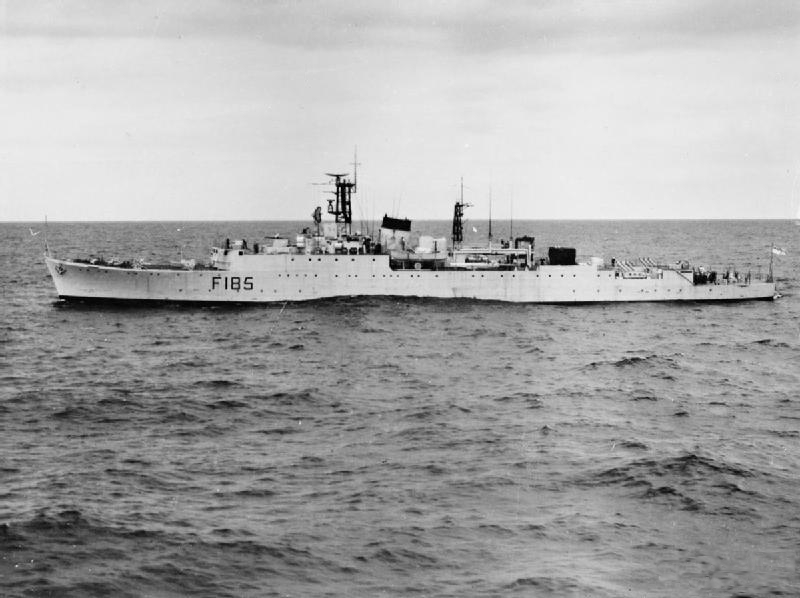
HMS Relentless. She remained active until 1965. Rapid was still active in 1966, Rocket until 1962, and Roebuck in 1962 as well.
The emergency destroyers and their old-fashioned low angle heavy main guns and torpedo tubes were virtually obsolescent by 1949, so decision was taken to convert them as ASW frigates with the first, HMS Rapid, being ready by 1951. In all 23 were converted of all these emergency ships, including HMS Rapid, Relentless, Rocket, Roebuck, Troubridge so all R class, no Q class. This conversion was studied, found practicable, and estimated much cheaper than new, dedicated escorts in these postwar budget-stricken years. The urgent need of fast frigates to counter the new generation of fast Soviet ‘Whiskey’ class submarines indeed could most readily be met by adapting the numerous “Emergency” destroyer hulls. By the late 1940s they were now totally unsuited to modern warfare, as the majority had low-angle guns and primitive fire control. Accordingly, in 1949 plans were drawn up to convert two prototypes, Rocket and Relentless.


Career of the Q class
 HMS Queenborough (G70)

Queenborough was laid down at Swan Hunter on 6 November 1940, launched on 16 January 1942 and commissioned on 15 September 1942. She was assigned to the 4th Destroyer Flotilla (all Q-class destroyers) with the British Home Fleet and in the fall of 1942 until early 1943 she escorted Arctic convoys. On 31 December 1942, she followed Admiral Tovey, covering Arctic convoy JW 51B after the Battle of the Barents Sea. Next she was deployed off South Africa before the 4th Destroyer Flotilla was assigned to Force H by mid-1943. She covered nearly all Allied landings of the Italian Campaign, such as the Allied invasion of Sicily on 10 July, the British landings at Calabria from 31 August to 3 September (with preparatory shelling, 31 August, 2 September) and a week later, she supported the USMC landings at Salerno until 16 September.
Next, she followed the 4th Destroyer Flotilla to the Indian Ocean in March 1944, joining the British Eastern Fleet. By late March she took part in Operation Diplomat. Leaving Trincomalee on the 21st she was part of a 18-ship fleet refuelling 800 nautical miles (1,500 km) south of Ceylon as a deployment test. On 27 March, USS Saratoga joined the fleet, plus three escorts and they were back at Trincomalee on the 31st. From 16 to 24 April she joined TF70 for Operation Cockpit escorting HMS Illustrious and USS Saratoga. After maintenance at Trincomalee she was assigned to TF 66 for Operation Transom, the air raid on Surabaya. She was resupplied from tankers at Exmouth Bay on 15 May before the attack on the 17th. She was back on the 27th.
Queenborough left Trincomalee on 15 October with TF 63 for Operation Millet, a raid on the west coast of Malaya as a diversion for the US Philippines landings. This played as an invasion of Malaya. She was in Group 1 as escort of HMS Renown and shelled Nicobar on 17-18 October. However this failed to attract much reaction from the Japanese as Leyte was still well defended. By late 1944, she was part of the splitted British Eastern Fleet and East Indies Fleet. Herself remained wit the British Pacific Fleet redeployed to the Pacific by November 1944. Her pennant was changed from G70 to D19. From 23 March to 29 May 1945 she escorted the British carriers for the Ryukyu Islands campaign and never sailed back home. Instead, strong of five battle honours including “Okinawa 1945” she was acquired by the Royal Australian Navy as HMAS Queenborough in 1945, and later converted to Type 15 frigate, sold for BU in 1975.
HMS Quadrant G11/G67
 Quadrant was laid down at Hawthorn Leslie on 24 September 1940, launched on 28 February 1942 and completed on 26 November 1942. She was engaged in convoy escort duties in the Arctic, South Atlantic, and Indian Oceans, took part in the North African landings. Later she was transferred and served with the British Eastern and British Pacific Fleets, escorting British aircraft carriers for strikes against Surabaya and the bombardment of the Nicobar Islands. She remaind with the British Pacific Fleet in 1945 for the operations against Formosa (Taiwan), Okinawa, and the Japanese home islands. She was transferred Australia as HMAS Quadrant on 18 October 1945, and used to transport soldiers from New Guinea home to Australia. On 16 August 1947 she was paid off into reserve, and later converted to Type 15 frigate, sold for scrapping 1962.
HMS Quail G45
 Quail was laid down on 30 September 1940, launched on 1 June 1942, commissioned on 7 January 1943. After a December 1942 in trials, then commission on 7 January 1943 she joined the 4th flotilla, Home Fleet at Scapa Flow for exercises. In February she covered the convoys WS27 and KMF10A from the Clyde, the first to the Middle East via the Cape of Good Hope the second to the Mediterranean via Gibraltar. It was planned for her to join the 3rd Flotilla, Indian Ocean and seh departed with Convoy WS27 on 27 February with HMS Malaya and near-sister Raider, Quadrant, Queenborough and Wolverine. On 8 March she was detached to Freetown and stayed there for convoy defence but not deployed in the Indian Ocean but assigned to Mediterranean ops. With Queenborough and Raider she escorted WS27 to Durban, arriving 24 March and back to Freetown in April, then the UK from 29 April with HMS Quality.
She was back at Scapa Flow in May and the next month she was in the Med to cover the landings in Sicily (Operation Husky) via Gibraltar, escorting capital ships, then Malta and underway on 8 July with Nelson, Rodney, Warspite and Valiant, Indomitable and Formidable, Aurora, Penelope, Cleopatra and Euryalus. The destroyer escort comprised the Greek Vasilissa Olga and Polish ORP Piorun. On 14 July she escorted HMS Cleopatra and Euryalus off Sicily for specific bombardments and throughout August, shelling positions on 21 August at the Straits of Messina. On the 31st August she screened Nelson and Rodney, Orion for the preliminary bombardment between Reggio Calabria and Pessaro and on 2 September she shelled positions south of Reggio. 9-16 September saw more screening and gunfire support, alternated with U-Boat and E-boat patrols. In October she was in the Adriatic, based at Bari for escort convoys. On 22 October she captured an axis merchant ship.
On 15 November whilst on patrol there she struck a mine laid by U-453 on 25 October. She was beached to await salvage and by December was towed to Bari for temporary repairs and from January to April 1944 she had temporary to sail to Taranto, towed there only to be returned to Malta and towed there in May but capsized and sank en route in the Gulf of Taranto, 18 May 1944. Her wreck was rediscovered in 2002.
HMS Quality G62
 Quality was laid down at Swan Hunter on 10 October 1940, launched on on 6 October 1941 and commissioned
on 7 September 1942. Bsed in the Med for convoy escorts, then the Indian Ocean in 1943. On 25 July 1944 she took part in Operation Crimson, a raid on Japanese airfields on Sabang, Lhoknga and Kutaraja. With HMS Quilliam, HMS Quickmatch and Dutch light cruiser HNLMS Tromp she entered Sabang to complete the job but was hit by a 3-inch AA shell destroying her rigging, damaging her after-bridge, mast and HA Director, with eight casualties (one mater died) and this was filmed at the time. Her career ended in September 1945 with four battle honours, “North Africa 1942–43”, “Sabang 1944”, “Okinawa 1945”, and “Japan 1945”. On 8 October 1945 she was transferred to the RAN on loan and commissioned on 28 November. Apart Aussies waters she patrolled at Manus Island and New Guinea until paid off into reserve on 25 January 1946 to be converted into a Type 15 Frigate, and definitively acqired in May 1950. However after conversion her general state was found quite bad and she was eventually sold for scrapping in 1958.
HMS Quentin G78
 Quentin was laid down at J. Samuel White on 25 September 1940, launched on 5 November 1941, commissioned on 15 April 1942. Quentin attacked and sank U-162 with HMS Vimy and Pathfinder in the Caribbean Sea, near Trinidad, on 3 September 1942. Quentin and HMAS Quiberon depth charged and sank also the Italian submarine Dessiè off Algeria, on 28 November 1942. She herself was torpedoed by German aircraft, sank off North Africa, on 2 December 1942 with 20 men, a few hours after the Battle of Skerki Bank. Indeed, soon after the beginning of Operation Torch, the Allied command wanted an offensive against the Axis supply route to Tunis and Bizerta and Force Q was created and based at Bône under Rear Admiral Cecil Harcourt around the light cruisers HMS Aurora (flagship), Argonaut and Sirius escorted by HMS Quentin and HMAS Quiberon. On 1st December after an aircraft recce identified a convoy, Force Q ran to intercept Convoy H (Transports KT-1, Aventino, Puccini, Aspromonte escorted by Nicoloso da Recco (flag), Camicia Nera, Folgore, Clio and Procione.). In this battle Quentin notably shelled Aspromonte from 8,000 yd (3.9 nmi) and latter destroyed De Recco.
HMS Quiberon G81
 Quiberon G81 was laid down 14 October 1940, launched on 31 January 1942 and commissioned 6 July 1942, named after the Battle of Quiberon Bay, which occurred in 1759. She started service in the North Atlantic for convoy escort duty from Scapa Flow. She took part in Operation Torch by October 1942 and 28 November, she sank the Italian submarine Dessiè off the Tunisian coast. Assigned to “Force Q” based at Bône (see above) she took part of the Battle of Skerki Bank on 1 December 40 miles (64 km) to the north of Cape Bon after midnight. All four cargos ships and the flagship destroyer were sunk with Quiberon firing the last shot at 01:35 on 2 December on the Lupo, part of the escort of another convoy. Quiberon later evacuated most of the crew of the torpedoed HMS Quentin. On 21 December she rescued survivors from the liner Strathallen.
By January 1943, she escorted a convoy from England to Cape Town and sailed to Victoria for a refit. She then joined the British Eastern Fleet as convoy escort across the Indian Ocean and by July 1943, rescued survivors from Jasper Park (sank by U-177). In April 1944, she took part in Operation Cockpit and in May, Operation Transom, the raids on the Dutch East Indies. After refit in Melbourne, she joined the Eastern Fleet in August and by October took part in the raid on the Nicobar Islands. By mid December she was a convoy escort in Aussies waters and by early 1945, joined the British Pacific Fleet from Manus Island, and the battle of Okinawa and attacks the Ryukyus. She was present in the Allied reoccupation of Singapore, and until February 1946 patroled the East Indies to reestablish Dutch control, move troops, repatriate POWS, ending with eight battle honours. In 1946-1948 she worked with the British Commonwealth Occupation Force and she was later transferred to the RAN, converted to a Type 15 frigate. HMAS Quiberon (G81) was sold for scrapping 1972.
HMS Quickmatch G92
 Quickmatch was laid down on 6 February 1941, launched on 11 April 1942 and commissioned on 14 September 1942 with the RAN. From October 1942 she was a convoy escort vessel in British waters, then South Atlantic, and eventually Indian Ocean. In July 1943 she rescued survivors from Jasper Park sunk by U-177. She covered convoys between the Gulf of Aden and India and by May 1944, joined the British Eastern Fleet. She was in carrier screen during Operation Transom on Surabaya. IN June she covered the raid on the Andaman Islands. In October she had a refit in Australia and remained on local patrol until March 1945. Reassigned to the British Pacific Fleet she took part in the battle of Okinawa and attacks on the Kyushus. She ended the war with six battle honours. Postwar she made several deployments to Japanese and Korean waters, and then around Australia. She was later converted to Type 15 frigate and in service as such until sold for scrapping in 1972.
HMS Quilliam G09
Quilliam was laid down at Hawthorn Leslie laid down on 19 August 1940, launched on 29 November 1941 and commissioned on 22 October 1942, named after Manx Lieutenant (later Captain) John Quilliam RN, First Lieutenant of HMS Victory at the Battle of Trafalgar. She was a convoy escort both in the Atlantic and Pacific (to be completed 2027). On 20 May 1945, she took part Operation Iceberg, the Invasion of Okinawa as part of the BPF when she collided with the British aircraft carrier Indomitable, leaving her with a badly damaged bow. She was still in repairs in Australia when the War ended. She became one of six Q-class to survive with five transferred to the Royal Australian Navy, and Quilliam instead transferred to the Royal Netherlands Navy, on 21 November 1945 as HNLMS Banckert (D801). She was later refitted to Dutch standards with a new bow and saw action during the Indonesian National Revolution, bombardment of Sibolga, occupation of Tegal, a refit back home, and operations in New Guinea until 1951. She was then in the RNLN’s European Training Squadron until paid off in April 1952, struck 19 October 1956, sold fpr BU at Antwerp, 1 February 1957.
Career of the R class
HMS Rotherham H09

Rotherham (after Napoleonic captain Edward Rotheram) was laid down at John Brown on 10 April 1941, launched on 21 March 1942 and commissioned on August 1942 (trials in June). Rotherham trained at Scapa Flow, and was assigned to the South Atlantic escort (Freetown-Cape Town-Durban). By February 1944 she was in the Indian Ocean. In April the Eastern Fleet for the raids on Sumatra and Java nd strikes again the Indian nationalist Azad Hind in the Andaman Islands, escorted aircraft carriers and battleships. In October 1944 she was refitted at Simon’s Town. By early 1945 she carried personnel to the Andaman and Nicobar Islands and supported operations in Burma. In February with Rapid, Rocket, and Roebuck she shelled the Great Coco Island. In April she covered the Rangoon landings, Operation Dracula. Escort went on until 15 August, the Operation Zipper, the liberation of Penang, and Operation Tiderace, escorting HMS Sussex to Singapore for the surrender. Her own commander personally accepted the surrender of 34,000 personnel of the IJN at the Singapore Naval Dockyard, Sembawang. She departed on 27 September 1945 to Trincomalee, then for Portsmouth, decommissioned in Reserve. She sold to India in 1948, transferred 27 July 1949 as INS Rajput (D141), seeing action in the Indo-Pakistani War of 1971 and notably was attributed the sinking of PNS ghazi albeit this is still disputed today. She was scrapped in 1976.
HMS Racehorse H11
 Racehorse was laid down on 25 June 1941, launched on 1 June 1942 and commissioned on 30 October 1942. She took part in operations Balsam and Livery and after the war she was placed in reserve in Portsmouth in 1946. Used as a target/trials ship in Gareloch and sold for BU at Troon from 8 December 1949. To be completed (detailed logs) in 2027.
HMS Raider H15
 Raider was laid down at Cammel Laird on 16 April 1941, launched on 1 April 1942 and commissioned on 16 November 1942. She was part of numerous escort convoy missions like her sisters in the Med, Atlantic and Indian Ocean. Postwar, she was placed in Reserve at Devonport in January 1946, but recommissioned for service in the Mediterranean on 6 May, deployed for Plane Guard duties with aircraft carriers and Fleet exercises back home by August 1947 back to Reserve status. She sold to the Indian Navy in 1948, recommissioned in 1949 as INS Rana (D115) and with Rajput and Ranjit made the 11th destroyer Squadron taking part in the war of 1965 and 1971 and was decommissioned in 1976, scrapped in 1979. To be completed (detailed logs) in 2027.
HMS Rapid H32
 Rapid was laid down on 16 June 1941, launched on 16 July 1942, and commissioned on 20 February 1943. After sea trials she was assigned to the 11th Destroyer Flotilla. She was in convoy escort of Atlantic convoys, via Freetown. By late 1943 she was sent to the Eastern Fleet based in Ceylon. In March 1945 she took part of Force 68 in the Indian Ocean and later Pacific with the BPF. In a bombardment operation she was damaged by a shore battery (11 killed and 23 wounded) towed to Akyab for repairs only completed by August 1945. She was to take part in the landings on Malaya (Operation Zipper) cancelled after the dropping of the atomic bomb. Postwar she saw service as training target ship and attendant destroyer to aircraft carriers. In February 1947 she was based at Rosyth, until converted to a Type 15 frigate in 1951-1953, and spent as target 3 September 1981.
HMS Redoubt H41
 Redoubt was laid down at John Brown on 19 June 1941, launched on 2 May 1942 and commissioned on 1 October 1942. No logs for her WW2 carrer, to be updated in 2027. Between 1946 and 1947 she was in the reserve at Chatham and transferred to the Harwich reserve in August 1947. In 1948-1949 she had a refit at Chatham before transfer to India 4 July 1949, recommissioned as INS Ranjit (D209). In 1953 she took part in the Fleet Review for Queen Elizabeth II’ coronation along with Rajput and Rana and back in India formed the 11th destroyer Squadron. In 1970 INS Karanj was badly damaged after a collision with the Ranjit when surfacing directly below her. Ranjit was undamaged and took part in the Indo-Pakistani War of 1971. She served until 1979, and was scrapped after decommissioning that same year.
HMS Relentless H85
 Relentless was laid down on 20 June 1941, launched on 15 July 1942 and commissioned on 30 November 1942. Relentless was in many anti-submarine escort missions and patrols, convoy escort activities in the South Atlantic and Indian Ocean. To be updated in 2027. Between 1946 and 1949 she was held in reserve at Chatham, then Harwich. From 1949 to 1951 she started a conversion to a Type 15 frigate 1951, active until sold for scrapping in 1971.
HMS Rocket H92
 Rocket was laid down at Scotts on 14 March 1941, launched on 28 October 1942 and commissioned on 4 August 1943. She worked up at Scapa Flow until 2 October 1943 and joined Plymouth Command for patrols against German shipping off Brittany (Operation Tunnel), then relieving HMS Ulster and made four night patrols on 14/15 October and 17/18 October but never caught the blockade runner Münsterland. She took part in the Battle of Sept-Îles escorting the cruiser Charybdis when she was torpedoed. Charybdis sank within 45 minutes, and HMS Limbourne was also torpedoed by remained afloat, so HMS Talybont attempted to tak her under tow but failed. She was scuttled by Rocket and Talybont. On 29 November 1943 Rocket and Tumult sank U-86 east of the Azores. In the 11th Destroyer Flotilla, Eastern Fleet from Trincomalee she started new convoy escort missions from 12 February 1944. On 25 July she took part in Operation Crimson on Sabang, escorting Illustrious and Victorious and shadowing the battleships, cruisers and destroyers, herself shelling a radar station. From 16 to 23 September she took part in Operation Light (raid on Sigli, Sumatra) on 18 September.
On 21–25 February 1945, with Rapid, Roebuck and Rotherham she patrolled the Andaman Sea and bombarded the Great Coco Island on 24 February and 27 February, notably sinking three coasters off Burma on 1/2 March. On 3 March they entered and shelled Port Blair (South Andaman), sinking sailing ships. On 14 May 1945 she ecorted a troopship and detached with Racehorse, Redoubt and Roebuck as a search party to find IJN Haguro. She was found by V-class DDs on 15/16 May. She was planned to take part in Operation Zipper at Port Swettenham and Port Dickson, Malaya on 9 and 12 September 1945, later cancelled with the surrender of Japan. She was sent to Sebang. Bakc home in October 1945, in 1946, she relieved HMS Highlander as air target ship at Rosyth. Placed in reserve on 4 September 1957, by May 1949 in Portsmouth. From November 1949 to July 1951 she was converted at Devonport to a Type 15 frigate 1951, sold for scrapping in 1967.
HMS Roebuck H95
 Roebuck was laid down on 19 June 1941, launched on 10 December 1942 and commissioned on 10 June 1943. She joined the 11th Destroyer Flotilla, Eastern Fleet, worked out at Scapa Flow with the Home Fleet and in August, sailed to Freetown, and arrived in the Indian Ocean in September for convoy defence and patrols. 12 March 1944 saw her escorting the carrier HMS Battler and the cruisers Suffolk and Newcastle, with her near-sister Quadrant, looking for an U-boat supply ship, the “Brake”, which was later discovered and scuttled by her own crew. Later she was in a force off Burma that bombarded Martaban. On 19 June she joined Force 60 with Quality, Quickmatch, Rotherham, Racehorse, Relentless and Raider escorting Illustrious, Renown, Richelieu, and the cruisers Nigeria, Kenya and Ceylon.
On 25 July, she screened Eastern Fleet major units for raids by Victorious and Indomitable p, Sabang and Sumatra, Operation Crimson. In August she was at Simon’s Town for a refit and back at Trincomalee in November. In February 1945 she joined Force 68 for a raid on the Cocos Islands, Operations Office and Training. On 27 April with Force 63 she took part in the landings at Rangoon, “Operation Dracula”. On the 30th with Force 62 she bombarded Matapan in “Operation Gable”. On 1 May she shelled Car Nicobar in Operation Bishop. On 13 May she covered HMS Nigeria from Trincomalee as Force 63 to the Andaman and Nicobar Islands to prey of Japanese shipping. On 18 Juneshe screened the 21st Aircraft Carrier Squadron (HMS Stalker, Khedive and Ameer) escorted by the cruisers Royalist and Suffolk for flights over southern Malaya in Operation Balsam.
On 5 July, she escorted Nigeria, with Eskimo and Vigilant for a minesweeping operation off Malaya-Nicobar and the bombardment of Nancowry. In August, she was prepared for “Operation Zipper” that never took place but instead sailed to Singapore for the re-occupation until and then Simon’s Town in October for a refit. Postwar she was selected for conversion to a Type 15 anti-submarine frigate in 1952 (F195), completed by May 1953 with the 5th Frigate Squadron. She was sold for scrapping in 1968.
Read More/Src
Books
Destroyers of the Royal Navy, 1893–1981, Maurice Cocker, Ian Allan
Connell, G. G. (1982). Arctic Destroyers: The 17th Flotilla. London: William Kimber.
English, John (2001). Obdurate to Daring: British Fleet Destroyers 1941–45. Windsor, UK: World Ship Society.
Friedman, Norman (2006). British Destroyers & Frigates: The Second World War and After. NIP
Lenton, H. T. (1998). British & Empire Warships of the Second World War. NIP
March, Edgar J. (1966). British Destroyers: A History of Development, 1892–1953. London: Seeley Service
Raven, Alan; Roberts, John (1978). War Built Destroyers O to Z Classes. Bivouac Books.
Rohwer, Jürgen (2005). Chronology of the War at Sea 1939–1945: The Naval History of WW2 NIP
Whitley, M. J. (1988). Destroyers of WW2: An International Encyclopedia. NIP
Links
/uboat.net Q class DDs
/uboat.net R class DDs
British Mechanical Computers RN
navypedia.org
en.wikipedia.org
iwm.org.uk
Wikimedia commons photos
gunplot.net
worldnavalships.com type 15 conversion
navweaps.com 4.7-in/45