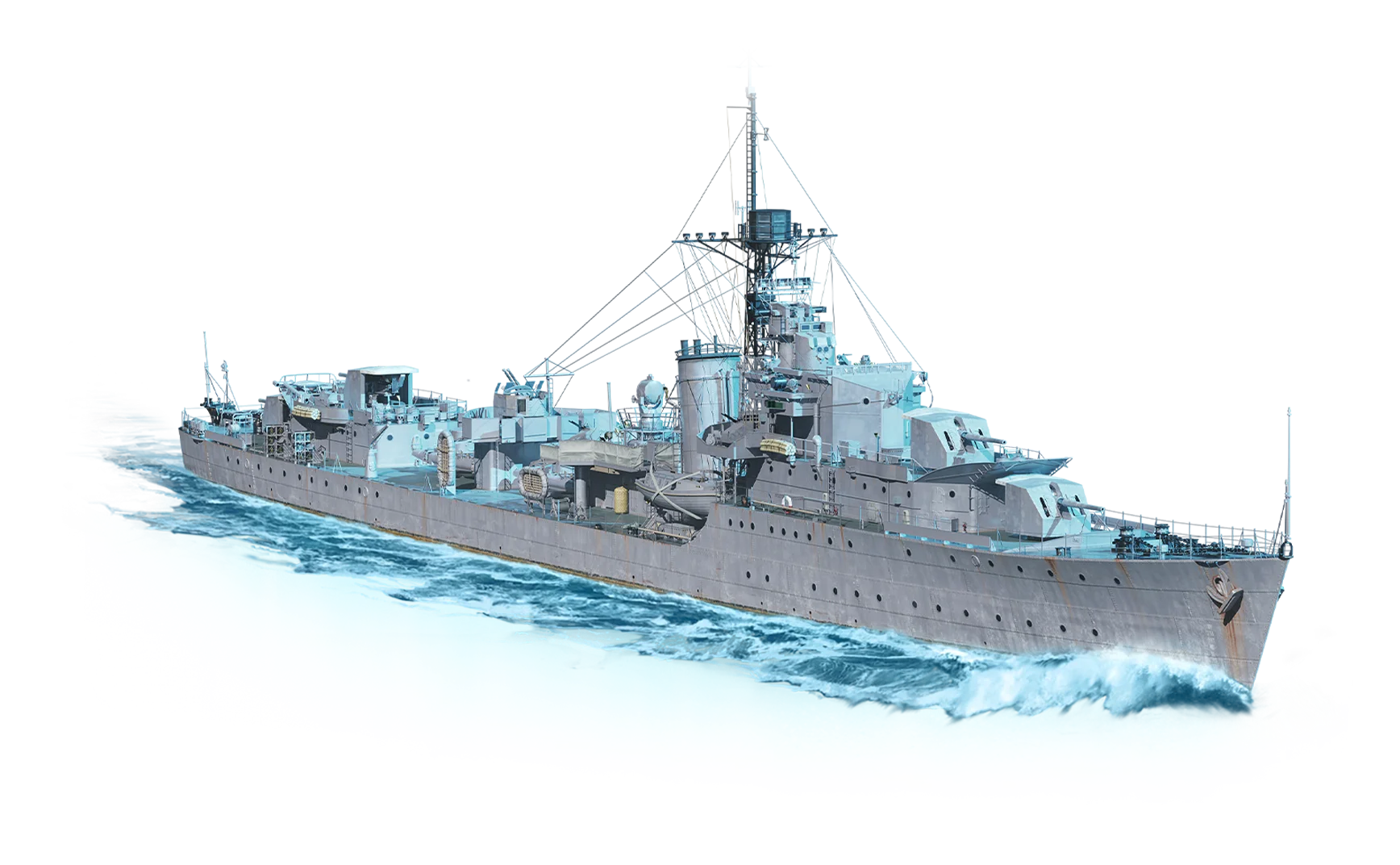
 Royal Navy – Emergency Fleet Destroyer (1942-43):
U class: Ulster, Ulysses, Undaunted, Undine, Urania, Urchin, Ursa, Hardy*
V class: Valentine, Venus, Verulam, Vigilant, virago, Viwen, Volage, Kempenfelt*
The U and V class were sixteen destroyers of the RN, launched in 1943–1944 for the 7th and 8th Emergency Flotilla. They acted as fleet and convoy escorts in World War II, essentially repeats of the S-T clas, themselves quite close to the Q-R classes apart for their armament of four 4.7-inch (120-mm) in new dual purpose mounts, same AA and eight torpedo tubes plus radar, sonar and depth charges. There were “only” a single loss, HMS Hardy, oddly enough a V class used as flotilla leader and renamed to honor an H-class lost in action. Four ships, Verulam, Venus, Vigilant and Virago, formed part of the 26th Destroyer Flotilla, and they entered the annals of the RN by ambushing and sinking the Japanese cruiser Haguro off Sumatra.
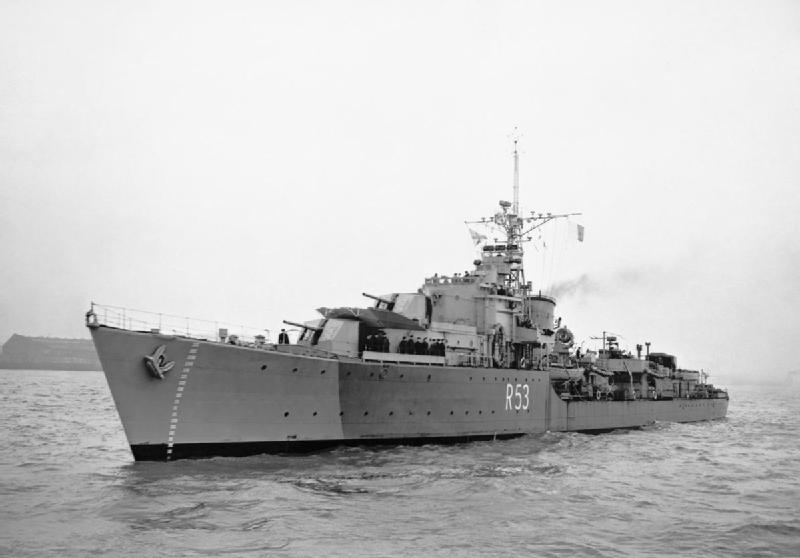
HMS Undaunted
Development
The U/V/W class were the continuation the effort started in 1940 to increase the number of destroyers available for fleet operations and convoy work, called the “the emergency flotillas”. The first of these were the L and M destroyers, that went all the way back to a new design planned in 1936 with twin gun mounts fully enclosed and greater top speed, defined to be of 10 knots above that of the King George V class battleships initially to be capable of 28 knots (52 km/h; 32 mph). Several sketch variants were discussed and compared to the earlier the Tribals, with a 3,200t standard displacement, the one retained in 1937 was a repeat of the J-K-N class but there was still debate about the armament. In between lessons from the Spanish Civil War pushed Vickers Armstrong to propose a newly mounted high angle (HA) variant of the QF Mark XI 4.7-inch, light enough for stabilit at 50° elevation and yet with an array of more powerful shell. Combined with the bridge of H-I classes and clipper bow this gave a first batch authorized 1938 for the 1937 Naval Estimates, eight ships and eight more for the 1939 Naval Estimates, the L and M classes.
Vickers could not produce these new twin mounts fst enough when the war broke out, so the admiralty chose to go back to the alternative design of “Intermediate destroyers” of 1938. Les costly and simpler than the Tribal, but much more capable than the Hunt class escort destroyer they were simplified in construction and armament and intended to replace the WWI V-W destroyer series. The “J” class was retained a as a base, with essentially the same hull and machinery but modified dimensions, redesigned forecastle, sheer for better seaworthiness, typical prismatic bridge, and the alternative armament, classic single 120mm (4.7 in QF) on A/S mount, as well as a pompom 2-pdr AA, quadruple mounts for Vickers 0.5 inches HMGs and quadruple Toproedo tubes and larger Depht charge stowage. When approved in September 1939 the completion planning was FY1941 if practicable. The first eight became the O class, 1st “emergency flotilla”. This quickstarted a large serie of ten of such flotillas, later reduced to seven as the war progress and the situation improved, until 1944.
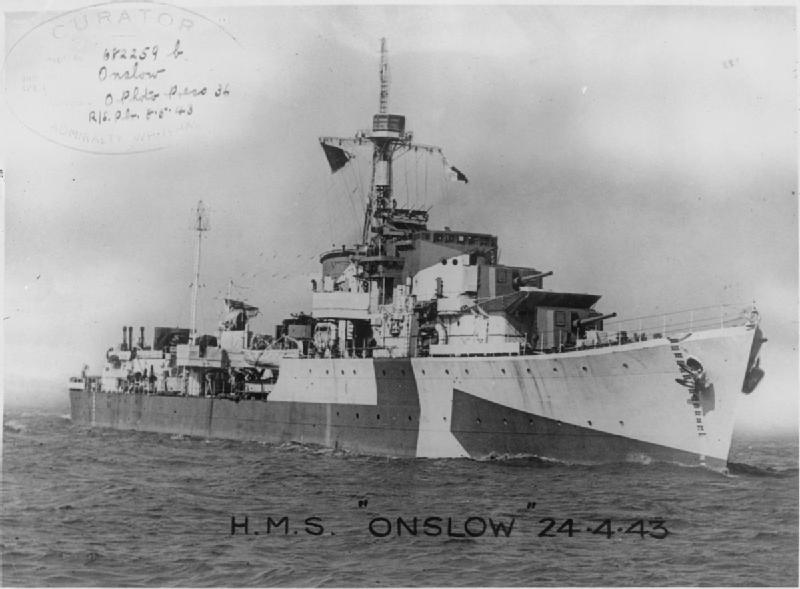
The O class: HMS Onslow in 1943.
The O and P class of the 1st and 2nd Flotillas had main guns fitted with the small shield Mark IX.
The next Q and R class (2nd emergency program destroyers, 3rd, 4th emergency flotillas) ordered in 1940 were a repeat, as the new Dual Purpose mount planned was still not ready.
The next S and T (5th and 6th emergency flotillas) reached 1,700 tonnes but had the same main guns, strong torpedo armament, and this time, had the new HA mount with reworked gun shields for better elevation to face mid-to-low-flying aircraft yet stil efficient against U-Boats, using HE shells were also twice as powerful compared to alternative 4-in shells.
The S class introduced the CP (central pivot) Mark XXII mounting for the QF Mark IX 4.7 in gun. Its shield had a sharply raked front for an elevation to 55 degrees. Like the T class she still used the Fuze Keeping Clock HA Fire Control Computer but their quadruple mounting Mark VII QF 2-pounder pom-pom were replaced by twin mount 40mm Bofors Mark IV instead, judged far superior.
To boot, these had indeed the new “Hazemeyer” advanced tri-axially stabilised mount to keep target in the sights despite a pitching deck. It went with a new analog fire control computer, new Radar Type 282 (metric range-finding set). That combination made them the best AA escort in the Royal Navy at this point, and T class only differered by the replacement of tripod masts by lattice ones, at least for the latter ships, now a new feature of all War Emergency Flotillas.
Specific of the U/V classes
Which brought us to the U, V and W. They were essentially a repeat of the S and T and were even considered as one and same class. However given the number of career destroyers, it was better to split this into two posts, one for the S and T, and one with the U, V and W. HMS Savage of the S class already tested a forward single mark III 4.5 in/45 with a new 80° mounting, faster-firing. But it was not adopted to not delay the constructtion of these new flotillas. Four ships retained their quad bofors, and two had only 20 mm Oerlikon guns. On this matter, the latter ships obtained up to 5 single extra Bofors and up to twelve 20 mm Oerlikon guns and 130 deep charges. The last were completed in 1944. Saumarez, troubridge, Grenville, Hardy, Kempenfelt were fitted as flotilla leaders, they even had names of former ones. HMS Shark was transferred to Norway and sunk by an E-boat, hardy by an U-Boat, Swift hit a mine. Valentine and Vixen joined the RCAN, three were transferred to the Dutch navy, one went to Norway, two to Yugoslavia, Three to South Africa after the war.
The U/V classes reproduced the O and P class hull, with the same sheer and details, same clipper bow, same forecastle proportions, same bridge, accomodations, ect to spare time and accelerate construction. The shipyards at play all had been briefed about the new mounts Mark XXII dual purpose and reinforced their base, modified the supply chain. The fact they elevated at 55 degrees oblinged modification to avoid hitting the deck with their recoil with a “seawater pit”. They also had an extended shield with a seabreaker and scoops to evacuate extra seawater. The amidship AA mount was now a pair of twin mounts 40 mm with Bofors Hazemeyer. The only major external difference was the systematisation of the lattice mast instead of a tripod, but also for the U-V class, a slightly different bridge and armament fit. The mast structure was heavier, but also sturdier in order to support radars that were grew larger and more powerful every year. This planned also for the future, giving margin for future upgrades. The crew no longer amounted to 180 men but rose to c200 or even close to 230 in 1945, and that was true for the flotilla leaders as well.
Naming
On that chapter, two ships of their respective 7th and 8th flotillas were renamed while in construction to honor lost destroyers, the first being HMS Grenville, a G-class, to lead the U class, and Hardy, same, for the V-class. The W class (more on them in an update) also had its flotilla leader namled after a lost destroyer in action, the C class flotilla leader Kempenfelt (also named after one lost in WW
1) continuing an old tradition. Like any destroyer class it seems PM Sir Winston Churchill was personnally behind these choices, never dropping his old habits.
Construction
Swan Hunter, Tyneside: Grenville (flotilla leader), Ulster 1941-1943, Vigilant, Virago 1942-43
Cammell Laird, Birkenhead: Ulysses, Undaunted 1942-1943, 42-44. Ursa 1942-44
John I. Thornycroft and Co. Woolston: Undine 1942-43
Vickers-Armstrongs, Barrow: Urchin, Urania 1942-43/1944.
Fairfields of Glasgow: Venus, Verulam 1942-1943.
John Brown & Co. Clydebank: Hardy (flotilla leader) 1942-43. Valentine 1942-1944, to Canada as HMCS Algonquin.
Samuel White, Cowes: Vixen (as HMCS Sioux), Volage 1942-1944.
Design of the class

Profile of HMS Grenville, U class flotilla leader
The main difference was for last 16 ships of “V” and “W” classes, which differed by their Arctic equipment, intended for the arctic convoys. On the “V” class, it was demounted early 1945 to be sent to the Pacific. The W class were the first to introduce a new fire control system but only three T class did not received Hazemayers mounts, in short supply. All U, V, and W had theirs.
Hull and general design
The U-V class were larger than the S and T class, at 1,777 long tons (1,806 t) standard and 2,058 long tons (2,091 t) full load versus 1,710/1,730 long tons standard, 1,780/1,810 long tons fully loaded.
This was quite substantial and even jumper to 2,545 long tons (2,586 t) for the W class. They were significantly heavier from c150 tonnes despiote having the exact same DP mounts and Bofors. Stability was still apparently sufficient. Now, in dimensions they reached 363 ft (111 m) overall, versus 362 ft 9 in (110.57 m) on the previous ships. The beam was however unchanged at 35 ft 8 in (10.87 m) and the draught was of 10 feet (3 meters) standard and likely aroind of 14 (4 meters) mean. Engineers did the same as the former class, just elongating the hull a bit to regain buoyancy and improve on speed.
Powerplant
This was a “rince and repeat” scheme essentially. The U-V like the S and T class had the same 3-bladed bronze propellers driven by two Parsons geared turbines with HP and LP stages, fed in turn by two Admiralty 3-drum boilers for a total of 40,000 shp (29,828 kW), for a top speed officially of 36.75 knots (42.29 mph; 68.06 km/h) helped by the slightly better hull ratio. Range was based on a 588 tons of fuel oil as standard, for 4,860 nmi (9,000 km) at 20 kn (37 km/h). Of course in service, that speed was often way inferior, especially depending of sea conditions, notably in the North Atantic and Arctic, in particular in winter, dreadful conditions. The V and W in particular had been tailored to deal with these arctic conditions, there was
Armament
The U and V class shared the same armament as the previous S and T class, four QF Mark IX 4.7 in gun on Mark XXII mounts with new shields, and a twin Bofors 40mm/56 Mk VIII. They had also two twin and two single 20mm/70 Oerlikon Mk II/IV, and two quad 533mm Torpedo Tubes Banks as well as four DCT, and two DCR (for a total of 130 Depth Charges).
There were differences through: Ulysses, Volage, Whelp, and Wessex were completed with a quad 40mm/39 2pdr pompom QF Mk VIII, compensated by four twin 20mm/70 Oerlikon Mk II/IV due to the shortage of Bofors with the Hazemeyer mount.
BL 4.7 inches/45 QF Mark 9/ Mark 22 Mount

The original Mark 9 prototype was mounted on HMS Mackay and was still present on W class destroyer and foreign ships. The original squared shield mount was only able to elevate to 40° elevation. The S and T class introduced the new DP Mark XXII mount. The latter also called CPXXII had an elevation from -10° to +55°. It weighted 11.58 tons or 11,766 kg versus 9.54 tons for the CPVII. The shield was 0.375 inch or 9.5 mm and it weighted 1.813 tons or 1,842 kg overall. The increase in weight was due to the reduced recoil length requirement (beefier, longer coils and hydraulic dampers), stronger structure overall, and this required strengthening of the ship’s structure around the gun mounts. The gun recoil was 18 in (45.7 cm) compared to 26.5 in (67.3 cm) on previous mounts. The best traverse was for “X” position superfiring aft at 360 degrees. The forward B mount was limited by the bridge despite its prismatic shape.

Main Gun aft shield on HMS Grenville deployed for sweeps in the Bay of Biscaye and Channek in July 1943 (IWM). Note the tarpaulin at its end.
Specifications 4.7-in/45 QF Mark IX
Gun weight 2.963 – 2.984 tons (3,011 – 3,032 kg), 220.62 in (5.604 m), bore 212.6 in (5.400 m).
Rate Of Fire on the CPXXII single Mounting was 10 – 12 rounds per minute with trained gunners.
Shell: HE 50 lbs. (22.68 kg) or SAP 15 in (38 cm), same weight.
Muzzle Velocity 2,650 fps (808 mps). Typically these destroyers carried 200 SAP rounds and 50 HE rounds plus 50 star shell per ship.
Range at 55° was well above 19,000 yards (17,373 m) with the HE shell. Armour penetration (AP) was 2.5″ (63 mm) at 6,500 yards (5,950 m).
40 mm/60 twin Mark IV Hazemeyer

The legendry AA ordnance that ruled the skies for the allies in WW2 had its origin in the interwar. The first order for the “real” L/60 was made by the Dutch Navy, ordering five twin-gun mounts for the cruiser De Ruyter in August 1934. They were stabilized by the Hazemeyer mount, a revolutionary set of layers aimed the gun with a second manually stabilizing the platform and they were all coordinated on a single target at once by a single fire-control system. United Kingdom took out a license but it took time before the Mark IV was standardized.
On the U, V class, they were installed on the same spot the former pompom was for the best arc of fire, on a banstand aft of the funnel and between the two torpedo tubes banks. This tri-axially stabilized twin mounting “Hazemeyer” had an on-mounting fire control, and depended from a Radar Type 282 for initial range information. Water-cooled it existed in left and right versionU, V, Wype D (left) and E (right). Many were later converted to the Mark XI standard, Mark V mountings. 484 Mark IV produced total. However the shortage of Hazemayers affected the T class, with only three ships entering service with them.
Specs
Barrel length 2.25 m (7 ft 5 in). Mount 9,800 to 13,000 lbs (4445-5897 kg).
Shell 0.9 kg (2 lb 0 oz) 40×311mmR 40 mm (1.57 in).
Action: Automatic extraction and integrated cam-operated recoil powered autoloader
Breech: Vertical sliding-wedge
Elevation −5°/+90° at 55°/s and full 360° traverse in 50°/s.
Rate of fire 120-140 rounds/min, decreased with elevation.
Muzzle velocity 850–880 m/s (2,800–2,900 ft/s)
Maximum firing range7,160 m (7,830 yd)
Crew: 5: 1 Gunner traversing, 1 elevating, 2 loaders, 1 pointer.
20 mm/70 twin Mk II/IV

They were located amidship, one either side of the projector aft of the funnel, and two on sponsons wings at the bridge forward. This was a compact, unshielded, hydraulically operated twin-gun mount that differed from the US twin mounts. The gun itself was called the 20 mm/70 (0.79″) Mark II in twin mount. It was ready in 1941, with a Mark IX mount and later XIA and XIIA, all manual. The Twin Mark V weighted 1.228 tons (1.248 mt).
Specs
87 in (2.210 m) barrel Bore 55.1 in (1.400 m), Rifling 49.1 in (1.246 m)
Rounds: HE 0.272 lbs. (0.123 kg), HE-I, SAP. Full round 7.18 in (18.2 cm) long
Propellant 0.063 lbs. (0.029 kg) NC flake or tube
Elevation -5 / +85 degrees
Working pressure 20 tons/in2 (3,150 kg/cm2)
Muzzle velocity: 2,770 fps (844 mps) new, down to 2,725 fps (835 mps) used barrel (life 9000 rds)
Cyclic 450 rpm x2, practical 250-320 x2 or 2,560 rpm for all four twin mounts combined.
Range at 35.32 degrees 4,734 yards (4,329 m).
Mark IX** Torpedoes

Two quadruple torpedo tubes banks aft amidships, placed on a deck top plaform, reloadable thanks to cranes. These destroyers like their predecessors used the Mark IX. The Mark IX design started in 1928. It was first deployed in 1930, and the design being considerably improved until 1939. The Mark IX was a larger and longer-range Mark VIII essentially. It kept for propulsion a very similar four-cylinder radial kerosene-air burner-cycle propulsion system and replaced the Mark VII in most RN ships in WW2. The main version used from 1940 was the Mark IX**, first issued to J- and K-class destroyers in 1939. In 1943 it was decided to further improve the Mark IX** by lengthening it by 12 inches (30.5 cm), and the weapon mass limit to 4,000 lb (1,800 kg), up to the capacity of torpedo tubes and ships under construction. Nitromethane-augmented propulsion was considered, but its implementation required too many alterations to be practical. The Mark IX*** took up the extra space by enlarging the warhead to 930 lb (420 kg) of Torpex. Sources diverged on their deployment but they only arrived by the end of the war in 1945, by which time the enlarged warhead became unnecessary. But the Mark IX** remained in service throughout the 1960-70s. Note that HMS Tumult had two experimental fixed torpedo tubes instead of the first bank, soon after completion until removed and replaced by regular TT bank after trials.
Specs
Specs 21 inches Mark IX** (1939)
Weight: 3,732 lb (1,693 kg)
Length: 286.5 in (7.28 m)
Explosive Charge: 810 lb (370 kg) Torpex
Range and Speed settings: 11,000 yd (10,000 m) at 41 kn (76 km/h), 15,000 yd (14,000 m) at 35 kn (65 km/h)
Power: Wet-heater
Depth Charges

The usual set comprised from two to four Mark II Depth Charges Throwers (DCT) aft on the poop deck, facing either side, and one or two Depth Charge Racks (DCR) at the stern. Each carried five charges but they were railing to the aft superstructure for a total storage of 40 more DCs. Reload was made by hand, using winches, always a dangerous task with a rolling deck washed by waves. These depht charges were of the standard British type, meaning it was the Mark VII: In entered service in 1939, weighted 420 lbs. (191 kg) and carried a 290 lbs. (132 kg) TNT with a sink Rate or Terminal Velocity of 9.9 fps (3.0 mps) with a max setting at 300 feet (91 m) later 500 feet (182 m).
It’s possible they were later upgraded to the the Mark X (1944) and the Mark X*. The X** was not introduced in service in 1945 despite its great depth (down to 1,500 feet (457 m)). Squid and Hedgehog made them obsolete. There are doubts also if the Mark VII Heavy studied from 1940 and proper to depth charge launchers were used aboard, outside experimentally. Weighting 420 lbs. (191 kg) with a 290 lbs. (130 kg) TNT charge, they had a sink rate/terminal velocity of 16.8 fps (5.1 mps) and a 300 feet (91 m) max setting, helped with a 150 lbs. (68 kg) cast-iron weight attached. The idea was to reach the U-Boat faster, and it was claimed it could split open a 0.875 inch (22 mm) hull at 20 feet (6.1 m), or force to surface at 12 m or more. The game changer was a minol charge (1942) for better results, with a 30% increase.
Fire control: Fuze Keeping Clock HA Fire Control Computer
 The Fuze Keeping Clock (FKC) was a simplified version of the High Angle Control System analogue fire control computer. The FKC MkII was installed first on the 1938 Tribal class, later variants on destroyers such as the J/K, L/M, and O/P and Q/R which still had the Fuze Keeping Clock HA Fire Control Computer. The FKC MkII was a non-tachymetric anti-aircraft fire control computer, able to accurately engage targets flying at 250 knots (460 km/h; 290 mph). The Mk V Fuze setting tray was combined with a 4 in (102 mm) anti-aircraft (A/A) round and the fuze timing data was received via electrical signals from the FKC, displayed on a dial. The operator matched these settings on the tray’s own dial, adjusting the clockwork in the A/A warhead to the calculated flight time.
Sensors
Grenville, Ulysses, Undaunted, Undine, Ursa, Hardy, Vigilant and Kempenfelt shared the same type 272, type 285, type 291 radars and type 144 sonar. Earlier Urchin, Ulster, Urania, and other V and W ships diverged by their type 276 radar, remainder identical.
Type 272 Radar
Peak power 90, Frequency 2,997 MHZ. Wavelength 100mm, introduction in 1941. A version of the Type 271 with a cable-drive and more powerful receiver allowing the antenna to be mounted remotely from the radar office. Was not considered successful and not widely used.
Type 276 Radar
Combined the electronics of the Type 277 and the stabilized mounting of the Type 273. Reduced 4-foot (1.2 m) antennas in aerial outfit AUS. Peak power 500 kW. Frequency 2,997 MHz, Wavelength 100 mm. In service by 1944.
Type 285 Radar
Ranging set for anti-aircraft fire control, fitted to HACS directors and rangefinder-directors and used ranging panel L12. Type 285 with six element Yagi antenna with separate Tx/Rx. Type 285P with five element Yagi antenna with combined Tx/Rx function. The Type 285M could provide accurate ranges via the mechanical ranging panel, L12, and bearing information using lobe switching, but height finding was primitive and had to be calculated using maximum signal indication. As such it could not achieve a target lock, and could not offer blind fire capability. Type 285P introduced a Precision Ranging Panel and had 25yd RMS range accuracy. The 285P had a peak power of 150 KW, Frequency 600 MHZ, 50 cm wavelenght. Introduced in 1942
Type 291 Radar
Metric air warning sets. Original Type 291 had a hand-steered antenna, replaced by Type 291M with power training and plan position indicator. Peak power 100 kW. Frequency 214 MHz. Wavelength 1,400 mm. In service by 1941.
Type 144 Sonar
From 1943, range 2500 yards (2300 meters) to 3000 yards (2700 meters), integrated into the fire control and coupled with Hedgehog. 1st with bearing recorder, automatic scanning, turning 5 degrees after each ping, often coupled with the Type 147 “Sword” depth finding sonar with a beam steerable vertically. Also coupled with the Q attachment reducing the under hull blind spot. 60° deep vertical beam, trained with the main Type 144 transducer.
Wartime Modifications
In 1945, Urchin saw the removal of her pair of twin 20mm/70 AA guns for a single twin 40mm/56 Bofors Mk VIII/IX, far more efficient in the Pacific. In 1945, Volage lost all four twin 20mm/70 for six single 40mm/56 Bofors Mk III and Verulam lost two twin Oerlikons for four single Bofors Mk III. On V-Day, HMS Grenville, Ulster, Undaunted, Undine and Ursa typically had all a twin 40mm/60 Mk IV Hazemeyer, four twin 20mm/70 Mk V, and the type 276, type 285, type 291 or type 293 radars as well as the type 144 sonar. Urania had however four Bofors 40mm/60 Mk III instead of the Oerlikon and same sensors. Ulysses had a quad Bofors 40mm/39 Mk VII, four twin 20mm/70 Mk V.
Coldwar Modifications
In the late 1950s, early conversions saw the removal of the two 21-in (533mm) TTs. In 1952, Verulam, Vigilant, Virago, Volage, and by 1953, Ulster, Ulysses, Venus, in 1954, Grenville, Undaunted, Undine, Urania, Urchin, Ursan and in 1956, Algonquin, in 1957 Troubridge were all converted as Type 15 frigates. Grenville and Undaunted in addition were furtyher modified to receive a flight deck for a Wasp helicopter.
Appearance
The U and V class destroyer had the late simplified “western approaches” pattern of curves in light blue, dark blue and dark greys.

⚙ U-V specifications |
|
| Displacement | 1,777 long tons standard, 2,060 long tons deep load |
| Dimensions | 363 ft x 35 ft 8 in x 10-14 ft (111 x 10.87 x 4.3 m) |
| Propulsion | 2 shaft Parsons geared turbines, 2 Admiralty 3-drum boilers 40,000 shp (30,000 kW) |
| Speed | 36.75 knots (42.29 mph; 68.06 km/h) |
| Range | c4500 nm/20 kts |
| Armament | 4× 4.7-in QF Mk IX, twin 40mm Bofors, 2×2, 2×1 QF 20 mm Oerlikon, 2×4 21-in TTs, 4 DCT, 2 DCR |
| Sensors | Type 282, 290 radar, Type 140 sonar, see notes |
| Crew | 180-225 |
Destroyer Leaders:
 HMS Grenville (ii) (R 97)

Grenville was designated flotilla leader of the 7th Emergency Flotilla whe ordered on 12 June 1941, then laid down at Swan Hunter, Tyneside on 1 November, launched on 12 October 1942 and completed 27 May 1943. Usual practice would have been for her to catrch a “U” name in 1941, but in between it reverted to an earlier practice, naming the flotilla leader after a prominent historical seaman. In that case it was Vice Admiral Sir Richard Grenville, an Elizabethan soldier and sailor, and the name of a former destroyer lost in action, of the G class, lost in January 1940 after stricking a mine outside the Thames Estuary. The new HMS Grenville by late August 1943 teamed up with the Canadian destroyer Athabaskan, covering the Canadian 5th Support group assembled off north-west Spain. They were attacked by 19 Dornier Do 217s using Henschel Hs293 A-1 glider bombs and Athabaskan was hit and heavily damaged, the sloop Egret sunk with all hands. The U-boat hunt was abandoned and the ships went back to port. September-October saw Grenville involved in a series of blockade runner sweeps along the French coast, called “Operation Tunnel”.
On 4 October 1943, she took part in one of these chance encounters, a naval clash with German destroyers. She was hit, with calualties casualties. After repairs in October in another sweep with the cruiser Charybdis and other destroyers as part of “Operation Tunnel” she met the escort of a blockade runner off the north coast of Brittany. Charybdis and Limbourne were sunk by German Type 1935 torpedo boats.
In November, Grenville joined the 24th Destroyer Flotilla in the Mediterranean, supported the Anzio landings. She sunk an S-boat sent in attack, and destroyed a train near San Giorgio along the Adriatic Sea. On 3 December, after refuelling, she arrived on Bari after an air raid causing a mustard gas disaster. In May 1944, she was back home, was prepped for D-Day cover and in June took part in the Normandy landings, es asecort and then as part of a shore bombardment unit.
By late 1944 after a refit on the Humber she was reallocated to the Indian Ocean and British Eastern Fleet. In January 1945 with three other U-class destroyers she was in the 26th Destroyer Flotilla. She was tasked to escort the British carrier force (Task Force 63), later renamed and reorganized as the British Pacific Fleet (BPF). She was part of the raids against Japanese installations on Sumatra and took part in the operation on Okinawa, after a stop at Sydney. There, she supported British air strikes on Japanese airfields as part of “Operation Iceberg”. Later she took part in the final raids on the Japanese home islands. Grenville was used to relay commercial programmes from 2KY Sydney in January 1946 to the troops deployed in Japan. She was pat of the 25th Destroyer Flotilla in the Pacific and placed in reserve in Portsmouth. In 1951 she wa sin the Plymouth Local Flotilla, used as air training targetbut collided with the Italian ship Alceo. Se was converted as Type 15 Frigate in 1953-54.
HMS Hardy (R 08)

HMS Hardy was ordered as flotilla leader (see the naming changes above) for the V-class. She was laid down at John Brown & Company, Clydebank on 14 May 1942, launched 18 March 1943, completed 14 August 1943. While escorting Convoy JW 56A she was torpedoed and damaged in the Arctic Ocean by U-278 on 30 January 1944, with the loss of 35. Th remainder were saved by nearby HMS Venus and HMS Virago. Her wreck was scuttled by a torpedo. HMS Virago damaged her bow in heavy weather when trying to board Hardy. She had to be later repaired by Russian workers in Murmansk.
 Canadian Ships:
 HMCS Algonquin (R 17)


HCMS Algonquin underway in northern waters in 1944 (top), bottom: gun crew cleaning her main 4.7-in guns between firing missions on the Normandy gunline, June 1944 (AWM). Note the size of the spent cartridges and imagine the weight to carry for the loaders of each full round.
HMCS Algonquin was a V-class, HMS Valentine (R17) laid down for the Royal Navy on 8 October 1942, launched on 2 September 1943 and commissioned on 28 February 1944, but transferred to the Royal Canadian Navy. Her marking operations were to escort British aircraft carriers during the air raids on KMS Tirpitz in March 1944. In June, she also provided naval gunfire support for the Normandy landings. As the war was about to end in Europe, the Mediterranean and the Atlantic were allied lakes, so she was sent to participate to the Pacific Campaign. However the war ended before her arrival. She was converted in 1953 to an ASW frigate and remained active in the Atlantic until being paid off in 1970.
HMCS Sioux (R 64)

HMCS Sioux was a V-class destroyer laid down at J. Samuel White, Cowes on 31 October 1942, launched on 14 September 1943 as HMS Vixen for the British Royal Navy but transferred to the Royal Canadian Navy before completion and named after a people of Canada’s western provinces. This transfer displeased the inhabitants of Kirkcaldy, Fife which adopted Vixen by January 1942. After completion on 5 March 1944 she joined the 26th Destroyer Flotilla, Home Fleet, at Scapa Flow with her sister Algonquin. On the 29th she covered convoy JW 58 sailing to Russia. On 3 April,she screened British aircraft carriers that attacked Tirpitz, anchored at Altenfjord in Norway. The same group also attacked shipping along the Norwegian coast. Ths was “Operation Tungsten”. On 26 April, she took part of the screening of the carrier group that made strikes on German shipping off the coast of Norway as well as in May 1944.

KMS Tirpiz as she was in the Altafjord in March 1944
On 15 May, the 26th Destroyer Flotilla started training in preparation for Operation Neptune, the naval phase of the Normandy landings. On 28 May, she sailed to Portsmouth as part of her deployment. She was sent to Juno Beach and there, she bombarded shore batteries for 40 minutes, followed by constant fire support all day, and the following. 10–11 June, Sioux and ORP Krakowiak sailed to intercept a German flotilla of schnellboote off Le Havre. On 23 June she shelled troop concentrations close to the River Orne and silenced a battery of field guns. The next day with her sister Algonquin she attacked a German battery near Franceville. This was her last mission off Normandy. She returned to Scapa Flow in July. In August 1944, Algonquin and Sioux escorted the carrier force raiding the airfields at Gossen in Norway, followed by another raid on Tirpitz. In September, she screened another raid on German shipping off Norway. Next this was ecorting a convoy sailing for Russi and when back, she had two merchant vessels torpedoed in her group. On 14–15 October she escorted another raid of air-mining Norwegian on Axis shipping and off Frohavet. Same on 26–28 October, escorting Implacable in “Operation Athletic”.
In early November she had a boiler cleaning and returned with Implacable for more raids in late November. Back to Scapa Flow, she escorted four convoys to the Murmank and fr 7–14 December, she screened the carrier force deployed in support of the convoy RA 62. On 30 December she escorted convoy JW 63 to Kola Inlet on 8 January 1945 and returned to Loch Ewe on 21 January with convoy RA 63, in a gale with winds at 85 knots (157 km/h; 98 mph) and drifting ice. The convoy fell apart. Sioux was sent to round up stragglers and helped rescue men from a disabled merchant and soon three more. She recovered and brought them all into the Faroes. On 6 February she was with convoy JW 64, under combined U-boat and air attack, arriving on 13 February (One corvette sunk by 13 German aircraft down). Next she escorted convoy JW 64 to Polyarny and departed on 14 February with a relief expedition for 500 inhabitants of Sørøya to safet with HMS Zambesi, Zest and Zealous. They embarked on ships of the return convoy RA 64 which Sioux joined on 17 February, under combined U-boat and air attack. Two freighters and one escort went down, another was severely damaged. On 12 March she was with convoy JW 65, attacked on 20 March. She was back with convoy RA 65, on 31 March 1944.
She sailed to Halifax on 6 April for transfer to the British Pacific Fleet after a major refit dragging on at Halifax until November 1945. The was was over. She was transferred to the west coast and paid off on 27 February 1946 at Esquimalt, but was fully modernized and recommissioned in 1950 with less artillery and two Squid ASWRL and by March she escorted the cruiser Ontario and destroyer Cayuga for a training cruise to Mexico. After start of th war in Korea, Canada ordered three destroyers from CFB Esquimalt. Sioux was in dry dock and the refit was rushed, so she could depart with Cayuga and Athabaskan on 5 July for Sasebo on 30 July. They joined Task Force 96.5, escorting convoys from Japan to Pusan. She helped in rescue missions in August and was transferred to TU 96.53.3, west coast of Korea. There, she was called to shell Popusompu on 20 August, followed by Te bu Somu with HMS Kenya and Cayuga and secired the landings at Inchon in September 1950 with TF 91.2, escorting the logistic support group. She shelled Wolmido Island. On 20 October she entered TG 95.1, being part of the blockade force on the west coast and back to Sasebo. She left Sasebo on 5 November 1950 for Hong Kong. However through Typhoon Clara, being damaged. She was back in blockade duties around Inchon and the Yalu River in TE 95.12.
On 3 December 1950 she covered the withdrawal of combat units from Chinnampo, escorting transports into the harbour, providing gunfire support. However by making her way up the channel by night she ran aground. She was able to get clear and accompanied HMAS Warramunga concluding the withdrawal next day. Next she screened HMS Theseus, in various missions and the evacuation of Inchon, back to Sasebo on 2 January 1951 and returning home on 15 January, relieved by HMCS Nootka. She made two more tours of duty in the Korea and became even the last Canadian ship leaving these waters. In 1953 she took part in the Fleet Review for Queen Elizabeth II. Uesd for training she was paid off on 30 October 1963 (pennant 225 until 1963). In November 1959 she was fuly converted as an ASW frigate. In 1965 she was paid off, sold for BU, towed to La Spezia. Chatham’s Royal Canadian Naval Association acquired her bell, used for baptisms.
Cold War Conversions: Type 15

HCMS Crescent as a type 15 Frigate
Some ships in class had been converted postwar into type 15 ASW frigates such as HMS Greenville. Indeed, after the end of the Second World War, the the Cold War started a shortage of fast anti-submarine escorts to deal with the latest Soviet fast subs led to use the recent War Emergency destroyers, convert into fast escorts as a stop-gap solution until new-build ships would arrive like the Type 12 frigates and successors. The Type 15 were considered ‘first-rate’ anti-submarine co,version compared to more austere type 14 conversions. Tey had a similar equipment as the new frigates, superstructure and armament entirely new, forecastle extended rearwards, low and wide superstructure fitted to deal with bad weather in the north atlantic, reduced gun armament and AA and same anti-submarine armament as the Type 12s. Grenville for example had two Limbo anti-submarine mortars directed by Type 170 and 172 sonar. For Greenville carrer, see the Type 15s. Other conversions included HMS Ulster,
Career of the U class:
HMS Ulster (1942)
 Ulster (H83), after the Irish county, was ordered from Swan Hunter, laid down on 12 November 1941, launched on 9 November 1942, and completed on 30 June 1943. She served in the English Channel and by the fall, transferred to the Mediterranean and Adriatic on ASW patrols. She was damaged by return fire and in April 1944 she was back in home waters. By the fall of 1944 she was in refit, with a new radar and advanced warning systems. In early 1945 she was transferred to the British Pacific Fleet, receiving the pennant “D” so D83. She had a near miss from a Japanese kamikaze and 500 lb bomb in Operation Iceberg, the battle of Okinawa. Her machinery spaces were blown and she was heavily flooded, saved from capsizing by the Australian corvette HMAS Kalgoorlie that supported her listing hull and passed on cables to prevent her to roll over. She was brought that way to Leyte for temporary repairs, completed in Australia. The attack had her loosing her first casualties of war, two sailors and one seriously injured. Funreals were conducted in Leyte Gulf. Six months later in October 1945 Ulster she returned home and entered HM Dockyard in Chatham for full repairs. Postwar she was used as a training vessel and placed in reserve. 1953-1956 saw her conversion into a Type 15 frigate at Chatham. See the type 15 for more. She was sold for BU in 1980.
HMS Ulysses (1942)
 Ulysses was laid down at Cammell Laird, Birkenhead, on 14 March 1942, launched on 22 April 1943, and completed on 23 December 1943. She entered the 25th Destroyer Flotilla, Home Fleet and started a campaign of Arctic convoys. In June 1944 she was deployed in Normandy, escorting ships and providing naval gunfire support. In late 1944-early 1945 she was refitted for the Far East and in March 1945 left home via Gibraltar, Suez, Colombo and Ceylan, for the British Pacific Fleet. Her service was completed and she returned home in 1946, placed in reserve. From 1946 to 1951 she remained in reserve at Devonport. In December 1951 she was recommissioned at the Plymouth local flotilla but in reserve again in 1953. 1954-1955 saw her conversion as a Type 15 anti-submarine frigate at Devonport. Recommissioned on 18 October 1955 she joined the 6th Frigate Squadron, Mediterranean/Home Fleet. She took part in the Suez Operation and in 1958 “Operation Grapple”, the nuclear tests off Christmas Island. On 27 October 1958 she collided with HMS Undine off Ushant. In 1960 she became a training ship, Plymouth local squadron. In December 1960 she entered the Devonport reserve. She was decommissioned in 1963, but in 1966 still in reserve, accommodation ship for the establishement HMS Danae in 1967, until stricke, sold for scrapp at Plymouth in 1970.
HMS Undaunted (1942)
 HMS Undaunted was ordered from Cammell Laird, laid down on 8 September 1942, Launched on 19 July 1943 and commissioned on 3 March 1944. After a quick work up at Scapa Flow, she joind the fleet intended to sink the German battleship Tirpitz in the Norwegian Altenfjord. She screened carriers in the North Cape, Furious, Victorious, Emperor, Fencer, Searcher and Pursuer, battleship Anson, cruisers Belfast, Jamaica, Sheffield, Royalist and several destroyer. The raid scored 14 hits. She then took part in the D-Day landings, Task Force G, covering the Roger section at Sword Beach. She hosted General Dwight D. Eisenhower from the fast mine laying cruiser Apollo, grounded. General Eisenhower and Admiral Ramsay sailed back to Portsmouth. Eisenhower flag became a Wardroom “Trophy” until 1969 until presented at the National Trust for Scotland in ceremony at Edinburgh. After D-Day, she was sent to the Mediterranean, escort convoys in and out of Malta. She visited Bari, Brindisi and Taranto, bombarding the Coast Road by Ancona helping the Army, and off the coast of Yugoslavia.
Then she was slated to take part in Pacific Operations, travelling through the Suez Canal, to Aden and Bombay, escorting troopships. She joined the British Pacific Fleet with the pennant number D25, Guard ship off Yokohama Bay on VJ Day, and present when the treaty was signed on USS Missouri. She then sailed into Sydney, Australia, flying many flags (Japan, Germany, Italy, France, United States, China and Poland, plus the personal flag of Dwight D. Eisenhower. She visited Auckland for a in refit of six weeks, after clocking out 150,000 miles since commissioning over 18 months beforehand. In January 1946, she sailed to Sydney, Melbourne, Cape Town, St Helena, Freetown and Gibraltar, then to Plymouth on 19 March 1946. 1946-1953 saw her in reserve at Devonport. 1953-1954, saw her converted into a Type 15 ASW frigate, at Cowes, J. Samuel White. See the Type 15 for more.
HMS Undine (1942)
 Undine was ordered to John I. Thornycroft and Co., laid down on 18 March 1942, launched on 1 June 1943 and commissioned on 23 December 1943. She worked up at Scapa Flow and joined the 25th Destroyer Flotilla, Mediterranean, on 2 February 1944. The 25th Destroyer Flotilla that included Undine was transferred back to British waters for the D-Day operations in Normandy by June 1944, in which she escorted Bombardment force K on Gold Beach, 6 June, with gunfire support until 8 June. Back to the Mediterranean with the rest of the 25th Flotilla by late June, she shell targets on the Adriatic coast in September 1944. She was refitted at Chatham from 25 September to 18 November 1944, as the 25th Flotilla was slated to join to join the British Pacific Fleet via Trincomalee, Ceylon in December. On 4 January 1945 she took part in “Operation Lentil” an air raid from Indomitable, Indefatigable and Victorious against Japanese oil installations at Pangkalan Brandan in Sumatra. She later rescued the crew of an Avenger, ditched due to engine issues. On 16 January 1945, she sailed from Trincomalee to the Pacific for “Operation Meridian”, a carrier strike against Sumatran oil refineries on 24 and 29 January. Undine rescued another Avenger crew as plane guard as the latter just took off from from Indomitable on 29 January.
In March–April 1945, she followed the BPF in further attacks against Japanese airfields at Sakishima Gunto in support of Operation Iceberg (Okinawa). On 26 March she was detached to rescue a FAA pilot shot down over Miyako-jima, but failed to find him, later rescued by USS Kingfish but she recued an US pilot who had been shot down off Okinawa. She remained in escort for the attacks on Sakishima Gunto in May 1945, now escorting the battleships King George V, Howe and the cruisers Swiftsure, Uganda, Gambia, Euryalus and Black Prince on 4 May. In July–August 1945, the BPF started attacks on the Japanese Home islands with the US Navy, Undine still as escort with the 25th DF. In the night of 29/30 July, Undine, Urania and Ulysses escorted King George V shelling factories of aircraft propellers near Hamamatsu. Undine opened fire on small craft, which turned away. She left the station on 12 August for Australia, leaning about VJ day. She left Fremantle on 18 February 1946 after a refit for home, Chatham, in March. She was placed in reserve at Harwich and from May 1949 she was refitted at Chatham. From March 1950 she was in the Sheerness reserve. In 1952-1953 she was converted into a Type 15 fast ASW frigate at Alexander Stephen, Glasgow.
HMS Urania (1943)
 Urania was ordered from Vickers-Armstrongs, laid down on 18 June 1942, launched on 19 May 1943 and commissioned on 18 January 1944. No records. She saw service with the British Pacific Fleet. From 1947 until 1950 she was in reserve at Devonport until converted into a reserve fleet accommodation ship in 1949, still at Devonport. On 11 November 1950 she she was sent to Hawthorn Leslie, Tyne, for a refit, and back in reserve at Harwich in 1952. From 23 April 1953 she she was sent to Liverpool for conversion into a Type 15 frigate at Harland and Wolff, pennant F08. Recommissioned on 2 January 1955 in the 6th Frigate Squadron, she was sent to the Mediterranean, with Ursa, Undine and Ulysses, taking part in the Suez Operation and Cyprus emergency. In 1958 she back into reserve at Devonport and had another refit. On 7 January 1959 she was re-commissioned for trials but returned to reserve from 1962 until 1967. In January 1967 she was transferred to the operational reserve but sold for scrap, BU at Faslane on 2 February 1971.
HMS Urchin (1943)
 Urchin was ordered from Vickers-Armstrongs, laid down on 28 March 1942, launched on 8 March 1943 and commissioned on 24 September. No precise logs. She was part of the British Pacific Fleet during in late 1944 to August 1945 with the BPF pennant “D28”. In 1946 she was placed in reserve at Harwich, then Chatham until 1952. In 1952-1954 she was converted into a Type 15 frigate at Barclay Curle, Glasgow, pennant F196. She was re-commissioned on 3 June 1954, entering the 3rd Training Squadron, based at Londonderry but in 1956 she was back into reserve at Portsmouth. In 1957 she was refitted as a training frigate, Dartmouth Training Squadron. Sehe was sent to Iceland during the ‘Cod wars’ in 1959. She was decommissioned in 1964, placed on the Disposal List, her stern structure removed and fitted to her sister ship Ulster in 1966 and was towed to Troon in August 1967 for scrapping.
HMS Ursa (1943)
 Ursa was ordered from by John I. Thornycroft, laid down on 2 May 1942, launched on 22 July 1943 and completed on 1 March 1944. Ursa was allocated to the 25th Destroyer Flotilla, Home Fleet, wotking up until 30 March 1944 when she left Scapa Flow with a covering force for the Arctic Convoy JW 58 and RA 58. On 14–15 May she screened the Escort carriers HMS Emperor and Striker for their strikes on Rørvik and Stadlandet, Norway. On 6 June 1944, Ursa she took part in the Normandy landings, at Gold Beach. In the night of 9/10 June, with the Hunt-class destroyers Glaisdale and Krakowiak on patrol off Le Havre she clashed with three German torpedo boats (5th Torpedo Boat Flotilla): Möwe, Jaguar and T28, to interfere with invasion shipping. This was inconclusive but the Allied destroyers outmanoeuvred the TBs, but no damage either side. In early August 1944, she operated along the French Atlantic coast, and the Bay of Biscay to prevent German surface units to escape back to Germany. On 14–15 August, Ursa adnd the cruiser Mauritius, Canadian Iroquois, attacked such German convoy (aircraft repair ship Richthofen, Sperrbrecher 157, T28, M275 and M385) off Les Sables-d’Olonne. Sperrbrecher 157 was sank, M385 ran aground, M275 was badly damaged, T24 lightly damaged. Iroquois had minor damage. On 22/23 August, Ursa, Mauritius and Iroquois ambushed two groups of German patrol boats (“Vorpostenboot”) off Audierne. They sank V702, V714, V717, V719, V720, V729 and V730. Sge was then refitted at Portsmouth in September–October 1944 for the Far East, with the 25 Destroyer Flotilla sailing to Trincomalee in November and she joined the BPF, formed on 22 November 1944. On 4 January 1945 shee took part in “Operation Lentil” with Indomitable, Indefatigable and Victorious in Sumatra. Back home she was paid off in 1946. She took part in Hendon’s Warship Week. She was then placed in reserve at Portsmouth, under transferring to the Chatham reserve in 1952 and converted as Type 15 Frigate in 1953-1954.
Career of the V class:
HMS Valentine (1943)
This was a case of thrice renamig: Ordered as Kempenfelt by the Royal Navy, her keel was laid down on 8 October 1942, her name was changed to Valentine in 1942. She was launched on 2 September 1943. She was renamed Algonquin, commissioned into the RCN on 28 February 1944.
HMS Venus (1942)
 Venus was laid down at Fairfields of Glasgow, laid down 12 January 1942, launched on 22 February 1943, and completed on 28 August 1943. No detailed logs for WW2, expecialy in the west. She was seen to join the BPF and there, she escorted the 21st Aircraft Carrier Squadron in “Operation Dracula” from April to May 1945. She took part in the Battle of the Malacca Strait with her sisters Saumarez, Verulam, Vigilant, Virago, that resulted in the sinking of the Japanese cruiser Haguro on 16 May 1945. Postwar: From 1946 to 1949, Venus entered the 3rd Destroyer Flotilla, Mediterranean. She took part in patrols preventing illegal Jewish immigration into Mandatory Palestine. In June 1946 she intercepted Josiah Wedgewood. On 2 August 1946 when the British oil tanker Empire Cross exploded in Haifa Roads, killing 25, Virago and Venus took part in the rescue, also dropping depth charges around to deter Haganah frogmen from using limpet mines. 1949 to 1951 she remained in reserve at Devonport and between 1951 and 1952 she was converted at Devonport into a Type 15 fast ASW frigate (F50). See that on the relevant post.
HMS Verulam (1943)
 Verulam was ordered from Fairfields, laid down on 26 January 1942, launched on 22 April 1943, and completed on 10 December 1943. Her name was inspited by the Roman name for St Albans (Verulamium). From January 1944, ater initial training, she joined the 26th Destroyer Flotilla, Home Fleet, for further manoeuvers, and on 6 February 1944, with Obedient and Swift, she joined the Arctic convoy RA 56 until 9 February, then convoy JW 57 along with hms Black Prince and the carrier HMS Chaser. On 28 February they reached the Kola Inlet after loosing HMS Mahratta, buy sank two U-boats, U-713 and U-601. Next was convoy RA 57 (one merchant sunk for three U-boats) and detached on 7 March 1944 as they proceeded to Loch Ewe on 10 March. In April 1944 this was JW 58 and Operation Tungsten. She was in Kola Inlet on 23 April, notablye repatriating the US crew of the cruiser Milwaukee loaned to the Soviet Navy. On 28 April she embarked 17 US navy personnel, joined convoy RA 59. She was under attack (1 merchant sunk, 3 U-boats sunk by aircraft from Fencer). She detached on 3 May.
In May 1944, she was detached to take part in Operation Neptune, later assigned to Force ‘S’, Eastern Task Force, Sword Beach. On 5–6 June with Virago, Kelvin and Eglinton, she escorted Convoy S7, with HQ ship Largs, and a first wave of five LSI and one LCI from Spithead. She shelled beach defences around Lion-sur-Mer and escorted Ramillies for more. She then alternated betwene on -called bombardments close to shore and patrols until 27 June. On 10 August 1944 she escorted Indefatigable, Trumpeter and Nabob raiding the German airbase at Gossen, Kristiansund and by September 1944, she covered Arctic Convoy JW 60 and RA 60. She then took part in a general offensive on German shipping in Norwegian coastal waters. On 21 October she escorted Implacable and Bellona for the raid on Bardufoss airfield and shipping. On 26-28 October she escorted Implacable, attacking shipping off Bodø, Rørvik, Lødingen and Kristiansund. On the night of 12/13 November, Verulam was part of a task force led by Kent and Bellona, Myngs, Zambesi Algonquin in Operation Counterblast, attacking a German convoy between Listerfjord and Egersund. They sank the freighters Greif and Cornouaille, M-416 and M-427, UJ 1221, UJ 1223 and UJ 1713, badly damaging the freighter Palermo and the M-446. Verulam was hit 22 times by German 37mm and 20mm shells, with 2 Kia and 5 wounded.
After repairs at Immingham until 7 February 1945 and working up at Scapa Flow, she was prepared to join the the East Indies Fleet, making it in Trincomalee and the 26th Flotilla on 4 April 1945. From 8 April, she was part of Operation Sunfish, with Queen Elizabeth, Richelieu London and Cumberland, together with the escort carriers Emperor and Khedive and 5 destroyers off Sumatra, shelling Sabang on 11 April, raiding Port Blair, Emmahaven and Padang until 16 April. Then she was part of the Battle of the Malacca Strait seeing the sinking of Haguro on 16 May 1945. In 1946 she was back home in the Londonderry Flotilla. In 1947-1949 she was in the 3rd DF, Mediterranean, involved in illegal immigration patrols to Palestine. In 1951-52 she was converted as Type 15 frigate at Portsmouth (F29).
HMS Vigilant (1943)
 HMS Vigilant was built by Swan Hunter. She was laid down on 31 January 1942, launched on 22 December 1942, and completed on 10 September 1943.
No logs for her early carrer. On 26 March 1945 took part in the intercepted a Japanese supply convoy east of Khota Andaman, Indian Ocean and with HMS Virago she sank CH-63. She escorted the 21st Aircraft Carrier Squadron in Operation Dracula, April-May 1945. She participated also in battle of Malacca strait, ending with the loss of Haguro on 16 May 1945. In January 1946 she ended at home in the Londonderry Flotilla. In September 1946 she was sent to the Mediterranean. 1947-1951 saw her held in reserve at Portsmouth. In 1951 her conversions into a Type 15 frigate commanced at Thornycroft, Woolston (F93).
HMS Virago (1943)
 Virago built by Swan Hunter, laid down 16 February 1942, launched 4 February 1943, and completed 5 November 1943. She took part in the Arctic convoys and participated in the Battle of North Cape on 26 December 1943, torpedoing the already badly beaten Scharnhorst, after her duel with HMS Duke of York. On 30 January 1944 with Convoy JW 56B to Murmansk, she rescued 78 men from HMS Hardy, loosing her bow to an acoustic torpedo (35 died). However this was in appealing conditions, and she collided with her, disengaged, replaced by HMS Venus, rescuing the rest of the crew and officers, and scuttled Hardy. On 3 April 1944 Virago escorted HMS Searcher in Operation Tungsten vs. Tirpitz in Kaafjord. On 6 June 1944 she fired on German positions at Lion-sur-Mer, Sword Beach, and covered troops advancing inland, remaining on call fire until 6 July, and departed, resuming operations off Norway. She sailed with the Arctic convoys until late September 1944 before transferred to the Eastern Fleet in January 1945.
On 26 March 1945 with Saumarez, Volage, and Vigilant, she intercepted a Japanese supply convoy east of Khota Andaman (Andaman Islands), sinking the submarine chaser CH-34. She supported Operation Dracula off Burma by late April 1945 with the 21st Aircraft Carrier Squadron and to the Battle of the Malacca Strait on 16 May 1945, a textbook destroyer night action, last naval gun battle of War, dispatching IJN Haguro de profundis. The same day she was refuelled from HMS Hunter. As the two closed, they were bombed by Japanese aircraft. A near miss killed 5, her only casualties of the entire war. She took part in the preparations for Operation Zipper over Malaya in July-August 1945, and reoccupation of September 1945. She remained in Hong Kong after VJ day and returned to Chatham in December 1945 still under the same capatain, Lt. Cdr. Archibald John Ramsay White.
1946-1949 saw her in the 3rd DF, Mediterranean. On 2 August 1946 she took part in the rescue of men from oil tanker Empire Cross in Haifa Roads (Palestine) after deterring Haganah frogmen trying to plant limpet mines. It was suspected the explosion started by a depth charge dropped by Virago in the first place, leading to an inquest, showing a page (of that day) in her logbook was missing. The Admiralty dismissed the idea. On 19 September 1946 she used gunfire to scuttle the remaining wreck of the tanker Ohio, taking part in the Siege of Malta. In 1949-1951 she was held in reserve at Chatham and in 1951-1953 converted to a Type 15 frigate there.
HMS Vixen (1944)
Vixen was ordered from J. Samuel White, Cowes, laid down on 31 October 1942, launched on 14 September 1943, and completed on 5 March 1944. She was transferred to Canada as HMCS Sioux.
HMS Volage (1944)

On 25 March, Force 70 saw the addition of Vigilant for another anti-shipping sweep between the Andamans and Malayan coast, “Operation On Board”. They found and decimated a 4 cargo ships convoy escorted by two sub-chasers from Singapore to Port Blair, joined by a Liberator from No. 222 Group RAF. There were 52 Japanese survivors. In April, Volage escorted convoys in the Indian Ocean and was ready to spot and destroyer German u-boats operating in the region. She sailed to Durban for refit (Arctic fittings removed, better radar, better AA) and returned in July 1945. So by August, she was sent for Operation Zipper, scaled down after the surrender, and instead she was in “Operation Jurist”, the recapture of Penang, screening capital ships to Penang and from Trincomalee to Penang. John Mills (of the crew) pretended she was the first allied ship into Penang. She later hosted Admiral Lord Louis Mountbatten and General Bill Slim, C-in-C 14th Army departing to Singapore for the Japanese surrender of the East Indies. Mountbatten addressed the crew. Volage stayed at Penang in September as radio ship and supported the landings at Port Dickson. Back to Trincomalee she entered the 3rd DF, Med. Fleet, Malta, and British Mandate in Palestine. On 22 October 1946, she struck a mine in the Corfu Channel (Albania), lost her bow as far as “A” gun position but her bulkhead held well and she was able to limp to Malta for repaits, but returned home in 1949, to Reserve. She was converted as a Type 15 Frigate at Chatham in 1952–1953.
Read More/Src
Books
Critchley, Mike (1982). British Warships Since 1945: Part 3: Destroyers. Liskeard, UK: Maritime Books.
Souvenir Programme, Coronation Review of the Fleet, Spithead, 15th June 1953, HMSO, Gale and Polden
Chesneau, Roger, ed. (1980). Conway’s All the World’s Fighting Ships 1922–1946. Conway Maritime Press.
Colledge, J. J.; Warlow, Ben (2006) Ships of the Royal Navy, Complete Record. Chatham Publishing.
English, John (2001). Obdurate to Daring: British Fleet Destroyers 1941–45. World Ship Society.
Lenton, H. T. (1998). British & Empire Warships of the Second World War. Annapolis NIP
Raven, Alan; Roberts, John (1978). War Built Destroyers O to Z Classes. London: Bivouac Books.
Whitley, M. J. (1988). Destroyers of World War 2. Annapolis, Maryland: Naval Institute Press.
Links
S_and_T-class_destroyer
navypedia.org
navweaps.com/Weapons/WNUS_2cm-70_mk234
avweaps.com/Weapons/WNUS_4cm-56_mk12
QF_4.7-inch_Mk_IX_%26_XII
47-45_mk9
uboat.net U class
uboat.net V class
uboat.net W class
clydesite.co.uk
britmodeller.com U/V class appearance
Model Kits
Scalemates: U/V class: Starling Models 1:700
ships plans (generic)
HMs Grenville 1:96 plans
3D
None found so far.