
 Svenska Marinen six destroyers:
 Göteborg, Stockholm, Malmö, Karlskrona, Gävle, Norrköping 1934-1941
The Göteborg class were Swedish World War II destroyer built between 1936 and 1941 and designed as escorts and neutral waters patrol ships. They were designed to reach better speeds, with construction changes, longer hull, lighter stuctures, new superheating systems and on trials reached 40-41 knots making them the world’s fastest destroyers for their size. After World War II they were all rebuilt a first time and modernized, then three were converted as ASW frigates, staying useful and relevant for the Swedish navy, with last ship decommissioned in 1968. They were succeeded by the Visby class.

Norköping in 1944, colorized by Erick Navas src
Development

In 1933 the Swedish government, and then the Riksdag granted funds to build two more destroyers of the same type as the Ehrensköld class. These two new destroyers, in line with previous classes, and like the former vessels, continued the tradition of being named after Swedish coastal cities. Later as more ships were ordered from the same class, they became the “Stadsjägare” or literraly “Town-class destroyers”. The first, Göteborg, was delivered in 1936, her sister Stockholm in 1937. Sea trials revealed this was a successful ship and already later in 1936 two additional destroyers were ordered. In 1939, wit the situation changing dramatically, two more were ordered in September 1939, a third pair named Gävle and Norköping.

Karlskrona being built
At the genesis of the project was a simple follow-up, a development of Klas Horn class, but differing from their predecessors by more powerful machinery and a slightly increased hull length making for a better hull ratio for overall greater speeds. It was required to be 39 knots compared to the Ehrensköld class’s 35 knots. These ships indeed ended as very fast with the best result shown by Malmö, reaching on trials 42 knots at full displacement, which was quite a feat at the time. In fact even of the others made 40 knots this still made them the fastest ships in the world for their size.
If the same was done at full power on light, the recorded speed could have been as much as 44 knots, making these the fastest destroyers in service anywere, when most contemporaries were stuck to 36 knots service speed. The other point was the new superstructure, streamlined but redesigned and slightly larger, and a new fire director installed. Famous Swedish marine engineer Curt Borgenstam later called theem “the most beautiful and well made destroyer class to have ever served in the Swedish navy”.
Design of the Göteborg class
Hull and general design

Profile and top view. The blueprints
The Göteborg class as said above was longer than the previous Klas Horn to reach a better hull ratio while the extra space would allow to accomodate a better powerplant. Displacement was now 1,040 long tons (1,060 t) standard, 1,184 tonnes full load, versus 1,020/1,190 tonnes for the Klas Horn, albeit fully loaded figures ar hard to obtain. In lenght, they progressed from 91 meters to 94.60 meters (304 ft 2 in) overall for 93 meters between parallels, and in beam to 9 m (29 ft 6 in) versus 8.90 meters on the previous class, and a draught of 3.8 m (12 ft 6 in), a bit more than the previous class at 3.70 meters max.
 They also had the same general outlook, with a flush deck, same stem and stern, rounded poop, same hull sections overall, same placement of the artillery and torpedo tubes as well as structures. However the main change was in the slightly beefier, larger superstructure, with a return to the broad, streamlined bridge of the earlier Ehrenskjold class, with a good panoramic view. The Klas Horn instead had a rather narrower bridge with wings. This bridge indeed went all the way to the beam, so it also protected the aft deck from high waves. The bridge base was larger that the upper bridge, creating wings. But more importantly, the hull was now partly welded, and superstructures were built of light metal, aluminium or soft, thin steel to spare weight. Metacentric height is unknown.
The enclosed bridge above had reduced windows to offer less surface to heavy seas waves. There was an open bridge above and behind, the main fire control system. There was a forward telemeter and another Both the top open bridge and wings had spash breakers. Raked funnels, one larger than the other. Raked main mast aft of the bridge, and lower aft mast. The poop had anti-collision bars above the propeller’s position. They had also service boats under davits abaft of the forefunnel. Unusually, the aft quartedeck structure was also streamlined forward. It supported an AA mount and a light projector. The poop was semi-rounded, with an ogival shape, and comprised overhanging chutes, two inner ones for depht charge racks and two outer ones for mines.

As for appearance, they were painted with the usual light grey peacetime livery, but in wartime, they received a white band, plus a green-based camouflage with crescent shapes which varied from one to another. Here is a good example of three such destroyers in wartime (CC).
Powerplant

HMS Nörkopping in drydock, propeller shafts.
It was described as comprising two screw propellers, likely of the same 3-bladed bronze type, single-pitch, with a set of shaft supported by struts, single rudder. The shafts were driven by two sets de Laval geared steam turbines fed in turn by three Penhoët boilers, the same arrangement since the Ehrenskjold, but the boilers had a more modern superheating system, enabling them to reach greater speed, for a total of 32,000 hp. The superheating system indeed needed extra space in the engine rooms. As said above, if the “standard” service top speed was 39 knots, on trials they reached between 40 and 41 knots on service load. Like the British, the Sweded did not chased after

HMS Karskrona underway, prow and bridge view
Armament
The Göteborg class reconducted the Klas Horn armament in the great lines, with three single 120 mm (4.7 in) guns in the same configuration as usual (one forward, one admiship, one aft) and two triple 533 mm (21 in) torpedo tubes. She could carry twenty naval mines and ASW grenades, but the main difference resided in the replacement of their pompom 40 mm AA weapons for three twin Bofors 25 mm (1 in) AA guns, bringing modern AA firepower to the design, something all nations buikdiung destroyers realized given the rapid progress of aviation.
120mm/44 Bofors K/45 M24C
These were common to both Swedish and NL destroyer. They were called the 12 cm/50 (4.7″) Models 1924, 1924B and 1924C. The Bofors M1924 and 1924B were slightly different, but the Model 1924C introduced a loose barrel construction. The Dutch called them the Mark 4 guns and they were licenced to Hollandsche Industrie-en Handelsmaatschappij (HIH) later as Mark 5 guns, but still interchangeable with the Mark 4. Munitions were produced by Bofors and Artillerie-Inrichtingen. True bore size was 4.724 inches. After scrapping all interwar Swedish DDs, their guns ended in thirteen fortifications in northern Sweden, with new ammunition for ground use until they were gradually demilitarized after the end of the cold war.
⚙ Bofors M24C Specs
2.95 tons barrel alone, lenght 251.6 in (6.39 m), bore 236.2 in (6 m).
Shell: HE L/4,2 94.1 lbs. (42.67 kg) or Starshell L/4,2: 74.0 lbs. (33.57 kg).
Muzzle Velocity HE L/4,2: 2,952 fps (900 mps), Starshell L/4,2: 1,640 fps (500 mps)
Rate Of Fire: 10 rounds per minute
Range: +30°: 21,300 yards (19,500 m), on the Bofors 8.56 tons mount (with shield).
Recoil 22.8 in (58 cm). Traverse 120° either side.
25/55 K/58 M32

25mm M25 on HMS Gävle
The M/32 was designed with a 64 calibers barrel. It fired a 25×205mmR cartridge at 160–180 rpm, muzzle velocity was 850 m/s. Later a 25×187mmR was produced. The M/32 was essentially a scaled down 40 mm, sharing the same long-recoil operating system and hydro-spring recoil but with a feed mechanism of 6-round clips hold in a vertical frame above the gun breech. Elevation was between −5° and 90°, traverse 360° and a rate of fire was 160 rpm, for a muzzle velocity of 850 m/s (2,800 ft/s), effective firing range of 3.5 km (11,000 ft) for the AA ceiling and 5.6 km (18,000 ft) in horizontal range.
40mm/56 K60 m/36 Bofors AA (1942)
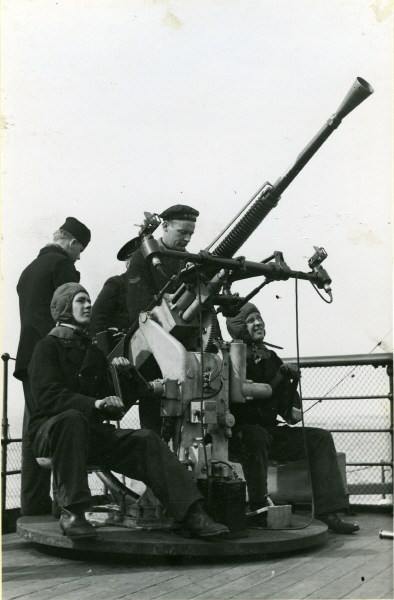 From 1948, their armament was revised: Stockholm, Malmö, Karlskrona, Gävle, Norrköping received two pairs of Bofors K60 m/36 in the same locations. The Swedish model was precisely coming from an official request to replace the British 2-pdr AA in the 1920s. It was funded by the Navy. The prototype barked first, testing its automatic loader on 17 October 1930. Design and manufacturing of the first model followed for more tests and fixes on 10 November 1931. By 25 November 1931 trials showed it was capable of eight rounds in 7.58 seconds, Bofors created an amazing autoloader design concept for “heavy” AA rounds but more effort was needed to meet the Navy’s 130 rpm requirement.
A new official test was a success on 21 March 1932. In 1933-34 with a watchful eye of the Navy, the model was further refined with 30,000 hours of drawing board work as well as producing all the machine tool necessary to create the masterpiece that was the 40 mm L/60 (In sweden L56, K60) Model 1934. Export success wa simmediate, but strangely the Navy did not adopted it, ordering instead in 1934 was a short-barrel version for submarines, the 40 mm L/43 M1932. Some sources argues that was the model installed on the Psilander class, but it’s doubtful. The model the Navy finally adopted was the 40 mm L/60 Model 1936, the base for the legendary WW2 allies Bofors gun, still in service to this day.
The Bofors 40 mm/60 (1.57″) Model 1936 is the least known variant over the web, so data is scarce. Bore lenght was 88.578 in (2.250 m), full 76.1 in (1.933 m), and as asked by the Svenska Marinen, a rate of fire of 120 rounds per minute per barrel nominal. It slowed down with gravity and elevation and practical if could fell below 80 rpm, especially with a worn out barrel (life 9,600 to 10,000 Rounds). It used an AB 40 mm L/60 HE-T – 2.05 lbs. (0.93 kg) round, complete Bofors 1936 HE – 4.63 lbs. (2.1 kg) with a 17.60 in (44.7 cm) busting charge of 0.150 lbs. (0.068 kg) TNT. It had a Brass cartridge of 40 x 311R, 1.93 lbs. (0.88 kg) filled with 0.661 lbs. (0.300 kg) propellant charge. Muzzle velocity was 2,789 fps (850 mps), bezst range at 42°, 11,019 yards or 10,076 m.
Torpedo Tubes
It seems Sweden built its own torpedoes, probably licenced from British Whitehead designs. These were 53.3 cm torpedo tubes m/30. More info in research.
Depth Charges
These were m/24 depth charge racks (seemingly 8 charge per rack, 16 m/24 total) and two m/24 depth charge throwers. The m/24 were replaced by m/33 throwers on the next classes. The topic of Swedish depth charges is also in research. They also carried presumably hydrophones.
Mines

Likely the Kontaktmina m31. No info yet, topic in research. The ships also carried two or four paravanes, installed close to the funnels.
⚙ specifications (1942) |
|
| Displacement | 1,250 tonnes standard |
| Dimensions | 84,9 x 8,6 x 2,6 meter |
| Propulsion | 2x Parsons steam turbines, 3x Thornycroft boilers, 36K hp. |
| Speed | 35 knots |
| Range | 1800 nm at 18 kts |
| Armament | 2×2 120mm/45, 2×1 40mm m/36 AA, 2×2 8mm m/36 AA, 2×2 533mm, 32 mines |
| Crew | 120 |
Cold War Modernization

After the war, all destroyers (Stockholm, Malmö, Karlskrona, Gävle, Norrköping) except Göteborg, in poor shape after the Hårsfjärden explosion, received a comprehensive refit, where the center gun was moved to the “X” position, on the aft deckhouse, which gave it better angles. The anti-aircraft armament was changed for four modern Bofors 40 mm L/70 guns m/36, concentrated on a platform amidship, close to the aft funnel and with twice as heavy shells as the previous 25 mm guns.
A stronger mast was built for mounting a new radar antenna, the hydrophone was modernized, and they received a new combat control. However, during trials after these modifications, it was found they had extra topweight and became unstable. The beam was increased to 9.70 m to keep stability and standard displacement rose to 1,140t. The 25mm/58 AA guns and 8mm/76 light MGs were removed. Mine stowage increased to 46 and they received a radar.

Karlskrona as a frigate firing a salute at Riddarfjarden
In 1958–1963 three were further modernized and rebuilt as frigates. The armament was completely changed. This concerned Malmö in 1962, Gävle in 1963 and Karlskrona, which saw the removal of their two twin 533mm TTs, for the addition of two triple 305mm Squid Mk 4 (licenced as M/51) ASW Rocket Launchers instead, and the mine stowage increased to 130. They also had the new type 293 radar, and a new sonar replacing the hydrophones.
Career of the Göteborg class
 HSwMS Göteborg (J5)

Göteborg was ordered as hull n°5 at Götaverken, laid down in 1934, launched on 14 October 1935 and commissioned in October 1936. In the autumn of 1936, she was ready for trials. No records for the interwar. When the war broke out in September 1939, Göteborg was part of the coastal fleet. Preparedness for ships on the west coast took time so she was seconded on 27 August 1940 with HMS Klas Horn (3), sent to the Gothenburg Squadron. In mid-October she was transferred back to the coastal fleet. On 17 September 1941, Göteborg was berthed at Horsfjärden, Stockholm archipelago, with HMS Klas Uggla and HMS Klas Horn. Suddenly an explosion at her stern caused a chain reaction down to the torpedoes, and the entire stern was blown away. She sank on site, and the ensuing fire also sank the two other destroyers moored alongside. 33 men died. She was eventually salvaged, repaired, and returned to service on 18 September 1943. She was finally decommissioned on 18 August 1958.
On 14 August 1962, she was towed out into Hanö Bay to be a target, for the 11th Destroyer Division. She was fired at with live ammunition. After the firing, security teams came on board to practice internal leak sealing in realistic conditions. However, they were forced to hastily abandon her: She was more badly damaged than they initially thought. A few minutes later, she sank, stern first. They manage to escaped as air pockets maintained her partially afloat, stern resting on the bottom. Only after further gunnery shooting at close range, with 40 mm artillery, it was finally possible to get her to slip for good at the bottom of Hanöbukten.


HSwMS Stockholm (J6)

Stockholm was laid down as hull N°6 at Karlskrona dockyard in 1934, launched on 24 March 1936 and commissioned on 27 November 1937. Interwar career details unknown. She was used for neutrality patrols in WW2. Postwar in 1948, Stockholm, Norrköping (J10) and Fylgia made a training cruise to Great Britain and Europe, stropping at Karlskrona, Malmö, Gothenburg then Loch Eye in Scotland, Bristol, Amsterdam, and back via Trondheim, and Gothenburg, then Karlskrona on 17 June.
Around 1950, Stockholm was reconstructed, the hull widened to increase stability, the middle 12 cm gun moved to the aft bridge. Her amidship gun between funnels was recoignized to have poor friring angles, and relocated aft, with 40mm Bofors for the anti-aircraft defense, a modern radar, hydrophones and combat control center. She remained part of the fleet until 1 January 1964 until decommissioned. In 1965, she was sold for scrap in Ystad.


HSwMS Malmö (J7)

HMS Malmö
Malmö was ordered as hull n°7 at Eriksberg NyD, Göteborg in 1937, launched on 22 September 1938 and commissioned on 15 August 1939. As the third destroyer in the Gothenburg class, she was ready on 15 August 1939, 15 days before the outbreak of World War II. Trials were accelerated, she was assigned to the coastal fleet, 2nd Destroyer Division, together with Gothenburg and Stockholm. Upon the delivery of Gävle, Gothenburg was transferred to the 1st Destroyer Division. She remained active throughout the war for neutrality patrols, with the exception of a short break in 1944 when she was decommissioned for a more thorough overhaul. At that stage she already had crossed the equivalent of 2.5 earth equator laps in exercises, both by patrolling or in escort duty. She shadowed passing by vessels of both the Germany Navy and British ones. In 1944 she started to took over refugees who came from the east. In October 1941, she picked up for example 60 refugees from the island of Gotland, landed in Nynäshamn. By September 1944, preparedness was tightened, Malmö was hastily re-equipped, and by November, she was back at sea, watching over Gotland Lake and escorting Gotland merchant traffic.
Her work ended on 10 April 1945, with the command ensign hoisted at the Stockholm Naval Yard. She then received a much-needed overhaul. Postwar, she was re-equipped for a short period in 1948 and transferred to the West Coast Naval District. From 1953–1957, she first became part of the coastal fleet and belonged to the Gothenburg Division. In 1950, Malmö was under reconstruction, in which her hull was widened to increase stability, the middle 12 cm gun moved to the aft bridge. Like her sisters, it was observed that amidship main gun between full had a poor arc of fire, and the first thing was to move it aft, whereas new 40mm Bofors were installed, radar and combat control center.
In 1960, shenentered Karlskrona Naval Shipyard for a second and last extensive reconstruction, reclassified as a frigate. The torpedo tubes were removed, replaced with ASW mortars, sonar modernized, combat control equipped with a submarine hunting console. The AA was also modernized and mine capacity increased to 130 mines. The aft deckhouse was extended aft to make room for stores and freezers. All portholes under the main deck were welded shut, boats and davits removed. Behinf the deck, an extra structure was installed, to the extent that a new crew mess was arranged aft of the gunroom. The crew was now sleeping in bunks three high. By the autumn of 1961, Malmö made a trial run, remained part of the fleet until 1 January 1967, and was decommissioned. In 1969, she was sold for scrapping in Gothenburg.


HSwMS Karlskrona (J8)

HMS Karlskrona J8
Karlskrona was ordered as hull n°8 at Örlogsvarvet, Karlskrona dockyard in 1937, she was launched in 19 June 1939 and commissoned on 12 September 1940. She immediately took on netrality patrol work, without any incident until May 1945. Around 1950, she underwent a reconstruction, with the hull widened to increase stability, amidship gun moved to the aft deckhouse and the anti-aircraft defense now comprised four 40mm Bofors. New hydrophones, combat control center also were part of the refit. Around 1960, she was rebuilt again with the torpedo tubes removed, to installed ASWRL mortars, and the mine capacity was increased from 40 to 130 mines. She was decommissioned in the autumn of 1966, but kept in reserve until sold for BU in 1974 and the remaining, stripped bare hulk spent afterwards as a target ship.
HSwMS Gävle (J9)
Gävle was ordered as hull N°9 at Götaverken in 1939, launched on 23 September 1940 and commissioned on 30 June 1941. Thrown into World War II, she undertook neutrality patrols and escort duty. She took part in the rescue of Baltic refugees, in the autumn of 1944. By 1950, she underwent the same modifications (see above), that is hull widened, amidship 12 cm gun relocated aft, new Bofors 40mm AA, new radar, sonar and combat control center. The same happened also in 1960, torpedo tubes replaced by ASWRLs, mine capacity increased (130 mines). She was eventually decommissioned on 6 December 1968, sold to ASEA-Atom, used as a floating steam powerplant for testing turbines, at the Oskarshamn nuclear power plant. In 1972, she was scrapped in Ystad but her 12 cm guns as well as those of HMS Kalmar, were relocated to Rödbergsfortet, Boden fortress.
HSwMS Norrköping (J10)

Norrköping was ordered as hull n°10 at Eriksberg, Göteborg, laid down in 1939, launched on 25 September 1940 and commissioned on 9 April 1941. HMS Norrköping had been delivered to the Navy after trials and winter equipment. She was done with initial training in May 1941 and started her neutrality patrols, which were unevenftul. In 1948, with Stockholm and Fylgia, she made a training cruiser to Great Britain and Europe from Karlskrona, via Malmö, Gothenburg, Loch Eye, Bristol, Amsterdam, Trondheim, Gothenburg and back on 17 June 1948. The next year she was placed in reserve for overhaul, same as the others, hull widened, admiship 12 cm gun relocated, new AA, radar, sonar, combat control center. She was not rebuilt later as an ASW frigates and instead scrapped on 1 February 1965,then used target ship for firing tests until sunk on 26 May 1977 in Hanöbukten, and now lies barely a nautical mile from HMS Göteborg (J5).


Read More/Src

Karskrona and helicopter, cold war.
Books
Borgenstam, Curt; Insulander, Per; Kaudern, Gösta (1989), Jagare : med svenska flottans jagare under 80 år (2:a), Karlskrona: Västra Frölunda CB Marinlitteratur
von Hofsten, Gustav; Waernberg, Jan (2003), Örlogsfartyg: Svenska maskindrivna fartyg under tretungad flagg (1:a), Karlskrona: Svenskt Militärhistoriskt Bibliotek.
Links
navypedia.org
sv.wikipedia.org
Göteborg-klass (jagare)
CC images
navweaps.com
digitaltmuseum.se
hhogman.se
facebook.com
Model Kits
None found yet
Videos