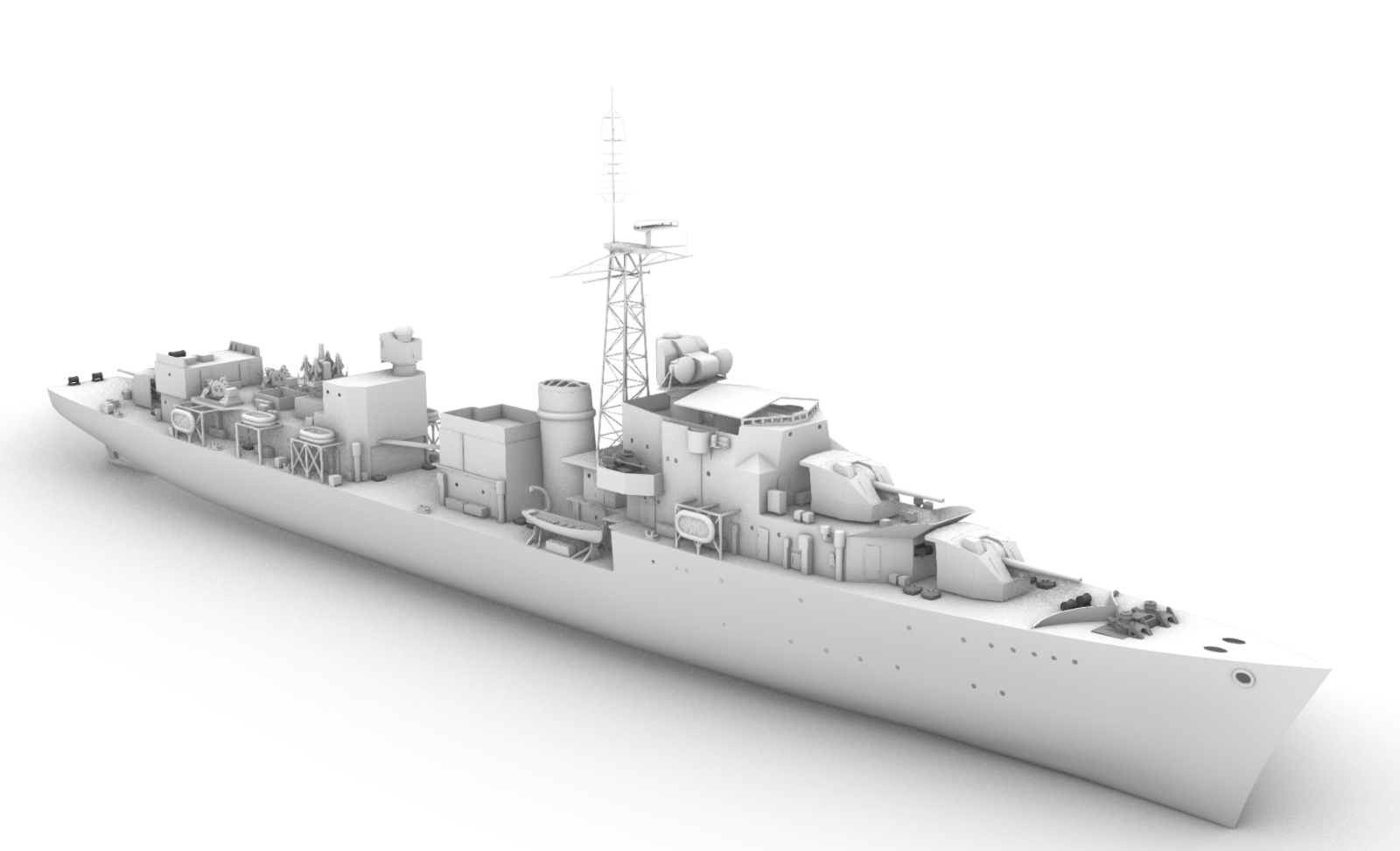
 Royal Navy – Ca-, Ch-, Co- and Cr- groups:
32 destroyer 1943-45
There are two “C” class destroyers in British Royal Navy service in WW2 confusingly enough, the ones from 1931 (grouped into the “C-D” group as they were very similar) and the ones of 1943, that many sources calls the “Ca-, Ch-, Co-, Cr-” class to avoid confusion, but constitutes an ensemble of thirty-two destroyer (34 planned, two cancelled 1944), roughly similar to fill the 11th, 12th, 13th and 14th Emergency Flotillas, as a follow-up of the wartime destroyer construction program. They were larger than the previous classes (W and Z classes), based on the prewar J-class but with the late dual purpose QF 4.5-inch L/45 Mk IV, same Fuze Keeping Clock High Angle Fire Control Computer but improved AA and sensors, notably thanks to their standardized lattice masts. Laid down from late 1942 to early 1944 for the last ones, they saw little action in WW2. The Ch-Cr class were sold postwar to Canada, Norway, and Pakistan, the latter still around in 1982.

Development of the C class
The “C” class destroyer were the last emergency destroyers ordered in WW2. According to Conways, the Z and Ca class were assimilated as a separate class, followed by the Ch-Co-Cr classes in that order, to constitute four groups. These would be separated also here given their few differences.
Previous destroyers
The associated Z class to the “Ca” were follow-ups of an unprecedented naval shipbuilding effort for Great Britain, delivering from 1940 onwards destroyers specifically for convoy work first, fleet escort second, the “emergency flotillas”. In total fourteen of them, each flotilla being eight-ship strong, including a flotilla leader, albeit they were absent from the Ca onwards. In total, a hundred a twelve emergency destroyer, to add to numerous Hunt-class escorts, River class Frigates and Flower class corvettes. The L and M destroyers were the bases for these new wartime designs, with its roots in studies going all the way back to 1936, as a secondary ship aside the powerful and costly Tribals. However the design evolved with the lessons of the Spanish Civil War and the new design was to be equipped with the QF Mark XI 4.7-inch and the bridge of H-I class as well as a new clipper bow.

HMS Wrangler (R48) in 1944
In 1939 this evolved again for a simplified construction, cheap standard armament and the justification to replace the vintage V-W destroyer. The “J” class was the base for all these emergency designs, all repeating the same hull and machinery, on slightly modified dimensions and improved seaworthiness. The first of these class and flotilla was approved in September 1939 with a completion FY1941. The “O” class were the first of these fourteen “emergency flotilla” continuously until 1945.
The P class combines its main guns with the small shield Mark IX. The Q and R classes (3rd/4th emergency flotillas) had Dual Purpose mounts. The S and T (5th/6th emergency flotillas) approached 1,700 tonnes but had the same main guns or the new HA mount with reworked gun shields and greater elevation. The S class introduced the CP (central pivot) Mark XXII mounting for the QF Mark IX 4.7 in gun elevating to 55 degrees while pompoms were retired for 40mm Bofors Mark IV, many having the new “Hazemeyer” tri-axially stabilised mount. Aslo a new standard was the new analog fire control computer and the Radar Type 282 making the S class excellent AA escorts. The follow-up T class inaugurated a new lattice mast that became standard until the end of the British gun-armed destroyer lineage. Then, the U, V were essentially a repeat of the S and T but with tests for the mark III 4.5 in/45 with a new 80° mounting an combinations of bofors and 20 mm Oerlikon guns (now in twin mounts), last being completed in 1944 and still with flotilla leaders.

HMS Zenith in 1944 (IWM)
Then came the W/Z classes, essentially repeats of the U-V, but with modified director structures, lattice mast. The Z class diverged in many aspects, dropping the QF 4.7 inch (120-mm) L/45 Mk.IX gun on single mount CP Mk.XXII, for a new QF 4.5 in (113 mm) Mk.IV gun on single mount CP Mk.V, with an higher angle for better AA defence, firing a shell slightly heavier. Other changes concerned the modernized sensors suite, with the Radar Type 272 for target indication and bearing, Type 291 for air warning, Type 285 for main fire control along with a director Mk.III, plus the Type 282 radar used as fire control for the 40 mm mount Mk.IV. Shortages forced to keep the old QF 2-pounder (40-mm) Mk.VIII “pom-poms” in quad mount Mk.VII, when QF 40 mm Bofors in twin mount “Hazemeyer” Mk.IV were not available. They also had twin 20 mm Oerlikon Mk.V and kept two quad torpedo tubes and a powerful ASW suite.
Naming

HMS Cassandra in 1944, IWM
Of course since the Z class ended the alphabet, so some argued in the admirakty to simply go back and start again. However many “A” and “B” names already had been chosen for destroyers still active, and it was determined that the letter “C” had the richest variety of words, adjectives and names in the dictionary. It is not known how much PM Wintson Churchill, which had a way with words, had an influence over the Admiralty on this, but exploiting “C-” names seemed to provide enough new ideas to populate four groups of thirty-two vessels total. Some, like Cossack, Crusader, Comet resurrected sunken destroyers, but some choices would have caused some grin for their newly-formed crews like “Chaplet” “Charity” and “Checkers”.
There was also a former cruiser (Cavendish), and a statesman (Cromwell). There were also name changes, in November 1942. For the Ca class, previous S/P/R/T-names were Sybil (Cavendish), Ranger (Caesar), Spitfire (Cambrian), Swallow (Caprice), Strenuous (Carron), Pique (Carysford), Tourmaline (Cassandra) and Pellew (Cavalier). Some follow up Classes also changed names after being ordered like Champion that became Checkers, Corso that became Concord, Craccher that became Crispin (after Shakespeare), and Cretan that became Crowmell.
Construction
Vickers-Armstrong: Constance, Cossack (Walker)
Yarrow, Scotstoun: Caprice, Cassandra
John Brown, Clydebank: Caesar, Cavendish, Crescent, Crusader
Scotts, Greenock: Cambrian, Carron, Checkers, Chieftain, Cromwell, Crown
White, Cowes: Cavalier, Carysford, Contest, Creole, Crispin
Thornycroft: Chaplet, Charity (Woolston), Comus, Concord
Alex. Stephen, Linthouse: Chevron, Cheviot, Consort
Denny, Dumbarton: Childers, Chivalrous
Yarrow: Cockade, Comet, Crozier, Crystal
Specifics of the Ca class
The Z and Ca class has much in common. In fact they are considered the same in many publications: Essentially thay are defined as S to W class destroyers, but with an improved fire control, especially for high angles, necessary to take advantage of their 4.5 in guns, which had a slightly lower muzzle velocity than the 4.7 in Mark IX, but the shell was better profiled (less air resistance), and heavier, with the new “new normal” 55 degree elevation. This was well completed by twin tri-axial (Hazemeyer) and radar-assisted twn Bofors mounts, albeit most ships retained four single QF 2-pdr pompom mounts, on power-operated mounts to traverse faster.
HMS Caprice differed however as she had a quadruple 2-pounder “pom-pom” instead of a twin Hazemayer Bofors mount, and Cassandra had eight Oerlikon 20 mm cannon instead pom-poms. Torpedo armament remained the same with eight 21-in (533 mm) torpedoes, still in two quadruple mounts, and 70 depth charges were distributed between reserves, four launchers, two racks. This was improved to 80 on the next sub-classes, but the Z class, mostly used for Arctic convoy escort, had up to 130 of them.
Design of the “Ca” class
Hull and general design

Ca class destroyer
Displacement was in standard 1,710 long tons (1,740 t) for 2,530 long tons (2,570 t) fully loaded, however some sources states the C were heavier at 1,730 tonnes standard and 2,575 tonnes fully loaded. In any cases, they had the same size, with an overall lenght of 362 ft 9 in (110.57 m) and 339 ft 6 in (103.48 m) between perpendicular. In beam they reached 35 ft 9 in (10.90 m) and in draught 10 ft (3.05 m). The general profile followed the Z class exactly, sharing the same hull as their predecessors in general design. The hull general shape and forecastle were the same, including with a sheer and details made it easier to produce, plus the same clipper bow inherited from the J-class.
Even the forecastle proportions were the same, as well as the bridge, with the exception of structure changes. The Ca like the Z class a new lattice mainmast, replacing the tripod of 1942 destroyers, but the accomodations remained the same. Yards could thus keep producing these with just incremental modifications, altering plans in a limuted way each time. Bot the admirakty and the years with their suggestions had time to perfect the same design between 1940 and april-1942 when it was approved. The new lattice mast was first tested on the V class and earlier ships. This new standardized structure was more complex and material intensive than a tripod, but it was also much more sturdier, causing extra air drag, as well as heavier as a structure. But there was a reason behind, to be able to support the latest radars, which grew in size as they were improved.
This structure planned for future upgrades and even heavier or bulkier aerials. This added topweight was somewhat counterbalanced by extra electric power, with large generators deep down, and better distribution in general, in the lower hull. The crew ranged considerably, from 186 versus 178 and up to 222, growing until 1945 with extra additions. For the first time, there was no dezignated flotilla leader to further simplify construction. The doctrine developed in wartime and experience return made that concept irrelevant. Only the Z class, similar to the Ca, had a true leader, HMS Myngs, which differed by its extra accomodations for a destroyer flotilla commander, albeit most sources states that Casear and Cavendish were for the Ca class completed as leaders. Others states that only Cavendish was completed as Myngs. HMS Contest was the first British fully-welded destroyer. It seems no leader was created for the Ch/Co/Cr.
Powerplant

Machinery Room, control display
The class, whatever the group, had the same two Admiralty 3-drum boilers working under a pressure of 300 pounds per square inch (2,100 kPa) at 630 °F (332 °C). They fed pressurized steam to Parsons single-reduction geared turbines. This ensembled passed on power to shafts through a reduction, for a grand total output of 40,000 shaft horsepower (30,000 kW), at 350 rate per minute. The shafts and their struts were the same as previous classes also to simplify manufacture, as were the propellers, still three-bladed, bronze and fixed-pitch. The Ca class was designed like the previous Z and next ships, a maximum of 36 knots (67 km/h; 41 mph) on trials, light, down 32 knots (59 km/h; 37 mph) in full load and combat condition. Heavy weather further accentuated the drop.

Propeller, Esplanade East, White NyD, Cowes
By that stage, speed was not a priority anymore, but rather a balance in armament and sensors. If any data was privileged, that was range. These ships were all engined by their builders, except Cossack and Constance, engined by Parsons. Whatever the origin of the boilers, they were all under the same strict standards, as Admiralty 3-drum types. There is some discrepancy in sources for their bunkerage. Some sources states they carried 615 tons of oil fuel, others 588 tonnes (conways), making for a radius of 4,675 nautical miles (8,658 km; 5,380 mi) at 20 knots (37 km/h; 23 mph), 1,400 nautical miles (2,600 km; 1,600 mi) at 32 knots (59 km/h; 37 mph) or max service speed. Note that the next C class sub-groups had tre same machinery and performances.
Armament

HMS Cavalier showing her forward artillery
The entire C class was not armed the same. The Ca, like the Z class, had all their eight torpedo tubes, in two quad mounts, whereas the Ch/Co/Cr sacrificed one to compensate for the installation of the RPC gear for the 4.5 inches gun, and in some ways, all Bofors were of the heavy Hazemeyer type, albeit there were exceptions like Chivalrous, Comus, Concord, Creole, crispin, Cromwell and Corwn which were equipped with simple biaxial mounts. Caprice was the last destroyer built for the Royal Navy to be fitted with the ubiquitous quadruple QF 2 pounder “pom-pom” mounting Mark VII.
In common however the C class in its entirety retained four 4.5-inch/45 Mark IV main guns, four in superfiring positions fore and aft, a twin Bofors 40mm/56 Mk VIII/IX AA mount on a platform between torpedo tubes, the latter, without reloads, and nothing else at first. Then were added two twin 20mm/70 Oerlikon Mk II/IV, and two single 20mm/70 Oerlikon Mk II/IV, but there were variations, as standard; Then there was the ASW suite with four depht charge throwers either side of the quarterdeck structure, and two racks at the poop. Number varied from 70 to 130 depht charge. The greatest change for the next class was indeed its new fire control system.
BL 4.5-in/45 QF Mark 4/ Mark 5 CP Mount
Conceived as a dual purpose weapon prewar for large ships in dual mounts, but also declined in single mounts with tailor shields for destroyers.
Specifications 4.5-in/45 QF Mark V
Barrel 16 ft 8 in (5.08 m), 45 calibres.
Shell: Fixed or Separate QF 113mm 640–645 mm R 55 pounds (24.9 kg)
Horizontal sliding block, +80°. 16 RPM at 2,449 ft/s (746 m/s)
Range 20,750 yd (18,970 m) at 2,449 ft/s (746 m/s), ceiling 41,000 ft (12,500 m).
40 mm/60 twin Mark IV Hazemeyer

The legendry AA ordnance that ruled the skies for the allies in WW2 had its origin in the interwar. The first order for the “real” L/60 was made by the Dutch Navy, ordering five twin-gun mounts for the cruiser De Ruyter in August 1934. They were stabilized by the Hazemeyer mount, a revolutionary set of layers aimed the gun with a second manually stabilizing the platform and they were all coordinated on a single target at once by a single fire-control system. United Kingdom took out a license but it took time before the Mark IV was standardized.
On the U, V class, they were installed on the same spot the former pompom was for the best arc of fire, on a banstand aft of the funnel and between the two torpedo tubes banks. This tri-axially stabilized twin mounting “Hazemeyer” had an on-mounting fire control, and depended from a Radar Type 282 for initial range information. Water-cooled it existed in left and right versionU, V, Wype D (left) and E (right). Many were later converted to the Mark XI standard, Mark V mountings. 484 Mark IV produced total. However the shortage of Hazemayers affected the T class, with only three ships entering service with them.
Specs
Barrel length 2.25 m (7 ft 5 in). Mount 9,800 to 13,000 lbs (4445-5897 kg).
Shell 0.9 kg (2 lb 0 oz) 40×311mmR 40 mm (1.57 in).
Action: Automatic extraction and integrated cam-operated recoil powered autoloader
Breech: Vertical sliding-wedge
Elevation −5°/+90° at 55°/s and full 360° traverse in 50°/s.
Rate of fire 120-140 rounds/min, decreased with elevation.
Muzzle velocity 850–880 m/s (2,800–2,900 ft/s)
Maximum firing range7,160 m (7,830 yd)
Crew: 5: 1 Gunner traversing, 1 elevating, 2 loaders, 1 pointer.
20 mm/70 twin Mk II/IV

They were located amidship, one either side of the projector aft of the funnel, and two on sponsons wings at the bridge forward. This was a compact, unshielded, hydraulically operated twin-gun mount that differed from the US twin mounts. The gun itself was called the 20 mm/70 (0.79″) Mark II in twin mount. It was ready in 1941, with a Mark IX mount and later XIA and XIIA, all manual. The Twin Mark V weighted 1.228 tons (1.248 mt).
Specs
87 in (2.210 m) barrel Bore 55.1 in (1.400 m), Rifling 49.1 in (1.246 m)
Rounds: HE 0.272 lbs. (0.123 kg), HE-I, SAP. Full round 7.18 in (18.2 cm) long
Propellant 0.063 lbs. (0.029 kg) NC flake or tube
Elevation -5 / +85 degrees
Working pressure 20 tons/in2 (3,150 kg/cm2)
Muzzle velocity: 2,770 fps (844 mps) new, down to 2,725 fps (835 mps) used barrel (life 9000 rds)
Cyclic 450 rpm x2, practical 250-320 x2 or 2,560 rpm for all four twin mounts combined.
Range at 35.32 degrees 4,734 yards (4,329 m).
Mark IX** Torpedoes

Two quadruple torpedo tubes banks aft amidships, placed on a deck top plaform, reloadable thanks to cranes. These destroyers like their predecessors used the Mark IX. The Mark IX design started in 1928. It was first deployed in 1930, and the design being considerably improved until 1939. The Mark IX was a larger and longer-range Mark VIII essentially. It kept for propulsion a very similar four-cylinder radial kerosene-air burner-cycle propulsion system and replaced the Mark VII in most RN ships in WW2.
The main version used from 1940 was the Mark IX**, first issued to J- and K-class destroyers in 1939. In 1943 it was decided to further improve the Mark IX** by lengthening it by 12 inches (30.5 cm), and the weapon mass limit to 4,000 lb (1,800 kg), up to the capacity of torpedo tubes and ships under construction.
Nitromethane-augmented propulsion was considered, but its implementation required too many alterations to be practical. The Mark IX*** took up the extra space by enlarging the warhead to 930 lb (420 kg) of Torpex. Sources diverged on their deployment but they only arrived by the end of the war in 1945, by which time the enlarged warhead became unnecessary. But the Mark IX** remained in service throughout the 1960-70s. Note that HMS Tumult had two experimental fixed torpedo tubes instead of the first bank, soon after completion until removed and replaced by regular TT bank after trials.
Specs
Specs 21 inches Mark IX** (1939)
Weight: 3,732 lb (1,693 kg)
Length: 286.5 in (7.28 m)
Explosive Charge: 810 lb (370 kg) Torpex
Range and Speed settings: 11,000 yd (10,000 m) at 41 kn (76 km/h), 15,000 yd (14,000 m) at 35 kn (65 km/h)
Power: Wet-heater
Depth Charges
 The usual set comprised four Mark II Depth Charges Throwers (DCT) abaft the quarterdeck house, facing either side, and two Depth Charge Racks (DCR) at the stern. Each carried five charges but they were railing to the aft superstructure for a total storage of 40 more DCs. Reload was made by hand, using winches, always a dangerous task with a rolling deck washed by waves. These depht charges were of the standard British type, meaning it was the Mark VII: In entered service in 1939, weighted 420 lbs. (191 kg) and carried a 290 lbs. (132 kg) TNT with a sink Rate or Terminal Velocity of 9.9 fps (3.0 mps) with a max setting at 300 feet (91 m) later 500 feet (182 m).
But they were rather upgraded to the the Mark X (1944) and Mark X* at completion. The X** was not introduced in service in 1945 despite its great depth (down to 1,500 feet (457 m)). Squid and Hedgehog made them obsolete. There are doubts also if the Mark VII Heavy studied from 1940 and proper to depth charge launchers were used aboard, outside experimentally. Weighting 420 lbs. (191 kg) with a 290 lbs. (130 kg) TNT charge, they had a sink rate/terminal velocity of 16.8 fps (5.1 mps) and a 300 feet (91 m) max setting, helped with a 150 lbs. (68 kg) cast-iron weight attached.
The idea was to reach the U-Boat faster, and it was claimed it could split open a 0.875 inch (22 mm) hull at 20 feet (6.1 m), or force to surface at 12 m or more. The game changer was a minol charge (1942) for better results, with a 30% increase.
Sea Cat SAM (1966)

Sea Cat Launcher on HMS Cavalier
Exceptionally, HMS Caprice and Cavalier, already modernized in 1959, wit their new bridge, new radars and fire control system (Mark VIM GFCS) and their pair of Squid ASWRL, lost their last torpedo tube bank remaining for a pair of Sea Cat short range AA missiles, becoming the only guided missile destroyer for the whole wartime C class. The GWS-24 Sea Cat was a short-range surface-to-air missile designed by Short and in service in 1962, so County class ships in construction could be completed by two systems installed on the broadside, each with four missiles. They were light enough to be reloaded by hand. Contrary to the Sea slug they enjoyed a considerable export success.
Specs
Missile length : 1480 mm (58,29 inch), Wing span : 650 mm (25,6 inch), Body diameter 191 mm (7,62 inch)
Missile weight : 62,71 kg (138,25 Lb). Continuous rod warhead : 13,83 kg (30,65 Lb)
Operational oil pressure on steering cylinders during flight : between 79 and 103 Bar (1150 to 1500 lbf/ in2)
Operational range : 500 to 5000 mtrs. Speed : Mach 0,8 (272,24 mtrs/sec).
Guidance system : CLOS (Command Line Of Sight) and radio link
Fire control: Type K Fire Control/Type 285
 The Fuze Keeping Clock (FKC) was a simplified version of the High Angle Control System analogue fire control computer. This was likely the Mark V on the Ca class, like for the Z class destroyers. The HACS A/A system was fitted on British destroyers from 1938. The pompom had their own director as well, using gyroscopic tachymetric fire-control. The new Type K was adopted by the Z and Ca class, and went with the Type 285P radar (1942) mounted on top, which had a peak power of 150 kw, frequency of 600, and wavelenght of 50. This made for a complete ranging set for anti-aircraft fire control, using ranging panel L12 (if the Type 285M was substituted). The Type 285 combined five Yagi antennae with combined Tx/Rx function and introduced a Precision Ranging Panel with a 25 yard RMS range accuracy. This was upgraded on the Ch/Co/Cr classes (see below).
Sensors
The Z and Ca class ships had the type 275 radar, Type 291/293 radar for target indication and a Type 285 fire-control radar on director type K as well as the Type 144Q sonar.
The Ch/Co/Cr classes had the type 275, Type 276, type 291, type 293 radars and same type 144Q sonar, so the type 276 was the main change, but the fire contril was brand new, as a proper dual purpose fire control system similar to ones on the “Battle” class. it weighted much, so the last three flotillas lacked one torpeod tube banks in compensation as well as a reduced anti-submarine armament.
Type 272 Radar
Peak power 90, Frequency 2,997 MHZ. Wavelength 100mm, introduction in 1941. A version of the Type 271 with a cable-drive and more powerful receiver allowing the antenna to be mounted remotely from the radar office. Was not considered successful and not widely used.
Type 282 Radar
Decimetric (50 cm) ranging set for Bofors 40 mm and pom-pom fire control, either the Mark IV “Hazemeyer” and “Pom-pom Director Mk IV” using twin Yagi antennas, mechanical ranging panel with 0-5000yd display. Likely they were fitted with the later Type 282M with increased transmission power to 150 kW with Beam Switching of the Type 282P with Precision Ranging Panel. PP 25 KW, Frq. 600 MHZ Wavelenght 50, 1941.
Type 285 Radar
Ranging set for anti-aircraft fire control, introduced in 1942 likely the 285P (see fire control).
Type 291 Radar
Designed as a search radar for destroyer-sized and submarines, in service by 1942. Combined transmitting and receiving antenna. Either a Type 291M, P, or Q with power training and plan position indicator were installed but on the W variant it had different antennas.
Type 293 Radar
Target Indication radar, installed from 1945 onwards. Short-range aerial-search model for surface ships, same transmitter as the Type 277 surface-search radar, but new antenna design for better coverage above the ship and for air warning. “cheese” antenna, 6 feet (1.8 m) diamete later upgraded to 8 feet (2.4 m) on the Type 293P and 12 feet (3.7 m) on the cold war 293Q.
Type 144Q Sonar
From 1943, range 2500 yards (2300 meters) to 3000 yards (2700 meters), integrated into the fire control and coupled with Hedgehog. 1st with bearing recorder, automatic scanning, turning 5 degrees after each ping, often coupled with the Type 147 “Sword” depth finding sonar with a beam steerable vertically. Also coupled with the Q attachment reducing the under hull blind spot. 60° deep vertical beam, trained with the main Type 144 transducer.
⚙ specifications Ca class |
|
| Displacement | 1,710 long tons standard, 2,530 long tons full load |
| Dimensions | 362 ft 9 in x 35 ft 9 in x 10 ft (110.57 x 10.90 x 3.05 m) |
| Propulsion | 2 shaft SRGST, 2 Admiralty 3-drum boilers 40,000 shp (30 MW) |
| Speed | 36 kts trials, 32 kn (59 km/h; 37 mph) service |
| Range | 4,675 nautical miles (8,658 km; 5,380 mi) at 20 knots |
| Armament | 4× 4.5-in/45 Mk IV, 2× Bofors Mk.IV, 4× QF 2-pdr Mk.XVI, 2×4 21-in Mk.IX TTs, 80 DCs |
| Sensors | 275, 291/293, 285 FCS radar (director type K), Type 144Q sonar |
| Crew | 186 (222 as leader) |
The Ca class
The 11th Emergency Flotilla was authorised under the 1941 Programme. The first two were ordered from Yarrow, on 16 February 1942 and the other six were on 24 March, pairs from John Brown, Scotts and Cammell Laird. On 12 August 1942 the contract for the last two Ca class ships, initially to from Cammell Laird at full capacity, was reaffected to White. The John Brown ships, HMS Caesar and Cavendish were both fitted as Leaders but it was less extensive that HMS Myngs.
On completion this 11th flotilla became the 6th Destroyer Flotilla, Home Fleet. It was transferred to the East Indies Fleet but arrived on station only between August and November 1945 so none saw action against Japan, after a service in Europe that was almost “cushy”. They remained in the Indian Ocean until May 1946 then sailed back home to paid off and placed in the operational reserve until stricken and sold for BU.
 HMS Caprice R01, D01
 Caprice was ordered originally as HMS Swallow at Yarrow, Scotstoun, laid down on 28 September 1942, launched on 16 September 1943 and completed on 5 April 1944. Assigned to the 6th Destroyer Flotilla, Home Fleet, she took part in Russian and Atlantic convoys, acting as escort to the ocean liners SS Queen Elizabeth and SS Île de France for high speed runs. In 1945, she was sent to the Far East just in time to receive the surrender of 5,000 Japanese prisoners at Uleeheue. Postwar she was paid off into reserve until selected for modernisation by Yarrow in 1959. She was sent to Far East, 8th Destroyer Flotilla (DF) at Singapore, remaining there for four years. On January 1961, she was underway from Hong Kong when answering a distress signal from the Panamanian freighter SS Galatea (ran aground on Pearson Reef, Spratly). She rescied all but one of the crew. The captain fell and drawn during the rescue. This was recoignized as two crewmen received Queen’s Commendation for Brave Conduct.
In 1963, Caprice returned gome to join the 21st DF, Mediterranean and Caribbean. Under West Indies Commodore Edward Ashmore she was a Guard ship at Georgetown until July 1963 and took part in anti-immigration patrols in the Bahamas until August. In 1966 Caprice, with Cavalier, she received the Sea Cat SAM in replacement of her remaining TT bank. In 1966–67, Caprice was far from home for six months and three on the Beira Patrol (Mozambique Channel, oil blockade against Rhodesia) as well at Aden to supported the Army. Three of her crew were wounded in a gunpower demonstration with a WOMBAT recoilless rifle. Back to Portsmouth on 22 February 1967 she started a refit. On 25 January 1968 she returned “East of Suez” via Gibraltar, Freetown and Simonstown and the Beira Patrol. She was in Singapore on 6 April 1968 and alternated between Singapore and Hong Kon in guard duties and exercises, and visited Japan. By September she visited Sydney for the ex. “Coral Sands” until October, and stopped at Auckland, tnen completed her round-the-world trip back to Portsmouth on 19 December 1969. She paid off in March 1973 and scrapped in 1979 at Queenborough.
HMS Cassandra R62, D10
 HMS Cassandra was originally ordered as HMS Tourmaline at Yarrow, Scotstoun, she was laid down on 3 January 1943, launched on 29 November 1943 and commissioned on 28 July 1944. After workups and training, she escorted Russian convoys and was detached to be engaged in the search for the Tirpitz. On 11 December 1944, she was hit by a torpedo from U-365 (Oberleutnant zur See Diether Todenhagen). 62 men died in the attack. Her bulkheads and she was towed by the frigate HMS Bahamas and then by a Soviet Navy tugboat, to Kola Inlet to be repaired. U-365 was sunk two days later by a Fairey Swordfish from HMS Campania. Her arctic convoy service ended as she was under repairs until the war ended. Once completed, she was placed in reserve in 1946. In the early cold war at the tilme of the Korean war, she was reactivated to serve in the Mediterranean Sea, Indian Ocean. Cassandra was modernised by Yarrow and Co., in 1958. Fitted with an enclosed bridge and a Squid ASW mortar. Her ‘X’ gun turret was removed as a TT bank.

HMS Cassandra c1964
Back into service in April 1960, was reassigned to the Far East, 8th Destroyer Squadron. By late June 1961, after Iraqi threats to annex Kuwait (already !), Cassandra entered the British naval forces in the Persian Gulf (Operation Vantage) from 7 July, which deterred Iraq. Cassandra was relieved by the frigate HMS Blackpool on 29 July and regained her Far East station. She covered 50,000 miles in a commission in 1962-3 to the Far East, and returned to Portsmouth. In February 1963 she was part of the 21st DS, Mediterranean. In 1964-1965 she alternated between the Mediterranean and the Far East and took part in the Indonesian Confrontation. She returned home to be was placed in reserve, then paid off in January 1966. Scrapped at Inverkeithing in 1967.
HMS Caesar R07, D07
 Caesar was ordered as Ranger at John Brown, Clydebank, laid down on 3 April 1943, launched on 14 February 1944 and completted and commissioned on 5 October 1944. After working up and baseic training and qualifications she was allocated to the 6th Destroyer Flotilla, Home Fleet. After a refit in mid-1945 for extra anti-aircraft armament, she was transferred for the Far East in June 1944, but by the time she arrived in the East Indies Fleet at Trincomalee (Ceylon) it was already August. She was underway east when learing about Japan’s surrender. She returned to the UK and was paid off into reserve. Selected for modernisation, it was done at Rosyth from 1957 to 1960. Work included a new enclosed bridge, Mark 6M gunnery fire control system and the installation of two triple Squid anti-submarine mortars. Re-commissioned in September 1960 she became leader of the DesRon 8 making most of her servoice in Far East startion. She was returned home and paid off in June 1965, stripped off at Chatham, stricke, and sold for BU to Hughes Bolckow on 13 December 1966, Blyth, Northumberland from January 1967.
HMS Cavendish R15, D15
Cavendish was ordered as Sibyl at John Brown, Clydebank, laid down on 19 May 1943, launched on 12 April 1944 and commissioned on 13 December 1944. After working up, trials and fixes, she was allocated to the 6th Destroyer Flotill, Home Fleet. She had a refit in mid-1945 for extra anti-aircraft armament, transferred to the Far East in June but like Casear she was still at Trincomalee by August and learned about V-Day underway.


Cavendish during Exercise Fotex, 1964
Following the war, Cavendish was paid off into reserve. She was selected for modernisation until completed in 1955. She entered service with the 6th Destroyer Flotilla, Home Fleet, alternating with missions in the Mediterranean. In 1960 she was reassigned to the Far Eastern Fleet, based in Singapore. In 1964, she was back to Portsmouth for a brief refit. She was paid off on 1 January 1965, sold for scrap to Hughes Bolckow on 2 August 1967, commencing on 14 August 1967.
HMS Cambrian R85, D85
 Cambrian was originally ordered as Spitfire from Scotts, Greenock. She was laid down on 14 August 1942, launched on 10 December 1943 and commissioned on 14 July 1944. She was assigned to the 6th Destroyer Flotilla, Home Fleet as most of her sisters. She had a refit in mid-1945 for extra AA armament and was transferred in June for the Far East, East Indies Fleet, arriving at Trincomalee in August and learning about V-Day soon after. Back home, she was paid off into reserve. She was selected for modernisation in 1963 until January 1964. She was reassigned off the coast of East Africa, for an operation to quell the Tanganyika Rifles mutiny, escorting the aircraft carrier Centaur, landing Royal Marines from 45 Commando. Her three 4.5-inch guns provided naval gunfire in support. From January 1968, she was sent on duty near Mauritius as the island was approaching independence. But she was detached and ordered to the island of Rodrigues to quell an uprising.
In reality these individuals arrested by local authorities looted a government food storage warehouse for sweet potatoes after the hurricane on Christmas Eve 1967. Assistance was provided by the destroyer’s landing party in addition to her firing her 4.5″ guns with blanks. Her men patrolled with the local police for weeks and restored order. This was her last mission. Afterwards she was sent back home to the decommissioned and paid off in reserve by December 1968. She was sold for scrap to Thos. W. Ward in August 1971, commencing on 3 September at Briton Ferry.
HMS Carron R30, D30
 Carron was ordered as HMS Strenuous from Scotts, Greenock. She was laid down on 26 November 1942, launched on 28 March 1944 and commissioned on 6 November 1944. Carron was allocated to the 6th Destroyer Flotilla, Home Fleet, likely takingpart like the others to Arctic Convoys until VE day. She had a refit in mid-1945 for extra AA armament, before being transferred for service in the Far East in June 1945 and arrived with the flotila at Trincomalee, in August, learning about V-Day in the east. Back home, she was paid off into reserve. She was became the first of her class to be selected for modernistion, at Chatham, completed in 1955. She thus became training ship at the Dartmouth Training Squadron for other crews of modernized destroyers in her flotilla. Her ‘B’ gun turret was thus replaced by a charthouse. In 1960 she was modified again as a navigational training ship. Further charthouses were fitted on the Squid deck. HMS Carron was eventually paid off on 5 April 1963. She was placed on sale after being stricken on 30 May and like most DDs of the time, sold to Thos. W. Ward on 10 March 1967, scrapped from 31 March at Inverkeithing.
HMS Cavalier R73, D73
Cavalier was originally ordered as HMS Pellew (A Napoleonic captain, also featured in the Hornblower series) from White, Cowes, laid down on 28 February 1943, launched on 7 April 1944 and commissioned on 22 November 1944. She joined the 6th Destroyer Flotilla, Home Fleet, taking part operations off Norway. In February 1945 she was sent with the Myngs and Scorpion to reinforce a convoy from the Kola Inlet suffering attacks from the Luftwaffe and U-boats and scattered by a violent storm. She helped reforming and shepherding the convoy, and returned to Britain. 3 of the 34 ships had been lost and this earned her a battle honour.
Later in 1945, she was sent to the Far East, not modernized unlike the others. So she arrived sooner at Trincomanlee and did took part in active operations, like to provide naval gunfire in support at the Battle of Surabaya. She helped reoccupation duties betwene late 1945 and early 1946. In February she went to Bombay to quell a Royal Indian Navy Mutiny. After some time in the British Pacific Fleet, she was paid off in May 1946, placed in reserve back home at Portsmouth. She was reactivated after selection for modenrization from 1955 to 1957 at Thornycroft’s Woolston in the Southampton shipyard and recommissioned on 16 June 1957. She relieved HMS Comus in the 8th Destroyer Squadron, Singapore. From March to April 1958 she took part in Operation Grapple, the British nuclear weapon tests at Malden Island/Kiritimati. In August 1959, she was sent at the RAF base at Gan Island, Maldives to quell civil unrest until relieved by HMS Caprice on 29 August. By December 1962, she carried 180 troops from Singapore to Brunei to quell a rebellion (start of the Indonesia-Malaysia Confrontation).
After landing troops she remained in gunnery support and as communications centre until other ships arrived. On 21 May 1964, she was towed by the tug RFA Reward to Gibraltar for refit when colliding with the Liberian tanker Burgan, 35 nmi (40 mi; 65 km) SW of Brighton. Her bows were badly damaged. She underwent temporary repairs at Portsmouth, completed at Devonport. She would have her planned refit at Gibraltar, from August 1964 to April 1966. On 6 July 1971, she raced against Rapid, narrowly winning after a safety valve blew on Rapid, presented the ‘Cock o’ the Fleet’ award. She was decommissioned in 1972, last surviving British destroyer of the WW2 as of today.
Laid up in Portsmouth, last WW2 British destroyer still in existence, she was saved from the blowtorch by a vigorous five-year campaign led by Lord Louis Mountbatten to have her purchased by the newly created “Cavalier Trust” for £65,000. She was handed over on Trafalgar Day 1977 in Portsmouth. A special warrant was issued to retain “HMS”, fly the White Ensign, a provilege shared by the cruiser Belfast. At Southampton, Cavalier after long transformations and restorations opened as a museum and memorial ship from August 1982. However she was not commercially successful. By October 1983 she was moved to Brighton as the centrepiece of a newly built yacht marina. Her Propeller was relocated in 1995 as a memorial at East Cowes, Wight Is. for its shipbuilder.
In 1987, she was brought to the River Tyne as an attraction for the national shipbuilding exhibition centre, by the South Tyneside Metropolitan Borough Council at Hawthorn Leslie. But these plans failed and the council, facing annual maintenance costs of £30,000 was forced to sell her in 1996. She sat in a dry dock in a rusting condition, awaiting scrapping but saved again by the reforming of the Cavalier Trust. The Parliament debated about a way to save her again in homage to all WW2 British destroyers. In 1998 she was bought again by Chatham Historic Dockyard, for display as a museum ship. From 23 May she was installd at No. 2 dry-dock. On 14 November 2007, she was officially designated as a war memorial for the 142 RN destroyers sunk in wartime, 11,000 men crew killed.
She was accompanied by a bronze monument from Kenneth Potts and the whole museum and monument were unveiled by Prince Philip, Duke of Edinburgh, adjacent to the ship. Now she resides at the modernized Historic Dockyard in Chatham, Kent. By the summer of 2009 accommodation on board were made available for youth groups to experience life on board. By September 2010, she fired a full broadside to mark the restoration of her three 4.5-in guns to working condition. By April 2014, Cavalier was added to Google Maps Business View for the 70th anniversary of her launch. Her full tour, includes her engine and gear room, alongside with interactive audio hotspots enabling accessibility issues to explore her.
HMS Carysfort R25, D25
 HMS Carysfort was originally ordered as Pique from White, Cowes, laid down on 12 May 1943, launched on 25 July 1944 and commissioned on 20 February 1945. After commissioning, and working up at Scapa Flow sje joined the 6th Destroyer Flotilla, Home Fleet. On 4 March 1945, she took part in Operation Judgement, part of the escort for HMS Queen, Searcher and Trumpeter operating against axis traffic off the coast of Norwa and from Kilbotn harbour near Narvik. They sank U-711, the depot ship Black Watch and a trawler. On June-October she was refitted at Devonport with a new Director Control Tower. Ordered to the East Indies Fleet, she ended fighting Indonesian nationalists in the Dutch East Indies and was back home by early 1946 to be placed in reserve at Portsmouth. She was recommissioning in 1947 for a training cruise in the Mediterranean and back to reserve. Modernised by Yarrow Scotstoun from 23 January 1954 to 14 December 1956 she was reassigned to the DesRon 6 for two commissions aletrnating between home and the Mediterranean. Until R J Trowbridge was in command. In 1959 shew as in Navy Days Portsmouth. By September she joined DesRon 8 as replacement for Cheviot and arrived at Singapore in November. She remained in the Far East as part of the Indonesian Confrontation.
From November 1962 and May 1964 she was refitted at Gibraltar. Next she entered DesRon 27 (Escort) for two Mediterranean and Far East missions. By June 1966 she was ordered to the Seychelles to quell violence but suffered an outbreak of dysentery there and quarantine. She was guardship for the Teignmouth Regatta 19-23 August 1967. Last mission was in the Far East from 20 November 1967 to 14 November 1968. She remained Active until February 1969, then placed in Reserve, then on the disposal List and sold on 20 October 1970 to BISCO, BU from 15 November.
Modernizations
In 1945, Cavalier: had two twin 20mm/70 and two single 20mm/70 Oerlikon guns replaced by four single 40mm/56 Bofors Mk III. Caprice lost its twin Oerlikon four single 40mm/39 2pdr QF Mk VIII pompom instead. Cambrian had its single Oerlikon replaced by twin Mk II/IV. Cavendish ended the war with its original main guns, twin 40mm/60 Bofors Mk IV Hazemeyer, two twin 20mm/70 Mk V, and all her TTs, and 130 depht charges. Caesar had a single 40mm/60 Mk Bofors III and two 40mm/39 pompom Mk VIII instead. Carron, Carysfort and Cassandra kept their two twin Oerlikon Mk V, and two single Mk III. Cambrian lacked the single 20mm, Cavalier had four single 40mm/60 Mk III Bofors. Caprice had a quad 40mm/39 Mk VII, and four single pompom. Creole and Crispin los their 4.5-in/45 “B” mount as a weight compensation measure.
Postwar, most ships lost their 4.5-in/45 “Y” mount. They generally kept their twin Bofors but lost their additional two single Bofors or 40mm/39 pompom alternated to two twin 20mm/70 and two single Oerlikon, for four single 40mm/60 Mk III Bofors and two triple 305mm Squid Mk 4 ASWRL on the poop deck, in place of “Y” mount. For it, they had their original sonar replaced by the type 147B sonar as a way to make them relevant ASW vessels. Later some experienced more radical conversions:
Postwar Conversions
In 1953 to 1961, all “Ca” were modernized, but not as Type 15, by Yarrow and other yards. They had the “austere” conversion. Their displacement at Full Load was decreased down to 2,675 tonnes. An addition at the poop made them longer at 110.6 meters overall. The powerplant was overhauled but remained the same, but the range was reduuced to 2,800 nm at 20 knots. They kept three main guns, the twin Bofors, but gained two single 40mm/60 Bofors Mark 9, kept a single TT banks but gained two triple Squid Mark 4 aft and the electronic suite comprised the type 275, type 293P or type 293Q, type 978/974, type 944 radars, type 147B, type 174P sonars, and the UA-3 ECM suite. The 147/174P were dedicated to the Squid. They also had a new enclosed bridge and Mark 6M gunnery fire control system.
In 1956 HMS Crescent was the only “Cr” converted to type 15 frigate. She has a brand new silhouette with a redesigned forecastle and new aluminium alloy superstructure. Displacement was now of 2,240t standard, 2,850t FL, lenght overall reduced to 109.2 meters, 4.20 to 4.30 meters in draught unchanged powerplant but a brand new armament suite and sensors: She had a twin 4-in(102mm)/45 Mk 19 gun, a twin 3-in(76mm)/50 Mk 22, two single 40mm/60 Bofors Mk 9, and two triple 305mm Limbo Mk 10 ASWRL. Sensors were modernized, comprising the type 278, type 262, type 293 radars, as well as the type 170, and type 174 sonars. She was protected by the UA-3 ECM suite. The crew rose to 195.
The Ch, Co and Cr classes
These destroyers were very close, but heavier due to the addition of a brand new gun laying and fire control system. They now reached 1,900 long tons (1,930 t) standard and 2,535 long tons (2,576 t) full load and dimensions remained unchanged apart their draught of 10 ft 6 in (3.20 m). The Armament comprised now four QF 4.5-inch (113-mm) L/45 Mk IV guns on powered mounts CP Mk.V using this autimated remote gunlaying system, but the remainder was almost unchanged: They kept their twin Bofors 40 mm L/60 guns on twin mount “Hazemeyer” Mk.IV between the TT banks, but lost their forward TT bank. They also kept two single single 2-pounder on powered mounts and two 20 mm Oerlikon cannons for weight economy and the ASW suite was drastically reduced, but
other characteristics were as per the Ca- class.
The next “Ch”, “Co” and “Cr” flotillas were a game changer as they adopted the new Mk VI HA/LA Director developed for the Battle class, instead of the Mk I Type K director, of the Z and Ca classes. It was a revolutionary system, featuring a remote power control (RPC) gunlaying equipment making elevaiton and traverse nearly entirely automated. There was a catch however: The Battle class were much larger destroyers designed a potential replacement for the 1937 Tribal class, but the “C” were lighter destroyers. This additional weight as well as the new powered mountings for the 4.5 inch guns meant that weight needed to be lost in compensation.
In that case, just one quadruple torpedo mount was fitted. The depth charge armament was reduced to 35 depth charges only and there was a single Hazemayer Bofors mount or even the lighter and simpler Mk V twin mount in place. However often two power operated single pom-pom mounts were kept as well as the two 20 mm Oerlikon cannon as they were lighter. HMS Contest as seen above, was the first all-welded hull in RN destroyer construction and the next “Cr” flotilla were all-welded as well. This becvame the new standard. However the late delivery of the Mk VI directors delayed completion: All but one of the Ch, Co, Cr entered service after the end of the War. HMS Comet was the only one commissioned before VJ Day in June 1945. Their cushy postwar career preserved them and made them ideal for exports, now they became surplus for the RN, especially the Cr.
About the Mk VI HA/LA Director
The Mark VI was a complete redesign of the HACS which incorporated the Type 275 radar. The radar operator now could track a new target and the director remained on this one when engaged. The The Mark VI however had a limited blind-fire capability but the former table remained the same. There were problems with the tachymetric fittings however. This new director did level and cross level stabilization. It was Metadyne powered, with scooter control, rate aiding for laying and training. HMS Anson was fitted with the complete system, the cruisers Ontario and Superb and the first eight “Battle” class destroyers, with a modified version, using a FKC instead of a Table. This system was much heavier than the Mark IV. On Anson it represented 12.5 tons (12.7 metric tons).
About the remote power control (RPC) gunlaying system
Going with the HACS Mark VI director in 1944, fitted with the centimetric Type 275 radar, another improvement was the addition of Remote Power Control (RPC): The anti-aircraft guns were automatically trained with the director tower and incorporated changes in bearing and elevation, to allow for convergent fire. Previously, gun crews had to follow mechanical pointers indicating where the director tower wanted the guns to train. This enabled a considerable time gain, ideal for rapid fire against aviation. The Co/Cr/Ch were the only Emergency Flmotilla destroyer fitted with this system.
⚙ specifications Ch/Co/Cr class |
|
| Displacement | 1900t standard, 2,535 full load |
| Dimensions | Same but draught 10 ft 6 in (3.20 m) |
| Propulsion | Same as above |
| Speed | Same as above |
| Range | Same as above |
| Armament | Same but see notes |
| Sensors | Type 275, Type 276, type 291, type 293 radars, type 144Q sonar |
| Crew | From 186 to 222 as FL |
Career of the Ch class
HMS Chaplet R52
Chaplet was laid down at Thornycroft, Woolston on 29 April 1943, laid down on 18 July 1944 and completed, commissioned on 24 August 1945. Laid up 1961. Sold for scrapping 1965. To be completed in 2027.
HMS Charity R29
Charity was laid down at Thornycroft, Woolston on 9 July 1943, laid down on 30 November 1944 and completed, commissioned on 19 November 1945. Transferred to Pakistan Navy as Shah Jehan 16 December 1958,[24] irreparably damaged by Indian Navy warships off Karachi 4 December 1971 and scrapped as a result. To be completed in 2027.
HMS Chequers R61
Chequers was laid down at Scotts, Greenock on 4 May 1943, laid down on 30 October 1944 and completed, commissioned on 28 September 1945. Laid up 1964, scrapped 1966. To be completed in 2027.
HMS Chieftain R36
Chieftain was laid down at Scotts, Greenock on 27 June 1943, laid down on 26 February 1945 and completed, commissioned on 7 March 1946. Scrapped 1961. To be completed in 2027.
HMS Chevron R51
Chevron was laid down at Alex. Stephen, Linthouse on 18 March 1943, laid down on 23 February 1944 and completed, commissioned on 23 August 1945. Accommodation ship at Rosyth, scrapped 1969. To be completed in 2027.
HMS Cheviot R90
Cheviot was laid down at Alex. Stephen, Linthouse on 27 April 1943, laid down on 2 May 1944 and completed, commissioned on 11 December 1945. Harbour training ship at Rosyth 1960. Sold for scrapping 1962. To be completed in 2027.
HMS Childers R91
Childers was laid down at Denny, Dumbarton on 27 November 1943, laid down on 27 February 1945 and completed, commissioned on 19 December 1945. Laid up 1958. Sold for scrapping 1963. To be completed in 2027.
HMS Chivalrous R21
Chivalrous was laid down at Denny, Dumbarton on 27 November 1943, laid down on 22 June 1945 and completed, commissioned on 13 May 1946. Transferred to Pakistan Navy on 29 June 1954 as Taimur, scrapped 1961. To be completed in 2027.
Career of the Co class
HMS Comus R43
Comus was laid down at Thornycroft on 21 August 1943, laid down on 14 March 1945 and completed, commissioned on 8 July 1946. Sold for scrapping 1958. To be completed in 2027.
HMS Concord R63
Concord (ex-Corso) was laid down at Thornycroft on 18 November 1943, laid down on 14 May 1945 and completed, commissioned on 20 December 1946. Harbour Training Ship Rosyth. Sold for scrapping 1962. To be completed in 2027.
HMS Contest R12, D48
Contest was laid down at White on 1 November 1943, laid down on 16 December 1944 and completed, commissioned on 9 November 1945. Sold for scrapping 1960. To be completed in 2027.
HMS Consort R76
Consort was laid down at Stephen on 26 May 1943, laid down on 19 October 1944 and completed, commissioned on 19 March 1946. Sold for scrapping 1961. To be completed in 2027.
HMS Cockade R34
Cockade was laid down at Yarrow on 11 March 1943 , laid down on 7 March 1944 and completed, commissioned on 29 September 1945. Paid off 1958. Sold for scrapping 1964. To be completed in 2027.
HMS Comet R26
Comet was laid down at Yarrow on 14 June 1943, laid down on 22 June 1944 and completed, commissioned on 6 June 1945. Paid off 1958. Sold for scrapping 1962. To be completed in 2027.
HMS Constance R71
Constance was laid down at Vickers Armstrongs, Walker on 18 March 1943, laid down on 22 August 1944 and completed, commissioned on 31 December 1945. Sold for scrapping 1956. To be completed in 2027.
HMS Cossack R57
Cossack was laid down at Vickers Armstrongs, Walker on 18 March 1943, laid down on 10 May 1944 and completed, commissioned on 4 September 1945. Sold for scrapping 1961. To be completed in 2027.
Career of the Cr class
HMS Crescent R16
Crescent was laid down at John Brown on 16 August 1943, launched on 20 July 1944, completed on 21 August 1945. To Canada 1945, extensive modernisation to anti-submarine Destroyer Escort 1952–56. Scrapped 1971. To be completed in 2027.
HMS Crusader R20
Crusader was laid down at John Brown on 15 November 1943, laid down on 5 October 1944 and completed, commissioned on 26 November 1945. To Canada 1945, Scrapped 1964. To be completed in 2027.
HMS Croziers R27
Croziers was laid down at Yarrow on 26 October 1943, laid down on 19 August 1944 and and completed, commissioned on 30 November 1945. To Norway as Trondheim 1945, sold for scrapping 1961. To be completed in 2027.
HMS Crystal R38
Crystal was laid down at Yarrow on 13 January 1944, laid down on 12 February 1945 and completed, commissioned on 6 February 1946. To Norway as Stavanger 1945, scrapped 1967. To be completed in 2027.
HMS Crispin R68
Crispin (ex-Craccher) was laid down at White on 1 February 1944, laid down on 23 June 1945 10 July 1946 To Pakistan as Jahangir 18 March 1958, scrapped 1982. To be completed in 2027.
HMS Creole R82
Creole was laid down at White on 3 August 1944, launched on 22 November 1945, and completed, commissioned on 14 October 1946. To Pakistan as Alamgir 20 June 1958, scrapped 1982. To be completed in 2027.
HMS Cromwell R35
Cromwell (ex-Cretan) was laid down at Scott’s on 24 November 1943, launched on 6 August 1945 and completed, commissioned on 16 September 1946 To Norway as Bergen 1946, scrapped 1967. To be completed in 2027.
HMS Crown R46
Crown was laid down at Scott’s on 16 January 1944, launched on 19 December 1945 and completed, commissioned on 17 April 1947. To Norway as Oslo 1945, scrapped 1968. To be completed in 2027.
Exports
 Trondheim class
Four ex-Cr class DDs were transferred to Norway in 1945-46:
-HNoMs Trondheim ex-Crozier, sold for scrapping 1961.
-HNoMs Stavanger ex-Crystal, scrapped 1967.
-HNoMS Bergen ex-Cromwell (1946) scrapped 1967.
-HNoMS Oslo ex-Crown (1945), scrapped 1968.
 Crescent class
Crescent was transferred to Canada in 1945. Later she had an extensive modernisation to anti-submarine Destroyer Escort Type 15 in 1952–56 and was scrapped in 1971. Her sister ships was HMCS Crusader also transferred to Canada in 1945, but never modernized the same way and scrapped in 1964.
 Taimur class
Thid class was composed of:
-PNS Taimur, ex-Chivalrous transferred on 29 June 1954 and scrapped in 1961
-PNS Shah Jehan ex-Charity, transferred on 16 December 1958. She was irreparably damaged by Indian Navy warships off Karachi on 4 December 1971 and scrapped.
-PNS Jahangir ex-Crispin on 18 March 1958, scrapped in 1982
-PNS Alamgir ex-Creole on 20 June 1958, scrapped in 1982.
Read More/Src
Books

Maurice Cocker, Destroyers of the Royal Navy, 1893-1981, Ian Allan: London, 1981
Mike Critchley, British Warships Since 1945: Part 3: Destroyers, Maritime Books: Liskeard 1982.
Norman Friedman, British Destroyers & Frigates: WW2 and After, Chatham Publishing
Gardiner, Robert; Chesneau, Roger, eds. (1980). Conway’s All The World’s Fighting Ships 1922–1946. Conway Maritime Press.
Robert Gardiner and Stephen Chumbley, Conway’s All The World’s Fighting Ships 1947–1995 NIP
David Hobbs, C Class Destroyers, Maritime Books: Liskeard, UK, 2012.
Peter Hodges and Norman Friedman, Destroyer Weapons of World War 2. NIP
H. T. Lenton, British and Empire Warships of the Second World War, Greenhill Books
H. T. Lenton, Navies of the Second World War: British Fleet & Escort Destroyers Vol.2, Macdonald: London, 1970.
George Moore, Building for Victory: The Warship Building Programmes of the Royal Navy 1939-1945, World Ship Society
M. J. Whitley, Destroyers of World War Two: An International Encyclopedia, Cassell and Co.: London, 2000.
Links
navypedia.org Z/Ca class
navypedia.org Ch/Co/Cr class
uboat.net ch
arctic.org.nz
ww2ships.com
lewin-of-greenwich-naval-history-forum
thedockyard.co.uk hms cavalier museum
islandecho.co.uk
HACS
navweaps.com HACS Mk.VI
CC photos of the class
C-class_destroyer_(1943)
avalanchepress.com Z armada
worldnavalships.com
worldnavalships.com
Gallery, HMS Cavalier