
 Hải quân nhân dân Việt Nam
50,000 officers and sailors, 109 ships. 1955 NVA, 1976-today
The Vietnamese Navy today and in the cold war: Three dates: The Navy in 1955-75, 1975-91 and 1992-today. So for the creation of the NVN after the Geneva accords and partition, the Vietnam War operations and assets, and unification of Vietnam, creation of the Vietnam People’s Navy (VPN) and inherited (ex-soviet, ex-south vietnam) assets and new ships and armaments transferred until the fall of USSR and by Russia afterwards. Development of a local naval industry. Shipyards, facility, bases, organation, training, marine infantry and air assets, complete list and specification of ships until 1991 and to this day.
Origins: The NVN 1955-75
 The NVN, or North Vietnamese Navy was founded on 7 May 1955, shortly after the Geneva Accords divided Vietnam. It evolved from coastal defense units of the Viet Minh and received aid, training, and equipment from the Soviet Union and China. It was primarily a coastal and riverine force. It lacked major surface combatants like cruisers or destroyers.
The NVN notably operated Torpedo boats such as the Soviet-designed P-4 and P-6 class boats, torpedo armed. It also used patrol craft for coastal defense and surveillance, transport ships, small cargo and junks for infiltration and also vital for the Ho Chi Minh sea trail. The NVN creted also a specialize Swimmer-sapper unit, special naval commandos for sabotage operations.
There was also a sizeable riverine force made of small craft for operations in deltas and rivers.
Albeit its core mission for the shore-based coastal forcces weee defense and surveillance along the northern coastlines, monitored enemy naval movements, there was also a massively important component called the “Maritime Ho Chi Minh Trail”: It was a clandestine supply route down the South China Sea to infiltrate arms and personnel into the South, bypassing U.S.-monitored overland trails. The NVN also extensively used Commando/Special Operations such as Naval sappers (đặc công nước) abotaging U.S. and South Vietnamese ships, ports, and infrastructure, famous for daring attacks on Da Nang and Cam Ranh Bay.
In 1955 the French Navy transferred most of its remaining local naval assets to the new Republic of Vietnam, few were available in the North. The Vietnam People’s Navy (VPN) started with whatever assets can be mustered, in May 1955 when it was created. But General Võ Nguyên Giáp started started to build a flotilla in 1946 while a department for naval R&D was created in 1949. The 1955 General Directorate of Coastal Defence concentrated on coastal defence and riverine warfare. As shown by statistics and data from Conways, the composition of the navy was unknown before 1961, when the USSR started documenting its transfers to the VPN:
-50 “Swatow” type patrol crafts, ex Chinese, based on the P6 (transferred 1958, 30, and 1964, 20). 26 were either lost in action or discarded until 1982.
-12 P4 FAC in 1961-64, 6 P6 FAC in 1967. So there are conflicting informations about the Gulf of Tonkin incident, involving for some Swatow-class patrol boats (based on the P6) rather than P4 boats in the second alleged attack on 4 August. The Swatow class PBs were inded by far the most numerous vessels in the VPN.
-15 SO-1 sub-chasers (1960-66), 8 Shanghai II (ex-PLAN) LPBs (1966-68)
-2 Poluchat class PBs (1960)
From 1972, and into the 1980s, many new, more capable Soviet vessels were transferred, but this is beyond our scope.
The ‘Viet Cong Navy’ never had a status but existed through hundreds of traditional junks and Sampans, and captured ex-French or ex-US crafts over time.
Gulf of Tonkin incident
As for the Navy, its most notable Engagement was the Battle of the Gulf of Tonkin (1964), in which two key incidents involved North Vietnamese torpedo boats and U.S. destroyers (USS Maddox and USS Turner Joy). The second incident’s legitimacy is however still debated, due to known radar glitches at the time. But its consequences were radical as it led to the Gulf of Tonkin Resolution, massively escalating U.S. involvement in Vietnam, until then restricted to advisors and limited operations.
August 2, 1964: The First Incident
The Gulf of Tonkin is located off the coast of North Vietnam.

Involved is USS Maddox (DD-731), a destroyer conducting intelligence-gathering (DESOTO patrol). Opposite were NVN Vessels: Three Soviet-built P-4 torpedo boats from the North Vietnamese Navy.
NVN boats reportedly approached the Maddox at high speed in an apparent attack. Maddox opened fire, hitting one boat; U.S. aircraft from the carrier USS Ticonderoga joined in, damaging others.
As a result of the engagement, one NVN boat sunk, others damaged. No U.S. casualties or damage.
The Maddox was in international waters (according to the U.S.), but North Vietnam considered it provocative surveillance near their coast.
August 4, 1964: Second Incident

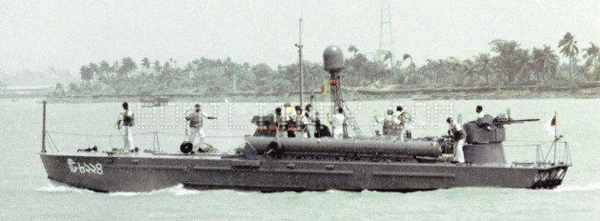
A P4 FAC/T (here Bangladesh Navy), official Soviet name was Project 123K
They involved USS Maddox and USS Turner Joy, patrolling in rough seas and poor visibility. According to their radar contacts, both ships believed they were under attack again by NVN boats.
They maneuvered evasively and fired back for hours. Later, the U.S. launched airstrikes in retaliation. However no confirmed enemy presence was ever found. Later investigations (NSA, Pentagon Papers, etc.) concluded no second attack occurred. Radar and sonar “contacts” were likely false positives (weather, misreadings, etc.).
As a consequence Pdt. Johnson passed the Gulf of Tonkin Resolution on August 7, 1964 by U.S. Congress, Voted nearly unanimous (House: 416–0, Senate: 88–2). What It Authorized:
President Lyndon B. Johnson was given sweeping authority to use military force in Southeast Asia without a formal declaration of war.
“To take all necessary measures to repel any armed attack against the forces of the United States and to prevent further aggression.”
This bevaame a major escalation of U.S. military presence in Vietnam which in 1965 resulted in the deployment of ground troops, airstrikes, and full-scale involvement.
Lrgely considered as a turning point and direct trigger for full U.S. entry into the Vietnam War, the second incident is still marked by controversy as evidence for the second attack (always denied by the NVN) was later proven unreliable or fabricated. It sparked decades of debate over executive war powers, intelligence manipulation, and credibility gaps between government claims and facts.
NVN Special Operations

RVNN Yabuta Junk, used for controlling riverine traffic and smugglers
The NVN multiplied coastal infiltrations to the south by night, a true campaign using a fleet of cargo trawlers, which frequently ran blockades to supply Viet Cong forces.
The U.S. and RVNN (South Vietnamese Naval Forces) countered this with Operation Market Time, an extensive coastal interdiction effort.
However the NVN had its Limitations and Challenges, no air cover or submarines, being heavily outgunned by the U.S. Seventh Fleet and even the RVNN and relying on concealment, guerrilla tactics, and local knowledge of waterways. Its Legacy and Evolution are found with the 1975 transition from the North Vietnamese Navy to the Vietnam People’s Navy. It was its core, providing the bulk of its assets and experiences officer cadree to train a new generation of Vietnamese naval officers, the generation shaping the VPN we know today.
Many of its riverine and guerrilla warfare tactics also influenced later asymmetric naval doctrines. Tactics that were used eslewhere in Asia and in Africa.
Creation of the VPN (1975)
When South Vietnam was conquered by the armed forces of North Vietnam in April 1975 most of her navy’s sea-going warships escaped capture by sailing into foreign ports (mainly Philippine). They totalled ten escorts, seven landing ships, three patrol vessels and three repair ships. Other ships were destroyed or were captured by the North Vietnamese in a poor state of repair. or example, the frigate Tran Khanh Du (HQ 04) was captured in Saigon during refit; others were scuttled, such as the LSM Lam Giang (HQ 402), Keon Neva (HQ 604) and the oiler HQ 474,
It is difficult to give an accurate account of the fates of most former South Vietnamese ships because of the lack of official information covering the last twenty years since the fall of Saigon. However, several larger units have been seen at sea and where more information has come to light about these ships, it has been added to their entries in the South Vietnam section. Large numbers of captured ships have either been stricken or are extant in a very marginal condition due to age and lack of spares.
The Vietnam War (1946 75) is thought of mainly as a ground and air conflict but in both phases, French and American, naval operations, especially amphibious and river ones, were widespread. One whole theatre of war, the Mekong Delta, was a watery maze never dominated by one side or the other. American involvement was gravely increased by the Gulf of Tonkin Incident in August 1964. On 2 August three North Vietnamese ex-Soviet ‘P 4’ torpedo boats attacked the destroyer Uss Maddox 30 60 miles off the coast because she had been violating territorial waters (Hanoi claimed 12 miles instead of 3) and more importantly because she had given distant cover to a South Vietnamese 31 July bombardment of the North Vietnamese islands of Hon Me and Hon Nieu, 3 5 miles from the mainland. Communist infiltration of the South was done by sea as well as by the Ho Chih Minh Trail. A second apparent attack (4 August) on Maddox and her sister destroyer Turner Foy in an atmosphere of considerable electronic confusion precipitated US carrier air strikes that claimed the destruction of twenty-five North Vietnamese warships and fuel bases for the loss of three planes and a pilot.
By this stage South Vietnam’s Navy (established 1 January 1955) numbered 15,350 men including a marine corps whereas the North had 2200 sailors (given warships from 1958). Six years later the South’s navy had doubled to crew thirty-nine surface combatants, 215 landing vessels, twelve mine launchers and thirty auxiliaries. Their role was increasingly active despite the US Navy’s obvious predominance. Both services played a crucial part in blunting the North Vietnamese 1972 offensive into Quang Tri Province with gunfire support and amphibious landings.
The South’s naval prowess was demonstrated in January 1974. A Chinese battalion-strong invasion of the Paracel Islands, 225 miles east of Vietnam, cost the Communist superpower two warships sunk and two heavily damaged for one Vietnamese vessel (twenty-three survivors rescued by a Dutch cargo ship). Ten days later the Souths’ warships put troops on to the Spratly Islands, 300 miles to the southwest, to prevent their seizure. In April 1976 the Vietnamese Liberation Navy replaced the garrison.
The fall of South Vietnam in early 1975 began in the Central Highlands and her navy, short of fuel and spare parts though not ammunition, could not provide the firepower that had been available in 1972. Evacuation of Hue, Da Nang (6000 marines and 4000 other troops), Qui Nhon and other coastal towns degenerated into chaos and heralded the exodus since of 800,000 ‘Boat People’.
In 1995 the Vietnamese Navy had some 7000 personnel operating its ageing ficet of ex-Soviet and American ships together with a landbased force of thirteen helicopters and three ASW. amphibians. During the brief Sino-Vietnamese war of 1979, the Soviet Pacitic Fleet increased its presence at Cam Ranh Bay, and it was reported that nuclear submarines were using the anchorage, but following the withdrawal of all Soviet forces from overseas bases, the loss of Soviet support has hit the navy hard and the operational status of many of its units is questionable.
Remaining South Vietnamese Naval Assets

RVNS Tran Hung Dao (HQ-1), Tran Hung Dao was acquired in 1971. To avoid capture by the communist forces in 1975-6, she fled to the Philippines, where she was taken into service as BRP Rajah Lakandula. Many other had the same fate.
Ex-US EDSALL (FMR’) class frigates
> Tran Hung Dao (HQ 01, ex-Camp, 6.2.71), Tran Kanh Du (HQ 04, ex-Forster, 25.9.71).
Former USN destroyer escorts. Built in 1943-44. Extensively converted to radar pickets after 1945. In 1965 large radar antennae was removed and the ships were employed in Indo-China as patrol.frigates until transferred to S Vietnam. It has been reported that former-HQ 4, renamed Dai Ky, was extant as a training vessel with the Vietnamese Navy in 1994.
Ex-US BARNEGAT class seaplane tenders (frigates)
> Tran Quang Khai (HQ 15, ex-Bering Strait WHEC 382, ex-AVP 34), Tran Nhat Duat (HQ 16, ex-Yakutat WHEC 380,. ex-AVP 32), Tran Binh Trong (HQ 17, ex-Castle Rock WHEC 383, ex-AVP 35), Tran Quoc Toan (HQ 02, ex-Cook Inlet WHEC 384, ex-AVP 36), Tham Ngu Lao (HQ 03, ex-Absecon WHEC 374, ex-AVP 23), Ly Thoung Kiet (HQ 05, ex-Chincoteague WHEC 375, ex-AVP 24), Ngo Kuyen (HQ 06, ex-McCulloch WHEC 386, exWachapreague AGP 8, ex-AVP 56)
Built 1942-44 as USN seaplane tenders and transferred in 1946-48 to US Coast Guard then to S Vietnam. First two pairs on 1 January 1971 and 21 December 1971. Tham Ngu Lao transferred on 15 July 1972 and the last pair on 2 June 1972. These ships were the largest combatants in the S Vietnamese Navy and the only ones to mount a 127mm gun battery. It is believed that all ASW weapons were removed before transfer. In the late 1970s, one unit of this class, former HQ 03, which had been captured in 1975 and renamed Pham Ngu Lao, was fitted with 2 SS-N-2 SSM removed from a stricken ‘Komar’ class FAC(M) and Soviet-built light guns were added. She was reported extant 1995.
Ex-US LST type tank landing ships:
> Cam Ranh (ex-Marion County LST 975), Da Nang (ex-Maricopa County LST 938), Thi Nat (ex-Cayuga County LST 529), Vung Tau (ex-Cochino County LST 603), Qu: Nhon (ex-Bullock County LST 509), Hna Trang (ex-ferome County LST 484). Built in 1943-45, transferred to S Vietnam in 1962 and numbered in order above (HQ 500, HQ 501), 1963 (HQ 502, escaped 1975), 1969 (HQ 503), 1970 CHQ 504, 505). Three reported extant, in poor condition, in 1995, Ex-US LSM type medium landing ships Class (former nos): Hat Giang (ex-LSM 9011, ex-LSM 335), Han Giang (ex-LSM 9012, ex-LSM 110), Lam Guang (ex-LSM 226), Ninh Giang (ex-LSM 85), Huong Giang (ex-Oceanside, LSM 175), Tien Giang (ex-LSM 313), Hau Giang (ex-LSM 276)
All seven built in 1944. First two units transferred by USA to France in January 1954 for use in Indo-China and in December 1955 transferred to Vietnam (fitted as hospital ships, LSM-H). Numbered HQ 400-406. LSM 175 transferred in 1961, LSM 313 in 1962 and LSM 276 in 1965. HQ 401 and HQ 404 escaped in 1975. HQ 402 scuttled.
Ex-US LSSL type landing support ships:
Nguyen Van Tru (ex-No Than, ex-Framée, LSSL 105), Le Trong Dam (ex-Linh Kiem, ex-Arquebuse, ex-LSSL 4), Le Van Binh (ex-Faveline, ex-LSSL 10), Deut Ngoc Tayg (ex-Hallebarde, ex-LSSL 9), Lulu Phu Tho (ex-LSSL 101), Nguyen Ngoc Long (¢x-LSSL 96), Nguyen Duc Bong (ex-LSSL 129).
All seven built in 1944-45. Numbered HQ 225 231 by S Vietnam. Fint four transferred to France in 1951 and two (11Q 225, 226) retransterred to Vietnam in 1955 and 1957. HQ 227-230 transferred in 1953 to Japan and retransferred to Vietnam in 1965. Nguyen Duc Bong transferred in 1966. First three officially stricken from the list in 1971. Le Van Binh sunk in 1966, Nguyen Van Tru sunk in 1970, Le Trong Dam sunk in 1970. Three (HQ 228, 229 and 231) escaped in 1975.
-6 LSTs (tr.1962), 7 LSM (1955), 7 LSSL (1955), 5 LSIL (1955), 18 LCU (1954, 1971). The 1954-55 were ex-French, ex-US landing crafts/ships.
-To this green water and coastal fleet, the RVNN received 3 PCE (1961), 5 Admirable class minesweepers (1962), 6 PCE 173ft (1955), 2 SC types sub-chasers (1955), 19 PGM patrol crafts (1963), 26 82ft “Point” patrol crafts (1969), 3 Bluebird class (1959), 3 YMS Type coastal minesweepers (1954).
US PGM (L00ft) type large patrol craft:
> Phi Du, Tren Moi, Minh Hoa, Kien Vang, Keo Ngua, Kim Quit, May Rut, Nam Du, Hoa Lu, To Yen, Dinh Hai, Truong Sa, That Binh, Thi Tu, Song Tu, Tat Sa, Hoang Sa, Phu Quit, Hon Troc, Tho Chau
Welded steel patrol boats built in the US yards specifically for foreign transfer and assigned PGM numbers (59 70, 72 74, 80 83, 91) for contract purposes. Twenty transferred on completion and numbered HQ 600 629 in 1963 67. Built by J M Martinac SB Corp, Tacoma (HQ 600-605), and Marinette Marine Corp, Washington (the rest). Phu Du and Hon Troc escaped in 1975.
Ex-US 82ft “POINT” class large patrol craft:
> Le Phuoc Dui (ex-Point Garnet 82310), Le Van Nga (ex-Point League 82304), Huynh Van Cu (ex-Point Clear 82315), Nguyen Dao (ex-Point Gammon 82328), Dao Thuc (ex-Point Comfort 82317), Le Ngoc Thanh (ex-Point Ellis 82330), Neuyen Ngoc Thach (ex-Point Slocum 82313), Dang Van Hoanh (ex-Point Huason 82322), Le Dinh Hung (ex-Point White 82308), Thuong Tien (ex-Point Dume 82325), Pham Ngoc Chau (ex-Point Arden 82309), Dao Van Dang (ex-Point Glover 82307), Le Dgoc An (ex-Point Jefferson 82306), Huynh Van Ngan (ex-Point Kennedy 82320), Tran Lo (ex-Point Young 82303), Bui Viet Thanh (ex-Point Partndge 82305), Nguyen An (ex-Point Caution 82301), Nguyen Han (ex-Point Welcome 82329), Ngo Van Quyen (ex-Point Banks 82327), Van Dien (ex-Point Lomas 82321), Ho Dang La (ex-Point Grace 82323), Dam Thoai (ex-Point Mast 82316), Huynh Bo (ex-Point Grey 82324), Neuyen Kim Hung (ex-Point Onent 82319), Ho Day (ex-Point Cypress 82326), Troung Ba (ex-Point Marmoc 82331)
Twenty-six former US Coast Guard 82ft cutters designated WPB (actual length 83ft oa). Transferred to Vietnam in 1969 (HQ 700-707) and 1970 (HQ 708 725). Huynh Van Cu (HQ 702) escaped in 1975.
Ex-US BLUEBIRD class coastal minesweepers:
> Ham Tu (HQ 114, ex-MSC 281, Chuong Duong II (HQ 115, ex-MSC 282), Bach Dang IT (HQ 116, ex-MSC 283)
Built in 1958—60 and transferred under MAP to Vietnam in 1959 (first two) and 1960. Bach Dang II grounded on 9 October 1970, was stripped and destroyed.
Ex-US YMS type coastal minesweepers Class:
> Ham Tu (HQ 111, ex-Aubepine, ex-YMS 28), Bach Dang (HQ 113, ex-Belledone, exYMS 78), Choung Dong (HQ 112, ex-Digitale, ex-YMS 83) Transferred from the French Navy to Vietnam on 11 February 1954. Ham Tu deleted in 1958, Bach Bang in 1963 and Choung Dong in 1964. Five ex-Soviet ‘K 8’ class, built in Poland in the late 1950s. Transferred to Vietnam in October 1980. Extant 1995.
RIVERINE CRAFT:
For its brown water navy the South Vietnamese Navy received a force of nearly 700 ships also served the RVN: The first were former French vessels ceded in 1955, and the US transferred in the late 1960s and until 1972 many of their own riverine patrol crafts. The only known list given by the USN during the withdrawals states the following:
107 Swift PCs, 293 PBR, 28 RPC, 84 ASPB, 42 river monitors, 22 LCM-6, 100 ATC (armoured troop carriers), 9 CCB command crafts, 4 CSB (salvage ships), 24 minesweeping launches. Added to this there was the large “junk fleet” backed by the US but relatively inefficient (see later).
There were over 700 armed craft transferred to South Vietnam by the US Navy from 1965 for use in the riverine and coastal areas of Indo-China. There were also many former French craft which were widely used in the late 1950s and early 1960s. Some of them™Survived even into the 1970s. The exact number of these small craft serving at any given time is difficult to determine. Below are listed all ex-American craft which were in existence in 1972. There were:
-107 ‘Swift’ type patrol craft; 293 PBR river patrol boats
-Twenty-eight RPC river patrol craft
-Eighty-four ASPB assault support patrol boats
-Forty-two river monitors
-Twenty-two LCM 6 landing craft
-100 ATC armoured troop carriers
-Nine CCB command and patrol boats
-Four CSB combat salvage boats
-Twenty-four minesweeping launches.
A coastal force of motorised junks was organised with US assistance on 12 April 1960 with 100 junks, twenty-eight groups of junks having been formed by June 1962. Mass production of improved design junks was undertaken to control infiltration of S Vietnamese coastal waters. The latest junks had diesel engines capable of reaching 15kts. They were fitted with armour plates and glass fibre to protect the wooden hull against marine borers and small arms fire. By 1969 about 500 junks were crewed by some 4000 men. Coastal Force (ex-Junk Force) become part of the Vietnamese Navy and no longer a paramilitary organisation in July 1965. Approximately 250 motor-propelled junks were pressed into naval service in January 1972 and these included sixty-rwo command junks, thirty-one Kien Giang junks, and 153 Yabuta junks. Some of the Yabuta junks were built of ferrous cement, the Yabuta junks usually had two .50 cal MGs; some also had a 60mm mortar, Diesel propulsion permitted them to overtake and search some of the thousands of coastal sailing craft in Indo-China waters.
1975-1991 Nomenclature
 Ex-Barnegat class fleet Tender

RVNS Trần Bình Trọng (HQ-05) pierside at right, with her sister ships RVNS Trần Quốc Toản (HQ-06) (center) and RVNS Trần Quang Khải (HQ-02) (left).
Ex-USN (ww2), ex-USCG, ex-South Vietnam. Pham Ngu Lao was commissioned into the Vietnam People’s Navy as the patrol vessel PRVSN Pham Ngu Lao (HQ-01). The Vietnam People’s Navy appears to have retained its major components, such as the 5-in/38-caliber and 81-mm mortars but by the mid-1980s, Soviet-made 37-mm and 25-mm guns were installed for close-in defense, as were two Soviet-made SS-N-2 (NATO reporting name “Styx”) anti-ship cruise missile launchers and two Soviet-made quad SA-N-5 (NATO reporting name “Grail”) surface-to-air-missile launchers. On 10 January 1979, Pham Ngu Lao joined the Vietnam People′s Navy patrol boats HQ-03, T-197, T-199, T-203 and T-205 in an action off Ream, Cambodia, that resulted in the sinking of two Cambodian warships. Pham Ngu Lao’s status in the secretive Vietnam People’s Navy is murky, but she was thought to be in active service into the 1990s and perhaps as recently as 2000. By the early-to-mid-2000s she apparently was inactive and may have been decommissioned. Two others had the same fate, the other Barnegat fled to the Philippines.
Specs:
Displacement 1,766 tons (standard), 2,800 tons (full load)
Dimensions 310 ft 8 in x 41 ft 1 in x 13 ft 5 in (94.69 x 12.52 x 4.09 m)
Installed power: 2 x Fairbanks-Morse 38D8-1/8-10 diesel engines 6,080 hp max, 3,540 hp sustained: 18 knots.
Range: 20,000 nautical miles (37,040 kilometers) at 12 knots. Crew c200
Sensors: Raytheon SPS-21 surface-search radar, RCA/GE Mark 26 fire-control radar
Armament (mid-1980s):
-2 × Soviet SS-N-2 “Styx” anti-ship cruise missile launchers (aft)
-2 × Soviet quad SA-N-5 “Grail” surface-to-air-missile launchers
-3 × Soviet 37-mm/63-caliber guns
-2 × Soviet twin 20-mm gun mounts
All missile armament probably removed in 1990s.
Ex-Soviet ‘PETYA’ class frigates
Class: HQ 9, HO 11, HO 13, HQ 15, HQ 17
First pair were ‘Petya III’ export type, as transferred to Syria and India, acquired 1978. Remainder were standard ‘Petya II’ type transferred in April
1981 (second pair) and December 1984. All reported extant 1995
Ex-Soviet ‘POLNOCNY B’ class landing ships
Class: HQ 511, HQ 512, HQ 513
Three units transferred May 1979, November 1979 and February 1980 respectively. All reported extant 1995.
OTHER LANDING CRAFT: Twelve ex-Soviet ‘T 4’ class landing craft transferred 1979.
Ex-Soviet ‘P 4 class fast attack craft (torpedo)
Twelve transferred to North Vietnam in 1961 and 1964. Some may have been built in China. Three of this class attacked US destroyers in the August 1964 Gulf of Tonkin incident. Several were sunk in action, remainder all now stricken.
P 6 class fast attack craft (torpedo)
Six Chinese-built Soviet ‘P 6’ class FAC(T) transferred c1967. All now stricken.
Ex-Soviet ‘KOMAR’ class fast attack craft (missile)

Three transferred 1972. One lost in action 19 December 1972. Remainder stricken by c1982.
Ex-Soviet ‘SHERSHEN’ class fast attack craft (torpedo)
HQ 301-HOQ 314
Two transferred (without TT) in April 1979, followed by eight, in pairs, in September 1979, August 1980, October 1980 and 1981, and a further four in June 1983. All reported extant 1995, but operational status unclear.
Ex-Soviet “OSA II” class fast attack craft (missile)
Eight transferred, in pairs, in October 1979, September 1980, November 1980 and February 1981. All extant 1995.
PATROL BOATS AND CRAFT
-Fifteen ex-Soviet ‘SO 1’ class submarine chasers, used as patrol boats. First group of seven transferred 1960-61 (two), 1964-65 (two) and 1966 (three). One lost in action to US air attack 1 February 1966. All of this group stricken. Second group of eight transferred in pairs March 1980, September 1980, May 1981 and September 1983 respectively. Of this group, four were reported extant in 1995.
-Eight ex-Chinese ‘Shanghai II’ class large patrol boats, transferrred in two groups of four in 1966 and 1968 respectively. None extant 1995.
-Four Soviet “Turya’ class patrol boats, transferred May 1984 (one), November 1984 (one) and 1986 (two). All reported extant 1995.
-Fifty ex-Chinese ‘Swatow’ type patrol craft transferred in 1958 (thirty) and 1964 (twenty). Up to twenty-six either lost in action or deleted by 1982, remainder since stricken.
-Two ex-Soviet ‘Poluchat’ type patrol craft transferred 1960. Both since stricken.
-Two ex-GDR ‘Bremse’ class patrol craft transferred cl1978. Both now stricken.
-Fifteen Soviet ‘Zhuk’ class patrol craft: three transferred 1978, three in 1979, one each in November 1981 and May 1985, three in 1986 and two each in 1989 and 1990. Four have since been stricken. Eleven reported extant 1995, but condition of older units unlikely to be poor.
-Two Soviet ‘PO 2’ class patrol craft, transferred 1980. Both extant 1995, MINE WARFARE VESSELS Two ex-Soviet ‘Yurka’ class ocean minesweepers, both transferred December 1979, Extant 1995, but must be near the end of their useful life.
-Four Soviet ‘Sonya’ class coastal minesweepers, New construction, transferred on 16 February 1987, February 1988, July 1989 and March 1990. All extant 1995.
-Two Soviet “Yevgenya’ class inshore minesweepers, delivered November 1984, Operate in Cam Ranh Bay. Both extant 1995.
Structure Today
 The VPN began started to modernize with contracts to Russia, purchasing two Gepard-class frigates in 2006. Many changes were implemented to transform the VPN from a brown-water to a green water navy capable of safeguarding its territorial interests at least for the South China Sea, notably due to Chinese PLAN’s agressive expansion. Its most modern ships in 2011 were the followjng:
-5 Petya-class frigates (2 Petya-III’s from the late 70s, and 3 Petya-III’s from the 80s)
-1 KBO-2000 fast attack craft. The navy attempted a KBO-2000 project with Russia on which worked the Severnoye Design Bureau, which designed it for construction in Vietnam, at Ba Son Shipyard in Ho Chi Minh City. She was designated HQ-381, but never meet the Navy’s expectations, so the project was canceled.
Organization
Operational Levels:
Naval Headquarters (Bộ tư lệnh Hải quân) takes command of the entire Navy
> Naval Regions (Vùng Hải quân) 1st, 2nd, 3rd, 4th, 5th
> Naval Brigade (Lữ đoàn Hải quân)
> Naval Regiment (Trung đoàn Hải quân)
> Naval Battalion (Hải đoàn)
> Squadron (Hải đội)
Naval Regions

On 26 October 1975, the Ministry of Defence issued Decision No.141/QD-QP establishing five Coastal Areas for the Naval Command and jurisdiction.
In 1978, they were renamed as the following naval regions:
1st Regional Command (A Regional Command)
Gulf of Tonkin, north coast from Quảng Ninh to Hà Tĩnh and the islands in Gulf of Tonkin. Command Headquarters: Haiphong. Note, each is under a commander, rear admiral, and political commissar, also a rear admiral.
2nd Regional Command (B Regional Command)
South China Sea and south coast from Bình Thuận to Bạc Liêu, southern continental shelf, including the key areas are economic science service areas (called are DK1, DK2). Command Headquarters: Nhơn Trạch, Đồng Nai.
3rd Regional Command (C Regional Command):
North central coast, from Quảng Bình to Bình Định, including the islands of Cồn Cỏ, Lý Sơn,… and Paracel Islands. Command Headquarters: Da Nang.
4th Regional Command (D Regional Command):
South China Sea, south central coast including Spratly Islands, Phú Quý island and the south central coast, from Phú Yên to Bình Thuận. Command Headquarters: Cam Ranh Bay military port, Khánh Hòa province.
5th Regional Command (E Regional Command):
South China Sea and coast in Gulf of Thailand from Cà Mau to Kiên Giang. Command Headquarters: Phú Quốc, Kiên Giang.
Vietnamese Naval Academy
The Vietnamese naval academy (headquarters Nha Trang) remains the main institute for training naval commanding officers at divisional level, but also commanding staffs at tactical/campaign levels. Students could be both undergraduates and postgraduates of the military (all branches). It inherited the assets of the Coastal Training School created in SVN on 26 April 1955 by the General Staff. It changed name several times (Training School 1959, Naval School of Vietnam 1961, Naval Officers School 1967, School of Naval Engineering Command 1980). It was last renamed the Naval Academy in 1993. It trained thousands of officers and technical staff in the following courses:
Vessel control, mining and anti-mine operations, anti-submarine missiles, gunships, information, radar, sonar, coastal radar, shipyard work, the Coast Guard, and Border Defence Force.
Reputed, it also trained both the Royal Cambodian Navy and the Lao People’s Navy.
Vietnamese Naval Infantry
 The Naval Infantry Brigades (Lữ đoàn Hải quân Đánh bộ) are a semi-independent combat arm of the Vietnam People’s Navy, stationing troops to protect islands, rocks and inland naval bases, wit more traditonal missions such as landings on the mainland or contested islands protecting territorial sovereignty and the Vietnamese EEZ.
According to the International Institute of Strategic Studies (IISS) in 2010 this is the second largest marine corp next to the US Marine Corps. It took its origin in the Vietnam War when after success of the sapper unit in 1967-69, the People’s Army of Vietnam raised a new 500-man sapper unit trained for amphibious warfare, the 126 Naval Sapper Group.
Itrs first deployment was around the Cửa Việt river, south of the DMZ, making many incursions, notably of the Cửa Việt Base. Largest action was for the Battle of the Paracel Islands, after the defeat of the SVN. It also acted as proxy for PLAN ground invasion phase when landing on the Spratly Islands and others still held by South Vietnam. Postwr it expanded to become a brigade of 950 men and renamed the 126 Marine Brigade.
It took part also in the Cambodian–Vietnamese War, reinforced by the creation in 1978 of a second brigade, taikng part in the invasion of Cambodia. On January 6, 87 commandos secretly landed and attacked to occupy a Khmer Rouge artillery position protecting the coast. There was a battle at sea, but thanks to its superiority in numbers and firepower, the Vietnam People’s Navy repelled or sank most of the Khmer Rouge ships, with one NVN hip hit (casualties).
Every year, NVN infantry brigades send waves of soldiers to Spratly Island to train for months and get used to all weather conditions and get used to the island landings, close to the battlefield. Today their mission is more complicated as China claimed all islands and archipelagoes in the area, including the Spratly and Paracel, in fact the entire South China Sea. On May 6, 2009, its nine-dash line plan submitted to the UN was contested by Vietnam, Malaysia and then Indonesia. The Brigades 101 and 147 today are completed with the 955th Amphibious Transport Brigade (Region 4 Command, 2024).
Its assets includes, apart a wide arrawy of smal arms, RPGs, mortars, RCR, ATGMs:
-150 Type 63 Chinese equivalent of the Soviet PT-76, called PT-85 in local service (85 mm gun)
-300 PT-76 (Soviet built, provided in the 1970s)
-45 T-34/85 ex-Soviet, inherited from Vietnam era, used for training.
-c100 BTR-40 4×4 APCs, ex-Soviet
-c400 BTR-60 8×8 APC, ex-Soviet
-c600 BTR-152 6×6 APC, ex-Soviet
Total accepted by most sources, 1100 in park. Status and maintenance is unknown.
-PTS-M: Tracked amphibian transport: Unknown numbers.
-Artillery (towed): D-44 85mm field gun and M-46 130mm field guns
-Artillery (rocket, SPG):
> A number of ACCULAR Israeli 6×6 truck based 122–160 mm rocket artillery
> K51 Rubezh Coastal defence missile system, 8×8 truck, uses the P-15 Termit, P-21, and P-22 missile 40 km for coastal defence
> 4K44 Redut-M Coastal defence missile system (P-5 Pyatyorka, 80 km of range) for coastal defense
> VCS-01 Trường Sơn Coastal defence missile system truck (80–300 km range with VSM-01 missile base KAMAZ-6560 8×8 truck)
> 20x EXTRA 306 mm rocket artillery (Israeli 8×8 truck system), 150 km range, coastal defense.
> 4x K-300P Bastion-P10 launchers (120–300 km range) with the P-800 Oniks missile 2011: 4 TEL along with radars, command, and support vehicles. Coastal defense.
Vietnamese Naval Air Component
-6x HC-6 Twin Otter Patrol aircraft (from Canada) for maritime patrol: ELM-2022A radar.
-2 Eurocopter Super Puma (H225M) Patrol helicopter
-8x Kamov Ka-27 and Ka-32 ASW Helicopter, modernized in Ukraine 2014. Spratly islands and from Gepard class FFs. Photo
-3x IAI HERON Mark 2 MALE UAV wit the ELM-2022 radar
-6x Insitu ScanEagle for maritime reconnaissance
-? Orbiter 2 (Israel) for artillery reconnaissance, 685th Coastal Missile Brigade.
Today’s ships
Hanoi class submarines

Class: Hà Nội (182) Thành phố Hồ Chí Minh (183) Hải Phòng (184) Khánh Hoà (185) Đà Nẵng (186) Bà Rịa-Vũng Tàu (187)
Six Kilo (Project 636.1) class conventional attack subs, Commissioned 2014–2017. Equipped with Kalibr/Club-S missiles.
Yugo type Midget Submarines
Class: 41 42 43 (TN-75). Used as training vessels. A part of the 196th Regiment of the Vietnam People’s Navy. Domestically overhauled.
The 196th Regiment introduced a third domestically produce midget submarine, known as TN-75. Specification is unknown but likely a reversed engineered variant of the Yugo class submarine. Designed by Naval Technical Institute and built by Factory X51.
~90-110 tons for Yugo class submarine.
~75 tons for TN-75 submarine.
The NVN also operates a Pluto Plus Unmanned Underwater Vehicle (UUV) built in Italy for mine warfare, often deployed from Sonya-class minesweeper. Used to better effectiveness of minesweeping and training.
Đinh Tiên Hoàng class Frigates

Class: Đinh Tiên Hoàng (011)Lý Thái Tổ (012)Trần Hưng Đạo (015)Quang Trung (016)
Russian-built Gepard class frigates Mark 3.9 (Project 11661E). 015 and 016 are tailored for ASW but 011 and 012 for A/S. Two more planned, contract terminated wit the Russo-Ukrainian war.Overhauled at Factory X52 in Vietnam. Hangar reconstructed, domestic AK-176 naval gun and AK-630 CIWS to be installed.
Petya class Frigates

Class: 09, 11, 13, 15, 17
Petya-II/-III (Project 159A/AE) class frigates built in USSR and transferred in the 1980s. Heavily modernized in Vietnam. Rebuilt stealthy superstructure, new combat suites. Electrical and mechanical systems upgraded with modern components, communication, radar, electronic, sensor, bridge systems upgraded, mosty with Israeli systems. Three are used in the ASW role, two converted to gunboats.
Ex-Khukri Missile Corvette

Single Khukri class Guided-missile corvette unnamed #26 transferred from India, ex-Kirpan after being decommissioned from Indian Navy service on 22 July 2023.
Pohang class Corvettes

Class: 2 ships, #18 and #20
Pohang (Batch III) Anti-submarine corvette built in South Korea, under maintenance, and parts replaced in Vietnam. Extensively overhauled domestically. Domestic KT-184 quad-launchers installed, to launch the Kh-35 Uran missile. May have been removed according to recent info.
Molniya class missile corvettes

class: #375-383: Eight Ships
Molniya (Project 1241.8) Guided-missile corvette: 2 transferred, 6 built Locally produced under licence, at Ba Son Shipyard. 4 more planned in phase two of this project, but the contract was terminated with the Russo-Ukrainian war. The subject is rich enough to be treated as a standalone in the future.
Tarantul-I class Missile Corvettes

Class: 4 ships, 371 372, 373, 374
Regular 459 tonnes Russian-built Tarantul-I (Project 1241.RE). Close enough to the Molniya but expected to be retired and replaced by the BPS-500. For now, they are prolongated.
BPS-500 class Corvettes

Certainly the most interesting topic of the whole nomenclature, they are the only truly Vietnamese designed and built design. The class comprises only one ship, #381.
Oly missile boat under the project KBO 2000, planned in the late 1990s. KBO 2000 is a joint project between Russia and Vietnam for missile boats, in partnership with Severnoye Project Design Bureau (SPKB), involved in the design scheme of the BPS-500 on Vietnam Navy specs. She was built at the shipyard in Ho Chi Minh City (Ba Son Shipyard) with technical assistance and equipment as well as spare parts supplied by Russia. Jane’s in March 1999 started she was completed, launched, and was undergoing sea trials in 1999.
The type shows modern modular technology and angled surfaces for radar scattering, and pump-jet propulsion for better maneuverability in shallow waters.
He combat suite comprises an Igla MANPADS (so so short range) and Kh-35 Uran-E anti-ship missiles.
However Vietnam halted the program without reasons being published, possibly cost, low speed, and seaworthiness issues.
Specs:
Displacement: 517 tons (standard), 600 tons (full load), dimensions 62 x 11 x 2.2 m (203.4 x 36.1 x 7.2 ft)
Propulsion: 2× diesels 19,600 hp, 30 knots/16 knots cruising, RA 2,200 nm at 16 kts or 30 days
Crew: 49. Sensors: Pozitiv-ME surveillance radar, MR-123-03 fire control radar
Armament: 1x AK-176 76mm gun, Igla SAM, 2 AK-630M 30mm CIWS 2x 12.7mm HMGs, 8x Kh-35 Uran-E SSMs
TT-400TP OPVs

Class: 272, 273, 274, 275, 276, 277
Officially classes as gunboats, mid-range offshore patorl vessels, capable of riverine ops. Designed and built in Vietnam.
Specs:
378 tons standard/420/455 tons FK, 54.16 x 9.16 m
2x uiesels, 32 knots, RA 2,500 miles, 30 days endurance
Crew: 28. Sensors: MR-123/176 Vympel/Bass Tilt, Bass Tilt AK-630 FCR
Armament: 1x 76.2mm AK-176, 1 x 30mm AK-630 CIWS, 2 x KPVT 14.5mm HMG
Svetlyak class OPVs

Class: 261, 263, 264, 265, 266, 267
Six Russian built Svetlyak class OPVs (Project 10412 export version) Patrol boats classed as Gunboats (no missiles).
TP-01 class OPVs
Class: 251, 253. Vietnam designed and built 250t CPVs
Turya class FAC/T
Class: 331, 332, 333, 334, 335
Ex-Soviet Turya class (Project 206M) Torpedo boat/fast attack craft. Legay 250t cold war boats. Unknown status as of 2025.
OSA class FAC/M

Class: 354, 355, 356, 357, 358, 359, 360, 361. Legacy Export versions of Osa (Project 205U) Missile boat/fast attack craft
Shershen-class FAC/T
class: 306, 307, 311, 312. Legacy export versions of Project 206 Fast Attac Craft; Torpedo. 172 tonnes, status unknown as of 2025.
Yurka class Minesweepers
Class: 851, 852. Legacy Project 266; 540t, transfer date unknown.
Sonya class Minesweepers
Class: 861, 862, 863, 864. Legacy Sonya class (Project 1265), Heavily overhauled at X-51 Shipyard in Vietnam, practically rebuilt. New Electronics and sonar.
Yevgenya class Minesweepers
Class: 2 ships (unnamed). Legacy coastal Project 1258 from Soviet Union, 96 tons. Status Unknown.
Vietnamese Amphibious Vessels

-2x LST-938 Tank landing ship, 2 ships, ex-US, ex-SVN former USS Maricopa County (LST-938) and USS Coconino County (LST-603), captured. Overhauled at Factory X51.
-4x 1,480 tons Damen Stan Lander 5612 Ro-Ro & Logistic-support landing ship (526,527,528,529). Built at Song Thu shipyard for the Venezuelan government, not delivered, repurchased.
-2x Hùng Vương class Ro-Ro/Logistic/support landing ship (521,522) built in Vietnam, 1,410 tons.
-3x Polnochny-B class landing ship from Poland (Project 771) (511,512,513). Currently being researched and manufactured.
-6x LCU 1466 Landing craft (551,552,553,554,555,556), ex-US, ex-SVN, captured in the Vietnam War.
-4x LCM-8 Landing craft (466,467,470,471), same, captured during the Vietnam War.
Transport/Logistics Support
1x K-122 Transport/Logistics support ship Trường Sa (571), Vietnam built
1x K-123 Logistics support/Hospital ship Khánh Hòa (561), Vietnam built
11x Trường Sa class Transport/Logistics support ship (Trường Sa 01-08, Sa 14-22 built in Vietnam
1x 996 Transport/Logistics support ship built in Vietnam
1x HQ-905 Replenishment oiler 905, built in Vietnam (3,000 tons).
Search-and-Rescue Ships

Truong Sa MT.01 fishing logistic service ship launched in Da Nang, src below
1x Damen RGS 9316 Submarine rescue ship Yết Kiêu (927) +1 built from March 2025 in VN. 927 in the Netherlands. Like Z189 Shipyard MV Stoker, MV Besant.
1x FET 10- Submarine Rescue Vehicle/Deep-submergence rescue vehicle (UK), with 2 RHIBS, decompression chamber, on-board medical facilities.
1x Perry® XLX-C Remotely Operated Vehicle, Remotely operated underwater vehicle 1 (+1) UK built
2x Small-size speed boat, +2 built Netherlands, comp. Vietnam
1x HSV-6613 Ocean surveillance ship Trần Đại Nghĩa (888), Netherlands, Damen designed and built by Song Thu Corporation (+1).
1x FC-624 Fast-react search-and-rescue & Patrol vessel (924), RHIB, helipad, built by X51 Shipyard.
1x HQ-954 Search-and-rescue vessel (954) Vietnam built.
Lê Quý Đôn (286) cadets TS

Polish Built schooner.
Armaments
To come in 2026
Read More/Src
Books
Chesneau, Roger. Conway’s All the World’s Fighting Ships 1922–1946. New York: Mayflower Books, Inc., 1980
Gardiner, Robert. Conway’s All the World’s Fighting Ships 1947-1982, Part I: The Western Powers. NIP
Gray, Randal, Ed. Conway’s All the World’s Fighting Ships 1947-1982 Part II: The Warsaw Pact and Non-Aligned Nations. NIP
Moore, John, Captain, RN, FRGS, Ed. Jane’s Fighting Ships 1973-1974. London: Jane’s Yearbooks, 1973.
Edward J. Marolda & Oscar P. Fitzgerald, The United States Navy and the Vietnam Conflict: From Military Assistance to Combat, 1959–1965.
Nguyen Duy Hinh, The South Vietnamese Society and the War Effort.
U.S. Naval War College publications on Operation Market Time and riverine warfare.
Vietnamese-language sources (official histories from the Vietnamese Ministry of Defense).
“Dereliction of Duty” by H.R. McMaster (on political-military decision-making in Vietnam).
The Pentagon Papers (declassified government study revealing the incident’s misrepresentation).
NSA Report (2005): Spartans in Darkness – confirmed no second attack occurred.
Links
web.archive.org/ vnafmamn.com
en.wikipedia.org Vietnam_People s_Navy
en.wikipedia.org/ List_of_equipment_ Vietnam People’s Navy
web.archive.org en.dangcongsan.vn/
defense-studies.blogspot.com vietnames ka-28 upgraded crimea
reddit.com WarshipPorn/ soviet_era petya class mod
sipri.org/ armstransfers
f-e-t.com forum c-rov successfully completes sea trials
asiapacificdefensejournal.com
asiapacificdefensejournal.com