
 France (1916-1953): Bretagne, Provence, Lorraine
Choices made in 1905 meant France only ever had two classes of Dreadnoughts ever: The Courbet and Bretagne, a total of seven ships, all sharing the same hull essentially, and only differing by the artillery type and arrangement. The three Bretagne (4 planned initially, the extra one for Greece) were laid down as fast as the Courbets could be launched, and entered service in 1916 as France’s first and last super-dreadnoughts, since their successors, the Normandie class and their fabled quad turrets, saw work stalling after the start of WWI. The Bretagne (Brest), Lorraine (Saint-Nazaire) and Provence (Lorient) spent the war in the Mediterranean, heavily involved with the events in Greece and standing watch over Austro-Hungarian moves, or ready to depart for any sortie from the Dardanelles. They were modernized several time in the interwar and arguably far more capable than the Courbets when WW2 started. Provence and Bretagne were sunk at Mers el Kebir (Operation Catapult) and Lorraine was disarmed in Alexandria. The latter saw service under the FFL however until the end of the war, taking part in Operation Dragoon and shelling the last German pockets on French the west coast, then a barrack ships until 1953.

Bretagne as completed, colorized by irootoko JR.
Development of the Bretagne class
France’s wartime dreadnoughts
Before the war, France’s first dreadnoughts, the Courbet class had entered service in 1911-1912 armed with 305 mm or 12 inches guns. In the meantime, the dreadnought design was still improving on the other side of the Channel, both in terms of calibre and configuration, but also speed, and entered from 1911 with the Orion class into the “super-dreadnought” type, sporting greater than 12-inches main guns. According to the ambitious French 1912 naval construction programme, a new battleship class was scheduled for 1913. It was to be like the British Queen Elisabeth and Revenge class, armed with a new generation of 15-inches guns. However, development at Schneider dragged on due to chronic underfunding that as construction already proceeded after plans had been approved, the alternative re-barreled 340 mm or 13.4 inches proposed were adopted as stopgap. The 15-in were planned for their successors, the Normandie class, but alas, it was decided to equip them with more 340 mm guns instead, but with quad turrets to compensate range by numbers.
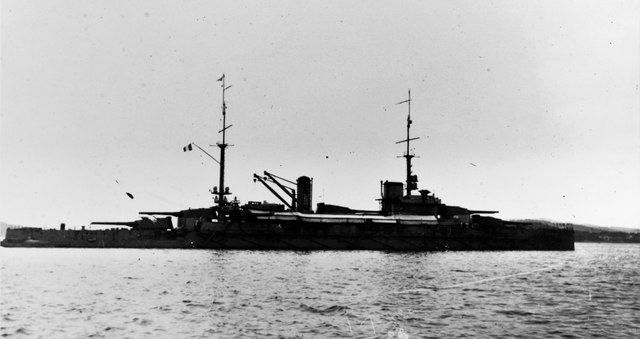
Bretagne in Toulon, 1915 – src history.navy.mil (cc)
Albeit excessive as legitimate battleships worthy of the name were built in the interwar and became the standard for ww2, the Bretagne were nevertheless a leap forward in terms of Battleship design as far as France was concerned, although still 2-3 years late. All three were started in may-july-november 1913 at Lorient, Brest and Loire shipyards (St Nazaire), and commissioned in 1916. Nominally, they were replacements for the Carnot, Charles Martel and Liberté. They had long careers after modernization, well until 1945. Following Normandie and ever more Lyons were to be really amazing designs and we’ll try to have a quick overview of these in another article.
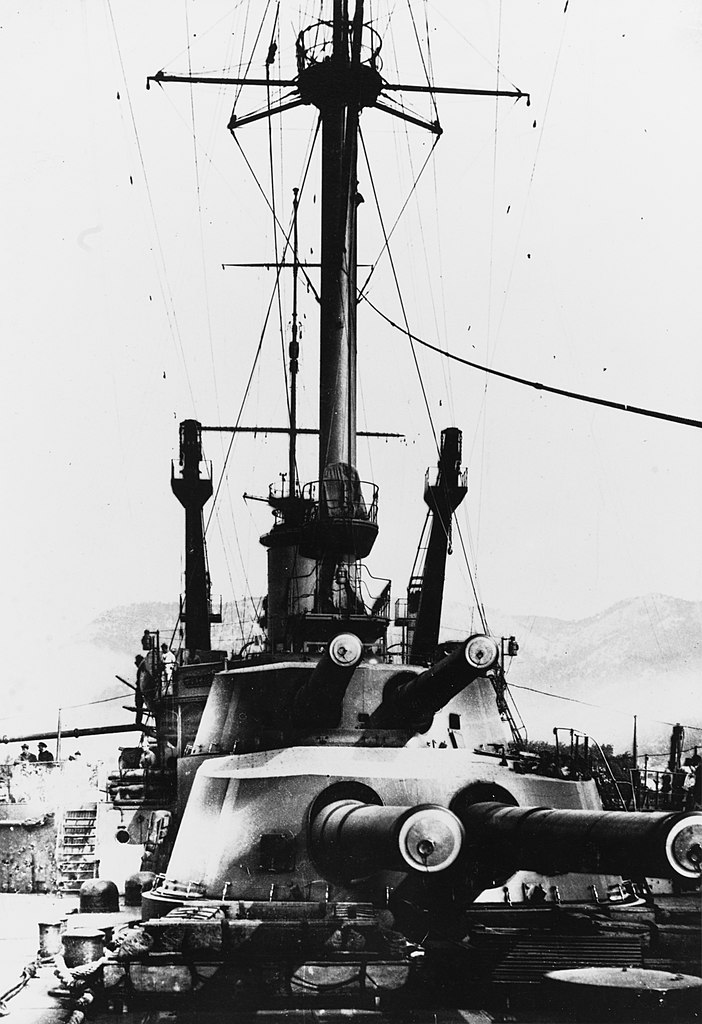
Battleship Bretagne’s aft turrets circa 1919 – Toulon. Photo by Robert Wilden Neeser for the Naval History & Heritage Command
Genesis of the Design
By 1910, France still has not laid down a single dreadnought battleship, whereas Britain had completed ten, plus five battlecruisers, eight and three more under construction, Germany also delivered eight dreadnoughts, the United States six, buiding four more, even the Russian, Austro-Hungarians, Spaniards and Italians had some in construction, on order or about to be delivered. South America was already in this race as well, with Brazil about to be the first equipped. Of all nations, France, which once possessed the world’s second largest navy in the previous century and innovated with Napoleon and Gloire, was facing the consequences of its radical choices with the Jeune Ecole era and returing to a more conventional approach.
But the Marine Nationale was constantly try to catch up in a context of political instability, with a new navy minister every year and shifting priorities and political leverage palying between the two branches. The greatest victim of this state of affairs were French naval infrastructures, which desperately needed modernization. The various yards and arsenals the French had were cramped and often stuck in locations that did not offer much chances of expansion. The cost of new drydocks in particular was difficult to sell to a volatile parliament. The result of this procrastination was a naval construciton in dire straits. The last French Battleships, the Danton class, were capable vessels, but still pre-dreadnought, and construction proceeded despite knowing perfectly that the dreadnought race was already ongoing.
 The French Navy then laid down the first of the four Courbet class ships, waiting for the Dantons to be launched and free their rare drydocks large enough for the task. The four Courbets, still 1st generation dreadnoughts with their 12-in guns were only commissioned soon before the war. Back in 1911 when these were laid down, the French naval staff obviously wanted to remedy to its clear inferiority and obtained that the government passed the Statut Naval on 30 March 1912, notably thanks to a new generation of officers that heavily criticized the Jeune Ecole. This naval plan authorized a force of no less than twenty-eight battleships to be in service by 1920. This of course, never planned the start of any war, like Plan Z for the Kriegsmarine back in 1939. The first three ships of the new class of dreadnought were to be laid down in 1912 and it was agreed to use a new artillery from the start.
The Bretagne class were officially designated to be replacements for the 1890s battleships Carnot, Charles Martel and Liberté to justify construction at the parliament. They were developed from the Courbet class, however. Indeed, if a new artillery was looked after and this development proceeded alongside at Schneider and Le Creusot, the other elephant in the room was a large hull, but again, the naval staff encountered a brick wall when trying to fund new drydocks AND new battleships, the argument put forward by many in the parliament was that even funded, the construction of these new drydocks would delay the dreadnoughts planned for a year or more and jeopardized Boué de Lapeyrère’s ambitious plan. So, the naval staff had to make due to the very same drydocks in emergency and reuse the same hulls to gain design time, by concentrating only in the new artillery.
So it was settled early on the new three battleships (two for 1910, one for 1911) would use the same hulls. The Courbet-class indeed already had been the largest possible ships fitting in existing dockyards and refitting basins at Lorient, Brest and St Nazaire. The Superior Naval Council (Conseil supérieur de la Marine) ordered the construction department to prepare these designs on a precise 23,500-metric-ton (23,100-long-ton; 25,900-short-ton) ship overall, that would be armed with twelve 340 mm (13.4 in) guns, in initially six twin gun turrets. These guns had an interesting story by themselves, to be developed in their respective post section, see later.
The additional weight of the six 340 mm turrets, to be fitted on the same hull, as opposed to six turrets carrying instead 305 mm (12 in) in the Courbet-class quickly appeared unrealistic. This imposed insurmountable problems for designers, which soon concluded it was impossible to use the same arrangement, four on centreline superfiring, two wing turrets amidships. They neeeded indeed an extra 3,000 metric tons (3,000 long tons) displacement together with a significant increase in length and beam so incompatible wth the existing facilities. There were several other proposals reviewed by the Superior Naval Council, which eventually settled on five twin turrets, all centreline design, that did not require a larger hull. It was argued the turret’s position would bringe the exact same broadside of ten guns. The width of the armored belt was also reduced by 20 mm (0.79 in) to compensate for the increased weight of the main battery.
Provence was the first laid down, on 21 May 1912 at Arsenal de Lorient. Bretagne followed at Arsenal de Brest on 22 July and Lorraine at the Ateliers et Chantiers de la Loire shipyard in St. Nazaire, six months later, on 7 November 1912. World War I shaterred all plans to have them completed in 1915 as initially planned. Instead, French industrial capacity was entirely redirected from the Navy to the army and a newly growing air force, sunking down engineers, skilled workers (many of which also enlisted) and resources. So work slowed down, with an already competing design in construction, the Normandie class. With so little to go for, it was decided to suspend the latter and concentrate on completing the three Bretagne class dreadnoughts.
Design
Introduction
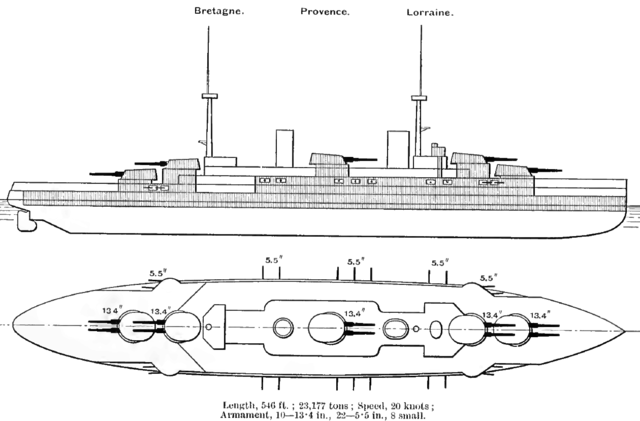
Bretagne design – Brassey’s naval annual (cc)
Both ships classes shared similar hulls and armour arrangements (because of shipyards limitations, as ordered by the Conseil supérieur de la Marine (CSM)), but of course the real change was artillery with 10x 340mm (13.4 in) main guns, arranged in five double turrets all in the centerline. These were the AB, XY front and rear, plus another in the center, located just between the two funnels and superstructures. This made for a reduction in firepower strength both in chase and retreat, but a bigger broadside.
The secondary battery comprised 22x 138.6 mm Mle 1910 guns in barbettes. Although inferior to the 152mm of the British and German types, they had toughly the same range but were much faster to reload, enabling true defensive advantages against fast ships like destroyers and torpedo-boats. There were also 7× 47 mm QF (1.9 in) guns also used for saluting, and 4× 450 mm (18 in) torpedo tubes.
On the armour side however, using the same hull imposed a sacrifice, as the width of the armored belt was reduced by 20 mm (0.79 in) to compensate for the increased weight of the main battery. Like the previous class, armour was in general a bit “light” according to contemporary standards, with only 270 mm for the belt, 314mm for the conning tower but 340mm for the turrets whereas the decks were 40mm thick. For propulsion, all three relied on four Parsons steam turbines, fed by 18 to 24 Niclausse boilers (Lorraine) generating a total output of 29,000 shp (22,000 kW). Speed was reduced at 19 knots but overall range slightly better at 4,600 nautic miles (8,500 km or 5,300 miles).
Hull and general design

The Bretagne class, like their predecessors, had a 164.9 meters (541 ft) waterline length, 166 m (545 ft) overall for a beam of 26.9 m (88 ft) and draft differing from prow to stern of 8.9 m (29 ft) and 9.8 m (32 ft). The calculated design displacement was 23,936 metric tons (23,558 long tons), but when fully loaded for combat it rose to 26,000 metric tons (26,000 long tons).
The overall design was very close as far as the main hull went, to the Courbets, with a streight stem, reinfirced still to act as ram, a flat hull without tumblehome, and a pointy stern. There was not straight section amidship but rather an elliptic profile.
Superstructures were constant from the bridge and conning tower to the “X” superfiring turret aft, with the forecastle extending from 2/3 of the hull, up to “X” barbette. Unlike the Courbets that lacked wing turrets, which enabled extra space for better placed casemates (see later). The amidship or “Q” turret was placed on a raised structure unlike most battleships having the turret on deck. Like the Courbets, the Bretagne had two mats of equal size with thick tubes and platforms, thenupper masts supporting the radio wiring. The fore mast supported two superposed seachlight platforms, those of the mainmast aft were placed lower and turned forward. The major difference with the Courbet also was the single forefunnel instead of two closed together.


Original plans of the Bretagne and Courbet to compare (below)
The hull had a progressive chin presenting a relatively modest prow, two counter keels, a single, large rudder aft, three anchors forward (two starboard). The bridge was rediced initially to an open ploatform located over and behind the conning tower, with extra platforms around the fore funnel. Both funnels were also capped. The crew amounted to 34 officers, 139 petty officers, and 1,020 enlisted men, for a total of 1,193. They carried smaller boats, such as:
-Two 10 m (33 ft) steamboats
-Three 11 m (36 ft) patrol boats
-Single 13 m (43 ft) long boat
-Three 10.5 m (34 ft) dinghies
-Two 5 m (16 ft) dinghies
-Two 8.5 m (28 ft) whaleboats
-Two 5.6 m (18 ft) lifeboats
They were stored on two stacks on the rear structure between the aft funnel and mainmast (to the exception of lifeboats under davits on either side of the hull), and managed not by a boom mast but two boom cranes abaft the aft funnel. Large hatches communicating below were close by, allowing the same cranes to be used to transfer ammunutions and large payloads on board as well.
Powerplant

The Bretagne’s propulsion was not French, they were, like the previous Courbets, four Parsons steam turbines per ship purchased in Britain. They however diverged for their boilers, all made in France and coal-fired:
Bretagne had twenty-four Niclausse boilers
Lorraine had twenty-four Guyot du Temple boilers.
Provence had eighteen Belleville boilers.
These turbines drove each a single bronze fixed-pitch 3-bladed 3 meters screw propeller. This machinery was rated on average for the trio at 29,000 shaft horsepower (22,000 kW). The contracted top speed was 20 knots (37 km/h; 23 mph). Normal coal provision was 900 t (890 long tons; 990 short tons). In wartime, additional spaces could be filled for storage, bringing the total up to 2,680 t (2,640 long tons; 2,950 short tons). However they were not very efficient steamers, limited to a meagre 600 nautical miles (1,100 km; 690 mi) at 13 knots (24 km/h; 15 mph) based n their nprmal coal load. However at full liad they were capable of 2,800 nmi (5,200 km; 3,200 mi) at the same speed, and then down to 10 kn (19 km/h; 12 mph) this increased tp 4,600 nmi (8,500 km; 5,300 mi). This machinery was modernized in the interwar as coal-only powered battleships were rare already in 1914.
Protection

The Bretagne class reproduced the Courbet’s protection scheme with the exception of a decrease in size. Total weight was 7,614 t (7,494 long tons; 8,393 short tons).
Main armored belt: 270 mm (11 in) amidships, 160 mm (6.3 in) either end. Width reduced by 20 mm (0.79 in)*.
Secondary battery casemate belt: 170 mm (6.7 in) steel plating.
Armored decks: Main deck 30-40 mm (1.2 to 1.6 in). Upper and lower: 40 mm thick, 70 mm (2.8 in) slopes to the main belt.
Main battery barbettes: 248 mm (9.8 in).
A and Y Turret faces and sides: 340 mm (13 in).
Superfiring (X and B) turrets 270 mm thick sides.
Amidships (Q) turret 400 mm (16 in) faces and sides.
Conning tower 314 mm (12.4 in) sides.
*Compared to the Courbets
Armament
The main difference with the Courbets was the main battery, five twin 340 mm armed gun turrets all in the axis versus six twin 305 mm armed gun turrets. The secondary battery still comprised Canon de 138 mm Modèle 1910, rounded by seven 47 mm M1885 Hotchkiss QF guns and four 450 mm torpedo tubes, submerged.
340mm/45 Modèle 1912 (13.4 in)

The main battery comprised ten 340mm/45 Modèle 1912 guns in five twin gun turrets, basically the configuration adopted for the british Orion class in 1911 and successors up to the Iron Duke class. The turrets were all on the centerline: Two superfiring forward (A,B) one amidships (Q) between funnels, two superfiring aft (X, Y).
Specs 340mm/45 Modèle 1912:
Mass: 66 t (65 long tons; 73 short tons)
Barrel length: 15.4 m (51 ft) L/45[1]
Shell: Separate-loading, bagged charge and projectile, 382–575 kg (842–1,268 lb)
Breech: Welin breech block
Rate of fire: 2 rpm
Muzzle velocity 800 m/s: (2,600 ft/s
Maximum elevation: 12 degrees
Range: 14,500 m (15,900 yd)*
Supply per barrel: 100 rounds (HE+AP) in shell rooms beneath the propellant magazines.
*The poor range resulted from the obstination of senior members of the Council that still believed that accuracy at the current state of fire control would be so poor as to force close combat. For them a decisive battle range should ideally be down to just 6,000 m (6,600 yd), and that in general fleets would avoid starting any engagement at 8,000 m (8,700 yd). This of course was proven quickly deadly wrong, and the Navy hastily tried to increase the gun’s range in 1917 with a reworked cradle allowing a mere 18 degrees, pushing the envelope to 21,100 m (69,200 ft). Bretagne and Provence were onl modified that way after the war in 1919. Later in the interwar, these gun mounts were coompletely changed for a range ported to 25–29 km (16–18 mi) at +23° in 1940. Those used on coastal defence had a 50° traverse, enabling a range of 38.7 km (24 mi) at +45°.
Ironically, during Operation Dragoon, the Free French battleship Lorraine engaged ‘Big Willie’, an ex-French turret battery controlling the approaches to Toulon, taken from her sister Provence as replacement for the original guns sabotaged by its French crews, making for an odd face-to-face in which ‘Big Willie’ while being the same 340mm/45 Modèle 1912 gun outranged Lorraine by a factor of two.
Canon de 138 mm Modèle 1910
This secondary battery comprised twenty-two Canon de 138 mm Modèle 1910 guns in casemates along the length of the ship’s hull. They were mostly provided hull cutouts in order to open their fiel of fire fore and aft, and places in small groups, similar port and starboard. In order: Two facing forward en echelon. Two more in a large cutout unable to fire forward, but with a limited rear arc. Then a group of three amidship,only facing broadside with limited arcs. Two facing aft in a deep recess and able to fire broadside at a larg eangle as well as aft, but not directly aft. Two lower deck barbettes facing aft. They were considered “wet” and soon discarded postar.
The 138.6 mm/55 (5.46″) Model 1910 were mass produced to be used on the Courbet, Bretagne, Normandie, Lyon and Arras Classes. They compensated on paper their lower calibre for a quicker velocity.
Specs 138mm M1910:
Gun weight and dimensions: 11,680 lbs. (5,300 kg), 309.2 in (7.854 m), bore 300.2 in (7.626 m)
SAP Shell: 39.5 kgs (87 lb) 27.8 in (70.7 cm) with 5.9 lbs. (2.66 kg) melinite. Muzzle velocity 840 m/s (2,800 ft/s).
HE Shell: 69.4 lbs. (31.5 kg) 23.11 in (58.72 cm). MV 2,756 fps (840 mps)
Elevation: 15°, range 10,970 yards (12,000 m).
Rate of fire: 5–6 rounds per minute
Storage per gun: 275 rounds.
The same size cartridge case was used in all 138.6 mm guns from the Model 1910 onwards.
Later in refits the mounts were mofified up to 25° elevation, range of 17,600 yards (16,100 m) SAP and 16,500 yards (15,100 m) HE.
47 mm M1885 Hotchkiss
The ships carried seven 47 mm M1885 Hotchkiss quick-firing guns, with two placed on the conning tower, one on each main battery turret. They acted as saluting guns as well.
Torpedo Tubes
These battleships, like the previous ones, had four 450 mm (18 in) torpedo tubes, submerged in the hull, port and starboard fore and aft outside the belt.
Fire Control
Like their predecessors the Courbets, fire control was limited to 4.57-metre (15.0 ft) Barr and Stroud rangefinders fore and aft. There was no ballistic computer associated.
In addition, one backup rangefinder was located on each turret, a 2-metre (6 ft 7 in) model under armoured hood at the rear of each roof.
In the interwar, new fire-control directors were installed to direct the main, secondary and anti-aircraft armament. The forward superfiring turret’s model was replaced by a 8.2-metre (27 ft) telemeter.
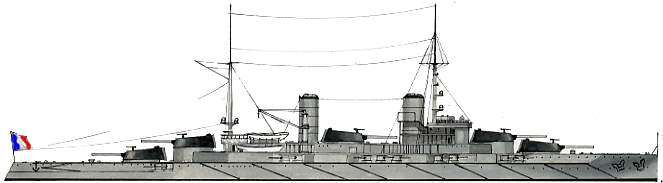
The Bretagne (“Britanny”) in 1916.
Provence class specs. (1916) |
|
| Displacement | 24,000t; 26 000 FL |
| Dimensions | 166 x 26,9 x 9,8 m () |
| Propulsion | 4 shaft Parsons Turbines, 18-24 Belleville/Niclausse boilers: 29,000 hp |
| Speed | 19-20 knots (39 km/h; 24 mph) |
| Range | 4,600 nmi (8,500 km; 5,300 mi) at 10 knots (19 km/h; 12 mph) |
| Armament | 10 x 340 mm, 22 x 138 mm, 7 x 47 mm et 4 TT sides 450 mm |
| Armor | Belt 270, turrets 340, blockhaus 314, barbettes 170 mm, Decks 40 mm |
| Crew | 1193 |
Early modernization
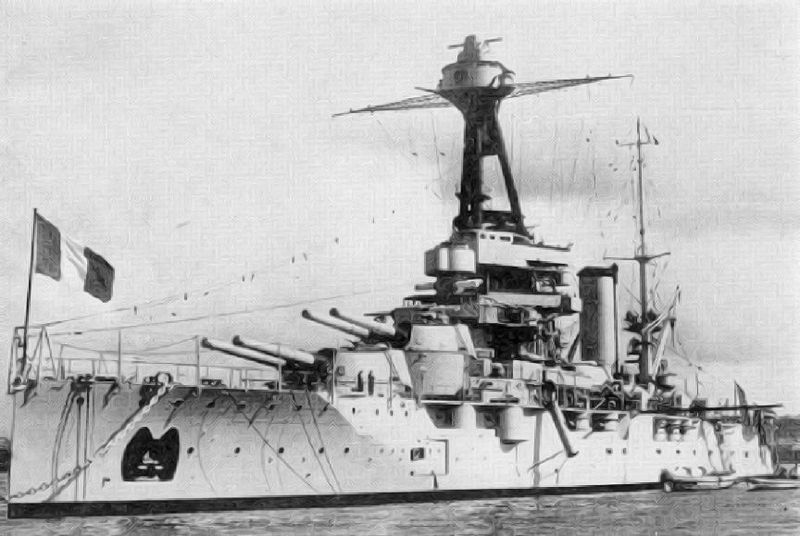
Battleship provence after refit, 1935. Src ONI identification booklet, USN
After 1918, these battleships underwent a number of modifications, including the modification of their main gun mounts and cradles, in order to increase their range in 1921-23. Then their coal boilers were partially swapped for fuel boilers in 1927-30 and finally all in 1932.
Their powerplant had been improved, though still walking on coal. The 340mm model 1912 guns proved to be one of the best designed by French arsenals. Many of these were used on the front on railways batteries with success. They were reliable, sturdy and accurate. The last captured ended during the occupation in casemates of the infamous Atlantic wall. Their initial range was 21,000 meters. An additional sistership was commissioned in 1914 by the Greek Navy, but construction was suspended in August due to the war.
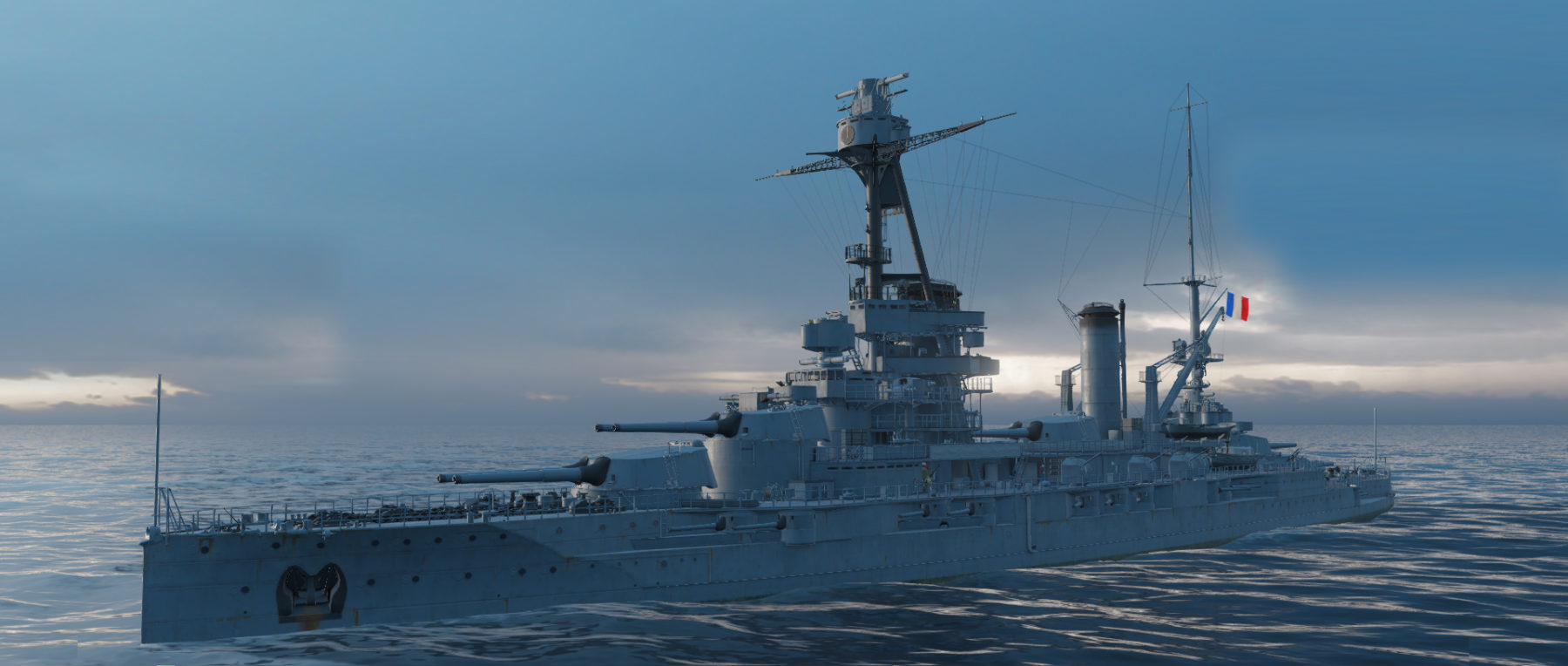
Wow’s rendition of the Battleship Provence in 1940
1919–1920: Bretagne’s armament was rearranged:
-Four forwardmost 138 mm guns removed, both 75 mm AA and two 47 mm guns.
-Four 75 mm mle 1897 guns were installed on the forward superstructure.
1927:
-Twenty-four 8 mm (0.31 in) Hotchkiss machine guns installed on the forecastle deck.
-Four rearmost 138 mm guns removed and the 75 mm replaced with eight 75 mm mle 1922 AA and sixteen 13.2 mm Hotchkiss HMGs in four quadruple mounts added.
Provence 1919:
Four forward 138 mm guns removed and same as Bretagne.
Provence 1931–1934: Eight 75 mm AA guns added
Provence 1940: three quad 13.2 mm AA fitted.
Lorraine has the same and,
Lorraine 1935:
-Center main battery turret removed and replaced by an aircraft catapult.
-Four 100 mm (3.9 in) Model M1930 guns added and two 13.2 mm quad.
Lorraine 1940: 100 mm guns removed for Richelieu, eight 75 mm M1922 guns fitted in stead.
Lorraine March–May 1944: Fourteen 40 mm (1.6 in) Bofors in single, twin and quadruple mounts, twenty-five 20 mm (0.79 in) in single mounts added with their FCS in the US (quad 13.2 mm guns removed).
1935 modernization
In 1935 they received new superstructures, fire direction positions (including a tripod mast), rangefinders, and secondary anti-aircraft artillery. They also received new 340 mm guns, with a new modified mount increasing their range to 30,000 meters. Their casemate and central battery saw their protection greatly improved. Lorraine also received a seaplane, hangar, cranes and catapult instead of its central turret of 340 mm. In 1939, however, this modernization still did not have the scope of a real overhaul, but no project in this direction had been planned so far. 1929 crisis and financing the Maginot line also dried budgets in this direction.
Characteristics, as rebuilt:
-Displacement: 23,230 t. standard -25 200 t. Full Load
-Dimensions: 166 m long, 28 m wide, 9.8 m draft.
-Machines: 4 propellers, 4 Parsons turbines, 12-24 Guyot Du Temple boilers, 29,000 hp. Maximum speed 20 knots.
-Armour: belt 270 mm, barbettes 170 mm, bridge 40, turrets 340 mm, blockhaus 314 mm.
-Armament: 10 x 340 mm, 8 x 100 mm AA, 8 x 37 mm AA, 12 x 13.2 mm AA MGs, 2 underwater TTs.
-Crew: 1130
Air Group
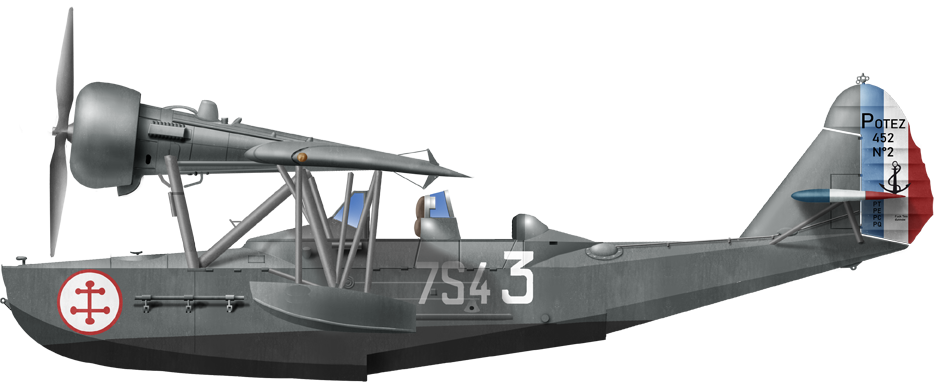
Illustration: Potez 452 on board Lorraine in 1936
The case only concerned Lorraine. In 1935 she had a comprehensive refit including the removal of “Q” turret and replacement by a hangar and capatuple above for three seaplanes, intended for spotting and reconnaissance. These models were successfively the following:
–Gourdou-Leseurre GL819 floatplane. Single engine monoplane, part of the 800 Series, probably replaced in 1937.
-Potez 452 seaplane: Single engine. To be published 10/09
–Loire 130 flying boats, replacing the 452 shortly before the catapult was removed.
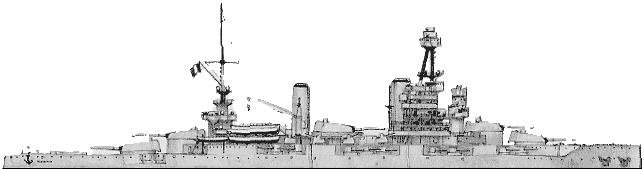
The Bretagne at Mers el Kebir, August 1940 – author’s illustration
Provence class specs. (1940) |
|
| Displacement | 24,000t; 26 000 FL |
| Dimensions | 166 x 26,9 x 9,8 m () |
| Propulsion | 4 shaft Parsons Turbines, 18-24 Belleville/Niclausse boilers: 29,000 hp |
| Speed | 19-20 knots (39 km/h; 24 mph) |
| Range | 4,600 nmi (8,500 km; 5,300 mi) at 10 knots (19 km/h; 12 mph) |
| Armament | 10 x 340 mm, 22 x 138 mm, 7 x 47 mm et 4 TT sides 450 mm |
| Armor | Belt 270, turrets 340, blockhaus 314, barbettes 170 mm, Decks 40 mm |
| Air group (Lorraine) | Gourdou-Leseurre GL819, Potez 452, Loire 130 |
| Crew | 1193 |
 Vasilefs Konstantinos (1914)
Greece had been equipped in the past with French vessels, such as the Spetsai class ironclads in 1886 and was looking at recent developments both in Italy and France. From the former was purchased the Giorgios Averoff, an Italian-built, privately-funded armoured cruiser that gained historical fame in two battles, taking part both in WWI and WW2 and now preserved as a national icon close to the Triere “Olympias” at the Piraeus. The motivation to acquire a modern capital ship for Greece, despite the enormous cost involved, was the threat of a new war with Turkey, started with a new arms race when the Ottoman Empire decided to purchase a second dreadnought in December 1913, Sultân Osmân-ı Evvel, previously Brazilian (later HMS Agincourt).
The Greek Navy responded by ordering a second dreadnought of its own (after Salamis ordered in Germany) to be named “Vasilefs Konstantinos” (Emperor Constantin) built to the same design as the French Bretagne class from AC de St Nazaire Penhoet, which was about to launch Lorraine there, by September 1913. Work however was delayed until June 1914, and ceased on the outbreak of war in August. It was never resumed. Since little work was done, it was proposed after November 1918 when men and material could be mustered to resume construction, the Greek Navy refused the incomplete ship since the geopolitical situation had changed damatically and naval technology went a long way in between. This refusal led to a contract dispute, only settled in 1925. The incomplete ship was returned to the yard and broken up on slip.
Active service
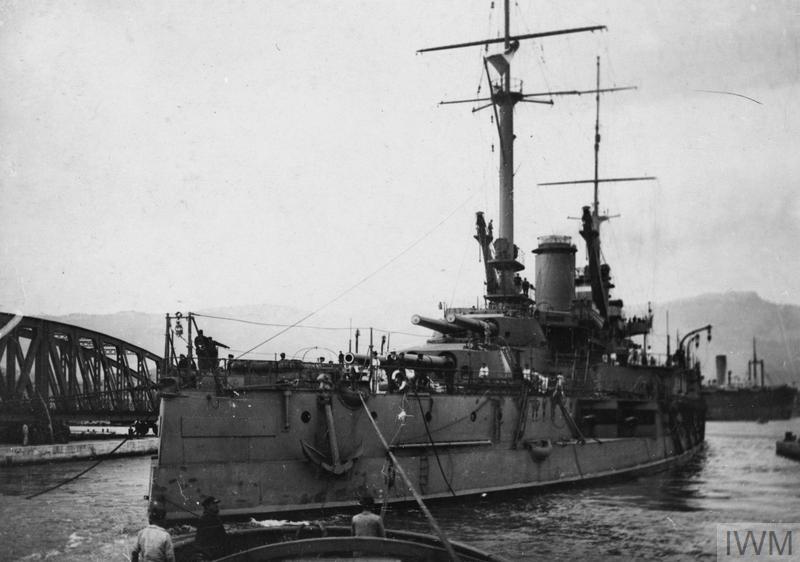
Bretagne and Lorraine were assigned to the 1st Division of the 1st Battle Squadron and quickly posted in the Adriatic, while the Provence became flagship for the Mediterranean squadron. She was also sent in the southern sector of the Adriatic, based at Argostoli and Corfu. Provence did some appearance off Greece putting pressure on the Gvt. not to join central powers. in January 1919, Lorraine was sent to Cattaro to guard the Austro-Hungarian fleet as her fate was discussed.
Lorraine and Provence were placed into reserve in 1922 due to budget cuts. Lorraine was active by 1923 after an overhaul. All three ships were taken in hands for a full modernization by 1935.
In the next war, Bretagne and Provence were part of the western Med squadron at Mers-el-Kebir when came Admiral Sommerville’s ultimatum to Admiral French Gensoul. Bretagne, hit in an ammunition bunker, exploded, causing the most casualties of the whole squadron. Provence nearly suffered the same fate and was badly damaged. Abandoned by her crew, she sank slowly into the harbor. The first waswritten off but the second was refloated later, towed to Toulon for repairs and resumed service in 1942 in Toulon, but only to scuttled in November 1942. Lorraine was in Alexandria (Force X) when Operation Catapult took place, and both admirals present agreed to disarm her. The crew was released and by 1943 she joined the FNFL (Free French Navy), was rearmed with modern AA in the United States, and took part in Operation Anvil/Dragoon). From 1945 to 1953 she became a training ship until converted into a depot before being sold for BU.
 Bretagne (1913)

Bretagne in Corfu 1916-17, colorized by Irootoko Jr.
Bretagne (“Britanny”) was laid down at Arsenal de Brest in the namesake city on 22 July 1912, launched on 21 April 1913 and completed on 10 February 1916. completed on 29 November 1915, and commissioned into the fleet on 10 February 1916. She was assigned to the 1st Division, 1st Battle Squadron as flagship, Vice-Admiral Dominique-Marie Gauchet on 10 May. She was sent to Corfu to prevent the Austro-Hungarian fleet any sortie into the Mediterranean. She also supported the Otranto Barrage against Austro-Hungarian U-boats and also took part in an attempt to intimidate Greece, which had become increasingly hostile to the Triple Entente. However after 1917 her crew was gutted in order to crew ASW vessels. Since the Austro-Hungarians made practically no sortie, Bretagne saw no action and even did not left port once in 1917, notably due to a severe shortage of coal at Corfu, to the point her reduced crew called here “hotel Bretagne”. The 47 mm m1902 guns were replaced 75 mm m1897 guns on AA mounts in 1918 and she went back to Toulon by November.
A lengthy refit was necessary between 12 June 1919 to 18 October 1920, and she had gun mounts modifications (elevation 18°) four 138 mm removed, casemates plated over, new 75 mm m1918 AA installed, foremast replaced by a tripod, mainmast shortened to fly a captive kite balloon, Vickers fire-control director with 3.66-metre (12 ft) rangefinder installed atop the tripod and 2m (6 ft 7 in) rangefinders on the superstructure for the secondary guns, flying-off platforms on the roofs of Turrets B and X for a short time (trials).
Bretagne was flagship of the Mediterranean Squadron from 6 June 1921 with Vice-Admiral Henri Salaun on board. With Provence she sailed to Le Havre for a naval review and back to Toulon in September. Lt. de vaisseau Paul Teste used Bretagne for dive-bombing experiments. Teste was the “French Mitchell”, militing for a “Squadron aviation” and helping design the Béarn. He would have a seaplane carrier named after him when he disappeared in an Atlantic corssing attempt. Bretagne and France (Courbet class) greeted HMS Queen Elizabeth and HMS Coventry in a port visit to Villefranche (18 February-1 March 1922).
Later, they had a gunnery exercise on 28 June vs. the former battleship Prinz Eugen as target and sank her. On 18 July, Bretagne, France and Paris visited French ports in the Bay of Biscay and English Channelbut on 25/26 August, France struck an uncharted rock while entering Quiberon and sank hours later with Bretagne and Paris in assistance, saving all but three of her crew. In a training, Bretagne herself ran aground in the Bizerte canal in Tunisia (22 June 1923) but remained undamaged. Provence relieved Bretagne as the flagship on 1 September so that she could have her first major refit at Toulon from 1 May 1924 to 28 September 1925.
The main gun cradles were modified for 23° elevation and greater range, she received two 1.5-metre (4 ft 11 in) HA rangefinders for her AA guns, part of her forward hull armour sacrificed to lighten her bow, increase her forward freeboard, some boilers converted to oil-firing, the flying-off platforms removed. She was back as flagship of the Mediterranean Squadron and carried Navy Minister, Georges Leygues to Malta for an official visit on 27 April – 1 May 1926 to the RN staff to decide of an agreement over naval responsability areas when facing the threat of fascist Italy. Provence became again fleet flagship from 1 October 1927 as Bretagne had a new boiler overhaul (notably oil injectors added) from 15 November to 12 May 1928, all converted to oil. She also had a new fire-control system, a French Saint Chamond-Granat model in a director-control tower and all original rangefinders replaced apart those on the turret roofs. Notably she received two 4.57-metre (15 ft) rangefinders on the conning tower roof and one over the DCT on top of the tripod mast, another at the base of the mainmast plus a 3-metre (9 ft 10 in) rangefinder to the DCT, solely to measure distances between the target and shell splashes, and another main rotating 8.2-metre (26 ft 11 in) rangefinder on the roof of No. 2 turret plus directors with 2-metre rangefinders for the secondary guns.
On 3 July 1928, Bretagne, Provence and Lorraine were at a fleet review for Pdt. Gaston Doumergue at Le Havre. Bretagne, Provence and Paris were in another fleet review by Doumergue on 10 May 1930 for the centennial of the conquest of Algeria. On 1 October 1930, Bretagne was decommissioned her her largest modernisation, from 1 July 1932. She was fully converted to smaller oil-burning boilers, with a former boiler room converted into an oil tank for a total capacity of 2,500 tonnes (2,500 long tons). She also had new Geared Parsons cruise (LP) turbines on the inboard propeller shafts as well as for the outer ones (HP). The four aft 138 mm guns were removed, casemates plated over, eight 75 mm M1922 AA fitted, TT removed. She also had a new DCT installed on her tripod and two new AA directors with 2m rangefinders. This was completed on 12 November 1934, working up until 11 May 1935, before joining the 2nd Division, 2nd Battle Squadron for exercises in the Azores and port visits in French Morocco and they proceeded to Brest to start combined manoeuvers from 16 June as tensions with Nazi Germany rose.
She remained there as deterrent, for the rest of the decade. In June 1934 there were new combined fleet exerczes. She had another refit from 29 October to 3 December and with Provence, Bretagne she had gunnery practice off Groix (Brittany, 7–11 July). On 15 August her unit, now the “Atlantic Squadron” (“Escadre de l’Atlantique”) had new exercises. In 1936 she received new 5-metre (16 ft 5 in) rangefinders and the Sqn. started visits of the Azores, Madeira, Portuguese Cape Verde, French Morocco and back to Brest on 26 February 1937. There was a review for Navy Alphonse Gasnier-Duparc on 27 May after the yealry manoevres. Frm 1938, the main rangefinder was replaced by a 8-metre (26 ft 3 in) model in another refit completed by 1 October 193 and still working up by May 1939. Now that the two Dunkerque class fast battleships were in service with the Atlantic Sqn. and the two Richelieu were awaited to join them, she was transferred back to the Mediterranean Squadron on 10 June 1939.

The French battleship Bretagne, after its reconstruction, circa 1920, Marius Bar scanned from the book Le Navire du Guerre Francais by Francis Dousset, released in CC.
When World War II erupted by September she was in Toulon and Italy remained neutral. She escorted troop convoys from French North Africa until 5 October and on 4 December, Bretagne and Provence, acocmpanied with the cruisers Colbert, Dupleix, and Primauguet, destroyers and submarines were based in Dakar, French West Africa to hunt down German commerce raiders, blockade runners before being sent back to the Mediterranean. Bretagne underwent an extensive overhaul until 3 March 1940, notably with a new 12-metre (39 ft 4 in) rangefinder on top of her tripod.
On 11 March, she she proceeded to Canada (Halifax) carrying 1,820 boxes of gold bars from the French treasury escorted by Algérie, carrying herself 1,179 boxes as “Force X”, arriving in Nova Scotia on 22 March. While back they escorted 2 US merchant ships carrying 82 aircraft purchased by France and regained Toulon on 10 April. Later she sailed to Oran with Lorraine on 18th to join Provence and on 27 April, her unit (2nd Battle Division) was transferred to Algiers and from there to Alexandria, still as “Force X”. They went through the Strait of Sicily on 30 April covered by the CruDiv3 to Alexandria and en route, met HMS Royal Sovereign and Malaya.
After 10 May and a likely Italian declaration of war, both Anglo-French naval command divided tasks and Bretagne and Provence were recalled from Force X, from the eastern to the Western Med. leaving Alexandria on 20 May, replaced by cruisers. Bretagne and Provence reached Bizerte on 23 May under under CiC Admiral Darlan she was sent in Mers El Kébir, arriving on 27 May,and meeting there the “Force de Raid” with both Dunkerque class Battleships. It acted as a deterrence force for the Regia Marina, but failed to prevent Italy joining the war in June.
After the French surrendered on 22 June 1940, the French fleet under the treatu’s terms was to disarmed under axis supervision but this did not sit well in particular with PM Winston Churchill which ordered Vice-Admiral James Somerville (Force H) to “neutralise” the French fleet at Mers-el-Kébir. On 3 July an ultimatum was delivered to Admiral Gensoul, which delayed an answer until Force H was forced to open fire on the ships stationed at anchor, bows turned towards the land.
Bretagne was soon hit by four 15-inch (381 mm) shells from Hood, Resolution, and Valiant. One destroyed her turret No.4, after hitting a magazine causing another massive detonation although immediate flooding limited further effects. Abnother hit her waterline and landed in the centre engine room, knocking out all power and severing internal communication. Another hit close to Turret No. 3 and ignited ready-use shells stored in lockers of the AA mounts, and at 17:09 Bretagne was blasted by a very large detonation, broke in two and rolled over, capsized and sank. She went down to 36 officers, 151 petty officers and 825 seamen. There was an attemppt to raise her in late 1942, but this was called off and the work was done eventually from 1952 until 21 December 1954.
Lorraine (1913)

Lorraine in Corfu, WWI (IWM)
Lorraine (In German “Lothringen”, under German Imperial rule since 1870 and contested like Alsace. The region was also the birthplace of Medieval icon and saint Joan of Arc) was laid down at Ateliers et Chantiers de la Loire, Saint-Nazaire on 7 November 1912, launched on 30 September 1913 and completed, commissioned on 10 March 1916. Lorraine and sisters constituted the 1st Division, 1st Battle Squadron. In the great war she spent most of her time stuck in Corfu to prevent an Austro-Hungarian fleet break out of the Adriatic. This presence also intimidate Greece into later joining the Triple Entente. By 1917 paert of her crews were diverted to ASW vessels, and the remainder entered a boring and demoralizing routine as the Austro-Hungarians never sortied pas the Otranto Barrage. So she made a single trip to Toulon for drydock maintenance and returned at Corfu until the end of the 1918.
By January 1919 she was in Cattar (Now Kotor), to guard the former Austro-Hungarian Navy and repatriated Austrian naval personnel, escorted former Austro-Hungarian warships to France and Italy when presented as war reparations until March. She was intended next to sail to the Black Sea and join operations against the Bolsheviks, but facing a mutiny she was sent in Constantinople instead by October 1919, creating the Eastern Mediterranean Squadron operating until July 1921. She had a new refit from 10 November 1921 to 4 December 1922 and was placed in reserve due to postwar budget restrictions. She returned to service by 1923 with the 1st Battleship Division, Mediterranean Fleet and modernized from 15 November 1924 and 4 August 1926 and then from 17 September 1929 to 6 June 1931. The last time was between 18 September 1934 and 20 September 1935, fourth and final prewar refit in Brest. This was radical as her main turret was removed, an aircraft catapult and hangar for three aircraft installed instead. In 1936 it was decided to transfer her to the Atlantic Squadron, to deter the Kriegsmarine, remaining here until September 1939.
After an agreement with the RN in case of war, the Marine Nationale decided to sent the sisters back in the Mediterranean. Lorraine became flagship of Force X, Vice Admiral Godfroy. On 4 December, she was based at Casablanca ready to operate against German commerce raiders and blockade runners in the Atlantic, with the cruisers Algérie, La Galissonnière, and Marseillaise, destroyers and submarines. She was then tasked to carry a gold bullion from the French treasury to Bermuda. On 1 January 1940, she was transferred to the 2nd Battleship Division, 1st Squadron and was in drydock refit until April.
On 27 April, she followed her sisters to Alexandria. On 10 June, Italy declared war on France so it was decided to transfer Bretagne and Provence back to the western Mediterranean and Mers El Kebir, under command of VADM Bruno Gensoul. Lorraine remainder in the eastern Mediterranean, anchored in Alexandria, soon joined by four British battleships and an aircraft carrier. On 20–21 June, she formed the center of an Anglo-French task force, the british adding to her an escort of three cruisers, HMS Neptune, Orion, and Achilles, to shell Italian positions at Bardia. This caused only minimal damage, and was the last combined British and French naval operation until the Frenc surrender. When it happened, PM Winston Churchill ordered Operation Catapult, in order to neutralize all French warships wherever they were stations, some in Britain, others in Mers El Kebit, where it went badly and Alexandria. There, the situation was hopeless for Lorraine, which was litterraly surrounded in port by the RN.
In fact when the operation was ordered, Vice Admiral Godfroy had an interview with Admiral Andrew Cunningham, as guns were traversed on Lorraine on the british side. The two men wanted to avoid a tragedy and concluded an agreement upon which Lorraine would be demilitarized and interned in Alexandria (her and other French ships present, four cruisers, and three destroyers). The gun breech blocks were dismounted and locked under keys in a depot of the port, injectors for the boilers were also removed. The crews were detained in Alexandria.
In between a lot happened. The North African Campaign went badly but the axis eventually were stopped at El Alamein in Egypt, not that far away from Alexandria while at the same time in November 1942, Operation Torch was launched and the allies took in a pincer the remnants of the axis in Tunisia. The fall of the Vichy regime in North Africa, and swap of allegiance of Admiral Darlan led to a collective swap of the remaining French Navy.

Lorraine in Casablanca November 1943, US release
By December 1942, Lorraine was issued to the Free French Naval Forces, and was put back in shape. However her age and general condtitions required a new refit and modernization to be of some use. By 3 July 1943, she left Suez and sailed around Africa to Dakar, reached on October 12, 1943, after being forced to stop in Durban following damage. Initial inspections of the ship concluded that it was too old and, above all, too slow to be accepted back into active service. Converted into a training ship at Mers el-Kebir, the Admiralty even considered cannibalizing her to complete the battleship Jean Bart, particularly her guns. It was decideed to have her used as training ship. On 2 December instead she was sent to Oran for refitting, loosing her aircraft facilities, installing a large number of French and US anti-aircraft guns, eight French 75 mm (3.0 in) guns, fourteen US 40 mm Bofors Mk I/III (1.6 in) guns, and twenty-five 20 mm Oerlikon Mk II/IV (0.79 in) guns and radar equipment installed. She was not refitted in the US as seen sometimes. She only had two 340 mm twin turrets operable and eight 138 mm guns, receiving also four 13.2/76 machine guns.
That overhaul enabled Lorraine to take part in frontline operations. After training her crew, she was stationed in Taranto along with the cruisers Emile Bertin, Jeanne d’Arc, Dugay-Trouin, Montcalm, Gloire, and Georges Leygues, supplemented by the 10th Light Cruiser Division and 16 torpedo boats, destroyers, and avisos. Her largest action was Operation Dragoon, the Allied invasion of southern France. On 15 August 1944, she entered the bombardment force (Task Force 86) in supported of the landings. With USS Nevada she hammered German defenses in and around Toulon, notably netralized the 340 mm turret “Big Willie” coming from one of Provence scuttled at Toulon two years prior, in an ironic twist of fate. The bombardment ceased on 21 August. On 1–13 September, Lorraine accompanied by four cruisers, two destroyers shelled German defenses along the French Riviera, squch as the fortresses at Sospel and Castillon, and positions around Carqueiranne and Saint-Tropez. She left on 17 September but remained in the western Mediterranean until sailing to Portsmouth for a brief refit, and then to Cherbourg in December.
By late March 1945, Lorraine left Cherbourg for her last operations under the FNFL, codenamed “Vénérable” and “Vermeille” in April. This consisted mainly in fire support to eliminate pockets of resistance in Gironde. On 14–20 April along with cruisers and destroyers she shelled the “Girond-Nord” fortress in Royan combined with the assault of the French 10th Division and US 66th Division. The fortress surrendered on the 20th. She headed for Brest to resupply and then moved back to Toulon after V-Day. She remained used as TS but saw little activity in piostwar budget restructions, and by February 1947, she was used as a stationary gunnery training ship. In 1949 or 1950 she started to be used as barracks ship, until stricken on 17 February 1953, sold on 18 December, BU at Brégaillon, Toulon from January 1954.
Provence (1913)
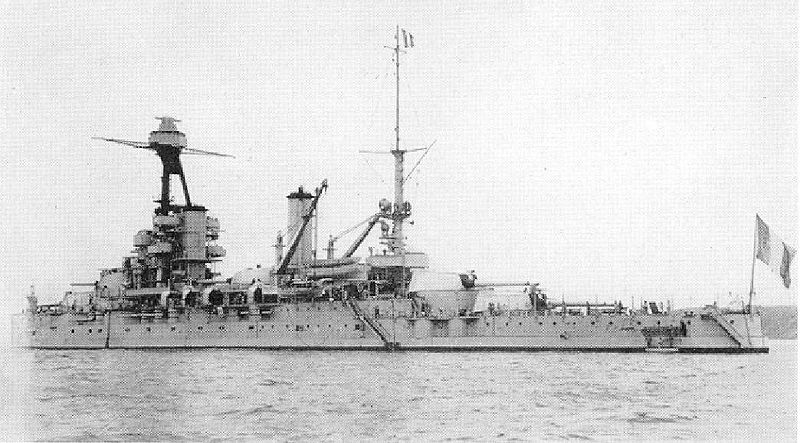
Provence Battleship, rear view in 1937 or 1939, US Navy recoignition archives.
Provence (home of Marseilles and Toulon, respectively the most important French Mediterranean trade port and Med Fleet home base, birthplace of several famous admirals such as Suffren) was laid down at Arsenal de Lorient in the namesake city, laid down on 21 May 1912, launched on 20 April 1913 and completed, then commissioned on 1 March 1916. She joined like her sisters the 1st Division of the 1st Battle Squadron, becoming fleet flagship for the remainder of the war.
Like her sisters she remained in Corfu to prevent an Austro-Hungarian break out of the Adriatic and also intimidated Greece into joining the Triple Entente. She lost part of her crew sent to ASW vessels and did a single overhaul at Toulon in 1917. By April 1919 she was back Toulon and never joined the allied Black Sea fleet against the Bolsheviks due to a major mutiny. Instead she stopped at Constantinople in October 1919, becoming the center of the Eastern Mediterranean Squadron.
From June 1921, Provence and Bretagne participated in a fleet review off Le Havre and back in Toulon by September. In 1922, Provence was placed in reserve and underwent a significant refit from 1 February 1922 to 4 July 1923 in Toulon. Next one was from 12 December 1925 to 11 July 1927 and a final one from 20 September 1931 to 20 August 1934, notably installation of six modern Indret oil-fired boilers and new turbines, revisions in artillery and fire control, after which she joined the 2nd Squadron in the Atlantic for fleet exercises off the Azores, Madeira, and Morocco. She took part in a cruise to Africa in 1936 and by August, started non-intervention patrols decided after the start of the Spanish Civil War, until April 1937.
By September 1939, she was in Toulon with Bretagne, 2nd Squadron, again as flagship for Vice Admiral Ollive. On 21 October, she was drydocked for maintenance until 2 December. Two days later, Provence and Bretagne, as well as cruisers and destroyers, sortied from Dakar covering French merchant shipping off West Africa and the Azores, then back to port.
Provence sailed to Casablanca to join Force Y. This force hunted down commerce raiders and blockade runners in the the Atlantic but neve rmade a kill or a capture, lacking air reconnaissance. While in Gibraltar she was damaged grounded and repaired afterwards in Toulon, but en route, she intercepted the Italian passenger ship Oceania (still neutral), dispatched to Marseille to be inspected for contraband. She headed for Oran on 24 January 1940, returned to Force Y in Dakar until transferred again to Oran on 11 April. On 27 April with her sisters, and several cruisers, she was stationed in Alexandria but on 18 May both Provence and Bretagne were recalled to Mers El Kébir, ready to intervene against the Italians.

Provence, ONI
After the French surrender on 22 June, she was to be disarmed under axis supervision under Armistice terms but instead Operation Catapult was launched. Vice Admiral James Somerville and Force H sent an ultimatum to Gensoul, which was initialy rejected. Negociations dragged while both Vichy and Winston Churchill grew impatient, and past the delay, Sommrville received news the French sent renforcement cruisers from Toulon. So that 3 July after 10 hours of fruitless, protracted discussions, the fleet opened fire. Provence returned just 90 seconds after with her aft turrets but lmet little success. Bretagne soon exploded and sank and Provence was hit several times, badly damaged. On fire, she to settle to the bottom but did not explode as her ammunition rooms were voluntarily flooded. Long after the event, she was refloated and patched, and on 5 November 1940, transferred to Toulon, on the 8th escorted along the way by the destroyers Épée, Fleuret, Le Hardi, Lansquenet, and Mameluk, fearing a British air attack. From 1 January 1942, she was again flagship, this time of the Training Division. On 27 November, the Germans launched Operation Lila to capture Toulon, and she was scuttled next to the old pre-dreadnought Condorcet and seaplane carrier Commandant Teste. The Italians raised her on 11 July 1943, salvaged two 340 mm guns, emplaced in a coastal battery and nesw turret at Saint-Mandrier-sur-Mer, Toulon. She was scuttled again blockship in the harbor, ultimately raised in April 1949 and BU.

Provence, ONI
Sources
Books

Conway’s all the world fighting ships 1906-1921.
URLs
Bretagne class on wikipedia
on laststandonzombieisland.com/
on forum.pages14-18.com
maritimequest.com/
Video
3D/Model Kits
https://www.artstation.com/artwork/vDb5Qa
1:700 French Battleship Bretagne, Full Hull, WaterLine, Bretagne class battleship, French Battleship, 3d printed, resin model
all the kits on scalemates.com