
 United Kingdom (1891)
HMS Edgar, Endmyon, Hawke, Gibraltar, Crescent, Royal Arthur, St Georges, Theseus, Grafton
Among the oldest cruisers in British service
Pre-1890s cruisers were often sail/steam thing intended to safeguard the immense colonial trade roads of the Empire. By 1890s the concept of protected cruiser was well accepted as more “military” ships compared to 3rd rate ones, barely better than enlarged gunboats, but still cheaper than armoured cruisers. Born from the 1889 program, these nine cruisers were smaller versions of the Blake (1890), yet offering the same protection and armament. Machinery was reduced, and the tonnage lowered by 1800 tons. However, these new steam engines gave them 20 knots and gave them a better range of 10,000 nautical miles. Tests proved their great endurance. These ships could sustain 18 knots for 48 hours.
They also had better seaworthiness in bad weather and were well suited for the North Sea, although intended as local “capital ships” for distant stations. HMS Gibraltar, Crescent, Royal St Georges, Royal Arthur were built by using large amounts of wood and copper for their tropical service overseas added an extra 380 tonnes. Royal Arthur and Crescent were slightly different with their raised forecastle, improving living quarters and more seaworthy in heavy weather, but they were also Heavier by 350 tonnes, had two forward 6-in guns replacing their 9.4-in (234 mm) guns.

HMS Royal Arthur (colorized)
These ships were originally ordered as nine new first-class cruisers, as required by the Naval Defence Act of 1888. They were envisioned as a reduced version of the previous Blake class, since the latter were impressive, but judged too large and expensive to be built in a larger series, especially for overseas stations. However, the admiralty wanted to retain the same main armament, two 9.2-inch BL guns, ten 6-inch QF guns. The larger cannons were placed for an aft on the centreline on turntable mountings but with well protected open-backed gun shields, which were designed as “quasi-turrets”. The 6-inch battery were spread between two decks either beam on double sponsons, six on the upper deck four on the main deck but only the lower ones were in enclosed casemates, the six upper ones had gun shields only. Close-range defence against torpedo boats was rounded by twelve QF 6-pounder Hotchkiss guns, four QF 3-pounder Hotchkiss guns and the usual close quarter 18-inch torpedo tubes.
The more interesting aspect was that designers managed to have their displacement shelved by 1,800 tons compared to the Blake class, and a length between perpendiculars reduced by 15 feet. Propulsion called for steam expansion engines driving two shafts. Funnels were as tall as the Blake class, but they eventually appeared stockier, less gracious, with tall masts and short hulls. By slimming their beam by 5 feet and slightly reducing draught while being equipped with a highly reliable machinery rated for 12,000 ihp compared with the previous 13,000 ihp they could practically match their two predecessors in speed.

HMS Crescent underway, circa 1900
Design of the class
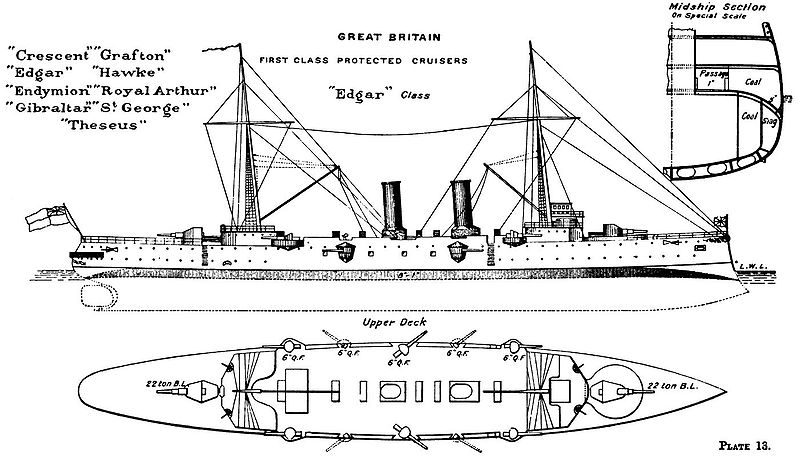
Edgar class cruiser – Brasseys Diagram of 1897
Hull and general design
The Edgar class displaced 6,870 tonnes standard for 7,700 tons fully loaded for an overall length of 387 ft 6 in (118.11 m) and they had a beam of 60 ft (18.3 m) and a draught 24 ft (7.3 m). To compare, the Blake class displaced substantially more at 9,150 long tons (9,297 t) fully loaded for 399 ft 9 in (121.84 m) in overall length, so 4 ft longer, but 5ft beamier at 65 ft (19.81 m) for a draught of 24 ft (7.32 m), so about the same. The more favourable hull ratio of the Egdar class made them potentially faster, but also less stable and meta centric height was probably degraded (data impossible to find).

Comparison between the Edgar (bottom) and Blake (top) classes.
As far as the design went, they showed the same “flush deck” hull with central bulwarked main deck, a bridge atop the conning tower forward, two masts composed of three parts, the foremast being fitted with a spotting top. Indeed, initially the profile of all but Royal Arthur and Crescent was the same with a raised forecastle featuring a ram, like the Blake, just shorter. The hull section was well-rounded as well with limited tumble home, rounded underhull as customary for the time. The sides of the forecastle ended with turtle-deck like curves before blending into a bulwark at the base of the bridge, which was a little more developed, to that of Blake.
The bridge was composed of an enclosed navigation part, wooden panelled, and of an open bridge above with repeaters and voice pipes, also used as admiral bridge. Past the forecastle was the main battery deck where all the secondary guns were located, the lower ones in two sponsoned casemates.
There were two tall, raked funnels and two masts, initially made of two masts like for the Blakes and in theory fitted for a limited schooner rig, but it was never installed, and they were completed with minimalist rigging for signals display. Later in their active service, the masts were heightened by the addition of a third level to support wireless radio cables. The extra height was better reception and keep the cables far from the funnel’s heat. It seems in early drawings these funnels were shorter as well.
As usual for the time, the space between the fore and aft “islands” around the funnels was jam-packed with hatches for machinery access and dorade boxes.
The upper deck guns were protected under bulwarks all along the amidship length between islands. The rear structure was modest, sitting at the foot of the aft mast. Boats of all sizes and description, a dozen, were stacked on the rear deck, aft of the second funnel, and under davits in four positions along the hull as well.
The case of the Royal Arthur sub-class

Semi-model kept at the Greenwhich Museum
HMS Royal Arthur and Crescent were completed on a modified design in the attempt of improving living conditions and seaworthiness, by adding an extra level for the forecastle deck. This went along with the fitting of a pair of 6-inches guns forward instead of the single 9.2 inches heavy gun in an attempt to reduce top weight albeit the difference was not that great. Otherwise, they were very close in design.
Indeed, this design choice was due to Crescent and Royal Arthur being intended to operate as flagships for cruiser squadrons, on foreign stations. To accommodate the additional flag officers and staff the entire forward part was raised by that extra forecastle, this higher deck however added additional weight forwards and was partly balanced by the pair of 6-in guns and its very heavy armoured gun shield. The pair of lighter guns in addition had light open-backed shields like the ones on both broadsides.
Powerplant

Cutaway and decks plans of HMS Royal Arthur
The propulsion of the Edgar class was basically the same as the Blake class, albeit improvements were made for greater efficiency and lighter, smaller size, with two vertical triple expansion steam engines, 2-cylinder, driving two shafts and fed by four cylindrical double-ended and one cylindrical single-ended boilers for a grand total of 12,000 hp or 8,900 Kilowatts on forced heat but 10,000 hp on normal draft. This made for a top speed of 20 knots (37 km/h) on forced draught and a range of 10,000 nautical miles (19,000 km) at 10 knots (19 km/h).
To compare the Blake class had two 3 cylinder triple expansion steam engines coupled with eight coal-burning double-ended boilers for 13,000 ihp (9,700 kW) in natural draught and 20,000 ihp (15,000 kW) in forced draught. The Edgar class maintained the same speed with lower output thanks to a better designed, lighter and shorter hull essentially. But in practice 20 knots obtained at forced draught was still two knots slower. In normal use, average top speed was around 18 knots, and they proved not only very good sea boats but also exceptional steamers with Royal Arthur, flagship for the Pacific station over 18 months still averaging 18kts for 48 hours.
Protection

The Edgar class were protected, not armoured cruisers, so they relied on a “turtle” armoured deck with sloped sides instead of a battleship-like scheme.
-They had for their main armour protection an internal protective deck: It was composed of 5 inches (130 mm) thick steel armour for the outboard slopes, connecting with the hull plating below waterline level, then rising up as it further it extending into the ship. In short, their armoured deck represented a substantial saving and cost.
-The flat section of the turtle deck was 3 inches (76 mm) on the flat, over the magazines and machinery spaces.
-The gun casemates were 6 in (150 mm) thick
-Ammunition hoists: From 2-in to 7.8-in (51-178mm)
-The main 9.2-in guns were protected by 3 in (76 mm) shields, which enveloped them well.
-The conning tower, below the bridge, and only present forward, had walls 10 inches (250 mm) thick.
-Four of the Edgar class were later upgraded in 1914 with anti-torpedo bulges after refit, and speed was degraded due to the added beam and drag.
Armament
As said above, the Edgar were armed like the Blakes, only the “package” was smaller. All cruisers but Royal Arthur and Crescent had the same armament, with the swapping of the 9.2 inches forward by a pair of 6-in guns in the former case. The slow-firing 9.2 in guns, able to even deter potential battleships, were compensated by the number and quick-firing abilities of the 6-in guns. The “usual suspects” were present as light artillery, the larger ones placed alongside the secondary guns on the broadsides, and the remainder in the superstructure fore and aft, plus the smaller ones in the fore and aft bridge’s upper positions. Fire control at the time was estimated from the spotting top built mid-height or atop the lower section of the foremast.
BL 9.2-inch (230 mm) Mk VI guns

The 234mm/32 BL Mk VI were a staple of intermediate heavy artillery, with Colonial service in mind, both from fortifications and ships. The Mark I entered service in 1881, but it originated from a request by the Admiralty in 1879. The idea was to rival Krupp’s 24 cm MRK L/25.5 (9.45 inch) that was tested by August 1879. The Admiralty submitted it to the Committee on Ordnance, and even considered swapping to breech-loading after a brief return to muzzle-loaders in the 1860s and 1870s.
This new breech-loader fired a 380-pound shell, which was calculated sufficient to answer the Krupp gun, despite the latter’s larger calibre. A total of 19 Mk.I and Mk.II guns, both in 26 calibres barrels, were manufactured in 1881-82, but delays and modifications never made them satisfactory, and they ended on land batteries only. The model was completely modified and led to the Mk.III and Mk.VII with much longer barrels at 31.5 calibres, which were satisfactory and became the first mounted on ships. Production was thus larger. The Mark IV was an intermediate mounted on the Blake class in 1886 and Edgar in 1889. Many ended as railway guns in WWI even though they were obsolete at sea.

Specs Mark VI:
Mass: 22 tons without the 3-inches shield (probably 5-6 more tonnes).
Barrel: 290 inches (7,366 mm) over a 31.5 calibre.
Shell: 380 pounds (172.37 kg) on 9.2-inch (233.7 mm)
Muzzle velocity: 2,065 feet per second (629 m/s)
Maximum range: 10,000 yards (9,100 m)
QF 6-inch/40 (150 mm) guns Mark I/II

These 152mm/40 QF Mk I/II were a staple of the RN from 1892 when entering service and the Mark I was adopted on the Edgar class. They were developed to exploit the new “QF” (quick firing) technology, in which the loading the propellant charge in a brass case comprised an integrated primer in its base instead of bagged propellant loaded in cloth bags with a separate friction or percussion tube. The brass case sealed the breech as well which made for a lighter breech mechanism, and made reduntant any washing or sponging to clear up fragments left from black powder.
It was manufactured by the Elswick Ordnance Company after being tested in 1888-89 at the Royal Arsenal of Woolwich.
Specs Mark I:
Mass 6.6 tons, length 240 inches (6.096 m) bore
Shell: QF, separate cartridge and shell 100 pounds (45 kg)
Elevation -5/+20 degrees, traverse +150/-150 degrees for 5–7 rounds per minute
Muzzle velocity 2,154 feet per second (657 m/s), range 10,000 yards (9,140 m) at 20°.
6-pdr/40 Hotchkiss Mark I

Mass: 849 lb (385 kg) barrel & breech for 8.1 ft (2.5 m) barrel 7.4 ft (2.3 m)/40
Shell: 57x307R 57mm (2.244 in) mv 1,818 fps (554 m/s)
Vertical sliding-block breech, hydro-spring recoil, 4 inch
25 rpm, Effective range 4,000 yards (3,700 m)
3-pdr/40 Hotchkiss Mark I (47 mm/1.9 in)

Mass: 240 kg (530 lb) 2 m (6 ft 7 in), barrel 1.8 m (5 ft 11 in)/40
Shell: Fixed QF 47 × 376 mm R 3 kg (6.6 lb)/1.5 kg (3.3 lb) mv 571 m/s (1,870 ft/s)
Breech: Vertical sliding-wedge, 30 rpm
Max range 5.9 km (3.7 mi) at +20°.
Torpedo Tubes
All cruisers had the same four torpedo tubes for 18-inch (457 mm) torpedoes, one submerged, one above water, per broadside.
Modernizations
By late 1914, Edgar, Endymion, Grafton, Gibraltar, St. George and Theseus lost their two main guns 9.4-in (234mm)/32 replaced by two QF 6-in/40 QF Mk I/II likke their secondary battery.
By late 1914, HMS Royal Arthur, Crescent lost their remaining aft main guns, replaced by a single 6-in/40.
Bulges were added in early 1915 on Edgar, Endymion, Grafton, Theseus and until 1918 they all received at least one or two 3-in AA guns.
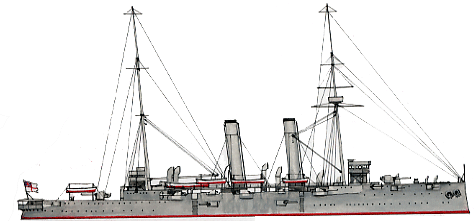
HMS Edgar illustration in 1914 (notice the raised forecastle).
Specifications |
|
| Displacement | 6,870t, 7,700 T FL |
| Dimensions | 387 x 60 x 24 ft (118 x 18.3 x 7.3 m) |
| Propulsion | 2 shafts Reciprocating TE engines, 4 boilers, 12,000 hp (8900 Kw) |
| Speed | 20 knots (37 km/h; 23 mph) |
| Range | 10,000 nautical miles (19,000 km) at 10 knots (19 km/h) | Armor | Ammo wells 160mm, Bulkheads 3-in, CT 12-in, decks 5-in, casemates 6 in |
| Armament | 2x 9.2-in, 10x 6-in, 12x 6-pdr, 5x 3-pdr, 4x 18-in sub/aw TT |
| Crew | 544 |
A long service worldwide for the King and country
 These ships began their careers in distant stations, Hong Kong, the East Indies, the Mediterranean, South Africa, Australia and the Pacific; Their career was more or less active during the Great War.
HMS Crescent was part of the 10th cruiser squadron in 1914, patrolling in the North Sea. In February 1915, she was assigned to the Defence of Hoy. In November, she was disarmed and converted into an anchored tanker in Hoy. She then joined Rosyth to be reformed in 1918.
HMS Edgar operated together with other units of the same class with the 10th squadron operating in the North of Scotland. In November-December 1914, her heavy guns were removed to be given to the new monitors. She was then kept at anchor, and later rearmed with 12x 152 mm guns and fitted with large side ballasts in order to carry out bombing missions on the Flemish coast. In May 1915, she was transferred to the Dardanelles and served there until 1918, date of retirement.
HMS Endymion was assigned to the 10th Wing also in 1914. She was then disarmed, rearmed and equipped with ballasts like the Edgar to serve in Flanders, but was transferred instead to the Dardanelles. She then served in the Aegean Sea and was decommissioned in 1920.
HMS Gibraltar served with the 10th Cruiser Squadron. In March 1915 she was disarmed and anchored to the Shetland Swarbacks Minns islands to serve as tanker for the 10th fleet, starting in June 1915. She was then sent to Portland to be assigned to a diving school. She then became a destroyer supply ship from 1919 to 1922.

HMS Grafton was affected to the 10th flotilla in 1914. She was then disarmed from its heavier guns, then rearmed and equipped with side ballast, for Flanders bombings. She was sent in mid-1915 to support the Dardanelles landings. On 11 June 1917 she was struck by a torpedo from a German U-boat, but survived and was towed for repairs. She then served in the Aegean until the armistice, then the Black Sea in support of “white” Russians as flagship. She was disarmed and demolished in the end of 1919.
HMS Hawke served with the 10th squadron, North Sea, in 1914. She narrowly escaped sinking after a collision with the large liner SS Olympic. She lost her bow and was repaired, but her ram was removed during reconstruction. Likewise, she served from 1908 to 1913 in Portsmouth, after being briefly a training ship for cadets. Furthermore, she was torpedoed in mission on October 15, 1914 by the U9 and sank with 524 hands.

HMS Royal Arthur was detached to the 10th squadron in 1914. In February 1915, she was reduced as a submarine supply ship, a role she held until 1919 in Scapa Flow. She witnessed the arrival of the great Hochseeflotte and was later disarmed.

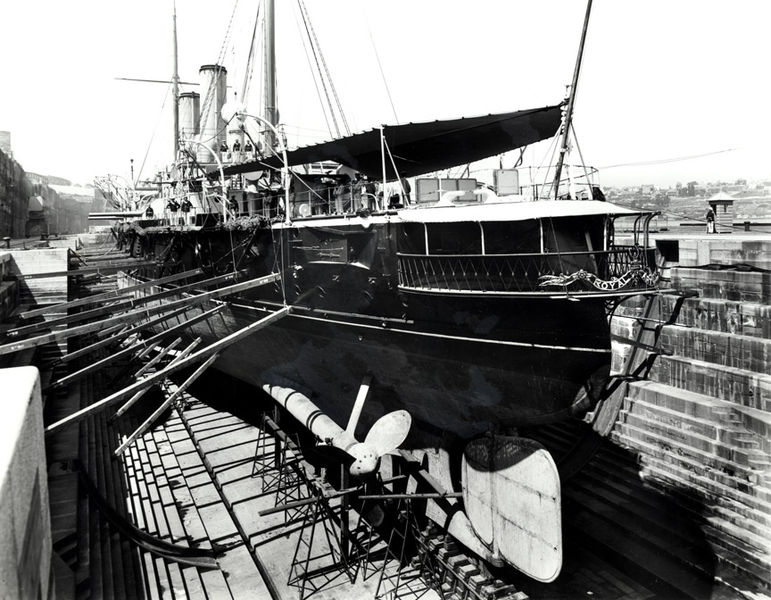
HMS Royal Arthur in Sydney dry-dock, Cockatoo
HMS St George was put in reserve, having served for the training of sailors student, in 1906. She also served as a supply ship, and was converted to Chatham for that very purpose from 1909. She served with the 9th flotilla of destroyers in November 1914, and later for patrols in the Humber. In 1917, she was converted into an armed tanker for submarines, and sent in the Mediterranean. She served in the Aegean Sea in 1918-19 with the second flotilla and was retired in 1920.
HMS Theseus served as tanker HMS Cambridge from 1905 in Devonport. In 1914, she was affected to the 10 squadron operating in the North of Scotland, and then was transformed in early 1915, rearmed with 152mm guns and fitted with ballasts to operate in Flanders. She was then sent to the Dardanelles and served in the white sea in 1916, before returning to the Aegean to serve as tanker, then the Black Sea in support of the “white” Russians. She was retired in 1920.
HMS Edgar
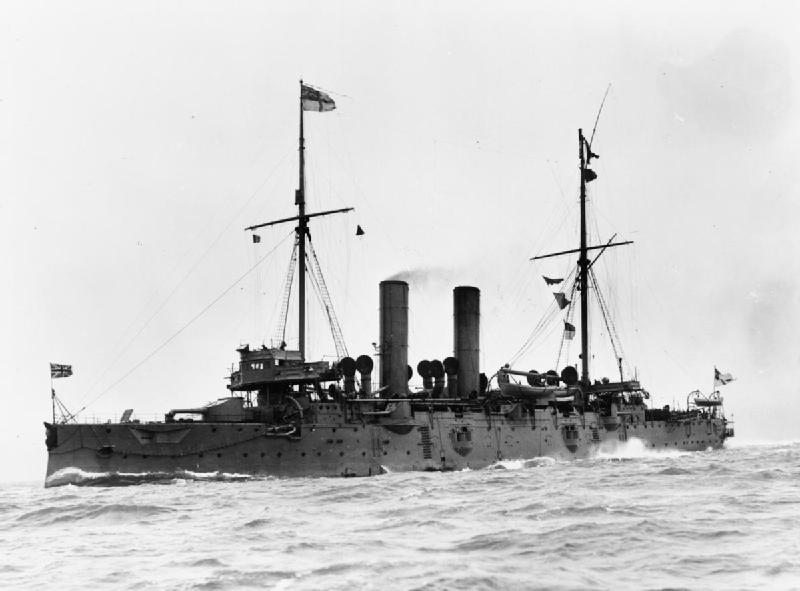
HMS Edgar was laid down at Devonport on 3 June 1889, launched on 24 November 1890 and completed on 2 March 1893. She had her machinery from Elder, and her cost was £401,083 in 1895.
At first was assigned to the Mediterranean Fleet, then the China Station. On 13 November 1895 her pinnace capsized in a storm off Chemulpo in Korea and 48 men were lost, 23 rescued.
She was recommissioned at Devonport on 20 February 1900 after refit to take relief crews for the sloops HMS Algerine and Phoenix, survey vessel Waterwitch recommissioned at Hong Kong as well as a crew for the river service steamer HMS Robin built at Hong Kong, leaving Devonport on 3 March and stopping at Gibraltar, Malta, Aden, Colombo and Singapore, arriving in the spring.
In April 1902 her boilers were re-tubed. Back home, she took part in the Coronation review in August 1902, and was commissioned to relieve Endymion at the China Station. In WWI she took part in the Mediterranean campaign, but as station ship, seeing little action. This changed when she was torpedoed by Austro-Hungarian submarine SM U-29 on 4 April 1918 but survived. HMS Edgar back home was decommissioned, stricken and sold for BU on 9 May 1921, a process that started at Morecambe on 24 April 1923.
HMS Endymion
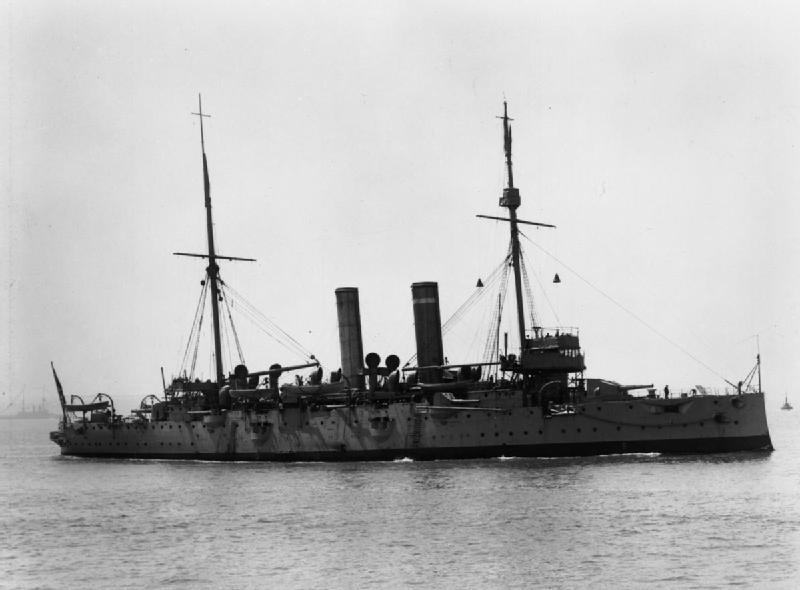
HMS Endymion was laid down on 21 November 1889, launched on 22 July 1891 and commissioned on 26 May 1894 at C & W Earle, Hull, with Earle Machinery, at a cost of 350,459 pounds. She took part in the Boxer Rebellion expedition in China, hosting the flag of rear admiral Eric Gascoigne Robinson. Captain Alfred Paget was appointed by February 1901. In December 1901 she visited Manila, and hosted the Governor and US officers. By May 1902 she was recalled home, stopping in Singapore on 22 June. She transited by Colombo on 5 July, Suez on 22 July, Malta on 28 July, and Gibraltar on 1 August on her way to Portsmouth. She was present in the fleet review at Spithead on 16 August 1902 (King Edward VII), then paid off at Chatham, 4 September 1902, entering the C division, Medway fleet reserve, and flagship in Cork Harbour, 1914. She served in the First World War, taking part in the Gallipoli Campaign. On 30 August 1918, she was damaged at Stavros in Greece, by SM UC-37 but survived. More logs to come in 2026-27. HMS Endymion was sold for BU at Cardiff on 16 March 1920.
HMS Hawke

HMS Hawke was laid down at Chatham Dockyard on 17 June 1889, launched on 11 March 1891 and after commissioning she joined the Mediterranean Fleet and remained on station for most of the decade. By early 1897 she was deployed to Crete and the International Squadron during the 1897–1898 Greek uprising to alleviate the rule by the Ottoman Empire. Greece landed 1,500 men on Crete to support the Cretan insurgency, which led to the Greco-Turkish War of 1897 (30 Days War in April). A Greek defeat was followed by a ceasefire and the Greek expeditionary force embarked on HMS Hawke on 23 May, brought back to Greece. By August 1901 Hawke was paid off at Chatham, in Fleet Reserve.
In February 1902 she carried relief crews to the Cape of Good Hope Station, recommissioned on 1 April. The crews were for HMS Forte, Dwarf and Partridge, and she ended in Simon’s Town on 10 May, then left South Africa 10 days later, via Saint Helena, Ascension, Sierra Leone, Las Palmas, Madeira, Plymouth on 16 June 1902. After a fleet review at Spithead (16 August) for King Edward VII she carried again relief crews for HMS Vulcan, Foam, Bruizer, Dragon, Boxer in the Mediterranean, making it in Malta on 27 August and returned with relieved crews, paid off, “A division”, Fleet Reserve (Chatham= on 4 October 1902. From January 1903, she carried again crews to the Mediterranean station (HMS Pyramus, Speedy, Dryad, Imogene) and was in Malta in early February, then paid off in March 1903. By November 1904 she became a Boy’s TS for the 4th Cruiser Squadron until August 1906. Next she was detached to the torpedo school at Sheerness. In 1907, Hawke was in the Home Fleet and by 20 September 1911, she collided underway in the Solent with the White Star ocean liner RMS Olympic (of the same class as Titanic) under Edward Smith (later on Titanic) and the cruiser Hawke lost her bow, replaced later by a straight bow while the enquiry showed her free from any blame. Nowadays, it is believed the Olympic displaced such a large amount of water it “sucked” Hawke off course and into her.
By February 1913, Hawke was in the training squadron at Queenstown in Ireland, with other sisters and from August 1914, she integrated the same 10th Cruiser Squadron, on blockade duties between the Shetland Islands and Norway. In October 1914, they were deployed in the North Sea to protect a troop convoy from Canada. On 15 October the patrolled off Aberdeen in line abreast at intervals of 16 km (9.9 mi) but Hawke stopped at 9:30 am to pick up mail from Endymion and then resumed her trip at 13 knots without zig-zagging, until at 10:30 she was hit by a single torpedo from U-9 (the same that claimed already Hogue, Cressy and Aboukir earlier on 22 September) and having no ASW protection she quickly capsized. Her disparition was known much later when retreating to the northwest and trying to contact Hawke. The “super destroyer” Swift was sent from Scapa Flow to search for her and only managed to spot a raft with 22 men. Later a boat with 49 survivors were rescued by a Norwegian steamer. In all, the cruiser vanished with 524 inc. her captain. Her wreck was rediscovered and surveyed on 12 August 2024 by the deep sea explorer group under 360 feet (110 metres) 70 miles (110 km) east of Fraserburgh in Scotland. Her sinking prompting the addition of bulges on her sisters.
HMS Gibraltar
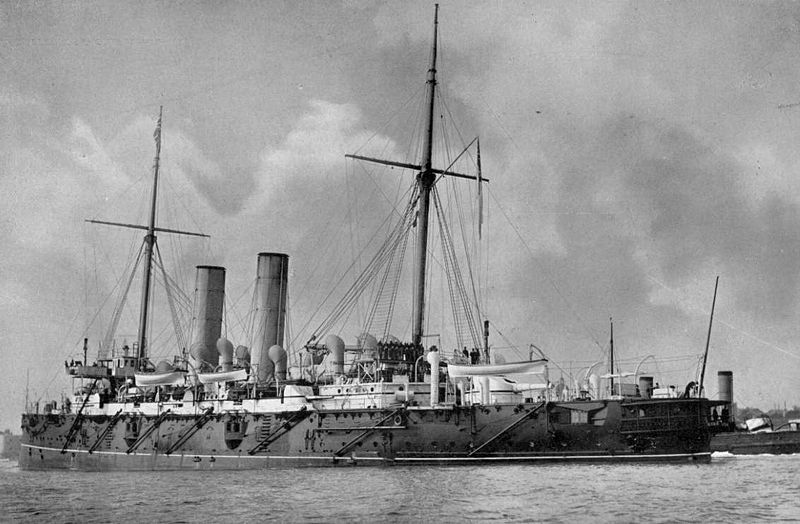
HMS Gibraltar
Gibraltar was laid down at Robert Napier & Sons, Govan with same builder’s machinery installed, laid down on 2 December 1889, launched on 27 April 1892, commissioned on 1 November 1894 a a cost of £347,634. During her early career, Gibraltar served mainly on foreign stations and by late 1899 she had her first complete refit at Portsmouth. By March 1901 she was commissioned by Captain Arthur Limpus as flagship of Rear-Admiral Arthur Moore, Commander-in-Chief on the Cape Station. She sailed and arrived at Durban by early September 1901.
In July 1902, she led a group of seven Royal Navy ships visiting Zanzibar, showing the flag after the death of the sultan and his son taking the throne. Next she visited Kenya and stopped at Beira, in Portuguese Mozambique, and back in South Africa by September. Three months later she stopped at Saint Helena and Ascension Island by December 1902, later she visited Bathurst and Sierra Leone. In the First World War, she was in the 10th Cruiser Squadron, Northern Patrol. By 1915 her age showed, and her crew was more useful on more recent ships so she ended as a depot ship for the same unit, in the Shetland Islands. Two QF 6-in Mk.I guns removed and moved to Swarbacks Head, Vementry and the other at Muckle Roe, an important shore battery and base (still there). John H. D. Cunningham served aboard as midshipman under Captain Ronald Arthur Hopwood by 1913–1914. The war ended, and HMS Gibraltar was put on the disposal list and sold in August 1923 to John Cashmore Ltd for BU at Newport.
HMS Crescent
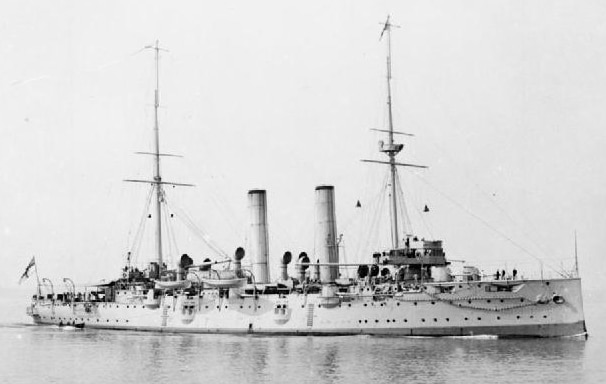
HMS Crescent was laid down at Portsmouth, Penn, on 13 Oct 1890, launched on 30 Mar 1892 and commissioned on 22 Feb 1894 for a cost of £383,068. Her first commission was at the Australia Station. She spent little time here, was recalled to England on 11 January 1895, leaving Australia under Captain Arbuthnot. From 1899 to 1902 she became flagship of Vice-Admiral Sir Frederick Bedford, CiC North America and West Indies Station. He was headquarters at Bermuda in winter and Halifax in the summer. Captain Charles John Graves-Sawle took command, and she visited Trinidad and Jamaica by February 1900.
Next month she headed for Nassau, Bahamas to assist HMS Hermes which was stranded with a broken shaft. Under Captain Stanley Colville from 1 March 1900 she was part of the coronation celebrations at Halifax. Fred Bedford left command of the station on 15 July 1902, and sailed back home on Crescent, replaced by HMS Ariadne. Instead, she was present at Spithead on 24 July and took part in the fleet on 16 August 1902 for the coronation of King Edward VII. Next the Kings started a tour westwards along the coast, Crescent in escort and back to Portsmouth in early September, paid off on 3 October for a complete overhaul. She saw action in the First World War until decommissioned, stricken and sold on 22 September 1921 for BU in Germany.
HMS Royal Arthur
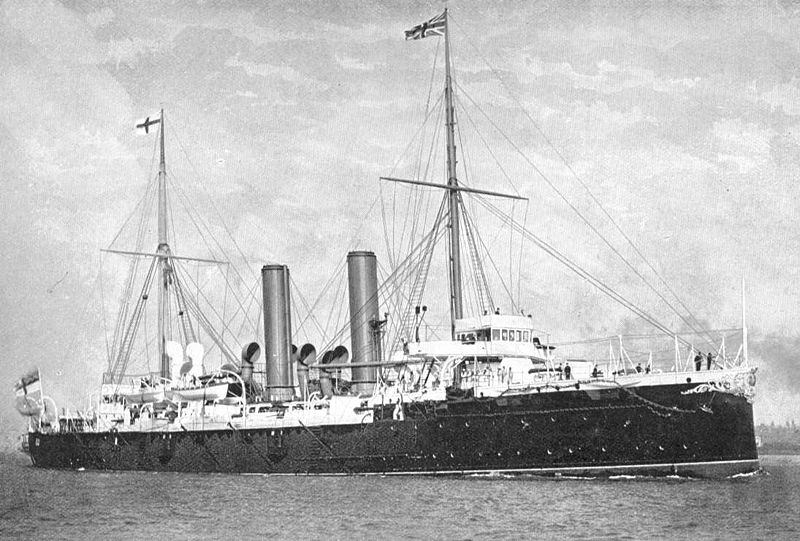
HMS Royal Arthur was the ex-Centaur, laid down under this name at Portsmouth Dockyard, with Maudslay machinery, on 20 Jan 1890, then launched as Royal Arthur on 26 February 1891 and commissioned on 2 March 1893 for £402,414. Royal Arthur and Crescent had a modified design to act as flagship, she headed for Nicaragua during the Crisis of 1894–1895 under command of Henry Frederick Stephenson.
She became flagship of the Pacific Station from 1893 to 1896 before a refit at Portsmouth in 1897. Next she became flagship of the Australian Station from 1897 to 1904, providing at some point escort for the royal yacht Ophir with the Duke and Duchess of Cornwall and York (future King George V and Queen Mary) for the inauguration of the new Federal Parliament in 1901. She visited Norfolk Island in July 1902, Suva, Fiji and by January 1903 a new CiC boarded her, Vice Admiral Arthur Dalrymple Fanshawe, hoisting his flag. On 6 April 1904, Royal Arthur returned home for a refit. She was paid off and the refit started at Portsmouth.
She was recommissioned in 1905 to take the lead of the North America and West Indies Station, and back home in 1906. Furthermore, she was laid up in reserve for three years, then entered the Home Fleet and later the Queenstown Training Squadron. In 1914 she was a guardship at Scapa Flow with a reduced crew and from 1916, a submarine depot ship. But on September 9th 1914, she collided with the swedish ship s/s Tua. The latter started to sink and even lines were cast to help save the crew, machinist Erik Gustav Sjölin went down. HMS Royal Arthur was finally paid off in 1920 and sold in August 1921 for BU in Germany.
HMS St Georges
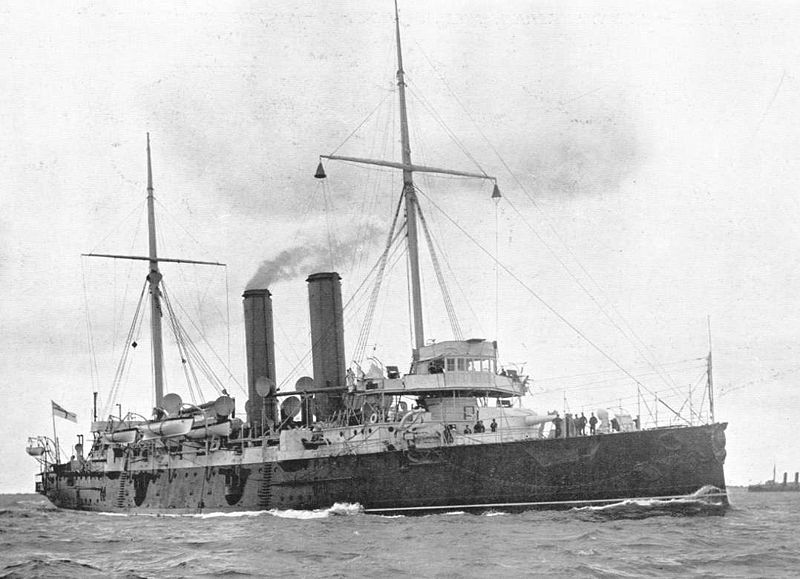
HMS St George was laid down on 23 April 1890 at C & W Earle for her Hull, and Maudslay provided the machinery. She was launched on 23 June 1892 and commissioned on 25 October 1894 for a cot of £377,204. In 1895, HMS St George headed for the West Coast of Africa accompanied by two Redbreast-class gunboats and local steamers for crushing a rebellion at Nimbi by King Koko, Niger delta. This was called the Akassa raid.
The crisis at Zanzibar followed, and she shelled bombarded the Sultan’s Palace for 40-minute in the short Anglo-Zanzibar War of 1896. HHS Glasgow of Zanzibar fired on St George, Philomel, Racoon, Sparrow and Thrush and was sunk quickly after being pummelled under the waterline. The yacht still flew the Union Jack in surrender so the flotilla launched lifeboats to rescue the men. The wreck would stay in Town Harbour until 1912.
Next, HMS ST. Georges was assigned to the Channel Fleet. In 1901, she escorted the royal yacht Ophir for their tour of the British Empire. Commodore Alfred Winsloe remained at the head of the Cruiser squadron, and by late 1901 his hoisted his broad pennant on HMS St George. By In May 1902 she entered Portsmouth for a refit, took part in the fleet review at Spithead on 16 August 1902 (coronation of King Edward VII) and by September was part of a squadron at Nauplia and Crete for combined manoeuvres. Back to Portsmouth in late October, she was paid off on 15 November, her crew was transferred to HMS Good Hope. Later she became flagship of the Cape & West Africa Station under Rear-Admiral Harry Rawson, Simon’s Town, until 1914, but also afterwards, as Sidney R. Olivier became her new captain from 2 November 1915 to 1919. She was a depot ship from 1919, decommissioned, paid off and stricken, sold for BU at Plymouth on 1 July 1920.
HMS Theseus
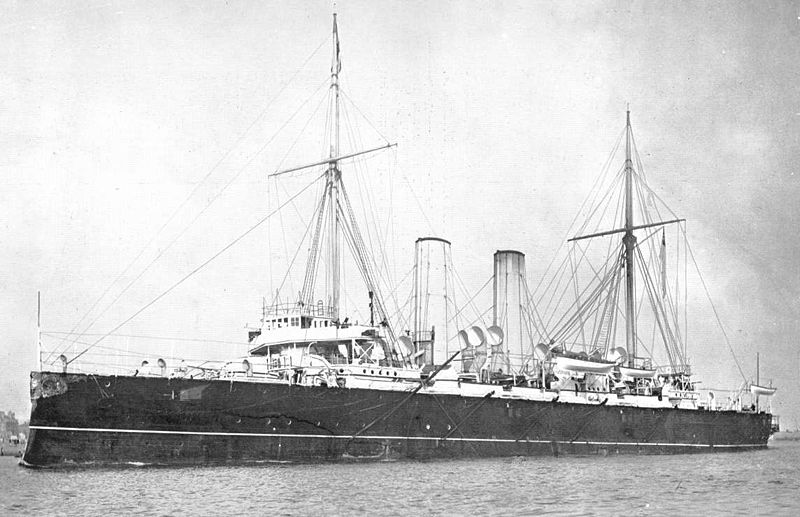
HMS Theseus was laid down on 16 July 1890 at Thames Ironworks of Leamouth, and she had Maudslay machinery. She was launched on 8 Sept. 1892, commissioned on 14 Jan 1894 at a cost of £347,577. Upon commission in 1896 she entered the “Special Flying Squadron” formed in response to a war scare with Germany. Afterwards she was sent to the Mediterranean Fleet. By January 1897 she joined Rear Admiral Sir Harry Rawson’s fleet sailing to West Africa for a punitive expedition against Benin. They arrived on 3 February, and landings took place on 9 February. Benin City was captured on 18 February and the fleet on her way on 27 February. The crew however was stricken by Malaria and sent home as the cruiser was refitted at Chatham, including a thorough disinfection.
She served in the Mediterranean until late April 1902, then left Malta to be paid off, dropped anchor at Plymouth on 6 May, and sailed to Chatham three, to enter the Medway Fleet Reserve on 28 May 1902. She became a tender ship to Cambridge from 1905 to 1913. From February 1913, she joined the Queenstown Training Squadron and as the war broke out in 1914, she joined the 10th Cruiser Squadron. By late August, Russian forces captured the German Navy codebook, and it was Theseus that sailed from Scapa Flow to Alexandrovosk to collect copies, planned for 7 September, postponed until 30 September and back to Scapa with two Russian couriers and the documents on 10 October. They were given to the first Lord, Winston Churchill, on 13 October and ended in the hands of the cryptanalysts at Room 40.
Next, she entered the 10th Cruiser Squadron. On 15 October she patrolled off Aberdeen, in line abreast with intervals of 10 nautical miles (19 kilometres) between ship when torpedoed by U17. Her flotilla was ordered to proceed northwest, but Theseus looked for HMS Hawke, torpedoed by U-9 several hours earlier. 70 of her crew were later picked up.
Theseus was rearmed and fitted with bulges so to take part in the Dardanelles Campaign. In 1916, she sailed for the Mediterranean and White Sea. In 1918, she sailed to the Aegean Sea as a depot ship. In 1919, she made her final deployment to the Black Sea to support British troops and the White Russians. By 1920 she sailed home, and was scrapped in Germany in 1921.
HMS Grafton
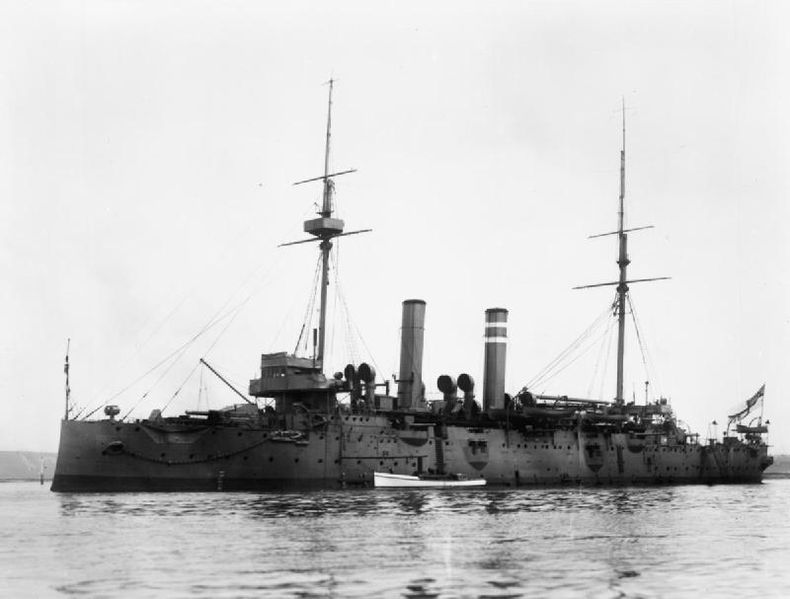
HMS Grafton in wartime livery.
HMS Grafton was laid down on 1st Jan 1890 at Thames Ironworks, Leamouth, with her machinery provided by Humphrys. She was launched on 30 January 1892 and commissioned on 18 October 1894 at a cost of £351,851. She was assigned to the China station from 22 April 1896 until 10 September 1899. By December 1901 she relieved the old Warspite as flagship on the Pacific Station. She was back at Chatham on 14 January 1902 and left Plymouth on 31 January 1902 via Madeira, São Vicente, Montevideo and Sandy Point for the Pacific station in Valparaíso in March. She hosted Rear-Admiral Andrew Bickford two days later. Captain Colin Richard Keppel became flag captain, moving from Warspite to Grafton.
On 18 April 1902 Grafton landed parties at San José in Guatemala, to deter the revolutionaries after British efforts to obtain re-payment of a loan from the government. It was paid. In December, she visited Monterey, as well as San Diego, Mazatlán and Acapulco. On 31 January 1903 she sailed to Callao, then Coquimbo in Chile, when she struck and killed a large whale.
When the First World War broke out, she had been reassigned to the 10th Cruiser Squadron, used to enforce the naval blockade of Germany. BY December 1914, the Edgar proved unsuitable for blockade work in the North Sea, so Grafton was withdrawn from service. Her two 9.2-inch guns were removed and ended on two M15-class monitors. It was planned to refit her for shore bombardment work for the Dardanelles, and she received two 6-inch guns instead of her 9.2 inch, and she also received anti-torpedo bulges (speed down by 4 knots (7.4 km/h; 4.6 mph)).
With HMS Endymion, Edgar and Theseus, she took part therefore in the Gallipoli Campaign, from July 1915. Grafton carried out shore bombardment (landing at Suvla Bay) as well as the Battle of Sari Bair, in August 1915. She was struck by Turkish shells off Suvla, on 12 August (9 killed) and helped to cover evacuations from Anzac Cove on 20 December 1915 as well later from Cape Helles, by January 1916. She was later awarded the battle honour “DARDANELLES”. On 10 June 1917 she was torpedoed by UB-43, 150 nautical miles (280 km) east of Malta. Her anti-torpedo bulges proved effective so she could proceed to Malta under her own power and no casualties for repairs. Another notable action in this war was her gunnery support in the Battle of Jaffa on 20–21 December 1917. Back home in late 1918, she was decommissioned, stricken, and sold for BU at Plymouth, 1 July 1920.
Sources
Books
Colledge, J. J.; Warlow, Ben (2006) [1969]. Ships of the Royal Navy: The Complete Record… to the Present. Chatham Publishing.
Gardiner, Robert, ed. (1979). Conway’s all the world fighting ships 1860-1905. Greenwich: Conway Maritime Press.
Morris, Douglas (1987), Cruisers of the Royal and Commonwealth Navies, Maritime Books, Liskeard, Cornwall
Brassey, T.A. (ed) Brassey’s The Naval Annual 1888-1906
Links
https://web.archive.org/web/20190722032026/http://www.navypedia.org/ships/uk/brit_cr_edgar.htm
conways all worlds fighting ships 1860-1905
The Edgar class on wikipedia
warhistory.org/ early-royal-navy-cruisers
en.wikipedia.org/ BL_9.2-inch_Mk_I MkVII naval gun
le.fantasque.free.fr/edgar
rmg.co.uk/collections
3D/Model Kits
1:48 Yard Model of HMS Gibraltar
