
 12 German Hilfskreuzer (1939-45): Orion, Atlantis, Widder, Thor, Pinguin, Stier, Komet, Kormoran, Michel, Coronel, schiff 5
During WW2, the Kriegsmarine deployed, just in WW1, Hilfskreuzer, nine officially: Orion (HSK-1), Atlantis (HSK-2), Widder (HSK-3), Thor (HSK-4), Pinguin (HSK-5), Stier (HSK-6), Komet (HSK-7), Kormoran (HSK-8), Michel (HSK-9), Coronel (HSK-10), Hansa (HSK-11). They were also registered as “schiff-” and “raider-” by British Intel. These were better armed, better equipped and more versatile than their WW1 counterparts, and one instrument in the German naval staff top wage war on British trade alongside submarines and existing warships. If not all were successful there are a few shining cases, like Atlantis (HSK 2), known as Schiff 16 (Raider-C) which travelled more than 161,000 km (100,000 mi) in 602 days, sank or captured 22 ships totaling 144,384 t (142,104 long tons) and needed no less than British heavy cruiser HMS Devonshire to sink her (the same also hunted down and sank HSK-5 Pinguin). There is also the Kormoran, which epic duel with HMAS Sydney (leading to mutual destruction) remains in the annals of WW2. Full rewrite and expansion of the 2016 article, one of the first of naval encyclopedia.
Hilfskreuzer: Historical Overview
For a fraction (1%) of the cost of KMS Bismark, these nine German auxiliary cruisers sank 142 ships, sunk or captured, for 870,000 tonnes, 3,769 days at sea with an average of 230 tonnes sunk daily. This was achieved by 3,000 officers and men, and freighters armed with obsolete artillery. Their commanders were chosen men, very competent, on par with those of major capital ships of the Kriegsmarine and choose their crews which were largely considered elite.
Privateers are already a very old idea: Since the Renaissance and seventeenth or eighteenth centuries, merchant ships were armed, but with a reduced artillery. One could still make a difference. But from the nineteenth century, all hulls were painted with rows of false gun ports, and this according to a stylistic tradition continued until the twentieth century.
The principle was to deter potential “predators”. Already in 1776-1783 and 1813 the young American navy used fast schooners, and armed merchant clippers to attack British vessels in 1815. During the civil war of 1861-65, the Confederate Navy, largely outclassed, fought with armed civilian steamers converted as commerce raiders and blockade runners, while some corsairs also started to use various disguises to hide their armament, unveiled only at the last moment. In 1898, the US Navy, outclassed by the Armada, made also good use of “auxiliary cruisers” which were, for all intends and purposes, armed merchant vessels, mostly liners due to their speed. The idea of course resurfaced in world war one, but applied differently between belligerents.
German Raiders in ww1
During the Great War, Germany employed several ways to disrupt British trade and counter the Blockade, using a number of privateers: Many ships such as Möwe, Wolf, Greif, Wolf II, Geier, Leopard, Iltis, and Seeadler (a tall ship). Using the latter was singular but not anachronistic for the time: Nearly half of the merchant tonnage in 1914 was still assumed by sailing ships. These ships enjoyed mixed success, had standard german artillery up to 105 and 150 mm (mostly from older stocks), light guns and torpedo tubes. Guns were hidden under the hinged folding panels for quick release. The Hochseeflotte also commissioned a number of fast liners as auxiliary cruisers: Steamer SS Kaiser Wilhelm der Grosse, Prinz Eitel Friedrich, Crown Prince Wilhelm, and Kormoran, Cape Trafalgar, Berlin, Vineta and Meteor. Opposite, both the British and French used AMCs or “armed merchant cruisers”. These were also liners, with steam turbines to be able to reach 20+ knots unlike standard merchant vessels, but their mission was instead to escort convoys… until the British had the idea of the Q-ships (decoy ships with hidden guns) to lure out closer U-Boats using in 1914-15 the “prize rule” (U-boat arrested, inspected merchant traffic instead of sinking them outright). WW1 corsairs had quite some successes, until the naval high command decided to bet everything on U-Boats, which successes in 1914 already was frightening.
German Auxiliary Cruisers in Action
The idea of a “Hilfskreuzer” or “auxiliary cruiser” in the Kriegsmarine operated on the same process as in WW1 to compensate the Kriegsmarine’s numerical inferiority -far deeper than in the previous war (the Navy expected to fight in 1946-47)- with converted merchant ships, as the war was close in 1939. In all, 12 total and operational ships were so converted.
Their process was intangible: When a raider spotted a merchant ship, the former was closing up to be at firing range, compared the name of the ship to Lloyd’s register to identify her as Belligerent or neutral. By megaphone, the raider’s captain then intimated his fellow counterpart to stop, while unveiling its artillery and true flag. The cargo was then torpedoed or gunned into oblivion after been warned to evacuate, leaving a chance to the crew. Neutrals were visited by a company that checked the bulk list.
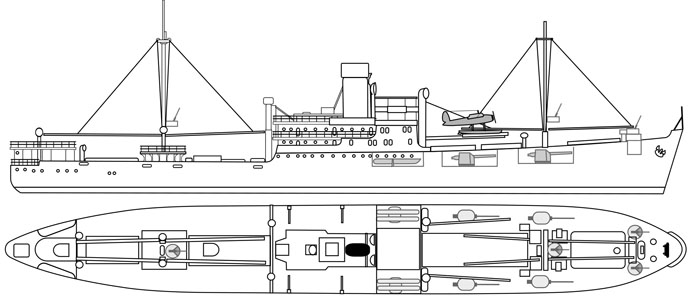
Komet, schematics. The fact to combine cruisers guns, AA guns sometimes of two calibers, torpedoes, mines, a motor boat to attack harbours and aircraft for reconnaissance plus all the equipments and paint onboard to change appearance at will made them very useful ships on paper.
If it was bound for neutral ports, the cargo could resume its journey unmolested, otherwise the process was repeated, crew evacuated and the ship sunk. Eventually raiders also sometimes attacked military vessels. Disguised as a cargo and flying neutral flags and markings or the silhouette of another ship through improvised contraptions. The captain waited until the military ship was close enough to launch an inspection party and unveiled at the last moment its true colours while revealing its artillery hidden behind folding panels, and opening fire asap, even also sometimes launching a torpedo without warning. What generally followed was a short and bloody artillery duel at close range for which the Raider had the advantage of surprise.
German Raiders in 1939
In 1939, facing a lack of ships to launch an effective commerce war, the concept was reactivated with new ships converted, even more heavily armed than in the first world war. The “Hilfskreuzer” (auxiliary cruisers, generally complemented by “HSK”- Handels Stör Kreuzer, commerce raiders) were one of the trump cards of Admiral Raeder in his strategy. They ships were generally recent, powerful and fast, roomy and adaptable (and equipped) to fake numerous identities. Their armament was obsolete (cannons salvaged from the previous Imperial Navy), but their crews were hand-picked and the best in the Kriegsmarine. However the results of their campaign was relatively disappointing. Here are some of these Ships and their stories.
During the Second World War, as in the First, the German Navy employed commerce raiders. These were merchant ships armed with obsolete 150mm guns removed from ships of the Imperial Navy; only during the latter stages of the war was it decided to equip new vessels with up-to-date weapons and radar. However, in contrast to their outdated main armament the crews of these ships were the best sailors to be found in the Kriegsmarine.
On being impressed into the Navy, all ex-merchant ships were allotted a simple number: Schiff 1, Schiff 2 and so on. Those converted to raiders held their old pennant numbers for security reasons, but were also given an additional Handels-Stor-Kreuzer (“commerce-disruption cruiser’) or HSK designation and a pennant number. The commander of the vessel was furthermore given the right to name the ship according to his wishes. All three systems were in use at the same time; in addition, British Intelligence allotted their own code letters to the ships: for example, Orion was ‘Raider A’ and Atlantis ‘Raider C’.
In the early stages of the war these raiders operated very successfully, but attempts to send out better-equipped ships after 1943 failed. The ships returned to Germany and were reconverted for other duties such as troop transport and fighter direction.
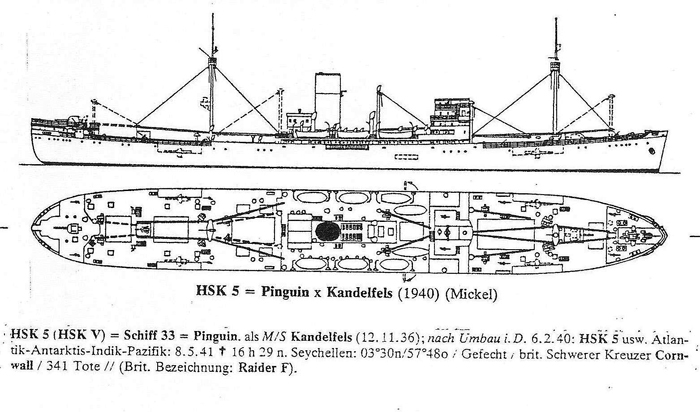
Blueprint of the Pinguin, same class as the Atlantis
Just as during the First World War, the German navy turned for use as auxiliary cruisers a number of recent, massive and fast freighters. The changes, made through civilian authorities with civilian engineers and military equipment were sometimes radical, and the vessels in question, apart from speed, had real offensive capabilities, threatening even for cruisers. The aim of the design was to have them mimicking a large array of near-similar or approaching neutral ships, approach other ships, then reveal their true identity.
Such procedure did not include capture but annihilation of the opposing ship, often after allowing the crew to evacuate, by means of 150 mm reformed guns and torpedo tubes. They could also laid mines unsuspected, or repel strafing attacks by their AA artillery, all served by modern fire control systems. For long range reconnaissance they embarked one of two seaplane. Small torpedo crafts tailored to operate also from the ship were another way to deal with protected harbours, extend her reach or catch faster ships.
The results they obtained in operations were generally good. 9 ships (HK1 to HK9) were put into service, keeping their civilian name: Orion, Atlantis, Widder, Thor, Pinguin, Stier, Komet, Kormoran and Michel. Their most active and effective period was 1939-1941: Together they sank 140 ships, a total of 700 000 tons. A score well above other military ships of the Kriegsmarine, and also superior to many U-Bootes. They were feared by allied crews, but in general their captains behaved according to the natural unwritten solidarity rules of sailors at sea. When not gathered to be kept on board, crews of sunk ships were often given food, blankets, navigation instruments or maps and directions.
Specifics of Hilfskreuzer
Armament
15 cm (5.9 in) SK L/45 guns
All were mounted on single pedestal mounts, behind folding down light panels, along the side, under specially built recesses. There were older models, but these were the latest and most common among stocks still available after olders surviving vessels of the Riechsmarine were scrapped. These guns were no joke, even for 1940: They were able to engage targets at 17,600 m (19,200 yd). Between 1,000 and 2,000 rounds were carried total (100-150 per gun) with available shells still in inventiory. The classics were 45.3-kilogram (100 lb) HE shells. They fired at 840 meters per second (2,800 ft/s) in muzzle velocity, with a max elevation at 30°.
Other intermediate calibers
This can vary wildly however. Atlantis, Orion, Widder, Pinguin, Kormoran for example had all a single French 75 mm/35 guns. Komet had a 60mm/18, Michel a 105mm/45 C32, and Schiff 5 two.
40mm/70 Bofors 28
Only used by KMS Coronel, which instead of 37 mm FLAK had six Swedish 40 mm, 70 caliber Bofors 28 AA guns.
3,7-cm/80 Schnelladekanone C/30
The C/30 was a semi-automatic anti-aircraft gun automatic ejection of spent cartridge casing but hand-loaded one round at a time for up to 30 rounds per minute. It was well below the Bofors 40 mm whereas its muzzle velocity was 12-15% higher with better aiming. It was ubiquitous in the Kriegsmarine.
Specs:
Mass: 243 kgs (536 lb), 3.074 metres (10 ft 1 in) long, 2.962 metres (9 ft 9 in) L/83 barrel
Fired a fixed, 0.68 kilograms (1 lb 8 oz) cased charge shell 37 x 380 mm R
The breech was a semi-automatic, vertical sliding-block type allowed 30 rpm (practical)
Muzzle velocity was 1,000 m/s (3,300 ft/s) 2,000 m (6,600 ft) effective ceiling and 8,500 m (9,300 yd) at 37.5° max.
2-cm/65 Schnelladekanone C/38
The rival to the allied oerlikon, this ordnance was developed and manufactured by Rheinmetall, a design linked to the earlier Solothurn ST-5 and declined int the C/30 and the C/38, both fully automatic. The C/30 was prone to jamming using a 20 rounds magazine with frequent pauses for reloading. The C/38 had a short recoil and the same 20-round magazine with a later 40-round magazine introduced, more reliable overall. The Navy mount was a tri-axial quad system develped for the C/30 guns with layer and pointer in front, cross-roll operator behind (Flakvisier 35 gunsight) and later evolved into the 2 cm Flak C/38 auf Vierlingslafette C/38 with a simplified bi-axial quad mounting (Flakvierling 38) operated by a single gunner behind. But these were single mounts in the earlier case, with c/38 guns here. Later Flakvierlings were installed (Barbara upgrade)
Specs:
C/38 weight 129 lbs. (57.5 kg) oa lenght 88.7 in (2.2525 m) barrel 51.2 in (1.300 m)
Rate Of Fire 480 rounds per minute cyclic, 220 rounds per minute practical
0.71 lbs. (0.320 kg) round, either AP-T 0.326 lbs. (0.148 kg), HE-I 0.265 lbs. (0.120 kg) or HE-T 0.256 lbs. (0.116 kg)
Complete round 8.99 in (22.8 cm) with 0.265 lb. (0.120 kg) RPC/38 propellant, Brass, 20 x 138B mm, 0.41 lbs. (0.186 kg)
Muzzle Velocity from 2,625 fps (800 mps) to 2,870 fps (875 mps) with HE-T.
2,000 rounds stored for each in 20-rounds mags (200 mags).
On board Aviation
If Atlantis started with two Heinkel He-114C, the model was later standardized as the Arado 196, from one to three, with some ships having catapults, but not present on all. These excellent, modern floatplane were intended for observation and artillery spotting, albeit their main targets were merchant vessels, and thus, they could engage them closely. This function was more useful against an escorting warship or AMC.

Arado 196 A2 from HSK-4 Thor in Malaysia 1941, note the Japanese roundels. The model had an uncanny resemblance to the Aichi E13A indeed.

Arado 196A3 from HK-6 Komet with False Frenche Markings in 1940
Torpedoes
This varied from ship to ship. Some had a single deck-mounted, traversing mounted torpedo tube, some had two twin, some had fixed tubes in the beam. They carried G7 models, of WW1 or interwar depending on available stocks. It is possible also they had reloads.
Below is the 1934 53.3 cm (21″) G7a T1 “ato” class:
⚙ specifications
Weight 3,369 lbs. (1,528 kg), Negative Buoyancy 605 lbs. (274 kg)
Dimensions: 23 ft. 7 in. (7.186 m)
Propulsion: Decahydronaphthalene (Decalin) Wet-Heater
Range/speed setting: 6,000 m/44 knots, 8,000 m/40 knots, 14,000 m/30 knots
Warhead: 617 lbs. (280 kg) Hexanite
Guidance: Federapparattorpedo; 1944 Lagenunabhängiger Torpedo
Mines
Again, only a few ships carried mines, notably Kormoran, Orion and Atlantis. The latter even carried 228 of these. The type is probably the standard one below:
EMC Contact Mines placed on trolley rails. These were spherical mines 44 inch (1.12 m) in diameter and with an explosive load of 661 lbs. (300 kg). Detonation was trusted to seven Hertz horns. These mines could be moored underwater, under 55, 109, 164 or 273 fathoms (100, 200, 300 or 500 m). First captured by the British in October 1939. See also.
Leichte Schnellboote (LS)
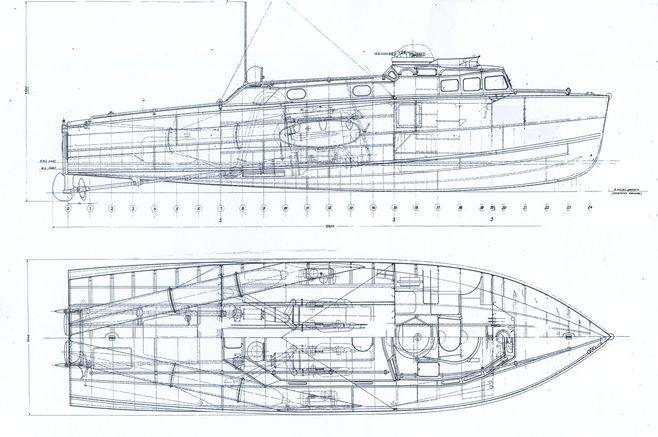
When the war broke out, mini-speedboats LS 1 and LS 2 had been designed to be carried and deployed by auxiliary merchant cruisers and German well-armed merchant raiders. However, they proved disappointing in operations. Developed by Dornier, first deployed with “Komet” (HSK 7) and “Meteor”. The planned 45 cm torpedoes (airbone model) was not ready in time, instead they carried three mines for port entrances. More.
Sensors
Of course, these ships were also equipped to intercept radio traffic and determine positions by triangulations, or just were vectored in by radio from the staff on potential targets. They lacked a bedframe style radar however, which would have been an instant giveaway of their true nature. The most common was likely the The FuMO 21 (Funkmess-Ortung, “Radio-direction finder, active ranging”).
Full List
 HSK 1 Orion
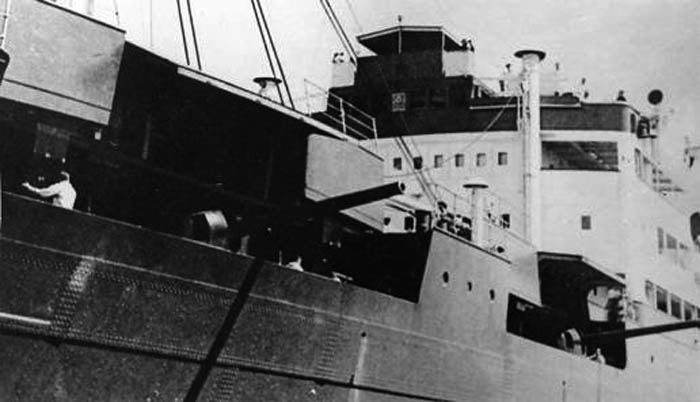
KMS Orion in 1940 (bismarck-class.dk)
Launched in 1931 in Hamburg, former SS Kurmark. Requisitioned, armed, equipped and put into service in December 1939. Covers: Dutch Beemsterdjik, Soviet SS Sovet, Japanese Maebasi Maru. Sank 5 ships (41 138 GRT), participated in the destruction of 4 others. Became the gunners training ship Hector in January 1944, then cadet training ship Orion in 1945. Sunk by RAF in Swinemünde April 4, 1945.
Specifications |
|
| Dimensions | 148 x 18,60 x 8,20m |
| Tonnage (Empty/Fully Loaded) | 15 700 tons (7021 GT) |
| Crew | 351 |
| Propulsion | 1 screw, Blohm & Voss turbine, 4 boilers, 6200 hp = 13,5 kn |
| Armament | 6 x 150mm, 1 x 75mm, 4 x 37mm AA, 4 x 20mm AA, 6 TT 533 mm, 288 mines, 2 planes |
HSK 2 Atlantis
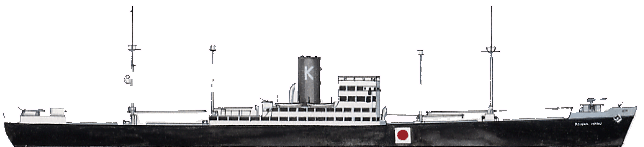
Profile of the Atlantis disguised as the Kasii Maru
Launched in 1938 in Bremen. Requisitioned, armed, equipped and returned into service in November 1939; Covers: Freighter MS Goldenfels, Norwegian Knute Nelson, Soviet freighter SS Kim, Japanese Kasii Maru, Dutch Abbekerk. Its 150 mm guns came from the battleship Schliesen. She had 2 Heinkel 114. Sank or captured 22 ships during her career (145 968 GRT), which classed her among the best German Hilfskreuzers. Ended in an unequal duel against the British heavy cruiser HMS Devonshire in the South Atlantic, November 23, 1941.

Specifications |
|
| Dimensions | 155 x18.70 x8.70 m ( ft) |
| Tonnage (Empty/Fully Loaded) | 17,600 tons (7862 GT) |
| Crew | 351 |
| Propulsion | 1 screw, 2 MAN diesels 6cyl, 7600 hp = 16 kn |
| Armament | 6 x 150, 1 x 75, 2 x 37AA, 4 x 20AA, 6 TT 533 mm, 92 mines, 2 planes |
HSK 3 Widder
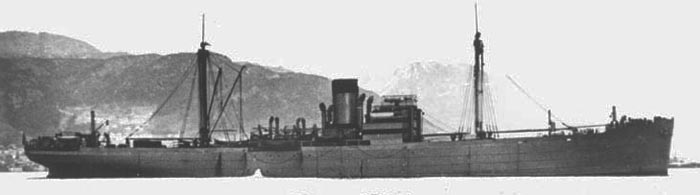
KMS Widder
Launched in 1930 in Kiel. Requisitioned, armed, equipped and put into service in September 1939. Also training ship Neumark. Covers: Norwegian SS Narvik, Spain’s Neptuno. Its 150 mm guns came from pre-dreadnought Deutschland. Had 2 Heinkel 114. Sank or captured 10 ships (58 644 GRT) in a 180-day cruise. Survived the war and became the British repair ship Ulysses. Returned to Germany, was used as training ship Fenchenheim. Ran aground on a sandbar near Bergen and was scrapped in situ in 1955.
profile to find
Specifications |
|
| Dimensions | 152 x 18,20 x 8,30 m |
| Tonnage (Empty/Fully Loaded) | 16 800 tons (7851 GT) |
| Crew | 364 |
| Propulsion | 1 screw, Blohm & Voss turbine, 4 boilers, 6200 hp = 14 kn |
| Armament | 6x 150mm, 1x 75mm, 4x 37mm AA, 4x 20mm AA, 6 TT 533 mm, 2 planes |
HSK 4 Thor
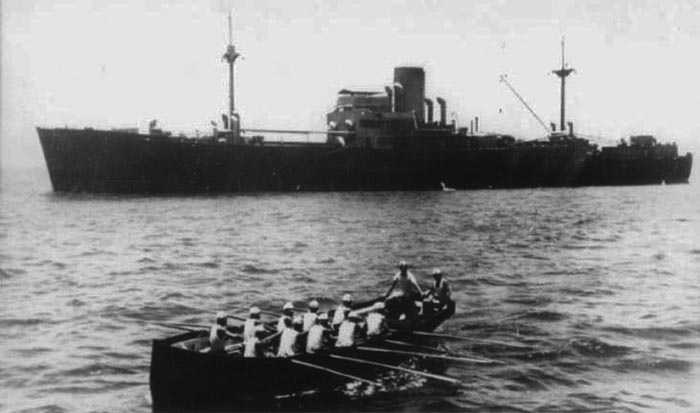
KMS Thor, South Atlantic 1940
Launched in 1939 in Hamburg as SS Santa Cruz. Requisitioned, armed, equipped and put into service in March 1940. Very fast for a cargo ship. Covers: Yugoslav SS Vir. Its 150 mm guns came from the old battleship Deutschland. Known by British intelligence as “Raider E”. Sank or captured 12 ships (96,541 GRT) in her first trip, 10 more in the second, totaling 55,587 GRT. Tied to the supply ship KMS Uckermark in Yokohama November 30, 1942 but exlosed for still unclear reasons. Declared total loss, scrapped in situ afterwards.

Specifications |
|
| Dimensions | 122 x 16,70 x 8,10 m |
| Tonnage (Empty/Fully Loaded) | 9200 tons (3862 GT) |
| Crew | 345 |
| Propulsion | 1 screw, AEG turbine, 2 boilers La Mont, 6500 hp = 18 kn |
| Armament | 6 x 150mm, 1 x 75mm, 1 x 37mm AA, 4 x 20mm AA, 6 TT 533 mm, 1 plane |
HSK 5 Pinguin
 Disguised to resemble the Russian SS Pechora, the Greek MS Knossos and the Norwegian MS Tamerlane, Pinguin (= HSKS = Schiff 33) was laid down by AG Weser at Bremen in 1936 and commissioned by the Kriegsmarine 6.2.40. She was formerly MS Kandelfels, and was known to British Intelligence as ‘Raider F’. Her main armament was taken from Deutschland class pre-dreadnoughts; her two He 114B floatplanes were replaced by a single Ar 196A-1 in March 1941. During a 357-day, 59,188nm sortie in World War II she sank 26 vessels totalling 136,642grt. She met her end in the Indian Ocean on 8.5.41, sunk by gunfire from the cruiser Devonshire; 341 men were lost.
profile to find
Specifications |
|
| Dimensions | 148/155 x 18.70 x 8.70m |
| Tonnage | 17,600t, 7766 GRT |
| Crew | 401 |
| Propulsion | 1 shaft, 2 MAN double-acting 6-cyl. diesels 7,600 bhp= 16kts |
| Armament | 6x 150mm/45, 1x 75mm/35, 1x 37mm/83 C30, 2×2 30mm C38, 2×2 533mm TT, 300 mines, 2 aircraft |
HSK6 Stier
 MS Cairo was laid down by Germaniawerft, Kiel, in 1936 and commissioned as Stier (= HSK6 = Schiff 23) in 1942, probably on 10 May. Designated ‘Raider J’ by the British, she carried two Ar 231 floatplanes. She was responsible for the loss of 4 ships (30,728grt) but had a relatively short career, being sunk in action with the US Liberty ship Stephen Hopkins in the South Atlantic on 27.9.42.

Specifications |
|
| Dimensions | 124/134 x 17.30 x 7.20m |
| Tonnage | 11,000t/4778 GRT |
| Crew | 324 |
| Propulsion | 1 shaft MAN 2-stroke 7cyl diesel: 3,750 bhp= 14kts |
| Armament | 6x 150mm/48, 2x 37mm/83 C30, 2×2 20mm C38, 2x 533mm TT sub, 2 aircraft |
HSK7 Komet
 This vessel, the former MS Ems, was the smallest but best-equipped German armed merchant cruiser. She was built by Deutschewerft, Hamburg, being laid down in 1937 and commissioned as HSK7 (Schiff 45) 2.6.40. The lavout resembled that of the Japanese MS Tokyo Maru, the Russian SS Denev and the Portuguese MS Sao Thomé. Komet’s 150mm guns originated from Deutschland class battleships; her 60mm weapon was an obsolete landing gun in service with the Imperial Navy. Her original speed was 16kts. Aircraft equipment comprised 2 Ar 196A-—Is; the MTB was one of the LS (leichtes Schnellboot) series of midget torpedo-boats carried by commerce raiders, Komet’s boat being LS2 (Meteont). After breaking through to Kamchatka via the Arctic passage, Komet sank 10 vessels (21,378grt) returning to Norway 9.7.40. Attempting a breakout via the English Channel for a second sortie, she was sunk by M7B236 on 14.10.42 with the loss of all hands.

Specifications |
|
| Dimensions | 109/115 x 15.30 x 6.50m |
| Tonnage | 7,500t/3,287 GRT |
| Crew | 269 |
| Propulsion | 1 shaft, 2 MAN 2-stroke 6-cyl. diesels, 3,900 bhp= 14.8kts |
| Armament | 6x 150mm/45 (6×1), 1x 60mm/18, 2x 37mm/83 C30, 2×2 20mm C38, 2×2, 2×1 533mm TT, 1 MTB, 2 aircraft |
HSK 8 Kormoran
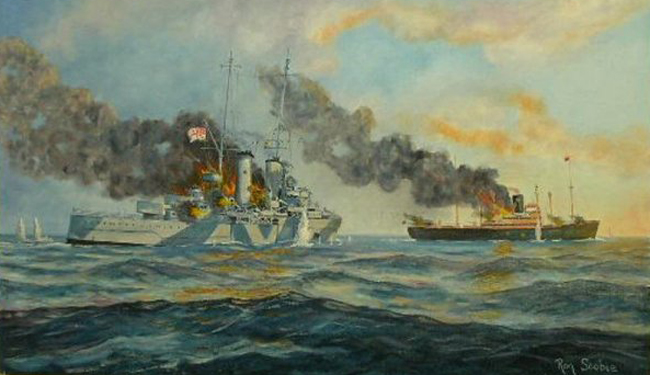
Battle between HMAS Sydney and Kormoran
Probably the most famous German Hilfskreuzer, and corsair of the Second World War. Formerly the bulk carrier Steiermark, it was rebuilt in Kiel in 1938-39, and completed in 1940 under the name of Schiff 41, and a profile resembling Viacheslev Molotov and Japanese Satiko and Kinka Maru (above). She could also quickly be converted in many other disguised. British secret service “Raider-G.” Like any of its kinds, she wore a heavy armament, hidden 150 mm pieces and AA artillery in dismantled parts easy to reassemble very quickly. Two banks of torpedo tubes were hidden in the sides, above the waterline, but the other two were submarine. No radar was provided so she carried Arado 196 for advanced long range recognition, and a single torpedo craft LS3, able to launch two aviation torpedoes. Her cruise in the Pacific lasted 350 days, during which she sank or captured 11 ships, to be eventually tracked down and sunk by the Australian cruiser Sydney (also lost), following a bloody close quarter duel.

Specifications |
|
| Dimensions | 164 x 20,20 x 8,50m |
| Tonnage (Empty/Fully Loaded) | 19 900 tons, 8736t GRT |
| Crew | 400 |
| Propulsion | 2 screws, 4 diesels Kupp-Germaniawerft, 2 Siemens Schuckert motors, 16 000 hp, 18 kn |
| Armament | 6 x 150mm, 1 x 75mm, 4 x 37AA, 5 x 20mm AA, 6 TT 533 mm, 360 mines, 1LS MBT, 2 planes |
HSK9 Michel

This vessel, the former MS Bonn (ex-Polish MS Bielsko) was laid down in 1939 by Danziger Werft and commissioned as HSK9 (= Schiff 28) on 17.9.41. Her 150mm and 20mm weapons were taken from Widder, she carried two Ar 196A-3 aircraft, and her MTB LS4 was named Esau. Known to British Intelligence as ‘Raider H’ Michel sank 15 vessels (99,368grt) on her first, 373-day raid, returning to Yokohama 1.3.43; on her second, 149-day sortie she sank only 3 ships (27 ,632grt) before being torpedoed by the US submarine Tarpon in the North Pacific 17.10.43.
profile to find
Specifications |
|
| Dimensions | 124/132 x 16.80 x 7.40m |
| Tonnage | 10,900t/4,740 GRT |
| Crew | 406 |
| Propulsion | 1 shaft, 2 MAN 2-stroke diesels, 6650bhp= 16kts |
| Armament | 6x 150mm/45 C13 (6×1), 1x 105mm/45 C32, 2×2 37mm C30, 2×2 20mm C38, 2×2, 2×1 533mm TT, 1 MTB, 2 aircraft |
Coronel (schiff 14, TBN Togo FDS)

Coronel (= Schiff 14), the former MS Togo, was laid down by Vulcan, Bremen, in 1938 and commissioned by the Kriegsmarine in December 1942. Attempting to break out via the English Channel, she was bombed and damaged off Dunkirk on 7.2.43. She returned to Germany and was converted into a fighter direction ship.

Togo after conversion
Specifications |
|
| Dimensions | 127/134 x 17.90 x 7.90 |
| Tonnage | 12,700t or 5042 GRT |
| Crew | 350 |
| Propulsion | 1 shaft double acting 2 stroke 8-cyl. diesels 5,400 hp: 16 kts |
| Armament | 6x 150mm/48, 6x 40mm/70 Bofors, 8x 20mm C38, 3 aircraft |
Schiff 5 (TBN Hansa)
 Laid down for the Glen Line as Glengarry in 1939 by Burmeister & Wain, Copenhagen, Schiff 5 never became operational owing to bomb damage at Hamburg, where she was fitting out at the Blohm & Voss yard. Her designed armament was believed to include an Fa 330 Bachstelze (rotary-wing kite). Schiff 5 was later named Hansa and served as a cadet training ship in the Baltic. She was handed back to the British in 1945, under the name Empire Humber; the following year she was returned to her original owners. and reverted to her original name. She was subsequently (1971?) broken up.
Specifications |
|
| Dimensions | 140/153 x 20.10 x 8.70m |
| Tonnage | 19,200t or 9138 GRT |
| Crew | Unknown |
| Propulsion | 2x double-acting 2-stroke 6 cyl. diesels 9,000 bhp= 17kts |
| Armament | 8x 150mm/48, 2-105mm/45 C32, 8-40mm/70 Bofors, 36x 20mm C38, 4x 533mm TT, 1 MTB, 1 aircraft |
More…
Books
Deutsche Kriegsschiffe Hilfskreuzer Und Blockadebrecher 1939-1945
Hilfskreuzer THOR. Hecht im Atlantik. by Brennecke, Jochen.
Links
https://www.wehrmacht-history.com/kriegsmarine/auxiliary-cruisers.html
https://www.german-navy.de/kriegsmarine/ships/auxcruiser/index.html
Hilfskreuzer on bismarck-class.dk
https://www.kbismarck.com/kriegsmarine-auxiliary-cruisers.html
Documentary duel HMAS Sydney vs Kormoran
https://www.bacuffz.com/tag/hilfskreuzer/
https://warhistory.org/@msw/article/hilfskreuzer-33-breakout-part-i
https://www.lexikon-der-wehrmacht.de/Waffen/Atlantis.htm
https://www.lexikon-der-wehrmacht.de/Waffen/Coronel.htm
https://www.lexikon-der-wehrmacht.de/Waffen/Hansa.htm
https://www.imm-hamburg.de/en/product-catchword/auxiliary-cruiser/
https://www.marine-seewoelfe.de/hilfskreuzer.html
https://www.feldgrau.com/ww2-german-kriegsmarine-auxiliary-cruisers/
https://www.bundesarchiv.de/im-archiv-recherchieren/archivgut-recherchieren/nach-themen/hilfskreuzer-der-kaiserlichen-marine-und-der-kriegsmarine-im-ersten-und-zweiten-weltkrieg/
3D/model kits
scalemates.com/ orion HSK-1
scalemates.com/ atlantis
https://www.scalemates.com/kits/navis-neptun-hilfskreuzer-stier-1940-hsk-6–1528595
Videos
See also this 1940 propaganda movie