
 Japan Maritime Self-Defense Force:
ASW destroyer (1959-93): JDS Akizuki, Teruzuki.
Here on naval encyclopedia, were are intended to cover all three Akizuki class destroyer (so far) in Japanese Naval History. The first was the well known “Type B” large AA destroyers of the Pacific war seen earlier this same months. The third are a 2010 class of stealthy escort destroyers of the Japanese Maritime Self-Defense Force. But they were preceded by a cold war one: A 1959 anti-submarine warfare class now largely forgotten. Here are their story. This destroyer class was planned to be a flotilla leader with enhanced command and control capability, and sometimes classified as “DDC” (commanding destroyer) unofficially. They remained active until 1993.

Development of the Akizuki class, F105 Program
Initially, they did not come from the JMSDF staff but rather from American Military Assistance Advisory Group-Japan (MAAG-J). The latter, seeing the warship capabilities recently developed by Japan, saw some possibilities of better cross-training with the USN and recommended a modified version of the American Fletcher class for an already constructed surface combatants, and the project was financed by the Off Shore Procurement (OSP), with a design and construction completely indigenous. The end result was much like its predecessors, Murasame and Ayanami classes, with the now typically Japanese Cold War “long forecastle” design with inclined afterdeck or “Holland Slope”.
On this new Akizuki class, an enlargement of the hull enabled to house for the turbine propulsion system larger and higher-pressure boilers (570 psi). There were a combination of the weapons of the Murasame class and torpedo/mines of the Ayanami class. But they were first and foremost the first vessels with a modern ASW armament, the US-provided Mk.108 Weapon Alpha. The JMSDF desired at first this ASW rocket launcher, but performances were not as good as reported, believed. So it was later replaced by the more classic Type 71 375 mm (15 in) quadruple ASW rocket launcher, a version of the Swedish M/50, in 1976. That was a first, an encroachment on the US-only procurement policy that was supported until then.
The Akizuki-gata Goeikan, were also the last to feature the “Dutch Slope”. Built with U.S. funds as an offshore procurement (OSP) they were also the first destroyer to exceed 2,000 tons in displacement, equipped with a comprehensive ASW and artillery arsenal plus flagship functions, they were also remarkable by their cost at approximately 3.4 billion yen.
Development of the Akizuki class (1957-58)
The Harukaze-class destroyers was defined under the 1953 plan, resuming domestic destroyers’ construction, and in order to prioritize the numerical expansion of the Japanese Navy, severely understaffed at the time, the 1954 plan focused on the construction of smaller vessels, such as submarine chasers, and did not include larger ships. However, after the establishment of the Japan Maritime Self-Defense Force in 1955, construction of these destroyer-size vessels resumed. First, construction of the 1,700-ton Ayanami-class started under the 1955 plan. This ship reflected the knowledge gained through planning, design, and construction of the Harukaze-class (28DD).
The difference was stretching the hull size and significantly redesigning it. However, in exchange for enhanced anti-submarine warfare capabilities, compromises had to be made for the artillery, which was downgraded. Thus, in budget requests and public presentations, she was unofficially referred to as an anti-submarine destroyer (DDK), a specialized ship unable to face contemporary destroyers, like the Soviet Skoryy class. Construction of a 1,800-ton model, the next Murasame-class thus started in parallel, under the 1956 plan. This was of a similar design but slightly larger, with a less impressive ASW armament for a much stronger artillery, and thus designated a Destroyer Anti-Aircraft (DDA) ship.
Initially, these two types were the only ones planned for construction in the early 1950s. But in January 1957, the US notified Japan it would need two more vessels and was read to go through Off Shore Procurement (OSP) for the financing, relieving some burden on a still rebuilding economy of Japan. In fact, this program was even added to the U.S. Navy’s fiscal year 1957 shipbuilding budget. The U.S. in fact initially wanted Japan to build a slightly improved Fletcher-class destroyer, at the time in service as the Ariake class. But given Japan’s track record of excellent design and shipbuilding skills since the Harukaze class, instead only financial assistance was to be provided, leaving the planning, design, and construction entirely to Japan. This marked a rare exception for the US offshore procurement program, which was used mostly to provided US-designed vessels and equipments to foreign, allied and friendly nations.
This new program was officialized in Japan, from a Cabinet decision on March 29, 1957 at the diet, and a contract was signed between the Japanese and U.S. governments the same day. The contract stipulated that the Japanese government would procure two 2,300-ton destroyers and deliver them to the U.S. government by March 1960 for financing, under a total contract price of $18.68 million (¥6,724,800,000) with the U.S. government paying 90% based on progress, and the remaining balance after delivery. The final cos rose to ¥3.4 billion.
Design of the class
Hull and general design
The new Akizuki class were the largest of the early generation Japanese cold war Destroyers, first in some features, last in others.
Like its predecessors, the basic design was outsourced to the Japanese Ship Design Association. It was assigned the basic plan number F-105. This was the last patrol ship designed there.
Like the Ayanami-class (30DDK) and Murasame-class (31DDA) they shared the long forecastle and so-called “Dutch slope” with a hull structure and materials nearly identical. However, when trying to build a ship as large as possible within the assigned cost, standard displacement was increased by 550 tons, length by 10 meters to stay feasible. This resulting in much more spacious design, and they ended popular with the crews. This extra space however was first and foremost used to build in new flagship facilities, some of the necessary compartments as accommodation rooms, being located within the superstructure, making for a much boxier structure, unusual compared to her brethren.
That larger hull also improved habitability, in the combat zone but also some accommodation areas, command room, captain’s room, officers’ quarters. They were also the first equipped with separate air conditioning systems and a complete NBC protection. In fact, full-scale anti-radioactive dust protection measures were set in place such as an outer sprinkler system to was out radioactive dust fro the deck, experimentally installed on the Ayanami-class previously. There was a full sealing of any doors and hatches, and the air conditioning provided overpressure. There were also external detectors of NBC threats. The class also differed by having, in addition to the usual boats, a small officer’s boat at the centre starboard to operate as flagship. There was still no onboard helicopter.
Powerplant
The main powerplant was not innovative, as it was generally similar to that of the 30DDK and 31DDA but with increased power output achieved by fitting larger Mitsubishi CE boilers, operating at greater steam pressure and temperature, 40 kgf/cm² (570 lbf/in²) and 450°C. These new boilers were adopted in all subsequent destroyers, except for the four DDHs. This was a double end water-tube boiler configuration, generating 85 tons of steam per hour. Not sisters differed in details, however, as DD161 Akizuki had Mitsubishi-Escher Weiss geared steam turbines, and her sister DD162 had two sets of Westinghouse geared steam turbines for comparative tests. In any case, this destroyer, albeit larger than previous classes, were also the fastest at 32 knots.
Like the US Gearing-class, the Akizuki class also featured a 6-meter intermediate compartment between the fore and aft engine compartment for increased fuel capacity, an entire beam was converted as a fuel tank for a range of approximately 7,800 nautical miles at 18 knots, significantly more than the 5,700 nautical miles of the 30DDK and the 6,000 nautical miles of the 31DDA. They were also the last destroyer to feature a hydraulic transmission steering system, all later had electric systems instead, easier to repair. For power generation when cold, the Akizuki class was equipped with two 440 kW (550 kVA) steam turbine main generators plus two 120 kW (150 kVA) diesel main generators.
Armament
5-inch/54 calibre Mk.16 guns
Three US-provided 54-cal. 12.7 cm (5 inches) single-barrelled guns (Mk.39) main guns on Mark 16 turrets like the previous Murasame class. Originally installed on the Midway-class aircraft carriers but removed during modernization in 1955, donated to the Japan Maritime Self-defence Force. Their gun shields were changed to the new standard thin high-tensile steel models to reduce weight. The weight imposed an arrangement with one forward, two aft in super firing position but all far apart. The one on the bow deck was far from the bridge. The ones aft took advantage of the “holland slope” to be positioned in super firing positions without actually be mounted on structures, but directly on deck. The clearance for “X” turrets however above “Y” turret was really short in direct fire at 0°.
Specs
3-inch/50 caliber Mk.22 guns
Two 50-cal 3-in twin rapid-firing gun (Mk.33) installed behind the main gun on the foredeck, and aft, super firing over “X” turret. In order to further lower the centre of gravity, the 3-inch guns were omitted their shields, and equipment position was lowered just enough for the horizontal firing field in the fore and aft directors. The first and second ships had a gun shield installed on their forward 3-in guns, however. This was a Japanese one, armoured. This gun was later produced in Japan under licence, installed on 44 JMSDF ships, until those planned in 1974. The associated gun fire control system was the Mk.63, same as for the 40 mm on the Harukaze.
Specs
Bofors 375 mm (15 in) ASW rocket launcher
This system was developed by the famous gun maker postwar in Sweden to replace the WW2 Hedgehog. It was used by Sweden, France, Denmark, Netherlands, Norway, Portugal, India, Japan (license-built as the Type 55) there, and others. 375 mm (14.8 in) calibre, 4-barrel trainable mount with rocket-propelled depth charge (HE depth bomb 100 kg filler) at a range of c300–1,200 m depending on propellant charge, full salvo per minute. Each bomb had a contact or depth (hydrostatic) fuse, but it was unguided, aimed using sonar data fed into fire control systems and launched in a pattern, fan or circular spread ahead.
RUR-4 Weapon Alpha anti-submarine mortar (1976)
The RUR-4 Weapon Alpha or simply “Weapon Alpha” or “Alpha ASW rocket” was a turret-housed Forward-throwing anti-submarine rocket launcher, single barrelled. It was to give initially the ability to attack submarines beyond the range of depth charges or Hedgehog mortars. Introduced in 1951, it served into the 1960s until, but largely replaced by the more mature RUR-5 ASROC.
This trainable, single-barrel system using pump-air fired an 8-inch (203 mm) rocket carrying a depth bomb with contact or time-fused detonation.
Range was about 800 yards (730 m) minimum to 3,200 yards (2,900 m) max, with a full salvo of 12 rockets per minute. It was linked with sonar systems to allow quick response against submerged targets. In the 1960s it was considered a transitional ASW weapon, still more advanced than the Hedgehog and Squid mortars but infinitely less capable than guided ASROC systems.
Hedgehog anti-submarine mortar
The anti-submarine weapons were based on the equipment of the 30DDK, with some reductions. The previous Ayanami-class was planned to be equipped with American Weapon Alpha and British Skid, new generation rocket artillery, but this was not realized. The next Akizuki obtained the new Weapon Alfa, but also retained the Mk.15 swivel-mounted version of the Hedgehog, installed forward at the foot of the bridge.
19-in (483 mm) Mark 2 torpedo ASW TTs
The heavy and bulky long torpedo tubes of the previous class were omitted, and the number of depth charges was halved. Still, they carried two tubes for the Mark 45 Torpedo, just put into service in 1958. The tubes were located either side of the bridge on platforms at the end of bulwarks.
They were likely of the Mark 45 Mod at that stage.
These 2,330 lb (1,060 kg) models measured 225 inches (5.72 m) for 19 inches (483 mm) and the original W34 nuclear warhead was replaced by a conventional one.
They were powered by an electric engine to a range up to 11,000 yards (10 km) at 40 kn (74 km/h), guided by Gyroscope and wire.
Y-gun
The Murasame-class was also equipped with Mk.2 launchers and depth charge projectors (Y-guns), and a single depth charge track. But the number of depth charges carried was reduced from 56 on the Ayanami-class to 18. Two Y-Guns, depth charge throwers capable of 60 to 150 yards (55 to 137 m) in just 3.4 to 5.1 seconds. Aft on deck abaft the deckhouse. Charges were 65 lbs. (29.5 kg) with increasing range, using black powder (settings 60, 90 and 150 yards (55, 82 and 137 m). Probably using the Mark 16. 435 lbs. (197 kg) model carrying 295 lbs. (134 kg) Torpex charge with a sink Rate of 31 fps (9.4 mps) and max setting of 2,500 feet (762 m). Mod 0 was hydrostatic and Mod 1 was acoustic.
Upgrades
1967 Teruzuki fitted with the OQA-1 sonar
1968, Akizuki fitted with the OQA-1 sonar
1977, Teruzuki: 2x 483mm TT as well as the 324mm Mk 108 Weapon Alfa ASWRL and SQS-23 sonar removed. 2×3 324mm TT, and quad 375mm type 71 ASWRL added, plus the SQS-29 sonar.
1979, Akizuki, same.
1985, both, saw the removal of their 533mm TT and OQA-1 sonar
1989 saw Akizuki losing the aftermost 5-in/54 main gun and instead the space was used to test a new towed sonar array.
Sensors
This class combined the 30DDK and 31DDA armaments for anti-aircraft, anti-submarine, and anti-ship capabilities and became the first true Japanese general-purpose destroyers. While slightly inferior to the U.S. Navy’s Forrest Sherman-class destroyers, they had a powerful wide-area air defense and anti-submarine warfare capabilities, on par with gun-equipped general-purpose destroyers in service in Europe and the United States. But this went with its own challenges for the integration of the right sensors and combat system.
C2 Suite
As command destroyers, they were the first equipped with powerful command and control (C2) capabilities, with a floor area in command space being the largest so far at 118 m2, nearly double that of the Yukikaze, already designed as flagships. This also came with extensive communications equipment, from the start 6-8 transmitters, 8-10 transceivers, 20-25 receivers, 3-4 cipher machines, and special communications equipment, facsimiles and duplicating transmission devices. The latter were housed in two telegraph rooms.
OPS-1 or AN/SPS-12
The radar suite was essentially based on that of the Murasame-class, OPS-1 for air search, OPS-5 for surface search, both domestically produced based on the AN/SPS-6 and AN/SPS-5.
The AN/SQS-4 family of sonars was however brand new. The AN/SQS-4 was developed as an extension of the previously QHB for a frequency range of 8 to 14 kHz and detection distance of 4,600 meters. They appeared on the Dealey-class destroyer escorts from 1954.
Air search radar developed as a successor to the SR-3/R-6 L Band ASR (air search radar) of WW2. Parabolic antenna using a horn antenna as primary radiation source, modular design for configuration changes. The antenna was 18 ft (5,500 mm) x 5 ft (1,500 mm), for a beamwidth of 3° x 10°, but could be detected at 80 nmi (150 km) away.
OPS-15
The Japan Maritime Self-Defense Force first acquired the AN/SPS-5B as an onboard radar for its Bluebird-class minesweepers, then replacement for the SG and SL-1 on the Asakaze-class escorts (former Greaves-class) and Kusu-class (former Tacoma-class). The OPS-15 was developed as a copy of the latter and became the first domestically produced surface search radar, by Japan Radio Co., Ltd. Larger than the original, it suffered from heat generation problems and was further developed into the OPS-5, linked to the indicator in the Combat Information Centre (CIC). They use a Xb band (6.4 GHz) but this was the same as for television relay broadcasting, interference became a problem. In 1957, they were upgraded to the C band (5 GHz) and by enlarging the antenna, the performances exceeded the OPS-2. It was also called the OPS-3.
Mark 57 GFCS (SPG-34)
Fire control for the 5-in/54 Mark 16 main guns. Coupled with the SPG-34 radar.
Mark 63 GFCS (SPG-35)
Fire control for the 3-in/70 Mark 33 main guns. Coupled with the SPG-35 radar.
SQS-4 sonar
Ensemble name for the AN/SQS-4 sonar, AN/SQR-8 sonar and QQA-1A sonar combined system.
The AN/SQS-4 was a long-range active/passive, search and attack sonar. It was the first major long-range sonar to be designed after World War II, and was the basis from which several subsequent US sonars were developed. Operating frequency was 14 KHz, with selectable pulse lengths of 6, 30, or 80 milliseconds and respective power outputs of 50, 30, and 10 kW. Range scales were 1,000, 2,500, 5,000, 10,000, and 15,000 yards (914, 2,286, 4,572, 9,144, and 13,716 m).
The AN/SQR-8 was a passive array linked to the above system. No info on the QQA-1A sonar.
So until February 1969, the Akizuki class destroyers came with that AN/SQS-4 suite, then it was upgraded to the SQS-29J (SQS-4 mod. 1 improved version) compatible with 8 kHz band systems. Teruzuki herself was upgraded to the AN/SQS-32 (SQS-4 mod. 4 improved versions) compatible with the 14 kHz band in March 1970, but had before the AN/SQR-8 attack sonar, removed when the SQS-32 was installed. Between 1968 and 1969, Teruzuki also sported the new OQA-1A variable depth sonar (VDS), and Akizuki was later upgraded the same.
Active protection
BLR-1 ECM suite
Called the Radio/Radar Interception System (1951/52). No data. Antenna assemblies.
In addition, they had the NOLR-1.
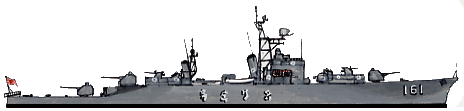
Author’s old illustration
⚙ specs. |
|
| Displacement | 2,350 long tons (2,388 t) standard, 2,890 long tons (2,936 t) normal |
| Dimensions | 118 x 12 x 4 (387 ft 2 in x 39 ft 4 in x 13 ft 1 in) |
| Propulsion | 2 shafts steam turbines, 4 boilers, 45,000 shp (34,000 kW) |
| Speed | 32 knots (59 km/h; 37 mph) |
| Range | 7,800 nautical miles at 18 knots |
| Armament | 3× 5″/54 caliber Mk.16, 2×2 3″/50 Mk.22, 1× Mk.108 ASWRL, 2× Hedgehog, 1x 4 Bofors ASWRL, 2× Mk.2 ASWTR, 4 × 533 mm (21 in) TTs, 2× DCT, 2× DCR |
| Sensors | Mark 57 FCR, Mark 63 FCS, OPS-1 ASR, OPS-5 SSR, AN/SQS-4+AN/SQR-8+QQA-1A sonar suite |
| Active Protection | NOLR-1 ESM |
| Crew | 330 |
Career of the Akizuki class

Teruzuki and Yugure in Guam, 1974
Akizuki was completed on February 13, 1960, and Teruzuki on February 29, but first registered as DD-960 and DD-961 respectively, with immediately delivery to the Japan Maritime Self-Defense Force, after the financing was completed by the US program, after inspection by the USN. Both were initially incorporated into the Yokosuka District Fleet for initial training.
Subsequently, after a major reorganization of the Self-Defense Fleet of September 1, 1961, the Escort Fleet was established but Akizuki kept incorporated into the Self-Defense Fleet, whereas only Teruzuki entered the Escort Fleet, both becoming their respective flagships.
On March 30, 1963, Teruzuki was under repairs for two months after a collision: It happened with Kamoharu Maru (46 crew members) owned by Shin Nippon Kisen Kaisha of Kobe, 4 km northwest of the No. 2 Sea Fort. Kamoharu Maru’s bow dug into the Teruzuki’s right rear, tearing down a 4-5m long hole in her hull, killing 5 (sleeping in the No. 8 accommodation area) and injuring 23 other crew member. The enquiry later pointed as the cause of the collision a lookout on Kamoharu Maru mistaking the Teruzuki’s taillights for a small fishing boat, assuming there was enough room to manoeuvre, all in poor visibility in the dark. Just before the collision, the lookout realized the size of the ship forward and took evasive action, but too late.

Akizuki berthed, rearview (CC as all four photos here)
The Self-Defense Fleet Headquarter were relocated to a land-based unit on April 1, 1963, and her sister Akizuki took her place as flagship of the Escort Fleet, a role she held for 23 years, until March 27, 1985. Teruzuki also became later flagship of the 1st and 4th Escort Flotillas. Both were converted as training ships and “special service ships” and, after a long service until the end of the Cold War, decommissioned in 1992 and 1993.
In general, the use of the Weapon Alpha, introduced as a promising new weapon, soon showed scores of issues in service, with many problems such as complex maintenance and unreliability. When its US Navy was discontinued, in Japan, some ships had no record of properly firing it since commission. It was replaced by the Type 71 Bofors rocket launchers in a refit after 1972. The torpedo launchers were also updated to Type 68 triple torpedo tubes at the same time and in addition, underwater attack control systems were replaced with SFCS-1C-5 both on Teruzuki and SFCS-1C-6 on Akizuki.
JDS Akizuki

Akizuki (あきづき) was ordered under the pennant DD161 (from march 1985 she became ASU7010), laid down at Mitsubishi Zosen, Nagasaki on 31 July 1958, launched on 26 June 1959 and completed, commissioned on 13 February 1960 and incorporated into the Yokosuka District. The launching ceremony was under USN auspices, she was christened by the wife of Rear Admiral Withington, Commander of the US Naval Forces in Japan. At the delivery ceremony the following year, completion and handover procedures were under US Navy supervision, with US Navy sailors raising and lowering the Stars and Stripes, symbolically, so she was “in service” with the USN under a provisional pennant for an hour. Then JMSDF personnel boarded the ship and raised the Self-Defense Force ensign, for her final commission. She entered the Japan Self-Defense Fleet as flagship, replacing Yukikaze on July 26, 1961. On April 1963, she was incorporated into the Escort Fleet and December 3, replaced her sister Teruzuki as second flagship, Escort Fleet. In March 1968 she had a VDS installed afte a refit, with the removal of her stern ASW DCR/DCT.
In April 1978, in a larger refit, she lost her criticized Mk. 108 “Weapon Alpha” as well as her Mk. 2 short-range TTs, for instead a Type 71 Bofors rocket launcher plus new US pattern triple short-range 324 mm torpedo launchers. On March 27, 1985, she ceded her role as flasghip to the new Murakumo, and was reclassified as “special service ship” (ASU-7010), Yokosuka District Fleet.
On March 24, 1987, she entered the Development Guidance Group to replace Murasame, scheduled for decommissioning. In 1989, her third 5-inch gun turret was removed, instead a new towed naval sonar was installed on her aft deck. She started a campaign of operational testing.
She was struck from the list on December 7, 1993 after 675,906.69 nautical miles (22 times around the Earth) of training cruises across the globe (see examples below), making five long-distance training cruises as flagship of the training fleet.
JDS Teruzuki

Teruzuki (てるづき) was ordered under the pennant DD162 (from March 1985 ASU7012 and July 1987, TV3504) at Shin Mitsubishi Jyuko, Kobe, laid down on 15 August 1958 and launched on 24 June 1959, commissioned on 29 February 1960 after being donated to the Japan Maritime Self-Defense Force, incorporated into the Yokosuka District. She became flagship on September 1, 1961, of the new Escort Squadron, Self-Defense Fleet. From June 8, 1962, she was on the 6th Ocean Training Cruise towards Australia but On March 30, 1963, collided with a cargo ship in the Uraga Strait, damaging the aft starboard side and killing five crew members. From July 19, 1963, she took part in a 7th long-distance training cruise, to Europe. On December 3, 1963, she handed over her duties as flagship of the escort fleet to her sister Akizuki.
From July 17, 1964, she was in the 8th training cruise to North America and Canada and by December 10, 1964, became flagship of the 1st Escort Flotilla. From June 11, 1965, she was in the 9th training cruise to Central and South America and from June 26, 1967, took part in the 11th cruiser, to North America and Canada. By May 1968, her depth charge track and depth charge projectors were removed for a VDS to be installed. From July 1, 1969 she was in the 13th training cruise to Australia. By February 1, 1971, she became flagship of the newly created 4th Escort Flotilla. From July 1, 1974, she trained off Guam with the USN. From June 26, 1976, same, as well as the 200th anniversary of the founding of the US held in Apra Harbor.
From September 1976, she had her weapon alpha, Hedgehogs, Mk. 2 torpedo launchers removed, for a Type 71 Bofors 324mm triple TTs when refitted at Sumitomo Heavy Industries’ Uraga Shipyard, completed on January 31, 1977.
On March 30, 1984, she entered the 3rd Escort Flotilla, transferred to Maizuru. On March 27, 1986, she was reclassified as “special service ship” (ASU-7012) Maizuru District in direct command with her 533mm torpedo tubes and VDS removed. By July 1, 1987, she was reclassified as training ship (TV-3504), incorporated into the 1st Training Squadron in Kure.
On June 20, 1991, she was reclassified as “special service ship” again, 1st Submarine Flotilla and stricken on September 27, 1993, but reconditioned as target ship in June 1994 at Kegoya Dock in Kure, and sunk on July 14 by airborne anti-ship missiles off Hachinohe.
Read More/Src
Books
Gardiner, Robert; Chumbley, Stephen (1995). Conway’s All The World’s Fighting Ships 1947–1995.
Abe, Yasuo, “History of the Japan Maritime Self-Defense Force’s Escort Ships 1953-2000,” Ships of the World, No. 571, Kaijinsha, July 2000
Abe, Yasuo, “Technical Features of Escort Ships – 2. Propulsion Systems,” Ships of the World, No. 742, Kaijinsha, June 2011
Ishibashi, Takao, “Hull (Development of Japanese Destroyers from a Technical Perspective),” Ships of the World, No. 453, Kaijinsha, February 1994
Katsuyama, Taku, “Old Sailor’s Memories, Part 4: Have You Gone?” Ships of the World, No. 688, Kaijinsha, April 2008
Koda, Yoji, “The History of Domestically Produced Escort Ship Construction,” Ships of the World, No. 827, Kaijinsha, December 2015
Sakata, Hideo, “The History of the Maritime Self-Defense Force FCS,” Ships of the World, No. 493, Kaijinsha, March 1995
Tada, Tomohiko, “4. Radar/Electronic Warfare Equipment (Japan Maritime Self-Defense Force’s Shipboard Weapons 1952-2010),” Ships of the World, No. 721, Kaijinsha, March 2010.
Kaijinsha, ed., “Japan’s Destroyers (Postwar Edition),” Ships of the World, no. 742, Kaijinsha, pp. 91-135, June 2011.
Otsuka Yoshifuru, “Technical Features of the JMSDF General-Purpose Escort Ship,” Ships of the World, No. 997, Kaijinsha July 2023.
Koda Yoji, “The Progress of Domestic Escort Ship Construction,” Ships of the World, No. 827, Kaijinsha, December 2015.
Sakata Hideo, “The Progress of the JMSDF FCS,” Ships of the World, No. 493, Kaijinsha, pp. 70-75, March 1995.
Sekigawa Takeshi, “Evolution of Underwater Attack Control Systems,” Volume 4, Torpedoes, Suikokai, “The JMSDF’s Painstaking Footprints,” 2013,
Tomohiko Tada, “4. Radar/Electronic Warfare Equipment (MSDF Shipboard Weapons 1952-2010),” No. 721, Kaijinsha, pp. 100-105, March 2010.
Eiichi Yoshihara, “Hull (History of MSDF Escort Ships 1953-2000) — (Technical Features of MSDF Escort Ships),” No. 571, Kaijinsha July 2000
Links
navypedia.org/ akizuki.htm
ja.wikipedia.org/ akizuki class
en.wikipedia.org Akizuki-class_destroyer_(1959)
Model Kits
None found