
 Bundesmarine, 82 Built 1981-today for 13 countries.
Germany Day ! If on one hand, the Bundesmarine was a relatively modest navy in comparison to West Germany’s and post-1990 unified Germany’s economical means up to this day, export was in addition a major asset to finance it. Indeed, Blohm & Voss was chiefly responsible for it. Probably the most venerable and prestigious German shipyard, nested in Hamburg, the old capital of the Hanseatic League, was founded in 1877. Fast-forward a century later, and B&V was able to create a true brand of ships for the international market, known as the MEKO® family, a portmanteau standing for “Mehrzweck-Kombination” (multi-purpose-combination). It is truly the lego concept of warships, an extremely modular approach to modern naval shipbuilding, for armament, electronics and other equipment, ease of maintenance and cost reduction. A way to create a truly “a la carte” warship, appealing to most navies while keeping overall the same DNA, hence his article. The same yards also provided Frigates and corvettes for the Bundesmarine, but also ocean-going patrol boats (OPVs).

Construction started in 1979 with Nigeria’s MEKO® 360 H1. MEKO® alone was able to deliver 82 ships, more than the Bundesmarine’s entire surface fleet. Today’s mainstay is the “Combat Ship for the Littorals” or MEKO® CSL, a “Littoral Combatant Ship”, comparable in concept to the US Littoral Combat Ship (LCS) but smaller (and far more successful). In all, Blohm & Voss through its MEKO® brand distributed the MEKO® 360 (1981), MEKO® 140 (1985), MEKO® 200 (1987), F123/F124/F125, K130, MEKO® A-100, A-200, CSL, MEKO® D, MEKO® 100, A-300, A-400 AMD.
Note: This post is not sponsored, nor endorsed by Thyssenkrupp® AG in any way.
About Blohm & Voss

Founding and Early Years (1877–1914): Bloh & Voss was Founded in 1877 in Hamburg by Hermann Blohm and Ernst Voss. Initially it was specialized in the construction of steel-hulled ships, a novelty at the time. The shipyard built both civilian and naval vessels, becoming one of Germany’s leading shipyards.

By the early 20th century, it was producing some of the largest and most advanced ships in Europe, such as the liners Prinzessin Victoria Luise (1900) for the Hamburg America Line and even RMS Majestic (1914), White Star Line liner and largest ship in the world until the completion of Normandie in 1935, or SS Leviathan (1914), a United States Lines liner and sister ship to RMS Majestic. When World War I erupted, the shipyard shifted almost entirely to military production.
The shipyard built the Kaiser class pre-dreadnought battleship SMS Kaiser Karl der Grosse, and the battlecruisers SMS Von der Tann, Goeben, Moltke, of the famous armoured cruiser Scharnhorst, flagship of Graf Spee, but also the battlecruisers of Jutland fame SMS Seydlitz and SMS Derfflinger, as well as many U-boats for the Imperial German Navy.

After Germany’s defeat, the Treaty of Versailles imposed restrictions, significantly reducing operations and the company returned to civilian construction, notably delivering the SS Cap Arcona (1927), a Hamburg Süd liner sunk near the end of WW2 or SS Monte Cervantes (1927) lost near Tierra del Fuego in 1930, SS Europa (1928), Norddeutscher Lloyd liner, Blue Riband winner, MV Monte Rosa (1930), MV Monte Pascoal (1930), SS Potsdam (1935), a Norddeutscher Lloyd turbo-electric liner; TS Pretoria (1936) and Windhuk (1936 for the Deutsche Ost-Afrika Linie or the infamous MV Wilhelm Gustloff (1937) for the world’s worst maritime disaster by lives lost and SS Jagiełło (1939), a Polish passenger liner, and many large private yachts. The Kriegsmarine soon ordered ships such as the KMS Admiral Hipper, lead vessel of Germany’s sole heavy cruiser class, or KMS Bismarck, perhaps the most famous battleship of WW2.

The launch of KMS Bismarck in February 1939.
The Interwar saw B&W surviving through merchant shipping and doing repair work. To diversify its activities, since the Luftwaffe had a better budget than the Kriegsmarine, the company entered the aviation industry by creating Blohm & Voss Aircraft (Hamburger Flugzeugbau GmbH), and focusing on flying boats, bombers, and experimental designs, notably large four-engine catapulted models or the gigantic (world’s largest aircraft), the BV 238. The company also produced other companies’ designs and major subassemblies under licence, tens of thousands of aircraft for Dornier, Heinkel, Junkers and Messerschmitt. The company then after 1935 delivered cruisers, destroyers, and especially U-boats (Type VII, Type XVII, Type XXI and Type XXVI U-boats) which occupied most of its activities until 1945. Postwar, the shipyard was accused of using forced labour during the war, with thousands of workers from occupied territories. The shipyard itself was heavily bombed by Allied air raids, suffering major destruction.

Postwar, the Allies dismantled much of the shipyard to prevent rearmament at first. However, as Germany democratized and the allies started to realize the new threat posed by USSR, Germany was reindustrialized and later rearmed, through the creation of the Bundesmarine, and the shipyard was to be an essential element in this recovery, so it was rebuilt during the 1950s as a commercial shipyard. It obtained the largest dry-docks in Europe, and specialized in supertankers, container ships, and luxury yachts, but the Cold War era saw it producing naval vessels for the Bundesmarine (West German Navy) and from 1976, the shipyard started working on a commercial approach for export.
 The Late 20th Century the company diversifying into engineering, offshore, and repair work and in 2005 it became part of ThyssenKrupp Marine Systems (TKMS). From 2011, the company split into two operations: Blohm+Voss Shipyards (civilian, luxury yachts, ship repairs) and Blohm+Voss Naval (warship construction, integrated into TKMS). In 2016 the Civilian yacht and repair division was sold to Lürssen Group, another German shipbuilder. Today, the Hamburg shipyard remains active, specializing in luxury yachts, naval vessels, and ship repair. Its contribution to the Bundesmarine includes the Rheinland-Pfalz (F209), Bremen-class frigate, Brandenburg (F215), lead ship of her class and Sachsen (F219), another lead ship of this frigate class.
Design
It’s not easy to pinpoint a common ground to all these ships, but there are certainly linked together in many ways. There is the aspect of modularization of construction, which is absolutely essential to the success of the brand. The most profitable class was the MEKO® 200, which is a good start. MEKO®s’ DNA is obvious through a few features, starting with full structures (meaning from starboard to port) and faceted hulls. The bridge was also always three faceted with the wings, enclosed, and two storeys tall.
The funnels were typically doubled and oriented at an angle with cool air injection to reduce the IR signature. Masts were either solid or full and short. The main gun (more often OTO Melara type) was generally installed on deck forward, followed by the SAM system, quad canister SSM behind the bridge or amidship, light CIWS and AA guns align to the structure and on top of the hangar aft. About 1/3 of the length was occupied by the hangar and helideck behind, fitted with a trap system for rough weather landings. The double-deck at the poop was to service the VDS when installed and spec ops rafts. In the late 1990s and early 2000s, stealth construction definitely altered the design, which became cleaner.
Powerplant
The powerplant proposed and chosen was most often CODOG, with a single General Electrics steam Turbines, the ubiquitous LM 2500, or for the first vessel to Nigeria, two Rolls-Royce Olympus TM3B gas turbines. There were always at least two main diesels, generally German MTU models. Back in 1980 this was the MTU 20V 956 TM92. However, the MEKO® 200 TN I for Turkey were CODAD with four diesels MTU 20V 1163. The constant for all ships were controllable pitch propellers. The first Nigerian ship had Mamewa propellers. The 2000s MEKO ships has often one ot two bow thrusters.
Late ships built for the Bundesmarine were interested in their propulsion choices, like the Frigate 125 (Baden-Württemberg class) currently in construction, as they have a CODLAG system, with a single gigantic 20 MW gas turbine, two 4.7 MW Electric Motors, four 2.9 MW diesel generators with a power passing through three gearboxes on 2 shafts and with a 1000W bow thruster.
Speed range was between 27 and 30+ knots (governed) and the range between 1500 and 5000 nautical miles, left to the choice of the customer.
In the late 2020s and early 2030s it’s likely that more and more customers will ask for directed energy weapons both to defend against incoming missiles and drones, and thus, power will be on the rise. This is also good for more powerful AESA type radars, as well as command and control. One interesting development is the CODAG-WARP (WAter jet and Refined Propellers) for mobility at low speed in silence for better ASW work.
Armament
On this chapter, these vessels are still “à la carte” and a comprehensive list would not be enough. The Frigates of the 200 series in particular are seen as versatile ships, not specialized in any precise role, and able to perform a wide range of missions of AA/S and ASW. From the start, an helipad hangar for one or two helicopter was standard, given their flexibility and advantages for projection and extra missions (like ASW).
All designs had always a single main guns, completed by lower calibre rapid fire station acting as CIWS and/or for close range asymmetric threat deterrence.
These ships rarely mounts German weaponry, apart Mauser MGL 27 mm RWS in recent cases.
The main gun was often Italian, typically an OTO Melara Otobreda 127mm/54, and more recently the 76mm super-rapido, completed in some cases by Breda-Bofors 40mm. In the case of the Portuguese ships, these were the French 100 mm Model 68 and in the Greek, Australian and Turkish case, the US 5-in/54 Mk 45. This could be completed by Vulcan-Phalanx CIWS as well.
Antiship missiles could be Exocet or Harpoon, or in the German case (Korvette 130), the Swedish RBS-15 Mk.3, and at the beginning, Italian Otomat in the case of the Nigerian 360H1.
As for AA missiles, Aspide, RIM-7 Sea Sparrow, RAM, Umkhonto SAM (SAN), Grom (Poland), or Barak-8 (Sa’ar 6).
The ASW defence was generally down to just two three classic US 324 m Mark 32 torpedo tubes with acoustic models, plus those carried by the helicopters.
On this chapter, this diverged greatly also between ships and customer’s preference.
Let’s cite: Alouette SA 319 and AS 555 Fennec, Sikorsky MH-60R Seahawk, Kaman SH-2G Super Seasprite, Sea Lynx or Super Lynx, AB 212, Atlas Oryx, Agusta-Westland AW109, Denel Rooivalk (SAN), and NH90.
Sensors
Again, the à la carte led customers to choose compatible packages in general, and the range is wide, Saab and Thales NL notably, but in some cases US radars and sonars. All ships had CCS, ECM, chaff dispensers as well like recently the Rheinmetall Defence MASS softkill.
 MEKO® 360H1

The single MEKO 360 H1 “Aradu” to Nigeria was the first ship of the brand, delivered in 1981. She was a 3,360 tons, 125.80 x 15 x 4.30 vessels armed with an Otobreda 127/54 Compact cannon and Aspide SAM. Laid down on 1 December 1978 after a design phase dating back 1977 from an international tender, she was launched on 25 January 1980, commissioned on 20 February 1982 and had been retired since. She was quite an important ship for the yard, as the initial design inaugurating the MEKO system.
She was indeed constructed using modular prefabrication and containerised weapons and sensors. She was the first frigate to be built in this manner, allowing for speedier construction time at least on paper. As in her case, construction took five years, not lightyear speed, but she helped setting up all processes, and they became leaner over time. Still, she was a complicated frigate, combining a lot of weapons systems on a relatively light hull, and the Nigerian Authorities asked for many last minutes modifications as well, which dragged her trials time until full commission. Her full equipments included eight Otomat Mk 1 ship-to-ship missiles an octuple Aspide SAM (24), a 5-in (127 mm) OTO Melara Otobreda 127/54, eight Bofors 40 mm gun twi triple 324 mm (13 in) torpedo tubes and a depth charge rack as well as the Lynx Mk.89 ASW helicopter, with a hangar. Her radar suite came from Decca and Plessey. She was a 30 knots ship with Mawewa controllable propellers. For this, she combined Rolls-Royce Olympus TM3B gas turbines and MTU 20V 956 TM92 diesel engines.
 MEKO® 360 H2

The MEKO 360 H2 was the first major contract, for Argentina, with the Almirante Brown class, four ships delivered in 1983–1984. Essentially an improvement of the first design. “360” refers to the tonnage, with 3,360 tons and a hull that was 125.8 x 15 x 4.30, also armed with an Otobreda 127/54 Compact and Aspide missiles. They also used the Aérospatiale Alouette SA 319 and later the AS 555 Fennec helicopters from 1996 as ASW helicopter.
The class comprises the:
Almirante Brown D-10 (laid down 8 September 1980, launched 28 March 1981, commissioned on 26 January 1983, In service
La Argentina D-11 (30 March 1981, 25 September 1981, 4 May 1983) In service
Heroína D-12 (24 August 1981, 17 February 1982, 31 October 1983) Decommissioned in 2024
Sarandí D-13 (9 March 1982, 31 August 1982, 16 April 1984) In service.
Rivadavia D-14, Cancelled
Moreno D-15, Cancelled
MEKO® 140

The MEKO 140 class was the first corvette in catalogue. The class comprised six ship with the lead vessel being A16 ARA Espora. They were dlivered in 1985–2002. These were 1,560 tons vessels, 91.20 x 11 x 3.33m long with an Otobreda 76 mm cannon. The first batch comprised the ARA Espora, Rosales, Spiro and the Second Batch, ARA Parker, Robinson and Gómez Roca. They are still active today.
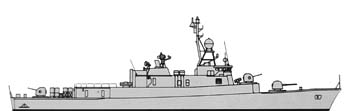
MEKO 140 class Specifications:
-Displacement: 1,560 tonnes standard, 1,790 tonnes FL
-Dimensions: 91.2 oa(86.4 pp) x 11.1 x 3.33 m (299 x 40 x 10 ft))
-Powerplant: 2 shafts Semt-Piesltick 16 PC2 5V400 diesel
-Performances: 22,600 bhp, 27 knots, range 4,000 nm/18 knots
-Armament: 4 MM38 Exocet, 76 mm OTO, 4×40 mm Breda, 2×3 324 mm ASW TT, Sea Lynx Helicopter
-Electronics: Decca 1226 radar, DA-05/2, WM-28, LIROD Gfes, Sonar Krupp A50 80
-Crew: 93, 11 officers
 MEKO® 200 TN I

Yavuz class for Turkey, 4 ships (Yavuz (F 240), Turgutreis (F 241), Fatih (F 242), Yıldırım (F 243)) built 1987–1989: 1 at B&V, 1 at HDW, 2 at Gölcuk Shipyard. First of a very successful lineage, the MEKO 200 family.
MEKO 200 TN I class Specifications:
3,030 tons full load. 110.50 x 13.25 x 3.94m (362 ft 6 in x 43 ft 6 in x 12 ft 11 in)
Powerplant: 2 shafts, 4 MTU 20V 1163 diesels 30,000 hp (22,000 kW) CODAD; controllable pitch propellers
Speed: 27 knots (50 km/h; 31 mph), Range 4,000 nautical miles (7,000 km) at 20 knots.
Crew 180 (29 officers, 151 enlisted).
Sensors & processing systems: Radars TM 1126, AWS-6, HSA D08, HSA STIR 124, Sonar SQS-56,, ARES-2NC ESM, Mk 36 decoy.
Armament: 2x Mk 141 quad RGM-84 Harpoon, MK 21 (16) RIM-7 Sea Sparrow, 5 inch /54 gun, 3× Oerlikon Contraves Sea Zenith 25 mm CIWS, 2×3 12.75-in Mk.32 TTs. AB 212 ASW helicopter, Hangar and helipad.
 MEKO® 200 PN

Vasco da Gama class, three ships (F330 Vasco da Gama, F331 Álvares Cabral, F332 Corte-Real), 1 built at B&V, at HDW (Howaldtswerke-Deutsche Werft, Kiel).
MEKO 200 PN class Specifications:
2,920/3,200 tons, 115.9 x 14.8 x 6.2m (380 ft 3 in x 48 ft 7 in x 20 ft 4 in)
Propulsion: 2 shaft CODOG CP propellers, 2x MTU 20V 956 TB92 diesel 8.14 MW, 2x GE LM2500 gas turbines 38 MW
Speed: 32 knots, gas turbines, 20 knots Diesels. Range 4,000 nmi/18 kts
Armament: 100 mm Mod68, 1× CIWS, 2×3 12.75-in Mark 46 TTs, 2×4 RGM-84 Harpoon, 8 RIM-7 Sea Sparrow
APECS II/700 ESM, SRBOC launcher, Thales DA08, MW08, 2x STIR 180 FCR, 1x SQS510 sonar. 2 Super Lynx Mk.95 helicopters.
 MEKO® 200 HN
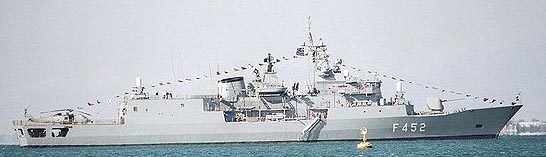
Four ships of the Hydra class (Hydra, Spetsai, Psara, Salamis). First at B&V, thre at Hellenic shipyards Skaramangas.
High-level specs. for shock resistance, stiffness requirements for fire control and radars, blast and gas pressure resistance. Construction of high tensile steel with a yield strength of S355 N/mm² structural steel grades. 12 self-sufficient watertight sections. Full Automation System Nautos. Spetsai was commissioned in 1996, Psara in 1998 and Salamis in 1999. All active.
MEKO 200 HN class Specifications:
Displacement: 2710/3200 (updated: 3,360 tons st., 4,000 FL)
Dimensions: 109.5 pp/117.5 oa x 14.8 x 6 (385 x 48 x 19ft)
Powerplant: 2 shaft CODOG: 2 GE LM-5000-30 Gas Turbines, 2 MTU 20V956 TB82 diesels
Performances: Gas Turbines: 60.650 bhp, 31 kts, Diesels 10,400 bhp, 21 knots, range 4100 nm/18 kts
Armament: Mk48 VLS Sea Sparrow (16), 2×4 Harpoon SSM, 5-in/54 Mk45 gun, 2 Phalanx CIWS, 2×3 324 mm TTs, 1 Helicopter
Electronics: Radar Decca 2690BT, HSA MW-08, DA-08, STIR-18, sonar SQS-56, ECM Argo AR 700, APECS-II jammer, 2 decoy launchers
 MEKO® 200 ANZAC

Ten in the joint Anzac-class design, eight for the Royal Australian Navy, two for the Royal New Zealand Navy. Anzac FFH 150, Arunta FFH 151, Warramunga FFH 152, Stuart FFH 153, Parramatta FFH 154, Ballarat FFH 155, Toowoomba FFH 156, Perth FFH 157. Built 1993-2006 at Tenix Defence, Williamstown.
Royal New Zealand Navy: Te Kaha F77 (1995), Te Mana F111 (1997).
Upgrade included RGM-84 Harpoon (2×4); Evolved Sea Sparrow (VLS, 32), 4x Nulka active missile decoy bay, TSM 5424 Petrel mine and obstacle avoidance sonar system, completed 2006.
All active.
Specs:
3,600 t full load, 118 x 14.8 x 4.35 m. CODOG, 1× GE LM2500-30 gas turbine 30,172 hp, 2× MTU 12V1163 TB83 diesels 8,840 hp: 27 knots.
Range: 6,000 nautical miles (11,000 km; 6,900 mi) at 18 knots (33 km/h; 21 mph)
Crew 22 officers, 141 sailors (+16 government worker/air crew).
Radar: Raytheon SPS-49(V)8 ANZ, Saab 9LV CMS, Saab Sea Giraffe TIR, Krupp Atlas 9600 NavR, Saab9LV 453 Ceros 200 FCR. JEDS 3701 ESM, Telefunken PST-1720 comms intercept
ThomsonSintra Spherion B hull-mounted bow sonar, Petrel Mine and Obstacle Avoidance Sonar system, optional towed-array sonar, Cossor AIMS Mark XII IFF.
Mark 36 SRBOC launchers, SLQ-25A towed torpedo decoy, Nulka decoy launchers, Rascal Thorn modified Sceptre-A electronic support measures, Telefunken PST-1720 Telegon 10 radar intercept unit
Armament: 8-cell Mark 41 VLS (32 RIM-162), 2×4 Harpoon/NSM, 2×3 Mark 32 TTs, MU90 Impact or Mark 46 torpedoes
1× 5″/54 Mark 45 mod 2, 2 × .50cal/Mini Typhoon or 2x20mm Vulcan Phalanx CIWS, Sikorsky MH-60R Seahawk or Kaman SH-2G Super Seasprite
MEKO® 200 TN II-B

Salih Reis/Barbaros class (TCG Barbaros F 244, TCG Oruçreis F 245, sub-class TCG Salihreis F 246, TCG Kemalreis F 247). Built in two batches, one at B&V, one at Gölcük Naval Shipyard, Kocaeli.
Like the TNI I, one of each sub-class, Barbaros and Salihreis were built each in Blohm & Voss and at Gölcük.
Specs:
3,100 tons standard, 3,350 tons full load 118 x 14.8 x 4.25 m
2 shaft CODOG, CPP, 2 GE LM-2500 gas turbines 60,000 hp, 2 MTU 20V 1163 diesels 13,060 hp (9,740 kW): 32/22 knots
Range: 4,100 nautical miles (7,600 km; 4,700 mi) at 18 knots (33 km/h; 21 mph)
Crew 24 officers+ 156
Sensors: Thales SMART-S Mk2, Decca 2040 BT, HSA D08, HSA STIR -24, HSA STIR 18, SQS-56, Racal Cutlass, Racal Scorpion, Mk 36 decoy, MLU-EW, ARES-2N(V)2 EDS, AREAS-2NC EAS, ASELSAN HIZIR Torpedo Jamming and Deception System.
Armament: 1× Mk 41 Mod 8 VLS (32 RIM-162 ESSM Sea Sparrow PDMS (SAM), 2× Mk 141 (8 RGM-84 Harpoon), 5 inch/54 gun, 3× Oerlikon Contraves Sea Zenith 25mm CIWS, 2× Mark 32 TTs, 2x S-70B Seahawk or AB 212 ASW helicopters.
 MEKO® A-200 SAN

The Valour class from South Africa were four ships built in 2003–2004, still MEKO 200 but of a completely new stealthy design. They are part of the Strategic Defence Package 1999. The first, SAS Amatola, was commissioned in 2006, and the fourth and final, SAS Mendi in March 2007. Planned for 30–40 year.
Class: SAS Amatola (F145), SAS Isandlwana (F146), SAS Spioenkop (F147), SAS Mendi (F148)
Specs:
Displacement 3,700 tons, 121 x 16.34 x 5.95 m. CODAG WARP, 2x MTU 16V 1163 TB93 diesel, 1 GE LM2500 GST 27,000 hp, waterjet, 28 knots.
Range: 8,000 nmi, endurance 28 days. Crew 152.
Sensors: Thales Naval Fr. MRR-3D NG, 2x Reutech RTS 6400, Reutech Electro-optical tracker, Tellumat IFF, M-Tek TDS, Thales UMS4132 Kingklip sonar, MDS 3060
Saab Grintek Avitronics SME 100/200 ESM+ ELINT, 2x Saab Grintek Avitronics MRL Super Barricade chaff launchers. CO protected by Welded GL-D36 steel.
Armament: 8x MBDA MM 40 Exocet Block 2, 16 Umkhonto SAM VLS, Otobreda 76 mm, Denel 35mm CIWS, 2x Mk1 Oerlikon 20 mm, 2x 12.7 mm Rogue RWS, 4x 324 mm TTs
2x SuperLynx 300, or 1x Atlas Oryx, or 2x Agusta-Westland AW109, 1x Denel Rooivalk or UAVs
 MEKO® MEKO 100 RMN

Offshore Patrol Vessel (OPV) of corvette size and capabilities. The Kedah class for Malaysia comprised six ships built 2004–2010:
F171 KD Keda, F172 KD Pahang, F173 KD Perak, F174 KD Terengganu, F175 KD Kelantan, F176 KD Selangor. The first was built 2001-2006 at Blohm & Voss and the second at HDW and with tech transfer and help, the remainder was built in Indonesia in 2005-2010 at Boustead Heavy Industries Corporation in Behrad, HQ Kuala Lumpur. At first 27 were planned but 21 cancelled due to financial and technical problems and delays in Indonesia.
Specs:
1,850 tons FL, 91.1 x 12.85 x 3.4 m. 2x CPP, Caterpillar 3616 diesels 16,000 bhp 24 kts, 6,050 nm (11,200 km), 21 days endurance.
Crew 78 (accommodations for 98)
Sensors: Atlas Elektronik COSYS-110 M1/ARGOS, ICMS CAE, EADS TRS-3D/ 16ES PESA radar, Oerlikon Contraves TMX/EO X-band FCR, Rheinmetall TMEO, L-3 ELAC Nautik NDS-3060 Obstacle Avoidance sonar and IFF system. Thales Sceptre-X, Sippican ALEX/SRBOC chaff/decoy launching system.
Armament: 76 mm Oto Melara, 30 mm Breda-Mauser, Super Lynx 300 helicopter
 MEKO® MEKO A-100

ORP Ślązak (2015) is a single ship ordered by Poland and built with assistance from B&V at Stocznia Marynarki Wojennej under licence. She was commissioned in 2019. In April 2011 the court declared Naval Shipyard’s bankruptcy and on 24 February 2012 Gawron program was cancelled, leaving only the lead vessel.
Specs:
Displacement 1,800/2,150 t, 95.2 x 13.5 x 3.60 m. Prop: 1× GE LM2500+ GST, 2× MTU 12V595TE90 diesels: 30 kn. RA 4500 nm.
Crew 97.
Sensors: Thales SMART-S Mk 2 SR, Thales STING-EO Mk 2 FCR, Thales MIRADOR, TACTICOS CMS, L3 ELAC Nautik Vanguard navR, TACAN, IFF.
1× 76mm Oto Melara, 2× 30mm Oto Melara Marlin-WS, 4× 12.7mm WKM-B, 4× Grom SAM, flight deck.
 Corvette 130

Better known as the Brauschweig class, 5 ships built for the Bundesmarine (10 planned).
First batch: F260 Braunschweig, F261 Magdeburg, F262 Erfurt, F263 Oldenburg, F264 Ludwigshafen am Rhein 2004-2013.
Second batch: F265 Köln, F266 Emden, F267 Karlsruhe, F268 Augsburg, F269 Lübeck, planned 2025.
Specs:
1,840 t, 89.12 x 13.28 x 3.4 m. Prop: 2 MTU 20V 1163 TB 93 diesels 14.8MW, CPP. 26 kts, RA 4,000 nmi (7,400 km)/15 kn.
Crew 65, Endurance 7 days; 21 days with tender
Sensors: Cassidian TRS-3D scanned array C-Band radar, 2 navigation radars, MSSR 2000 i IFF, MIRADOR, UL 5000 K ESM, Link 11/16 com. 2× TKWA/MASS decoy launcher, UL 5000 K ECM suite
Armament: 1× OTO Melara 76 mm, 2 × Mauser BK-27 RWS, 4× RBS-15 Mk.3 SSM, 2× RAM Block II(21), 2 mine racks (34 Mk.12), Helicopter pad, 2 drones.
Frigate 123

Brandenburg-class frigate built in replacement for the Bremen and Hamburg class for the Bundesmarine.
Class: F215 Brandenburg, F216 Schleswig-Holstein, F217 Bayern, F218 Mecklenburg-Vorpommern built at Blohm & Voss, HDW, Nordseewerje and Bremer Vulkan in 1992-95.
See the full post
The F123 Brandenburg class were four frigates ordered in the cold war for the Bundesmarine in June 1989, as the Berlin Wall was about to fall. They were completed and commissioned between 1994 and 1996. They had been planned to replace the 1960s Hamburg-class destroyers. Their design reflected decades of technological advancaments and new concepts. They were tasked to carry out anti-submarine warfare (ASW) but with still strong capabilities for local anti-ship and anti-air defenses as well as squadron command and and gunnery shore operations. Todat with the following 2000s F124 Sachsen-class they constitute the core of today’s Bundesmarine. #bundesmarine #germannavy #frigates #coldwar #brandenburg
Although a bit off-topic since the lead ship was completed well after the end of the cold war, the Brandenburg class frigates were planned and studied in the 1980s, as the last Bremen class were entering service. They were succeeded themselves by the derived Sachsen class (Sachsen, Hamburg, Hessen launched 2001-2003) and the actual Baden-Württemberg class (Baden-Württemberg, Nordrhein-Westfalen, Sachsen-Anhalt, Rheinland-Pfalz 2013-2017), very different.
The Type F123 frigates were ordered by the German Navy in June 1989, the last being commissioned in 1996 to replace the 1960s Hamburg-class destroyers. They were mostly tailored for ASW warfare, with a residual anti-aircraft role, while gearing towards tactical command notably for surface-to-surface operations. The next Sachsen were suppose to replace the first batch of Bremen class. Today, all these four frigates are the bedrock of the Bundesmarine.
Specs:
3,600 tons (4,490t FL), 138.85 x 16.7 x 4.35 m. CODOG: 2x MTU 20V 956 TB92 diesels, 2x GE LM2500 gas turbines 38 MW
Speed 29 knots (54 km/h; 33 mph), Range 4,000 nmi (7,400 km)/18 knots
Armament: OTO-Melara 76 mm/62 Mk 75, 2x BK-27 27 mm, Mk 41 Mod 3 VLS Sea Sparrow, 2x Mk 49 RAM, 2×4 Harpoon SSM, 4x 324 mm TTs
Sensors: Thales LW08, Thales SMART-S, Thales STIR 180, Raytheon Redpath I, STN Atlas DSQS-23BZ sonar, STN Atlas TASS 6-3 (LFTASS) VDS*
Air Group: 2 Sea Lynx with Mk46 Torp. +Sea Skua SSM
Crew: 26 officers, 193 enlisted.
Frigate 124

Sachsen-class frigate, built in 1999–2006 at 700 million euros apiece. Four planned, one cancelled.
Class: F219 Sachsen, F220 Hamburg, F221 Hessen built at B&V (Hamburg), HDW (Kiel) and Nordseewerke (Emden).
Specs:
5,690t FL, 143 x 17.44 x 6 m. 2 CPP, 2× MTU V20 diesels, 1 GE LM2500 GST, 7.4 MW (9,900 hp) per diesel. 29 knots, RA 4,000 nmi (7,400 km/18 kn).
Complement: 230 crew, 13 aircrew
Sensors; Thales Nederland SMART-L, APAR, Hensoldt TRS-4D AESA* STN Atlas 9600-M ARPA, MSP 500, DSQS-24B bow sonar.
FL 1800 S II ECM suite and 6x Sippican Hycor SRBOC launcher
Armament: 1x OTO-Melara 76 mm, 2× Mauser MLG 27 27 mm RWS, k 41 VLS cells SM-2/RIM-162 ESSM (32), 2× RAM CIWS, 2×4 Harpoon, 2×3 MU90 torpedoes.
2× Sea Lynx Mk.88A or 2 NH90 helicopters.
Frigate 125

Baden-Württemberg class frigates for the Bundesmarine. Large in size and displacement, the press still dubbed them as “underarmed frigates”, with an emphasis on ground strike in addition to classic frigate missions. They were indeed criticized for their weak missile armament for their tonnage (7200t). Tailored for spec ops in the post cold war context, they are able to operate Submarine ROVs and four 11 m (36 ft) RHIBs for commandos. They also have a space for two 6.1 m (20 ft) containers for a modular approach to their combat missions.
Class: F222 Baden-Württemberg, F223 Nordrhein-Westfalen, F224 Sachsen-Anhalt, F225 Rheinland-Pfalz. Built 2011-2022 at the same yards as above.
Specs:
Displacement: 7,200 t, 149.52 x 18.80 x 5.40 m.
PP: 43,000 shp (32,000 kW) CODLAG, 20 MW gas turbine, 2× 4.7 MW EM, 4× 2.9 MW diesel generators, 3× gearboxes, 2 shafts CPP, 1 MW bow thruster.
Speed 20 knots diesel, 26 knots (48 km/h; 30 mph) max. RA 4,000 nmi (7,400 km)
Crew up to 190 with accomodations (standard 110).
Sensors: 4 × Hensoldt TRS-4D AESA fixed planar arrays radars, 2× navR Anschütz, INBS Synapsis, IFF, no sonar.
Laser warning, KORA-18 Combined RADAR/COMMS ESM, 2 × MSP 600 vid, SIMONE 360 IR, Link 11, 16, 22. 4x TKWA/MASS launchers, ECM
Armament: 1× 127 mm Otobreda Vulcano, 2× 27 mm MLG 27 RWS, 5× 12.7 mm Hitrole-NT, 2× 12.7 mm HMG, 2× RAM Block II (21), 2×4 RGM-84 Harpoon, 2 × NH-90 helicopters.
 MEKO® A-200 AN

Algerian Erradi class, two vessels ordered in 2014, Erradii (910) and El Moudamir (911). They are based on the MEKO A-200SAN when ordered from ThyssenKrupp Marine Systems. Construction was subcontracted to ADM Kiel with an option for two more in 2014, never actioned.
Specific Armament & sensors:
Oto Melara 127/64 LW 127 mm main gun
MSI-Defence 30 mm cannons
Denel Dynamics Umkhonto-IR surface-to-air missiles
Saab/Diehl Defence RBS-15 Mk3 anti-ship missiles
Rheinmetall Defence MASS softkill decoy launchers
Saab Sea Giraffe AMB 3-D surveillance radar
Saab CEROS 200 radar/electro-optical fire control directors
Thales UMS4132 Kingklip sonar
They are supposed to be equipped for one, with the CODAG-WARP (WAter jet and Refined Propellers) like the A-200SAN, another having a water-jet drive and two propellers.
 Mod K130 Sa’ar 6

The design is based on the K130, but no official model. Sa’ar 6-class corvettes became after delivery the bedrock of the Israeli Navy, largest ships in inventory. They are far larger than usual FAC/M of the previous Sa’ar types, and a conttract was secured for NIS 1.8 billion (US$557 million) for 4 ships (2015 est.) loosely based on the German Braunschweig-class corvette (thus K130) but with Israeli sensors and aramment. See the IDF Navy for more.
 MEKO® A-100 BR

The Tamandaré-class frigate were ordered from ThyssenKrupp Marine Systems afetr a process from 2015 to 2019. The conrtact was secured in 2021 for four ships:
Tamandaré F200, Jerônimo de Albuquerque F201, Cunha Moreira F202 and Mariz e Barros F203 all built at ThyssenKrupp Marine Systems, Itajaí in Brazil. The first was delivered recently for sea trials and is expected to be commissioned in December 2025. The third was launched in last June. Four more to be named are planned.
Specs:
3.500t, 107.2 x 16 x 5.2 m.
CODAD 4× Caterpillar C32 diesel gen., 4× MAN V12 28/33D, 5-bladed CPP: 21,280 kW (28,540 shp)
Top 25.5 knots (47.2 km/h; 29.3 mph), 14 knots (26 km/h; 16 mph) cruise, RA 5,500 nmi (10,200 km)
Crew 13, carries also 2× RHIBs.
Sensors: Atlas ANCS, Hensoldt TRS-4D AESA radar, Anschütz NSX X-band nav, Atlas ASO 713 hull sonar, Thales STIR 1.2 EO FCR, Safran PASEO XLR, IFF, SATCOM, Omnisys MAGE Defensor ESM, Terma C-Guard decoy launching system.
Armament: VLS 12-cell Sea Ceptor SAM, 8 MANSUP SSM, 2×3 Mark 54 TTs, Oto Melara 76 mm Super Rapido, Sea Snake 30 mm, 2× Sea Defender 12.7 mm, 2x 0.5 HMG. S-70B Seahawk or H225M ScanEagle.
 MEKO® A-200EN

The Al-Aziz class Frigates ordered by Egypt are the latest in the 200 range. They were on construction in 2022 to 2025, six ships.
Class as of January 2024: ENS Al-Aziz, ENS Al-Qahhar and ENS Al-Qadeer. ENS Al-Jabbar is fitting out in 2025.
The contract was signed in December 2021, later increased to 4, then 6, the latter to be built in Egypt. The first was completed by October 2022.
Specs:
3,700 tonnes, 118 x 14.8 x 4.3 m.
CODAG WARP, 2 shafts CPP, 2× MTU 16V 1163 TB93 diesel, 1 GE LM2500, waterjet: 27,000 hp.
28 knots (52 km/h), range 7,200 NM (13,300 km) at 16 knots (30 km/h).
Oto Melara 127/64 LWn MSI-Defence 30 mm, 32 VLS MICA NG SAM, 8 Exocet, Rheinmetall MASS softkill decoy launchers, NS-110 4D AESA radar
Read More/Src
Links
nvl.de shipyards-and-docks blohmvoss
thyssenkrupp-marinesystems.com
rnsubs.co.uk
nautiek.nl/
welt.de/p Blohm-Voss liefert modernste Korvette
marineverband.at veranstaltungen B+V.htm
kurt-bonsels.de zeittafel.html
naval-technology.com/ meko-a-class-combat-ship/
dmkn.de Die-MEKO-D-Fregatte-von-Blohm
www1.wdr.de/
shipshub.com/
thyssenkrupp-brazil.com
de.wikipedia.org/wiki/MEKO
en.wikipedia.org/wiki/MEKO
en.wikipedia.org/wiki/MEKO_200
warhistory.org/ meko-200
weser-kurier.de/ blohm-voss
tib.eu/ von Blohm Voss MEKO
Videos