
 United Kingdom – HMS Surrey, HMS Northumberland
The Surrey class were a never-built heavy cruiser class, in fact the very last of the Royal Navy, capped by treaties, notably the 1930 London treaty. The 1929 financial crisis, that hit hard in Britain as well, and criticisms over a woefully inadequate protection led to their cancellation in January 1930 before their keels were even laid down at Admiralty Yards Devonport and Portsmouth. But HMS Northumberland and Surrey were not just stretched out Exeters in appearance, the design was a series of compromises and an interesting counterpoint to the earlier County class, worth exploring.
The Surrey-class heavy cruisers were in many sources defined as a ‘quartet of heavy cruisers’ as a York class, better armed and armoured at the cost of 2 knots in speed, ordered in the 1928-1929 Programme and that would have been completed in 1932. Most sources however only agrees on two cruisers for a first batch that actually had a registered name in the Royal Navy register. The second two, likely to have been ordered a year later, remained unnamed, but would have taken also country names, such as HMS Essex and Lancaster.
Development of the Class and Genesis
The County class are assimilated to the Washington cruiser design “Class A” cruiser, reaching the ceiling of what was authorized within the 10,000-ton range, while keeping pace with technological advances and filling an important need of protecting the Empire’s far away trade lines. However, just as they were designed in the 1920s, the admiralty wanted a “second-rate” heavy cruiser called “Class B” for home waters, and under budget constraints. This was before the 1929 crash. Note the “A2” to match the County/York logic is purely conjectural and does not appear in official documentation.

Rendition photoshopped, based on Exeter 1931.
Design X and Y 1927-28
Originally, the still unnamed Surrey class originated as an extra pair of Norfolk class heavy cruisers but with modifications. In 1927, a first design (“W”) was submitted with five extended turrets, but the plan was dismissed due to the too thin ammunition wells.
Next, Design “X” was submitted through several proposals and sub-variants, planning a 5.75 -inch (146mm) captain’s design, with the next Design “Y “reducing the boilers from 8 to 6 to reduce construction cos, down to 30 knots from 60,000 SHP, length reduced to 570 feet (173.74m) and thicker turret barbettes compared to the Norfolk. This design “Y” was approved by the committee on November 22, 1928.
The new cruisers ended as successors rather than follow-up to the previous Norfolk class, the last of the County’s three classes, after the Kent and London. The Surrey class has a rather long design history when studied in 1926-27 just as “Design B” was formulated. In the end, two designs were considered to the Royal Navy:
Design “X” is faster at 32 knots but less well protected
Design “Y” is considered to be better protected, even than foreign contemporaries* but slower at 30 knots.
Design “Y” was favoured, as the value of speed was considered less important for the Royal Navy at that time, already with fifteen fast heavy cruisers already with a relatively weak protection. So swapping onto ships with heavier protection seemed appropriate. Britain was not along on this. In 1927, countries that built heavy cruisers reaching the 10,000 tonnes Washington limit for a cruiser, preferred to have speed and firepower at the price of protection at all cases, and the doctrine at the time emphasised fast engagements over slower but better armed vessels, taking lessons of WWI and battlecruiser warfare.
But soon, all would return to a better protection by making sacrifices elsewhere. France and Italy rivalled with their “tin-clad” cruisers barely able to resist destroyer fire while sporting amazing speeds and eight 8-in guns, but as the heavy cruiser design matured after two generations (Duquesne and Suffren in France, Trento and Bolzano in Italy), bot were contemplating more balanced designs, which led to the 1930 Zara class and Algérie, a single one in that case. Both were smaller, slower, but with a far better distributed and efficient armour. The Italians even boasted the Zara were a return to the extinct armoured cruiser brand.
This was never the case, as the new heavy cruiser never were intended to take place in a battle line with capital ships. The County class were in a sweet spot for their very light protection,
in their high-seas commerce protecting and raiding role, they would not expect to encounter a destroyer that far from shore, and keep at bay at the same time any light cruisers due to the effective range of their 8-in guns. But this was a WWI view. Destroyers started to grow in size and in 1930 had much longer range and better armament.
That move towards better protected heavy cruisers seemed logical already in 1927. However, if “heavy cruisers” were further defined in the 1930 treaty has having 8-inches guns versus 6-inches guns for the light cruisers, no cap was placed on tonnage on the second category (apart the 10K tonnes Washington ceiling for the cruiser category at large). So the next generation would be in some case reaching 10,000 tonnes with triple turrets with 6-in guns to fill unexplored the light cruiser niche.
The Class B Design
The “Class B” (York) would motivate the construction of the Arethusa class, an example of 6-6-in guns light cruisers on a budget, hoping to stick to a 5,000 tonnes design.
But back to the “Design Y” that was worked on in 1927 when accepted by the admiralty.
Unlike the earlier County, the Surrey had streamlined bridges and vertical masts and funnels, making it more difficult for the enemy to judge their course, but also improve aircraft arrangement.
The final design, as shown on surviving blueprints, shows a design really closer to the Exeter, than the York. Basically, they looked like “stretched exeters”.
The “Class B” was a 8,500 tons instead of 10,000 tonnes standard design and this needed many drastic changes, that were approved in 1927, before even the global stock market crisis. Based on these limitations, the engineers managed to obtain a decent design still, later called the York class. This compromise was found very convenient for the admiralty in a context of budget and tonnage constraints. The main focus was that the roomy County class “ate” a lot of tonnage that can be reduced in many ways for a more useful package.
One example was to ditch out their tall, roomy and seaworthy flush deck hull for a more traditional forecastle hull that was shorter by almost twenty meters. But the most significant sacrifice was one aft 8-in turrets, making for six instead of eight. Engineers and the admiralty were much aware this was less than their contemporaries. Both French and Italian heavy cruisers had the same four twin arrangements, the US even tried and stuck to a three triple arrangement (making for three more guns) and the Japanese eventually settled on a five twin, making for four more guns.
Sure, the tonnage saved was about 4,000 tons, traduced in cost savings for the British taxpayer, however these weight savings were not enough to free tonnage for an extra cruiser within the capped global cruiser tonnage. Furthermore, the engineers managed through a better concentration and distribution of the armour, to have a thicker and more effective protection compared to the County class. However, it was still weak to face aerial attacks, which were still not taken seriously back in 1926.
Despite the limited size available still, engineers were able to cram into her hull the same large power plant as for the County class, four boilers in two boiler rooms, four Parsons geared turbines, for the same 80,000 shaft horsepower total. The design speed of the Class B was thus was maintained to 32.5 knots, faster than the County class by one knot. The result was that Class B in 1927 was both faster and better protected for a cost reduction of £250,000, and manpower reduced by 50, all this was seen also under a very favourable light by the Ex-checker.
That’s why they were built and not the Surrey class, especially after the signing of the London treaty of 1930.
So the Surreys would remain a remarkable “what if”.
Order and Planning of the Surrey class

The development of the Class B had an immediate impact on the modified Class A (Surrey) development. This improved design applied while constructing the York-class was reflected, and the shape of the bridge, mast, and funnels were changed. By July 1927 indeed, the Director of Naval Shipbuilding ordered the designer to change power back to 80,000 shp., increased speed to 31.5 knots and increased length to 600 feet (182.88 m). The final design established in 1929 settled on a 600ft hull still 64ft wide (like Class B) (182.9 m x 19.5 m), and four 8-inch extended turrets. The secondary and AA armaments as well armour scheme were finalized.
They were were ordered in the 1928-1929 Programme for completion in May 1932. Design work progressed on the first two, named Northumberland (assigned to Devonport) and Surrey (assigned to Portsmouth) but their keels could not be laid down yet. Indeed, Devonport NyD at the time worked already on HMS Exeter, laid down on 1st August 1928, and Portsmouth NyD. waited to launch HMS Dorsetshire, laid down in September 1927 and expected to be launched on in January 1929. So it’s likely Surrey would have been laid down in January or February that year, versus Northumberland, not before July or August. The class name thus became officially the Surrey class, and it remained so in all publications afterwards.
The Surrey class design

The Surrey class was planned under the 1928-29 program for completion in 1932, but they were cancelled on 14 January 1930, right after the financial crisis and in parallel to the London naval treaty. Indeed, Great Britain was permitted 15 heavy cruisers with a total tonnage of 147,000 tonnes and had already reached her limit with the County class.
The Surrey were quite well known cruiser projects as the design work progressed well. They were basically four turrets versions of the Exeter. They shared the same hull, but elongated from 175 to 183 m (575 to 600 feet) and the forecastle was prolonged to “X” turret, using the upper superstructure deck as a super firing position. Furthermore, they displaced as planned 10,000 tons standard still, for a calculated 12.664 tons fully loaded and protection inherited from the class B, but that was judged later judged totally inadequate for a heavy cruiser.
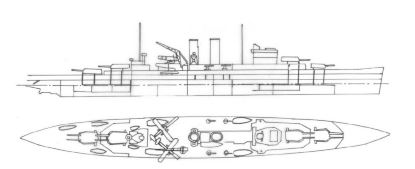
A modified Surrey design at the end of the 1930s. The complete reconstruction of the London also give clues about the possible 1940s design.
Hull and Final Layout
The final design was between perpendiculars, 570 feet (173.74 meters) long, and Overall 600 feet (182.88 meters) for a beam of 64 feet (19.51 meters) and a draft of 21 feet 6 inches (6.55 meters). This was for a displacement of 10,000 tons Standard and a calculated 12,664 tons full Load with the ammunition, fuel oil, water, and storage for weeks.
The design was very much the same as Exeter built as an improvement over the York, with straight masts and a new type of bridge that became standard, adopted also by the Arethusa, Leander and Perth classes. Compared to HMS Exeter, the biggest change was the location of “X” turret in a super firing position aft where the hull stretch was. The bow still had the same knuckle, the shape and shear were the same, height and freeboard were the same fore and aft, even the funnels looked similar, with one large, one thin close together amidship.
This new bridge was lower, wider, offering better protection and supporting two fire control positions instead of the narrow bridge type of HMS York inherited from the County class bridge designs. The hull was however fuller up to “X” turret and the cutout for the triple torpedo tubes located further aft compared to Exeter, abaft the mainmast.
All in all, they looked elegant and better balanced even than Exeter.
Powerplant
They would have been given a reduced machinery, four Parsons turbines fed by six admiralty 3-drums type boilers rated for 60,000 hp (instead of 80,000 hp for the York), enough for a design speed of 30 knots. 60.000 SHP made them the only heavy cruiser with such a low power output, but the idea was that the better hull ratio of 183/19 or 1/10 versus 1/9 on the York would benefit speed. The downsides of a longer hull were degraded stability and agility, bleeding speed in hard turns. Buut the general concept was sound. An extra 33% horsepower is required indeed for less than 10% extra speed. To compare weight machinery, it was down to 1,435t on Surrey versus 1,770t on York and 1,830t for Kent (County leading class). The French Algerie also had a “light” powerplant.
Protection
Protection-wise they were given a 5-1/2 in belt protecting the machinery spaces and extended 9 feet below the lower deck, 2-1/2 in thick on 1-1/2 in plating. Closing bulkheads were extended for a further 5 feet. 3 in protected the magazines, while the turrets, trucks, ring and bulkheads, steering gear, were 1 in thick.
So in resume:
Belt: 5.5-inches (139.7 mm)
Bulkheads: 5.5-inches (139.7 mm)
Ammunition Spaces: 3 to 5.75-inches (76.2 – 146.05 mm)
Turrets: 1-inch (25.4 mm)
Turret Trunks: 1-inch (25.4 mm)
Turret Ring: 1-inch (25.4 mm)
Commentary: Note that going from 3 inches or 75 mm to 140mm so twice more was a real improvement over the York class, this was now capable of stopping 6-in shells, not just destroyer calibres.
But the decks are not protected at all, which is an open bar for aviation hits. To reach the level of an “armoured cruiser” like the Italians claims with the Zara, the Surrey class would have needed a citadel with at least 7 inches or 175 mm armour. The Zara class in comparison had a 150 mm (5.9 in) belt and bulkheads, turrets were far better protected (same) as their barbettes, plus their decks were 70 mm thick (2.8 in) versus nothing on the Surrey but limited box magazine armour, way lighter than fully armoured decks. On a treaty cruiser, it was impossible to have deck armour proof against the 250lb to 500lb pre-war bombs anyway.
Box armour is intended to defeat 6″ and 8″ guns at most practical battle ranges. But the Surrey’s turret were just terrible, as they can be defeated at any range, any angle by destroyer calibres. The devastation endured by Exeter at the battle of River plate showed just how it was inadequate. The original idea was to stop shrapnel only, not a direct hit.
The Surrey class, like the Yorks, had no conning tower, but that feature was soon to be discontinued anyway. ASW protection was also quite poor, but this was general, however. Protection against underwater damage on an inherently narrow, high-speed ship was almost impossible to achieve. It was hoped that thick bulkheads would keep the ship afloat against water pressure after a flooding, allowing towing the ship to safety. Good bulkheads saved ships in WW2, that was proven again and again.
Greenwhich Museum has the original plans, “Cruisers A 1928” signed by Sir William Berry, Director of Naval Construction between 1924 and 1930. These Scale: 1:192 sketches are unfortunately not on display yet. But they can be consulted on site.
Armament
Eight 8″/50 Mk.VIII

These 1927 BL 8 inch Mk.VIII (203 mm, L/50) guns, twin mounts Mk.II were essentially the same as fitted on the County class (and York class) heavy cruisers as standard. A-B and X-Y forward in superfiring positions.
Specs: Mass 17.5 tonnes, Barrel 400 inches/10 meters (50 calibres) for 8-inch (203 mm)
Shell: 256 pounds (116 kg) Muzzle velocity 2805 fps (855 m/s)
Maximum firing range: 28 kilometres (17 mi) at max elevation of 50° (Exeter Mark II* mount).
These 50 calibres built-up guns had a wire-wound tube encased within a second tube and jacket. They ended by a Welin breech block and hydraulic mechanism with hand-operated Asbury backup system. Each round need two cloth bags 15 kg (33 lb) each fill with cordite. HE and AP rounds were distributed, c150 rounds per gun.
Four 4″/45 Mk V

For secondary armament, they would have four 4 in/45 QF Mk V HA as completed, (six QF 4 inch Mk.V on York). These were 102 mm, L/45 dual-purpose guns, on single mounts HA Mk.III. Thy would have been located abaft the funnels amidships, without shields to deal with altitude bombers with preset fuses.
Specs:
Mass 4,890 lb (2,220 kg), barrel length 15 ft (4.6 m) (45 cal), oa 15 ft 8 in (4.8 m)
Shell: 31 lb (14.1 kg) fixed QF or Separate-loading QF 4-inch (101.6 mm)
Breech: horizontal sliding-block, recoil hydro-pneumatic or hydro-spring 15 inches (380 mm)
Muzzle velocity 2,350 ft/s (716 m/s)
Maximum firing range 16,300 yd (15,000 m) and in AA 28,750 ft (8,800 m)
2-pdr Pompom AA

In addition they would have been fitted with sixteen Bofors ‘Pom-Pom’ in two octuple mounts, likely located forward, abaft the bridge.
Specs:
Mass 850 lb (390 kg), 8 ft 6 in (2.59 m) length
Shell: 40×158mmR calibre 40.4 mm (1.59 in) filling 71 g (2.5 oz). Muzzle velocity 732 m/s (2,400 ft/s)
Feed system 14-round steel-link belt, Rate of fire 115 rpm
Effective range 3,960 m (13,300 ft).
The Surrey would also have four saluting guns, 3-pdr (47 mm) able to fire also flares for night illumination of targets.
Torpedo Tubes
Two banks of three, located aft amidship, abaft the aft structure and mainmast, not on the weather deck but in an encased location into the forecastle’s end. The torpedo models would have been the same as the York class, the Mark VII, and not the Type 21″ (53.3 cm) Mark IX which entered service in 1930.
The 21″ Mk.VII was a model entering service in 1927 after a development started in 1925. These 21 inches or 533 mm model had a 336 kg warhead and twin setting, either 5,200 m at 35 knots or 14,600 m at 33 knots.
It’s possible they would have swapped to the Mark IX later in their career:
Mark IX Specs: 3,732 lbs. (1,693 kg), 23 ft 10.5 in (7.277 m) long for 750 lbs. (340 kg) TNT, 10,500 yards (9,600 m) at 36 knots or 13,500 yards (12,350 m) at 30 knots using Burner-cycle engine for 264 hp @ 41 knots. This cruiser and destroyer model was constantly improved, to the IX* in 1936 and IX** in 1939.
However, like the Yorks, the Surreys would carry two fewer torpedo tubes, because of the narrower beam compared to the County class.
Air Group
The Surrey would have carried two seaplanes on rotatable catapults, each side behind the funnel N°2. By default, if completed in 1932-33, this would have been the Fairey Seafox or later the Supermarine Walrus.
HMS Surrey specifications /*York |
|
| Displacement | 10,000t standard; 12,664t deep load (*8390 t/10 410 t) |
| Dimensions | 600 x 64 x 21ft 6in (182.87 x 19.51 x 6.55m) (*175 x 18 x 5.2 m). |
| Propulsion | 4 shafts Parsons turbines, 6 Admiralty boilers, 60,000 hp (*80,000). |
| Speed | (*32.5 kts RA . |
| Range | Oil 2,450t estimated range 10,000 nm (*10K nm/14 knots) |
| Armament | 8-8in/50 Mk VIII (4X2), 4—4in/45 QF Mk V HA (4X1), 4-3pdr saluting, 162 8-2lin TT aw (2X4), 2 aircraft pdr 8 pdr pompom (2×8) (*3×2 8-in, 4×2 4-in MK VIII). |
| Armor | Box protection to ammunition spaces 5-in-3in, belt and bulkheads 5-in, turret, bulkheads 1-in trunks and ring |
| Crew | 653 (*630) |
Fate
Conway’s take on the Surrey class: Originally to have been built under the 1928-29 Programme for completion by May 1932, this class would have resembled 4-turret versions of the Exeter in appearance, but with the forecastle deck continued to ‘X’ turret. The ships were never laid down, and work on them was suspended on 23.8.1929. The belt covering the machinery spaces would have extended 9ft below the lower deck which here had 2-in armour on in plating, while the closing bulkheads extended for a further 5 ft. There was 1-in protection to the steering gear, and the platform deck over the ammunition spaces was to have 3in armour. Most of the defects in the protection of previous 8in cruisers were remedied at the price of 30kts speed, but though 1-in trunks were added to the turrets, the armour remained entirely inadequate. There would have been two catapults.
 HMS Northumberland
Order to be placed at Devonport Naval yard in July 1929, cancelled on 14 January 1930
HMS Surrey
Order to be placed at Portsmouth Naval yard in July 1929, cancelled on 14 January 1930.
Links/sources
Books
Conway’s all the world’s fighting ships 1922-1947
Links
naval-history.net/
world-war.co.uk/
uboat.net/
en.wikipedia.org York-class
reddit.com/r/WarshipPorn/ cruiser_surrey/
navweaps.com/ WTBR_WWII.php
weaponsystems.net 1220-Mark+VIII
le.fantasque.free.fr surrey
naval-history.net/
rmg.co.uk/ mgc-object-667612
rmg.co.uk greenwhich collection plans reference
navistory.com/