
 Japanese Self Defence Naval Force: Minegumo, Natsugumo, Murakumo (1967-70) Active until 2000.
The Minegumo-class destroyer of the Japanese Maritime Self-Defense Force were designed in 1965 as the the successor of the Yamagumo class, ASW specialists. They derived from the Yamagumo and still feature the US QH-50D DASH drone, in return for the removal of the ASROC system. In 1969 however, production of the QH-50D ceased, all ships constructed from 1969 onward were again built according to the 37DDK design (with ASROC). Thus in 1979-82, the ASROC system was fitted again. In complement they had the Bofors 375 mm (15 in) ASW rocket launcher and HOS-301 ASW torpedo launchers. The project of deploying the Kaman SH-2 Seasprite never materialiaed due to costs. The Minegumo class ceased service long after the end of the cold war, in 1999-2000.
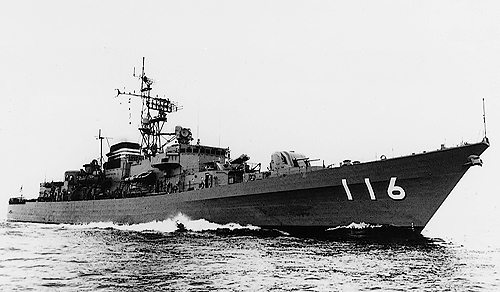
Development
The basic design of the Minegumo was based on that of the Yamagumo-class (37DDK) under the basic plan number E105. Hull and engine were largely based on the 37DDK, but the funnel was unified for deck layout, leaving extra space aft for a DASH operating space, including the helipad and small hangar. While the 37DDK’s bridge structure and funnel were integrated into the forward superstructure, this class separated them by one meter, in order to reduce the impact of diesel vibrations. This was also adopted by the Yamagumo-class (44DDK). The third ship, Murakumo (42DDK), added an air defense command center above the bridge, and she ended with a slightly different appearance, seen from the front. The aft superstructure featured a second compass at its forward end, and a second gun turret immediately behind. She had a hangar for the DASH aft. The aft deck behind was used as a DASH landing and takeoff deck as well.
During sea trials of the Minegumo, issues arose with excessive splashing onto the bridge even at a standard speed of around 20 knots. This was found to be due to insufficient flare of of the bow slightly aft of the bridge, and so knuckles were created, as well as on the later Takatsuki-class (40DDA) the same year. The main anchor arrangement also modified to count for that wetness of the bow deck. Later as seen above, the DASH program was cancelled in the US despite its initial promises and the operating equipment was removed, ASROC was installed instead. Two long, and thin steel belts were installed on each side of the hull, spanning approximately 70% of length, to ensure extra strength and avoid twisting.
Design
Hull and general arrangements

JDS Natsugumo DD-117, color, 1980s
The Minegumo class displaced 2,100 long tons (2,134 t) standard (Murakumo was a bit heavier at 2,150 long tons (2,185 t)) for 2,750 long tons (2,794 t) at full load, measuring 115 m (377 ft 4 in) for a beam of 11.8 m (38 ft 9 in) and draft of 3.8 m (12 ft 6 in). The overall design was flush-deck, with a clipper bow, flat transom stern. The knuckle was not there initially but was added at the prow, and the superstructures were relatively low, like for the Yamagumo, with the forward Mark 33 AA turret on deck, then the forward Bofors ASWRL at the foot of the bridge, then the fire control, the main main radar mast, followed by the single blocky funnel, flaked by two mortor cutters under davits, followed by the aft fire control for the aft Mark 33. The entire aft section past the elevated Mark 33 on top of the structure was the DASH hangar and helideck occupying the whole aft section. They were very different externally compared to the Yamagumo, with their more compact outlook and single funnel.
Powerplant
Like the Yamagumo-class, the powerplant was made for flexibility and range rather than speed. It combined dix diesel in a CODAD system with of six high-output, two-stroke, medium-speed V-type diesel engines. As with the Yamagumo-class, they differed per ships, either Mitsui or Mitsubishi diesels. The former consists of three Mitsui 12UEV30/40 V12 engines rated for 4,650 horsepower each, mounted on each side. The alternative were two 1228V3BU-38V V12 Mitsubishi marine engines rated for 4,250 horsepower each and two Mitsubishi 1628V3BU-38V V16 engine rated for 5,600 horsepower each, mounted either side. The Minegumo and Murakumo had Mitsui Diesel. Only Natsugumo had Mitsubishi diesels.
Like the Yamagumo-class, the engine room was separated into three engine rooms: Forward, middle, and aft. The two engines in the forward engine room and port engine, middle engine room, drove the left shaft, the starboard engine, middle engine room, and the two engines in the aft engine room drove the right shaft. Power supply was the same as that of the 37DDK, two diesel generators rated for 400-kilowatt and one 200-kilowatt emergency generator. Top speed, based on the total outut of 26,500 hp was 28 knots (DD-118: 27 knots) for a range of 7,000 nautical miles (cruising at 20 knots).
Armament
DASH Drone
As mentioned above, the most significant change in weapons systems was the replacement of the initially planned ASROC by two QH-50 DASH unmanned anti-submarine helicopter and their operating facilities. The DASH was a promising new weapon, as “sold” by the US, expecting scale economics, to provide far longer-range anti-submarine firepower than ASROC. However, due to frequent accidents, the US Navy discontinued operation with the DASH in 1969, and the Japan Maritime Self-Defense Force also also discontinued operation in 1979 due to the interruption of parts supplies. As a result, there was a plan to convert the DASH’s operating equipment to use SH-2F LAMPS Mk.I helicopters, but this was not realized. Space was also lacking and the cost of creating a new hangar and associated modifications got in the way. However both the Minegumo and Yamagumo classes, all six “-Gumo” lacked an helicopter, which for ASW in the 1980s was sorely lacking. That’s why tailored helicopter destroyers were built alongside.
RUR-5 ASROC
In 1979-1982, the DASH was removed, replaced with an ASROC launcher installed in front of where the DASH was previously on the helideck. This made the armament the same as the Yamagumo-class. The third ship, Murakumo (42DDK), was refitted in 1978, earlier than the other two, and therefore its missile loading mechanism was a mechanically assisted, but human-powered system similar to that of the 37DDK. However, the other two ships were refitted three years later, in 1981, and therefore equipped with the same type of fully automated, direct loading system as the Hatsuyuki-class destroyers.
76 mm/50 OTO Melara
The main battery for the third ship, Murakumo, was modified as a single OTO Melara 75mm/50 was installed aft on a box-like structure atop whre was located the former Type 69 dual 75mm mount. Identical to the standard Italian/NATO gun of the “super-rapido” type. Murakumo kept her aft twin Type 69 (Mark 33) DP mount. This was part of the 1978 reconstruction alongside the installation of ASROC.
3-in/50 Mark 33
The first two had a couple of 50-caliber 76mm twin rapid-fire guns (Type 68), the same as the 37DDK. Forward and aft these 50-caliber 3-inch twin rapid-fire gun were replaced with a 62-caliber 76mm rapid-fire gun, during which and Murakumo the first to test the next-generation artillery weapon system. This gun weapon system was widely adopted on ships after the Fourth Defense Warfare Class, such as the Hatsuyuki class, but it remained even after tests were completed. The experimental FCS-2 was later replaced with the operational Type 2-21, licence version of the OTO Melara gun.
Bofors M/50 375mm multiple ASW rocket launcher
Swedish system, licensed version of the M/50 375mm anti-submarine rocket launcher already used on the Kitakami-class, associated with the Underwater Strike Control System (SFCS), Japanese SFCS-1C-3 Bofors guiding system later integrated into the SFCS-2.
HOS-301 324mm TTs
A Japanese copy of the US standardized triple 324 mm torpedo tibes for the Mark 46 acoustic ASW torpedo, built in Japan, both the tubes and torproedoes as the HOS-301.
Sensors
DD116 and 117, the first two, had the OPS-11B main radar, OPS-17, SPG-34 radars, OQS-3 sonar.
DD118, third vessel, had the same OPS-11B, OPS-17, SPG-34 radars, OQS-3 sonar, but the new SQS-35(J) sonar.
This class retained the 37DDK’s electronic detection and response system (ESM), but the radar was upgraded to the improved OPS-11B, and the sonar was upgraded to the domestically produced OQS-3, which offered performance equivalent to the AN/SQS-23. Murakumo was also equipped with the SQS-35(J) variable depth sonar, the first JMSDF DD to be equipped with this device from commissioning.
The Underwater Strike Control System (SFCS) controlled the Bofors ASWRL and later ADROC: The SFCS-3 was installed on the first ship, Minegumo (40DDK), and the second and third ships were equipped with the SFCS-3A, reducing roll and pitch data with a new detection function deroved from the SFCS-3, due to the introduction of the Gyrocompass Mk.19 as main navigation system. Later, with the removal of DASH and installation of ASROC, it was replaced with the SFCS-4B/4B-1.
The Gun Fire Control System (GFCS) of the lead ship, Minegumo (40DDK), retained the 37DDK’s configuration, with a Mk. 56 primary compass forward and a Mk. 63 secondary compass aft. From the second ship, Natsugumo (41DDK), the primary compass was upgraded to the domestically produced FCS-1B. Like ASROC, the DASH required tracking using the primary compass during anti-submarine attacks, meaning that anti-aircraft fire was limited to the manual Mk. 63. This, like the Yamagumo class, reduced the ship’s ability to counter airborne threats. This issue was particularly significant for this class, as the DASH required longer attack times than the ASROC. The third ship, Murakumo (42DDK), had its second compass replaced with an experimental FCS-2 in 1975.
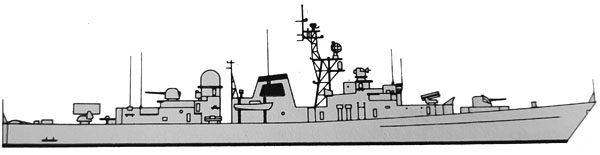
Conways profile
⚙ specs. Minegumo as completed |
|
| Displacement | 2,100 long tons* (2,134 t) standard, 2,750 long tons (2,794 t) full load |
| Dimensions | 115 x 11.8 x 3.8m (377 ft 4 in x 38 ft 9 in x 12 ft 6 in) |
| Propulsion | 2 shafts 6 diesels 26,500 hp |
| Speed | 28 knots (DD-118: 27 knots) |
| Range | 7,000 nautical miles (cruising at 20 knots) |
| Armament | 2×2 Mk.33 3″/50, Bofors quad 375 mm ASWRL, 2×3 HOS-301 324 mm TTs, 2× QH-50D DASH |
| Active Protection | NOLR-1B electronic warfare suite |
| Sensors | OPS-11B EWR, OPS-17 SSR, OQS-3 hull-sonar, SQS-35 VDS, Mark 56 FCS |
| Crew | 210 |
*Murakumo : 2,150 long tons (2,185 t) and an OTO Melara 76 mm.
The Minegumo class in service
 JDS Minegumo (DD-116)

DD-116 was laid down on March 14, 1967 at Mitsui Shipbuilding, Tamano shipyard, No. 2204 planned for fiscal year 1965 under the Second National Defense Program. She was launched on December 16, 1967 and commissioned on August 31, 1968. She entered the 1st Escort Flotilla as direct command ship, stationed in Kure. She remained homeported in Kure, without ever being transferred to another headquarters until decommissioned. On April 25, 1969, the 22nd Escort Squadron was newly formed, under the 1st Escort Flotilla, and Minegumo was incorporated into it with her sister Natsugumo, commissioned on the same day. The two remained in the same unit for 30 years until decommissioned. From November 24, 1981 and May 12, 1982, she underwent special modifications, removing the dash system on the aft deck, installing an ASROC launcher. On March 27, 1982, the 22nd Escort Squadron was reorganized, under the 2nd Escort Group. On March 19, 1986, the 22nd Escort Squadron was reorganized under the Kure District Force.
On June 11, 1995, at approximately 8:30 a.m., a fire broke out in the engine room during trials in the Kii Channel, killing one crew member, injuring two. On August 1 of the same year, JDS Minegumo was reclassified as a training ship, her pennant changed to TV-3509. She was then assigned to the Training Squadron 1. On March 18, 1999, she was decommissioned and struck from the Navy register. Her career saw her cranking up 674,753.1 nautical miles.
JDS Natsugumo (DD-117)

DD-117 was ordered from Uraga Heavy Industries, No. 2205 FY66 under the same program, laid down on June 26, 1967, launched on July 25, 1968 and commissioned on April 25, 1969. She was assigned to the newly formed 22nd Escort Squadron under the 1st Escort Group, along with her sister Minegumo, stationed in Kure. The two ships remained in the same unit for 30 years until decommissioning. They remained in Kure without ever transferring headquarters. She was the first to be equipped with the domestically produced Type 72 Fire Control System Model 1B, introduced on a trial basis.
At approximately 9:30 PM on March 31, 1978, while training in the Enshu Nada Sea, approx. 120 km south of Omaezaki, Shizuoka Prefecture, she collided with the submarine JDS Asashio. The latter’s periscope owas bend, and her starboard propeller partially damaged (two bladed bent). At the time, ASW training targeting the Asashio was being conducted and its rather Asashio that collided with Natsugumo at periscope depth under approximately 16 meters rather than the contrary. Natsugumo’s captain escaped blame. Between December 15, 1981 and June 15, 1982, she underwent special modifications, with the removal of the dash system aft and the installation of ASROC, like Minegumo.
On March 27, 1982, the 22nd Escort Squadron was reorganized under the 2nd Escort Flotilla and 1984, Minegumo participated in a long-distance training cruise. On March 19, 1986, the 22nd Escort Squadron was reorganized under the Kure District Fleet. On August 1, 1995, she was reclassified as a training ship, pennant TV-3510, assigned to the Training Squadron 1. She was decommissioned and struck on March 18, 1999. She cranked up 670,610.4 nautical miles in service.
JDS Murakumo (DD-118)

DD-118 was ordered from Maizuru Heavy Industries as No. 2206, FY67 under the Third Defense Program. She was laid down on October 19, 1968, launched on November 15, 1969 and completed on August 21, 1970. She was assigned to the 22nd Escort Division, 1st Escort Group, and deployed to Kure. Her stern was extended by one meter, after the experience with her sisters and their wet forecastle, increasing standard displacement by 50 tons. She was also equipped with a variable depth sonar (VDS) from the time of her construction, and a new upper command post was added to the bridge.
During a FY75 reconstruction overhaul, her aft US pattern Mk-63 fire control system was removed, replaced by a domestically produced Type 2 fire control system. This was completed in October. The fire control system then underwent sea trials. Between September 27, 1978 and March 30, 1979, she went through anothr “special refit” with the removal of the DASH and installation of ASROC. The 3-inch aft gun was also removed and replaced with a 76mm OTO Rapido. It was installed on the ship for preliminary testing, selected as main gun for the Japan Maritime Self-Defense Force’s new escort ships. Subsequently, tests were conducted along with functional tests of the new Fire Control System Type 2. The OTO Melara was later adopted for licence production as standard.
On March 27, 1982, the 22nd Escort Squadron was reorganized under the 2nd Escort Squadron. On March 27, 1985, she became flagship of the third Escort Fleet, transferred to Yokosuka. Command and control equipment was installed and remodeled. On March 16, 1998, Murakumo was reclassified as a training ship pennant changed to TV-3511. She was assigned to the Training Squadron’s 1st Training Unit and her home port transferred back to Kure. Conversion work into a training ship took place between February 9 and April 24. Her ASROC magazine was removed, and a new training auditorium was built in its place. On June 13, 2000, she was decommissined and struck from the Navy register. In service she cranked up some 620,329 nautical miles.
Read More/Src

Books
Sharpe, Richard (1989). Jane’s Fighting Ships 1989-90. Jane’s Information Group.
Hull (Hardware of JMSDF destroyers)”. Ships of the World (in Japanese) (742). Kaijin-sha: 100–105. June 2011.
Yasuo Abe (June 2011). “2. Propulsion system (Hardware of JMSDF destroyers)”. Ships of the World (in Japanese) (742). Kaijin-sha: 106–111.
Keiichi Nogi [in Japanese] (March 2010). “1. Missiles (Shipboard weapons of JMSDF 1952-2010)”. Ships of the World (in Japanese) (721). Kaijin-sha: 82–87.
Heihachiro Fujiki (August 2007). “A history of JMSDF’s missile destroyers”. Ships of the World (in Japanese) (678). Kaijinn-sha: 98–103.
Conway’s all the world’s fighting ships 1947-95
Links
seaforces.org
navypedia.org
helis.com
ja.wikipedia.org/wiki/
en.wikipedia.org