
 Marynarka Wojenna, fleet destroyers Wicher, Burza (1930-1960)
Polish Day ! For this Polish Day, were go back to the Marynarka Vojenna (The Polish Navy) at the eve of WW2. It was a small regional navy with some impressive destroyers, four in total, plus a support destroyer. This naval plan started with two ships, Wicher and Burza, that were ordered in France. Both took part in WW2, one was lost, but the other soldiered on under the Free Poles, taking its place alongside the allies and under RN command.
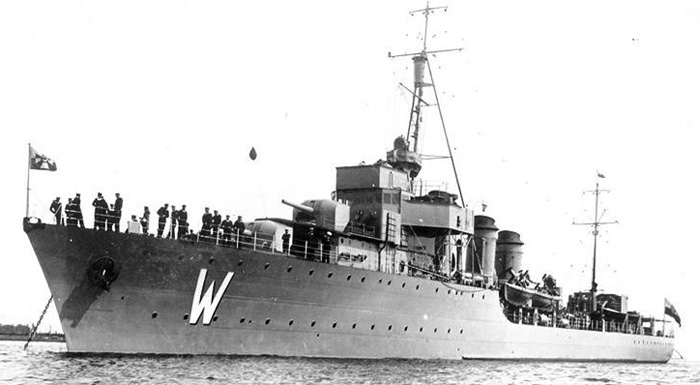
After the Great War the short Polis shoreline, only 142 km (88 mi) initially led politicians to believe there was no need to create a large naval force. Initially the Navy started with four naval trawlers and two monitors inherited from the Kaiserliche Marine but in 1924, it was decided upon a massive deterrent, a force of nine submarines. Poland’s perceived primary adversary was still to be the Soviet Union, so the new planned navy’s main task would be to secure supply convoys from France in case of war. However, due to the economic crisis and customs war with Germany, this plan was abandoned curtailed down to only three submarines ordered from France…
Development

In its first years, the Second Polish Republic’s Navy consisted of vintage pre-WWI vessels, both worn out and obsolete, purchased from other countries, or awarded as war reparations, and originating from the Kaiserliche Marine. These ships could not adequately fill the tasks assigned to the Navy as defined by the Council of Ministers of the Republic of Poland, of 3 April 1922. These comprised:
1)- The defense of the Republic of Poland in internal waters and at sea
2)- Defending maritime access to the coast.
From its inception, the Department of Maritime Affairs put forward an ambitious fleet expansion, but the economic situation of the Second Polish Republic and lack of appropriate infrastructure put a brake on this will. Only the small fleet expansion plan presented in 1924, assuming the purchase of two cruisers, six destroyers, 12 torpedo boats, and 12 submarines gained traction, due to the improving economic situation, and the conviction from the naval command’s CiC, Cmdr. Świrski, and political authorities, that there were real prospects enabling its implementation. The 1925 budget saw the allocation of 5.7 million złoty for the purchase of new ships.

On the other hand, the efforts of the French Maritime Mission in Warsaw and Commander Jolivet at its head, saw the French government opening a credit line for 300 million francs to the Polish government in 1921 to ease these purchases. However, by the autumn of 1925 due to the Polish economic crisis, the Minister of Military Affairs, General Władysław Sikorski, was forced to revise the fleet expansion plan twice. As a result, it was drasticall scaled back. Thus it was only decided to purchase three submarines. The order for submarines was was placed with French shipyard Chantiers Augustin Normand in Le Havre, a token of good will to develop military cooperation between France and Poland.
Admiral Porębski instead wanted to rely on Great Britain to expand the Polish Navy, but this came to nothing due to the British government’s reluctance to develop the Polish Navy. At the same time, the French government continued to pressure the Polish government to commit to the submarines from the Chantiers Navals Français, whose shareholder was the French Minister of Foreign Affairs, Aristide Briand. The Polish ambassador to France, Alfred Chłapowski, was seeking a loan from the French government for the failing Bank Cukrownictwa, of which he was president. At a meetings in Inowrocław between Sikorski and Chłapowski, and between Sikorski and Świrski, it was agreed that the Chantiers Navals Français shipyard would be confirmed to deliver submarines.
From Submarines to Destroyer
But the head of the KMW criticized this choice, as the yard in question lacked the experience and facilities to build them. Instead, it was decided more advisable to build two destroyers, referred as destroyers. General Lucjan Żeligowski who replaced General Sikorski as Minister of Military Affairs, wanted to limit this order to just one destroyer. However, due to opposition from Commander Świrski, this did not get traction from PM Skrzyński. On March 16, 1926, the Economic Committee of the Council of Ministers approved the contract of two destroyers, and authorized Commander Świrski to sign contract on April 2, 1926, in Paris on behalf of the shipyard by one of its shareholders and director, engineer E. Dhôme.
The final contract called for two destroyers with armament and ammunition, for a total of $2,404,200, to be delivered, the first within 27 months, and the second within 39 months of the contract’s conclusion. When news of the Polish order appeared in the French press, the British ambassador in Paris, Lord Robert Crewe-Milnes, forwarded it to the British government, issuing a strong protest, citing a violation of Article XVI of the 1922 Washington Naval Armament Limitation Agreement. They demanded an explanation from the French government as to why the parties to the agreement had not been notified of the construction of the ships for Poland. The French notification memorandum only reached London after the signing of the Franco-Polish agreement. French explanations were ultimately accepted by the British government.
Bourrasque Clones ?
The ships under construction were modeled after the French Bourrasque-class destroyers Orage and Ouragan, already ordered by the Marine Nationale from Chantiers Navals Français in 1922. But due to design issues identified by the Polish Naval Command (KMW) in the design, a number of changes were made at the request of the Polish side. The ships had to be made wider than the original, about 40 cm, resulting in a displacement increased to 130 tons for a total of 1,540 tons. The layout was changed as well, and in the opinion of KMW, and according to the original design, the equipment was arranged incorrectly according to the Poles. They theorized that one hit would have been enough to immobilize the ship entirely. In addition, changes were agreed upon about equipping the ships with mine tracks on deck, enough for 60 minees. It was also decided to strengthen the anti-aircraft artillery, replacing the Frencn 37 mm guns with 40 mm “pompom” Vickers guns, and kept the 12.7 mm (0.5 inches) Hotchkiss machine guns.
The contract agreement provided for penalties in case of any delays. Failure to meet specifications, but also rewards if the ships exceeded 33.7 knots on trials. It was specified payment methods, and details of the technical execution, and acceptance under construction with the insurance, and guarantees. If any disagreements emerged between parties to the contract, a super-arbitrator would be selected by the Court of Arbitration, the International Chamber of Commerce in Paris. It was selected to resolve them. The guarantee for each ship was to be of six months from signing the acceptance protocol.
Construction
 The keel of “Wicher”, was laid in Blainville on 19 February 1927. The first rivet was ceremonially driven by Aleksander Chłapowski, Polish ambassador to France, and second by Commander Świrski. Construction of the second destroyer “Burza”, started on 1 November 1927. Construction was supervised by the Shipbuilding Supervisory Commission, appointed by the head of KMW, under Lieutenant-Cdr. Engineer Ksawery Czernicki. Other members included 2nd. Lieutenant-Cdr. Engineer Alojzy Czesnowicki as a boiler and machinery specialist (until July 1927), Lt.Cdr. Engineer Aleksander Rylke as the hull specialist, Lt.Cdr. Engineer Stanisław Rymszewicz for the boiler, machinery, and electrical engineering, from July 1927, as and second Lieutenant Commander Eng. Stanisław Kamieński, Walerian Antonowicz, Captain Marek Eng. Witold Szulc, Captain Marek Walerian Januszewski, Lieutenant Marek Eng. Zbigniew Wroczyński, and Lieutenant Marek Eng. Tadeusz Dobrzyński. They established a HQ in Paris, and had a local branch at the shipyard for Warrant Officer Józef Wojtkowiak.
Construction was not progressing according to schedule however. It became apparent poor organization of the workforce and worst, repeated strikes, or even cases of deliberate sabotage and damage to machinery by workers were so serious the Polish Commission noted an increasing number of issues as construction progressed. Correcting these prolonged construction time. The launch of “Wicher” as a result was delayed by a year, and delivery on July 8, 1930, represented a 21 months late schedule. In the case of “Burza”, delivered on August 10, 1932, the delay amounted to over 2.5 years, due to the need to replace defective condensers, turbines, and boilers. The Poles never accepted the defective boilers, and was contested by the Yard, resulting in the activation of the arbitration proceedings, resulting in the suspension of work.
Although the chief arbiter agreed with the Poles to replace the already installed boilers, the Yard protested it would result in the removal of the hull’s upper plating, ome structural elements, causing additional disruptions to the completion schedule. In the case of “Wicher”, the arbitration commission also ruled out in favor of Commander Rylke’s findings about the ship’s initial metacentric height (80 cm) in specifications was not reached. The chief arbitrator also agreed with the Poles to ask the yard a $60,000 fine in this regard, but given the shipyard’s bankruptcy, the fine was enforced. Overall, this prolonged construction contributed to the bankruptcy, but one of the shareholders being a member of the French government and France’s credibility as an ally saw the shipyard placed under judicial administration, obtaining loans to continue construction. The bankruptcy contributed to extra delay in delivery by approximately three months.
The ships were accepted at last by the Acceptance Committee, presided by Czesław Petelenz on September 9, 1930. He replaced Commander Włodzimierz Steyer, Aleksander Rylke, Captain Witold Szulc, and Alfred Jougan on the French side. Secretary of the Commission was Captain Kazimierz Kalina with co-opted officers. Individual ship acceptance was led by Second Lieutenant Commander Bolesław Sokołowski in the case of “Burza” and Tadeusz Podjazd-Morgenstern in the case of “Wicher”. NCOs were to take command of the ships, provided active assistance to the commissions for the training work ahead and defining procedures.
Part of the Polish destroyer squadron
When the ships were delivered to the Polish Navy, the latter still looked at potential adversaries, The Soviet Baltic fleet, the Kriegsmarine, and the Svenska Marinen (Swedish Fleet). Objectives were to provide deterrence via four submarines, two Wilk, and two Orzel) and lay mines with Gryf and others vessels. They were also to provide support to potential western allies, France and Britain, providing destroyers for Baltic operations, escorting larger ships and providing ASW defence. This ended in a diverse procurement, two French submarines, two Dutch submarines, Gryf which was French built as well as the Wicher class.
The procurement of these two ships by the Władysław Grabski government in 1924, via a large credit from France, with French stock owners at the new Caen shipyard was not, for the reasons seen above, a success. The Wicher class, when ordered on April 2, 1926, were basically a repeat of the Bourrasque class, with two funnels and other peculiarities. If for political reasons, France wanted these built at Caen shipyard, inexperienced and with a hastily-assembled workforce, the end result was nothng short but a massive embarrassment. ORP Burza survived the war and was active until 1960 (scrapped 1977), but her sister was sunk during Operation Peking. But when they were delivered in 1928, the Polish admiralty was not impressed, neither by many delays, lingering quality issues remaining, and then by their lackluster performances. This experience led to instead turn to Great Britain for the next class, the fantastic Grom. This was decided upon in the next 1931 Expansion Plan.
Design of the class
The Wicher class were a bit more than just clones of the Bourrasque class. The Poles asked to make many changes, resulting in a greater beam as said above, traduced into a greater displacement, as well re-planning of internal compartments, with the boiler rooms moved on some frame spaces ahead, and replacement of 37mm by British 40mm pompoms as well as extra minelaying abilities. Other than the AA, the Poles decided to keep the main French guns and torpedo tubes in order not to cause more delays. The naming (“Wicher”, “Burza”) as they were built in Blainville, referred to as by the Minister of Military Affairs, Marshal Józef Piłsudski, in an order dated 27 July 1926, was to insert into the French Bourrasque-class thematic conventon of natural events. “Wicher” in fact was the Polish equivalent of a “Bourrasque” (wind gale), “Burza” was closer to “Orage” or “Tempête” in French (Storm). Names of subsequent destroyers for the Second plan continued the tradition with Grom and Byclawicka.
Hull and general design of the Wicher class
The Wicher followed the general architecture of the Bourrasque-class, but with a standard displacement of 1,540 tons, full displacement of 2,010 tons (2,430 tons) for a hull that was conservative at 107.2 meters long and length between perpendiculars of 100.9 meters, and at the waterline at 104.8 meters. However they were beamier, reaching at the waterline 10.5 meters, with a maximum draft of 3.5 meters with an average of 2.97 meters. The hull was made of non-galvanized steel plates and sections, in order to avoid corrosion. The steel used in construction had a tensile strength of Rr > 60 kg/mm². The stem was significantly raked forward, the keel was straight. The foredeck went on up to the height of the first funnel.

As completed in 1939
There were three superstructure islands, the forward deck bridhe housed the radio and tech. rooms on the first level, navigation cabin above, main command station and rangefinder station on top. Forward of the bridge were the superfiring first and second main guns. Behind the bridge was a tripod mast with a small spotting top. Further aft were the galleys, crew quarters, ventilation shafts and funnels (on Wicher), then the two torpedo tube banks separated by a small structure supporting the main searchlight. The aft superstructure housed the staff quarters, a second galley, and the ventilation systems. It support No.3 main gun, superfiring above No. 4 on the quarterdeck. There was also a shorter, tripod stern mast, with radio cables extending back to the mainmast. Amidships were davits with a 7-meter whaleboat, a motor launch, a motor yawl, and small yawl stowed over it. The hull was divided by 10 bulkheads creating eleven watertight compartments. Frame spacing was 1.8 meters. The fuel tanks were separated from the ammunition stores by cofferdams, 0.9 meters wide.
Powerplant of the Wicher class
Three main water-tube boilers were of the du Temple type on Wicher, and Yarrow-Normand in Burza. They were installed in the forward and aft boiler rooms, thre groups in total, resulting in three funnels for Wicher and two on Burza. These boilers were housed in airtight chambers where atmospheric pressure was maintained at all times. There were two Boiler pumps per boiler, that forced air directly into the furnaces. The boiler rooms had a separate ventilation system. Each boiler had eight burners plus a Penhoet air distributor. Total heating surface was 930 m². They had a working pressure of 18 kg/cm², for a steam output of 80 tons/h. They were supplied with water, by two turbopumps in the forward boiler room, plus three piston pumps in the aft boiler room. The ballast tanks held 69 m³ of boiler water at the bottom, 28 m³ in tanks on both sides. Fuel oil was pumped in by piston with a capacity of 7.5 t/h. Centra heating was provided by an auxiliary boiler of 25 m², with working pressure 8 kg/cm², located in the forward superstructure, powering also various auxiliary equipment.
Each main boiler weighed 45 tons with fittings but empty, consuming up to 15 tons of oil per hour. The fuel supply was 330 tons of oil stored in eight tanks. However design errors resulting in the ships being overloaded and out of their planned metacentric height, some of the oil and water reserves could not be used and had to remain in tanks at all times as liquid ballast, reducing range and speed. They made it into operational recommendations. Captains knew they needed to keep at least 100 tons of oil and 20 tons of boiler water in the tanks at all times.
Unlike the boilers, the Poles ordered their steam turbines from Parsons. Four were ordered for both destroyer. Their total output was 33,000 hp. Each group was composed of a high-pressure turbine ahead, a low-pressure turbine, and a final turbine astern, mounted on a common shaft. When ordered full ahead, the shaft rotated at 360 rpm. Full astern this was 225 rpm. The turbines were housed in a single engine room. Contract speed was 33 knots, range, at economical speed of 15 knots was to be 3,000 nautical miles. On trials they reached 33.8 knots still thanks to two three-bladed propellers. The auxiliary equipment comprised two turbo pumps forcing seawater in order to cool the condensers, with air intakes creating a vacuum in the condensers, and steam piston pump powering the fire-fighting system and bilge water removal system as and oil centrifuge system. These were manufactured by Rateau.
Aside the main propulsion, when at anchor and for all systems in general, main output for everyhting that needed electricity on board was generated by two turbogenerators, each rated at 60/66 kW. They were manufactured by Five of Lille Co. There were also two auxiliary generators rated at 15/18 kW, from Chantiers de la Loire, St. Denis. The electrical system operated at 110 V, with a two-wire electrical network for the lighting system, a total of 200 bulbs and two arc searchlights as well as auxiliary systems such as the pumps, fans, ammunition elevators, torpedo tubes, galley’s equipments, cranes, ect.
Armament
Main guns: 130mm M1924


They had the same four 12.7 tons, 130 mm (5.1-inches) Schneider-Creusot model 1924 guns as on the Bourrasque. They were mounted on the axis in two superfiring positions fore and aft, under masks, with canvas covers at their rear to protect from bad weather. Traverse either beam was 135° and elevation 35°. The gun barrel was a monobloc, 5.2-meter-long with right-hand rifling. The breech was of the Welin type with a stepped-screw type, firing mechanical or electrical. Manual loading with separate-loading ammunition. In total they carried 125 rounds per gun (500 in common). They weighted 32.5 kg, for training, illumination armor-piercing and high-explosive, or fragmentation-high-explosive. Range was 18.1 km.
Vickers 2-pdr pompom
 The Poles decided to ditch the French 37 mm for two 305 kg. 40 mm Vickers-Armstrong called wz. 28 in Poland, licence built. These anti-aircraft guns were placed on R4SM naval mounts, positioned amidships near the aft superstructure. They were semi-automatic gun with wedge breech, hydro-spring recoil. The 1.575 meters long barrel was water-cooled. Theoretical rate of fire was 200 rounds per minute, 120 rounds per minute in practice. They came up with ammunition belts of 25 rounds. Elevation was 85°. Range 3,980 meters. They carried 1200 rounds for them.
Hotchkiss 13.2 mm
The Poles kept however the original Four 13.2 mm Hotchkiss anti-aircraft machine guns on R4SM naval mounts on the bridge wings, near the main command station (two twin mounts). The barrel was 1,000 mm long, air-cooled, with an elevation angle of +85°. Rate of fire was 450 rounds per minute at a max range of 3,000 meters. Ammunition came by 30-round magazines, or from a rigid belt of 15 or 30 rounds. The Hotchkiss 13.2 mm, including its mount, weighed 350 kg. They were fitted with a Le Prieur DAC940 sight, firing mechanically with a trigger pedal. They carried 10,000 rounds for them.
Torpedoes: 2×3 550 mm M23D
The torpedo armament was moderately powerful and French in origin, same a the Bourrasque class. It was standard for the time with two triple tubes of the 550 mm Creole-type torpedo tubes, with caliber reduction inserts enabling to fire 450 mm or 18-inches torpedoes either British or French. They were positioned in the axis amidships with torpedoes aimed and launched manually at the launching station, or remotely from the bridge, by compressed air (200 atm) or a powder charge. The tubes were adapted from the French 550 mm firing the 1923D torpedoe yet compatible with 533.4 mm British Mk IX and Polish 450 mm wz. A torpedoes. The Poles ordered sixty-six model 1923D torpedoes before the outbreak of the war. There were limited spares due to stability issues carried on board but it needs to be cross-checked. It seems they carried 12 torpedoes total, meaning six in tubes, six spares. Compared to their contemporaries, these torpedoes were slow, but for a good range and heavy payload, rather on top of their category.

Model 1923D original plans, credits navweaps.com
The standard French model 1923D torpedoes had the following specs:
4,560 lbs. (2,068 kg) for 27 ft. 2 in. (8.280 m) long
Explosive Charge: 683 lbs. (310 kg) TNT
Power unit: Schneider alcohol/air heater
Range/Speed settings: 9,840 yards (9,000 m)/39 knots or 14,200 yards (13,000 m)/35 knots
ASW armament
The Wicher were provided a not stellar, but pretty standard anti-submarine suite: Two depth charge racks, and two depth charge launchers located in tunnels below deck at the stern, with a conveyor belt typical of French destroyer. The latter were closed by hatches, the DCs released using an electrically driven convyor belt with Gall chains. The reserve consisted of twenty BH200 charges. Additionally, two Thornycroft depth charge launchers were positioned on the aft sides, each with a supply of 10 DCs, one per launcher and four adjacent reloads on racks. In total they carried twenty-four DCs.
Mines
The Wicher class also had minelaying capacity, with two pairs of mine tracks mounted on the stern deck, enough for sixty Model 08 mines, called Poland wz. 08.
Fire Control

It was likely the same as the original French vessels, with barr & Stoud telemeters in the bridge.
Sensors & Communication
The Wicher class had a main SM1K radio station, a shortwave RKD/K radio station, and the Y alarm station, plus a R-J radio direction finder. They were equipped with hydrophones, and Challenger MS IV echosounders. Their planned crew was of 10-12 officers and 150 petty officers and sailors.

Burza later in her career after postwar refit modernization.
⚙ Wicher class specs. |
|
| Displacement | 2,144 tons standard, 2,560 tons full load |
| Dimensions | 114 x 11.3 x 3.3 m |
| Propulsion | 2 shafts Pearson geared turbine engines, 4* boilers 54,000 shp |
| Speed | 39 knots (72 km/h; 45 mph) |
| Range | 350t oil, 3500 nm/15 kts |
| Armament | 7x 120mm, 4x 40 mm AA, 8x 13.2 mm AA, 2×3 550-533 mm TTs, see notes |
| Sensors | Hydrophones, see notes |
| Crew | 192 |
*3 main 3-drum, 1 auxiliary
Career of the Wicher class
Reception

The Wicher were the first large new surface ships received by the Polish Navy, first of this class in the Polish Navy and, upon entering service, largest in terms of displacement. Although not very modern, they represented a certain upgrade for the Polish fleet, albeit their early operation records highlighted many shortcomings. Some were already known, like poor stability, also insufficient speed, as according to Cdr. Francki in April 1940 “Burza” was only capable of 28 knots, preventing operation with the remainde rof the Squadron. Both also had insufficient anti-aircraft armament also in 1940 and for the standards of the day. Furthermore they lacked range, soon an issue during service in the Atlantic. They also constantly had issue with their condensers due to early quality issues. Also since they were oiriginally built for the Mediterranean in minbd, their widely spaced frames combining with many openings, passages in the bulkheads, reaching four times than in a British destroyers led to issues with longitudinal strength, that flew in the face of Atlantic service.
Other shortcomings, recognized by the Naval Command before 1939 included the placement of the turbines in a single watertight compartment, too exposed in case of a single hit. They would have been immediately dead in the water. Also criticized, especially when compared to the British designed Grom, a “dysfunctional arrangement of the crew quarters”. They were based on seniority rather than combat assignments, men were far from their intended posts. The arrangement of three funnels and two masts was als criticized as they acted as extra markers for the enemy to estimate their speed and distance in an engagement.

Wicher and Burza at the Kieler Week 1935
Armament wise, the low rate of fire of their 130 mm model 24 guns was also criticized. The shape of the bow chin, dictated for a higher speed, was also crititized as the fine lines made for poor buoyancy, with any reserve completely eaten away by her two heavy 130 mm gun mounts at the bow. It resulted in the impossibility to maintain speed difficult in high, short waves. Due to the contractors exceeding the ships’ design displacement limits and poorer-than-expected stability, the entire boiler water and fuel supply could not be used to the full in order not to compromise an already limited metacentric height. Captains were intructed to keep at all times 100 tons of oil and 20 tons of boiler water as ballast, this reduced their range by 30%.
To alleviate for these deficiencies, countermeasures were taken. This started with checking the metacentric height as the ship’s current armament and equipment was loaded. To improve stability, the 450 mm torpedoes (Model A) were loaded in the midship torpedo tubes or left unloaded, shelving a ton. In 1938, plans were to modernize them an partial reconstruction to unify them with the new Grom-class destroyers were enisioned. One proposal was to replace three funnels with a single one, replace the main artillery with five 120 mm Bofors L/50 Mod. 34/36 and adpt the same anti-aircraft armament as on the Grom class, with 40 mm Bofors L/60 mm gun mount, two extra 13.2 mm Hotchkiss HMGs and the modernization of the ammunition feed system, artillery display syste, new torpedo installations, new radio sets, new intercom. The conversion was planned for 1940–1942 at a cost estimated at 900,000 złoty for the hull alone, 3.5 million złoty for the armament. This was included in the “6-year fleet expansion plan.” This was estimated to add 5–7 years after conversion to their career. This was never done. “Wicher” received no modernization and was sunk in Operation Peking, unlike “Burza” which had several major reconstructions under British Standards.
Modernization
Early in their service, they underwent limited modernization: In 1934, the Thornycroft side-mounted depth charge launchers were removed. In 1935, tey received a new Walker navigation mechanical log register. Hotchkiss heavy machine guns were added either side of the bridge. The aft masts were removed, replaced with lighter antenna brackets. New rangefinders were installed. In 1937, they receoved 12 smoke buoys dispensers, six either side under the torpedo tubes and rangefinder platform. They also received a protective net. The breakwater was strengthened, handrails were installed on the navigation bridge, spacing in the davits were changed, rooms were better indulated, sewage pipping were made larger and replaced (for cold use), additional fans and freshwater tanks were installed. The radio sets were modernized to the Polish N-31/O-31 and Z-33 transmitting and receiving radio stations, as well as a MG goniometric radio stations added.
 ORP Wicher

Shortly after arriving in Poland, “Wicher” was assigned the task of escoring the passenger ship “Polonia,” carrying the President of the Republic of Poland Ignacy Mościcki on an official voyage to Estonia from August 8–13, 1930. Back home, she starteds intensive training and combat exercises. In March 1931, she sailed to Funchal, Madeira to pick up Marshal Józef Piłsudski, who was there for medical treatment. She visitedLisbon en route. In June 1932, she played a decisive role in the “Gdańsk Crisis”, showing the guns and deterring the Germans. In August 1932, as flagship, Fleet Commander Unruga, she made a courtesy visit to Stockholm with her sister Burza and the Submarine Squadron. On her next visit, with the Destroyer Squadron she sailed to Leningrad in July 1934. She was in Copenhagen in August. In 1935, with Burza she visited Cologne in Germany, then Helsinki and Tallinn. In 1937, cadets embarked on Wicher, as she started a training cruise in the Baltic Sea.
She made her last pre-war foreign voyage with the Destroyer Squadron in August (all four, with Grom and Blycawicka) visiting Tallinn and Riga. After the outbreak of war in September 1939 she was called to defend the coast, repelling air attacks in Oksywie, providing cover for Operation Rurka. On September 2nd, she was moored in Hel, as a floating battery. On September 3rd, she had an artillery duel with Kriegsmarine light ships, as a result of which one German destroyer was damaged (). In the afternoon, she was caught and sunk by Stukas from 4/Trägerguppe 186.

ORP Burza

Burza arrived in Gdynia on 19 August 1932. Loke her sister she embarked in a courtesy visit to Stockholm. In later years, she visited also Leningrad, Copenhagen, Cologne, Helsinki, Tallinn, and Riga (see for her sister). In 1937, she took part in the Spithead Naval Review, representing Poland in the coronation ceremonies for King George VI. In April 1939, she escorted the Dutch-built submarine ORP Sęp home. Then she was called to take part in Operation Peking, leaving the Baltic Sea on the eve of the war, with Grom and Blyckawyka, raking the direction of Great Britain. It was thoerized indeed with the RN the sacrifice of the Polish Navy at the hand sof the Luftwaffe served little purpose. Her sister, less capable, was not even considered and stayed behind, fighting on. Her fate in the hands of Stuka only demonstrated the righteousness of the Polish’s staff choice.


Polish destroyer stands by disabled coast guard cutter. While the U.S. Coast Guard cutter, Campbell, floated adrift, her engines dead after ramming a Nazi sub and sinking it, the Polish destroyer, Burza, stood by to her aid. Though fuel and supplies were desperately low, the Polish ship evacuated 104 Coast Guard enlisted men and officers and stayed on the scene until help came to the stricken cutter. It happened in July 1943. She still had the same Western Approach camouflage.
Upon arrival, Burza was pressed on in the new Free Polish Navy, under supervision of the Royal Navy, like her sisters Grom and Blyckawyka. Burza thus had quite an active career despite of her shortcomings, alleviated in part by numerous refits. She took part in the Norwegian Campaign, Operation Dynamo, escorting Atlantic convoys, as well as Operation Alacrity. During her service, she suffered several hits, loosing men killed and wounded, rescued over 250 survivors, sank U-606 (still contested), damaged two others, shot down one aircraft.
In 1944, she was withdrawn to the 1st Reserve and became a training ship for the Free Polish Navy. She was handed over to the Polish People’s Republic authorities in 1951. After being refitted and put to Watsaw Pact Standards, she served until 24 February 1960 as AA defense ship. In 1960, she was converted into a museum ship, a role she held until 1975, visited by just over 3.7 million. In 1977, after being replaced as a museum ship by Błyskawica, she was scrapped. Note: A full update with more detail on her career is planned for a future upgrade.

Burza as a museum ship 1960-75. She had the typical dark grey livery of soviet ships of that era.
Read More/Src

Books
Jerzy Łubkowski: Kontrtorpedowce „Wicher” i „Burza”, cz. 1. T. 28. Gdańsk: AJ-Press, 2004, seria: Encyklopedia Okrętów Wojennych.
Encyklopedia II wojny światowej nr 6: Wojna na Bałkanach. Atak na Tarent – Obrona Malty – Operacja „Merkur”. Oxford Educational sp.
Dramat ORP Wicher. W: Mariusz Borowiak: Plamy na banderze. Almapress, 2008, s. 270–279, seria: Nieznane oblicza historii.
Tadeusz Kasperski. Niszczyciele PMW w walce z U-Bootami. „Morze, statki i okręty”. XVIII (specjalne, nr 1), s. 2–12, 2015.
Tadeusz Kondracki: Niszczyciele „Wicher” i „Błyskawica”. Warszawa: Edipresse Polska, 2013
Edmund Kosiarz: Na wodach Norwegii. Warszawa: Książka i Wiedza, 1982.
ORP Wicher. W: Witold Koszela: Niszczyciele Polskiej Marynarki Wojennej. Wyd. I. Warszawa: Oficyna Wydawnicza „Alma-press”, 2013
Jerzy Pertek: Wielkie dni małej floty. Wyd. X. Poznań: Wydawnictwo Poznańskie, 1987.
Stanisław Piaskowski: Okręty Rzeczypospolitej Polskiej 1920-1946. Album planów. Gdańsk: Wydawnictwo Lampart, 1996
M.J. Whitley: Destroyers of World War Two. An international encyclopedia. Annapolis, MD: Naval Institute Press, 1988
Tadeusz Kondracki: Niszczyciele „Wicher” i „Burza”. Warszawa: Edipresse Polska, 2013, s. 44–46
Polska Marynarka Wojenna. Dokumentacja organizacyjna i kadrowa oficerów, podoficerów i marynarzy (1918–1947).
Waldemar Nadolny, Artyleria Okrętowa. Wrzesień 1939; WLU tom Nr 143 WLU, 2018.
Maciej Tomaszewski, Działa 120 mm L/50 wz.36 Bofors z okrętów ORP Gryf, ORP Wicher i ORP Błyskawica. (technika)
Links
uboat.net
pl.wikipedia.org
navypedia.org
navweaps.com