
 Indian Navy (1977-today)
INS Rajput, Rana, Ranjit, Ranvir, Ranvijay
The Rajput class (or “R” class) were basically Kashin II class destroyers built in Nikolaiev, USSR between 1979 and 1988. Project 61ME, the export version for Indian their only buyer, they had SSN-2C “Styx” launchers mounted forward on either side of the SAM. These missiles for the 1990s seemed antiquated, if capable to strike at 80km at Mach 0.9, they were sensitive to jamming and flares. Also, the stern turret was eliminated to make room for a hangar and helicopter deck, reached by a ramp. For close defence had twin 30 mm CIWS. Started in 1976-82, they were commissioned in 1980-87 and in service well after the Cold War. Modernized, three are still active today, but they are the forerunner of a long lineage of Indian guided Missile Destroyer.

INS Rajput as modernized with her Revathi 3D Radar
Development
In 1970, the Indian Navy had three elderly WW2 vintage destroyers, the “R class”, or in other sources, Rana class. They were former British R class, emergency 1940 program destroyers (laid down 1941) with four single guns and two quad TT banks. They were transferred in 1949 after the Independence, and became the first destroyers of the Indian Navy. All were given lattice foremast in place of the original tripod before transfer, as well as new funnel ventilating trunks for tropical service, and re-tubed boilers (worn out after WW2 service) plus new radars and a new top hamper counterweighted with 30t of permanent pig iron ballast. They escorted notably the first Indian Aircraft carrier, INS Vikrant for most of its service and saw action in 1949, and the war of 1965 and 1971, but at that stage they appeared antiquated.
In between, starting after the war of 1971 with the realization they were helpless against modern anti-ship missiles, the Indian Navy started to investigate a replacement. The new “R class” was unanimously decided to be a guided missile destroyer, however the known of the Indian Navy at the time was inexistent. Geopolitically, Indian leaned towards the USSR for weapons procurement, a trusted source for decades. Meanwhile, the start of a shipbuilding industry started in the 1960s but only allowed for limited prowesses, and indeed the first large warship resulting for the best Indian shipyards, Mazagon dock, was essentially a heavily modified “broad beam” Leander class frigate, the Nilmgir class, which lead ship was launched in 1968.
From there, the same yard developed the first truly Indian-designed frigates, the Godavari class, the first of which was launched in 1980. However, the complexity of designing a much more ambitious guided missile destroyers in 1975 from scratch was still out of reach.
India and the USSR enjoyed a “special relationship” during the Cold War, especially after the Indo-Soviet Treaty of Peace, Friendship, and Cooperation (1971). The treaty provided for mutual consultations in case of security threats, and while not a formal military alliance, it gave India strategic assurance. During the 1971 Bangladesh Liberation War, the Soviet Union strongly backed India during the war with Pakistan, including sending naval assets in the eastern Indian Ocean. The USSR also used its UN Security Council veto multiple times to block resolutions against India. Soviet naval forces also shadowed US and British fleets in the Indian Ocean to deter intervention, providing India with vital strategic cover.
The USSR was India’s largest supplier of arms, machinery, and industrial technology and Soviet aid helped establish major public sector projects like Bhilai Steel Plant, heavy machinery factories, and hydroelectric projects. This registered as a master geopolitical turnover after the Sino-Soviet split of 1961.
The Soviets also provided India with low-interest loans, technical training, and blueprints. In addition of MiG-21 fighter jets, T-55 tanks, the Soviets also provided India’s first submarines, and missile systems, significantly modernizing India’s military. This was completed by Joint exercises and training exchanges deepened defence ties and went also in the civilian sector such as nuclear energy development, eve, from 1984, space technology. Both countries shared an emphasis on state-led economic development while the Communist Party of India (CPI) had close ties with Moscow, while Indira Gandhi’s Congress leaned on Soviet support diplomatically.
Thus, it was only natural that India under Prime Minister Indira Gandhi at the time looked at USSR to provide a naval solution to replace these elderly R class destroyer, especially at the recent Kashin class Frigates, the first modern guided missile Frigates of the Soviet Navy. They looked impressive, fast, mean, and were armed with an all-round panoply ensuring the defence of capital ships such as the Moskva class helicopter cruisers. India also hoped, through a comprehensive assistance and maintenance contract, to acquire considerable experience handling such designs to, in the future, be able to create their own purely Indian designed and built class.

INS Ranvijay off Malabar in 2007
Still, the negotiations dragged on between 1972 and 1974, notably to finalize some technology transfer and modifications to the basic design, which were quite important. The Soviet design bureau in charge worked with Nikolayev and in late 1975 the design was ready. The yard had been busy with other Kashin class destroyers, and was well experienced with the Project 61M, the modernized version of the original design, working on the Project 61MI (“I” for “India”) which was a dedicated, tropicalized and modified export version. Orders were placed at 61 Kommunara Yard, Nikolayev, Black Sea for five destroyers, under the pennant 51 to 55, all to be named under the new “R” class. The shipyard capacity was however limited, and the first two were laid down on 11 September and 29 November 1976, then one in June 1977, one in October 1982 and one in March 1982, the latter, Ranvijay, being commissioned in December 1987. The financial situation of USSR was desperate at the time, and this order was important to maintain the shipyard’s activity.
The new R-class destroyers, to be replaced by a new “R” class as we speak (2025), are an important landmark in the Indian Navy as being the first missile destroyers, necessary to guard the eastern and western task forces based around INS Vikrant and Viraat, and then Vikramaditya, split between the eastern and western fleets. They were the first ships in the Indian Navy also to deploy the BrahMos supersonic cruise missile.
Design of the class

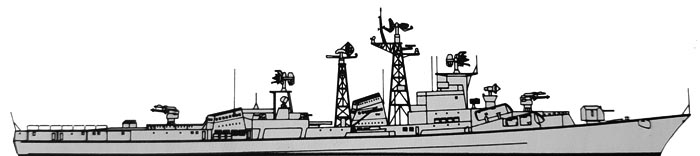
Kombrig’s rendition of the Rajput class, Project 61ME/MI
The Rajput class inherited their anti-aircraft and anti-submarine warfare roles for aircraft carrier task-force defence against submarines, low-flying aircraft, and cruise missiles from the Kashin class, specially based on the project 61ME, the export versions. They were still looking like Kashin class destroyers, albeit being a much latter and ultimate variant of Project 61. They were modernized multiple time to later in life act as training ships, in the context of the rapid 2000s extension of the Indian Navy, accepting many new missile destroyer in service.
Hull and general design
The Rajput class were Kashins with extra displacement at 3,950 tons standard and 4,974 tons full load (versus 3,400 tons standard, 4,390 tons full load), an a but longer at 146.5 m (481 ft) versus 144m for a similar beam 15.8 m (52 ft) but greater draught at 4.8 m (16 ft) versus 4.6m. They inherited this from the Project 61M already, but ended as the largest of the Kashins variants.
The general outlook was the same, apart from details in sensors and more importantly the location and placement of the missiles. The core of the design was more versatile, with a good balance in anti-air, anti-surface and ASW threat response, whereas the original Kashins were more AA oriented.
Powerplant
The Rajput class had the same machinery essentially as the original Kashins, with four Zorya-Mashproekt M3E gas turbines in a COGAG arrangement, rated for a total of 72,000 hp (54,000 kW) on two shafts for a top speed of 35 knots (65 km/h), an inferior speed compared to the original. The basic Project 61 was indeed rated for 96,000 hp (72,000 kW) and 38 knots.
As for range, they could reach 4,500 nmi (8,300 km) at 18 knots (33 km/h) or 2,600 nautical miles (4,800 km) at 30 knots (56 km/h), versus 3,500 nmi (6,480 km; 4,030 mi) at 18 knots for the Kashins, so the Project 61MI ships had an emphasis on range over speed, notably to rapidly transition from the western to the eastern Indian Ocean and vice versa.
Protection
It was essentially the same as the Kashins, with active weaponry such as 30 mm (1.2 in) AK-630M CIWS. The were delivered also with the MRP-15-16M ECM suites, and four PK-16 decoy rocket launchers.
The passive protection included compartimentation below the waterline, extra protection for all ammunition magazines and the command and control centre, automatic fire extinguisher and a full NBC suite well completed by the tropicalized larger air climatize system.
Armament
This varied considerably, not only over time, but between ships, from the start. In the end, all ended with different armament and sensors configuration.
The only common ground between all ships was their single 533 mm (21 in) PTA 533 quintuple torpedo tube launcher and a pair of RBU-6000 anti-submarine rocket launcher.
As completed, D51 to DD53 had their four Termit SSM (4 P-20) in individual launchers forward, two twin M-1 Volna-M SAM (32 V-601 or 4K91), a twin 76mm/59 AK-726 main gun, two twin 30mm/71 AK-230, quintuple 533mm TT, two twin 12-tubes RBU-6000 Smerch-2 ASWRL, and an helicopter of the Ka-25 type.
Completed later in the 1980s, the D54 to 55 were upgraded with the Termit-M SSM (P-20M), the M-1 Volna-P SAM (V-601P), same AK-726,but four sextuple 30mm/54 AK-630 CIWS, same TTs and RBU-6000 ASWRL but the new Ka-28 helicopter.
SS-N-2D Styx AShM (P15 Termit)
Deployed on all ships until partial or full replacement by the Brahmos on four launching canisters forward, abaft the first Volna SAM.
Specs: 2,580 kg (5,690 lb), 5.8 m (19 ft) x 0.76 m (2 ft 6 in), Wingspan 2.4 m (7 ft 10 in)
Warhead: 454 kg (1,001 lb) hollow charge high explosive.
Engine: Liquid-propellant rocket, solid-propellant rocket booster for 40 km/80 km, 25-100 m altitude at Mach 0.95
Guidance: INS, active radar homing, supplemented in some with infrared homing.
BrahMos SSM
Obtained in their mid-life upgrade. Replaced either totally (Rajput) or partially the Styx (last two). Ranvir and Ranvijay indeed had them in VLS aft instead, keeping their four forward Styx.
First Indian cruise missile (PJ-10) and major program of the Indian military, introduced in 2007.
Specs: 3,000 kg (6,600 lb), 8.4 m (28 ft) x 0.6 m (2.0 ft). Warhead 200–300 kg (440–660 lb) nuclear conventional semi-armour-piercing warhead.
Engine 1st Stage Solid rocket booster, 2nd Stage liquid rocket ramjet (Solid fuel/Liquid fuel)
Range 800–900 km (500–560 mi). Ceiling 15 km (49,000 ft), flying at 3-10m at Mach 3 (3,700 km/h; 2,300 mph; 1.0 km/s)
Guidance: Mid-course: INS + multi-GNSS, terminal: ARH, accuracy 1 m CEP (if nuclear).
M1 Volna (SAN-1 Goa)
Located forward and aft in two twin arms launchers, reloaded vertically, like for the original Kashin.
Weight 953 kg, dimensions 6,090 mm x 375 mm. wingspan 2,200 mm
Propulsion: Solid propellant rocket motor, Mach 1, Range 35 kilometres (22 mi)
Guidance RF CLOS, ceiling 18,000 metres (59,000 ft). Payload Frag-HE 60 kg, Proximity fuse.
The forward launched was removed in the 2020s on the last three ships.
VL-SRSAM
Two octuple VL-SRSAM replaced the aft S-125 launcher on INS Dana (D52).
Barak SAM
For short range protection, the last two D54-55 were given two octuple Barak VLS (port and starboard; replacing 2 AK-630).
AK-726 76 mm
Single turret forward, bow deck. Weight 26 t, barrek 59 calibers, 76.2 mm (3 in), twin, −10° to +85°, c300°
Loading system: Sliding wedge, automated. Round 5.9 kg (13 lb), 40-45 rpm (80 combined). Muzzle velocity 980 m/s (3,200 ft/s)
Range: Surface 15,700 m (17,200 yd), Ceiling 11,000 m (36,000 ft).
OTO Melara 76 mm naval gun
An OTO Melara 76 mm naval gun replaced the replaced AK-726 twin naval gun on D54 and D55.
AK-630M CIWS
Four present on all ships, but two removed and replaced by more modern missile CIWS recently on the last three ships.
PTA 533mm TORPEDO Launcher
Single quintuple bank located amidship aft, between the two aft masts. Weight 4,409 lbs. (2,000 kg), 299 in (7.600 m), powered by Kerosene-Hydrogen Peroxide Turbine
Range/speed setting 19,700 yards (18,000 m)/45 knots. Warhead 672 lbs. (305 kg), Sonar guided, setup to target.
RBU-6000
Two 12-tubes forward, classic ASW rocket launchers for close range ASW defence.
Sensors
The ships diverged between them, with D51-53 being delivered with the MR-500 Kliver, MR-310 Angara-A, 2x Yatagan, MR-105 Turel, two MR-104 Rys, two Volga radars, a MGK-335 Platina sonar, Krab-11, Krab-12, MRP-11-14M, two MRP-15-16M ECM suites, four PK-16 decoy RL and Planshet-61ME CCS. D54 and 55, the 1980s late ships had the same as above except the new Yatagan II radars, MR-123 Vympel instead of the Rys, and the upgraded MP-401E Start ECM suite.
MR-500 Kliver
Main aerial first warning and tracking radar (NATO BIG NET). Data for the next Update. 1
MR-310 Angara-A
Surface surveillance and acquisition radar 2
4R90 Yatagan FCS
Better known as the M-1 Volna complex fire control and target acquisition radar 3
MR-105 Turel FCS
Fire Control Radar Associated with the 76mm gun turret. NATO Owl Screech. 4
MR-104 Rys FCR
NATO Drum Tilt, naval fire-control radar associated with the AK-230 30-mm anti-aircraft (AA) twin guns. 5
Volga radar
Navigation Radar. No more data.
MGK-335 Platina sonar
Hull-mounted sonar, NATO Bull Nose. Range Max: 27.8 km.
Krab-11/12
No Data
MRP-11-14M & MRP-15-16M
ECM suites, no data.
PK-16 decoy RL
Standard 82mm Soviet Decoy Rocket Launchers 6
Planshet-61ME CCS
Basic Combat and Control Suite, buried into the hull and protected. It was still lightyears away from AEGIS developed at the same time.
Air Group
The ships carried either the Kamov Ka-25 or Kamov Ka-28 ASW helicopters (1980s ships). There was a small helipad aft but no proper hangar. When stored permanently the helicopter needed to be protected by a tarpaulin.
⚙ specifications |
|
| Displacement | 3,950 tons standard, 4,974 tons fully loaded |
| Dimensions | 146.5 x 15.8 x 4.8m (481 x 52 x 16 ft) |
| Propulsion | 2 shafts, four Zorya-Mashproekt M3E gas turbines (COGAG), 72,000 hp |
| Speed | 35 knots (65 km/h) |
| Range | 4,500 nmi at 18 kts (8,300 km) or 3,500 nm (other sources), 2,600 nm at 30 knots |
| Armament | 4×1 Termit SSM, 2×2 M-1 Volna-M SAM (32), 1×2 76mm/59 AK-726, 2×2 30mm/71 AK-230, 1×5 533 TT, 2×12 RBU-6000 Smerch-2 ASWRL |
| Protection | |
| Sensors | 2 x Volga (“Don Kay”) radars, MP-500 Kliver (“Big Net-A”), MR-310U Angara (“Head Net-C”), Inmarsat comlink, Vycheda MG-311 (“Wolf Paw”) sonar, Vyega MG-325 (“Mare Tail”) variable depth sonar. |
| Air Group | HAL Chetak (first three), Ka-28 (last two). |
| Crew | 320 |
Modernizations
The R class underwent a mid-life refit in 2010 with modernization of their electronics. Two MR-104 Rys’ radars, two additional Rashmi radars, the TQN-2 ECM suite, MR-500 Kliver radar with additional two RAWL-02 rada, Planshet-61ME CCS and Thomson CMS-SNF CCS. In 2015, INS Ranvir received a twin forward 76mm OTO-Melara Compact SR and INS Ranvijay received an updated vertical launcher for her BrahMos missile.
A new upgrade was planned in the 2020s to replace their worn out and antiquated propulsion system, with DRDO Kaveri Marine Gas Turbine in testing phase until 2023. INS Ranjit differed by having two Bharat RAWL (Dutch Signaal LW08) radars working at D-band. On all ships, the MR-310U Angara (“Head Net-C”) was replaced by the Dutch EL/M-2238 STAR and Bharat HUMSA sonar during their major refit. Armament also differed among ships: INS Rajput was given four BrahMos and two SS-N-2D Styx, one Dhanush ballistic missile. Rana and Ranjit had their four original SS-N-2D Styx while Ranvir and Ranvijay they were replaced by BrahMos (aft VLS) and still two SS-N-2D Styx forward.
All four had the same S-125M (SA-N-1) launchers, for and aft, apart Ranvir and Ranvijay which had one and a Barak 1 SAM cell launcher.
All have two 76.2 mm main gun, Rajput and Rana four 30 mm AK-230 CIWS in, Ranjit four 30 mm AK-630M CIWS and Ranvijay two 30 mm AK-630M CIWS in addition.
All four had the same ASW equipment: Single quintuple 533 mm PTA TT, and two RBU-6000 anti-submarine mortars.
Career of the Rajput class
INS Rajput (D51)

 Rajput राजपूत was ordered as Nadyozhnyy, later D51 N°2201 at 61 Kommunar Yd, Nikolayev, laid down on 11 September 1976. She was launched on 17 September 1977 and completed on 30 November 1979 commissioned on 30 September 1980. It was commissioned as the INS Rajput at Poti, Georgian SSR (now Georgia) on 4 May 1980 by Inder Kumar Gujral, Ambassador of India and later Prime Minister.
Captain (later Vice Admiral) Gulab Mohanlal Hiranandani was her first commanding officer. She became a trial platform for the BrahMos cruise missile, first warship to be so equipped and for this, her former P-20M inclined single launchers were replaced by eight boxed launchers (4 port and 4 starboard). It was tested twice in 200, once in 2004, 2005 and 2008 for the land-attack variant. The Prithvi-III naval missile variant Dhanush was also test fired from Rajput in March 2007 on a land-based target at 350 km. Rajput tracked the Dhanush ballistic missile in 2005. Her most important missions had been Operation Aman off the coast of Sri Lanka, assisting the Indian Peace Keeping Force in the Sri Lankan Civil War. But also Operation Pawan patrolling duties off the coast of Sri Lanka, and Operation Cactus to resolve the hostage situation off the Maldives, as well as Operation Crowsnest off Lakshadweep. She was decommissioned on 21 May 2021 at Visakhapatnam.
INS Rana (D52)

Rana राणा was ordered as Gubitelnyy, later D52 N°2202 at 61 Kommunar Yd, laid down on 29 November 1976, launched on 27 September 1978 and completed on 30 September 1981 commissioned on 28 June 1982. Rana, Ranjit and the corvette INS Kuthar plus maritime patrol aircraft represented the Indian Navy at the Singapore-India Maritime Bilateral Exercise (SIMBEX) from 23 to 28 March. The latter hosted Indian crews on board the Frigates RSS Valour and RSS Vigour and others. Rana, Ranjit, Kuthar, Mysore and the tanker INS Jyoti took part in the 2007 edition of the Malabar naval exercise off Okinawa (6-11 April). Rana and Ranjit made a call at Qingdao on 12-16 April and made some exercises with the PLAN. She also took part in Indra 2007 (bilateral exercise between India and Russia), the latter sending Marshal Shaposhnikov and Admiral Vinogradov, off Vladivostok on 22-26 April. The Indian flotilla was under command of Rear Admiral Robin K. Dhowan as Flag Officer Commanding Eastern Fleet (FOCEF).
In April 2008, Rana and Kirpan visited Bangkok and later Manila. On 5–6 June 2010, she visited Fremantle to enhance bilateral cooperation. In 2019, Vice admiral Karambir Singh (Eastern Naval Command) became 24th Chief of the Naval Staff from 31 May, with flagship INS Rana. On 17 January 2020 at Navy Day, Rana and INS Kulish showcased their capabilities to the public off Chennai with SAE operations and AA fire among others.
In 2012 Rana was part of a battle group deployed to the South China Sea and the North West Pacific Ocean (Shakti, a Deepak-class fleet tanker, Shivalik, Karmuk under command of Rear Admiral Ajit Kumar P, Eastern Naval Command). The BG made several passage exercises with navies of the countries visited and focused on humanitarian aid & disaster relief operations as well as visit, board, search and seizure (VBSS) drills (anti-piracy operations). She took part in the North West Pacific exercise (JIMEX 2012) with Japan off Yokosuka, notably with JS Onami and JS Hatakaze and visited Tokyo on 5 June after Singapore, Vietnam, Philippines and Korea, notably for commemoration of 60 years of diplomatic relations between India and Japan. Vice Admiral Anil Chopra also visited Tokyo for this JIMEX. Next she was deployed in the South China Sea, visited Shanghai on 13 June 2012 (5-day goodwill tour) and made a routine passage exercise with the PLAN.
She stopped at Port Klang, Malaysia and returned to the Eastern fleet.
ana visited Ho Chi Minh City (goodwill visit) on 27-30 September 2018, and later the Jeju Naval Base in South Korea for an International Fleet Review on 8-15 October and exercises with the ROK Navy, later docking at Manila in a 4-day goodwill visit from 24 October.
On 1 November, Rana was in Singapore for a goodwill visit, visited Surabaya, Indonesia (bilateral exercise Samudra Shakti 12-18 November).
In 27 June 2020, Rana and Kulish conducted exercises with JMSDF (JS Kashima, JS Shimayuki). On 20 July she was in exercises with the US Navy off the Andaman and Nicobar Islands, with INS Sahyadri, INS Shivali, INS Kamorta, the US having the Carrier Strike Group 11 around USS Nimitz and the guided missile cruiser USS Princeton. Rear Admiral Sanjay Vatsayan hosted afterwards Rear Admiral Jim Kirk. They notably played a scenario of blockading the Malacca Strait. Rana took part in the 27thSIMBEX with INS Kamorta and Karmuk, INS Sindhuraj, having Chetak helicopters onboard, training with RSS Intrepid and RSS Steadfast among others in Andaman Sea 23-25 November. On 30 June 2023 Rana and INS Sumedha took part in a Maritime Partnership Exercise with the French FS Surcouf visiting Visakhapatnam, and they conducted tactical manoeuvres, replenishment at sea, air defence drills and cross deck helicopter operations.
On 28 March and 2 April 2025, Rana and INS Kuthar were in exercise INDRA with the Russian Navy. On 11 August 2025, Rana arrived at Trincomalee in Sri Lanka for a formal visit and departed on the 14th, and with INS Jyoti she visited Colombo for the 12th edition SLINEX-25 until 18 August with SLNS Gajabahu and SLNS Vijayabahu and Special Forces teams deployed. Under Captain KP Sreesan, Rana was at Colombo for the 79th Indian Independence Day on 15 August. More to come.
ISN Ranjit (D53)

Ranjit रणजीत was ordered as Lovkiy, later D53, laid down as N°2203 on 29 June 1977. She had previously been planned to be named Porazhayushchy on 16 May of that year, and was built as a Project 61MZ. She was launched on 16 June 1979 and completed on 20 July 1983, in service by 24 November the same year under Captain Vishnu Bhagwat, followed by post commissioning trials and she sailed from Poti on 14 November 1983 and arrived at Mumbai on 22 Dec 1983. In this trip she stopped in Bulgaria, Yugoslavia and Egypt. On arrival, she was assigned to the Western Fleet and started operation from April 1999. From May 1999, sge was reassigned to Vishakhapatnam, Eastern Fleet. INS Ranjit was decommissioned at Visakhapatnam on 6 May 2019 after 36 years service with commanding officer was Captain Vikram C Mehra. She was scuttled by a torpedo at TROPEX-21.
INS Ranvir (D54)

 Ranvir रणवीर was ordered as Tviordyy at 61 Kommunara Shipbuilding Plant, later D54, N°2204 when laid down on 24 October 1981, launched on 12 March 1983 and completed on 30 December 1985, commissioned on 28 October 1986. With INS Mysore, she took part in a security plan in Sri Lankan territorial waters for a state visit by Dr Manmohan Singh, and other high-ranking officials at the 15th SAARC summit. On 22–26 May 2015, INS Ranvir and Shakti visited Singapore. On 31 May to 4 June 2015 they visited Jakarta, under command of Captain Jaswinder Singh. From 18 January 2022, there was an explosion in an internal compartment while under maintenance at the naval dockyard in Mumbai (3 dead, 11 injuries). It was caused likely to leaking Freon gas leak in the AC compartment under the junior sailors’ dining hall. The investigation revealed an incompatible type of refrigerant (R125) supplied by a private firm instead of the standard naval model. Ranvir sailed to Chattogram, as part of Operational Deployment on 29 June 2024 followed by an Exercise with the Bangladesh Navy. INS Ranvir was at the Exercise Bongosagar 2025 with the BNS Abu Ubaidah, Bangladesh Navy, in March 2025. More to come.
INS Ranvijay (D55)

 Ranvijay रणविजय was ordered originally as Tolkovyy, later D55, laid down as N°2205 at 61 Kommunar on 19 March 1982, launched on 1 February 1986, completed on 15 October 1987 and commissioned on 15 January 1988. She won the Cock Trophy for the annual Western Fleet whaler boat regatta of 7 January 2006. Ranvijay took part in the multinational Malabar Naval Exercise between Australia, India, Singapore, Japan and United States in the Bay of Bengal in 2011-2015 and 2020-2021. In July 2014, Ranvijay and Shivalik plus the tanker Shakti took part in the INDRA War Games with Russia, focused on anti-terrorism. By November 2016, Ranvijay, Kamorta took part in SIMBEX War Games with the Singapore Navy stealth frigate RSS Formidable. On 23 October 2021 she caught fire at the Visakhapatnam Naval Base and had four men hospitalised. She was awarded “best ship of the Eastern Fleet” Trophy for 2006–07 and 2011–12. More to come.
Read More/Src
Books
Commodore Stephen Saunders, ed. (2005). “India”. Jane’s Fighting Ships 2005-2006 (108th ed.). Coulsdon: Jane’s Information Group. p. 314.
J. Gardiner Conways all the world’s fighting ships 1947-1995
Links
web.archive.org/ navypedia.org/ rajput.htm
en.wikipedia.org/ Rajput-class_destroyer
globalsecurity.org rajput.htm
web.archive.org/ bharat-rakshak.com/
web.archive.org/ russian-ships.info/