
 Koninklijke Marine Frigates: Frigate 8 Built .
HNLMS Karel Doorman, Willem van der Zaan, Tjerk Hiddes, Van Amstel, Abraham van der Hulst, Van Nes, Van Galen, Van Speijk (F827 to F834)
The Karel Doorman-class were a new type of eight multi-purpose vessels of the Royal Netherlands Navy, they were a replacement for the 1950s Roofdier-class frigates, now completely outdated, and in urgent need of replacement. The RNLN staff thus approved in 1977 the development of a new frigate named the “Noordzeefregat” (North Sea frigate), a project different from the Kortenaer, which rather answered a NATO requirement and indeed became “standard” frigates. There were many common features between the two classes nevertheless, but construction of the Karel Doorman-class started almost a decade later in the mid 1980s after a long process to finalize the design and requirement. In all, eight were built, entering service between 1991 and 1995. Two were later sold to Belgium, two to Chile, two to Portugal, one was laid up in 2021 and one is still in service as TS.
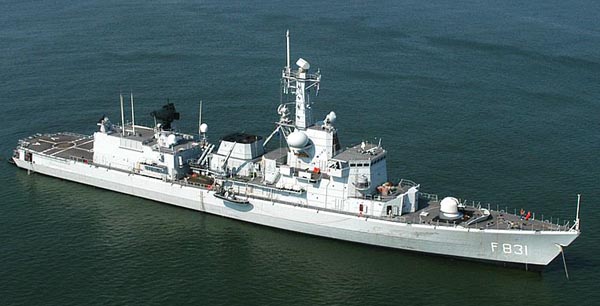
HMS Van Amstel, F831

This class was originally intended to replace the six elderly US-built frigates of the Roofdier class. Four ships were to have been built, and the design was essentially a scaled down version of the ‘Standard’ frigate, with a standard displacement of 1900t and a length overall of 111.8m (367ft). Intended to operate primarily in the North Sea, the ships were to be fitted for peacetime surveillance and fishery protection duty, but were to be capable of operating with the ‘Standard’ in the North Atlantic in the antisubmarine role.
With the completion of the ‘Standard’ construction programme there was a crisis at the De Schelde Shipyard, and in order to provide continuity of work the first batch was ordered three years earlier than planned. The contract was signed in June 1985, after the first hull had been laid down. Contracts for the weapons, electronics and command systems were placed later in the same year. A further four ships were ordered in April 1986 to replace the frigates of the Van Speyk class, which were retired early to finance the programme.
The final design is significantly larger, the lengthened stern section reflecting the decision to provide hangar/flight deck facilities for a helicopter larger than the current Westland Lynx (probably the NATO NH-90). To port of the hangar are vertical launch tubes for NATO Sea Sparrow, which have replaced the conventional eight-cell box launcher. Other changes reflect the lessons of the Falklands crisis and advances in electronics. In particular, the original DAISY computer bank has been superseded by a combat system based around a triple Ethernet based databus, which allows the physical distribution of — processors — and databases over the whole area of the ship, The sides of the hull and superstructure have been angled to maxmise radar discretion, and a passive ‘rudder-roll’ stabilisation system fitted in place of the traditional fins.
Otherwise, the ships reflect many of the original requirements. Three semi-rigid inflatables are carried for boarding ships and oil rigs, and there is accommodation for a detachment of thirty marines. Extensive automation has enabled the crew size to be reduced to 154 officers and men. The decision to order the ships earlier than planned has resulted in the hulls being ready in advance of much of their equipment.
Karel Doorman was completed with the less powerful Spey SM-1A gas turbine, and has run trials lacking the SMART 3-D radar, the US Argo APECS-II EW suite, and _ the Thomson-CSF DSBV 61 Anaconda towed array. She has an interim SEWACO VII A combat system and the integrated monitoring and control system (IMCS), which looks after propulsion, power generation, accommodation, and NBC facilities, has yet to be installed. The SMART radar ran trials on the Jan van Brakel of the Kortenaer class, and was installed only in 1992.
The first ship to have the APECS-II EW suite, the DSBV 61 towed array and the upgraded SEWACO VII B combat system was the fifth unit Abraham van der Hulst. These systems will eventually be retro-fitted to all ships. In 1987 the names were reshuffled, Van Speyk becoming the last ship; she retains her original pennant number.
Development
As seen above, the Kortenaer class were a replacement for existing, now quite old frigates, the Roofdier-class. The latter were obtained in 1954, as HMS Wolf, Fret, Hermelijn, Vos, Panther, Jaguar, built in the US under MDAP funding and similar to the Agile class multipurpose vessels of 1944, originally designed as minesweepers/escorts. They were 800 tonnes, only capable of 15 knots, armed with an antiquated 3-in gun and four to six 40 mm AA, eight 20 mm AA, one Hedgehog, 2 DCT and the very old Sonar QCU-2. In the 1970s this was WW2 tech. So there was an emergency at first to design a replacement, but the situation changed rapidly. The replacement frigate, to be built in the Netherlands, was approved by the RNLN leadership in 1977 under the project name “Noordzeefregat”. But in parallel, the Netherlands was engaged in another project since 1968, a NATO ASW Frigate, which extras could have been built in the meantime as replacement, just repurposed as AA frigates, the role intended to be filled by the Noordzeefregat.
However, it was decided of a compromise as the design was worked out between 1977 and 1982. What became the Karel Doorman-class frigates needed finalised design and requirements and if they borrowed many elements to the Kortenaer, ther latter were really tailored for a NATO standard, whereas the new Doorman were really tailored for Dutch needs.
The in-house design was done at the Royal Netherlands Nav, in close collaboration with De Schelde in Vlissingen and the design agency Nevesbu. For the first time, stealth technology was incorporated in the design, like the sloping walls of the bridge section. The French soon worked on the Lafayette probably because of this, but pushed stealth further. Still, the Dutch were pioneers in Europe for stealth technology.
The Germans also followed suite with their Brandenburg class, all these three classes entered service just as the Cold War has ended. Much attention was paid to the care and facilities for the crew, with more privacy and improved comfort in order to retain personal. This proved critical in the post-cold war years as the motivation was no longer there and recruitment was more difficult. Just like past ships like the Tromp class, automation played a crucial role to reduce personal and thus, benefited the crew of 154 as a whole, since the ships felt more spacious, comfortable, and had more amenities making life easier. The ships were also already though to integrate women as well and had a modular approach for the way living quarters were designed.
The Karel Doorman class were designed as true multi-purpose frigates, with an edge on A/S defence compared to the Korteaner, this was reflected by their armament reflects, perfectly able to engage threats of all nature, submarines, aircraft and surface vessels but also and mostly their electronics and sensors suite, far better at this multi-threat environment and management as well as a brand new CCS. The ships also were able to support anti-drug and piracy operations, a mission that took greater importance in the 1990s and especially 2000s.
First laid down was HNLMS Karel Doorman on 8 April 1975 at Koninklijke Schelde Groep, Vlissingen (Netherlands), and she was also the first launched in April 1988, commissioned by the Royal Netherlands Navy in May 1991, so technically man months before the official end of the cold war, which was on December 25, when the Supreme Soviet dissolves the Soviet Union. Karel Doorman was followed by Willem van der Zaan, Tjerk Hiddes, Van Amstel, Abraham van der Hulst, Van Nes, Van Galen, and Van Speijk, all named after admirals of the golden years of the Dutch Republic apart Karel Doorman, which sank a hero at the head of a squadron on his cruiser De Ruyter in the East Indies in WW2.
Even while under construction, Dutch authorities senses the Cold War was likely going to end and started to negotiate sales to foreign navies. But this early, that did not work, the Navy had to absorb the whole eight frigates in a budget-restricted era. Fortunately the Kortenaer were mostly sold, and in the end, six decommissioned Karel Doorman-class frigates, after only a big decade of service, were purchased by the Belgian, Chilean, and Portuguese navies. These sells financed the development of the Holland-class offshore patrol vessel (OPV), far better suited to the new requirements of the Dutch Navy in the 2000s. Their successors are the Damen Schelde Anti-Submarine Warfare Frigate design (ASWF) of the 2020s, much larger at 6,650 tons and 145 m (475 ft 9 in).
Design of the class
Hull and general design
The Karel Doorman class frigates were smaller than the Kortenaer and their AA Frigates derivatives, the Jacob van Heemskerck of 1983. They were smaller ships, designed as 2,800t standard and 3,200 tonnes fully loaded, 400 feet (122m), so shorter, narrower the Kortenaer and Heemskerck classes. The stealth incorporated in the design was still moderate in scope as they kept the same general outlook. To be precise, they measured 401 ft (122 m) overall for a beam of 47 ft (14 m) and draught of 20 ft (6.1 m).
Also called the “M class” Frigates, they were taller and more compact than previous ships, with a main gun on the bow deck, raised weapon system platform behind, a tall 4 deck bridge, a stepped mast structure aft, a funnel (with indirect exhaust using cool air injectors to decrease heat), a stepped down structure to support the quad Harpoon launchers, the aft radar mast, and hangar plus helideck. The hull shape introduced a stepped longitudinal shape to break radar waves, and the structures were sloped, but there was still clutter along the structure, so the stealth signature was still there, albeit equivalent to a smaller ship, not a frigate.
Powerplant
It was not much different from its predecessors, the Kortenaer and Hermskeerk: This was a CODOG-propulsion with a main powerplant using two 16,700 hp (12,500 kW) Rolls-Royce Spey 1A gas turbines (for the lead ship), 37,530 hp total for speed, and a combo of two 4,895 hp (3,650 kW) hp 2 Stork-Werkspoor-Wärtsilä 12SW 280V12 diesels for a total of 9,800 hp for range plus four Stork DRO 218K auxiliary diesel engines used as backup (6-cyl. 900 rpm 800 hp/634 KW each), powering the ship when cold, making for a grand total of 45,625 hp (by adding the auxiliary power) and a top speed, official and governed, of 30 knots (56 km/h; 35 mph). However, this was for the lead ship. The follow-up sisters were all equipped with the new Rolls-Royce Spey 1C gas turbines for a gain in power, 48,900 hp.
Armament

These multipurpose frigates were tailored like a synthesis of both the Kortenaer and Jacob van Heemskerck in a smaller package, to address the anti-submarine, anti-aircraft, or surface combat roles. For the A/S role they kept two quad RGM-84 Harpoon anti-ship launchers amidship with some close quarter engagement possible with the light OTO Melara 76 mm gun, doubling with the anti-air and anti-missile capabilities as well as naval bombardment, albeit the calibre had little effect.
Air defence comprised, outside the main gun, a combination with the AIM-7 Sparrow medium-range semi-active radar homing air-to-air missile (range 14 kilometres) not in a classic double quad canister mount, but instead, a sixteen VLS cell block mounted on the port external bulkhead of the hangar. The closer range was provided by the Goalkeeper close-in weapon system both for air and missile defence, with a 4000 rpm rate, all with 30-millimetre (1.2 in) rounds from 200 to 3,000 metres (660 to 9,840 ft).
The anti-submarine warfare suite comprised two twin torpedo launchers with Mark 46 torpedoes (same as the Kortenaer) and a single NH90 NFH or Westland Lynx helicopter, capable of carrying itself two Mk 46 torpedoes, a dipping sonar and forward-looking IR systems. The ships had their hull sonar and VDS to provide a first underwater picture.
Main Gun: OTO Melara 76/62 Compatto

The design called for a single OTO Melara 76 mm (3 in)/62 calibre naval gun in single mount forward. The OTO Melara 76/62 Compatto 76 mm gun fired a 6 kg (13 lb) shell to 8.6 nmi (15.9 km; 9.9 mi) in range and up to 85 degrees elevation. This lightweight, fast firing gun was designed and introduced in 1963 with a rounded turret, fully automated. It was capable of 85 rounds/min and of 16 km range, but later versions of the super Rapido could fire up to 40 km. This gun became standard in Europe as well, one of the bestseller of the 1970-80s. Magazine capacity was 80 ready rounds on Compatto gun mount.
⚙ specifications OTO 76/62 Compatto:
Weight 7.5 tonnes (17,000 lb), Barrel 62 caliber: 4,724.4 mm (186.00 in)
Elevation/Traverse
Loading system: Full auto. Muzzle velocity 915 m/s (3,000 ft/s), 85 rounds/min
Range HE-PFF 16,000 m, radar guided, remote control.
Round<: 76×636mmR 12.5 kgs (28 lb)oa/6.3 kgs (14 lb)/PPlt 2.35 kgs (5.2 lb), prox. fuse HE/Frag
CIWS: SGE-30 Goalkeeper
The seven-barreled SGE-30 Goalkeeper 30 mm (1.2 in) close-in weapons system (CIWS) installed on top of the hangar aft is capable of a 2 km (1.2 mi) range, usable mostly against incoming missiles.
⚙ specifications Goalkeeper CIWS
Weight 9,902 kg (21,830 lb) total, 6,372 kg (14,048 lb) gun alone.
Barrel lenght3.71 m above deck, total 6.2 m over and under deck.
Elevation/Traverse +85 to −25° (80 degree/s)
Loading system Automated 7-barrel feed, 1,190 rds of ammunition above deck
Muzzle velocity 1,109 m/s (MPDS round)
Range 350-1,500/2,000 metres dependent on ammunition
Guidance Radar guided, full auto tracking
Crew: Automated, with human oversight
Round 1.2 in or 30×173mm TP, HEI, MPDS, or FMPDS
ate of Fire 7-barrel rotary cannon GAU-8/A Avenger, 70 rps/4,200 rpm
Harpoon Missiles
Two quad launchers for Harpoon anti-ship missiles mounted amidship, with quad canisters facing both sides, unarmoured. They formed the primary line of defence against ships, with the longest reach of all three weapons systems, 140 km. This was also a brand new weapons system, in service by 1977 and installed in their early years. Block I of course. Each missile was capable of travelling 70 nmi (130 km; 81 mi) at Mach 0.9 carrying a 227 kg (500 lb) warhead.
⚙ specifications RGM-84 Harpoon Block I
Weight 1,523 lb (691 kg) including booster
Dimensions 15 ft x 13.5 in (4.6 m x 34 cm), wp 3 ft (0.91 m)
Propulsion Teledyne CAE J402 turbojet/solid propellant booster, 600 lbf (2,700 N) thrust
Speed 537 mph (864 km/h; 240 m/s; Mach 0.71) Range 75 nmi (139 km)
Guidance Radar altimeter, active radar terminal homing
Ceiling: Sea Skimming. Payload: HE warhead

Sea SparrowSAM
These ships were the first to introduce a VLS (Vertical Launch System) instead of the good old Mark 29 octuple launcher Sea Sparrow missile (24 in reserve, reloaded vertically) like the two previous classes. The VLS is capable of launching all 16 missiles in short order, with a better guidance enabling mutiple kills instead of the 1970s system, one channel (one radar) guiding a single missile to target by riding a beam. The Sea Sparrow had a range of 8 nmi (15 km; 9.2 mi), Mach 2.5 with a 30 kg (66 lb) warhead. This is a short range AA defence system. It was developed by Raytheon and General Dynamics. Mach 4 compensated for the Short Range.
⚙ specifications RIM-7 Sea Sparrow
Weight 510 lb (230 kg), dimensions 12 ft x 8 in (3.7 m x 20 cm) wp 3 ft 4 in (1.02 m)
Propulsion Hercules MK-58 solid-propellant rocket motor
Speed 4,256 km/h (2,645 mph) Ceiling 10 nmi (19 km)
PayloadAnnular blast fragmentation warhead, 90 lb (41 kg)*
*Proximity fuzed, expanding rod, with a 27 ft (8.2 m) kill radius
Torpedo Tubes
The frigates were equipped with two twin-mounted Mk 32 324 mm (13 in) torpedo tubes like in all previous classes. They are used to fire the Mk 46 Mod 5 acoustic torpedoes for close range (5.9 nmi; 10.9 km; 6.8 mi) ASW defence, at 40 knots (74 km/h; 46 mph) with a 44 kg (97 lb) warhead.
Sensors
This varied between ships:
F827, the lead ship, had the type 1007, Scout, LW-08, two STIR-18, Goalkeeper radars, PHS-36 sonar, AR700 ECM suite, two Mk 36 SRBOC decoy RL, SLQ-25 Nixie torpedo decoy and the SEWACO VIIA CCS. The second in class, F829 only changed by its SEWACO VIIB CCS, whereas the next F830, 831 had the SMART-S radar, and with F828, and fril 832 to 834 added the DSBV-61 Anaconda sonars, but also two APECS II ECM suites.
Radars
-Thales LW08 long-range surveillance radar
-Thales Smart-S Mk.1 long-range 3D surveillance and tracking radar
-Thales LW08 long-range surveillance radar
-Thales SeaWatcher 100 active phased array surface detection and tracking radar (NLD and BE ships only)
-Thales GateKeeper Electro-optical 360° surveillance system (NLD and BE ships only)
-Thales STIR 1.8 Tracking and Illumination Radar system
-Thales Scout surface surveillance and tactical navigation radar
Sonars
-Thales PHS-36 hull-mounted sonar
-Thales Anaconda DSBV 61 VLF passive tactical towed array sonar (VDS)
Active Protection
Thales Vigile APX Radar electronic support measures or AR700 ECM suite
Mark 36 SRBOC: Tow launchers of decoys
SLQ-25 Nixie torpedo decoy: Anti-torpeod system also built in the Netherlands under licence


Air Group

Both operated two SH-14D Sea Lynx as well as the NH90. It seems the former was preferred. The Royal Netherlands Navy’s as part of its Naval Aviation Service operated 24 Lynx over 36 years. They entering service at the same time as the Tromp class in 1976 phased out in 2012 (replaced by the EH-101). They were used for SAR, transport and ASW/ASUW, special forces tasks. They flew from the aft helideck of the Tromp class and had a hangar just large enough for maintenance. In 1993, this Lynx fleet was upgraded to the common Lynx SH-14D standard. One was lost in 1999 due to a rotor-head issue. All were temporarily grounded until retrofitted with new titanium rotor-heads.
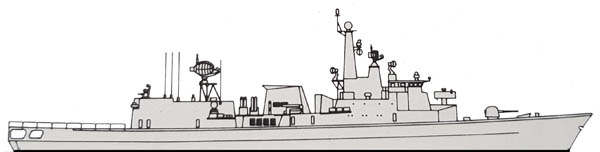
⚙ specifications |
|
| Displacement | 2,800 tons standard, 3,320 tons full load. |
| Dimensions | 122 x 14 x 6.1 m (401 x 47 x 20 ft) |
| Propulsion | CODOG, 2x RR Spey 1A gas turbines, 2 × Stork-Werkspoor 12SW280+ 4 Stork DRO 218K diesels |
| Speed | 30 knots max, 20 knots cruise |
| Range | c5000 nm at 18 knots |
| Armament | OTO-Melara 76 mm/62, Goalkeeper CIWS, 2×2 Mk46 TTs, 2×4 RGM-84 Harpoon, 1× 8 Sea Sparrow |
| Sensors | Type 1007, Scout, LW-08, STIR-18, HS-36 sonar. |
| Protection | AR700 ECM suite, Mk 36 SRBOC, SLQ-25 Nixie, SEWACO VIIA CCS |
| Air Group | 2× NH-90/Lynx helicopters |
| Crew | 154 |
Modernization

M-Klass Fregat (pinterest)
In 1992, Karel Doorman and Willem van der Zaan received the new SMART-S radar, which was standard at completion for the others. Later in the 1990s, Karel Doorman, Willem van der Zaan, Tjerk Hiddes, and Van Amstel received two APECS-II ECM suites. In 2004, all saw the removal and replacement of their 20mm/70 Oerlikon guns for Browning 50 cal. (12.7mm/90) heavy machine guns, shelving some weight.
In 2010 Van Speijk entered the upgrade program (called ‘IPM’) fitted with new mast section with Seastar (small target radar system), Gatekeeper, as well as a new combat computer system, Linux based, new computer networks, communication equipment, enlarged helicopter deck to for the NH90 NFH helicopter. Visually, she had a bigger mast custom-built by the Navy’s maintenance establishment, ‘Marinebedrijf’. HNLMS Van Speijk was the first of four ships to get this update also ported on the Belgian ships. A new towed sonar was latter added during their maintenance period, to replace the older TACTAS towed array system. In 2012, Van Speijk swapped her SH-14D Sea Lynx for the NH 90. Her DSBV-61 Anaconda sonar and SEWACO VIIB CCS were replaced by a Gatekeeper e/o system, IRFLAS sonar, and the new SEWACO XI CCS. in 2014, Van Amstel also had the same helicopter swap, as well as its SEWACO VIIB CCS replaced by the SEWACO XI, and same as above.
The M class in service
 Karel Doorman (ex-Groningen) F827

Karel Doorman (Schout-bij-nacht Karel Doorman) was laid down as N°364 at KM De Schelde, Vlissingen on 26.2.1985, launched on 20.4.1988 and completed on 31.5.1991. Lead ship of the “M-fregat” class, third ship of that name Admiral Karel Doorman, killed during the Battle of the Java Sea, she was later attributed the motto “Audaces Fortuna Juvat” in Belgian service. She took part in anti-drug operations in the Caribbean together with the US Navy, then UN operations in the Adriatic Sea following the breakup and war between former republics of Yugoslavia, plus many NATO exercises. She was resold to Belgium as Leopold I in December 2005 after 14 years service in Dutch colours.
Willem van der Zaan (ex-Friesland) F829

Willem van der Zaan was ordered as N°365 at KM De Schelde, Vlissingen, laid down on 6.11.1985, launched on 21.1.1989 and commissioned on 28.11.1991. She was the second of the two frigates of this class purchased y Belgium on 22 December 2005 as Louise-Marie. As HNLMS Willem van der Zaan (F829), named after the 17th-century Dutch Rear Admiral Willem van der Zaen she sailed approximately one million nautical miles in 15 years of service. Some of the duties it has performed include: Assistance in the restoration of democracy in Haiti in 1994; Relief efforts after Hurricane Mitch on Saba and Hurricane George in Honduras in 1998; Patrols in the Mediterranean during Operation Active Endeavour after the September 11, 2001, attacks; Anti-drug operations in the Netherlands Antilles-Suriname area, where large quantities of cocaine were seized.
Tjerk Hiddes (ex-Utrecht) F830

Tjerk Hiddes was ordered as N°366 at KM De Schelde, Vlissingen, laid down on 28.10.1986, launched on 9.12.1989 and commissioned on 26.2.1993. In June 1994 she took part in the BALTOPS 94 naval exercise with vessels from several other navies. She operated in the Atlantic Ocean and Caribbean Sea, took part notably in Operation Enduring Freedom around the Arabian Peninsula and Operation Active Endeavour in the Mediterranean Sea. On 3 February 2006 she was decommissioned and sold to the Chilean Navy as Almirante Riveros, still active today.
Van Amstel F831

Van Amstel was ordered as N°367 at KM De Schelde, Vlissingen, laid down on 3.5.1988, launched on 19.5.1990 and commissioned on 27.5.1993. In 1995, she assisted in the response after Hurricane Luis at Sint Maarten, Netherlands Antilles (West Indies). She was deployed in a multinational force in the Oman Sea in 2001/2002 for Operation Enduring Freedom. In September 2005 she assisted in the Dutch response to Hurricane Katrina, sending sailors ashore to southern Mississippi, distributing aid supplies to hurricane victims with Mexican marines, USN sailors and US Marines.
On 11 May 2012, Van Amstel caught 11 Somali pirates detected by her Lynx helicopter, spotting a suspicious fishing dhow towing two skiffs, 400 nautical miles off the Somali coast. Skiffs were launched, the boarding team captured 11 suspected pirates and 17 hostages on board. Significant evidence linked the 11 men to an armed attack on the tanker “Super Lady” a few days prior. The 17 hostages were freed, and the pirates placed in detention. In 2016, Van Amstel joined Standing NATO Maritime Group 2 and rescued migrants in the Mediterranean.
In April 2017, Van Amstel seized nearly 700 kilograms (1,500 lb) of cocaine in two separate drug busts between Curaçao and Colombia.
From 26 June to 6 July 2018, Van Amstel took part in the international Exercise Dynamic Mongoose 2018.
In May 2022, Van Amstel took part in the Mjølner exercise off Andøy Island, Norway.
On 9 October 2022, Van Amstel and HNLMS De Zeven Provinciën conducted drills with the aircraft carrier USS Gerald R. Ford.
In June 2025 Van Amstel and HNLMS De Ruyter took part in the international maritime combat exercise Polaris. More to come in the next years.
Abraham van der Hulst F832

Abraham van der Hulst was ordered as N°368 from KM De Schelde, Vlissingen, laid down on 8.2.1989, launched on 7.9.1991 and commissioned on 15.12.1993.
On 13 February 1998 while off Corsica as part of the NATO squadron STANAVFORMED she was ordered to sail at full speed to the Suez Canal and enter the Persian Gulf to join a UN operation to enforce a trade embargo on Iraq, an operation lasting until 31 May that year. Next she was sent to Eritrea to assist with the evacuation of European citizens as the civil war raged on.
After 9/11 she was deployed to the Caribbean in 2002, to assist in US counter narcotics’ operation, and replacing some US Coast Guard units, deployed abroad to Operation Enduring Freedom.
In 2003, she took part herself in Operation Active Endeavour, as flagship op STANAVFORMED. Her last operational mission with the Koninklijke Marine, was to protect US cargo vessels sailing through the Strait of Gibraltar, on their way to the Persian Gulf by 2003. Her last foreign port of call was Lisbon, before she returned to Den Helder and prepared for transfer. She was sold to Chile on March 2004 as Blanco Encalada, still in service today.
Van Nes F833

Van Nes was ordered as N°369 at KM De Schelde, Vlissingen, laid down on 10.1.1990, launched on 16.5.1992 and commissioned on 24.6.1994. She was named after Aert Jansse van Nes, a 1600s naval commander. She served in the NATO squadron STANAVFORLANT from 9 October to 31 December 1999 and again in 2001. She also took part in Operation Enduring Freedom around the Arabian Peninsula.
She was sold to Portugal in January 2009 as Bartolomeu Dias, still in service today.
Van Galen F834

Van Galen was ordered as N°370 at KM De Schelde, Vlissingen, laid down on 7.6.1990, launched on 21.11.1992 and commissioned on 1.12.1994. She was named after captain and convoy commander Johan van Galen and served from 1994 to 2008 with the Dutch navy (radio call sign “PAMG”). In 2002, she participated in Operation Enduring Freedom for six months. No more logs. In November 2009 HNLMS Van Galen was sold to Portugal, transferred in 2010 and in service as NRP Dom Francisco de Almeida (F334).
Van Speijk F828

Van Speijk was ordered as N°371 at KM De Schelde, Vlissingen, laid down on 1.10.1991, launched on 26.3.1994 and commissioned on 7.9.1995. She was the seventh ship in the Royal Netherlands Navy named after Jan van Speijk, a hero of the Belgian Revolution, blowing up his ship rather than let it fall into Belgian hands. In 2005, Dutch Clubland music artist Candee Jay filmed “Back For Me” on board. On 22 December 2017 she was a stationed ship in the Caribbean part of the Netherlands, intercepting drug smugglers with 500 kilograms (1,100 lb) of cocaine. On 31 December 2017 to 1st Jan. 2018 she intercepted 1,600 kilograms (3,500 lb) of cocaine in a sweep in the Caribbean. In 2010-2013 she was upgraded. She was laid up from summer 2021 due to staff shortage, then mothballed, anchored at the Nieuwe Haven Naval Base. By late 2024 it was decided to reactivate her, modernizing her to be back into service in 2026, courtesy of the war with Ukraine. Before entering service a thorough maintenance is also ongoing in all departments, from electrical systems to powerplant, to make her ready again, but specialized in anti-submarine warfare.
Exports
 Blanco Encalada class Frigate (2004)

In 2004, Tjerk Hiddes and Abraham van der Hulst were sold to Chile and renamed Almirante Riveros (FF-18) and Blanco Encalada (FF-15) respectively. Blanco Encalada commissioned into the Chilean Navy on 16 December 2005, with Almirante Riveros commissioned in April 2007. They are still in service today.
 Leopold I class Frigate (2005)
Leopold I, Louise-Marie
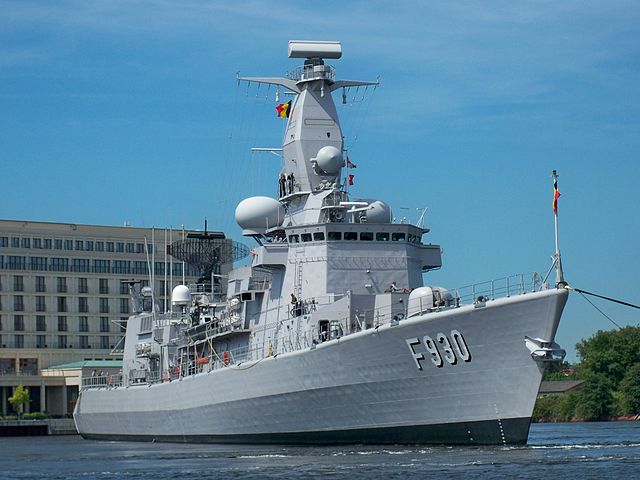
The Belgian Frigate Leopold I (F930). The second one is Louise-Marie (F931), also transferred in 2005 and currently in active service. They were the first two of the Doorman class, dating back 1991.
These were two ex-Karel Doorman class Frigates, completed in 1991 at KM De Schelde, Vlissingen, acquired in 2005 and in service since:
Leopold I was the ex-Karel Doorman, class lead (F930/364), 26.2.1985/20.4.1988/31.5.1991 > 22.12.2005.
Louise-Marie (ex-Willem van der Zaan) (F931/365) 6.11.1985/21.1.1989/28.11.1991 > 22.12.2005.
They were modernized: In 2008, Leopold I and in 2010, Louise-Marie had their Sea Lynx helicopter replaced by a NH90 helicopter, and the helipade was stretched and reinforced, fill lenght now 124.3m. In 2013, Leopold I, and in 2015, Louise-Marie saw the installation of a Seastar radar, APX Vigile ECM suite, SEWACO XI CCS to replace their AR700 ECM suite and SEWACO VIIA CCS.
 Bartolomeu Dias class Frigate (2006)

n the 2000s negociations led to the purchase of two-ex Karel Doorman class Frigates. In May 2006, indeed Portugal’s MoD under Luís Amado, showed interest in buying two Karel Doorman-class frigates and replaced two old João Belo class instead of two frigates Oliver Hazard Perry offered by the United States. A committee arrived in the Netherlands to evaluate the condition of two existing frigates to be bought. On 1 November 2006 MoD Nuno Severiano Teixeira signed a contract for the purchase of Van Nes and Van Galen. The first was transferred on 16 January 2009 and the second on 15 January 2010.
Read More/Src

Books
Baker, A. D., ed. (1998). The Naval Institute Guide to Combat Fleets of the World 1998–1999. NIP
Friedman, Norman (1997). The Naval Institute Guide to World Naval Weapon Systems 1997–1998. NIP
Gardiner, Robert; Chumbley, Stephen, eds. (1995). Conway’s All The World’s Fighting Ships 1947–1995. NIP
Moore, John, ed. (1979). Jane’s Fighting Ships 1979–80. London: Jane’s Yearbooks.
Saunders, Stephen, ed. (2002). Jane’s Fighting Ships 2002–2003. Coulsdon, UK: Jane’s Information Group.
Links
navypedia.org/
on navalanalyses.com/
damen.com/ custom built combatants m-frigates
navaltoday.com
weaponsystems.net
naval-technology.com
skylineships.com stork-werkspoor auxiliary engine/
en.wikipedia.org/ Karel_Doorman
seaforces.org Doorman-class.htm