
 Royal Navy, Type 81 or Tribal-class frigates:
7 ordered, 7 completed, service 1961-2000: Ashanti, Nubian, Gurkha, Eskimo, Tartar, Mohawk, Zulu F117, 131, 122, 119, 133, 125, 124.
The British tradition of naming warships after tribes and peoples of the Empire and beyond, already sported by pre-WW1 British destroyers and 1937 Destroyers, was resurrected once last time with a series of versatile frigates that were the sum of all the lesson learned with previous 1950s classes. In contrast to the next Leander class, the Type 81 Frigates of the Royal Navy however were not among the best.
The Type 81 were ordered and built originally as sloops to replaced the WW2 legacy Black Swan and Loch-class frigates, specifically tailored for the Persian Gulf. However after completion all seven Tribals were reclassified as “second-class, general-purpose frigates” to make for frigate numbers. After the policy of ceasing any presence “East of Suez” in 1971, the Tribals remained with NATO North Atlantic command, with only update the addition of Seacat missiles in 1977. Their single propeller and low speed of 24 knots were not ideal characteristics. In 1979–80 they were transferred to stand-by squadrons, and three reactivated for the Falklands War for training in the West Indies.
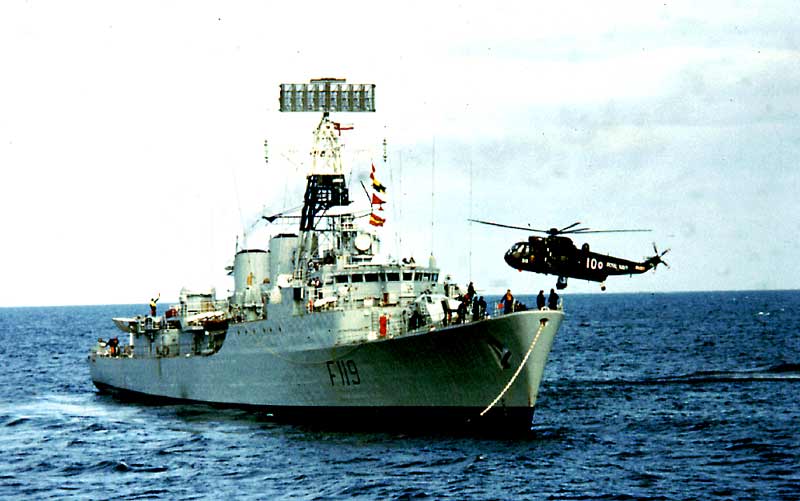
HMS Eskimo in 1975
Development
The Tribals were planned and designed in the 1950s due to the increasing cost of single-role vessels like the Type 14s. They were from the start truly designed as “multi-role” yet light, and specifically to retake the old Imperial colonial gunboat duties, notably specifically for the Middle East, a vital area not only for the control of Suez and for the British oil reserves. They were thought of as “self-contained warships” with weapon and sensor systems to cover any possible threats, albeit “low intensity” unlike ships designed to face NATO standard of Soviet threats. Not only that, but they also had from the start air conditioning and all measures to protect the crew from the heat so they were “tropicalized” for extended deployments. They were the first with modern habitability features and notably bunk accommodation instead of hammocks for example.
The other point was they were made on a budget, not to hunt down Soviet submarines, but for just going from point A to point B in local deployments. However, if they were fitted out with a gas turbine boost engines, the idea was to instantly leave port or a naval base in an event of a nuclear war, rather than rapid deployment to a crisis area. However, the result was the same, it avoid to wait typically 4-6 hours flashing up steam boilers. The choice of a single unit went with a single shaft for economic measures (it was argued as well that a single prop meant less drag), and agility was not a priority. In operation the G6 gas turbine proved reliable and used to leave port during their career, paving the way for gas generalized turbine propulsion in the RN and that was perhaps the best contribution of the class.
Another sticking point of the design was they were the first designed from the start to operate a helicopter.
As for sensors, they were the first “small escort” operating a long-range air search radar, the Type 965 and its ‘rake’ AKE-1 antenna.
However, on the other hand, cut-saving measures showed up still: Their two QF 4.5-in (113 mm) Mark 5 guns were salvaged from scrapped WW2 destroyers. The barrels were given a new liner and their mountings were refurbished with Remote Power Control (RPC) operation but still needed required manual loading and the turret’s back was still exposed. In other terms, this was not an NBC armament. To operate in such environements, the gun servants needed full individual NBC proof suites, which did help smooth operations…
The original armament comprised twin 4-inch (102 mm) on WW2 mounts plus two twin 3-inch (76 mm) 70 calibre mounts (US pattern), but the two main gun turrets weighted 256t combined and this was judged way too heavy. They ultimately received a lighter automatic gun fit. The N(R) single automatic 4-inch guns were the same as on Chile’s Almirante-class destroyer, but this required to stretched out the hull by 10 ft (3 m) and just like the twin 3-in/70s, judged too expensive.
The stretching up of the hull during development to fit this armament had another consequences, reaching a 3000-ton displacement, that exceeded the limit the UK Treasury imposed for a sloop or frigate design in 1960. The automatic guns were thus ditched out, despite they answered adequately the RN AA/DP gun requirement. There were also questions of cost for developing stocks and logistic support, as they would have used new types of ammunition and overall their utility against post-1962 jets or missiles was questionable at best.
For the start however, they had been designed to carry the GWS-21 Seacat anti-aircraft missile system as a modern point defence system to deal with Jets and large missiles. However, development took time and they were not fitted before the mid-1970s. So in between, all except Zulu only had a single Mark 7 40 mm Bofors gun as a provisional measure. Their seacats, where installed, were left over from Battle-class destroyers and the County-class destroyer refits.
Back to the powerplant, and the tribals were the first designed to use combined power sources, something already trialled in 1930s on the minelayer HMS Adventure. They were initially to be fitted with a combination of steam and gas turbine, the “Combined Steam and Gas” (COSAG), giving the advantage of a rapid start-up and acceleration thanks to the gas turbine engine, but the range was obtained through steam turbines for cruising efficiency and reliability. They could in addition use all three for top speed all combined to an electric gearbox through generators in order to drive a single shaft with flexibility in operations.
The issue of being single-shaft was known to greatly restrict their manoeuvrability as well as acceleration and deceleration, however, a tradeoff given their “gunboat” role in overseas stations. But after the “East of Suez” their reallocation to the Atlantic proved this limitations, notably in the Cod Wars of the 1970s, where their single screw prevented effective manoeuvres notably in ramming situations against Icelandic coast guard cutters.
The other criticism concerned the helipad: This was on paper a great capability to have, but again, self-imposed tonnage limited for budgetary reasons resulted in a cramped and awkward helipad. It was barely good enough in tropical waters, but in the North Atlantic later, it was almost impossible to handle landings, they were down right dangerous, as exposed in the 1976 Cod War. In addition, they could only operate light helicopters, with limited range, capabilities and payload. This imposed modifications on the Rothesay-class frigates, where the Tribals received none and spent more time in reserve by the early 1980s.
Design of the class
Hull and general design

The Tribal class were initially, if their planned armament was installed, close to 3,000 long tons standard, so it was shelved to decrease when completed down to 2,300 long tons (2,300 t) standard and 2,700 long tons (2,700 t) full load. In dimensions, they reached 360 ft (109.73 m) overall and 350 ft (106.68 m) between perpendiculars for a beam of 42 ft 3 in (12.88 m) and a draught of 13 ft 3 in (4.04 m) or 17 ft 6 in (5.33 m) taking in account the propeller.
As for their outlook, they were quite different from earlier designs, with some superficial resemblance to the Rothesay class. Indeed, unlike most frigate designs, the hull was tall and flush deck all the way from the stern to stem, with a clipper bow and some flare, a rise in the foredeck, then the typical beam-wide structure, with a low bridge above, including the typical advanced helmsman position. The structure went aft supporting in succession the main fure control system for the gunnery, a gunnery radar on a short mast support and a single derrick mainmast, which supported the main aerial and others radars and antennae. Next came the two raked funnels exhausting the two steam turbines and single gas turbine.
The Bofors (and later Seacats) were located abaft the mainmast, on the beam-wide structure deck, then came two utility boats, and the aft deck structure, including the ASW mortar and ending with the small helideck. Next came the aft main gun. The hull had two cut counter keels, with stabilization planes installed admiships. The propeller was 6-bladed, supported b a single strut, and there was a small rudder aft of it. Transom stern with flat back section.
Powerplant

The design was innovative as being COSAG, ensuring a soft transition and flexibility. They combined indeed with the single-shaft COSAG for a fixed pitch 6-bladed propeller a single Steam turbine rated for 12,500 shp (9,300 kW) and a single Metrovick G-6 gas turbine 7,500 shp (5,600 kW). Providers varied from them, Vickers-Armstrong (Engineers) Ltd, Barrow-in-Furness provided the steam turbine and either Associated Electrical Industries Ltd, Manchester or Parsons Marine Turbine Co Ltd, Wallsend-on-Tyne for the gas turbines and associated gearing and transmission.
The combined gas turbine and steam turbines provided a total of 20,000 hp combined, enough for 27 knots (50 km/h; 31 mph). The range was relatively good at 4,500 nautical miles (8,300 km; 5,200 mi) at 12 knots (22 km/h; 14 mph).
Armament
QF Mk. V mod 1 4.45-inch (113 mm)
 The gun itself was designed from 1936 and operational in 1938. The one chosen for weight reason was a single tube masked gun (rear-open turret) with manual operations exposing the crew to the elements. More a problem in the north Atlantic, less in the Tribals initial posting. But they looked very outdated in 1960, more so in 1970, crying out loud “budget restrictions”. Still, they had a punch against surface targets but were useless in an AA role even with the HA mount and radar assistance.
Specs:
Fixed or Separate QF 640–645 mm R 55 pounds (24.9 kg) shell.
Vertical sliding block 0° to +80° for 16 RPM on Mk III UD mount.
Muzzle velocity 2,449 ft/s (746 m/s), range 20,750 yd (18,970 m) at 2,449 ft/s (746 m/s), ceiling 41,000 ft (12,500 m).
40mm Mark 7 Bofors
No STAG mount but instead, while waiting for sea cat missiles two single mounts with the trusted Mark 7 mounted was added, wer installed, located abaft the derrick mainmast.
This rock-solid WW2 proven system was gravity fed, manually, with 40×311mmR 0.9 kg (2 lb 0 oz) 40 mm (1.57 in) rounds.
It used automatic extraction and integrated cam-operated recoil powered autoloader and a vertical sliding-wedge breech.
Each mount weighted 522 kg (1,151 lb), far less than a STAG mount and could elevate to +90° at 55°/s for 120-140 rounds/min at 850–880 m/s (2,800–2,900 ft/s) and 7,160 m (7,830 yd).
They were radar guided thanks to the GWS-21 system also working later for the Seacat.
Sea Cat SAM (1970s)
 The Seacat was a short-range surface-to-air missile designed by Short and in service in 1962, so County class ships in construction could be completed by two systems installed on the broadside, each with four missiles. They were light enough to be reloaded by hand. Contrary to the Sea slug they enjoyed a considerable export success.
Specs
Missile length : 1480 mm (58,29 inch)
Wing span : 650 mm (25,6 inch)
Body diameter motor : 191 mm (7,62 inch)
Missile weight : 62,71 kg (138,25 Lb)
Weight continuous rod warhead : 13,83 kg (30,65 Lb)
Operational range : 500 to 5000 mtrs
Speed : Mach 0,8 (272,24 mtrs/sec).
Operational oil pressure on steering cilinders during flight : between 79 and 103 Bar (1150 to 1500 lbf/ in2)
Guidance system : CLOS (Command Line Of Sight) and radio link
Triple 12-in Limbo Mk 10 ASWRL
The ASW defence was located aft of the twin funnels, close to the helipad.
Developed in 1950 as replacement for the Squid, the Limbo became widespread, also fitted to the Australian Daring class DDs, updated cold war River class frigates, RCN destroyers, and SAF President class Frigates. The mounts could traverse fully, the three mortars could be angled up and down and fire a 12 inches (30 cm) 400 lb depth charge from 400 yards (366 m) to 1,000 yards (914 m). The 94 kilograms (207 lb) Minol Warhead could use both proximity and/or time fuse. The whole system was slaved to the Type 170 sonar for traverse and bearing to gain reaction time. It created a pattern of three explosive charges roughly around the expected target location, creating a combined pressure wave with devastating effects. The Limbo remained active until the 1980s.
Sensors
Radar type 965 air-search
Radar type 993 low-angle search
Radar type 978 navigation
Radar type 903 gunnery fire-control
Radar type 262 GWS-21 fire-control
Sonar type 177 search
Sonar type 170 attack
Sonar type 162 bottom profiling
Sonar type 199 variable-depth*
Type 965 Air search Radar
The Type 965 (AKE-2) was caracteristic, with its large “double bedstead” antenna. The Type 982M radar had the smaller “hayrake” antenna.
Type 978 Navigation Radar
Type 978 was operating in X band surface warning and navigation radar for British destroyers and frigates. This radar replaced the earlier Type 277Q. Later it was also replaced by Type 1006.
The antenna ATZ is a 6 feet wide double-cheese, the upper for transmission, the lower for reception. The speed of rotation depends on the feed with either 50 or 60 Hz mains voltage.
frequency: 9,410 MHz. PRF: 1 000 or 2 000 Hz
pulsewidth (τ): 1 µs or 0.2 µs
Instrumented range: 40 NM (≙ 74 km)
range resolution:< 46 m
accuracy: 2%
antenna rotation: 20 or 24 min⁻¹
Type 903 Gunnery FCR
Type 903 was operating in X band naval fire control radar using a conical scan.
The antenna was a symmetrical parabolic reflector with a diameter of 4 feet (120 cm) fed by a Cutler-feed. The antenna was mounted to the gunnery director and moving with it.
frequency: 8,500-9,600 MHz
pulse repetition frequency: 3000 Hz
pulsewidth (τ): 0.1 µs
peak power: 50 kW
Instrumented range: 15 NM (≙ 28 km)
Type 262 GWS-1 FCR
Type 262 is operating in the X band naval fire control radar for 40 mm anti-aircraft gunnery or for “Sea Cat” close-range surface-to-air missiles. It was developed in 1958.
The antenna used the principle of conical scan with a fixed feeding point but with slightly eccentric rotating parabolic reflector.
frequency: 9.67 GHz
pulse repetition frequency (PRF): 1.5 kHz
pulsewidth (τ): 0.5 µs
peak power: 30 kW
instrumented range: 29 NM (≙ 54 km)
beamwidth: 5.2°
GWS 20
The Seacat missile system installed used the GWS 20 optically guided system shared with the modernized Rothesay-class frigates.
Sonar suite: Type 177 search sonar+ 170 attack sonar
The first was a Medium range passive search sonar. The second was introduced in 1950, fitted under a dome that was tear-dropped shaped. Inside was a double faced oscillator that could be rotated electrically, and either face of the oscillator could be shut off from the sonar control room. Frequency range 14 to 22 Kcs.
Type 162 Cockchafer bottom profiling sonar
side-looking and bottom-scanning shipboard sonar. Classifies objects at mid-depth and on the sea floor, the three transducers working together to provide a profile of the area surrounding the ship. The starboard and port transducers look to the sides, and the centre transducer looks downward.
Type 199 variable depth sonar
Only installed on Ashanti and Gurkha. Initially a Canadian designation, of the AN/SQS-504 diver VDS. Usable from speeds of 15 to 20 knots (28 to 37 km/h; 17 to 23 mph).
Active Protection
UA-8/9 ECM suite. No data.
Two Corvus decoy RL: Cylindrical rotating structure that carries eight launching tubes mounted in two sets of three (one above the other) and crossed at 90° in azimuth. Two further tubes are set above this arrangement and are aligned midway between the other tubes, all at a fixed elevation of 30°. A deck-mounted pedestal supports the rotating structure on its training bearing and houses a self-contained electrical power conversion unit for the control circuits and associated electrical equipment. The training drive consists of a gearbox driven by a reversible motor.
Air Group

Westland Wasp HAS.1 helicopter of 829 Naval Air Squadron in 1967.
The innovation in the design was the presence of a small (quite cramped) rooftop helipad located aft, close to the “X” gun turret, and sandwiched between it and the ASW mortar.
There was no hangar, thus the helicopter needed to be solidly strapped under waterproof canvas when not in use. Not an issue in tropical waters, but a problem later in their career.
They carried the Wasp Helicopter, a lightweight piston-powered model just developed and usable as scout mostly (first flight 1962). It was developed from the Saro P.531 to fit on small ships such as frigates and destroyers. It was limited to 104 kn (120 mph, 193 km/h) and a range of 263 nmi (303 mi, 487 km) but could carry a large payload of armaments and carry four personal. In ASW role the Wasp could carry two Mk.44 or a single Mk.46 acoustic torpedo or two Mk.11 depth charges, or even a WE.177 600lb tactical nuclear depth bomb. In an antiship role, it could also carry four SS.11 or two larger AS.12 missiles. The ARA Santa Fe was sunk by those missiles in 1982.

Author’s rendition of the type 81, HMS Tartar
⚙ Type 81 specifications |
|
| Displacement | 2,300 long tons (2,300 t) standard, 2,700 long tons (2,700 t) full load |
| Dimensions | 360 ft x 42 ft 3 in x 13 ft 3 in (109.73 x 12.88 x 4.04 m) |
| Propulsion | Single-shaft COSAG, Steam turbine 12,500 shp, Metrovick G-6 gas turbine 7,500 shp |
| Speed | 27 knots (50 km/h; 31 mph) |
| Range | 4,500 nautical miles at 12 knots |
| Armament | 2× QF 4.5 inch Mk 5*, 2× Mark 7 40 mm Bofors (2×4 GWS-20 Seacat*), 2× 20 mm Oerlikon, Mark 10 Limbo ASWRL |
| Air Group | Helipad, Westland Wasp helicopter (No Hangar) |
| Sensors | Radars type 965, 993, 978, 903, 262, Sonars type 177, 170, 162, 199 VDS* |
| Crew | 253 |
Overall Shortcomings and Service
Despite all the limitations and specialization they were built with, the Tribals cost only escalated above the ones initially envisaged, so the initial plan of twenty was cancelled after the first batch of seven once completed. In fact the treasury wanted t pull the plug after the fourth ships even, only prevented by penalties for cancellation due to contractual commitments of the Royal Navy for the supply of complex engines and machinery on eight frigates, lawyers from Rolls-Royce were indeed hard at work ensuring all seven ships of the first contract would be built.
In the end the RN ended with relatively small, at 360 ft (110 m) ships due to the initial self-inflicted tonnage control, while made versatile, but this reduced options for later modernizations and upgrades quite severely, they were already at the limit of top heaviness, which by the time of their development was a critical issue for her main armament. The Type 84 was an utterly compromised design, and on top of this, the single-shaft propulsion was certainly not an advanced other than their initial, restrictive environment, that was ended in 1971.
The class was however generally regarded by the RN as “good enough warship” despite having outdated guns (the crew nickamed them the “guided flagpoles”) yet still capable of 18 rounds per minute for two minutes. The class also overall proved the usefulness of a general purpose frigate concept, as well as the advantages of gas turbine propulsion. Still, final unit cost in 1963-64 was £500,000 mat completion, which ended more than the first eight next Leanders. Ashanti, completed in 1961 was the costliest of all, notably due to inflation and this stopped all prospects of more being built, certainly not the twenty-three initially planned.
Thus, next RN frigate development returned to the more conservative steam-powered Type 12 (Whitby) class, modernized Type 12M (Rothesay) and all lessons well digested however led to the best RN frigate so far, the Type 12I Leander class. The later Type 21 (Amazon) were truly the first satisfying General Purpose Frigates, despite they were originally envisaged for a similar “gunboat role” to the Tribal-class as the policy of a presence “East of Suez” was still active at the time.
The class served for two decades, the 1960s and 1970s, and indeed gave satisfaction in their general purpose colonial gunboat role. But changed on British foreign policy made this role redundant. After the termination of any “East of Suez” presence, they were back home waters, where they never intended to serve, and saw actions in the Cod Wars of the 1970s, showing not well suited since even their hull form had been optimized for calm, shallow water of the Persian Gulf, not speaking of their single shaft preventing close quarter agility and “pocket helipad” too dangerous to use. Being of little use but to show the flag, they were all decommissioned from 1975 to 1979, and that was coupled with a manpower crisis and general inflation, also impacting maintenance costs. Three were resurrected from their mothballed still in the Falklands War, HMS Gurkha, Tartar and Zulu, to cover ships deployed to the South Atlantic, but they needed serious refits and maintenance for which their mothballed sisters were cannibalized. Ultimately, after the war ended they were presentable enough to be sold in 1984 to Indonesia, seeing more service until 2000. The others ended as targets.
Career of the Tribal class
 HMS Ashanti (F117)

HMS Ashanti was laid down at Yarrow & Co Ltd, Glasgow on 15 January 1958, launched on 9 March 1959 with the Associated Electrical Industries Ltd, Manchester providing her machinery. She was completed in November 1961 and commissioned on the 23th under £5,315,000, the first commissioned RN warship with a COSAG propulsion. Commissioned on 23 November 1961. In 1962, she was deployed to the Caribbean for her trials, suffering early on from a failure of her COSAG engines. It was later discovered her gas turbine was defective, with blades fractured. There were also vibrations and sagging that needed Hull strengthening in dry-dock. She was also chosen to trial the Westland Wasp helicopter, prior to its introduction. Next, she was deployed in the Persian Gulf and Arabian Sea for 10 months. In May 1965, she collided with the Russian cargo ship Farab in Mombassa (Kenya). In 1966/67 Ashanti she was deployed on the Beira Patrol and stayed in Aden for a gas turbine refit, with part of the crew joining the army to cover the withdrawal (General Service medal with South Arabia clasp awarded). She visited later the Kuria Muria Islands, Bahrain and Kuwait. During the Six-Day War and blockade of the Suez Canal being, she was sent to the Cape of Good Hope and Simons Town. She departed to Persian Gulf late February to early March 1967 back to Aden a last time in early June. In 1969, she had a Royal Marines Commando on board at Bermuda for the Black Power Conference.
In 1970, she returned to the Beira Patrol (oil embargo on Rhodesia via Mozambique). By 1971, she was present for the withdrawal from Malta. In 1974, she was in the Caribbean, and while back home she was hit by a large wave, lost two men (one washed over, never recovered, the other injured, died later), four hours out of Bermuda. Her upper deck structure was damaged. Bermudian radio stations reported initially she was lost at sea.
In 1977, she had cases of carbon monoxide poisoning on three sailors, which died after a fire broke in a boiler room. She had repairs and refit and returned into service in 1978 but was placed in reserve as a Harbour Training Ship. Sunk as a target in 1988 with hits by HMS Sceptre and Spartan and Swiftsure submerged at a large distance, launching two Sub Harpoon. The other two launched Mk24 torpedoes, which broke her back.
HMS Nubian (F131)
 Nubian was laid down at HM Dockyard, Portsmouth on 7 September 1959, launched on 6 September 1960, with her completion ensured by the Associated Electrical Industries Ltd, Manchester providing the machinery in November 1962, and she was commissioned on 9 October 1962 at a cost of £4,360,000. In 1964, she had a collision but minor damage. In 1967 She took part in the Beira Patrol off Mozambique. In 1969, she was part of the escort providing radar coverage for the Daily Mail Trans-Atlantic Air Race commemorating the 50th Anniversary of Alcock and Brown flight from Newfoundland to Britain. In 1971 she was at Portsmouth Navy Days. In 1975, she was sent with troops to the British garrison in Belize after the standoff with Guatemala. In 1977 she took part in the Spithead Fleet Review (Queen Elizabeth II’s Silver Jubilee) in the 5th Frigate Squadron.
In 1978, she assisted in the cleanup after the grounding and breakup of Amoco Cadiz off the coast of Brittany, helping to channel a small part of 200,000 tons of oil had polluting the coastline. From 1979 she was in reserve, Standby Squadron and on the disposal list in 1981. She first acted as training ship until her parts were cannibalised to maintain her three sister-ships sold to Indonesia in 1984. She ended sunk as target on 27 May 1987.
HMS Gurkha (F122)

Gurkha was ordered from JI. Thornycroft & Co Ltd, Southampton, laid down on 3 November 1958, launched on 11 July 1960. Her steam and gas turbines were provided by JI Thornycroft & Co Ltd of Southampton and Parsons Marine Turbine Co Ltd (Wallsend-on-Tyne) provided the gearing. She was completed in February 1963 and commissioned on 13 February at a cost of £4,865,000.
She joined the 9th Frigate Squadron in the Middle East and in 1965 was present at Portsmouth Navy Day, then returned to the Middle East. On 19 June 1966 she left Aden for the Seychelles and support the Seychelles police due to strikes and violence. On 14 January 1967 she was recommissioned after some reserve and refit. On 24 July she returned to African waters for the Beira Patrol and took part in the withdrawal from Aden before patrolling Persian Gulf, the back to Rosyth on 14 May 1968.
In 1975, she was deployed to the West Indies. In 1976, she took part in the third Cod War. On 7 May, she was rammed by the Icelandic patrol ship Óðinn while protecting the trawler Ross Ramilles. Óðinn’s port propeller was damaged by Gurkha’s starboard stabiliser, so both returned to port for repairs.
Gurkha took part in the 1977 Spithead Fleet Review as part of the 1st Frigate Squadron.
In 1980 Gurkha entered the reserve, Standby Squadron. Despite being on the disposal list, with the Falklands War she was hastily prepared for service, fully recommissioned on 24 July. Gurkha however remained as backup, training in home waters, and taking place of the ships sent in the South Atlantic. In October 1982 she was sent to Gibraltar as Guardship. By late 1982 she was sent to the Caribbean late in 1982 and part of the “Carib Train” back to the UK in early 1983.
She was decommissioned for good by March 1984, sold to Indonesia in April. She was under refit at Vosper Thornycroft in Woolston, Southampton, until recommissioned into the Indonesian Navy on 21 October 1985 as KRI Wilhelmus Zakarias Yohannes. She served in Indonesian waters until stricken in 2000.
HMS Eskimo (F119)

HMS Eskimo was ordered from JS. White & Co Ltd, Cowes (Isle of Wight), laid down on 22 October 1958, launched on 20 March 1960 after her steam and gas turbines were provided locally and Fairfield Shipbuilding and Engineering from Govan in Glasgow provided the gearing. She was completed in February 1963, commissioned on 21 February 1963 at a cost of £4,560,000.
No data for her first two years. She left Portsmouth in May 1967 under Captain Simon Cassels for Port Said with the start of the six-day war, but was unable to transit the Suez Canal as planned. She remained three months in the Mediterranean, operating from Malta and left for a grand tour of Africa via Gibraltar, Simonstown, making two Beira patrols underway, then stopping at Mombasa, and arriving on station in Bahrain by December. She was relieved by Ashanti off Aden in 1968 to take part in the withdrawal. Eskimo was back home for a refit in May 1968 having after twelve months overseas. She took part in Portsmouth Navy Days. No data afterwards. In 1974-1975 she was under command of Alan Grose. In reserve by 1980, Standby Squadron. On disposal in 1981. 1984 saw her cannibalised for parts. On 16 January 1986, she was towed from Portsmouth to Pembroke Dock to be spent as target, but never used and instead after degrading much, the hulk was towed again in May 1992 to Bilbao to be scrapped.
HMS Tartar (F133)

HMS Tartar was ordered from HM Dockyard, Devonport on 22 October 1959. She was laid down there on 119 September 1960 and launched in April 1963 with Vickers-Armstrong (Engineers) Ltd, Barrow-in-Furness contracted to provide the steam turbines and gearing and Yarrow and Co Ltd, Glasgow for the gas turbine. She was commissioned on 26 February 1962 at a cost of £4,300,000.
In 1963, she was deployed to the West Indies (Carib.) to provide support to Trinidad after Hurricane Flora. By December, her crew apprehended nine armed Cubans off Cay Sal in the Bahamas, and discovered and arms cache. On 1967, she was at Portsmouth Navy Days. In 1968 she was in the Persian Gulf in 1968 via Simonstown, Mombasa and the Seychelles to avoid Suez.
On 29 March 1968, she escorted the amphibious assault vessel Intrepid off the Greater and Lesser Tunbs (small islands, Persian Gulf) in order to deter Iran from occupying these. Between 1969 and 1971 under command of Captain Cameron Rusby she was sent to the Seychelles where the fleet auxiliary vessel RFA Ennerdale was lost, grounding on a reef. She remained in the Gulf and took part in the Beira Patrol over six weeks. She was detached at Cape Town and Gibraltar to be present during peace talks between PM Harold Wilson and Ian Smith from Rhodesia on HMS Tiger.
In 1975, Tartar started a tour of fishery protection in the Barents Sea and 3rd Cod War with Iceland. She was rammed by ICGV Týr on 1 April 1976 and ICGV Ægir on 6 May, spending six weeks on there with four collisions. After repairs, she was sent to the West Indies to search for the wreckage of Cubana Flight 455. She took part in the Spithead Fleet Review in 1977 in the 1st Frigate Squadron.
In 1980, she was placed in reserve, Standby Squadron. She was fully recommissioned and prepared for the Falklands War, staying in home waters and replacing ships departed to the Falklands. She acred as guardship in 1982-1983 over 3 months, detached to St Petersburg in Florida for Xmas 1982. In June 1983, her Westland Wasp evacuated the crew from the supply ship MV Spearfish, endangered after a collision with an oil rig in the Channel and scuttled by gunfire.
She was decommissioned in March 1984, sold to Indonesia, had a refit in Vosper before being delivered on 22 January 1986, recommissioned on 3 April 1986 as KRI Hasanuddin. She remained active until stricken in 2000, place in reserve, BU since then.
HMS Mohawk (F125)

F125 Mohawk was ordered from Vickers-Armstrongs Ltd, Barrow-in-Furness on 23 December 1960. She was laid down on 5 April 1962 and launched December 1963. The Associated Electrical Industries Ltd, Manchester provided the gas turbine and Vickers-Armstrong (Engineers) Ltd, Barrow-in-Furness provided the steam turbines and gearing. She was commissioned on 29 November 1963 at a cost of £4,750,000. In 1965, HMS Mohawk was deployed to the Persian Gulf but also joined the Beira Patrol the next year. 1966. In 1967, she was deployed to the West Indies and Mediterranean, became a Gibraltar guardship in 1968. The next year, she was deployed again to the West Indies.
She underwent a conversion as a training ship: Removal of the aft 4.5-inch gun, hangar converted as classroom, but this was cancelled and in 1973 with HMS Antrim she relieved the HMS Devonshire and Lincoln from the Far East Squadron. She returned to the Beira Patrol and was back home in 1973. Furthermore, she then toured the Norwegian coast, called to assist in the search for the fishing vessel Gaul, missing in the Barents Sea.
In 1974, she made a double tour of the West Indies and Mediterranean. In 1977, she joined NATO On-call Force NAVOCFORMED and later formed part of task force “Group 6” led by HMS Tiger, touring the Middle and Far East. The following year she slipped her moorings and her hull was damaged in the port of Valletta. In 1979, Mohawk she was placed in reserve, Standby Squadron. On the disposal list in 1981, she was sold for BU at Cairnryan.
Zulu (F124)

F124 Zulu was ordered to Alex Stephen & Sons Ltd, of Linthouse, Glasgow, with J I Thornycroft & Co Ltd, Southampton providing her steam and gas turbines on 13 December 1960. She was laid down on 3 July 1962 and launched with engines from Parsons Marine Turbine Co Ltd, Wallsend-on-Tyne in April 1964, then completed on 17 April 1964 at a cost of £5,100,000.
After commissioning, she joined the 9th Frigate Squadron east of Suez and on 1 July 1965, assisted survivors from the Greek merchant ship Thrasyvoulos, disabled and washed ashore at Abd al Kuri island in South Yemen. On 16 August 1965, she was back home for a refit, completed at Rosyth by January 1966. In 1966, she was part of the Beira Patrol off East Africa, and over 120 days until 1967, intercepting four ships smuggling oil to Rhodesia.
From January to October 1967 she was under command of William Staveley (future admiral). On 23 October 1970, she assisted, fought fore after a collision between the Liberian-flagged tanker Pacific Glory and tanker Allegro off the Isle of Wight (13 killed on Pacific Glory). She was assisted by HMS Andromeda and two tenders, Atherfield and Culver. In 1972, a United States Navy P-3 Orion aircraft crashed on a mountain in northern Morocco (14 killed). Zulu’s Westland Wasp found the wreckage and recovered five bodies. In 1974, Zulu was in the West Indies. When Guatemala threatened to annex Belize in 1975 she departed there from the US in such urgency she left 20 sailors behind.
She took part in the 1977 Spithead Fleet Review as part of the 4th Frigate Squadron. She took part in the Task Force Group 6 deployment (6 ships led by Tiger) for exercises in the Far East.
Manpower shortages struck her and her sister so she was placed in reserve in 1979, Standby Squadron. On the disposal list in 1981 she was reactivated as the Falklands War broke out and recommissioned on 9 August alternating between home waters and West Indies as Guard Ship.
In November 1983 she was the Gibraltar Guardship. She was decommissioned again on 30 March 1984, the last ship in commission with both original gun turret, symbolically firing the last “full” broadside of the Royal Navy. She was purchased on 16 April 1984, became after refit at Vosper KRI Martha Khristina Tiyahahu, recommissioned on 2 May 1985 and active until stricken in 2000.
Read More/Src
Books
Colledge, J. J.; Warlow, Ben (2006) [1969]. Ships of the Royal Navy: The Complete Record. London: Chatham Publishing
Purvis, M.K., “Post War RN Frigate and Guided Missile Destroyer Design 1944–1969”. Royal Institution of Naval Architects (RINA) 1974
Marriott, Leo (1990). Royal Navy Frigates Since 1945 (2nd ed.). Surrey, UK: Ian Allan Ltd.
Friedman, Norman (2006). British Destroyers and Frigates, the Second World War and After. London: Chatham.
Blackman, Raymond V. B., ed. (1971). Jane’s Fighting Ships 1971–72. London: Sampson Low, Marston & Co., Ltd.
Gardiner, Robert; Chesneau, Roger, eds. (1995). Conway’s All the World’s Fighting Ships 1947-1995. London: Conway Maritime Press.
Links
navypedia.org/
globalsecurity.org/
web.archive.org hazegray.org/
en.wikipedia.org Tribal-class_frigate
commsmuseum.co.uk/radars/
warsearcher.com royal-navy-surface-units
worldnavalships.com
battleships-cruisers.co.uk/
commons.wikimedia.org :Tribal class frigates