
 1949-2011

USS Waller DDE-466 underway c1961 (AI colored)
After covering all WW1, WW2 and cold war US destroyers up to the Arleigh Burke and Zumwalt what was left for consideration ? The forgotten stopgaps on the 1950s: The Fletcher, Sumner and Gearing conversions, a solution mirroring the GUPPY conversions for submarines. The USN (and the RN) had indeed a problem from 1947. The USSR was certainly not going to play ball with the West and its new generation submarine program was in full swing. However at home, the Congress was not about to vote the construction of hundreds of dedicated ASW escorts. The solution was the same as for the RN: Converting surplus WW2 destroyers. The first in this SBC-74 program conversions were the WW2 famous Fletcher class.
The Fletcher class had been among the most remarkable allied destroyers of WW2. They were probably the best assets of the surface fleets in the Pacific war (older classes mostly took on escort roles in the Atlantic) and with a grand total of 174 launched and completed between 30 June 1942 for USS Fletcher (DD-445) to DD-804 USS Rooks on 2 September 1944 they put on the hardest fights of the campaign, being present at all major engagements. Declared surplus in 1946 they entered the reserve. The more larger Sumner and Gearing seemed better suite for post-war modenrizations. However with the outbreak of the Korean War many, the mostly mothballed Fletcher class destroyer started to return to active duty. Overall, only a part of the total, thirty-nine were so refitted under project SCB 74A.

USS The Sullivans (one of the most famous Fletcher, named after the brothers killed at Guadalcanal) underway in October 1962.
 Their overall main armament and torpedo tubes were partly removed to make room for ASW weapons like Weapon Alpha, installed in most, when not trainable Hedgehogs. Eighteen were redesignated as escort destroyers (DDE) in this total, optimized for ASW until reverted to destroyer DD designations in 1962. The last decommisson was USS Ulhmann (DD-687), on July 15, 1972, but under foreign flags, Fletchers soldiered on for some until …2010. Many were preserved as well. One for example was used for the movie “greyhound”.
The Fletcher class Origins and Legacy

The baseline was a displacement of 2,325 tons (2,924 tons Full load) for an overall length of 376 feet 5 inches, a beam of 39 feet 7 inches and draught of 13 feet 9 inches. They were powered by four Babcock & Wilcox boilers feeding two 2-shaft G.E.C. geared turbines, producting a total output of 60,000 shp for 38 knots. They also carried 492 tons (3,250 barrels) of oil, enough for 6,500 nautical miles at 15 knots. So not only they ended faster than Japanese destroyers, but they had the “legs” to operate in the Pacific unlike earlier classes. They were also the best armed so far (apart very large twin armed DDs such as the Porter class) with five turreted single 5 inch/38, completed (at the start) with a single quad 1.1 inch “Chicago Piano” and four 20 mm Oerlikon. For A/S work they had tw banks of torpedo tubes, in all ten 21 inch.

Harry S. Truman aboard USS Renshaw (DD-449) at the Navy Day Fleet Parade at Noew York Harbor 27 October 1945
The original class went from DD 445 Fletcher to DD 804 Rooks so 175 vessels. The first was completed in late 1942, the last on September 1944. On this total, 25 were sunk or declared total constructive losses, and 17 were lost just between March and July 1945 off Okinawa due to the actions of Kamikazes, many in dangerous advanced radar picket duties, alone. In surface actions, particularly in the long Guadalcanal and Carolines campaign, they had been superb. Former destroyer commander Arleigh Burke became CNO of the USN in a crucial post-Vietnam phase of its transition.

USS Fletcher at Pearl Harbor in 1964. Note it’s weapon alfa replacing the “B” 5-in/38 mount and two aft 3-in/50 AA aft in open mounts, plus tripod. She was discarded in 1972, making for an useful career of 30 years, making the best of taxpayer’s money, albeit their DDE reconversion was not cheap, it proved much more cost-effective than brand new vessels. Still, the DDEs were more unstable than their WW2 forebears.
In September 1945, these destroyers grew in displacement with new sensors and a reinforced armament: Standard Displacement jumped to 2,050 tons and full Load Displacement to 2,940 tons (top speed down to 35 knots) with their AA ported to five 40mm twin anti-aircraft mounts and they kept both quintuple torpedo tubes, two racks, eight launchers for circa 150 depth charges. To be precise, apart their five original 5-in/38 Mk 30, they ended with five twin 40mm/60 Bofors Mk 1, and seven single 20mm/70 Mk 10 Oerlikon AA guns, their two quintuple 21-in TTs, six Depht charges throwers and two racks plus 56 depht charges total.
They had a new radars, the SC or SR, SG, Mk.4 or Mk 12.22 radars and QCJ sonar depending on the history of their last refits. But post victory, crews returned home and the Navy shrinked down to its peacetime occupations in home waters, albeit supporting the occupation forces in japan, troops repatriation from Europe, kept them budy for a few more months or even a full year. By late 1946 their fate was sealed and they ended partly in the mothballs.
SBC-74A conversion (1949)

USS Nicholas (FRAM II, closer) and USS O’Bannon DD-450 (unconverted) escorting USS Enteprise CVAN-65 in the Gulf of Tonkin in March 1968
In 1947 as tension grew between W Europe under US protection and USSR the specter of a third world war stopped any attempt to scrap even the previous 1941 Benson-Livermore class. 12 of them were modernized for ASW work and took new DMS designations. Two were offered to Japan under MDAP and then passed on to Taiwan, the others were decommissioned in 1971. In 1947, discussions in the US admiralty board about the fate of the arguably larger and better (treaty-free) Fletcher class, more suited for upgrades than the Bensons, but less than the next Gearing-Sumner, led to modernization studies.
There was no shortage of ideas for post-war destroyers (the first being the Forrest Sherman class) but the Congress was not enthusiastic about financing a new large class of destroyers, with so many ww2 still active destroyer, quite recent and with growth potential. Some voiced the lack of jobs for all demobilized men returned home in 1946, and keeping the shipyards busy, especially for the most concerned Congressmen, was enough to justify at least some studies. But in 1947 the cold war started, tensions escalating rapidly. It was known at the time the Soviets had their hands on German blueprints of the Type XXI and XXIII next gen submarines and it was very likely if not certain Soviet shipyards spurred by Stalin were about to deliver potentially hundreds of these new submarines, posing a real threat to lines of communication in the Atlantic again in case of war.

The first dedicated ASW escorts of the Dealey were planned for the 1950s. Here USS Hammerberg in 1957.
In 1946 already there had been studies for a replacement for all the 500+ destroyer escorts of WW2, many being mothballed since, and take into account the latest advances in ASW technology both in weazpons and sonars. However for the same reaons of funding and all these surplus DDE, Congress was cold-footed about funding a new class so fast and the first cold war new ASW escorts that became the Dealey class were started in 1952, two years into the Korean war. In the meantime, the existing DEs (destroyer escort) were a bit limited to catch up and track for long hours the 15+ knots underwater next gen Soviet submarines (later known as the Whiskey class or Project 613).

Another part of the answer were a serie of DER (WW2 destroyer escort) conversions to modern standads, like here USS Falgout (DER-324) in 1963, quite radical in cope.
The admiralty estimated these same DEs needed to be capable at least 30 kts in rough weather. Yet, re-engineering them was just not feasible, and building a new class of ASW escorts out of the way for the time as seen above. It was thus decided to convert these surplus WW2 destroyers into fast ASW escorts, starting with the Fletchers and then going onto the Sumner and Gearing with more ambitious conversions (which became FRAM I and II) in the late 1950s and early 1960s. Britain, confronted by the exact same problem and even being at the forefront, did exactly the same conversion program for its surplus WW2 destroyers (of the emergency 1940-41 programs), even pushing the concept quite far. Plans in 1946 were thus prepared to convert Fletchers in an “austere” type conversion, that could be cheap and quick and procure the needed interim escorts in about a year.
A general survey led to an evaluation of existing hulls, the less battered, with the least worn out machineries for an extra decade or more of active service post-modernization and conversion. The list established was of 39 ships. The program was called SBC-74. This was on top of a sub-selection that singled out eighteen hulls in this total for a further upgrade called as the DDE program. Going from 39 to 18 ships “only” for full conversions, the remainder being of the “austere” batch was due to a US intel study showing that the Soviets were not ready yet to deliver their expected Project 613 en masse in time. The USN still had a turn ahead to play. Many copnsidered it would be better to keep funding for R&D destined to the new generation of weapons and ASW ships of 1950, especially with more advanced and numerous submarines were expected. In 1947, ASW weaponry was still a legacy of WW2 depht charges and hedgehog, plus new detection techniques and better sonars.
But the most promising and only ASW program of the time was the Weapon Alfa. It was selected for this conversion, and to be systematically installed on the DDE selected. The RUR-4 Weapon Alpha (originally Weapon Able) was a naval ahead-throwing anti-submarine rocket launcher inspired by the hedgehog and British R&D for a replacement to it which led to the Limbo and Squid. It was designed between 1946 and 1949, installed on warships from 1951 to 1969. It was a projection pattern weapon in some way similar to the Bofors-origin “American Mousetrap”, a 375mm (14.8″) mortar and its story started right in 1944 when intel revealed the existence of the Type XXI U-Boat. That crash program in 1944–45 emerged in 1949 as a 227-kg (500 lb) 127mm (5″) rocket with a 113-kg (250 lb) warhead. It sank at 12 m/s (40 ft/s) compared to a depth charge (2.7–5 m/s (8.9–16.5 ft/s)). It had also a time pistol and a range of 360–730 m (400–800 yd).
On key asset to go with it was the new SQG-1 depth-finding sonar for setting the time fuse, rather than an hydrostatic pistol, much more precise as the sonar had a calculator to predict a value. This was fired from a revolving Mark 108 launcher, fitted with 22 rounds of ready ammunition and capable of twelve rounds per minute. This was more than any other mortar or rocket launchers at the time, albeit Soviet RBUs were designed to fire much faster as all rockets were already mounted and ready.
This ready-service magazine could ony be reloaded when fire stopped and it took time. So this gave some flexibility as the captain and ASW chief operator under his authority could choose all sorts of patterns, not just the typical triangle of the British mortars. The Mk 108 launcher was essentially a turret, so i could elevate and traverse at will to create such patterns, that could be precisely calculated to give the best chances of a hit, taking in account the speed and depth of its target. It was eventually replaced by the RUR-5 ASROC developed in the 1950s, a longer range torpedo-carrying device that offersfar more certainty. Still Weapon Alpha remained the principal ASW weapon of the DDE until the end of their carrier. The ASROC was jusged too heavy to be fitted to the Fletchers.
The Fletcher FRAM I conversion (1950)

USS Uhlmann FRAM Conversion src
The Fleet Rehabilitation And Modernization program was a 1950s and 60s effort by the US navy to turn wartime and immediately postwar gun destroyers into effective anti-submarine escorts in order to counter a (later discovered to be fictional) Soviet submarine mass construction program. the rebuilds, while fairly austere compared to some proposals like the one prototyped with the USS Gyatt, were comprehensive and invasive, reconditioning the machinery and replacing one or multiple turrets with some combination of ASROC, QH-50 DASH anti-submarine drones, a towed array sonar, and the massive SQS-26 bow sonar.

FRAM I Fletcher-class destroyers saw their No. 2, 3 and 4 five-inch/38 caliber gun mounts removed, leaving two deck mounts fore and aft. They had the trainable Mark 15 Hedgehog mount in place on the superfiring (No. 2) gun mount forward. It was connected to better sonar suite. All 21-inch (533 mm) torpedo tubes were removed. In place were two tubes mounted in the after deckhouse for ASW torpedoes, also 21-inches but of the new Mark 23. It was considered later as a ASW “heavy” torpedo. A single twin 3-inch/50 AA gun mount was still place aft atop the after deckhouse. USS Boyd differed since she had her third and fourth (aft) 5-inch/38 mounts removed for two twin 3-inch/50 AA mounts above the after deckhouse. Both were connected to a computer controlled aft director.
The Fletcher FRAM II conversion (1951)

USS Nicholas, one of the only three Fletcher FRAM II in 1960
Overall specs did not changed compared to the DDE, still the two single 5-in/38 Mk 30 N°1 and 5. The greatest change now are the two side single 21-in Mk 23 TTs, plus two triple 324 Mk 32 ASW TTs, still the single Weapon Alfa Mk 108 in N°2 position, and its sidekicks two 24 Hedgehog Mk 11 ASWRL on the upper deck as before. However the entire aft section was modified to receive a platform for a DASH drone helicopter. Only three Fletchers received the FRAM II upgrade: USS Radford, Jenkins and Nicholas.
They were indeed less successful than the Sumner FRAM II, which hae beamier hull, and so were more stable. Plus the Fletchers did not have their “legs” for long ASW chases. Typically they had two remaining 5-in/38 Mk 30 (A and Z), two 21-in Mk 23 TTs where fixed, but not their two triple 324 Mk 32 TT on the amidship upper deck, abaft the second funnel. The Weapon Alfa Mk 108 forward and two 24 Hedgehog Mk 11 ASWRL were completed by the drone helicopter (DASH) that was supposed to bring ASW reconnaissance. But the program ended in a failure.

FRAM II USS Nicholas (DD-449) off Vietnam in 1962.
DDE446 and 449 as sensors had the SPS-6, SG, Mk 25, Mk 34 radar, as well as the SQS-4 VDS, SQG-1 sonars, and the WLR-1, ULQ-6 ECM suites, plus two Mk 28 decoy RL as active protection. The unique DDE447 (USS Boyd) differed again with its non-VDS SQS-4 sonar, but the rest was identical. The refits in general were not comprehensive, favoring economy and rapidity over thoroughness, and they had some reliability issues as they ended occasionally top-heavy and generally pushed further than they should have been, already worn out in 1945 (Like USS Fletcher converted as DDE). RADFORD, JENKINS and NICHOLAS under FRAM II needed 7 month overhaul, and it brought a Variable Depth Sonar (VDS) for USS RADFORD and NICHOLAS as a DASH drone, yet at the cost of all of their AA guns to save on top-side weight and it was still not enough.
General Design
USS Fletcher in 1964 at Pearl Harbor
This was an extensive but still cheap ASW conversion. Displacement standard 2,325 tons, full 2,950 tons, dimensions raised to 112.5 wl 114.8m oa (), beam unchanged to 12.1 m but draught 5.50m max. From 2,325 tonnes standard and 2,950 tonnes FL. Draught went down to 5.50 meters max. They had the same powerplant, unchanged, two sets General Electric geared steam turbines, with an output of four Babcock & Wilcox boilers, rated for 60,000 shp, same fuel storage of oil of 492 tonnes, and 6,500 nautical miles at 15 knots.
Powerplant
Same powerplant, 2 sets General Electric geared steam turbines, 4 Babcock & Wilcox boilers rated for 60,000 shp however top speed reduced to 35 kts. Same range based on 492 tonnes of oil at 6,500 nm at 15 kts, or likely less given the heavier displacement. So, same displacement as the origin as planned in 1940. That means for the ships active until the late 1980s or 1990s these steam turbines were a well understood tech, but skills to manage them at a time Gas Turbines and Diesels ruled, was trickier than before. It was especially true for Nations that received these ships under MDAP and had to maintain them for some until even the 2000s.
Armament (DDE and FRAM)
Armament was reduced to two single 5-in/38 Mk 30 fore and aft, two twin 76/50 Mk 33, four twin 20mm/70 Mk 24, a single 21-in TT bank, but also one Weapon Alfa Mk 108 ASWRL instead of N°2 superfiring turret, and two 24 tubes 178 Hedgehog Mk 11 ASWRL installed on either side of the bridge forward, angled slightly outwards. Later ships were upgraded to a new TT banks, quintuple but firing the new TT heavy torpedo type. ASW was reduced to a single 24 tubes (178mm) Hedgehog Mk 15 ASWRL instead of the Weapon Alfa and still kept their two Hedgehog Mk 11 ASWRL, while the stern received six DCT (Throwers) and 2 DCR (Racks).
So most ships retained two 5-in/38 Mk 30 deck guns, but two twin 3-in/50 Mk 33 aft (one replacing N°3 mount), four twin 20mm/70 Mk 24 as a close-in backup, four 21-in TTs, and the Weapon Alfa Mk 108 ASWRL replacing N°2 mount forward, plus two 24 x 178mm Hedgehog Mk 11 ASWRL located on rhe superfiring deck forward, aft of the Weapon Alpha and abaft the bridge. This made for a powerful pattern. Some ships had a variant, as they kept their original quintuple 21-inches (533 TT) bank, capable of firing the new Mark 23 (see later) or just the regular Mark 14 as some ww2 vets top brass in the Navy were uncomfortable giving up that A/S capability entirely for a destroyer. Later ships differed by having their quintuple TT bank TT still, but a single 24x 178mm Hedgehog Mk 15 ASWRL replaced the weapon Alpha, and they kept two 24x 178mm Hedgehog Mk 11 ASWRL forward, plus their initial six DCT and two DCR. The removal and replacement of the Weapon Alpha was because of weight issues as well as its relative ineffectiveness.
5-in/38 Mk 30
The class was initially completed with five 5-inch (127 mm) dual purpose guns controlled initially by a Mark 37 Gun Fire Control System. After cionversion only the N°1 and 5 deck mounts remained.
⚙ 5-in/38 Mark 12 specifications:
Mark 30 mount Mod 41 41,400 lbs. (18,779 kg), barrel 3,990 lbs. (1,810 kg).
Muzzle Velocity 2,500 fps (762 mps), 15-22 rpm, elevation -10/+85° range 2,940 yards (2,688 m).
Crew: 8 inside, 7 outside, 360 rounds per gun, penetrating power 1.0″ (25 mm) armor.
3-in/50 Mk 33
The 3-inch/50 was used in the U.S. Navy and Coast Guard from 1900 through to 1990. The Mark 33 was its last AA iteration, on a twin mount sported by early cold war ships. It was initially intended as a one-for-one replacement for the 40 mm mounts, but was found too heavy (32,400 lbs. (14,696 kg)). DDEs had to of these on the quartedeck house aft, both open. They had a common power drive that to train at a rate of 30 degrees/second and elevate from 15 degrees to 85 degrees at a rate of 24 degrees/second. They were fed automatically from an on-mount magazine replenished by two loaders on each side and rounds had proximity fuze and fire-control radar for 50 rpm per barrel, 100 rpm for the mount total. The latter were 13 lbs. (5.9 kg) Shell with MV 2,700 fps (823 mps) and range at 85° max at 29,800 feet (9,083 m).
40mm/50 Bofors AA
This known beast of burden in WW2 proved its worth. It was capable of 16-round bursts cycles, but 900 g (2.0 lb) high explosive 40 × 311R (rimmed) shell at 2,960 ft/s (900 m/s) could reach 120 rpm with a well-trained crew. They could hit a target at 7,200 m (23,600 ft), but the practical maximum was about 3,800 m (12,500 ft).
Hedgehog Mk 11/15 ASWRL

The venerable ww2 system was modernized with the Mark 15 that had its own mount to elevate and traverse like a turret. But the Mark 11 was sitll the fixes, stocked WW2 type system. After WW2 thousands of spigot bombs for these had been manufactured and were still available to the allies for ASW defence. These projectiles were 7 inches (18 cm) long for 65 lbs. (29.5 kg), roughlut half being a 35 lbs. (15.9 kg) Torpex warhead. Sinking rate was 22 to 23.5 fps (6.7 to 7.2 mps) and the way the rack was arrange gave a circular pattern 40 yards (37 m) in diameter, forward of the ship 200 yards (183 m) ahead. The spigots had a spring-loaded firing pin with electrical firing impulse, igniting the propellant which gasses ejected the projectile. However all firing pin had to be later re-cocked. The racks came with 24 projectiles in six rows of four. The Modified Fletcher had an upper deck “Split Hedgehog” arrangement. Smaller ones had 12 projectiles each at each beam near the bridge coupled with hydraulic jacks.
Weapon Alpha

 Weapon Alpha, RUR-4 in USN ordnance, was inn service from 1951 to 1969 only within the United States Navy and Japan for a time. Designed by Naval Ordnance Test Station in 1946–1949 it only existed as the Mark 1. Specs are as follows:
Mass 525 pounds (238 kg) for a Length of 8 feet 6 inches (2.6 m) and diameter of 12.75 inches (324 mm)
Warhead: High explosive, 250 pounds (110 kg), with depth charge settings
Engine: 5.25 in (133 mm) rocket with solid fuel for a 800 yards (730 m) range at 190 miles per hour (310 km/h).
Depth Charge Racks and Launchers
Kept as a backup of a backup (If the Weapon Alpha failed, the Hedgehogs were the backup), these did not changed much since WW2. Early depth-charges still in use were 1944-designed Mark 16 models, in service by 1946. They still used set proxmity fuses. Total Weight was 435 lbs. (197 kg), Explosive Charge 295 lbs. (134 kg) of Torpex, and sink rate/Terminal Velocity was about 31 fps (9.4 mps). Maximal setting was 2,500 feet (762 m). These models were thrown in standard racks (stern) or mortars/projectors (side) like for WW2 ships.
Mark 23 ASW 21-in Torpedo (FRAM I)
The Mk.23 torpedo tubes were a common new generation ASW torpedoes in service, called in naval nomenclature Surface Vessel Torpedo Tubes (Mk 32 SVTT). They were tailored to fire relatively small homing torpedoes of the 12.75-inch (324 mm) caliber but the base 533 mm tubes had cradles to fire these in order to swap back to standard 21-inches A/S toropedoes if needed. These torpedoes were modernized in successive lines, the Mark 44, 46, 50 and 54. They were light enough to be manned by the crew without the intervention of a crane or pulleys. This universal standard used by other navies of NATO also allowed the use of Australian MU90 Impact models and British Sting Ray torpedoes.
Mark 44 12.75 in torpedo (FRAM II)
The standard was the Mark 44 ASW homing torpedo, the most common NATO model also used and built under licence by Canada, France, Italy, Japan and the United Kingdom. About 10,500 has been made for the U.S. Navy alone, with a production starting in 1957 and spanning until 1967. Designed by Naval Ordnance Test Station Pasadena (GE), it weighted 432 pounds (196 kg) for 8.2 feet (2.5 m) by 12.75 inches (32.4 cm). Projected at 400 ft/s its payload was a Mk 101 Mod 0, HBX-3 75 pounds (34 kg) torpex charge, explosing on contact. Operating depht was 1,000 yards (910 m), at a speed of 30 knots (56 km/h; 35 mph), thanks to a 30 hp (22 kW) eletric engine and operational range of 3.4 miles (5.5 km). The Helix was a vacuum tube-based guidance system with a range of settings, driving the active sonar. The torpedo searched a target until exhausting its 6-min endurance.
DASH Drone (FRAM II)

The Gyrodyne QH-50 DASH (Drone Anti-Submarine Helicopter) was one of the first recorded naval drones. By eliminating the human factor, it was possible to design a much smaller craft, available to be used on smaller USN ships, such as frigates and patrol boats. It was not tasked of the same duties as regular helicopters, usually performing SAR missions much often than ASW hunting or communication relay for OTH missile guidance. The system was created to boost ASW capabilities of existing ships -new and converted- at a time the Soviet Navy was building submarines faster than the USN could build ASW frigates.
Tests began in the late 1950s already and the first operational model was introduced in 1962. The intermediate, and most current model Mark II was propelled by a pair of Porsche YO-95-6 engines and carried a single Mk 43 homing torpedo. It used a contrarotary drive to stay compact. The idea came from the attempted USMC scouting RON Rotorcycle. But in the end the DASH was considered expendable and used extensively cheap off-the-shelf industrial electronics with no back-ups and multi-channel analog FM. In action, the attrition rate was enormous, with 80% losses due to system failures and malfunctions. So much so that the whole program was scrapped in 1969, when the USN was focused on Vietnam and ASW was no longer a priority, at least officially.
USS HAZELWOOD (DD 531) which did not receive FRAM, was the first DASH Ship, prototype carrier fitted with flight deck for DASH trials in 1958, while maintaining her DD status. She remaine otherwise as any “stock” 1945 Fletcher. By the year 1963 alone, USS HAZELWOOD recorded over 1,000 DASH landings…

USS Taylor escorting USS Yorktown (CVS-10) in 1966.
Sensors
SPS-6 radar (1948)
2D radar manufactured by Bendix and Westinghouse, 1st-generation air-search radar after WW2, widely exported to allies. The improved AN/SPS-12 was its main derivative types developed in other countries. Under the Joint Electronics Type Designation System (JETDS) its designation represents the 6th design of an Army-Navy electronic device for a surface search radar. This is a L-Band 1.25–1.35 GHz(24.0–22.2 cm) with a range of 70–140 nmi (81–161 mi; 130–260 km) and peak power of 500 kW.
SG radar
Introduced in 1942 this classic among classics 220 kW Air/Surface-search radar worked on VHF band: PRF 60 Hz, Beamwidth 10–25°, Pulsewidth 4–5 μs, Range 48–120 km (30–75 mi), Precision 90–180 m (98–197 yd). Originally it was coupled with the Mark IV FE Fire Control Radar for the main guns and Mark 12.22 FE FCS Radar.
Mk 25 radar
Operating in the X band, this is an automatic tracking fire-control radar equipment coupled with the Fletcher’s above bridge Gun Director Mark 37 to control the main caliber. Provides data in train, elevation and range of targets. Stayed relevant until the end of their career. It is a paraboloid reflector type of 62 inch with vertical polarization. frequency: 8500 to 9000 MHz. PRF 2000 Hz, pulsewidth 0.2 µs, peak power 50 kW, range 24 NM (45 km -resolution 36 m), beamwidth 1.3°.
Mk 34 radar
Small dish-type, solid symmetric parabolic reflektor has a diameter of 30 inches with conical scan antenna was coupled with the 40 mm Bofors AA guns mounts. Operating in the X band or I band (NATO) for fire-control, coupled with the gun-director Mark 63, improved version of the radar Mark 28 with higher frequency, better angular resolution and accuracy and better low-angle pointing. Frequency 8815 ±75 MHz, PRF 1800 Hz, pulsewidth 0.5 µs P.power 32 kW (average 287 W), range 19.8 NM (36.5 km at 180 m resolution), beamwidth 2.25°.
QHB sonar
Scanning sonar equipment, ultrasonic, magnetostrictive, echo-ranging-listening for a video presentation of acoustic reception from all directions and audio presentation of reception on any selected bearing. It transmits a pulse of sound power in all directions, and scans/samples all echoes to produce on the screens of associated cathode-ray tubes a plan-position indication of all echoes received. The audio-channel sensitivity pattern may be trained in any desired direction for aural recognition of the echoes, determination of range with a range recorder. More

USS Taylor (DD-468) underway off Oahu 8 March 1963 (AI colorized)
SQS-4 VDS (FRAM)
Long-range active/passive, search and attack sonar. First major long-range sonar designed after World War II, basis for later USN sonars with an operating frequency of 14 KHz, with selectable pulse lengths of 6, 30, or 80 milliseconds with corresponding power outputs of 50, 30, and 10 kW. Range up to 15,000 yards (13,716 m). Used in a vertical dipping configuration it remained more useful than directly in the hull.
SQG-1 sonar (FRAM)
This set is an attack sonar, working with the SQS-4. It provided the UBFC system with accurate target angles relative to bearing and depression, well used for the hedgehogs and Weapon Alpha. Visual indicators shows the figures to appy and a searchlight type transducers maintains contact with the target when computer assisted, with tracking and stabilizing equipment. Used both on the DDE and FRAM. Replacing the CKLP in the Navy. 440v, 3 phades, 60 cycles. FRQ 45-55 Kcycles, operating FRQ 45, 47.5, 50, 52.5, 55 Kc.
Output 10 Kw at 5 microseconds pulse widths, emission CW (AO.1), pulse lenghts 5, 12, 36 and 60 microseconds. 1
Active Protection
WLR-1:
Early ECM system, for countermeasures, passive, to receive electromagnetic radiatons in the frequency range of 50 mc to 10,750 mc. The receiver is a high-sensitivity superheterodyne capable of distinguishing between close spaced signals, and the FRQ range is covered by 9 RF converter tuners overlapping in frequency coverage. More.
ULQ-6 ECM suite:
Deception repeater deployed on destroyers or frigates, in combination with the AN/WLR-1 receiver and later replaced by the AN/SLQ-32 (V)3. Still used for long on the Canadia IROQUOIS class guided-missile destroyer as well. More data to come.
Mk 28 decoy RL:
Early type or decoy launcher, distant ancestor of the Mark 36 SRBOC. This target flare is used to provide an infrared source on the missile target to enhance survivability of the target during missile firings.
Gallery
USS Nicholas in heavy seas, 1968

US Amphibious Ready Group TG 76-5 underway in 1965 with USS Obannon to the right

O’Bannon with TG 76-5 underway and refuelling from USS Valley Forge (LPh-8) in April 1965
New generation: Old Vets USS O’Bannon and Nicolas escorting CVAN 65 USS Enterprise to the Gulf of Tonkin on 6 March 1968
USS Nicholas after cinversion at Mare Island 17 March 1951

Escorting HMAS Sydney off Korea
USS Nicholas in 1962 after her GRAM II conversion
Exports
Many of the ships were sold to other navies during the mid-1950s. On the continent, 5 to Argentina (Brown-class), 7 to Brazil (Pará-class) and 2 to Chile, a single one to Colombia but also 2 to Mexico and 2 to Peru.
To Europe via MDAP, 7 to Greece, 3 to Italy (Fante-class), 5 to Spain (Lepanto-class), 4 to Turkey and 6 to West Germany (Zerstörer class).
To Asia under the same, 2 to Japan as the Ariake-class and 3 to South Korea (Chungmu-class) plus four to the Republic of China (Taiwan).
Remaining ships, unmodified, and those modified under SBC-74A were broken up in the 1970s. The last Fletcher still active was the Mexican BAM Cuitlahuac (ex-John Rodgers) in 2001, for a total service life of the Fletchers of nearly six decades…
 Argentinian Brown class (1961)

D-20 ARA Almirante Brown was the ex-USS Heermann, acquired on 14 August 1961, Scrapped in 1982.
D-21 ARA Espora was the ex-USS Dortch, acquired on 16 August 1961 and Scrapped in 1977.
D-22 ARA Rosales was the ex-USS Stembel, acquired on 7 August 1961 Scrapped in 1982.
D-23 ARA Almirante Domecq Garcia was the ex-USS Braine, acquired on 17 August 1971. Sunk as a target on 7 October 1983.
D-24 ARA Almirante Storni was the ex-USS Cowell, acquired on 17 August 1971. Scrapped in 1982.
 Para class (1959)

D27 Para, ex-USS Guest was transferred on 5 June 1959, struck in 1978. sunk as a target on 23 February 1983
D28 Paraiba was the ex-USS Bennett was transferred on 15 December 1959. struck and scrapped in 1978
D29 Paraná was the ex-USS Cushing was transferred on 20 July 1961. struck in 1973 and scrapped in 1982
D30 Pernambuco was the ex-USS Hailey was transferred on 20 July 1961. sunk as a target about 1982
D31 Piaui was the ex-USS Lewis Hancock was transferred on 1 August 1967. struck and scrapped in 1989
D32 Santa Catarina was the ex-USS Irwin was transferred on 10 May 1968. struck in 1988 and sunk as a target in 1990
D33 Maranhao was the ex-USS Shields was transferred on 1 July 1972. struck and scrapped in 1990.
 (19)
(19)

D-14 Blanco Encalada (ex-USS Wadleigh), transferred on 26 July 1962. struck in 1982, sunk as a target on 28 September 1991
D-15 Cochrane was the ex-USS Rooks, transferred on 26 July 1962 struck in 1983, scrapped
Unnamed (ex-USS Charles J. Badger), was transferred 10 May 1974 for parts, never commissioned. Cannibalised and scrapped.
 ARC Antioquia (1961)

ARC Antioquia in the inner bay at Cartagena, circa 1963 (Navsource.net, ctds Robert Hurst).
DD-01 ARC Antioquia was the ex-USS Hale, transferred on 23 January 1961, struck in 1973, scrapped.
 Zerstörer class (1958)
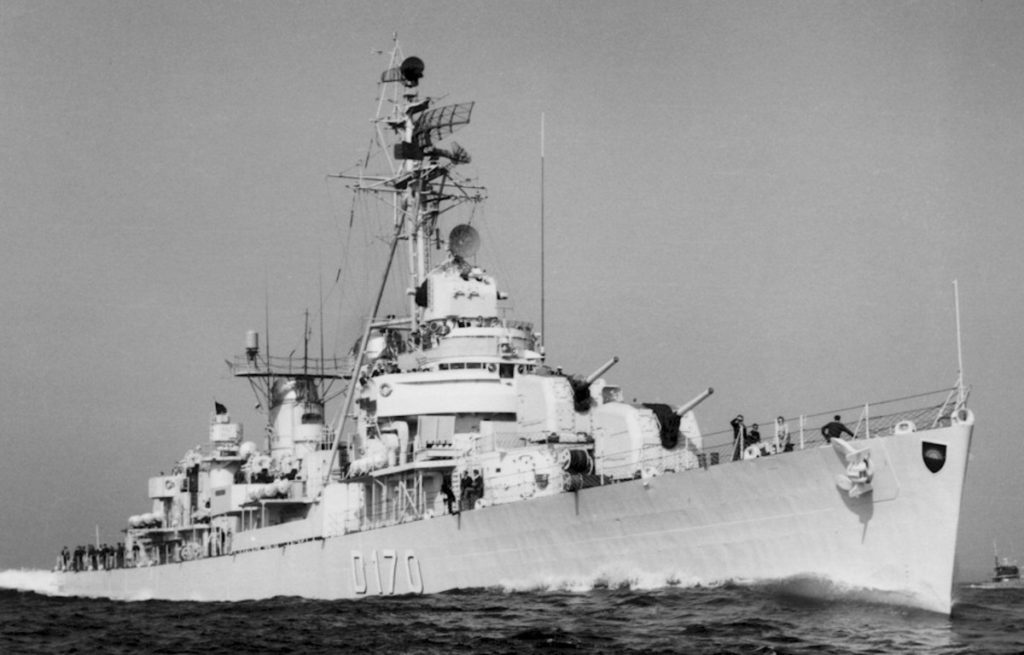
D 170 Zerstörer 1 was the ex-USS Anthony, transferred on 1 January 1958, struck in 1976, sunk as a target on 16 May 1979
D 171 Zerstörer 2 was the ex-USS Ringgold, transferred on 14 July 1959. Transferred to Hellenic Navy on 18 September 1981
D 172 Zerstörer 3 was the ex-USS Wadsworth, transferred on 6 October 1959. Transferred to Hellenic Navy on 15 October 1980
D 178 Zerstörer 4 was the ex-USS Claxton, transferred on 16 December 1959. Transferred to Hellenic Navy in February 1981
D 179 Zerstörer 5 was the ex-USS Dyson, transferred on 17 February 1960. Transferred to Hellenic Navy in February 1982
D 180 Zerstörer 6 was the ex-USS Charles Ausburne, transferred on 12 April 1960. Scrapped in October 1968
 Aspis class (1959)

D-06 Aspis was the ex-USS Conner, transferred on 15 September 1959. struck in 1991, scrapped in 1997
D-16 Velos was the ex-USS Charrette, transferred on 16 June 1959. Active – In commission as museum ship since 1991
D-28 Thyella, was the ex-USS Bradford, transferred on 27 September 1962. Struck in 1981, scrapped in 1981
D-42 Kimon, was the ex-USS Ringgold, transferred on 18 September 1981. Struck in 1993, scrapped in 1993
D-56 Lonchi, was the ex-USS Hall, transferred on 9 February 1960. Struck on 10 October 1990, scrapped in 1997
D-63 Navarinon, was the ex-USS Brown, transferred on 27 September 1962. Struck in 1981, scrapped in 1981
D-65 Nearchos, was the ex-USS Wadsworth, transferred on 15 October 1980. Struck in 1991, scrapped in 1991
D-85 Sfendoni, was the ex-USS Aulick, transferred on 21 August 1959. Struck in 1991, scrapped in 1997
Unnamed, un-commissioned was the ex-USS Claxton, transferred February 1981, scrapped and cannibalized
Unnamed, un-commissioned was the ex-USS Dyson, transferred February 1982, scrapped and cannibalized
 Fante class (1969)

D-560 Lanciere, was the ex-USS Taylor, transferred on 2 July 1969, struck in 1971 and cannibalized to provide spare parts for her sisters in Italian service
D-561 Fante, was the ex-USS Walker, transferred on 2 July 1969, struck and broken up for scrap in 1977
D-555 Geniere, was the ex-USS Prichett, transferred on 17 January 1970, struck and broken up for scrap in 1975
 Ariake class (1959)
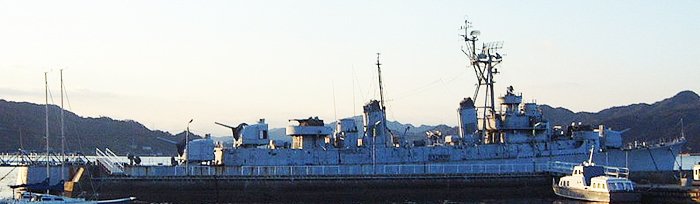
DD-183 JDS Ariake, was the ex-USS Heywood L. Edwards, transferred on 10 March 1959, struck in 1974, scrapped in 1976
DD-184 JDS Yūgure, was the ex-USS Richard P. Leary, transferred on 10 March 1959, struck in 1974, scrapped on 1 July 1976
 Cuauhtémoc class (1970)

E-01 ARM Cuauhtémoc, was the ex-USS Harrison, transferred on 19 August 1970, Dismantled
E-02 ARM Cuitláhuac, was the ex-USS John Rodgers, transferred on 19 August 1970, Scrapped in 2011
 Lepanto class (1957)

D21 Lepanto, was the ex-USS Capps, transferred on 15 May 1957, struck in 1985, scrapped
D22 Almirante Ferrandíz, was the ex-USS David W. Taylor, same, struck in 1987, scrapped
D23 Almirante Valdés, was the ex-USS Converse, transferred on 1 July 1959, struck in 1986, scrapped in 1988
D24 Alcalá Galiano, was the ex-USS Jarvis, transferred on 3 November 1960, struck in 1988, scrapped
D25 Jorge Juan, was the ex-USS McGowan, transferred on 1 December 1960, struck in 1988, scrapped
 Chung Mu class (1963)

DD-91 ROKS Chung Mu, was the ex-USS Erben, transferred on 16 May 1963. possibly scrapped.
DD-92 ROKS Seoul, was the ex-USS Halsey Powell, transferred on 27 April 1968. struck in 1982, scrapped in 1982.
DD-93 ROKS Pusan, was the ex-USS Hickox, transferred on 15 November 1968. struck in 1989, scrapped in 1989.
 Kwei Yang class (1971)

DDG-108 ROCS Kwei Yang was the ex-USS Twining , transferred on 16 August 1971. Struck in 1999, scrapped
DDG-109 ROCS Ching Yang, was the ex-USS Mullany, transferred on 6 October 1971. Struck in 1999, sunk as a target on 1 November 2001
DDG-918 ROCS An Yang, was the ex-USS Kimberly, transferred on 1 June 1967. Struck in 1999, sunk as a target on 14 October 2003
DDG-919 ROCS Kuen Yang, was the ex-USS Yarnall, transferred on 10 June 1968. Struck in 1999, scrapped.
USS Fletcher (DDE 445)

USS Fletcher was laid down as DD445 (from 3.1949 DDE445) as work 198 at Federal, Kearny in October 10 1941, launched on 3.5.1942 and completed in June.2. She saw heavy action and was placed in reserve and decommissioned in 1947. Recommissioned 3 October 1949 she was reconditioned and rearmed as a DDE conversion, specialist in ASW and redesignated DDE-445. She left San Diego on 1 May 1950 and returned in the Pacific, meeting the 7th Fleet. Soon the Korean War broke out and she teamed up with USS Valley Forge at Hong Kong. On 3 July she started her combat patrols off Korea and soon Valley Forge was joined by HMS Triumph, starting airstrikes. She only left the area for resplenishement in Buckner Bay (Okinawa) and later Sasebo in Japan.
She was present for the Battle of Inchon on 13-17 September and returned for an overhaul at Pearl Harbor on 11 November. By 19 November 1951 she left for another TOD in Korea. Again she screened more carriers of the 7th Fleet and had occasions of shore bombardment, cut by ASW training. She also patrolled in the Taiwan Straits and was back to her homeport at Pearl Harbor on 20 June 1952. She departed on 5 September up to 24 November taking part in Operation Ivy. Back to Pearl she sailed again for a last TOD between 14 May to 30 November 1953 off Korea.
She went on in service with the 7th fleet yearly from 1954 to 1962. In 1955 she screened the fleet evacuating the Tachen Islands. In 1957-1958, she made a passage to Samoa and Australia. Intensive ASW training had her staying at the top of her game in very tense situation, notably during the Cuba crisis and beyind. After many years of service she was eventually decommissioned in 1967, stricken on 1 August 1969, and sold on 22 February 1972.
In addition to her 15 battle stars for WW2 and 5 battle stars for Korea, she was awarded the Korean Service Medal with five battle stars, Philippine Presidential Unit Citation, Korean Presidential Unit Citation, Philippine Liberation Medal with two stars, and United Nations Service Medal.
USS Radford (DDE 446)

DD446 became in March 1949 DDE446 but from June 1962 reverted to DD446. Radford was ordered as work 199 at Federal, Kearny in October 1941, launched on 3 May 1942 and commissioned in July. She also was one of the most popular and successful in the Fletcher class. Radford was decommissioned at San Francisco just months after returning from her 1969 WestPac tour. She was stricken from the Naval Vessel Register on 10 November 1969, and sold for scrap in October 1970, but not before she fought one last battle on her own. She broke away from the tug that was towing her from Vallejo, California to the Portland, Oregon scrap yard, and took them on a 34-mile (55 km), all day chase toward the Oregon coast.Awards
Radford received twelve battle stars and two Presidential Unit Citations for World War II service, five battle stars for the Korean War, four for the Vietnam War, and the Armed Forces Expeditionary Medal.
USS Radford National Naval Museum
Radford following her FRAM II modernization with DASH-flight deck aft.
The USS Radford National Naval Museum was a collection of memorabilia about the ship that was located in Newcomerstown, Ohio.[2] The museum closed in 2011[3] and its contents were moved to the USS Orleck Naval Museum that is located in Jacksonville, Florida. Exhibits include photos, uniforms, and displays about the ship and her service.
USS Jenkins (DDE 447)

USS Jenkins 1969 after her last WestPac, from navsource.net, credits Clyde R. (Ron) Henderson.
DD447 was converted in January 1951 as DDE447. But from June 1962 like her sisters she reverted back to DD447. Jenkins had been built at Federal, Kearny from November 1941, launched on 21 June and completed in July 1942. “”The ship was decommissioned on the 17th of January 1946 and placed in reserve at San Francisco.
Radford was recommissioned on 17 October 1949, and operated with the United States Seventh Fleet in support of United Nations Forces during the Korean War. Following the armistice in 1953, she alternated operations along the west coast and in Hawaiian waters with annual deployments to the western Pacific with the Seventh Fleet. In 1960, Radford underwent an extensive Fleet Rehabilitation and Modernization (FRAM II) overhaul at the Pearl Harbor Navy Yard.
On 3 March 1965, Radford, in company with other units of Destroyer Division 252, departed Pearl Harbor on short notice to augment destroyer forces for the rapidly expanding naval commitments in the South China Sea. In October and December Radford served as an alternate recovery ship in Project Gemini and participated in Sea Dragon and Market Time operations, patrolled on search and rescue duties and carried out naval gunfire support (NGFS) missions during the Vietnam War from 1965 through 1969.
Radford off Korea in 1951.
Her eleventh WestPac tour began on 5 July 1966. During this period, she participated in anti-submarine operations, escorted aircraft carriers in the Gulf of Tonkin, had two tours of duty on NGFS missions, a turn on the Taiwan patrol, served as forward picket for the Seventh Fleet units operating in the South China Sea and escorted President Lyndon B. Johnson’s support units to Malaysia during his tour of southeast Asia. DesDiv 252 returned to Pearl Harbor on 16 December 1966.
Radford was decommissioned at San Francisco just months after returning from her 1969 WestPac tour. She was stricken from the Naval Vessel Register on 10 November 1969, and sold for scrap in October 1970, but not before she fought one last battle on her own. She broke away from the tug that was towing her from Vallejo, California to the Portland, Oregon scrap yard, and took them on a 34-mile (55 km), all day chase toward the Oregon coast.
Awards
Radford received twelve battle stars and two Presidential Unit Citations for World War II service, five battle stars for the Korean War, four for the Vietnam War, and the Armed Forces Expeditionary Medal. “”
USS Nicholas (DDE 449)

DD449 (from March 1949 DDE449) then from June 1962 back to DD449. Originally built at Bath Iron Wks between April 194 and June 1942.
Korean War as DDE 1951-53
Decommissioned on 12 June 1946, Pacific Reserve Fleet she was taken in hands for DDE conversion as DDE-449 on November 1949 until February 1951. After shakedown off the west coast she joined at Pearl Harbor CortDesDiv 12 and CortDesRon 1 sailing to the Western Pacific and Yokosuka on 10 June. She screened carriers of TF77 off Korea and patrolled between Yokosuka and Okinawa as well as the Taiwan Strait. On 3 May 1952 she sailed from Pearl Harbor for Korea, second TOD with DesDiv 112 and TF77, taking the gun line under CTF95 until July. She made a third Korea TOD with CortDesDiv 12 by November until 20 May 1953. Next she was in stabdard WestPac exercize routune with the 1st Fleet and later 7th Fleet from Japan to Sumatra, and EastPac from Hawaii to the west coast. She also took part in the attomic tests, Operation Castle.
After several routine years post-Korea she underwent her Fleet Rehabilitation and Modernization (FRAM) between December 1959 and July 1960, taking part in her WestPac, duties back to the South China Sea. DD-449 from 1 July 1962, she returned in the China sea by March 1965, engaged in Operation Market Time along the South Vietnamese coastline. She would return in Viet Nam by mid-September between surveillance and gunfire support, then patrolling off Taiwan. By 1966 she made a third Viet Nam TOD on “Yankee Station”, Gulf of Tonkin, and another “Market Time” patrol. After a stop and rest to Australia she proceeded to Hawaii in March. Next years saw her in WestPac tour, gunfire support in late 1966 to May 1967 and Operation Deckhouse Five where she patrolled the Mekong Delta and DMZ. She made yet another TOD in 1968 mostly “Yankee Station” and gunline. She made an EastPac TOD in 1968, taking part in NASA’s space capsule recovery missions, notably Apollo 8. She later made another Western Pacific cruise and by 30 January 1970, she was now the oldest active US destroyer, being decommissioned in a ceremony at Pearl Harbor with O’Bannon. After towed to Portland she was BU in 1972, among the last 7 Fletchers in service.
In addition to 16 battle stars for WW2 only surpassed by USS O’Bannon she earned 5 more in the Korean War, 9 for the Vietnam War for 30 total, making her the most decorated ship in US history so far.
USS O’Bannon (1942)

O’Bannon out of Mare Island after her DDE conversion in 1951
DD450 (from March 1949 DDE450, back to DD450 from June 1962) USS O`Bannon was originally built at Bath Iron Works between March 1941 and June 1942. From 17 January 1949 O’Bannon was chosen for conversion as DDE, proceeding until 10 February 1950 at Long Beach Naval Shipyard (DDE-450, 26 March 1949). Fully recommissioned on 19 February 1951 and homeported to Pearl Harbor she started her post-reconstruction sea trials, training and weapons tests. When ready she sailed for her first tour of duty (TOD) with the United Nations forces in Korea on 19 November. She stayed in the area, as carrier screen for seven months and became flagship for the Wonsan Element of the East Coast Blockade and Escort Group, with shore bombardments. Next she returned to convoy escort between Korea and Japan.
Back to Pearl Harbor for maintenance and training in June 1952, she took part atomic tests off Eniwetok. By April 1953 she left for her second Korean TOD with the carriers. She also took part in the Taiwan Patrol and trained off Japan and Okinawa.
postwar, she trained with the 7th Fleet, alternating all six-month between the Far East and home waters of Pearl Harbor. She made also numerous port visits to the Philippines, Taiwan, Australia and New Zealand or Hong Kong. She was her for the commemoration of the Battle of the Coral Sea (she was still in constuction at the time) and trained woth SEATO allies or the Marines. When in Pearl Harbor, she helped training reservists and sailed to look for missile test cones or the Appollo missions when they started. By 1962, she took part in the atomic tests at Johnston Island.
In 1964, O’Bannon became the centerpiece of the 1965 film “In Harm’s Way”. starring Kirk Douglas. Her first TOD off the coast of Vietnam was her 1964–65 deployment. On 26 December, she left Hong Kong for hydrographic surveys. Her 1966 TOD was as plane guard for USS Kitty Hawk, striking objectives on South and North Vietnam. By May-June, O’Bannon took part in the gunline, destroying Vietcong base camps and troop concentrations among others.
She sailed to Yokosuka and from there to Pearl Harbor on 30 July. Next she took part in Apollo space craft recovery operations in August, used for Gemini 11 in September. She visited Guam in 1967 and was prepared for another Vietnam TOD, bound for Japan on 28 September, then Subic Bay on the 15th of October. She screen the new supercarrier USS Constellation as plane guard and patrolled atn Yankee Station until 4 November 1967. After rest at Subic Bay and Hong Kong, she took the gunline at Da Nang. She visited Taiwan in December but returned to cover fire on the DMZ. She rescued the crew of an American plane and silenced an enemy battery that targeted her in the process. She stayed on the gun line in 1968 as well. It’s only on 30 January 1970, that O’Bannon was decommissioned in a unusual ceremony at Pearl Harbor due to her amazing career, with all the top brass present, and was stricken, sold for scrap on 6 June 1970, BU in 1972. In addition to her Presidential Unit Citation and 17 battle stars, three battle stars for Korea, she was nicknamed the “Lucky O” since she went trhough hell and back without casualty…
USS Saufley (DDE 465)

DD465 (from March 1949 DDE465 and in June 1962 back to DD465) USS Saufley was laid down at Federal, Kearny in January 1942 and commissioned in August 1942. Saufley earned 16 battle stars during World War II, making her one of the most decorated US ships of World War II. Decommissioned on 12 June 1946, she stayed in the Reserve Fleet for three years and was redesignated DDE-465 on 15 March 1949, then recommissioned on 15 December 1949 with Escort Destroyer Squadron (CortDesRon) 2 for the Atlantic Fleet. She took part in two search and rescue operations, the first in June 1950 (36 passengers from a downed commercial airliner), and in October, a Navy TBM pilot from USS Palau.
After reassignation as DDE she took part in experimental work under the Operational Development Force Command. Next, she entered DesDiv 601 homeported at Naval Station Key West in Florida. She tested and evaluated sonar equipment and antisubmarine weapons, looking their effects on shipboard habitability. From 1 July 1962, reclassified once again as general-purpose destroyer she took part in the movie “PT 109”. In September she was back in evaluation work and in late October, placed on standby with the Cuban crisis and quarantine, then patrolled off Florida until 20 November, until back at NAVSTA Key West. On 26 November she was back in the Quarantine Force for a review by President John F. Kennedy. For two years she returned in experimental projects, interrupted by scheduled exercises or work for the sonar school and another SAR in 1963, for the sunken USS Thresher. Back to NS Norfolk by late 1964, she was decommissioned on 29 January 1965, stricken on 1 September 1966. bbut kept as static experimental ship and in 1967, she registered the strain and stress of detonation tests close to her hull, until she sunk on 20 February 1968 off Key West.
USS Waller (DDE 466)

DD466 was laid down at Federal, Kearny on February 1942, launched on 15 Augst 1942 and commissioned in October 1942. She became DDE 466 in March 1949 and back to DD in June 1962. Decommission when back from the Pacific in 1946 and attached to the 6th Naval District, she remained in reserve at Charleston until the Korean War. Selected for conversion as escort destroyers the process started on 26 March 1949 until she was recommissioned at Charleston on 5 July 1950. After shakedown, she joined Escort Destroyer Squadron 2 as flagship on 28 January 1951 and departed for Korea on 14 May, joining TF 95 to Wonsan harbor. For 10 days, she joined the shore bombardment, sending 1,700 rounds on NK positions. The next summer, she reverted to ASW work for 7th Fleet off Okinawa and back to seaborne blockade from October 1951 and back home.
From 1951 to late 1956, she took on many ASW exercises off the east coast and deployed to the Mediterranean and Caribbean. Late 1956 she had a refit at Norfolk with alterations to her ASW battery and back to the 6th fleet in the Med for 1957 in DesRon 28, Task Force Alfa. Then DesRon 36 on 1 July 1964 with more Med. deployments over 4 years and on 6 September 1968 she departed Norfolk with DesDiv 362 for Vietnam, and from October, arrived at the “gunline” for patrols on Yankee Station, Tonkin Gulf, Qui Nhon in South Vietnam. She supported Korean troops with gunfire destroying Viet Cong bunkers and storage areas. Next off Phan Thiet for the U.S. Army 173rd Airborne Brigade, blasting structures, rest camps and cutting supply traffic, spending 2,400 rounds and receiving a “well done” by the Task Unit 70.8.9 CO.
Newt she escorted USS Intrepid (CVS-11) and next Ranger (CVA-61) spending 109 days in escort before departing for home on 2 March 1969. Planned for the Naval Reserve training and extensive inspection saw her decommissioned, struck on 15 July 1969. She was disposed of as a target on 2 February 1970 off Rhode Island, on 17 June 1970. In addition to 12 battle stars for WW2, she received 2 for Korea and 2 for Vietnam and one for the Cuban missile blockade in October 1962 when she detected a Russian submarine and dropped a hand grenade to force it to surface.
USS Taylor (DDE 468)

DDE 468 from January 1951 until June 1962, USS Taylor was laid down at Bath Iron Wks in August 1941, launched on 7 June 1942 and commissioned in August. On 31 May 1946, she decommissioned in reserve at San Diego and after four years she was reactivated and sent to San Francisco Naval Shipyard on 9 May 1950 for her DDE conversion until recommission on 3 December 1951 under Comdr. Sheldon H. Kinney as CO. On 3 February 1952 she had a 2-month shakedown off San Diego. Then on 24 March, she headed for Pearl Harbor for two months of training here, and her first WestPac since WW2 via Midway and Yokosuka, then joining TF 77 on 16 June, screening carriers in air strikes off the Korean coast. She spent here five months in different assignments: Fast carriers plane guard and escort, shore bombardments. In July she had R&R and upkeep in Japan. She then had refresher exercises in hunter-killer operations and was back in August with TF 77. By September she was part of the blockade watch off Wonsan (3 weeks), being called upon to shell enemy shore batteries and transportation lines, screening minesweepers in daily sweeps. Next she had a tour of duty on the Taiwan Strait Patrol, stopping for R&R at Hong Kong. By late October, she was at the western coast of Korea patrolling with the carrier HMS Glory (R62) and cruiser HMS Birmingham (C19). On 21 November she was back to Yokosuka, and after patrols in the western Pacific she headed for to Hawaii, entering Pearl Harbor on 8 December. After leave and upkeep, she entered the Shipyard for maintenance and shakedown training with rookies.
On 2 May 1953,she left Pearl Harbor for Yokosuka (12th) and Sasebo, and joined USS Bairoko (CVE-115) and HMS Ocean (R68) off Korea, screening them and detached for shoreline patrols. She was back at Sasebo on 1 June for R&R and upkeep, then Okinawa for ASW training. On 25 June she was at Yokosuka, and the Taiwan Strait Patrol, stopping at Hong Kong and Kaohsiung, trainign with the Republic of China Navy. Back to Yokosuka on 20 July, then Pearl Harbor on the 31st July and a 3-month overhaul. When at Pearl Harbor she learned about the the formal end to hostilities, with an armistice came on 27 July 1953 while back to Yokosuka. Her final two years of deployments, were quiet. From 1 March 1954 and 1 March 1959, she completed five more deployments, exercises, goodwill visits there and at Pearl Harbor. In her 1959-1960 Westpac, she visited Australia for the Coral Sea battle celebrations. Back at Pearl Harbor on 26 May 1960 she was back at Pearl Harbor for a major overhaul and departed for a new WestPac in August 1961. In the spring and summer 1962 she was in the mid-Pacific for Operation Dominic, nuclear tests conducted in the upper atmosphere. In October she was back at Hawaii until late 1962.
Local operations at Hawaiian until late 1962 and and until mid-1963 followed by a deployment in June with a hunter/killer group of the 7th Fleet, visting Kobe, Hong Kong, Okinawa, Kushiro, Yokosuka, Sasebo, Subic Bay. In Kushiro she took part in unilateral and bilateral training exercises. She was back at Pearl Harbor on 29 November and in 1964 was in drydock for three-month and back in exercises until the fall 1964. On 23 Novembe she operated with USS Yorktown (CVS-10) and Thomason (DD-746) via Midway, Yokosuka, makin combined exercises with USS Hancock (CVA-19) and Strauss (DDG-16) near Okinawa. On 19 December, she was back at Sasebo, spending Xmas and the New Year here. On 4 January 1965, she left Sasebo and rejoined Yorktown and Thomason to Hong Kong. Next, the Philippine Sea. She entered Subic Bay on 24 February, then back to Sasebo on 3 March. She headed for the South China Sea and arrived off Vietnam on 21 March, patrolling for five weeks. On 27 April, she returned to Yokosuka and then Hawaii, Pearl Harbor for local operations and drydock overhaul.
She left it by mid-January 1965 for loca refresher until 7 February, joined DesDiv 111, and headed for the western Pacific, Yokosuka and left o, 25 February to join Task Group 70.4 off Vietnam, patrolling until March, then north in the Taiwan Strait, stopping at Kaohsiung. She was relieved on 12 April, and ended in Hong Kong for five-day then back to Yankee Station. She joined naval gunfire support from 28 April to 1 May. After upkeep at Sasebo, ASW drills until 10 June she returned to the Taiwan Strait for operation Sand Pan from Da Nang and detached for gunfire on co-ordnance. Next she joined TG 70.4 on 7 July, stopped at Yokosuka and then Pearl Harbor on 22 July. On 2 August she was in tender availability with USS Prairie (AD-15) and after gunnery practice, was in restricted availability until late November. By December, she headed for Pago Pago, Samoa and back to Pearl Harbor for holiday leave/upkeep. In 1967 she had operations around Hawaii and repairs, then back to Vietnam in late spring, greenlighted after a Operational Readiness Inspection at Pearl Harbor she joined the 7th Fleet. On 25 April she headed for Yokosuka and in June, had exercises with the Japan Maritime Self-Defense Force and Korean Navy.
On 19 June she was at Yankee Station and in plane guard dutoes in the Gulf of Tonkin for USS Hornet (CV-12) providing gunfire support. On 27 June she was in Subic Bay for tender availability and visited Manila. On 10 July she took part in SEATO “Sea Dog”, visited Bang Saen (Thailand) and was back at Yankee Station until 1 August. Next she headed for Taiwan, Kaohsiung on 3 August, until 15 August and back to Yankee Station for the sand pan operation. Until 11 September she provided naval gunfire support. After a stop in Hong Kong she had another TOD in the Gulf of Tonkin, then Yokosuka on 11 October and Hawaii, 23rd. She started an overhaul on 11 December until early 1968. On 22 March she was in sea trials until early April but engineering problems postponed her deployment.
She had her refresher training in May-June and headed for San Diego on 27 June. She trained off San Clemente Island from 3 to 11 July and back to Hawaii for gunnery drills at Kahoolawe Island. Dhe left on 5 August for the Gulf of Tonkin via Midway, Guam, and Subic Bay. She arrived on 21 August, in plane guard duty for USS Intrepid (CVS-11) and headed with USS Maddox (DD-731) and Preston (DD-795) to Sasebo, then back in the Gulf of Tonkin on 5 September for an air and surface surveillance, ASW exercises and planeguarding, then naval gunfire until 6 October. Next she had a refit and supplies at Subic Bay. On 20 October she returned on the gunline, and back to Cebu City and Subic Bay. Until December, she resumed her duty on the gunline before heading for Yokosuka for RéR and upkeep, Xmas and the New year, and back at Yankee Station in January 1969.
By mid-January, she left Vietnamese for good, via Subic Bay, Manus Island, Melbourne, Auckland, and Pago Pago to Pearl Harbor on 28 February. In May, the inspection and survey stamped “unfit for further naval service” on her file, and by June, she headed for San Diego, California to be decommissioned on 3 June 1969, struck on 2 July 1969. She was transferred to the Italian Navy as Lanciere D 560 until January 1971, cannibalized for the other Italian Fletchers. Her sercice records comprised a Navy Unit Commendation and 14 battle stars making her among the most decorated US ships of World War II with 2 more battle stars for Korea, 5 for Vietnam so a total of 21 battle stars and 29 years of service. A good use of taxpayers money.
USS Bache (DDE 470)

DDE 470 from January 1951 until June 1962 USS Bache was laid down at Bethlehem, Staten I, Port Richmond in November 1941, launched on 27 July and completed in November 1942. USS Bache On 4 February 1946, was decommissioned in reserve at Charleston. In 1950, she was converted to an escort destroyer at Boston Navy Yard, recommissioned on 1 October 1951, assigned to the Atlantic Fleet. She made six Caribbean Sea cruises for operations and training, three Mediterranean deployments for the 6th Fleet. She received her Weapon Alpha anti-submarine rocket launcher later than others, but in one deployment she was blown aground outside of the Rhodes harbor in a gale dueing a three-day port of Greece on 6 February 1968. Declared a constructive total loss, she was scrapped there and decommissioned and stricken on 1 March 1968.
USS Beale (DDE 471)

DDE 471 from January 1951 until June 1962, USS Beale was laid down at Bethlehem, Staten at Port Richmond in December 1941, launched on 24 August 1942 and December. After a 3-month inactivation overhaul, she was decommissioned at Charleston NyD on 11 April 1946, in reserve for six years. She was reactivated at Boston and taken, in hands for conversion to a DDE, recommissioned on 1 November 1951. On 8 January she had her shakedown cruise via Norfolk and the West Indies. Post-shakedown availability at Boston followed until early May and she was pressed to the Atlantic Fleet, HP Norfolk. In the Gulf of Mexico she became planeguard for USS Cabot and trained off Florida until back to Norfolk on Independence Day. After training in the Virginia Capes, upkeep at Norfolk by January 1953 she took part in the Springboard exercises bringing her to Midway and off Florida, Mayport, Puerto Rico until early March, Norfolk on the 13th. On 17 April she was in Chesapeake Bay, then sailed to the British Isles, and Mediterranean, stopping at Londonderry, Golfe Juan in France, and Naples in Italy. She departed on 13 June back home to Norfolk (26th).
Afterlocal operations in July and August she sailed to Nova Scotia, as planeguard for USS Valley Forge. Back at Norfolk on 4 September she entered a routine of local training and upkeep until October, stopped at New York for a 3-month overhaul, refresher training off Cuba in early 1954, back to Norfolk in March and on 11 May mde her first full tour of duty in the Mediterranean, 6th Fleet and back on 10 October. January 1955 saw her in East Coast operations from Rhode Island to Puerto Rico/Key West, then upkeep at Norfolk. Off Newport she had exercises with carriers and went to Bermuda, tracking USS Nautilus. She was back to Norfolk on 6 August, then back for NATO exercises “Centerboard” and “New Broom IV” ending off Portugal. She entered Lisbon and departed for Norfolk. After upkeep she resumed exercises off the Virginia Capes by January 1956 and in mid-February took part in “Springboard” and back off Norfolk more training until late May. She headeed for the Gulf of Mexico and stopped at Pensacola, New Orleans, and Galveston, and bacl to Norfolk for a regular overhaul until November. She had a post overhaul shakedown at Guantanamo Bay and refresher training and spent Xmas at home and the first weeks of 1957.
On 18 March she started a circumnavigation Africa, due to the Suez Canal being closed (Suez crisis). First stop was in the Azores, and Freetown on 30 March, Simonstown, on 10-12 April, Cape Agulhas, Mombassa, and the Persian Gulf, Qeshm in Iran, and Bahrain. She then transited via the reopened Suez Canal via Massawa to Piraeus until mid-June, crossed the Mediterranean to Rota, Spain for four weeks and stops at Valencia, Cartagena, and Barcelona in a PR campaign. She departed via Gibraltar on 14 July and entered Norfolk on 26 July. On 3 September she was back for the British Isles, Plymouth, and NATO Exercise “Stand Firm.” She then spent 10 days in Cherbourg. On 10 October she was back again, arriving in the Chesapeake Bay on 22 October. By late March 1958, her Mediterranean deployment was changed to a presence with Task Group Alfa, for advanced ASW techniques and procedures over 5 years alays along the East Coast. She was still detached for patrols off Cuba dueing the revolution, notably on 13-26 April 1961 and June to mid-August 1962. Then she joined the “quarantine” of Cuba from 25 October to 5 November 1962.
On 27 October, she dropped practice depth charges on the Foxtrot class B-59. After which she surfaced, USS Beale closed to 500 yards on a parallel course and illuminating her with her searchlight. Unwillingly Beale’s captain might have provoked WW3 as the unstable captain Savitsky, unable to contact the base, considered firing a 15-kiloton nuclear torpedo but wazs prevented to do so by two other senior officers by a vote with the single contraty vote of Vasili Arkhipov that prevented the launch. The destroyer remained on the East Coast-West Indies and by November 1963 started a new major overseas deployment to Pollensa Bay in Majorca on 11 December to relieve USS McCaffrey (DD-860) on station here. By February 1964 she headed to the eastern Mediterranean to an international fleet preventing the insurrection in the island of Cyprus to spill over. She made a 6-day liberty call at Istanbul and took part in NATO exercises in the Ionian Sea. By March she spent nthe Mid-Med her last 6 weeks of deployment and returned bia Pollensa Bay in May, Gibraltar and Hampton Roads. Later she had a visit to Baltimore and resumed training off the East Coast, with a regular overhaul at Norfolk, refresher training.
On 1 June 1966 she was sent to the Far East via Panama to Hawaii and Guam and joined the 7th Fleet at its base at Subic Bay. She was a station ship at Hong Kong and sent to Vietnam on 24 July joining the “gunline” for two weeks and back to Subic Bay to replenish and maintenance. She was back for the same in August and later plane guard for USS Intrepid. After her final tour she returned home via the Indian Ocean, Suez, the Mediterranean and Atlantic for a circumnavigation until reaching Norfolk on 17 December. March 1967 saw her training in the Virginia Capes and on 10 April in the Chesapeake Bay, Key West as school ship for the Fleet Sonar School, then Norfolk on 8 May. She took part in the large 36 ships ASW Exercise “New Look” with four NATO navies. In July the board of inspection and survey mandated a restricted availability, doe at Baltimore in August. Still she was in normal operations off Norfolk by September and made her final deployment overseas. On 14 November she departed for the Mediterranean as part of DesRon 32 to Majorca, then Italy, the Adriatic by late January 1968, stopping in Split, exercises and many French and Italian ports visits, as well as Malta and being relieved by Moale at Málaga, heading for Norfolk, without USS Bache wrecked by a storm at Rhodes in February. After upkeep USS Beale had limited ops. in May, Newport, Rhode Island, as training platform, Destroyer School until June. On the 25th she sailed to Norfolk for a last review by a board of inspection and survey recommending her decommission, made at Norfolk on 30 September 1968. She was struck on 1 October 1968 and towed to be sunk as target on 24 June 1969, 250 miles east of the mouth of Chesapeake Bay. She received a battle star for her Vietnam service on top of her 6 others for WW2.
USS Philip (DD 498)

DDE 498 until March 1949 until June 1962, USS Philip was laid down at Federal, Kearny in May 1942, launched on 13 August 1942 and commissioned in November. The veteran destroyer got back to the West Coast just in time to allow the crew to spend Xmas and New Year’s ever on home soil. She was decommissioned in January 1947, Atlantic Reserve Fleet in Charleston until 30 June 1950. Next she sailed through Panama for her new HP at Pearl Harbor from 10 September and for advanced hunter-killer exercises. The autumn of 1950 saw her acting as plane-guard for Pdt. Harry S. Truman and his mid-ocean conference with Gral. Douglas MacArthur, on Wake Island about the Korean War. On 1 June 1951 she left for Midway and Yokosuka and later joined TF 77 in the Sea of Japan, screening the fast carrier task force operating raids over North Korea. Back off Japanshe had ASW exercises from 30 June to 10 July. Next to the Taiwan Straits for patrols, stopping at Hong Kong from 29 July and weathering Typhoon Louise. Until August she went on patrol and had in September ASW drills off Okinawa and was in Yokosuka for upkeep.
On 24 September she sailed for the east coast of Korea and TF 77 until 3 October, detached to the west coast of Korea to cover a UN led force and Australian and British units, screening them, enforcing the naval blockade and avoiding a massive typhoon. She was back with TF 77 on 15 October and headed for Yokosuka then 2 November to Pearl Harbor, before a yard period and refresher training, plane guard until 27 October 1952, new short drydock before a new tour of duty in Korea from 10 November via Yokosuka. On 25 November she joined TF 78, with shore bombardment, patrols with USS Los Angeles and on 5 December, incursion in Wonsan Harbor, shelling shore targets, and for call fire missions. She also had an hot ASW alert and performed two pilot rescue missions and a tender availability time in Yokosuka, back on May 1953. She was back at Pearl Harbor on the 29th and had training but from June started a 3-month overhaul. She departed for the Western Pacific on 14 June, arrived at Yokosuka on the 23th, had tender availability and headed for the Shimonoseki Straits and Chinhae, TF 95, Inchon and HMS Warrior as plane guard for the Blockade. She entered Kure on 4 July, then Sasebo for restricted availability and was back to Pearl Harbor on 29 August for overhaul.
On 8 August 1955 she sailed for Yokosuka, and had the largest ASW exercises off Okinawa with TF 77 so far, a round of Taiwan Patrol and back home on 6 January 1956. On 30 October she returned in the Japanese waters, and back on 22 January 1957. Assigned to DesDiv 25 ahd was sent to the Far East from 27 December, Yokosuka and exercises off Japan and Okinawa, the Philippines, South China Sea, until 23 April and a stop at Brisbane on 2 May, Melbourne and Sydney, Wellington, Pago Pago, and Pearl Harbor on 29 May. Until late January 1959, she had intensive hunter-killer operations, shore bombardment and gunnery drills, plane guard dueties for the brand new supercarrier USS Ranger. On 18 February with DesDiv 252 she was back at Yokosuka, for a tour in the South China Sea and Brisbane on 11 July, Pearl Harbor on the 30th. She was soon back to Yokosuka on 22 April 1960 and back to Pearl Harbor on 29 October 1960. On 4 February 1962 she was at Yokosuka and operated off Japan, the Philippines, Vietnam, Pearl Harbor on 18 July. On 3 October she operated with USS Kearsarge CVS-33 and help the recovery of astronaut Wally Schirra, back from the Mercury–Atlas 8 mission. Back to Yokosuka 12 November 1963 for Philippines and Vietname exercises, back on 10 April 1964. She was back to Yokosuka on 19 April 1965, with duties at Yankee Station and Taiwan straits patrol until back home on 1 October 1965.
In 1965 the destroyer was featured in Otto Preminger’s “In Harm’s Way” starring John Wayne, as the fictitious USS Cassiday DD 298 at Pearl Harbor on 7 December 1941. Fictionally depth charging a Japanese submarine and hemping Wayne’s cruiser after she was torpedoed. The real ship had there her last appearance as she was after inspection (releaving the usual high wear and tear) decommissioned on 30 September 1968, struck on 1 October 1968, sold for BU on 15 December 1971 but sank in a storm underway on 2 February 1972. USS Philip received 9 battle stars for World War II service and 5 battle stars for Korean War service.
USS Renshaw (DDE 499)

DDE 499 from March 1949 until June 1962, USS Renshaw was laid down at Federal, Kearny in May 1942, launched 13.10.1942 and commissioned in December. Renshaw was decommissioned in February 1947, U.S. Atlantic Reserve Fleet. She was converted as DDE in 1949-50, recommissioned in June 1950 and soon had two tours of duty in the Korean War, May to November 1951 and November 1952 to June 1953, as escort, patroller, SAR ship and plane guard, joinin also the gunline. She was also part of the atomic history, being present at the Pacific Proving Grounds from February to May 1954 in Operation Castle and Task Force 7. She was back to the Far East from June to August 1954 and rescued a British airmanas plane guard of HMS Warrior. She had also a hunter-killer exercise with Canadian ships. On 8 August 1955 she started her 4th tour in the Far East, mostly in hunter-killer exercises, TF plane guard. From Pearl Harbor she returned for more on October 1956-May 1957, and December 1957 to May 1958, February 1959 to July 1959, April 1960 to October 1960. In 1960 she had her new Weapon Alpha. On 17 December 1961 she recovered the cone of Discoverer 36. She had another WestPac deployment in 1962 and on 3 October, took part in the recovery of Project Mercury. In 1963 she remained at Pearl Harbor, but had a new WestPac from November 1963 for 6 months and also took part in the movie “In Harm’s Way”.
On 3 March 1965, USS Renshaw and DesDiv 252, departed Pearl Harbor for the South China Sea. In April-May, she was in in surveillance roles, supporting carrier strikes and in June, in the Taiwan patrol, then Vietnamese waters in July until September and back to Pearl Harbor. In October-December she was part of the recovery team of Project Gemini. Next she started her 11th WestPac tour on 5 July 1966, for ASW operations, CV rescue, special operations with USS Chicago in the Tonkin Gulf, special operations in the Taiwan Strait and bacl to Pearl Harbor 16 December 1966. She left again on 8 April 1968 for a WestPac with the fast carrier attack forces, Yankee Station, Tonkin Gulf and by September back to Pearl Harbor. In June she had another WestPac, Yankee Station, plane guard, and by December back to Pearl Harbor. She was decommissioned after an inspection on 14 February 1970, struck from the List as well, sold for scrapping in October 1970, BU at Zidell Explorations. In addition ot her 8 battle stars for WW2 service she was awarded 5 battle stars for Korea, 6 battle stars for Vietnam. Her Bell is displayed at the Portsmouth Naval Shipyard Museum.
USS Conway (DDE 507)
 DDE 507 from March 1949, until June 1962, USS Conway was laid down at Bath Iron Wks in USS Conway was laid down on November 1941, launched in 16 August 1942, and commissioned in October 1942. After a well filled WW2 campaign, she was decommissioned in reserve 25 June 1946, and berthed at Charleston. Recommissioned at Boston 8 November 1950, she had a DDE conversion and after training, departed Norfolk 14 May 1951 for Sasebo, then escorted a convoy from Shandong to Manchuria and had a hunter-killer exercise off Okinawa. She screened TF 77 for strikes off Korea. On 14-28 October she also shelled Kolgochi-Ri, Hodo Pando, Hungnam, and Wonsan, patrolled there and departed Sasebo on 31 October for the Suez Canal, returning via the Mediterranean and Atlantic to Norfolk on 20 December. She left the next year for Caribbean training from 16 September 1953 and first NATO exercise in the North Atlantic, then her first tour of duty in the Mediterranean, 6th Fleet, back to Norfolk on 8 February 1954. In 1955-1957 she was back to the Mediterranean, eastern and Dardanelles (crisis in Jordan). By early fall 1957, she visited northern Europe and had NATO exercises. From January to March 1958, she tested her newly installed Weapon Alpha off Key West.
In April 1958, she joined TF Alfa experimenting with ASW tactics, as well as 1958, 1959, and 1960. By June 1960 she visited Quebec City. In December she rescued survivors of a merchant tanker off Cape Hatteras. She deployed in a West Pac to Vietam from July 1966 through December 1966. An inspection in 1968 had her decommissioned and stricken from the Naval Vessel Register on 15 November 1969 and sunk as a target on 26 June 1970. In addition to her 13 battle stars for WW she had 4 for Korea.
USS Cony (DDE 508)

USS Cony became DDE 508 from March 1949 until June 1962. She was laid down on Bath Iron Works in December 1941, launched in 16 August 1942 and commissioned on October 1942. She was decommissioned after eher wartime service, placed in reserve 18 June 1946. Fully recommissioned as DDE on 17 November 1949 she had training and and saw operations off the east coast and Caribbean, then sailed from hernew home-port of Norfolk on 14 May 1951. She started a circumnavigation while making her first tour of duty on the Korean war zone from 18 June to 28 October and back home via the Indian Ocean, Suez, the Med, Atlantic to Norfolk on 20 December 1951. In September 1953 she took part in NATO Operation “Mariner” with the Royal Navy in realistic ASW operations off Northern Ireland. Next she joined the 6th Fleet in the Mediterranean and returned there in 1955 and 1957, but by September and October 1957, was in NATO ASW exercises in the English Channel. She also trained in the Caribbean in 1958, 1959 and 1960 and joined TF Alfa axperimental tactical group on the east coast, stopping at Quebec City in June 1960. She was also detached to take part in the Bay of Pigs invasion of Cuba in April 1961. By October 1962, she took part in the blockade of Cuba. On 27 October, she hammered with practice grenades the Soviet submarine B-59 until she surfaced, a close call incident. After the usual inspection she was declared unfit for more service and decommissioned, stricken 2 July 1969. Sunk as a target off Puerto Rico, 20 March 1970. In addition to her 11 battle stars for WW2, she earned 2 for her Korean War service.
USS Eaton (DDE 510)

From January 1951 she became DDE510, and in June 1962 back to DD510. She was laid down at Bath Iron Wks on March 1942, launched on 20 September 1942 and commissioned by December 1942.
USS Walker (DDE 517)

DD517 becale DDE 518 in March 1950 and back in June 1962. She was laid down at Bath Iron Wks in August 1942, launched on 31 Juanuary and commissioned in April 1943.
USS Murray (DDE 576)

DD576 and from 1951 DDE576 back to DD in June 1962, USS Murray was laid down at Consolidated, Orange in March 1942, launched on 16 August 1942 and commissioned in April 1943. Inactivated at Philadelphia Naval Shipyard, Murray decommissioned 27 March 1946, and went into reserve at Charleston, South Carolina.
Korean War years.
USS Sproston (DDE 577)

DD577 was laid down at Consolidated, Orange in April 1942, launched on 31 August 1942 and commissioned in May 1943. She became DDE in March 1949 until June 1962. Sproston arrived at San Francisco on 14 July 1945 where she underwent yard overhaul and prepared for inactivation: She moved to San Diego in mid-December and was placed out of commission on 18 January 1946.
Read More/Src
auer, K. Jack; Roberts, Stephen S. (1991). Register of Ships of the U.S. Navy, 1775–1990: Major Combatants. Westport, Connecticut: Greenwood Press.
Davis, Rick E. & Wright, Christopher C. (2010). “USN Aircraft-Handling Destroyers 1919 to 1943, Part I: 1919–1941”. Warship International. XLVII.
Friedman, Norman (2004). US Destroyers: An Illustrated Design History (Revised ed.). Annapolis: Naval Institute Press.
Gardiner, Robert; Chesneau, Roger (1980). Conway’s All the World’s Fighting Ships 1922–1946. London: Conway Maritime Press.
Gardiner, Robert; Chumbley, Stephen (1995). Conway’s All the World’s Fighting Ships 1947-1995. London: Conway Maritime Press.
Silverstone, Paul H. (1965). U.S. Warships of World War II. London: Ian Allan Ltd.
Toby, A. Steven (2015). “Note on High Speed Destroyers’ Maneuverability”. Warship International. LII (1): 24–27.
Vinock, Eli, CAPT USN “FRAM Fixes the Fleet” United States Naval Institute Proceedings August 1984 pp.70-73
Gyrodyne Helicopter Historical Foundation (12 July 2007). “FRAM”.
Cooney, David M., RADM USN Ships, Aircraft and Weapons of the United States Navy (January 1980) U.S. Government Printing Office p.42
Links
navypedia.org
destroyers.org/Class/c-Fletcher.htm
destroyersonline.com/
destroyers.org (portal)
gyrodynehelicopters.com: DASH on fletchers
navyaviation.tpub.com
navweaps.com
navweaps.com
FRAM program
wiki Fletcher-class_destroyer
List_of_Fletcher-class_destroyers