
 Fleet Destroyers (1912-45):
Almirante Lynch, Almirante Condell (+4 more).
Almirante Williams, Uribe, Riveros (1920)
The “Almirante” class destroyers were part initially of a class of six vessels ordered in Britain, from J. Samuel White in 1911, derived from his own private venture design. He proposed to the Chileans a destroyer than would have a significant advantage over other standard destroyers in the Pacific, as they were significantly larger and heavier armed. They were also enormous by European standards. Their silhouette was characteristic, with four funnels showing a tall and narrow fore funnel plus three equally spaced broader and shorter ones. The Yard previously never built such large destroyers and the Chilean order obliged the White Yard to expand its drydocks and purchase of a 80 ton hammerhead crane from Babcock & Wilcox. Only two were delivered just as WWI broke up, the others were requsitioned by the RN.
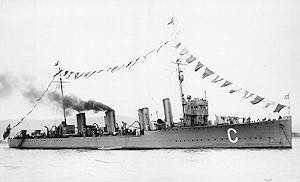 These first two were still active in 1939-45: Almirante Lynch and Almirante Condell. They were joined by the Almirante Williams class in 1919, originally also ordered prewar (Almirante Riveros, Williams, Goni and Simpson) but requisitioned in 1914 as HMS Botha, Broke, Faulknor and Tiperrary, very active in WWI. Resold to Chile in 1920 they became Almirante Williams, Uribe and Riveros, active until 1933. This post is about all these six destroyers, very similar in origin, design, albeit ending in two separate classes.
Development
General Context
In 1910, when the Chileans came with a new naval plan, building large destroyers for the Pacific were part of the naval staff ideas to escort their powerful cruiser force. Chilean President Ramón Barros Luco sent a minister to Great Britain to commission the construction of two battleships and six destroyers. Chile was still reeling from an intense South American rivalry almost a decade prior with Argentina. This had been fed by territory disputes leftover after the Pacific war, leading to an intense naval rivalry between the two, that started in 1887 and went on for more than a decade, eventually ended by British mediation as this weighted financially heavily on their economies, and both were importants partners for Britain. The RN needed notably Chilean nitrate/salpeter (from guano, bird droppings) for its shells. It was used for fertilizers, essential for British agriculture, explosives and munitions and extracted mainly from northern Chile, the Atacama region, especially after Chile gained nitrate-rich territory in the War of the Pacific. By the early 1900s, Chile supplied the majority of the world’s natural nitrates, and Britain was a major customer.
Chile also exported Copper, vital for the whole British electrical wiring industry (and also for RN). British firms invested heavily in Chilean copper mining before WWI. Another export was Iodine,
a byproduct of nitrate production, used in medicine and industrial applications, Wool and Agricultural Products, wheat and other, and Silver, which however declined in relative importance. In return, British capital financed railways, ports, and mining infrastructure in Chile. Many nitrate companies operating in Chile had British ownership. Chile also in return imported British manufactured goods, textiles, machinery, railway equipment.
More so, the Chilean Navy is perhaps the one that had the strongest links with Britain. Not only its ships came from Britain, but its entire naval command structure, tactics, training, academy, even uniforms, were heavily influenced by Britain, just as much as its Army was modelled after the Prussian model. So in 1903, when the race ended, Chile had an armada of cruisers, the Presidente Errázuriz class cruisers (1887), Blanco Encalada (1892), Esmeralda (1894), Ministro Zenteno (1894), O’Higgins (1896) and Chacabuco (1901). It had also four ageing coastal battleships. Chile had been forced to take out a £2 million loan in order to purchase Krupp weaponry in addition to all these ships purchased from Britain, leading the banking industry to suspend loans to Chile until the diplomatic crisis with Argentina was solved. It was through the “pact of may” on 28 May 1902. The paradox was that Chile lacked destroyers to escort all these cruisers.
The 1911 naval plan and purchases
There were the torpedo boats of the Capitano Orella class (1896), Jarpa class (1896), and Ijiniero class (1901). It was obvious they were too small to escort these cruisers in the Pacific and were rather intended for coastal protection. Finances prevented any new plan before 1910, and the new government wanted two modern battleships (none were delivered before WW1) and six modern fleet destroyer, that could escort these or the cruisers out at sea. The ministerial delegation came to Britain to study the purchase of large destroyers, and looked at existing designs. One that retained attention were the Tribal class from 1905, as well as the Acorn, Beagle, Acherons. They approached a naval architect that already designed some Chilean cruisers, J. Samuel White, director of the shipyard under his name based in Cowes.
J. S. White’s docks with its steam sawmills and engine shops, mast and block shops, provided work for c500 craftsmen in the 1870s already and his yard was expanded further in 1899, rapidly becoming a world leader in design and construction of small to medium naval and merchant ships, as well as a lifeboats specialist. Sir Barnes Wallis, later famous as an aeronautical engineer started her as a draughtsman. The proposal from White was a private venture, expecting the Chilean order. The destroyer he proposed were not tied to any RN plan. But these were the largest destroyers planned in Britain at the time, and for this, he needed to expand the shipyard’s facilities, expanding drydocks and purchasing of a large 80 ton hammerhead crane from Babcock & Wilcox of Renfrew, installed in 1912 on the Cowes side of the river, last used in 2004…
Contract for the new destroyers, six to be built, when accepted by the Chilean commission, notably to counter four destroyers ordered by Argentina from France, in 1911 (exact date unknown). They were planned to be started later that year. They were all to be named after past Chilean admirals hence the “almirante class” found in some sources. The class was named after the lead ship, Almirante Lynch. White proposed ships that were significantly larger and heavier armed than their contemporaries in Europe, and that would be the largest in South America with a fair margin. They had four funnels and a tall, narrow fore funnel, three broad, short funnels, a hull that emphasised seaworthiness, as the forecastle was of normal size, but the break deck behind was much higher than usual, mid-way tall, meaning the internal compartments did not matched. But this gave the advantage of a much taller aft freeboard, for better seakeeping in the rough seas of the south Pacific.
The ships were initially designed to be armed with six single QF 4-inch guns, arranged in a pair at the forecastle, two sited abreast the bridge and the remaining on the quarterdeck. This was more of a cruiser artillery than destroyer arrangement. These guns were also the latest and best from Elswick. These ships however would be rearmed in 1918 with a BL 4.7-inch gun on the forecastle and another on a bandstand between the two aft funnels, while still retauning a pair of 4-inch guns abreast the wheelhouse plus two QF 2-pounder pom-poms. They were also noted for their lavish officer’s accommodations, including silver-plated chandeliers in the captain’s quarters. In all, six were ordered at White shipyard, Almirante Lynch, Almirante Condell, Almirante Riveros (ex-Simpson), Almirante Uribe (ex-Almirante Goni) and Almirante Williams.
A construction caught by WWI
The first two were laid down in 1912, launched on 28 September 1912 and 27 January 1913, and commissioned in 1913 and 1914. The big issue that with its limited capacity, White could not start the other four right away as its third dedicated dock was still in construction in 1911-13. Almirante Simpson, Almirante Goni and Almirante Williams were all laid down as soon as the drydocks were free, notably the one housing Lynch and Condell, to lay down these destroyers in 1913. Of course, they were planned to be commissioned by late 1914, but in August 1914, Britain was at war and requisitioned all the ships in construction whatever the customer or type. Chile was not refunded apparently, rather had a promise from the Government to recover the destroyers postwar, and had to be content with only the first two of this class of six, quite a disappointment. The sixth destroyer, Almirante Riveros had to wait for the drydock building Simpson to be free, and the ship, that would have been named so was laid down for the RN as HMS Tipperary, famously sunk at the Battle of Jutland, 31 May 1916.
The ships completed for the RN, Almirante Simpson, became HMS Faulknor. Almirante Goni became HMS Broke, and Almirante Williams became HMS Botha. With Tiperrary that came out later in early 1916, they formed the “Faulknor class” and they were so large they were considered and used as flotilla leaders, seeing a lot of action in WWI. They were appreciated for their seaworthiness, speed and firepower and had some influence on other designs, albeit later flotilla leaders (like the shakespeare class) adopted a more conventional design, with four 4.7 in BL main guns instead. The Faulknor class were seen as a bit odd with their cruiser-like artillery arrangement and were soon rearmed. The topic will be developed in detail in a dedicated article in the future.
Long story short, the war ended in 1918 and the RN was found with a lot of surplus destroyers on its hands. The Faulknor class had survived, with all but one lost (Tiperrary) and were proposed back to Chile in 1919 as they were intended to be placed in reserve and scrapped. Negociations went on as the Chileans wanted a modernization, and eventually were content with the rearmed ships as they were, when returned in 1920: Almirante Riveros, ex-HMS Faulknor, ex-Almirante Simpson, Almirante Uribe, ex-HMS Broke, ex-Almirante Goni. The only one not remained was Almirante Williams
ex-HMS Botha. Chile did had a refund for the missing HMS Tipperary/Almirante Riveros sunk at Jutland. The three ships arrived in Chile in 1920 after some refurbishement and joined their modernized sisters. But they did not served for long, notably due to their intensive wartime service, lacking maintenance and having a mistly worn out machinery compared to their preserved sisters, Lynch and Condell. All three were decommissioned and sold for scrap in 1933. The other two were still around in WW2 and were decommissioned in 1945.
Design of the class
Hull and general design

Profile as completed (Russian Illustration, from pinterest)
The Almirante class were seriously large destroyers, at 1,430 long tons (1,453 t) standard, 1,850 long tons (1,880 t) fully loaded, for an overall length of 101 m (331 ft 4 in), a beam of 9.9 m (32 ft 6 in) and a draught of 3.35 m (11 ft). Their four funnels were the only shared aspect compared to the Tribals, as they were much larger, as well as larger to the contemporary Laforey class destroyern 965–1,010 long tons and 81 meters long (268 ft). The closest in size were perhaps the Medea class ordered by the Greek Navy originally and also requisitioned with 1,040 long tons (1,060 t) and 83 meters. Fisher’s HMS Swift also come to mind, but it was so large that it noes not even register as a “standard” destroyer. Design layout was perculiar as seen above, with a forecastle continued by a lower deck that was mid-way tall, just to avoid making a flush-deck hull. The second pair was located on elevated position between the forecastle and aft deck, and the aft pair were on elevated positions as well. The prow was straight, with a small bulwark and the poop was rounded, cruiser-style.
This mid-height forecastle was unique to this class, never repeated. But it made for exceptional habitability as well. The Lynch class had a long forecastle as well in proportion with the rest, notably to create enough buoyancy forward to support of pair of main guns. The bridge was well developed, with a map room at weather deck level, topped by a fully enclosed bridge, topped itself by a well provisioned open bridge. The forecastle ended with a thin and tall funnel and three large aft, heavenly spaced to exhaust the most gargantuan powerplant of the day. They had a Barr & Stoud telemeter on the bridge, a searchlight projector on a platform on the foremast. They had a similar 3-part mast aft originally. One the ships later requstioned it was reduced to a smaller raked aft mast. The torpedo tubes were located between the 3rd and 4th funnels and behind of the aft mast, four single 45 cm initially. They had six boats under davits for a crew of 160 officers and ratings. However in 1920 this was closer to 197 and in 1939-45 it reached c205 men.
Powerplant

The Lynch class in Janes 1930
The Almirante class had 3 shafts with three Parsons steam turbines fed by six White-Forster boilers for a total of 30,000 shp (22,000 kW). This was enough for a top speed of 30 knots (56 km/h; 35 mph), with 31 knots obtained on light, with forced heat on sea trials. To be precise, on 6 hours trial runs, Almirante Lynch cranked up 31.8kts, and Almirante Condell even reached 33.4 kts. The yard obtained bonuses. However for the second series in 1920 it had been reduced by wear and tear, plus wartime armament additions, to c28 knots at best. They carried a total of 427 tonnes of coil and had sprinklers to boost the burn rate, with a reserve of 80t oil originally for a range estimated to 2,750 nautical miles at 15 knots. The Lynch class had their machinery modernized in 1930. Boilers were converted to burn oil only for a range that jumped to 4200 nm at 15 kts.
Armament
These destroyer diverged, as the ones requisitioned were stabdardized to British standards. On plans, the Lynch class had six single 4 in (102 mm) guns in three pairs as decribed above, two twin 21 in (533 mm) torpedo tubes or four single tubes and two Vickers 7 mm Machine guns. A single 37 mm Vickers pompom (1.5 in) AA gun was added on Botha & Tipperary during the war.
Eventually they were rearmed, with two single 4.7 in (119 mm) guns, one fore, one aft, and retaining 4 in (102 mm) guns admiship, the two single 2 pdr 40 mm (2 in) pompom AA guns and same torpedo tubes as before.
102/40 (4-in) Armstrong Pattern S
Weight 2,912 pounds (1,320 kg) (barrel & breech), barrel lenght 159.2 inches (4.044 m), elevation/traverse -10° to +20°, 300°. Loading system: Welin, single-motion screw breech. These 4-in gun could fire at a rate of 15 rpm a shell weighting 14.06 kg with a bursting of charge of 0.82 kg at a muzzle Velocity of muzzle velocity 2,287 feet per second (697 m/s), 590 tm at the barrel. Range was 10.6 km. In 1915, they lacked punch and were to be replaced by the 4.7 inches BL as soon as possible.
4×1 torpedo launcher 18-in (origin)
Originally it seems they were planned instead with four indivisual 18 inches or 457 mm torpedo tubes. One was located between the 2nd and 3rd funnel, another between the 3rd and 4th, and a twin mount aft of the rear mainmast. The ships also had two Vickers machine guns 7 mm (0.28 inches) for close quarters.
Twin torpedo launcher 533.4mm Mk IV (second serie)
In British service, the ships had two twin mounts 21-inches between the 2nd and 4th funnel. Full torpedo mass 1,454 kgs. Length 6.90 m, warhead 234 kg. Range setting 7.3 km at 35 kts.
The Lynch class were given two twin 533mm TT in turn during their 1930 modernization.

Lynch profile in the 1930s
⚙ specifications 1912 |
|
| Displacement | 1,430 long tons (1,453 t) standard, 1,850 long tons (1,880 t) FL |
| Dimensions | 101 x 9.9 x 3.35 (331 ft 4 in x 32 ft 6 in x 11 ft) |
| Propulsion | 3 shaft Parsons direct turbines, 6× White-Forster boilers: 30,000 hp (22,371 kW) |
| Speed | 31 knots (57 km/h; 36 mph) |
| Range | 4,205 nm (7,788 km; 4,839 mi)/15 knots (28 km/h; 17 mph)* |
| Armament | 6× 4 in (102 mm), 2×1, 1×2 18-in (457 mm) |
| Crew | 160 (197 in ex-British ships) |
*After oil conversion 1930
Career of the Almirante class
Almirante Lynch (1912)

Launch of Almirante Lynch in 1913.
Almirante Lynch laid down in 1912, launched on 28 September 1912 and commissioned in 1913. She sailed in Chile and entered service with the Armada de Chile. No logs of service. In 1930 she was modernized like her sister, with her boilers converted to oil-only combustion, for a net gain of range (almost double), likely at 500+ tonnes. She was also rearmed with two twin 533 mm or 21-inches torpedo tubes replacing their original single 450 mm tubes. Almirante Lynch remained operational in 1939-45, sidelined after the adoption of the Serrano class destroyer built 1927-29 at Thornycroft. It’s likely they mainly operated for training. After the loss of her sister in 1944, Lynch was eventually decommissioned in 1945 and sold for BU.
Almirante Condell (1913)
 Almirante Condell was ordered in 1912, laid down that year, launched on 27 January 1913 and completed in January 1914. She was named after Admiral Carlos Condell, Chilean sailor, hero of the War of the Pacific. She departed for Chile later in 1914, and joined her sister at Valparaiso. The details of her service in WW1 and the interwar are unknown. Like Almirante Lynch she was taken in hands in 1930 to be modernized, with her boilers converted to oil-only combustion, for a net gain of range (almost double), likely at 500+ tonnes. She was also rearmed with two twin 533 mm or 21-inches torpedo tubes replacing their original single 450 mm tubes. In 1944 she was apparently damaged by an accidental explosion and never repaired or recommissioned. She was officially discarded and stricken in 1945, sold for BU.
Almirante Riveros (1914)
Ordered initially as Almirante Simpson, she was launched on 26 February 1914 and requisitioned while in completion for the RN. She was completed on 25 August 1914 to the latest RN standards, rearmed for a final tonnage of 1700 tonnes standards, renamed HMS Faulknor. She became the lead ship of a class of flotilla leaders, comprising other sisters in class, Brke, Botha and Tiperrary. HMS Faulknor had a long and colorful career, ending the war in 1918 with the battle honours “Jutland 1916”, “Dover Patrol 1916–18”, “Zeebrugge 1918” and “Ostend 1918”. In 1919 alongside her sisters Broke and Botha, she was proposed to Chile and sold back in April–May 1920, renamed Almirante Riveros. She had been considerably changed during her wartime service and became the first of a separate class called Almirante Williams class. She took part in the Chilean naval mutiny of 1931, hit several times by shells from the Chilean Army attacking Talcahuano. One of her boilers exploded, and she retreated to Quiriquina Island. Five of her crew were killed. Thus damage and in general the fact of being burned out from WWI service, and despite the high maintenance standards of the Chilean Navy meant she was stricken in 1933, sunk as a target by the battleship Almirante Latorre, on 10 April 1939.
Almirante Uribe (1914)

As HMS Broke in WW1
Originally ordered as Almirante Goni in 1912, she was launched on 25 May 1914 and Acquired in August 1914 by the RN, then Completed on November 1914 renamed HMS Broke. She was present at the Battle of Jutland on 31 May to 1 June 1916, when out of control after hits from German ships, she collided with the Acasta-class destroyer HMS Sparrowhawk. The latter, much smaller, wwas broken in two and sank. Broke saw action in several battles, gaining honours, and she was mothballed in 1919. After negociations, she was resold to Chile and renamed Almirante Uribe in her transfer by 1920, sent to Chile. No logs for the interwar, no modernization. She was eventually sold for BU in 1933 like her sisters of the Almirante Williams class.
Almirante Williams (1914)

As HMS Botha in WW1
Almirante Williams was the 5th ship ordered by the Chilean Government in 1912. Due to the limited space at JS White shipyards, she was laid down in late 1913, and was still not launched when the war broke out. She was acquired in September, launched on 2 December 1914 as HMS Botha and only completed to RN standards in March 1915. As Botha she was quite active, as a flotilla leader, and initially assigned to the Grand Fleet, but then transferred in 1917 to the Dover Patrol. She was back with the Grand Fleet in 1918.

As almirante Williams in 1930
Negociations in 1919 with Chile had her resold to the Armada in 1920 when she was renamed back to Almirante Williams Rebolledo. After she arrived in Chile her whereabouts are unknown. She was not modernized, and eventually decommissioned and sold for scrap in 1933 like her sisters.
Almirante Riveros (1915)

Riveros was the sixth and last ship ordered by Chile in 1912. Due to the lack of space at JS Samuel White, her keel laying was postponed in 1914. She was launched on 5 March 1915, acquired in September 1914 by the British Government, renamed HMS Tiperrary and Completed in June 1915. As part of the Faulknor-class flotilla leader, she was initially assigned to the Harwich Force, but was transferred in 1916 to the Grand Fleet. In that unit she fought and was sunk during the Battle of Jutland on 1st June 1916.
Read More/Src
Books
Conway’s all the world’s fighting ships 1905-1921, 1922-47.
“Buques de Guerra Chilenos” pages 356-360.
“Морская Кампания” Year 2007 Number 2 Publication 5 pages 16 onwards
Jane’s Fighting Ships 1940
Links
navypedia
battleships-cruisers.co.uk
Plans (youtube)
shipsnostalgia.com
forum.warthunder.com
en.wikipedia.org Samuel White
bartiesworld.co.uk
armada.cl
Almirante Lynch class wiki
Model Kits
Gallery


