
 Ten aviso planned, 9 completed 1931-39:
Bougainville, Amiral Charner, Dumont d’Urville, D’Entrecasteaux, La Grandière, D’Iberville, Rigault de Genouilly, Savorgnan de Brazza, Beautemps-Beaupré, La Pérouse*
The Bougainville class were considered as “colonial aviso” (or sloopin some sources), designed as substitutes to cruisers, to operate and police waters in distant colonial outposts of the French Empire, aside existing naval bases between North and West Africa and Indochina. They played the role of gunboats, but resembled stocky destroyers, with heavy guns and a minelaying capacity as deterrent plus a seaplane for reconnaissance. Ten were ordered, the last, La Pérouse & Beautemps Beaupré were of a new design, never completed or cancelled. Of the remainder, they were split between Vichy French and the Free French. One was scuttled in Toulon, one sunk by HMS Pandora in July 1940, one scuttled in 1945, the remainder survived. Savorgnan de Brazza, in Free French service, fought and sank her Vichy-held sister ship Bougainville at the Battle of Libreville on 9 November 1940, a unique case in WW2.

Development
No Gunboats in the French Navy ?
In 1939 when the second world war started the French Navy had no proper gunboat (canonnière) in service. The only “gunboats” in service still in 1940 were the Ardent class of 1916 but the survivors in 1940 had been reclassed as “2nd-class aviso”. They were originally designed for escort and ASW patrol and were much too small for the tasks of a colonial flagship. One of the inspirations for the new “1st class aviso” that was discussed in the naval staff back in 1925 when the need for such replacement class was first expressed, was the 1917 Friponne class. They were similar in many aspects to the Ardent, but powered by Sulzer diesels for 14.5 knots, 315/410 tons and 66.4 meters long, range 3000 nm. But they had a low freeboard and were designed to operate in shallow waters. None were around in 1939, all had been retired or sold to the Romanian Navy. The Vaillante class gunboats (1917) were another evolution, still around in WW2 but as “2nd class aviso” as well. Conquerante was seized by the British in July 1940 during Operation catapult but sunk at Falmouth in 1941 by the Luftwaffe. They were also in essence the last French “ASW gunboats”.

The Friponne class diesel ASW gunboats (1917)
These ships all had clear limitations in size, armament, range, speed, and versatility, so the French Navy, despite its tonnage limitations by treaty, was in principle free to build categories of ships not comprised in the initial treaty nor the London treaty. That means the Marine Nationale was free to have all types of vessels below the 600 tonnes standard. Unlike Italy or Germany, this niche was seldom exploited, but by a few torpedo boats (two classes started in the 1930s). There was a free range of minelayer/minesweepers, sloops, gunboats to exploit, the only limiting factors being budgetary constraints and shipyard capacity.
So by 1925 the replacement for these ships and the newly expressed needs for « avisos pour campagnes lointaines » (“sloops for far away campaigns”) were designed in 1926, with specifications laid down to be proposed to private shipyards, not the usual military shipyards that were already fully booked at the time. The parliament ratified this class, also unnamed still but under the “1st class aviso” type, and the Minister of the Navy of the time, Georges Leygues, managed to approve the programme and have it financed by the naval law for the “tranches” FY1927, FY1928, FY1930, FY1931, FY1937 and FY1938ter. This was confirmed by the next minister, René Renoult. Leygues returned to office in 1926-1930 and “sanctuarized” them.
The Bougainville-class avisos were a unique product of the interwar French Navy. They had been designed for colonial service abroad, and to cope with austere conditions, little maintenance and support. So they needed to be pretty autonomous in the defennce of far-flung outposts of the Empire. Endurance was a primary consideration, with accomodations that were tailored to cope with tropical climates. In case of combined operations, they had to also accomodate an admiral staff as flagship for overseas divisions. Air conditioning and well though after insulationhad been integrated in the design, as an on-board seaplane, rare for a gunboat or sloop-class vessel. The last two, Beautemps-Beaupré and La Pérouse, had a modified design featuring a single funnel and were modified to act a survey ships.
This series was the first of the French Navy’s surface ships to be powered by diesel engines. They had been originally intended for operation within the French colonial empire, and with their very long range and shallow draught, could also navigate upriver either in Africa or Asia, and carry a company of marine infantry for landing parties. Their fuel capacity was 60 tons, for fuel oil and 220 tons of diesel fuel. The choice of a seaplane was there early on too. Construction of the ships was mostly done at Bordeaux, either Chantiers Maritimes du Sud-Ouest or Forges et Chantiers de la Gironde, Lormont. There was a single exception, Chantiers et Ateliers de Provence, Port de Bouc. In all the latter case, she was fitted out and armed at Toulon, and her sisters made in Bordeaux likely were armed at Brest.
The construction programme included Bougainville (FC Gironde à Bordeaux), first laid down on 25 november 1929, launch 21 avpil 1931, commissioned 15 feb. 1933 for FY1927. Dumont-d’Urville was the second, at Chantiers Maritimes du Sud-Ouest (CMSO) on 19 nov. 1929, launched 21 march 1931, commissioned 4 june 1932. FY1929 tranche included Savorgnan de Brazza (1931), D’Entrecasteaux (first ordered from CAP, Port de Bouc) (1931), Rigault de Genouilly (1932) and Amiral Charner (1932). FY1931 only included D’Iberville (FC Gironde, 1932) and FY1937 comprised the sole Ville d’Ys, later renamed La Grandière (second at CAP Port de Bouc, French Riveria) launched in 1939, commissioned 1940. The last two FY1938 were Beautemps-Beaupré and La Pérouse, both from Forges et Chantiers de la Gironde. Note that the names were all from French explorers of the past centuries.
Semantics on “aviso”
The name “aviso” is an old one, used both by the French and Germans for a time. The term derived from “avis”, and the sailing navy of old, when fast cutters were used to carry dispatches (“avis”) from the flagship to the rest of the fleet. So it means basically “dispatch vessel”. The term was however used almos interchangeably with “cannonière” (“gunboat”). Some authors also use “aviso” as a loose equivalent to “sloop” for which the French used the exact same word but only for small sailing vessels as it based on the same Dutch root “sloep”.
A variant, the “cotre” (“cutter”) was indeed used as despatch vessel. The term “aviso” was used alternatively for small cruisers in the German Navy before its extension in the 1890s, but disappeared, whereas it remained in use until recently in the French Navy. The next French ‘aviso’ were the 1850-60s Commandant Rivière (“aviso-escorteur”) followed by the 1980s A69 D’Estienne d’Orves-class in about the same role. They had been in turn replaced recently by the civilian-grade Floréal class Frigates (assimilable to very large OPVs).
Design of the class

Hull and general design
These avisos were large ships at any standard, larger than most gunboats in use in many minor navies of the time. They looked like compact destroyers (without torpedo tubes) and had an intmidating appearance which was part of the package. Their overall length was 103.7 metres (340 ft 3 in), for a beam of 12.7 metres (41 ft 8 in), and draught of 4.15 metres (13 ft 7 in). So they were slightly shorter than the contemporary Bourrasque and L’Adroit class destroyer, but much wider. The destroyers had a beam of 9.8 meters only. Draught was inferior however, and that ratio was to preserve buoyancy and stability as shallow-draught and inland waterway operations were mandatory. They had counter keels and a straight chin. Anti-collision bars were wlded aft at the poop to protect the propellers. Single axial rudder and the shafts had V-struts. Two main anchors forward, one aft axial.
They displaced much more than a destroyer in fact, at 1,969 tonnes (1,938 long tons) under standard load and 2,600 tonnes (2,600 long tons) deeply load. The crew amounted to 14 officers and 121 ratings in peacetime but it could rise to 150+ inclusing as flagship in wartime. Design-wise, the hull had fine entry lines and a clipper stem and poop, but the hull was very much slab-sided for most its lenght. The proportions were about the same as a destroyer for the forecastle cmpared to the aft deck, but with fuller hull lines fore and aft, and an amount of sheer at the prow. Decks were wooden all the way, and ventilation hatches were assorted with pumps to foce air circulation. They were the first French ships provided with an air conditioning system, powered by an auxiliary generator.
The bridge superstructure were better developed than for a destroyer, albeit the overall appearance was the same. Past the two superfiring guns there was a supplementary superfiring deck large enough to mount light AA, followed by the three-faceted enclosed bridge topped by the open bridge. A rangefinder on a raised platform was located there. Behind was the tripod mast, supporting the searchlight platform. A spotting top was located higher up. The raked tripod was connected to the aft pole mast via the radio cables. Past the forecastle cut, unlike a destroyer, the deck continued beam-wide, forming a gallery either side to shade the crew.
This wide deck was dotted by the two raked funnels, a few hatches, and a fleet of seven utility boats, yawls, whalers, cutters, served by two gooseneck cranes. Further aft was the aft mainmast and quarterdeck structure, supporting also a searchlight platform. There was a single masked gun aft, not on deck but superfiring. The aft deck itself was free apart a capstan, but with apparatus to manage minelaying. Theere optional mine rails running from the quartedeck house level down to the poop on rail chutes. They could carry 24 mines in stadard configuration but more were possible (see notes). They also had four paravanes located aft of the second funnel on either sides. The space freed between the latter funnel and mainmast, which had a service boom, was to keep a seaplane resting on a chassis frame (see below).


Powerplant
As per the specifications, the ships had to be long-range, speed was not a factor. Hence the choice of diesels made early on, a novelty that had two benefits: Freeing a lot of space otherwise dedicated to the couple VTE +boilers for more compact diesels and extra fuel oil. This choice was well suited for shallow-draught vessels and freed also space for extra accomodations.
The Bougainville class had two license-built six-cylinder diesels. They could be, depending on the yard, either Swiss Sulzer, or Danish Burmeister & Wain types. Each had the same nominal power and driving a single propeller shaft, 3-bladed bronze fixed pitch (diameter unknown).
Savorgnan de Brazza for example, like Dumont D’Urville, D’Iberville, Ville D’Ys had two Sulzer 2-stroke engines rated for 4,200 metric horsepower total (3,089 kW; 4,143 bhp). Designed speed was 15.5 knots (28.7 km/h; 17.8 mph). Bougainville, D’Entrecasteaux, Rigault de Genouilly, Amiral Charner, Beautemps Beaupré, La Pérouse had two Burmeister & Wain diesels. On sea trials, Savorgnan de Brazza (Sulzer) managed 18.3 knots (33.9 km/h; 21.1 mph), apparently the second best speed in class. Dumont D’Urville (Sulzer) managed 17.2 kts and Amiral Charner (B&W diesels) was the fastest at 18.9 kts.
It seems the average output was 3,200 bhp based on the metric system, as stated in many sources. The ships carried 297 tonnes of diesel fuel (conways) for a range of 9,000 nautical miles (17,000 km; 10,000 mi) at 14 knots (26 km/h; 16 mph), however French sources gave the following:
-13.000 nm (24.000 km) at 8,5 kts (15,7 Km/h)
-10.000 nm (18.520 Km) at 10 kts (18,5 Km/h)
-7.600 nm (14.000 Km) at 14 kts (26 Km/h).
Protection

The hull was subdivided by 10 transverse bulkheads making for 11 watertight compartments for ASW protection. The lower hull and keel were assembled from 50-kilogram (110 lb) mild steel but the upper plating, deck and ammunition lobbies, as well as the armoured gun shields, bridge, deckhouses and aft-funnel crown were all made of high-tensile 60-kilogram (130 lb) bullet-proof steel in a chrome-cobalt-molybdenum alloy. This was similar to Ducol (‘D’) in the RN. For riverine operations, just as any gunboats, these avisos could afford to withstand small arms and machine gun fire from the shore.
Armament
Given their role, the ships were armed as gunboats. No torpedo tubes were procured. They were rearmed later in their career (see below) but originally they carried three 138 mm (5.5 mm) main guns, shielded, same model as the large “contre-torpilleurs”. They also had four 37 mm AA guns (1.5 inches), and six heavy machine guns in three twin Hotchkiss 13.2 mm mounts (0.5 inches). Optionally they could carry 50 mines, depending of the type. It seems also Dumont D’Urville, Bougainville, Savorgnan de Brazza, D’Entrecasteaux, Rigault de Genouilly, Amiral Charner, D’Iberville: had six single 8.80mm Hotckiss light AA MGs instead. All were fitted to carry and lay 50 mines, and had an unarmed seaplane (GL.832 or later Potez 542). Beautemps Beaupré, La Pérouse had the two twin 37mm installed first, and apparently they received the first a complement of four 20mm/70 Oerlikon Mark 4 in complement.
Main Guns: Three 138.6mm/40 M1927 (5.5 inches)

Museum preserved Model
The M1927 were designed to be faster-firing compared to the M1923, albeit the range was inferior to the M1923. The Canon de 138 mm Modèle 1927 was indeed derived from a German World War I design and adopted for the Aigle, Vauquelin classes DDs, Bougainville-class sloops. Overall, they were faster guns with a firing cycle of 4 or 5 seconds thanks to their automatic spring rammer, but this was broken by their antiquated dredger hoists transporting shells and cartridge cases, so they ended at 8-10 rounds per minute practical, which was even worse than for the M1923 of the previous class.
Shells:
-SAP M1924: 88.0 lbs. (39.9 kg); 26.9 in (68.3 cm) (called OPFA Mle 1924)
-HE M1928: 88.6 lbs. (40.2 kg); 26.9 in (68.3 cm) (OEA Mle 1928)
-Starshell M1925: 66.1 lbs. (30.0 kg) (OEcl M1925)
-Bursting Charge SAP: 5.1 lbs. (2.3 kg) Melinite
-Propellant Charge: 19.8 lbs. (8.97 kg) BM7, cartridge 48.5 lbs. (22 kg) Brass 900 x 187.5 mm
The shells used specific colors (dispositif K) to distinguish ships fire in combat by the late 1930s. The SAPhad a red primer for the lead ship in flotilla, green for the second and white (later yellow) for the third.
Magazines for held 100 SAP and HE rounds per gun, plus 85 starshell. Stowage racks had 24 ready rounds for all but N°3 which was given 48 rounds given the most complicated reload process.
These guns had a long range but were hampered by their obsolete 3m coincidence rangefinders effective only out to 12,000-13,000 m. They were protected by “wrap around” shields.
⚙ specifications 138.6mm/40 M1927
Weight: 4,100 kg (9,000 lb)
Barrel length: 5.544 m (18 ft 2.3 in)
Elevation/Traverse -10/+28 degrees, 300°
Loading system: semi-automatic spring rammer, horizontal sliding-block
Muzzle velocity: 700 m/s (2,300 ft/s)
Range: 28 degrees: 16,600 m (18,200 yd) SAP
Guidance: Optical + FCS
Crew: 7-8
Round: 130x900mm R Separate-loading, cased charge
Rate of Fire: 8-10 rounds/minute
Canon de 37 mm Modèle 1925 (1931)

The ships had four Canon de 37 mm Modèle 1925. Two were installed on deck either side of the rear bridge structure and the other two either side of the quarterdeck house. All in single gun mounts, hand-loaded and semi-automatic guns with unitary rounds, they still had a low rate of fire compared to their clip-fed equivalents. The projectiles were also quite light and gave an overall poor anti-aircraft capability, the dark side of French naval vessels up to WW2. Many were captured by the axis and reused in WW2 under different names.
⚙ specifications 37mm M1925 Gun
Mass: 300 kg (660 lb), Length 2 m (6 ft 7 in), barrel 1.8 m (5 ft 11 in).
Shell 0.72 kg (1.6 lb) 37 × 278 mm (1.5 in)
Elevation −15° to +80°, traverse 360°, 15-21 rpm, mv 810 m/s (2,700 ft/s)
Effective range: 5,400 m (5,900 yd) at +45°, max 7,000 m (7,700 yd).
Mitrailleuse Hotchkiss de 13,2 mm
 Initially three twin 13.2 mm/75 heavy machine guns were installed, one in front of the bridge on the second superfiring platform, one aft of the bridge and in front of the first funnel and one located either on the quartedeck house, facing aft, or on the aft deck. They had a high rate of fire system on a light mount designed by Le Prieur. This was a Gas-operated system fed by 30-round box magazine, or 15-round feed strips. It was copied by Japan and Italy and used by the axis in WW2. The round was peculiar in this it was a 12.7 × 99 mm Browning (.50 BMG) cartridge necked up to 13.2 mm caliber. A short round (96 mm) was introduced in 1935. It was mostly adopted for fixing the barrel wear issue.
⚙ specifications 13.2mm M1929 HMG
Mass 37.5 kg (83 lbs) per gun stripped.
Length: 1.67 m (5 ft 6 in), Barrel 1 m (3 ft 3 in)
Shell: 13.2×99mm Hotchkiss Long (1929).
Elevation -10° to +90°, traverse 360°, 450 rpm cyclic, 200-250 rpm sustained
Muzzle velocity: 800 m/s (2,625 ft/s)
Max range: 7.2 km (4.5 mi), Effective 4,200 m (13,800 ft)/45°
Mines
-Sautter-Harlé modele H4/H4AR (1924) 1.04 m 1.13 ton coastal mines
-Sautter-Harlé modele H5/H5AR (1928) 5-switch horn type 1.04 m (41 in) 1,160 kg (2,557 lbs.) 220 kg (485 lbs.) TNT charge.
French sources also states some received a single ASW DC rack and two Thornycroft throwers, likely by 1940.
Air Group
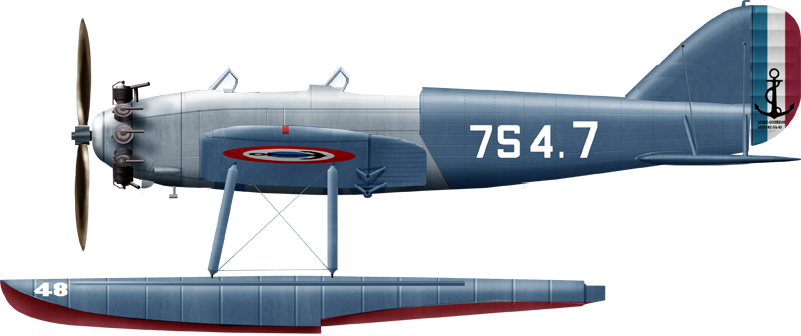
The Bougainville class aviso lacked a catapult but carried a floatplane for observation and artillery spotting, notably for shoer bombardment or in naval operations. This was according to Frenc sources, either a Gourdou-Leseurre GL-832 HY when completed, or a later a Potez 452. They were lifted up and down at sea by the mainmast boom, but this required calm waters, especially for recovery. Indeed, pilots managed to start the engine while the aircraft was still lifted down, in order to keep away from the hull as soon as they were at sea. The presence of these was not systematic and depended on local conditions. Sometimes, seaplanes were operated by a shore base instead. See the relevant pages for more.

⚙ Bougainville class specs. |
|
| Displacement | 1,969 t (1,938 long tons) standard, 2,600 t (2,600 long tons) FL |
| Dimensions | 103.7 x 12.7 x 4.15 m (340 ft 3 in x 41 ft 8 in x 13 ft 7 in) |
| Propulsion | 2 shafts diesel 4,143/4,322 bhp (3,089/3,223 kW) |
| Speed | 15.5 knots (28.7 km/h; 17.8 mph) |
| Range | 9,000 nmi (17,000 km; 10,000 mi) at 14 kts |
| Armament | 3× 138.6 mm, 4x 37 mm AA, 4×2 8 mm LMG, 50 mines |
| Protection | Deck 6 mm, Gun shields 3 mm |
| Air Group | Optional Seaplane |
| Crew | 14 officers and 121 crewmen |
The Planned Beautemps-Beaupré
picccc
The last two ships in class, Beautemps-Beaupré and sister Lapérouse were both ordered at F C de la Gironde, Bordeaux in 1937 as part of the FY1937 tranche, launched on 20 June 1939 but scuttled incomplete, at 84%, on 24 June 1940 as the Germans were closing on the yard (Bordeaux fell under axis control) like the whole coast down to the Spanish frontier. Her sister was ordered as part of the FY1938 tranche, never laid down, cancelled in 1940. They were redesigned completely, as survey ships. Their superstrcuture was remodelled as the Hardi class destroyer, they had a single funnel, and a new armament made of four (two twin) 100mm/45 M1933, in turrets fore and aft, two twin 37mm/50 M1933 AA and four single 20mm/70 Mk 4. The superstructures were rearranged and they had no seaplane.
Wartime Upgrades
Avisos under control had little occasons of upgrades, unlike ships which fell under Free French control that benefited from allied support: La Grandière was a good example as she was completely modernized in 1944. Her new fitting for armament comprised four Bofors 40 mm/60 AA replacing the 37mm, and no less than thirteen Oerlikon de 20 mm/70 AA in twon and single mounts, replacing the Hotchkiss 12.3 mm. She also had a full ASW suite, with four depht charge thrower and six loaders for sixty-six ASW grenades, 180 kg each. La Grandière also a US standard SA radar, SF, and a QJA sonar model 1942/43 and an ASAP.
Savorgnan de Brazza was also modernized in 1940. The mainmast was removed, a platform with two additional twin mounts for 37 mm AA guns and twin-gun 8 mm Mle 1914 Hotchkiss LMGs installed. The rangefinder was moved from the roof of the bridge, to the aft end AA platform. Two 25-mm (1 in) Hotchkiss AA guns were added on the forward superstructure. Newt, two twin mounts 13.2-millimetre (0.52 in) Mle 1929 HMGs were also added. Another pair of twin 8 mm M1914 were installed on the quarterdeck. The aft pair of paravanes were replaced by smoke generators. She also gained four Thornycroft Mle 1918 depth-charge throwers (quarterdeck), and a rack for F28 depth charges at the stern. The port mine rail was replaced by one handling two 200-kilogram (440 lb) depth charges. She was moved to Cherbourg on 29 May 1940 to received a new 4-metre (13 ft 1 in) rangefinder installed on the bridge roof and a British Type 128A ASDIC.
But Savorgnan de Brazza also lost her seaplane for all these additions. In the winter of 1940, her ASDIC installation was completed, and her 13.2 mm forward of the bridge were moved to the forecastle deck with 20mm (0.8 in) Oerlikon installed instead. Later she was refitted in UK by late 1941: She received an all-British ASW suite (DCR and DCT) and the latest radar to pickup surfaced submarines by night. A Type 271 surface-search radar was installed on the bridge, a Type 286 search radar on the mast. She had 12 depth charges, 4 Thornycroft DC throwers with ready racks for three each.
Others had more of less limited upgrades. In 1941, Dumont D`Urville lost her seaplane, but for sour single 37mm/50 M1925, two 25mm/60 Bofors M1938, two twin Hotchkiss 13.2mm/76, and two 8.80mm Hotchkiss LMG AA remaining. In 1944, D’Entrecasteaux in FFL service lost her four single Hotchkiss 0.3 in for six 13.2mm/76 Hotchkiss HMGs. Dumont D`Urville the same year lost all her 37mm/50, and her two 25mm/60 M1938 plus twin 13.2mm/76 Hotchkiss and LMGs for four 40mm/56 Bofors Mk 1.2 AA, and eleven 20mm/70 Mk 4 Oerlikon, four DCT, two DCR (66), and the SA, SF radars, QJA sonar like La Grandière. Savorgnan de Brazza howeve gained a twin 37mm/50 M1933 AA, three single 25mm/60 M1938 AA, two 20mm/70 Mk 4 Oerlikon AA, two twin 13.2mm/76 Hotchkiss and the same ASW and radar, sonar suite.
Career of the Bougainville class
 Bougainville (1931)

Bougainville (after Louis Antoine de Bougainville) was laid down at FC de la Gironde, Lormont in late 1927, launched on 25 April 1931, commissioned on February 15, 1933. She sailed to take on her firtst station in Asia and in the Indian Ocean but by 1935, wit the Abyssinian crisis she was back in the eastern and southern Mediterranean. In early 1939 she was based in Djibouti. As the war broke up she was recalled to Toulon escorting a group of submarines, placing a small landmark on the Possession Island (Crozet) while stopping there on January 26, 1939. This was part of a mission in the southern Indian Ocean, bound for the Crozet, Kerguelen, Saint-Paul and Amsterdam Islands, under command of Commander Fabre de la Ripelle. Naturalist René Jeannel studied the fauna and flora of these subantarctic islands. During the official naming ceremony for the Kerguelen Islands, the aviso, gave its name to the Bougainville peninsula, south of Grande Terre.
Back to WW2 and she operated from Toulon as an escort ship until France fell. She was then sent to Africa, protecting Libreville, Gabon’s capital, part of the French west African colonial empire. On November 9, 1940, Savorgnan de Brazza (Lieutenant Commander Roux) led the battle of Libreville, in what became arguably one of the strangest naval battles of WW2. That day, Bougainville’s commander spotted an approaching Free French Naval Forces (FNFL) other vessel, loaded with troops and intended to take the city under orders of De Gaulle. Bougainville, commanded by Lt.Morin remained like the governor, under Vichy French control.
FS Savorgnan de Brazza, part of a flotilla commanded by admiral Thierry d’Argenlieu, entered the port and bay, arrived at a distance to make a challenge with its morse projector. The challenge was simple, join the Free French or surrender the ship. Lieutenant Commander Roux was in a base position. A good third of its crew was on land, left ashore to defend Libreville against a land assult by Colonel Leclerc. Thus, the ship remained at anchor, and the crew manned the guns as he replied that he was under orders to resist any takeover. Lt.Cdr Roux made another plea, which was again refused, and after a warning shot, Bougainville fired back at Savorgnan, starting the battle.
But this fratricidal exchange lasted only twenty minutes. Bougainville’s guns were the first targeted, after which the well trained FFL gunners aimed at the bridge, and continued to pummel the supersttructure at a relatively short range (and decreasing). Bougainville ended ablaze, with many deaths and injuries and the white flag showed up just as abandon ship orders were given. Rather than fighting the fire, Captain Mprin ordered to open the cocks and she ship sank, settling on the bottom upright. General de Gaulle was denied the ship. Bouganville was later refloated to free the port, and scrapped. But Gabon fell to the Free French anyway, the first of many territories that would do so by force or negociations.
Amiral Charner

Amiral Charner was named after another explorer and admiral, Léonard Charner. She was built at AC Maritime de Sud-Ouest, Bordeaux, laid down in 1930, launched on 1 October 1932 and commissioned in 1933. Designed for service in the French colonies she was posted in the Far East, Indochina station for most of the interwar and until WW2 started. On January 17, 1941, under overall command of Admiral Bérenger, hoisting his flag on Lamotte-Picquet, she accompanied the sortie in what became the Battle of Koh Chang, the naval side of the Franco-Thai war. This would be her only significant action part of the only victory for the French Navy without other Allied ships. Charner then escorted convoys in the Indian Ocean, but still under Vichy French control. With the Japanese coup of March 9, 1945, she was scuttled by her crew in the port of My Tho, where she was docked under refit, to avoid capture.
Dumont d’Urville

Dumont d’Urville, named after Jules Dumont d’Urville, a polar explorer, was laid down in Bordeaux in 1927, launched on 21 March 1931 and commissioned in 1932. No records for the interwar. After the Fall of France in June 1940, Dumont d’Urville remained under Vichy French control. By September 1940, she was in New Caledonia in order to keep control of the French colony againsty Free French or allied attempts. However, the Royal Australian Navy cruiser HMAS Adelaide arrived, carrying a new Free French temporary governor, Henri Sautot. He landed along at first, backed up by a Free French party reinforced by an Australian party, and negociated the departure of the Vichy French governor aboard Dumont d’Urville on 25 September. New Caledonia became the most important local possession for future operations at Guadalcanal.
Dumont d’Urville sailed to the closest Vichy-held naval station, in Indochina, incorporated into the French Far East Naval Forces. On the night of 16–17 January 1941n Dumont d’Urville took part in the Battle of Koh Chang. Along with the WWI avisos Tahure and Marne she surprised the Thai fleet at anchor off Koh Chang. The flotilla led by the Cruiser Lamotte-Picquet sank two armored coast guard vessels, three torpedo boats, and damaging several other units, and returned unharmed at naval base Poulo Condor. It seems she later fell under Free French authorities and was assigned Atlantic escort work.
In September 1942, she rescued survivors of RMS Laconia, torpedoed by the German submarine U-156. In 1944, she was modernized. She remained in service until the end of the war. By September 1946, Dumont d’Urville transported Ho Chi Minh and his delegation back to Indochina from the Fontainebleau Conference, after the failure of negotiations. She took part in the shelling of Haiphong under orders of D’Argenlieu on November 23, 1946. She remained in service with the French Navy until March 1958, before being scrapped.
D’Entrecasteaux (1931)
D’Entrecasteaux (after Antoine Bruni d’Entrecasteaux) was laid down in 1928 at AC de Provence (Chantiers et Ateliers de Provence shipyard), Port-de-Bouc, launched on 22 June 1931, completed in 1933. She fully commissioned in Lorient, sailed in the Atlantic and Pacific Oceans and arrived to the Grand Banks of Newfoundland in 1934. No more interwar records. In 1939 she was stationed in Casablanca. She left Morocco for Senegal on September 5, 1940, participated in the defense of Dakar for the Vichy French Forces on September 23-25. On May 6, 1942, she was present at the Diego-Suarez base, taking part in the Battle of Madagascar. After a challenge by the RN which was refused, she was gunned into submission, badly damaged and her captain had her running aground in flames lest she sank, at Baie des Cailloux Blancs. 16 were killed. None on the British side. Refloated on April 3, 1943, repaired, she joined the Allied forces after a refit. In 1944, she sailed to the Indian Ocean via Diego Suarez, Aden, Djibouti in escort. On August 4, 1944, she was in Bizerte, placed in reserve until struck from the lists on October 19, 1948. She was sold to the Tunis State Property Office on November 9, 1950, which in turn sold her to a shipbreaker in Italy, so she was towed to Savona in April 1951.
La Grandière (1939)

La Grandière (ex-Ville d’Ys), named after Pierre-Paul de La Grandière, was laid down in 1937 at A C de Provence, Port-de-Bouc. She was launched on 22 June 1939 and commissioned on June 20, 1940. She was immediately assigned to the Levant Naval Division, based in Beirut. She left in April 1941 to join Ocean Patrols, escorting and protecting French convoys off French West Africa. On June 27, while refueling, she rescued a seaplane with a punctured float. On August 13, she was boarded by British Motor torpedo boats, allowing her to leave. On August 22, she took part in the AA defense of Conakry, driving off a British seaplane. She remained an escort vessel until the spring of 1942 and underwent a refit at La Ciotat, from April 1st to June 17th, 1942, still under Vichy control.
On July 27th, 1942, she left Toulon, in company of the submarine Archimède, first for Oran, then for Casablanca. At the time under supervision of admiral Darlan, all assets in North Africa remained under Vichy control. She resumed escort duties in the Atlantic, from September. However as part of Operation Torch by November 1942 on November 7th, her crew remained at their battle stations for 72 hours, engaging enemy ships four times with their 138mm guns and enduring seven air attacks in Casablanca. On November 8th, she managed t escape destruction, sailing though 16-in(406mm) shell plumes of USS Massachusetts, picking up the survivors of the sinking destroyer Le Fougueux. She managed to shoot down one aircraft attacking the cruiser Primauguet and was herself badly damaged by more air attacks that evening. On the 9th, La Grandière claimed another aircraft attacking the battleship Jean Bart. In total, 4 sailors were killedn 21 wounded, 10 very seriously. After Admiral Darlan joined the Allies, La Grandière remained in port for three months and took part in the AA defence during a Luftwaffe attack on Casablanca on December 29-31, 1942. By late January 1943, she resumed escort missions, often with Dumont d’Urville, making several detectiopn and attacks of U-Boats. She was back to Casablanca for dry-docking refit from January until February 1944.
She left Casablanca on February 16, 1944, joining convoy G.US.30, crossing hampered by bad weather. From March 9 to April 30, she had a diesel overhaul and modernization in Norfolk, new AA, ASW, as well as US modern radar and ASDIC, leaving on May, 1 escorted by USS Clemson, with the freighter Sagittarius and LST Egeria, to Panama. She transited the canal on May 9, 1944, sailed from Balboa on May 11,, then joined French Polynesia and Bora Bora on May 26. Under Allied Naval Command she protected Pacific French interests against the Japanese and took part in escort missions. From June 12, 1944, to April 20, 1945, she became a picket ship off Guadalcanal. She also patrolled against Japanese submarines in conjunction with US and Dutch aircraft west of Espiritu Santo. She left Guadalcanal for New Caledonia on April 21, Nouméa on the 25t to resupply, R&R and left on May 13 for a final mission to the New Hebrides. On June 19, 1945, she was ordered back to France for a major refit via Papeete, departing on July 14. She reached Brest on August 23rd via Panama Canal and the French West Indies.
After her major refit in Lorient until February 3rd, 1946, she joined the Far East fleet by April, patrolling off Japan and China in May-June but by September 1946, she toures the islands of the South Pacific, arrived in Tahiti on October 27th, and toured the French Polynesia. In 1947 she took part in more maritime surveillance operations, humanitarian and medical missions at Cu Lao Chaut, Vietnam and Paracel Islands. On July 8th, 1950, while patrolling the Saigon River she camed under shore fire from the Viet Minh, returning fire with AA guns but having 2 wounded, both died upon arrival at the Saigon hospital. She joined UN naval forces in the Korean War from November 1950, took part in the Incheon landing on November 15th and received a commendation from the French Army and citation from the President of the Republic of Korea and the crew, the UN medal. She was ordered back to Indochina on December 10, 1950, starting Surveillance operations against arms smugglers. From May 1951, she returned to Oceania, Papeete in October and left for Brest, arriving on November 25, 1951. From September 9 1952, to April 2, 1953, she started a serie of training cruises in the Atlantic, from Rio de Janeiro to Abidjan. From 1953 to 1958, she made 200,000 nautical miles. On May 20, 1959 she wa splaced in special reserve, sold and scrapped the same year after a career spanning 489,915 nautical miles since commissioning.
D’Iberville (1934)
D’Iberville (named after Pierre Le Moyne d’Iberville) she was laid down at AC Maritime de Sud-Ouest, Bordeaux in 1930, launched on 23 September 1934, and commissioned in January 1935 under command of Commander Jean Tracou, attached to the Levant Naval Division (Syria-Lebanon, Beyrouth Base). With Italy’s invasion of Ethiopia, D’Iberville was sent in observance in the Red Sea. After a 20-month campaign, she returned to Lorient in April 1937. She sailed from Lorient under command of Lt.Cdr. Caude for another campaign in the red sea again. In WW2 she remained under Vichy French Navy control in Dakar when the allies launched Operation Menace, from September 23 to 25, 1940, defending the port under Vice Admiral Émile-Marie Lacroix and Governor General Pierre Boisson. By June 1941, she resupplied Djibouti during the British blockade from June 1941 to May 1942. On November 27, 1942, she was present in Toulon, close to the north quay, Grands Bassins. Instead of departing the crew sabotated her diesels and retired the artillery breeck screws, cocks were opened and she sank in the harbour. In January 1943, Les Abeilles du Havre attempred to refloat her but this was abandoned in March 1944. She was handed over after the agreements of April 1944, remaining in active until she was sold for BU in 1956 using explosive charges and underwater demolition work.
Rigault de Genouilly (1932)
Rigault de Genouilly (named after explorer Charles Rigault de Genouilly) was laid down in 1930 at FC de la Gironde, Lormont, launched on 18 September 1932 and commissioned by March 1934. After commissioning, she started a scientific mission to Easter Island, arriving on July 24, 1934, landing a scientific team from the National Museum of Natural History on the Easter Island. In March 1938, part of her sailors embarked from Marseille aboard the mixed cargo ship Ville d’Amiens, bound for Nouméa, later picked up by Rigault de Genouilly on March 13, sailing them to Port Vila, followed by exercise with the training cruiser Jeanne d’Arc. She arrived in Papeete on June 15, 1938 and remained under sailing for Sydney, to be repainted in Navy gray (she had the colonial white livery before). On February 20, 1939, she headed for Saigon, later relieved by Savorgnan de Brazza, heading to Shanghai and the Indian Ocean from October 10, and seeing a crew change on March 6, 1940, at Diego Suarez. On July 3, 1940, she was present in Oran during the Battle of Mers el-Kébir, under the command Louis Georges Emile Frossard. She left and sailed at full power to meet the battleship Strasbourg which escaped, but her speed prevented to catch her. She turned back and faced the pursuing British squadron. After some gunfire, Rigault de Genouilly was damaged by the cruiser HMS Enterprise. She still managed to fire 19 main guns rounds but made no hit. The engagement was broken off as she was not a priority for the RN. The following day off Algiers, near Cape Matifou, she was spotted and torpedoed, sunk by the submarine HMS Pandora, thinking she was a French cruiser. 12 sailors died but the remainder abandoned ships and survived.
Savorgnan de Brazza (1931)

Savorgnan de Brazza was authorized in the 1929 Naval Estimates (named after French explorer Pierre Savorgnan de Brazza) and laid down on 6 December 1929at Ateliers et Chantiers Maritimes du Sud-Ouest, Bordeaux, launched on 18 June 1931 and commissioned on 21 February 1933. She was sent for the Pacific. Based in Papeete from 7 May she toured French Polynesi, visited New Caledonia and proceeded to Saigon, French Indochina. She visited Hankou, adnd was permanently based in Saigon, receiving her GL 832 seaplane by October 1935. Next year she was moved to Nouméa, New Caledonia (November-October 1936) and back. She remained in the Far East until the Second World War and by December 1939, she departed for a lengthy refit at La Pallice from 14 February 1940. After completion she became the flagship of Rear Admiral Marcel Landriau, Pas de Calais Flotilla, assigned to defend the English Channel and taking part in the Dunkirk evacuation, berthed in Dover and providing AA defence. Landriau coordinated the evacuation with Vice-Admiral Bertram Ramsay. She ferried troops from Dunkirk to Dover on 4 June and departed Cherbourg for Britain on 18 June.
On 3 July she was seized by the British at Plymouth (Operation Catapult). After an agreement was found with De Gaulle, she was recommissioned on 17 July as part of the Free French Navy under RN supervision, and with a mixed British and French crew due to limited Free French crews presence. Savorgnan de Brazza started operations from 23 August under Lieutenant Commander André Roux and assigned convoy escort duties. She was sent to take part in the attack on Dakar, Operation Menace, and on 23 September, lowered two motor boats, 4.8 km (3 mi) off the western entrance to the harbour. One carried a delegation led by Georges Thierry d’Argenlieu, to negotiate a surrender, the other a security detachment, flying white flags. They were refused permission to land and the local commander ordered even the arrest of d’Argenlieu. They hastily turned around, engaged by MG fire on the jetty. D’Argenlieu was wounded, and Savorgnan de Brazza approached the harbour entrance to rescue them, but kept at a distant by accurate 100-millimetre (3.9 in) fire from Richelieu anchored nearby. Later that day she tried to return and land French troops at Rufisque, 20 km (12 mi) south east of Dakar with two other avisos, but was driven off.
De Brazza then returned to escort missions, like with a troop convoy from Freetown to Douala in French Cameroon in October. She famously took part in the Battle of Libreville on 9 November 1940. There, she spotted, challenged, and engaged (whe refused) her sister ships Bougainville, which opened fire first, but had only a limited crew, sent to Ogooué River. Her rate of fire was vastly inferior so she was savaged by Savorgnan de Brazza, sent on fire, sank in 20 minutes. This won Gabon to the Free French. After a refit in Durban from 31 December 1940 to 9 January 1941 she escorted ships by March–April with Free French Orient Brigade to Sudan for the East African Campaign. She was based in Aden, patrolling the Red Sea, blockading Vichy French Djibouti in French Somaliland and supporting Allied operations in Italian Somaliland.
While off Djibouti on 27 July, she was torpedoed, but missed, by the Vichy submarine Vengeur.
Relieved by Commandant Dominé in January 1942, she left Aden for an overhaul in UK, Swan Hunter until 12 November and working up under Lieutenant Commander André Jubelin until the end of the year followed by intensive RN standards ASW training on 1–9 January 1943, then escorting Convoy KMF 8 on 24–26 January, followed by fixes to her equipment and diesels until 14 March. She escorted Convoy KMS 11G from Greenock to Gibraltar and shot down a Focke-Wulf Fw 200 Condor from 2. Staffel, Kampfgeschwader 40. She escorted a convoy to Freetown in April and in June she was sent to the Indian Ocean, Tamatave, French Madagascar, by 7 July and Réunion on 12 August. U-181 torpedoed and sank the British cargo ship Clan Macarthur off Farafangana and she rescued 76 survivor, landed in Mauritius.
On March-April 1944 she was transferred to the South Pacific but returned to France for a La Ciotat refit from January to October 1945, gaining her eight 37 mm guns, three 25 mm, two 20 mm guns. Postwar, she was sent to Indochina from 1946, bombarding Kien An on 23 November (Haiphong Incident) est. killin 300 people between the lines. From January 1947, she supported French operations off Da Nang. She left on 29 April for Lorient (13 June) for a refit but sailed back to Vietnam on 16 February 1948. She departed for good Saigon on 16 October 1953, disarmed in French by December 1954, a pontoon at Toulon until sold for scrap on 20 March 1957.
Beautemps-Beaupré (1939)
Beautemps-Beaupré was a new type of aviso with a revised design, named aft Charles-François Beautemps-Beaupré and ordered frrom FC de la Gironde, Lormont in 1937, launched on 24 June 1939 but never completed. To avoid captured by the Germans she was Scuttled on 24 June 1940. The German made no serious attempts to refloat her. Her hull was scrapped postwar.
La Pérouse(1940)
La Pérouse (after Jean-François de Galaup, comte de Lapérouse, probably the most famous french explorer) was planned also in 1938, but because of the lack of drydock, never laid down, and cancelled on 24 June 1940.
Gallery (WoW)


Read More/Src
Books
F. Vincent-Bréchignac, Les Flottes de combat 1940, Société d’éditions géographiques, Maritimes et Coloniale, 1940.
Roberts, John (1980). “France”. J.Gardiner Conway’s all the world fighting ships 1922-47, p276.
Campbell, John (1985). Naval Weapons of World War II. NIP
Jordan, John (2016). “The Colonial Sloops of the Bougainville Class”. In Jordan, John (ed.). Warship 2016.
Le Masson, Henri (1969). The French Navy. Navies of the Second World War. Vol. 2. London: MacDonald & Co.
Links
navypedia.org
netmarine.net
uboat.net
uboat.net
en.wikipedia.org
fr.wikipedia.org
commons.wikimedia.org
bts.bougainville.free.fr
secondeguerre.net
Note: Iconography comes in great part from the ONI203 book, French Navy section published 9 nov. 1942.
Videos
Model Kits
none found yet