
 Kriegsmarine (1939), 593 submarines. U-69 to U-1210
After the Type VIIA mid-sized oceanic submersible pre-serie in the interwar, the question of fuel oil storage was solved by the next VIIB, with external saddle tanks, and more powerful diesels and being more agile. It seems like the perfect recipe was found, but after twenty-four were built, more improvements were look after, that will culminate with the mass-produced VIIC, that took the brunt of the battle of the Atlantic from 1940 to 1945. With 593 total started, 577 completed, this remained the largest class of submarine ever built, anytime, anywhere. They sucked up more of the Kriegsmarine budget, resources and personal, and yet did not win the war for Germany. Deep dive in the technical peculiarities of this class… For obvious reasons of post size, only ace submarines or those with very peculiar fate will be fully covered, but ultimately all will be covered. Next stop: The more confidential VIIC/41 and 42.

Type VIIC development
The excellent Type B as a base
The Type-VIIB was developed from the Type A, which roots went back to the 1919 Versailles treaty interdiction for Germany to built submarines. Covert development via a front company, IVS (Ingenieurskantoor voor Scheepsbouw Den Haag) at the Hague nevertheless, helped to hone in skills in submarine design and construction, from the best WW1 types (UB-III and UC-II.), leading to fewer, more rational designs, while trying to stick to customer’s own specifications, that is Turkey, Finland, Sweden, Russia, or Spain. This enables to test large, medium, coastal and minelayers types.
The best intermediate design, able to round the British Isles in case of war and even reach mid-Atlantic areas or the Bay of Biscaye from Germany, were looked after. The Type Ia were rather large oceanic models that will be built later as the Type IX, whereas the smaller Type II were confined in defensive roles. Thus, the Type VII development went back as early as 1933 when specifications were down.
However, you ask why the Type VII and not the III, IV, V or VI?
So we need a sneak peek on this projects.
Type III (1934)
This 1934 project for a purpose-built minelayer was closely based on the Type IA. This Type III had her hull lengthened by 7.5 m, for 970 tons. She was to carry 54 to 75 mines depending on the type, but can also cruise and hunt shipping with two 105-mm deck guns, and AA covered by a 20-mm FLAK gun. The Type IIIA was a planned minelayer similar to the Type IA but with a larger outer hull and a large, watertight cylindrical hangar (aft deck) for two small MTBs plus carried 48 mines, the boats helping laying and recovering mines. However, it was soon judged an impractical solution and the program was cancelled. Nothing came out of this perhaps too ambitious “U-Kreuzer”. A fascinating paper project to be covered in the future nevertheless.
Type IV U-Boats (1936)
These Type IV were the original idea behind the Type XIV “milk cows” as resupply and repair models for long operations. They would carry torpedoes, fuel, food, water, and spare parts, while also had the staff and material necessary for light repair work but in calm weather. The program was cancelled, until the battle of the Atlantic urged the completion of the Type XIV was the only one ever operational, their operational successors.
Type V U-Boats (1939)
This was an experimental midget submarine designed by Helmut Walter using his hydrogen peroxide-fuelled turbine. Only one experimental boat called the V80 was ever built, but no production of Type V followed as the design was redefined during the war and new types started.
Type VI U-Boats (1939)
Another paper project, a planned conversion of Type IA U-boats to run both submerged and surfaced from steam propulsion. Given the British mishaps with the E class back in WW1 it’s not surprising it remained low-priority.
So, it is clear that the Type VII were designed as a medium-type “regular” oceanic type using only proven ideas, in short, a modern take on the UB-III back in the last war. However, nothing would have been ever possible without the Anglo-German naval treaty of 1935 that opened new doors for the Kriegsmarine, not only on tonnage (35% of the Royal Navy) but placed the German Navy under the rules of the 1922 Washington and 1930 London treaty.
However, here’s the catch: This officially never lifted the ban on submarines. Hitler just decided to violate the treaty openly, and this remained unanswered. In 1935 IVS at the Hague now appeared, to those informed as it was, a covert submarine design bureau managed from Berlin. However, construction started at that time. The Type I was launched in 1936 (2 prototypes), as the Type IIA-D coastal submarines, in numbers (50), the last completed in 1940, which were presented as coastal submarines for the defence of the Baltic, so quite acceptable on the western perspective. However, the ones really that were itching, the mid-oceanic types able to perform a trade war, were kept as secret as possible. These were the Type VIIA.
They were drawn from several designs, including the Type IA. At that stage, allied inspections were kept at bay, so design edn construction, after the “test” that was the rearmament of the Rheinland, absence of reaction from France or Germany, proceeded anyway. Already the Type VIIA took general inspiration of the UB III, with a double-hull type, stern torpedo tube above the waterline, Delfinen class and more so the Russian S1 class (1934-38) as well as the cancelled UG type of WWI, from its blueprints.
The VIIA was approved in 1934 with five tubes, four in the bow, one in the stern in the pressure hull, too narrow aft for two tubes and carrying eleven torpedoes, less five preloaded in tubes. Detailed designs were worked on between AG Weser (creating the Type IA) and D. Krupp in Germaniawerft. Ten were approved in 1935, six laid down at Weser, four at Krupp, completed in 1936, 37 last in September 1939. But the design, tested in the Baltic, far from preying eyes, was criticized for its lack of range. It was not able to reach the mid-Atlantic as planned, with margins of safety. A new type with more fuel oil and thus range was needed, which led to the Type VIIB.
The Type VIIB: A Mature Design

U83 underway, one of the most famous Type VIIB
When evaluating and comparing the Type I and Type VIIA, one had the range but was not agile and slow to dive, the other lacked so the high command (under Grand Admiral Raeder) asked for an improved version of the Type VII and by 1939, retrospectively this evolution was called the Type VIIB. By then in 1937 it was known as the U-45 class. Specifications precise it needed a smaller turning circle, a better surface speed, a larger range and more torpedoes, in the same package, more or less. A daunting proposition but not for engineers at the time, which addresses all these.
For better manoeuvrability two rudders were chosen instead of a large one, in line with each of the two propellers, so the wash of the propeller added an extra boost effect. For the armament, engineers managed to revise the stern internal arrangement helped by the twin rudders and the external single torpedo tube in the stern now could be relocated in the pressure hull, between the two rudders and thus reloaded at sea. Space was found, after stretching the hull a bit, to add two more spare torpedoes as well. One was located below the forward deck, another below the afterdeck, stored externally in pressure-tight containers between the pressure and outer hull. However, this made still reloading at sea these spare torpedoes difficult.
The other improvement was the adoption of external saddle tanks intended to carry extra fuel oil and thus improve the range. Engineers with that solution also compensated for the top weight caused by the two reserve torpedoes below the weather deck. These tanks rose the beam and re-established stability, at least as far as they were not empty. The pressure hull was extended as seen above by 2 meters (6 ft 7 in) also to increase internal fuel storage. The saddle tanks contained 40,000 L (1,400 cu ft) of fuel. Overall this made for a range of 2,500 nautical miles (4,600 km; 2,900 mi) at 10 knots (19 km/h; 12 mph). A last advantage of this external oil storage was to reduce the risk of oil leaks if the outer skin was damaged, “buffering” depth charge shocks as well given the viscosity of marine oil.
There was the question of power, and speed. For this, engineers wanted to go past 16 knots and looked after new marine diesels. The Type VIIB would test modified MAN M6V40/46 as for the Type VIIA, and the Germaniawerft F46 with greater power output by installing superchargers. The MAN diesels as supercharged reached 2,800 brake horsepower (2,100 kW). The Germaniawerft diesels had their compressor driven by the engine shafts and managed to reach 3,200 brake horsepower (2,400 kW). Thanks to this, the Type VIIB reached 17.2 knots (31.9 km/h; 19.8 mph) and 17.9 knots (33.2 km/h; 20.6 mph) respectively. The electric motors, were either Brown, Boveri & Cie GG UB 720/8 like in the Type VIIA, or AEG GU 460/8-276, but their improvements in top speed underwater was marginal: With 375 shp combined they managed to reach 8.8 knots versus 8 knots on the VIIA.
Surface displacement increased by 120 t (120 long tons) as well. All this was well and good and saw the construction of no less than twenty U-Boats total of that type. The last, U-102 was only commissioned on 27 April 1940. In between, a new series with their successors started when U-69 was laid down. She was followed by 567 more, all commissioned and operational during the war, with a construction that never stopped growing, especially from 1942 when U-Boote received all priority. In reality the VIIC class was larger than 568, many more boats were laid down, but many also were cancelled (see construction), with authors generally putting down 593 as the number “completed and commissioned”. There are still debates about these numbers.
Genesis of the Type VIIC

Colorized photo from U-96 and its famous emblem (pinterest)
So, what really motivated the creation of a new incremental class ? The VIIB improved on all aspects but still lacked an important aspect: The Type VIIB as satisfactory as it was, lacked a sonar. Extra room had to be created, there was no way around it. So it was decided to add another full frame section of 0.6 meters (2 ft) wide in the control room. This enables to install this sonar and also to get more room immediately around. This change was already important enough to call this variant the Type VIIC. However, immediately engineers had to deal with other problems. This caused an extra weight which reduced performances. In addition, this stretch also concerned the saddle tanks, and instead of filling it with more oil, it was separated there to include instead an extra buoyancy tank, and keeping a better control in pitch. Also, it was decided to swap the electrical air compressors by a single Junkers diesel-powered air compressor to provided more power for electrical systems in the U-boat. The catch was the sound it produced.
Of course this loss in speed was not pleasing for the naval staff, and the VIIC, in addition to be longer, for the same beam but a larger draught of just 10 cm (4 inches), the overall displacement, surfaced, reached 749 tonnes versus 741 on the VIIB, and 851 tonnes versus 843t submerged. To speed fell to 17 knots instead of 17.2 surfaced and 7.6 kts versus 8.8 kts submerged. It was considered to give them better diesels and electric engines, but production started on that basis.
Indeed, early Type VIIC U-boats were stuck with the 2,800 bhp (2,100 kW) MAN M6V40/46, while others kept the 3,200 bhp (2,400 kW) Germaniawerft F46. Only the latter enabled a top speed of 17.7 kn (32.8 km/h; 20.4 mph). For submerged propulsion, electric motors came for four companies to spread up the manufacturing load, all providing identical performance, the AEG GU 460/8-276 and BBC GG UB 720/8 but also the new Garbe, Lahmeyer & Co. RP 137/c and Siemens-Schuckert-Werke (SSW) GU 343/38-8.
The tube arrangement remained the same, except for U-72, U-78, U-80, U-554, and U-555, modified for other tasks and reduced to two bow tubes, whereas U-203, U-331, U-351, U-401, U-431, and U-651, had no stern tube.

Conning Tower evolution from the VIIA to the VIIC/42.
Other official documentation gave the following points of improvements for the Type VIIc:
1. New electronic and communication equipment required more space to install. This space was obtained by lengthening the control room by the distance of one half frame forward of, and one half frame aft of the search periscope. The type VII C boat was lengthened by one frame.
2. Related to above changes, the quite constricted type VII B conning tower dimensions were increased in width by 60 mm and length by 300 mm.
3. Diving characteristics, especially in heavy seas, were improved by adding pressure-proof negative tanks forward of the port and starboard regulating tanks.
4. Surface range was improved by increasing the fuel oil capacity of fuel oil tank 1 (internal). This was achieved by moving the aft bulkhead of main ballast tank 3 one frame forward. The volume of fuel oil tank 1(internal) was increased from 32.5 m³ in the type VII B to 37.9 m³ in the type VII C.
5. One of the two electrically driven compressors (Krupp design) was replaced by a diesel engine driven compressor (Junkers design) in order to reduce electric power consumption.
6. To achieve required reliability the lubricating oil purifying installation was provided.
The final design was worked on by a Primary Yard, Friedrich Krupp Germaniawerft AG. The plans were state-sponsored and printed, shared to the manufacturing yards, Nordseewerke Emden
Kriegsmarinewerft Wilhelmshaven, Vegesacker Werft, Blohm and Voß Hamburg, Howaldtwerke Hamburg, H.C. Stülken Hamburg and for the Baltic Area, Flensburger Shipbuilding Company, Deutsche Werke Kiel, Lübecker Flenderwerke, Danzinger Werft and Schichauwerft Danzig.
Construction

From Pinterest, U136 starting a patrol from St. Nazaire (Kptlt. Heinrich Zimmermann), 6th flotilla, colorized.
In reality, if U-69 is sometimes indicated as the first in class, it was U-93, first commissioned on 30 July 1940. By the end of the war, 577 Type VIIC had been built on fifteen shipyards.
These numbers, by Möller & Brack in their 2004 book, p. 73 of “The Encyclopedia of U-Boats” published in London by Chatham, but also Stern, Robert Cecil in 1991 Type VII U-boats. p. 155 now published at Annapolis Naval Institute Press. The former is based on the latest archives.
So, for a start, here was Conway’s take on the matter, back in 1995.
Laid down at various yards: 593 units “completed and commissioned”.
U474,U769, U770, U996, U1011 and U1012 were bombed on slip and written off.
U1026—U 1031 were scuttled incomplete at the end of the war
U395, U684—U700, U723-U730, U780-U790, U807-U820, U823, U824, U829-U840, U909-U920, U931-U950, U1032-U1050 and U1066—U1080 were cancelled.
Alterations late in the war followed those done for the Type VIIBs.
Most were lost from various causes during the course of the war.
Scuttled at the end of hostilities: U71, U230, U267, U290, U316, U323, U339, U349, U351, U370, U382, U397, U428, U466, U474, U475, US52, USS4, US60, US96, U612, U704, U708, U717, U721, U733, U746, U748, U750, U822, U827, U828, U903, U904, U922, U924, U929, UIS8, U963, U967, U979, U999, U1007, U1016, U1025, U1026, U1028-U 1030 and U1056
Surrendered: U228, U244, U245, U249, U255, U256, U262, U276, U278, U281, U291, U293, U294, U295, U298, U299, U310, U312, U313, U315, U318, U324, U328, U345, U363, U368, U369, U427, U471, U481, U483, U48S5, US55, U637, U668, U680, U712, U716, U720, U739, U758, U760, U764, U766, U773, U775, U776, U778, U779, U825, U826, U901, U907, U926, U928, U930, U9S53, U9S6, U968, U97S, U977, U9I7S, U985, U99I-U995, U997, U1002, U1004, U100S, U1009, U1010, UI0N1S, U1022, U1023, U10S2, U1054, U10S7 and U1058.
Wartime swaps: U428-U430 became S1-S3 and U746-U750 as S4-S9 in the Italian Navy already by 1943.
Postwar war reparations:
-U471 and U766 were taken over by France in 1945, active until the early 1960s as Mille and Laubie
-US70 was by the Royal Navy and became “HMS Graph”, tested for intel until wrecked in 1944
-U573 was interned by Spain in 1943 recommissioned in the Armada postwar as G7
-U923 was raised after the war by the East Germans and recommissioned to serve until 1954.
-U926 and U995 were captured by the Norwegians and became Kya and Kaura, in service until the early 1960s and the latter preserved at Kiel.
U1057, U1058 and U1064 were taken over by the Soviet Union in 1945, in service as S81, S82 and S83 until 1963.
Naval Yards

The yards responsible for their construction were in alphabetical order:
AG Weser, Bremen: 162 delivered
Blohm & Voss, Hamburg: 224 delivered
Bremer Vulkan-Vegesacker Werft, Bremen-Vegesack: 74 delivered
Danziger Werft AG, Danzig: 42 delivered
Deutsche Schiff und Maschinenbau AG, Bremen: 16 delivered
Deutsche Werft AG, Hamburg: 113 delivered
Deutsche Werke AG, Kiel: 69 delivered
F Schichau GmbH, Danzig: 94 delivered
F. Krupp Germaniawerft AG, Kiel: 131 delivered
Flender Werke AG, Lübeck: 42 delivered
Flensburger Schiffsbau-Ges, Flensburg: 28 delivered
H C Stülcken Sohn, Hamburg: 24 delivered
Howaldtswerke AG, Kiel: 31 delivered
Howaldtswerke Hamburg AG, Hamburg: 33 delivered
Kriegsmarinewerft (KMW), Wilhelmshaven: 27 delivered
Neptun Werft AG, Rostock: 10 delivered
Nordseewerke, Emden: 30 delivered
Oderwerke AG, Stettin: 2 delivered
Stettiner Maschinenbau AG, Stettin: 1 delivered

Captured VIIC in construction, captured in May 1945.
As seen here, many joined the fray later in the war, especially when Dönitz took command of the Kriegsmarine on 30 January 1943.
Some of these yards only had a limited experience in warships or not at all. There were engineers teams dispatched to advise in what as not mostly the assembly of preformatted modules. This never went as far as for the Type XXI, but the principle was there, and this accelerated and spread construction. However, they were bombing disruptions all the way, especially from 1943-44 from the allies. The aforementioned yards, in particular AG Weser in Bremen and Blohm & Voss in Hamburg, were pummelled in a regular basis. Photos in 1944 showed impressive series of U-Boats in dry-docks all in joint construction, which went complete, was traduced by a flooding and towing of all these hulls.
Supply Chain
The construction involved Deschimag Bremen, Germaniawerft Kiel, but also Vulcan and Flenderwerft. It rested on a network of suppliers that for many, had a monopoly on their product. Let’s cite:
Electrical engines: Allgemeine-Elektrizitäts-Gesellschaft (AEG, Berlin), Brown, Boverie & Co. (BBC, Mannheim) and Siemens-Schuckert AG (SSW, Berlin)
Batteries: By the former Accumulatoren Fabrik AG (today VARTA/VHB, Hagen)
Diesels: Maschinenfabrik Augsburg-Nürnberg (MAN, Augsburg) and Germaniawerft for the diesels. The latter’spublic yard essentially produced a copy of the first.
Watch and Attack periscopes: Zeiss works in Jena. Also providing optics for tanks and antitank guns, famous for their long range accuracy.
Main deck gun: The 8,8 cm was manufactured by Krupp.
Torpedoes: The G7 since WWI were designed and manufactured by the Kiel arsenal. They were tested by the Torpedo Trials Institute at Eckernförde.
Construction Evolution

Earlier, the traditional construction method, that could be limited to a square of around 70 x 70m saw ten U-Boats in construction side by side, on movable skids in order to start a new one at the start, while the 10th closer to the river (when the yard was thus located well inland) was side-launched, a technique still used today as it consumes less space than a traditional stern-first gravity launch.
Thanks also to the efforts of production minister Albert Speer, production reached a peak in 1943 with 286. In 1940: 50, Type VIIB/C and in 1941: 199, 1942: 238. By 1944 bombing disruption reached such a level it dropped to 229 despite the new measures taken in 1943 started to bear fruit. In 1945 with the front collapsing and some yards already in the hands of the allies, this fell to just 91 and by that time, the bulk was newly ordered Type XXI and XXIII. Also these numbers are not just the VIIC. They were VIIC/41 and a few sub-types but also the Type XIV, IX and their variants, such as the Type X. The “midgets” such as the Seehund does not count here. The latter were so small as to be produced anywhere there was a railway line.
Why the Type VII was produced until 1945 ?

“Valentiner Manufacture” one of the fantasized giant bunker factories intended for the highly modular Type XXI. At that stage, the modular construction enabled to spread construction in many places, transported by rails and barges to the final assembly site, so that these previous modules escaped bombings. If the Type XXI had never been produced it’s likely the late VIIC/42 would have been built that way. However, the technological gap between the VIIC and XXI was immense. One was a submersible in the WW1 style, the other was the first true submarine, with a long list of innovations. No wonder it was considered enough a game changer for Dönitz to sanction its production in May 1943 already.
And yet, the Type VII was still produced until the last days of the war. This was because swapping to such a radical new design was not an easy thing and most shipyards needed such a transition time the disruption of production would equal allied bombings. Most yards, especially the smaller ones, less exposed to allied bombings, just carried on with the VII/41 and 42, the latter having 176 ordered but never completed. Compared to the game-changing XXI, the VIIC was well known, less costly, simpler, better understood. Just training on the XXI was sure to cause long delays before any operational sorties.


For Pinterest
The VIIC repeated the same torpedo tube arrangement as before, but a few boats experimented with new arrangements: U-72, U-78, U-80, U-554, and U-555, only had two bow tubes. U-203, U-331, U-351, U-401, U-431, and U-651 had no stern tube. The first VIIC, U-93, was commissioned on 30 July 1940 and provided useful data for future improvements across the board, but all limited in scope so that by the end of the war, 577 Type VIIC had been built, on fifteen shipyards, with incremental yet unspectacular changes. The greatest changes triggered two new sub-types sometimes called improperly “U-Flak”, the VIIC/41 and VIIC/42.
So to be precise, there were 568 boats commissioned for the Type VIIC, 91 Type VIIC/42, none Type VIIC/42*. The remainder were 6 Type VIID and 4 VIIF, 4 “Flak-U” and many paper projects.
*The VIIC/42 had 176 orders, 164 contracts signed however, and they were all cancelled on 30 September 1943 as the Elektro Boat XXI looked far more promising.
Design of the Type VIIC
Hull & General layout

The Type-VIIC measured 67,10 (220 ft 2 in) x 6,20 (20 ft 4 in) x 4,8 meters (15 ft 9in) with a pressure hull that was 50.50 m (165 ft 8 in) pressure hull compared to 48,8 meters long (157 ft 5 in) and 4.70 m (15 ft 5 in) (pressure hull) same as for the Type VIIB.
The VIIC displaced 749 tons (including fuel and water tanks) surfaced at 17 knots, and 851 tons at 7.6 knots submerged. She was 1070 (total) tons fully loaded with her crew and food on board. Her distinctive conning tower was shaped after the one on the Type IA, slightly reduced.
It remained the same for the VIIC, with a size and shape judged optimal to limit drag underwater while offering good enough protection against the elements when surfaced in the winter North Sea and North Atlantic. There was enough free space for lookouts to spot anything around. No surface helmsman and orders relayed from the CT by voice pipes and/or direct voice.
German conning towers were created to offer the minimal amenities in order to maximize diving time. The type was adopted by the Italians in wartime, suffering from slow diving times. However, of this CT did not change much, the periscopes did, as well as the addition later in that war of a snorkel and a radar masts, intercept antenna, plus a reinforced rear platform for a 20 mm FLAK gun instead of the usual MGs.
The VIIC had a crew of 44 men, usually 4 Officers and 40 ratings, not different from previous boats but the extra space in the pressure hull enabled extra food, for a 30 days patrols or more. The crew among other equipments, had an inflatable dinghy at their disposal, stored under the foredeck, near the torpedo boarding hatch.
Powerplant
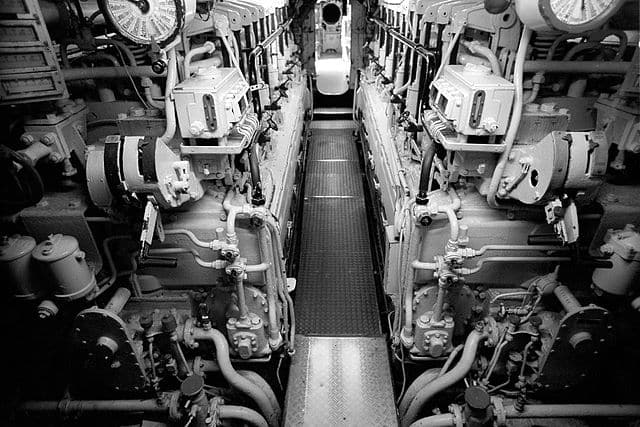
> 2,800 bhp (2,100 kW) MAN M6V40/46, for 17 knots (31 km/h; 20 mph)
> 3,200 bhp (2,400 kW) Germaniawerft F46 for 17.7 kn (32.8 km/h; 20.4 mph).
For submerged propulsion (all had the same ratings):
-AEG GU 460/8-276
-BBC GG UB 720/8
-Garbe, Lahmeyer & Co. RP 137/c
-Siemens-Schuckert-Werke (SSW) GU 343/38-8.
The MAN M6V 40/60 was a 6-cylinder 4-stroke engine with a cylinder diameter of 400mm and a piston stroke of 460mm. The piston displacement or cylinder capacity was 57,8 litres per cylinder.
The F46 was a 4-stroke, six-cylinder supercharged diesel with a range from 2,800 to 3,200 metric horsepower (2,060 to 2,350 kW; 2,760 to 3,160 shp).
Other Tech Details
The VIIC came with a stern buoyancy tank of 4.28m3, and a bow buoyancy tank of 8 m3. The VIIC had three Main ballast tank. The largest had a 47.750m³ working volume, two regulating tank 2 stb. two aft trim tank, a Forward trim tank, three torpedo compensating tanks, three Fresh water tanks, a Wash water tank in the Listening room, two Waste water tanks, two Negative buoyancy tank either side. Fuel oil tanks comprised three ballast and reserve fuel oil tanks, two regulating and reserve fuel oil tank, two main oil tank and a collecting tank, four lubricating oil supply tanks and dirty lubricating oil tank, a Fuel oil gravity feed tank, a Lubrication oil daily service tank, a Wash water daily supply and a brine tank, as well as a Water distillate tank.
For storage, the Type VIIC was given a box for flare shells, one for demolition charges, an Ammunition magazine, Provisions storage aft & forward.
Armament of the Type VIIC

Type G7e(TII) captured in Scapa Flow (dud) after being fired at HMS Royal Oak, preserved at Birkenhead.
Five 533 mm torpedo tubes (4 bow and 1 stern). 14 reserve torpedoes or 26 TMA or 39 TMB mines.
One 37 mm gun as designed, replaced by a 88 mm C35 L/45 when available.
One 20 mm C30 machine gun in the CT aft platform.
From 1944: Enlarged CT for one 37 mm gun and a flakvierling (4x) 20 mm Flak.
Deck Gun: 8.8 cm/45 (3.46″) SK C/35

The type VIIA U-boats had the 8,8cm as deck gun. The Type IA and later Type IX had the larger 105 mm deck gun, and the small Type II had a 20 mm AA gun. This deck gun was produced by Krupp but had absolutely no relation to the famous German Army 8,8 anti-tank and anti-aircraft gun. They did not even share the same ammunition. The 8.8 cm/45 (3.46″) SK C/35 was also used on Type 40 minesweepers and sub-chasers. After 1942, many U-Boats had it removed to install more FLAK instead. Only in the Mediterranean and the Northern Sea, U-boats kept their guns for a few months longer. It seems the original 37 mm was only sported at completion but the first two boats and replaced, the 8,8 cm was installed at completion on all the others as the production at Krupp was ramped up.
This was a pure “marine guns”, with material resistant to corrosion, simpler mechanisms and lubrication was limited or made internal. The goal was to have a permanent deck gun that could stay very long periods underwater at great pressures that could damage mechanisms and smaller parts. It was tested in a pressure chamber to the equivalent of around 200m (650 ft) which was the max theoretical diving depth at the time. These constraints made for a completely different gun than the more complex land-based 8,8 cm FLAK gun.
The 8,8 cm caliber had been used for many decades in the German Navy, all the way back to the 1890s and saw many iterations over the years. Unlike its land-based counterpart, it was a pure anti-ship model as it was limited by its mount to 30°.
The model used on the Type VIIA and following was designed in 1935 and introduced in 1938 so it’s likely the Type VIIA U-Boats were completed without it. It was a very rugged gun, albeit not having the same punch as its land counterpart, and a AP round (AP 35) which was far weaker. At 700 mps (2,300 fps) versus 840 m/s (2,690 ft/s) it lacked the speed and range as well, but was very impressive an efficient as a naval gun, especially for such as “small” submarine. It’s just that from 1942, no U-Kaptain would be mad enough to try to sink a cargo while surfaced with this single gun, staying exposed for an hour or more. More
Specs 8.8 cm/45 (3.46″) SK C/35
Weight: 5,346 lbs. (2,425 kg), Barrel alone 1,711 lbs. (776 kg)
Length: 157 in. (3.985 m) bore 146.9 in (3.731 m).
Rate of fire: 15 rounds per minute
Shell: 33 lbs. (15 kg) 14 in (385.5 mm) HE, AP, Incendiary, Illumination (90-10.2 kgs).
Bursting charge: AP 35S 0.064 kg. HE L/4.5 0.698 kg, HE L/45 Inc. Brandkörper A
Propellant charge: 3.70 lbs. (1.68 kg) RP C/32, 3.90 lbs. (1.77 kg) RP C/38, 4.63 lbs. (2.1 kg) RP C/40N and PL/V41
Muzzle velocity: HE 2,300 fps (700 mps), Illum.: 1,970 fps (600 mps).
Range: 13,070 yards (11,950 m) at 30°. Depression -10° on Ubts LC/35 mount.
Ammunition stowage Type VII: 220 rounds.
Barrel life: 12,000 rounds.
Torpedoes

For the Torpedo tubes I-V, Piston was 70 kg, forward +25.25 with piston inserted, 1680m3 and aft: -26,15 without piston and 1740m3. There was an upper deck container forward and aft, with and without G7A. Torpedo in the tubes were the G7E/G7A models. There was also a reserve stowage forward, aft. Note: The “Torpedokrise” lasted until the end of 1941. The result were scores of duds or precocious detonations. It was less severe than the infamous USN Mark 14, but limited the effectiveness of the Type VIIA, B and C until solved.
G7A Torpedoes
Direct involvement of Spain in the development of German torpedoes started in the late 1920s when the Spanish businessman Horacio Echevarrieta decided to start a torpedo factory in Cádiz (Fábrica Nacional de Torpedos, F.N.T. / National Torpedo Factory) with a theoretical production capacity of 100 torpedoes per year and license-build German torpedoes. But the G7 was created in WWI. The lineage comprised the pre-WWII G7A (T1) using compressed air and thus leaving a visible trail of bubble.
https://en.wikipedia.org/wiki/G7a_torpedo
The G7a (TI) torpedo calibre was the standard 533.4 mm (21 in), for a length of 7163 mm (23 ft 6 in), fitted with a Ka or Kb warhead, Pi1 or Pi2 pistol. The warhead carried 280 kg (617lbs) Schießwolle 36. The model remained standard issue from 1936 to the end of WW2. This model was of a straight-running unguided model only controlled by a gyroscope. It could be set at a variable speed, 5,000 m at 81 km/h or 7,500 m at 74 km/h (8,250 yd at 40 kt) but also “long course” 12,000 m at 55.6 km/h. The 44 knots model setting was only used by Schnellboote with a reinforced engine.
Later were introduced the G7a (T2) electric, T3, T4, T5 (Zaunköning), and T11, but the latter remained a prototype.
In 1940-41, the Type VIIA were likely upgraded with the G7a T2:
G7E Torpedo (T2)
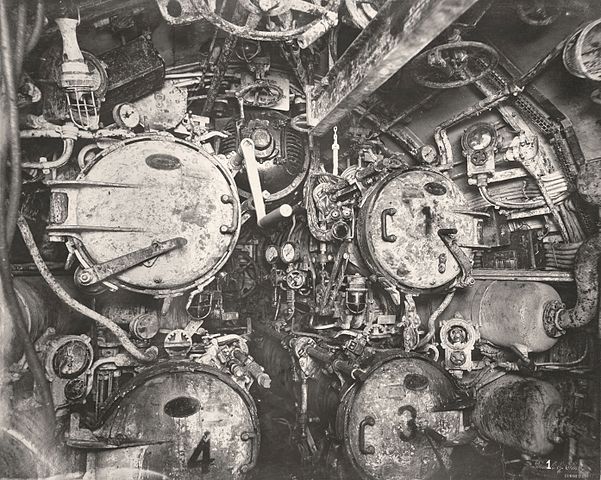
They had a unique setting of 5000m at 30kts. Standard torpedo of the war, it suffered from early issues with the internal depth-keeping equipment and firing pistol, solved after the Norwegian Campaign, but only gradually implemented. The “torpedokrise” was thus only resolved in mid-1941 when all stocks had been changed or spent. Full effectiveness on the T2 was obtained when preheated electrically to 30 degrees Cent (86 F) before firing. If not, speed was down to 28 knots for 3000m.
The G7e(TII) already entered service in 1936 and was a “secret weapon” for the Germans as much as was the “long lance” (type 93) for the IJN. Its existence was virtually unknown to the British until fragments were recovered following the sinking of HMS Royal Oak in October 1939. The G7e was electric, no longer using a wet-heater (steam-driven) and was simpler and cheaper to manufacture (half the cost), as well as being virtually silent, leaving almost no visible trail of air bubbles.
The latter was by far its biggest advantage. It was virtually invisible in the dark North Atlantic and spotters needed to be posted high and have an excellent view to see them via the water disturbances they still create at this speed, so a very faint trail underwater, still. It was most often heard first but the hydrophones’ operator, getting a bearing.
The T2 had many issues, it was however less reliable and performed unpredictably compared to the G7a(TI). Just like the Mark 14, both the contact and magnetic detonators were unreliable. But the feedback loop was quicker and there was less inertia from the engineering department to solve these issues way quicker than in the US. The T3 became the Stradivarius of the G7 type in 1942.
G7E Torpedo (T3)
By mid-1942 the improved version had an increased battery capacity, asking for a 50% superior range as the T3a. Range was now, 7500m at 30 knots, but in a preheated state it was 4,500m at 28 knots. More detail to come for the next articles on the Type VII. Thy did not have the previous faulty exploders and had a brand-new system, with a perfected proximity feature. This enabled what the US and other navies looked for, a torpedo that can dive below the keel of a ship and explode, breaking it.
G7e Falke Torpedo (T4)
The Falke was the model allowing a sub to fire them while deeply submerged inside the convoy. Their main advantage was to start like a straight-running torpedo for the first 400 m (440 yd) to enable its acoustic sensors, then actively search for a target. Since this equipment was sentitive, the propeller needed to be as quiet as possible, by its shape, and also speed, at only 37 km/h (20 kn), while the Carrier sub was also to be dead silent. This model was mostly intended for merchant targets. its use was limited, as it was merely a “proof of concept” for the acoustic homing torpedo.
G7e(TIII Fat II) Torpedo
FaT stands for Flächenabsuchender Torpedo. This model had a devise to changed the torpedo’s course over time so that it ran various patterns. Three versions: Fat I, II and III (Fat III was later redesignated Lut I).
LuT/Lut II (Lagenunabhängiger Torpedo)
All pattern-running systems for convoy attacks. They made their course unpredictable. More to come.
TMA Mines
In alternative to their torpedoes, the Type VIIA U-Boats could also carry 22 TMA mines, for a ration of two for one. The Type VIIs did manage many mine laying missions, but the size of their individual minefields was fairly limited, so losses were few, but not absent. The TMA mines were shaped as cylinders, they were moored mines, attached by cable to float above the surface, while the anchor secured its position. The correct depth setting needed to be applied depending on the observed depths. Two could be carried in each torpedo tube.
Length/Diameter: 11.1ft (3.38m)/21in (533mm)
Maximum Depth: 270m
Warhead: 215kg.
Sonars
Gruppenhorchgerät
The GHG was an early acoustic system, a hydrophone array used on all models, including the Type VII. It was developed in WWI already following Pierre Curie discovery in 1880 using the piezoelectric principle. Atlas Werke AG in Bremen and Electroacustik (ELAC) in Kiel worked on transducers, detectors and amplifiers and found the best being the Seignette crystal formed from a mixture of different salts. From 1935, crystal receivers were permanently installed on German submarines.
The GHG was the final product, GHG made of two groups of 24 sensors, one on each side of the boat. Each sensor had a tube preamplifier. These 48 low frequency signals were routed to a switching matrix and the sonar operator could determine the side and direction of the sound source. To improve resolution, a frequency of 1, 3 and 6 kHz could be setup. There was however a dead zone of 40° fore and aft, but range was 20 km to individual ships and 100 km against a full Convoy.
The Search area was 2 × 140° with a resolution of less than a degree at 6 kHz, 1.5° for 3 kHz, 4° for 1 kHz and without crossover 8°.
The Royal Navy in May 1942 captured a submarine and its ELAC equipment. Later the Balkongerät was tested on U-194 in January 1943 and installed a few Type VII/41 or 42 but became standard on the Type XXI.
VIIC Minutia

Cutaway and every bit of details in the interior, equipments and all (to come).
uboatarchive.net/Manual/ all you need to know in nerdy details
The Crew (To come)

From pinterest, showing the leathery battledresses.
In Culture: Das Boote

The CT of “Das Boote”. The movie made a nice effort of reconstructing the life on board of one of the hundred boats and their crews thrown in the Atlantic. It was such as success it became the new standard on which all submarine movies compared. It relaunched a genre popular in the US in the 1950s. Released in 1981 it was directed by Wolfgang Petersen, which was later to direct quite a few blockbusters for Hollywood, not very far from the sea, like “perfect storm”. The movie, like almost always, was based on a German 1973 best-seller of the same name, by Lothar-Günther Buchheim, a former war correspondent who spent time aboard precisely the U-boat depicted in the movie… Which was to be U-96. Most occurred during a patrol in the Battle of the Atlantic in 1941, focuses on the claustrophobic tension, boredom, and sudden bursts of danger characterized U-boat life.
The theatrical cut was about 2.5 hours, director’s cut about ~3.5 hours, and it was released in 1997. The uncut miniseries were over 4.5 hours, aired on German TV. It was praised for its extreme realism with cramped sets, authentic dialogue, and unromantic depiction of submarine warfare, completely at odds with the lighter tones of war movies or comedies of the 1950s. Its sound design became iconic, to retranscript the realism of the situation. Petersen’s masterwork received six well deserved Academy Award nominations, including Best Director and Best Cinematography in the US which was rare for a German-language film at the time. Always imitated, never equalled, it remains one of the rare “classics” in the genre, on equal footing with crichton’s based “hunt for the red October”, and certainly the best movie about U-Boats ever made.
Appearance

Author’s renditions of various camouflaged from photos and other references
The VIIB started career with a medium blue-grey Dunkelgrau 51 (RAL7000) for the upper hull. In artime, a darker grey was used for som time wit a lower colour as the dark grey Schiffsbodenfarbe III Grau (RAL7016). From August 1939 pre-war markings and inscriptions were removed and by the winter 1940 of the new scheme was the following:
Upper colour Dunkelgrau 51 (RAL7000, FS35237, RGB: R120, G131, B137), darker grey, Schlickgrau 58. Upper colour: shade of grey.
Some were given the Schiffsbodenfarbe III Grau (RAL7016, in between FS36076 and FS35042, RGB: R54, G61, B65) and the Schlickgrau 58 which was darker (FS36134, RGB: R77, G81, B76).
More to come.

Author’s camouflaged profile of U81 in 1942


U617 in Salamis and U596, uploaded by Richard Migliori on pinterest. The spotty camo was the ratest. Assumed to be dark green or dunkelgrau.

Regular VIIC

“U-Flak” (VIIC based) in 1944
Old author’s illustrations
⚙ specifications |
|
| Displacement | 769 tonnes (757 LT) surfaced, 871 t (857 LT) submerged |
| Dimensions | 67.2 (50.5 ph) x 6.20(4.7 ph) x 4.74 m draught |
| Propulsion | 2 shafts, 2800-3200 bhp diesels, 750 shp (560 Kw) electric |
| Speed | 17.7 knots surfaced, 7.6 knots submerged |
| Range | 8,500 nmi/10 knots surfaced, 80 nmi/4 knots submerged |
| Depth | 220 m (722 ft), CD 250–280 m (750–820 ft) |
| Armament | 5× 533 mm TTs (1 stern ph), 14 torpedoes/26 TMA/33 TMB mines, 8.8 cm deck gun, twin 2 cm C/30 AA |
| Sensors | Gruppenhorchgerät |
| Crew | 4 officers, 40–56 enlisted |
Memorablia: U995 at Laboe
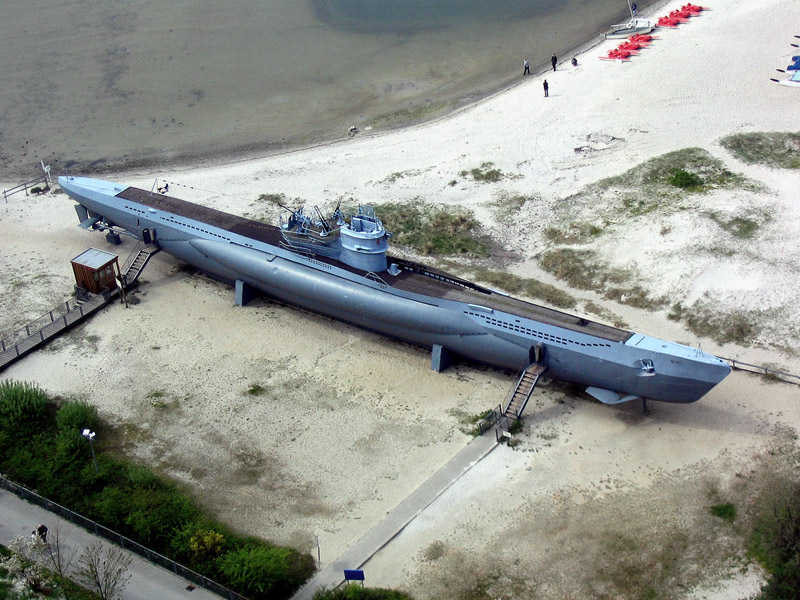
U-995, was a late VIIC/41 type now on display at the Laboe Naval Memorial near Kiel. Originally built by Blohm & Voss in Hamburg she was commissioned in September 1943. She would remain the only remaining Type VII U-boat in the world so far in her original condition. She Surrendered in May 1945, was transferred to Britain, then to Norway (renamed Kaura) remaining in service until 1952 and then versed to other roles. Decommissioned in 1965, she was offered to Germany for a symbolic single Deutsche Mark but declined by the then government.

However it was saved by the German Navy League (Deutscher Marinebund) which assembled former veterans, they paid for it. U995 was converted into a museum ship, placed at Laboe in October 1971 with an official handover in March 1972. It stands beside the Laboe Naval Memorial (Marine-Ehrenmal Laboe), a towered structure originally dedicated to WWI sailors and later rededicated in 1954 to all sailors who perished at sea, regardless of nationality. She is also a remainder how 30,300 men lost their lives in service in the Kriegsmarine on thise u-Boats alone. That was three quarter of the U-Boat force deployed in this war. Especially from 1943 onwards.
Operations:
U-Boat Flotillas
France:
1st, 9th Flotilla in Brest
2nd, 10th Flotilla in Lorient
3rd Flotilla in La Rochelle
6th, 7th Flotilla in St. Nazaire
12th Flotilla in Bordeaux (called BETASOM by the Italians)
All equipped with the VIIB and VIIC, frontline units with the best reach.
Germany:
5th, +5th* training Flotilla in Kiel
33rd Flotilla in Flensburg
4th Flotilla i Stettin*
5th Flotilla in Kiel*
8th, 23rd Flotilla in Danzig*
18th Flotilla in Hela*
19th, 20th, 21st Flotilla in Pillau*
22nd, 27th Flotilla in Gotenhafen*
24th Flotilla in Memel*
25th Flotilla in Libau*
26th Flotilla in Pillau*
31st Flotilla in Hamburg*
32nd Flotilla in Königsberg*
Norway:
11th Flotilla in Bergen
13th Flotilla in Trondheim
14th Flotilla in Narvik
Mediterranean:
23rd Flotilla in Salamis, Greece (VIIC)
29th Flotilla at La Spezia, Italy (VIIC)
30th Flotilla in Konstanza, Romania (Black sea) Type II and smaller types
*Note starred ones were training units moslty with older VIIA/B types in the Baltic.
3rd Flotilla La Rochelle

Probably the best known because of the movie “das boote”, it’s symbol was a turtle. The true location was called La Pallice. La Rochelle was and still is an old nice port with the old port’s entrance barred by a castle and famous tower. The base received U-Boat Pens started at some point in April 1941, and operated in all some 109 U-boats: U-8, U-10, U-12, U-14, U-16, U-18, U-20, U-22, U-24, U-82, U-85, U-132, U-134, U-138, U-141, U-143, U-146, U-147, U-205, U-206, U-212, U-231, U-241, U-242, U-245, U-246, U-257, U-258, U-259, U-262, U-275, U-280, U-289, U-332, U-333, U-334, U-341, U-343, U-344, U-352, U-373, U-375, U-376, U-378, U-384, U-391, U-398, U-402, U-423, U-431, U-432, U-433, U-444, U-451, U-452, U-458, U-466, U-468, U-469, U-476, U-478, U-483, U-484, U-553, U-567, U-568, U-569, U-570, U-571, U-572, U-573, U-596, U-600, U-611, U-613, U-615, U-619, U-620, U-625, U-630, U-635, U-645, U-652, U-657, U-661, U-671, U-677, U-701, U-706, U-712, U-719, U-734, U-752, U-753, U-760, U-763, U-952, U-953, U-957, U-960, U-970, U-971, U-975, U-978, U-992, U-993, UD-3 and UD-4. The first were Type IIB (see later) but when the base was taken over and afterwards, it only operated the three VII types, B, C and C/41. It was headed by Kptlt. Hans Eckermann in 1937-39 when created in Germany in 1937 as Unterseebootsflottille “Lohs” with the Type IIB.
Next was Korvkpt. Hans Rösing (Knights Cross) in 1941 when transferred at La Rochelle in March 1941. He was replaced by Kptlt. Herbert Schultze (Knights Cross) from July 1941 to March 1942 and then Kptlt. Heinz v. Reiche until June 1942 and from there and until th base surrendered, Korvkpt. Richard Zapp (Knights Cross) in October 1944. The siege of La Rochelle was quite a famous battle in which the French Resistance had a serious role.
German U-Boat Pens
It was clear that being exposed right under the nose of the RAF, for this French “U-Bases” was not going to cut it for their survivability on the long run. In effects, the RAF launched countless raids on these from late 1940 to January-March 1941, so much so that the Naval Construction Office in Berlin, which alread thought about this question in 1935, already had plans in motion in 1940. But the first constructions were not in France. The prototypes of U-Boat pens started by the autumn of 1940 with the construction of the “Elbe II” bunker in Hamburg and “Nordsee III” on Heligoland and others swiftly followed.
More to come.
VIIC aces
1. Erich Topp
Commanded the Type VIIC U-552, famously dubbed “The Red Devil Boat.”
Carried out 10 patrols and sank significant Allied tonnage. Notable feat: sinking the USS Reuben James—the first American warship lost in the conflict.
2. Heinrich Lehmann-Willenbrock
Commanded the Type VIIC U-96, immortalized in the book and film Das Boot. Over his career, he sank 24 merchant ships totaling approximately 179,000 tons.
3. Friedrich Guggenberger (Honorable Mention)
While not an ace by tonnage, he achieved one of the most high-profile VIIC successes: Sinking the British aircraft carrier HMS Ark Royal aboard Type VIIC U-81.
For all U-Boat types, top aces were:
Otto Kretschmer (Type VIIB): Sunk 47 ships, ~273,000 tons—“Tonnage King.”
Wolfgang Lüth (Various Types): 46 ships, ~225,000 tons.
Viktor Schütze: 35 ships, ~180,073 tons.
Heinrich Liebe: 34 ships, ~187,267 tons.
While commanding Type VIIC boats, Erich Topp and Heinrich Lehmann-Willenbrock stand out as the aces most closely associated with that subtype—especially given Lehmann-Willenbrock’s connection to Das Boot.
Most Successful VIIC War Patrols: None. Only Type IXB/C and a single VIIB by tonnage.
Attacks Against Large Passenger Liners:
Ernst-Ulrich Bruller on U-407 on 11 Nov. 1942 against Viceroy of India (19,600 GRT)
Gustav Poel on U-413 on 14 November 1942 against Warwick Castle (20,100 GRT)
Horst Hamm on U-562 on 21 December 1942 against Strathallan (23,700 GRT)
VIIC Combat Evolution
The Type VIIC was the workhorse of Germany’s WWII U-boat fleet, and its combat evolution was shaped by both early successes and rapid Allied countermeasures.
Here’s how its role, technology, and tactics changed over the course of the war:
1. Early Service (1940–1941) “Happy Time”
Context: Allied convoys lacked full escort coverage in the Atlantic. Radar and sonar were primitive, and air patrols had short range.
Tactics: Surface night attacks using high speed (17+ knots surfaced) to intercept convoys.
Wolfpack tactics (Rudeltaktik) introduced by Admiral Dönitz—multiple boats attacking simultaneously to overwhelm escorts.
Technology: Basic hydrophones for passive detection. Early torpedoes (initially plagued by magnetic/impact fuse defects, mostly fixed by late 1940) and deck gun (8.8 cm) frequently used against unescorted merchantmen.
2. Mid-War Adaptation (1942) – Expanding Range, Facing Radar
Context: U-boats moved further west to avoid expanding Allied air cover; U.S. entry into the war opened “Operation Drumbeat” off the U.S. East Coast.
Tactics: Solo “shark in the water” patrols off poorly defended coasts. Submerged daylight operations, surfaced at night. Technology changes: Metox radar detector (FuMB 1) to detect 1.5 m ASV Mk II radar. More anti-aircraft armament as air attacks increased. Slight structural improvements for deeper test depth (~220 m for Type VIIC/41 variants).
3. Crisis & Countermeasures (1943) – The Turning Point
Context: Allied HF/DF radio tracking, centimetric radar (ASV Mk III), long-range Liberators, and improved convoy escort groups with hedgehog mortars devastated U-boat operations.
Tactics: Greater emphasis on submerged approach and evasion. Abandonment of daylight surface cruising in many areas. Increased defensive AA use, though “flak trap” boats had limited success.
Technology changes: Radar warning receivers (Naxos) for new Allied radar frequencies. Balkongerät improved hydrophone arrays. Some boats received extra batteries and streamlining for longer submerged endurance. Experimentation with snorkels (borrowed from captured Dutch subs) began.
4. Late-War Evolution (1944–1945) – Desperation & Survival
Context: The Atlantic was essentially lost to U-boats as an offensive arena; operations shifted to coastal harassment and Arctic routes.
Tactics: Short-range ambushes near British waters. Snorkel-equipped patrols to minimize surface exposure. Greater use of homing torpedoes (T5 Zaunkönig) to target escorts. Technology changes:
Widespread snorkel installation for underwater diesel running. Streamlined conning towers (Turmumbau) to reduce radar signature (transition to the Type XXI) and enhanced AA positions removed in favor of stealth—acknowledging Allied air supremacy. Acoustic torpedoes introduced.
Gallery


Uploaded by Dave Turnbull, pinterest


WoW renditions of U69
VIIC in service
U-69 U-70 U-71 U-72 U-77 U-78 U-79 U-80 U-81 U-82 U-88 U-89 U-90 U-91 U-92 U-93 U-94 U-95 U-96 U-97 U-98 U-132 U-133 U-134 U-135 U-136 U-201 U-202 U-203 U-204 U-205 U-206 U-207 U-208 U-209 U-210 U-211 U-212 U-221 U-222 U-223 U-224 U-225 U-226 U-227 U-228 U-229 U-230 U-231 U-232 U-235 U-236 U-237 U-238 U-239 U-240 U-241 U-242 U-243 U-244 U-245 U-246 U-247 U-248 U-249 U-250 U-251 U-252 U-253 U-254 U-255 U-256 U-257 U-258 U-259 U-260 U-261 U-262 U-263 U-264 U-265 U-266 U-267 U-268 U-269 U-270 U-271 U-272 U-273 U-274 U-275 U-276 U-277 U-278 U-279 U-280 U-281 U-282 U-283 U-284 U-285 U-286 U-287 U-288 U-289 U-290 U-291 U-301 U-302 U-303 U-304 U-305 U-306 U-307 U-308 U-309 U-310 U-311 U-312 U-313 U-314 U-315 U-316 U-331 U-332 U-333 U-334 U-335 U-336 U-337 U-338 U-339 U-340 U-341 U-342 U-343 U-344 U-345 U-346 U-347 U-348 U-349 U-350 U-351 U-352 U-353 U-354 U-355 U-356 U-357 U-358 U-359 U-360 U-361 U-362 U-363 U-364 U-365 U-366 U-367 U-368 U-369 U-370 U-371 U-372 U-373 U-374 U-375 U-376 U-377 U-378 U-379 U-380 U-381 U-382 U-383 U-384 U-385 U-386 U-387 U-388 U-389 U-390 U-391 U-392 U-393 U-394 U-396 U-397 U-398 U-399 U-400 U-401 U-402 U-403 U-404 U-405 U-406 U-407 U-408 U-409 U-410 U-411 U-412 U-413 U-414 U-415 U-416 U-417 U-418 U-419 U-420 U-421 U-422 U-423 U-424 U-425 U-426 U-427 U-428 U-429 U-430 U-431 U-432 U-433 U-434 U-435 U-436 U-437 U-438 U-439 U-440 U-441 U-442 U-443 U-444 U-445 U-446 U-447 U-448 U-449 U-450 U-451 U-452 U-453 U-454 U-455 U-456 U-457 U-458 U-465 U-466 U-467 U-468 U-469 U-470 U-471 U-472 U-473 U-475 U-476 U-477 U-478 U-479 U-480 U-481 U-482 U-483 U-484 U-485 U-486 U-551 U-552 U-553 U-554 U-555 U-556 U-557 U-558 U-559 U-560 U-561 U-562 U-563 U-564 U-565 U-566 U-567 U-568 U-569 U-570 U-571 U-572 U-573 U-574 U-575 U-576 U-577 U-578 U-579 U-580 U-581 U-582 U-583 U-584 U-585 U-586 U-587 U-588 U-589 U-590 U-591 U-592 U-593 U-594 U-595 U-596 U-597 U-598 U-599 U-600 U-601 U-602 U-603 U-604 U-605 U-606 U-607 U-608 U-609 U-610 U-611 U-612 U-613 U-614 U-615 U-616 U-617 U-618 U-619 U-620 U-621 U-622 U-623 U-624 U-625 U-626 U-627 U-628 U-629 U-630 U-631 U-632 U-633 U-634 U-635 U-636 U-637 U-638 U-639 U-640 U-641 U-642 U-643 U-644 U-645 U-646 U-647 U-648 U-649 U-650 U-651 U-652 U-653 U-654 U-655 U-656 U-657 U-658 U-659 U-660 U-661 U-662 U-663 U-664 U-665 U-666 U-667 U-668 U-669 U-670 U-671 U-672 U-673 U-674 U-675 U-676 U-677 U-678 U-679 U-680 U-681 U-682 U-683 U-701 U-702 U-703 U-704 U-705 U-706 U-707 U-708 U-709 U-710 U-711 U-712 U-713 U-714 U-715 U-716 U-717 U-718 U-719 U-720 U-721 U-722 U-731 U-732 U-733 U-734 U-735 U-736 U-737 U-738 U-739 U-740 U-741 U-742 U-743 U-744 U-745 U-746 U-747 U-748 U-749 U-750 U-751 U-752 U-753 U-754 U-755 U-756 U-757 U-758 U-759 U-760 U-761 U-762 U-763 U-764 U-765 U-766 U-767 U-768 U-771 U-772 U-773 U-774 U-775 U-776 U-777 U-778 U-779 U-821 U-822 U-825 U-826 U-901 U-903 U-904 U-905 U-907 U-921 U-922 U-923 U-924 U-925 U-926 U-927 U-928 U-951 U-952 U-953 U-954 U-955 U-956 U-957 U-958 U-959 U-960 U-961 U-962 U-963 U-964 U-965 U-966 U-967 U-968 U-969 U-970 U-971 U-972 U-973 U-974 U-975 U-976 U-977 U-978 U-979 U-980 U-981 U-982 U-983 U-984 U-985 U-986 U-987 U-988 U-989 U-990 U-991 U-992 U-993 U-994 U-1051 U-1052 U-1053 U-1054 U-1055 U-1056 U-1057 U-1058 U-1101 U-1102 U-1131 U-1132 U-1161 U-1162 U-1191 U-1192 U-1193 U-1194 U-1195 U-1196 U-1197 U-1198 U-1199 U-1200 U-1201 U-1202 U-1203 U-1204 U-1205 U-1206 U-1207 U-1208 U-1209 U-1210
 U69 (1940)
U69 was ordered on 30 May 1938, built at Germaniawerft, Kiel at a cost of 4.439.000 Reichsmark, yard number 603, laid down on 11 November 1939, launched on 19 September 1940 and commissioned on 2 November 1940. She was very successful, sinking over 72,000 gross register tons (GRT) over two years and 10 patrols, making her one of the longest in serving of the class. The most infamous attack was the one of the civilian ferry SS Caribou off Newfoundland in October 1942. She met her fate on 17 February 1943, depth charged and damaged to the point she had to surface and was rammed and sunk by HMS Fame. Her “horrido”(Tally-Ho) emblem with “LM” (leck mich am Arsch) referring to Gotz von Berlichingen. It was adopted by Prien’s unit.
U70 (1940)
U70 was ordered on 30 May 1938 at Germaniawerft, Kiel (Yard number 604), Laid down on 19 December 1939, launched on 12 October 1940 and commissioned on 23 November 1940. She served in the 7th U-boat Flotilla under Kptlt. Joachim Matz from 23 November 1940 to 7 March 1941(when she was sunk by escorts), making a single patrol, sinking a merchant ship of 820 GRT and damaging three for 20,484 GRT.
U71
 U71 was ordered on 25 January 1939 from Germaniawerft, Kiel (Yd n°618), laid down on 21 December 1939 and launched on 31 October 1940, commissioned on 14 December 1940. She was at first part of the 7th U-boat Flotilla from 14 December 1940 to 31 May 1943 under Kptlt. / K.Kapt. Walter Flachsenberg until 3 July 1942 and Oblt.z.S. Hardo Rodler von Roithberg until 1st May 1943. After this, she was under Lt.z.S. Erich Krempl until 30 June 1943, now in the 24th U-boat Flotilla (Training), then 22th, until 27 February 1945 (same) under Oblt.z.S. Uwe Christiansen until May 1944, Oblt.z.S. Curt Hartmann until June, Oblt.z.S. Emil Ranzau until 27 February 1945, scuttled on 2 May under Dönitz orders to avoid capture.
In total, she performed 10 patrols, with 17 Wolfpack, the first from 14 June to 2 July 1941, then 2 August to 7 September, 29 September to 31 October, 29 November to 5 December 1941, 18 December to 21 January 1942, 23 February to 20 April, 11 to 20 June, 4 July to 15 August, 5 October to 17 November, 23 December to 12 February 1943 and 27 March to 1 May 1943 before being sent to training in the Baltic. She only sank 5 merchant ships for 38,894 GRT. The largest was the San Gerado of 12,915 GRT on 31 March 1942.
U72
U72 was ordered as yard number 619 at Germaniawerft, Kiel, laid down in December 1939, launched on 20 March 1940 and commissioned on April 1940. She was sunk on 30 March 1945. To come soon, work in progress.
U77
U77 was ordered as yard number 5 at Vulcan, Vegesack laid down on 3.1940, launched on 23.11.1940 and commissioned in January 1941. She was sunk on 29 March 1943. To come soon, work in progress.
U78
U78 was ordered as yad number 6 at Vulcan, Vegesack, in March 1940, launched on 7 December 1940 and commissioned in February 1941. She was sunk on 16 April 1945. To come soon, work in progress.
U79
U79 was ordered as yard number 7 at Vulcan, Vegesack in April 1940, launched 25 January 1941, and commissioned in April 1941, she was sunk on 23 December 1941. To come soon, work in progress.
U80
U80 was ordered as yard number 8 at Vulcan, Vegesack, laid down in April 1940, launched on 11 Febuary 1941 and commissioned on April 1941. She foundered on 28 november 1944. To come soon, work in progress.
U81 (1941)
 U81 was ordered as yard number 9 at Vulcan, Vegesack, laid down on May 1940, launched on 22 February 1941 and commissioned n April 1941. Made famous for the sinking of HMS Ark Royal under Kapt. Friedrich Guggenberger. First successes came on her second patrol, from Trondheim to the North Sea, North Atlantic, and reaching Brest after savaging Convoy SC 42, bagging Empire Springbuck on 9 September, Sally Maersk on 10 September (8,843 GRT). Her first ordered crossing to the Mediterranean almost failed when on 30 October she was attacked and severely damaged by Catalina of No. 209 Squadron RAF while approaching Gibraltar. Next a Lockheed Hudson dropped depth charges and damaged her further, she was forced back to Brest, leaving after repairs on 4 November for La Spezia but on the 13th November off Gibraltar she crossed Force H, fired a single torpedo into HMS Ark Royal, and survived depth charge attacks. She arrived in Italy on 1 December, joining the 29th U-boat Flotilla.
In April 1942 she roamed the Egyptian shores, sinking more ships. Next she was based at Salamis from 25 April but returned to La Spezia. She latter attempted to intercept convoys for Operation Torch, sinking Maron on 13 November. Next she shifted to Pola in December under Oblt.z.S. Johann-Otto Krieg and in February 1943 she was in Salamis. She was attacked by US bombers while in Pula on 9 January 1944 and sank with 2 men trapped inside, 51 survivors. The wreck was raised on 22 April 1944, BU. In 17 patrols she sank 26 ships (42,934 GRT) and damaged for 6,671 GRT plus a total loss for 7,472 GRT.
U82
U82 was ordered as yard number 10 at Vulcan, Vegesack, laid down in May 1940, launched 15 March 1941, commissioned in May 1941. She was sunk on 6 February in 1942. To come soon, work in progress.
U88
U88 was ordered as yard number 292 at Flenderwerft, Lübeck, laid down in July 1940, launched on 16 August 1941 and commissioned on 10/1941. She was sunk on 12 September 1942.
To come soon, work in progress.
U89
U89 was ordered as yard number 293 at Flenderwerft, Lübeck, laid down August 1940, launched on 20 September 1941 and commissioned on November 1941. She was sunk 12 May 1943. To come soon, work in progress.
U90
U90 was ordered as yard number 294 at Flenderwerft, Lübeck, laid down on October 1940, launched on 25 October 1941, and commissioned in December 1941. She was sunk on 24 July 1942. To come soon, work in progress.
U91
U91 was ordered as yard number 295 at Flenderwerft, Lübeck, laid down on November 1940, launched on 30 November 1941 and commissioned by January 1942. She was sunk on 26 February 1944. To come soon, work in progress.
U92
U92 was ordered as yard number 296 at Flenderwerft, Lübeck, laud down in November 1940, launched on 10 January 1942 and commissioned in March 1942. She was badly damaged on 4 October 1944, never repaired, decommissioned as total constructive loss. To come soon, work in progress.
U-93 (1940)

U-93 departing on her maiden voyage
Ordered on 30 May 1938 to Germaniawerft, Kiel under Yard number 598, U93 was laid down on 9 September 1939, launched on 8 June 1940 and commissioned on 30 July 1940. Her first patrol was preceded her voyage from Kiel to Kristiansand, Norway. She departed, under command of Kptlt. Claus Korth from there on 9 September 1940 for St. Nazaire, France, reached, via the North Sea and Faroe-Shetland gap on 25 October.
On the way, she sank Hurunui (15th) 120 nm (220 km; 140 mi) west of Butt of Lewis, northerly point of Lewis Is. Outer Hebrides (73 survivors). She was attacked three times on 17 October by ships and an aircraft. Next she sank Dokka on the 17th south of Iceland. She had to dive when HMS Folkestone arrived. Her second patrol from St Nazaire was uneventful but she sank Dione II with gunfire off Northern Ireland. She was targeted by an Armstrong Whitworth Whitley of No. 502 Squadron RAF and badly damaged before she could dive. She limped back to port and needed three months of repairs. For her 4th patrol under Oblt.z.S. Horst Elfe from 12 July 1941, three men were wounded in an accident when a 20 mm machine gun burst. She sank Elusa on 21 May SE of Cape Farewell in Greenland.
Her 5th patrol saw her off Mauritania and Western Sahara. She was bombed by the RAF while back west of Cape St. Vincent, Portugal.
Her sixth patrol was east of Newfoundland and Labrador, Canadian Atlantic coast, no kills. Her 7th and final patrol from St. Nazaire on 23 December 1941 saw her sunk by depth charges from HMS Hesperus between Portugal and the Azores, on 15 January 1942.
U-94 (1940)

U94 arrival in St Nazaire observed by Admiral Dönitz in June 1944
U94 was ordered on 30 May 1938 at Germaniawerft, Kiel (Yard number 599), laid down on 9 September 1939 and launched on 12 June 1940, commissioned on 10 August 1940.
For her first patrol she left Kiel on 20 November 1940 for Lorient via the North Sea, and arrived on 31 December, sinking undeway Stirlingshire on 2 December, some 280 nautical miles (520 km; 320 mi) northwest of the Bloody Foreland as well as a Wilhelmina and Empire Statesman on the 2nd and 11 Dec. For her 2nd patrol she headed west of Ireland and Scotland, sank three ships, Florian on 20 January 1941, West Wales on the 29th and Rushpool on the 30th. For her 3rd she headed west of Iceland, sank Harbledown on 4 April 1941, Lincoln Ellsworth on the 6th, using deck gunfire but she was attacked by OB 318 escorts on 7 May 1941, survived 98 depth charges over four hours. Next she returned and sank Eastern Star and Ixion and on the 20th Norman Monarch and John P. Pedersen. For her 5th patorl west of the Canary Islands no kill. For the 6th patrol from St. Nazaire on 2 September 1941, she headed southeast of Cape Farewell and sank Newbury, Pegasus and Empire Eland on the 15th. On 1 October she sank San Florentino but she had to finish off the bow section by gunfire as it remained afloat.
HMCS Alberni picke dup survivors later. She was back to Kiel for a refit on 15 October. For her 7th patrol she departed on 12 January 1942 through the GIUK gap, no kill, back at St. Nazaire on the 30th. For her 8th patrol she sank Empire Hail east of St. Johns (Newfoundland) on 24 February 1942, Cayrú 130 nm from New York on 9 March, Hvoslef 2 miles east of Fenwick Island (Delaware Bayç on the 11th. For her 9th patrol she left St. Nazaire on 4 May for her top-scoring sortie south of Greenland, bagging Cocle (12 May), Batna, Tolken (13th), the sailing ship Maria da Glória on 5 June, Ramsay and Empire Clough (10th) and Pontypridd (11th). He 10th patrol was her last. She left St. Nazaire for the Caribbean on 3 August 1942. On 28 August she hunted down convoy TAW 15 off Haiti when attacked by escorts after a first spotting and bombing by a PBY Catalina. Then HMCS Halifax and Snowberry attacked, depth charged her so bad she was forced to the surface. The corvette rammed U-94 twice and XO Hal Lawrence from Sackville even led a boarding party of 11 sailors, entered through the conning tower after after 2 kills, the rest of the crew surrendered without incident. Only to realized the Germans had already scuttled which started sinking fast. The Canadians left and she sank with 19 of her crew. HCMS Oakville rescued 26 including Oberleutnant zur See Otto Ites.
U95 (1940)
U95 was ordered on 30 May 1938 at Germaniawerft, Kiel, Yard number 600. She was Laid down on 16 September 1939, Launched on 18 July 1940 and Commissioned on 31 August 1940
The submarine successfully forced the heavily defended Strait of Gibraltar and entered the Mediterranean Sea. She was sunk by a torpedo from the Dutch submarine O 21 southwest of Almeria in Spain on 28 November 1941. She was relatively successful: In seven patrols, she sank eight ships (28,415 gross register tons) and damaged four others (27,916 GRT) until sunk by a torpedo from HNLMS O 21 on 28 November 1941 in the Mediterranean. 35 died, but there were 12 survivors.
U96 (1940)
This very special U-Boat was the main inspiration for “das boote”. She had one of the longest career of any Type VIIC, and survived the war, unlike in the movie. She performed 11 patrols, was quite succcessful (27 ships sunk 181,206 GRT, 4 damaged 33,043 GRT), the last ending in early 1943 and ended her career as a training sub in the Baltic, sunk indeed in port but not in la Rochelle, but Wilhelmsmhaven in an air raid. She was refloated and scrapped. It was war correspondent Lothar-Günther Buchheim, on board in 1941, which made this best-seller postwar and movie so important to relaunch public interest for U-Boats and submarines in general.
U96 was ordered on 30 May 1938 at Germaniawerft, Kiel, Yard number 601. She was laid down on 16 September 1939, launched on 1 August 1940 and Commissioned on 14 September 1940 under Obt.Lt.zS Heinrich Lehmann-Willenbrock. She was assigned to the 7th U-boat Flotilla in Saint Nazaire, taking part in her career in eleven wolfpacks, depht-charged numerous times, but she suffered no casualties. Her famous CT emblem was the green laughing sawfish which became the symbol of th entire 9th Flotilla when Lehmann-Willenbrock took its command in March 1942.
First patrol: She left Kiel on 4 December 1940, sailed acrossed the North Sea, through the GIUK gap into the North Atlantic and on 11 December, she tracked convoy HX 92, torpedoing the passenger ship Rotorua (10,890 GRT), and later that day, the Dutch merchant Towa (5,419 GRT), finished off by a second torpedo and then shelled for 30 minutes. She howeve rmissed later the Cardita (8,237 GRT) and on 12 December, attacked the Swedish steamer Stureholm (4,575 GRT), single torpedo. Next she sank the Belgian Macedonier.
Two days later on 14 December she sank the Western Prince (10,926 GRT) with two torpedoes and later at 21:02, tried to stop the Empire Razorbill wit gunfire but had to drop it due to bad weather. On 18 December she caught the Dutch motor tanker Pendrecht, hit her astern but she remained afloat, and survived, escorted by a British destroyer. U-96 lost contact during the night and left, stumbling upon a British battleship and escorts, but was not in position to attack. She went back in Lorient on 29 December, bagging 37,037 GRT, damaging 15,864 GRT.
Her second patrol started on 9 January 1941 from Lorient to west of Scotland, sinking SS Oropesa (14,118 GRT) on 16 January with three torpedoes (106 passengers and crew perished). A day after she attacked the steamer Almeda Star (14,936 GRT) but she needed five torpedoes (360 lost). She was back on 22 January 1941, docked for maintenance. Her 3rd patrol started on 30 January 1941, for a 3rd patrol in the North Atlantic, sinking a straggler from convoy HX 106, the Clea with a single torpedo and artillery. Netx was another tanker, Arthur F. Corwin (10,516 GRT), already savaged by U-103, lagging behind. Two torpedoes did it. But escorts of HX 106 spotted and attacked her with four depth charges passes, she escaped.
On 18 February, she sank the Black Osprey (5,589 GRT) of HX 107. On 21 February she was signalled a straggler, already attacked by a FW 200 “Condor” of I./KG 40 from convoy OB 287, 6,999 GRT Scottish Standard. U-96 spotted and launched two “fish” at the abandoned tanker sinking her, but she was tracked down and hunter by HMS Montgomery for five hours. On 23 February she spotted at last convoy OB 288, attacking by night with U-69, U-73, U-95, U-107 and Michele Bianchi, sinking nine ship and a escort, three by U-96: The British 5,457 GRT Anglo-Peruvian, SS Linaria (3,385 GRT) and SS Sirikishna (5,458 GRT) also claiming the commodore of OB 288, Rear Admiral R.A.A. Plowden. She was attacked HMS Churchill but escaped to St. Nazaire after 30 days and bagging 7 ships for 45,391 GRT. Lehmann-Willenbrock was presented with the Knight’s Cross of the Iron Cross, awarded by Dönitz two days before.
Her 4th patrol started on 12 April 1941. On the 16th she tracked convoy OB 309 and torpedoed but only damaged HMS Rockingham. On 28 April with U-95 she attacked convoy HX 121. She launched on three tankers and hit Oilfield (8,516 GRT), the Norwegian tanker Caledonia and the steamship Port Hardy (8,897 GRT) but was chased off by the Flower-class corvette HMS Gladiolus.
After 13:00 the next day, U-96 was attacked by a Lockheed Hudson from No. 233 Squadron RAF, only missed by its bombs. On 1 May she attacked an unescorted freighter, and on 4 May too and lost contact with a convoy. On 7 May she was spotted and attacked by a Short Sunderland shortly after noon, and over 2.5 hours, received 32 bombs but escaped. An unditendified 4-engine bomber attacked her on 14 May, three bombs missed. On 19 May she bagged the steamship Empire Ridge (2,922 GRT) 90 nm west of Bloody Foreland, Ireland. After 41 days she was back at Saint Nazaire on 22 May (30,227 GRT).
Her 5th patrol started on 19 June 1941 from Saint Nazaire for the North Atlantic, and 15 days in patrol, U-96 spotted a small convoy, 300 nm north of the Azores on 5 July 1941. She spotted HMS Challenger leading the armed merchant cruisers HMS Cathay and SS Anselm, cargo and passenger liner (5,954 GRT) converted as troop ships escorted by three Flower-class corvettes, HMS Lavender, Petunia and Starwort. She sank Anselm but counting her twice and repelled by Lavender and Petunia, this time she was seriously damaged and ended her patrol, repaired Saint Nazaire.
Her 6th patrol started on 2 August 1941. On the 12th she joined the wolfpack Greenland. On 28 August, “Prince-Elector”. In early September, “Seawolf”, but had no kill and was back to base on 12 September.
Her 7th patrol started on 27 October, with journalist Lothar-Günther Buchheim aboard. She joined the wolfpack Stoßtrupp and on 31 October, tracked convoy OS 10. She launched four torpedoes at long range, one struck the Dutch SS Bennekom, sinking in 30 min but was chased off by the sloop HMS Lulworth, by gunfire and depth, remaining unscathed. Next she was attacked by HMS Gorleston and Verbena. In November she patrolled the North Atlantic with Wolfpacks Störtebecker and Benecke until reaching Vigo in Spain to being resupplied by the interned German MV Bessel on 27 November. She was ordered for the Strait of Gibraltar and ordered to join the Mediterranean. On 30 November she was spotted by a Fairey Swordfish of 812 NAS and bombed, heavily damaged. She had to cancel the trip and return to Saint Nazaire, missing on the way, the Spanish SS Cabo de Hornos, returned from South America with Jewish refugees to Curaçao, after Brazil denied entry. She missed but stopped her and checked her papers and left her go. On 6 December 1941 she was back to Saint Nazaire for long repairs.
Her 8th patrol started with a mission off the Canadian east coast. On 20 February she sank Lake Osweya near Halifax, then Torungen off Nova Scotia 2 days after. The on 9 March, Tyr, 100 nm from Halifax. Her 9th patrol from St. Nazaire started on 23 April 1942. She returned 73 days later on 1 July without a kill. On the 10th patrol she only damaged F. J. Wolfe on 10 September 1942 but sank Sveve the same day and Elisabeth van Belgie, and Deläes on the 11th.
Her 11th patrol from Saint Nazaire started on 26 December 1942. She crossing the Atlantic and had to transfer a sick crew-member to U-163 on 3 January 1943. She was ordered to end her operatonal carrer and become a TS. She arrived at Königsberg on 8 February. She was decommissioned on 15 February 1945 in Wilhelmshaven but bombed by the 8th Air Force on 30 March 1945, and sank in Hipper basin, scrapped postwar.
U97 (1940)

U97 colourized by Erick Navas src
U97 was ordered 30 May 1938 at Germaniawerft, Kiel as yard number 602, laid down on 27 September 1939, launched on 15 August 1940 and commissioned on 28 September 1940 under command of Kapitänleutnant Udo Heilmann. She was assigned to the 7th U-boat Flotilla, and completed training by early 1941 before her first patrol, from Kiel on 17 February 1941. On the 24th she sank Mansepool, Jonathon Holt, (SW Faroe) and British Gunner off Cape Wrath. She also later damaged G.C. Brøvig, which survived, saved by HMS Petunia. Her 2nd patorl started from Kiel again, she sank 3 ships off Greenland, Chama, Hørda and Conus. In her 3rd patrol she sank HMS Camito off southern Ireland (6 May 1941) but her best “coup” was to sink on 8 May The Revenge class HMS Ramillies southeast of Cape Farewell. Her 4th patrol was from from St. Nazaire (2 July-8 August) with no kill. For her 5th she left St Nazaire on 20 September and down to Gibraltar and Mediterranean, sinking Pass of Balmaha west of Alexandria on 17 October (Operation Cultivate, relief of Tobruk) and Samos. She arrived at Salamis, Greece on the 27th from where she made her 6th and 7th patrols, notably she crossed the Aegean Sea towards Turkey and was back on 9 January 1942 due to an ill crew member.
Her 7th patrol was uneventful. For her 8th she was reassigned to La Spezia in February but was bombed (no damage) by a Sunderland from No. 230 RAF Sqn off North Africa. For her 9th patrol she went on in her patorl route between Salamis and La Spezia. For her 10th patrol she sank Zealand and Memos off Haifa on 28 June, then Marilyese Moller off Rafah and attacked by the armed trawler HMS Burra. She ended in Pola, Croatia by May 1943. Her 13th and final patrol started on 5 June 1943 and she bagged sank Palima off Beirut and Athelmonarch off Jaffa on the 15th but was spotted and sunk by a Lockheed Hudson of 459 Sqn RAAF on 16 June 1943 west of Haifa. 21 survivors.
U98
To come soon, work in progress.
U132
To come soon, work in progress.
U133
To come soon, work in progress.
U134
To come soon, work in progress.
U135
To come soon, work in progress.
U136
To come soon, work in progress.
U201
To come soon, work in progress.
U202
To come soon, work in progress.
U203
To come soon, work in progress.
U204
To come soon, work in progress.
U205
Under KptLt Franz Georg Reschke, U-205 on 16 June 1942 sank the 5,600t light cruiser HMS Hermione.
To come soon, work in progress.
U206
To come soon, work in progress.
U207
To come soon, work in progress.
U208
To come soon, work in progress.
U209
To come soon, work in progress.
U210
To come soon, work in progress.
U211
To come soon, work in progress.
U212
To come soon, work in progress.
U213
To come soon, work in progress.
U214
To come soon, work in progress.
U215
To come soon, work in progress.
U216
To come soon, work in progress.
U217
To come soon, work in progress.
U218
To come soon, work in progress.
U219
To come soon, work in progress.
U220
To come soon, work in progress.
U221
To come soon, work in progress.
U223
To come soon, work in progress.
U224
To come soon, work in progress.
U225
To come soon, work in progress.
U226
To come soon, work in progress.
U227
To come soon, work in progress.
U228
To come soon, work in progress.
U229
To come soon, work in progress.
U230
To come soon, work in progress.
U231
To come soon, work in progress.
U232
To come soon, work in progress.
U233
To come soon, work in progress.
U234
To come soon, work in progress.
U235
To come soon, work in progress.
U236
To come soon, work in progress.
U237
To come soon, work in progress.
U238
To come soon, work in progress.
U239
To come soon, work in progress.
U240
To come soon, work in progress.
U241
To come soon, work in progress.
U242
To come soon, work in progress.
U243
To come soon, work in progress.
U244
To come soon, work in progress.
U245
To come soon, work in progress.
U246
To come soon, work in progress.
U247
To come soon, work in progress.
U248
To come soon, work in progress.
U249
To come soon, work in progress.
U250
To come soon, work in progress.
U251
To come soon, work in progress.
U252
To come soon, work in progress.
U253
To come soon, work in progress.
U254
To come soon, work in progress.
U255
To come soon, work in progress.
U256
To come soon, work in progress.
U257
To come soon, work in progress.
U258
To come soon, work in progress.
U259
To come soon, work in progress.
U260
To come soon, work in progress.
U261
To come soon, work in progress.
U262
To come soon, work in progress.
U263
To come soon, work in progress.
U264
To come soon, work in progress.
U265
To come soon, work in progress.
U266
To come soon, work in progress.
U267
To come soon, work in progress.
U268
To come soon, work in progress.
U269
To come soon, work in progress.
U270
To come soon, work in progress.
U271
To come soon, work in progress.
U272
To come soon, work in progress.
U273
To come soon, work in progress.
U274
To come soon, work in progress.
U275
To come soon, work in progress.
U276
To come soon, work in progress.
U277
To come soon, work in progress.
U278
To come soon, work in progress.
U279
To come soon, work in progress.
U280
To come soon, work in progress.
U281
To come soon, work in progress.
U282
To come soon, work in progress.
U283
To come soon, work in progress.
U284
To come soon, work in progress.
U285
To come soon, work in progress.
U286
To come soon, work in progress.
U287
To come soon, work in progress.
U288
To come soon, work in progress.
U290
To come soon, work in progress.
U291
To come soon, work in progress.
U292
To come soon, work in progress.
U293
To come soon, work in progress.
U294
To come soon, work in progress.
U295
To come soon, work in progress.
U296
To come soon, work in progress.
U297
To come soon, work in progress.
U298
To come soon, work in progress.
U299
To come soon, work in progress.
U300
To come soon, work in progress.
U301
To come soon, work in progress.
U301
To come soon, work in progress.
U302
To come soon, work in progress.
U303
To come soon, work in progress.
U304
To come soon, work in progress.
U305
To come soon, work in progress.
U306
To come soon, work in progress.
U307
To come soon, work in progress.
U308
To come soon, work in progress.
U309
To come soon, work in progress.
U310
To come soon, work in progress.
U311
To come soon, work in progress.
U312
To come soon, work in progress.
U313
To come soon, work in progress.
U314
To come soon, work in progress.
U315
To come soon, work in progress.
U316
To come soon, work in progress.
U317
To come soon, work in progress.
U318
To come soon, work in progress.
U319
To come soon, work in progress.
U320
To come soon, work in progress.
U321
To come soon, work in progress.
U322
To come soon, work in progress.
U323
To come soon, work in progress.
U324
To come soon, work in progress.
U325
To come soon, work in progress.
U326
To come soon, work in progress.
U327
To come soon, work in progress.
U328
To come soon, work in progress.
U329
To come soon, work in progress.
U330
To come soon, work in progress.
U331 (1940)
 U-331 was ordered on 23 September 1939 from Nordseewerke, Emden, Yard number 203. She was laid down on 26 January 1940, launched on 20 December and commissioned on 31 March 1941. She sank three warships, including Barham under Kptlt. Hans Diedrich Freiherr von Tiesenhausen. In her first patrol from Kiel on 2 July 1941 to mid-Atlantic ended in Lorient on 19 August (no kill). Next on 24 September she lef for the Mediterranean and on 10 October engaged three British tank landing craft off Sidi Barrani, missing with a torpedo (low draught), engaged them with her deck gun, damaging HMS TLC-18 but breaking off after a deluge of Bofors rounds, wounded two men (one fatally), damaging her conning tower. She was repaired at Salamis on 11 October.
Her 3rd patrol started on 12 November to the Egyptian coast and on 17 November she landed 7 commandos from Lehrregiment Brandenburg east of Ras Gibeisa to blow up a railway line near the coast (failed). On 25 November north of Sidi Barrani she spotted and fired four torpedoes at HMS Barham. Two hit, defeating her ASW protection. She rolled over, her magazines spectacularly exploded and she broke in two and sank with 861 men, 395 rescued. U-331 was back to Salamis on 3 December, Freiherr Hans-Diedrich von Tiesenhausen being promoted to Kapitänleutnant with the Knight’s Cross of the Iron Cross. Her 4th patrol started on 14 January 1942 off the Egyptian coast, no kill. She was sent to La Spezia in a 5th, arriving on 28 February 1942. No Kill, back in Salamis on 19 April. Next four patrols uneventful from Messina, La Spezia. Her 10th patrol
from La Spezia was the last one on 7 November 1942 to attack the armada of Operation Torch. On 9 November she spotted and tproedoed the 9,135 GRT troopship USS Leedstown (AP-73) off Algiers, already damaged a day before by a Ju 88 bomber from III./KG 26. U331 launched four torpedoes, two hit home, she settled by the bow with a heavy starboard list, abandoned, sunking fofor good hours later. On 13 November U-331 she was hunted down by an escort ship and damaged when hitting the sea bed.
On 17 November, north of Algiers she was caught by a Lockheed Hudson from No. 500 Squadron RAF. One near miss damaged her forward hatch, jammed open. Unable to dive she signalled surrender to the Hudson and when HMS Wilton arrived to seize her, three Fairey Albacore from 820 NAS escorted by two Martlet from 893 NAS coming from HMS Formidable and unaware of any surrender signals, strafed and torpedoed her. 17 survived, including the commander.
U332
To come soon, work in progress.
U323
To come soon, work in progress.
U324
To come soon, work in progress.
U325
To come soon, work in progress.
U326
To come soon, work in progress.
U327
To come soon, work in progress.
U328
To come soon, work in progress.
U329
To come soon, work in progress.
U330
To come soon, work in progress.
U331
To come soon, work in progress.
U332
To come soon, work in progress.
U333
To come soon, work in progress.
U334
To come soon, work in progress.
U335
To come soon, work in progress.
U336
To come soon, work in progress.
U337
To come soon, work in progress.
U338
To come soon, work in progress.
U339
To come soon, work in progress.
U340
To come soon, work in progress.
U341
To come soon, work in progress.
U342
To come soon, work in progress.
U343
To come soon, work in progress.
U344
To come soon, work in progress.
U345
To come soon, work in progress.
U346
To come soon, work in progress.
U347
To come soon, work in progress.
U348
To come soon, work in progress.
U349
To come soon, work in progress.
U350
To come soon, work in progress.
U351
To come soon, work in progress.
U352
To come soon, work in progress.
U353
To come soon, work in progress.
U354
Under KptLt Hans-Jurgen Sthamer, U-354 on 22 August 1944 sank the 11,400t escort carrier HMS Nabob.
To come soon, work in progress.
U355
To come soon, work in progress.
U356
To come soon, work in progress.
U357
To come soon, work in progress.
U358
To come soon, work in progress.
U359
To come soon, work in progress.
U360
To come soon, work in progress.
U360
To come soon, work in progress.
U361
To come soon, work in progress.
U362
To come soon, work in progress.
U363
To come soon, work in progress.
U364
To come soon, work in progress.
U365
To come soon, work in progress.
U366
To come soon, work in progress.
U367
To come soon, work in progress.
U367
To come soon, work in progress.
U368
To come soon, work in progress.
U369
To come soon, work in progress.
U370
To come soon, work in progress.
U371
To come soon, work in progress.
U372
To come soon, work in progress.
U373
To come soon, work in progress.
U374
To come soon, work in progress.
U375
To come soon, work in progress.
U376
To come soon, work in progress.
U377
To come soon, work in progress.
U378
To come soon, work in progress.
U379
To come soon, work in progress.
U380
To come soon, work in progress.
U381
To come soon, work in progress.
U382
To come soon, work in progress.
U383
To come soon, work in progress.
U384
To come soon, work in progress.
U385
To come soon, work in progress.
U386
To come soon, work in progress.
U387
To come soon, work in progress.
U387
To come soon, work in progress.
U388
To come soon, work in progress.
U389
To come soon, work in progress.
U390
To come soon, work in progress.
U391
To come soon, work in progress.
U392
To come soon, work in progress.
U392
To come soon, work in progress.
U393
To come soon, work in progress.
U394
To come soon, work in progress.
U395
To come soon, work in progress.
U396
To come soon, work in progress.
U397
To come soon, work in progress.
U398
To come soon, work in progress.
U399
To come soon, work in progress.
U400
To come soon, work in progress.
U401
To come soon, work in progress.
U402
To come soon, work in progress.
U403
To come soon, work in progress.
U404
To come soon, work in progress.
U405
To come soon, work in progress.
U406
To come soon, work in progress.
U407
To come soon, work in progress.
U408
To come soon, work in progress.
U409
To come soon, work in progress.
U410
Under KptLt Horst-Arno Fenski, U-410 sank in 18 February 1944 the 5,300t light cruiser Penelope.
To come soon, work in progress.
U411
To come soon, work in progress.
U412
To come soon, work in progress.
U413
To come soon, work in progress.
U414
To come soon, work in progress.
U415
To come soon, work in progress.
U416
To come soon, work in progress.
U417
To come soon, work in progress.
U418
To come soon, work in progress.
U419
To come soon, work in progress.
U420
To come soon, work in progress.
U421
To come soon, work in progress.
U422
To come soon, work in progress.
U423
To come soon, work in progress.
U424
To come soon, work in progress.
U425
To come soon, work in progress.
U426
To come soon, work in progress.
U427
To come soon, work in progress.
U428
To come soon, work in progress.
U429
To come soon, work in progress.
U430
To come soon, work in progress.
U431
To come soon, work in progress.
U432
To come soon, work in progress.
U433
To come soon, work in progress.
U434
To come soon, work in progress.
U435
To come soon, work in progress.
U436
To come soon, work in progress.
U437
To come soon, work in progress.
U438
To come soon, work in progress.
U439
To come soon, work in progress.
U440
To come soon, work in progress.
U441
To come soon, work in progress.
U442
To come soon, work in progress.
U443
To come soon, work in progress.
U444
To come soon, work in progress.
U445
To come soon, work in progress.
U446
To come soon, work in progress.
U447
To come soon, work in progress.
U448
To come soon, work in progress.
U449
To come soon, work in progress.
U450
To come soon, work in progress.
U451
To come soon, work in progress.
U452
To come soon, work in progress.
U453
To come soon, work in progress.
U454
To come soon, work in progress.
U455
To come soon, work in progress.
U456
Under KptLt Max-Martin Teichert U-456 sank in 30 April 1942 the 10,600t light cruiser HMS Edinburgh.
To come soon, work in progress.
U457
To come soon, work in progress.
U458
To come soon, work in progress.
U459
To come soon, work in progress.
U460
To come soon, work in progress.
U461
To come soon, work in progress.
U462
To come soon, work in progress.
U463
To come soon, work in progress.
U464
To come soon, work in progress.
U465
To come soon, work in progress.
U466
To come soon, work in progress.
U467
To come soon, work in progress.
U468
To come soon, work in progress.
U469
To come soon, work in progress.
U470
To come soon, work in progress.
U471
To come soon, work in progress.
U472
To come soon, work in progress.
U473
To come soon, work in progress.
U474
To come soon, work in progress.
U475
To come soon, work in progress.
U476
To come soon, work in progress.
U477
To come soon, work in progress.
U478
To come soon, work in progress.
U479
To come soon, work in progress.
U480
To come soon, work in progress.
U481
To come soon, work in progress.
U482
To come soon, work in progress.
U483
To come soon, work in progress.
U484
To come soon, work in progress.
U485
To come soon, work in progress.
U486
To come soon, work in progress.
U551
To come soon, work in progress.
U552 (1940)

One of the top “top scorer” among the VIIC, U552 was ordered on 25 September 1939, laid down on 1st Dec. 1939 at Blohm & Voss, Hamburg (werk 528), launched on 14 Sep 1940 and commissioned on 4 December 1940. She made an amazing total of 15 patrols, first in the 7. Flottille for training until February 1941, then active in the same until 30 April 1944 and until February 1944 in the training unit, 22th flotilla. Her commanders were successively until 8 Sep 1942 KrvKpt. Erich Topp (Knights Cross), futire unit commander and ace, then until 10 July 1944 Kptlt. Klaus Popp and until Feb. 1945 Oblt. Günther Lube. She 30 ships sunk under her belt for a total tonnage of 163,756 GRT, one auxiliary warship sunk (520 GRT), one warship sunk, the Clemson class destroyer USS Reuben James, and three ships damaged (26,910 GRT).
U553
To come soon, work in progress.
U554
To come soon, work in progress.
U555
To come soon, work in progress.
U556
To come soon, work in progress.
U557
Under Ottokar Paulsen on 15 Dec. 1941 she sank the 5,300t Arethusa class light cruiser HMS Galatea.
U565
KptLt Johann Jebsen on 10 March 1942 sank the 5,600t AA cruiser HMS Naiad.
… To 722.
U731
To come soon, work in progress.
U731
Under KptLt Gerhard Bigalk U-751 on 21 Dec, 1941 sank the 11,000t escort carrier HMS Audacity.
…
U782
To come soon, work in progress.
U821
To come soon, work in progress.
…
U826
To come soon, work in progress.
U901
To come soon, work in progress.
….
U908
To come soon, work in progress.
U921
To come soon, work in progress.
…
U928
To come soon, work in progress.
U951
To come soon, work in progress.
…
U994
To come soon, work in progress.
U1051
To come soon, work in progress.
U1052
To come soon, work in progress.
U1053
To come soon, work in progress.
U1054
To come soon, work in progress.
U1055
To come soon, work in progress.
U1056
To come soon, work in progress.
U1057
To come soon, work in progress.
U1058
To come soon, work in progress.
U1101
To come soon, work in progress.
U1102
To come soon, work in progress.
U1131
To come soon, work in progress.
U1132
To come soon, work in progress.
U1161
To come soon, work in progress.
U1162
To come soon, work in progress.
U1172
Under KptLt Jurgen Kuhlmann, U-1172 sank on 15 Jan. 1945 the 11,400t escort carrier HMS Thane.
To come soon, work in progress.
U1191
To come soon, work in progress.
U1192
To come soon, work in progress.
U1193
To come soon, work in progress.
U1194
To come soon, work in progress.
U1195
To come soon, work in progress.
U1196
To come soon, work in progress.
U1197
To come soon, work in progress.
U1198
To come soon, work in progress.
U1199
To come soon, work in progress.
U1200
To come soon, work in progress.
U1201
To come soon, work in progress.
U1202
To come soon, work in progress.
U1203
To come soon, work in progress.
U1204
To come soon, work in progress.
U1205
To come soon, work in progress.
U1206
To come soon, work in progress.
U1207
To come soon, work in progress.
U1208
To come soon, work in progress.
U1209
To come soon, work in progress.
U1210
To come soon, work in progress.
Read More
Books
Busch, Harald (1955). U-Boats at War.
Stern, Robert C. (1991). Type VII U-boats.
Type VII by Marek Krzysztalowicz
U-Boote by Jean-Philippe and Dallies-Labourdette
The U-Boat Type VII by Robert Cecil Stern
Type VII U-Boat (Anatomy of the Ship) by David Westwood
Typ VII C – Das Kampf-U-Boot der Grauen Wölfe der meistgebaute U-Boot Typ der Welt, Schiff Profile No. 1
U-552 The Red Devil Boat Its Operational History in Words and Images by Axel Urbanke, Michael Rey 2020
U 48 (Kagero 07) pierwsza załoga In Combat No. 07 Mirosław Skwiot 2021
Graue Wölfe auf allen Meeren U-VII (Podzun-Pallas-Verlag Band 37) Waffen-Arsenal No. Band 37. Heinz J. Nowarra
Busch, Rainer; Röll, Hans-Joachim (1999). German U-boat commanders of World War II : a biographical dictionary. Greenhill Books NIP
Busch, Rainer; Röll, Hans-Joachim (1999). Deutsche U-Boot-Verluste von September 1939 bis Mai 1945. Hamburg, Berlin, Bonn: Mittler
Gröner, Erich; Jung, Dieter; Maass, Martin (1991). U-boats and Mine Warfare Vessels. German Warships 1815–1945. Vol. 2. Conway Maritime Press.
Kemp, Paul (1999). U-Boats Destroyed – German Submarine Losses in the World Wars. London: Arms & Armour
Links
https://www.uboat.net/boats.htm
uboat.net/types/viic.htm
uboat.net u69.htm
uboataces.com successful-attack
u-boot-archiv.de/ u69.html
On navypedia.org
en.wikipedia.org/ Type_VII_submarine
commons.wikimedia.org Type_VIIC_submarines
en.wikipedia.org List_of_U-boats_of_Germany
u-boote.fr/charact.htm
uboat.net/ top patrols.htm
uboatarchive.net/ Manual.htm
Caractère Edtions: LOS! n°61 TYP VIIB U-48
uboatarchive.net/ U-570 British Report
Model Kits (list on scalemates)