
 Regia Marina: Single ship Built 1931-34
Albatros was a submarine chaser of the Regia Marina that saw action during the war. The type branched out later to the smaller and simpler Gabbiano class Corvettes. She was reclassified as a torpedo boat, most likely purely for administrative purposes but influenced the design of modern Italian torpedo Boats. She took part in World War II, sank by HMS Upright on 27 September 1941.

Design of Albatros
Development
In the late 1920s and until 1930 the Regia Marina looked at a new dedicated anti-submarine vessel that could be built in numbers in case of war. Albatros was this first experimental ship.
It was based on a preliminary study conducted in 1929, influenced by the hull shapes of contemporary coastal torpedo boats. It could have been retrofitted with a pair of 450 mm torpedo tubes in the bow, presumaby fixed like German Schnellboote. But in 1930, Italy was bound by the new terms of London Naval Treaty. To avoid a rush in “naval dust”, signatories agreed to limit the number of ships above 600t. That left wide open the category below, in which Japan and Italy believed to have free hands to built new generation torpedo boats. The new ship was officially a sub-chaser in order to disguise its true dual nature, and was designed with this displacement limit in mind.
A tender was presented and several yards answered the call, the proposal of CNR, Palermo won, and it was and accepted for production. The original plan called for the construction of 25 ships.
However on trials, Albatros showed itself rather unsuccessfu between poor seaworthiness off coastal areas. It was difficult to operate, maintenance of her steam propulsion turbine proved difficukt the best of times, and the armament was outdated. After all this, the project was canceled outright. Instead a new direction was chosen, that led to the more successful, and larger Pegaso-class. That took all these lessons to improve the design between a better armament, and easier engines. She never received her torpedo tubes as intended and soldiered on as is, almost rearmed later in 1934, 1935 and 1937-39.
Among the reasons given are probably the neglect of light ships for the majority in the Fascist government, favouring instead capital ships. Enormous resources (unlike in France) went indeed on the complete reconstrction of WWI dreadnoights of the Cesare and Doria classes, early heavy cruisers or extending service of even older vessels, which starved R&D as well as the production of ammunition. In 1935, Albatros, amready modernized, was reclassified as a 2nd line ship. She was part of the Regia Marina’s naval experimental unit at La Spezia, but when the war started for Italy in 1940 she was pressed on as sub-chaser (cacciasommergibli) as initially intended.
Hull and general design
No plans, but a profile from culturanavale.it here shows how much the ship was barebones, but had fine lines. She had an unusual arrangement with her forecastle (1/3 total lenght) preceding the two-storey bridge instead of the latter built at its end. It was likely due to stability reasons and stay in the 400-500 tonnes ballpark. The bridge, three faceted and topped by an open bridge with the main telemeter and projector, supported also the taller foremast. Behind was the admiship funnel, capped and slightly raked, as the masts, than an AA platform, the shorter aft mast with battleflag gaff, supporting wireless cables attached to the foremast. No structure visible on deck apart low access hatches to the engine room. See also this more detailed scheme.
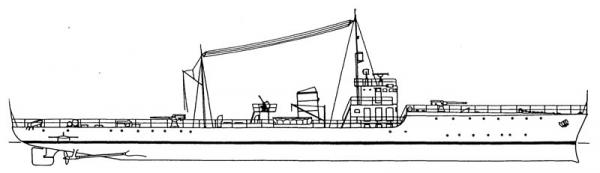
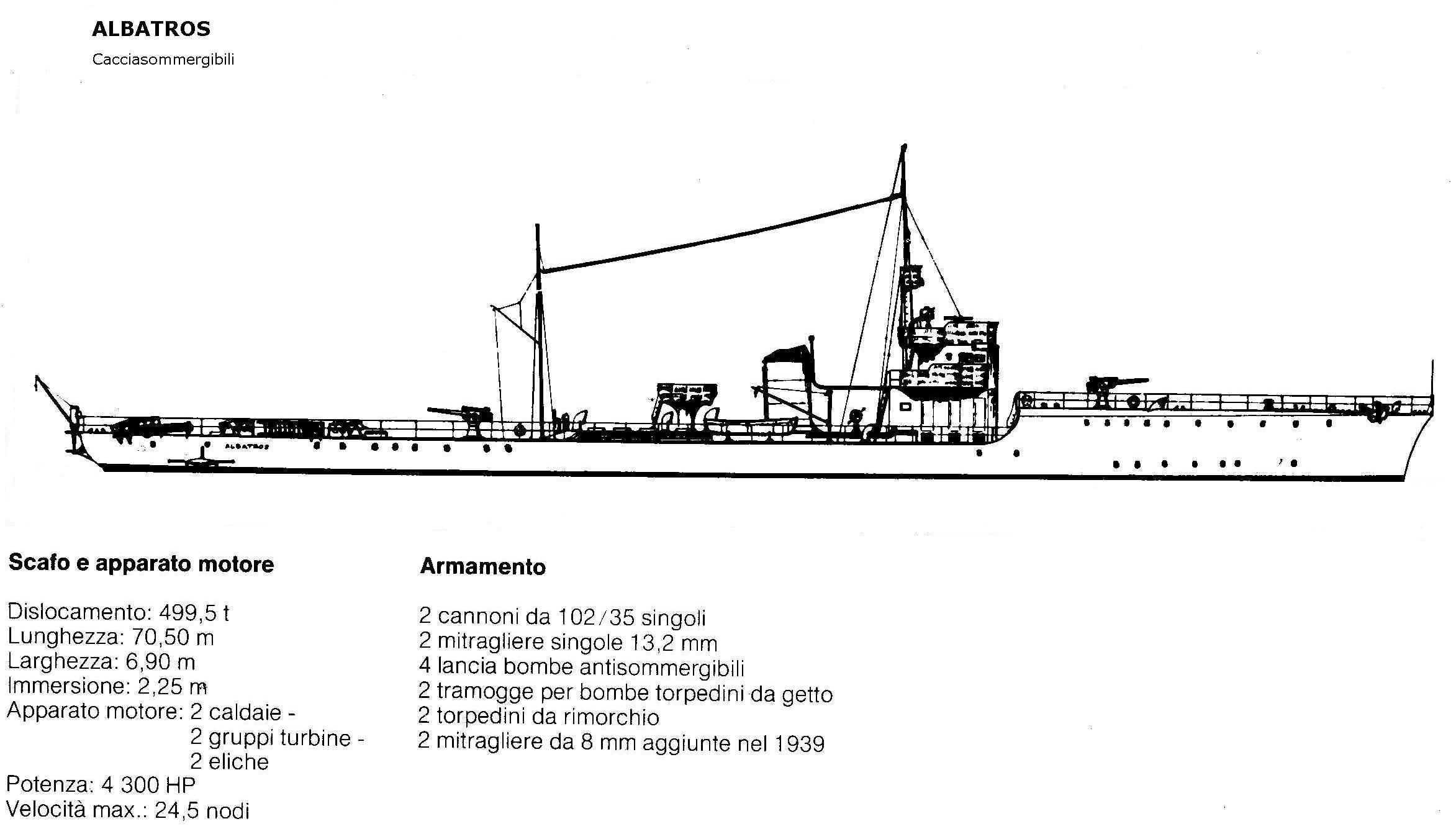
The first main gun was all the way back to the forecastle, the aft one close to the mast on deck, leaving a wide free space for the ASW suite of throwers, racks and towed torpedoes. Back to the hull itself, the rim transition between the foredeck and hull morphed from streight edges close to the bow to a turtledeck transition at the end of the forecastle to help clearing out rushing seawater before reaching the cut. The bow was had moderate clipper style angle, moderate flare, and ended with a pronounced almost straight-edge chin. The stern both rounded and almost pointed like a yacht, elegant. There were anti-collision bars/propeller guards aft also, and a classic single L-shaped rudder, two shafts and their struts.
But she remained large in dimensions still, while being lighweight, at just 334 tonnes (329 long tons) standard for 490 tonnes (482 long tons) full load. She reached 231.50 ft (70.56 m) long overall for a beam of 22.5 ft (6.9 m) and a draught of 1.71 m (5 ft 7 in) standard and 2.25 m (7 ft 5 in) full load. The crew amounted to 52 with 3 Officers and 49 Petty officers and sailors, and two boats plus a few life rafts for rescue.
Powerplant
She had two shafts, driven by Beluzzo geared turbines, fed by two boilers of 3-drum type, for a total of 4,300 hp (3,200 kW). They procured enough output for a top speed of 24.5 knots (45.4 km/h; 28.2 mph) and an endurance of 1,420 nmi (2,630 km; 1,630 mi) at 14 knots (26 km/h; 16 mph). 24 knots was seen as largely enough to chase down a submerged submersible, however it provided any efficient listening via her hydrophones. The big issue as seen above was the complexity of the powerplant for such a secondary ship. 24 knots was also considered not safe enough to launch torpedoes and withdraw under enemy fire, a better top speed was needed, leading to a larger vessel altogether.
Armament of Albatros
100 mm (4-in)/47
As completed she had two dual-purpose, unmasked, fore and aft. Standard, based on the 1907 Škoda 10 cm K10, they were dated in 1932 already with a poor rate of fire and range. It was likely the OTO Mod. 1931 with a -6°/+45° elevation. Rate of fire 8-10 rpm, muzzle velocity 880 mps (2,900 ft/s), max range 15.2 km (9.4 mi) at 45°. In 1935 they were replaced by Vickers-Terni 100 mm (4 in)/35 caliber guns (1935). Rate of fire: 7 rpm, muzzle velocity 755 m/s (2,480 ft/s), effective firing range 9.4 km (31,000 ft) AA ceiling, maximum firing range 11.7 km (7.3 mi) at +45°.
Breda 13.2 mm AA
For AA defence Albatros had a pair of twin 13.2 mm Breda anti-aircraft guns installed on the platform aft amidship, behind the funnel. They had a 400 rpm (cyclic) and 200-250 rpm (sustained) rate of fire, a muzzle velocity of 805 m/s (2,640 ft/s) and effective range of 2 km (1.2 mi) at +45° or 3.98 km (13,100 ft) at +80°. They were fed by 30-round box magazines. They were replaced in 1937 by single mounts, but in 1939 they were removed and replaced in turn by two Breda 8 mm machine guns. This was still weak by 1940 standards. Fortunately they soon obtained two 37 mm AA guns.
ASW suite
It was composed of the following:
Four Depth Charge Throwers
Four Depth Charge rails
Two Ginnochio towed torpedoes.
For details, see italian destroyer classes.
Profile planned
⚙ specifications as built |
|
| Displacement | 334t standard/490t full load |
| Dimensions | 70.56 x 6.9 x 1.71 m (231.50 x 22.5 ft x 5 ft 7 in) |
| Propulsion | 2-shaft Beluzzo GST, 2 boilers 3-drum type: 4,300 hp (3,200 kW) |
| Speed | 24.5 knots (45.4 km/h; 28.2 mph) |
| Range | 1,420 nmi (2,630 km; 1,630 mi)/14 kts (26 km/h; 16 mph) |
| Armament | |
| Crew | 52 (3 officers, 49 ratings) |
Career of Albatros
Albatros was laid down at CNR Palermo, laid down on November 1931, Launched on 27 May 1934 and commissioned on 10 November 1934. She entered service at the end of 1934, started her career of experimental vessel, officially the first modern anti-submarine ship of the Regia Marina. Initially, the 450 mm torpedo tubes were planned, but never installed. What initial and ater trials revealed, was that she was a poorly built unit, and the concept was never reproduced. The initially planned class of 24 sister ships was cancelled, now most historians attributed this to a short-sighted decision was influenced by the desire of a minority in the navy and majority in government and party to concentrate on battleships, skimping on funds for escort ships and R&D in general.
Albatros was considered a “second-line” ship and in 1935 (or 1937) she had her two 100/47 mm guns replaced by the 102mm/35 Mod. 1914 guns. In 1937, her twin Breda Modello 31 13.2 mm guns were replaced by single ones, and then by two single 8 mm machine guns. In 1939 she was reclassified as torpedo boat for administrative reasons, but at least she was reinforced by two Breda 37mm/54 anti-aircraft machine guns, and an echo sounder, the first Italian vessel to carry such a sonar.
That system installed in June 1939 was the SAFAR 600, first Italian sonar or echo-goniometer, successfully tested, but production was halted due to a more urgent need for submarines sonars. The results of sonar tests were pretty good as Albatros could identify targets up to 3,000–3,500 meters (9,800–11,500 ft) or even 7,000 m (23,000 ft) in 1940. But at the reduce speed of 12 knots (22 km/h; 14 mph). However the top brass decided to appoint her to the Strait of Messina, stopping experiments, and even effcetive patrols with her sonar, as strong currents in the Strait interfered with the sonar equipment. This under command of Lieutenant Commander Alessandro Mazzetti di Pietralata. She started anti-submarine patrols in the Strait and took on escort missions along the eastern coast of Sicily. Overall she performed 57 various missions.

She escorted the transatlantic liner SS Rex on her last voyage on 6 June 1940, from Genoa to Trieste, and from there to Pola on 15 August. On June 22, 1940, she led a first unsuccessful anti-submarine action. She was fired upon by an enemy submarine, but was not hit, and counter-attacked, but the later made a dive and escaped.
On July 16, Albatros, sailing off Augusta, her spotters identified the trail of two torpedoes coming their way (from the British submarine HMS Phoenix). She was able to dodge them in time and men jumped to the guns, while she turned towards the origin point and rushed forward. She counterattacked with depth charges on the supposed location, slowed down, used the sonar, and likely located, then sinking HMS Phoenix, bringing down her entire crew of 55 men.
On September 27, 1941, Albatros now under the command of Lieutenant Torquato Serio however had a fatal encounter with the more nimble British submarine HMS Upright: At 6:40 she had left Messina to meet up with U-371, and escort her through the Strait of Messina. At 8:20 they were spotted by HMS Upright layed in ambush. She spotted Albatros off Milazzo and attacked. Albatros detected Upright also, and she rushed to action at full speed, closing fast while trying to ping up her position. At 8:55, as Albatros came in for the second pass, Upright launched two torpedoes from 2,750 m (9,020 ft) away, one hit home. The British submarine dived and the crew heared the hull of Albatros creaking up as she sank 38°24′N 15°22′E, eight miles (13 km) of Cape Rasocolmo, northwest of Milazzo. 36 went down, but there were 47 survivors, including the commander.
Read More/Src
Books
Bagnasco, Erminio (2003). Le navi da Guerra Italiani 1940–1945. Parma: Ermanno Albertelli.
Rohwer, Jürgen (1972). Chronology of the War at Sea, 1939–1945: The Naval History of World War Two. London: Chatham Publishing.
Greentree, David (2016). British Submarine vs Italian Torpedo Boat Mediterranean 1940–43 (Duel). Osprey Publishing.
Wingate, John (2003). The Fighting Tenth: The Tenth Submarine Flotilla and the Siege of Malta. Periscope Publishing Ltd.
Links
conlapelleappesaaunchiodo.blogspot.com: Super gallery
More details on her career
regiamarinaitaliana.it
uboat.net HMS Upright
On HMS Phoenix
Model kits
None found