
 Regia Marina: 10 Built 1935-37:
 Ambra, Berillo, Corallo, Diaspro, Gemma, Iride, Malachite, Onice, Perla, Turchese
The Perla-class submarines were the third class in the 600 Series, Regia Marina’s most important class of coastal submarines from the interwar to WW2. These were named after gemstones and ten boats were built between OTO and CRDA shipyards in 1935-37. They were successful, but of these tne boats six were lost and only three survived World War II.

Development
The Perla-class submarines were essentially repeats of the preceding Sirena class, “Bernardis” with single hull but blisters and minor upgrades and modifications, brought by the commission and trials of the lead boat Sirena and earlier Argonauta. For example the shape of the top of the conning tower “bridge” forward was modified, lowered and refined for better underwater speed. Fine-tuning of the hull profile, as well as internally, more modern engines enabling extra output, as well as the installation of a radiogoniometer controllable from inside. Improvements went on, like the installation of a new air conditioning equipment, to the delight of the crew. All this traduced to an increase in displacement, alstogether with an increase in fuel stowage for better autonomy, especially compared to the previous series.
This first serie of “metals” confirmed the 600 series was a winning formula to improve further. The Perla class remained fundamentally coastal but the improved range added new distinations from Italy or the read sea to contemplate, and in wartile, they even proved able to operated in the Atlantic (see below). The class was planned in 1934, awarded to CRDA Montfalcone and OTO Muggiano. The first was laid down in 1935, and for that third series ten were made, all named after metals and minerals.
During the war, they achieved some successes, such as the sinking of the Dido-class British cruiser HMS Bonaventure by Ambra, and several merchant vessels. Iride and Ambra were also converted to carry underwater assault vehicles. Iride however sank in 1940 in her first attempt on Alexandria. Perla was transferred from Massawa in Eritrea, close to fall along with the rest of Italian East Africa, and she went for the long southern route, evading British patrols at the Cape and managing to round the continent all the way up to the Atlantic base at Betasom (Bordeaux) quite a feat for a “coastal” submarine. She made a single sortie in the Atlantic and later returned to the Mediterranean through the always dangerous Strait of Gibraltar.

Turchese (colorized)
Design of the Perla class
Hull and general design

Perla class cutaway src assoc. navimodellisti bolognesi via betasom.it
The new submarines had a designed surfaced displacement of 622 or 626 tonnes (other figures are given) for a full load displacement around 690-697 metric tons (684 long tons) surfaced and 850-860 metric tons (841 long tons) submerged. This varied between builder and even between some boats. navypedia for example gives a range between 622 and 626t for the surfaced displacement, and 680 to 844 tonnes, presumably submerged and fully loaded and submerged. In any cases, they all had the same size, an overall length of 197 ft 6 in (60.18 m), a beam of 21 ft (6.4 m) and a draft of 15 ft 5 in (4.70 m).
The overall design was very much a repeat of the Sirena in the great lines,
The crew comprised either 32 ratings and 4 officers, or 45 men in other sources, like the previous submarines. They sported the new “shark bow”, some sort of “clipper” bow for better seaworthiness, with a raised deck, but same outer hull lines as previous 600 series, in the line of Bernardis designed submarines. Engineers had this time the leisure to improve their work based on practical experience, and they adreessed some shortcomings of the Argonauta, the 1st class in series, thanks to this one being the 3rd generation alerady.
The main water scoops were located over the ballasts, with a few ones in the bow. The conning tower design had been revised on the Sirena, and they were also again on the Perla, albeit details are scarce. The transition between the vertical bulwark and CT plus deck was the refined further, the shape of the aft platform kept enlarged. It’s perhaps a translation issue, but the design seems to have the “false tower at the top” being enlarged. In short, the conning tower’s forward helmsman’s post was indeed flush with the aft walls of the CT, and not raised with a cutout like previous submarines, to improve on hydrodynamics. Otherwise, this CT has a stepped tail and gradual forward foot to breal turbulences past the deck gun. See also this graphic showing the conning tower differences between OTO and CRDA boats.
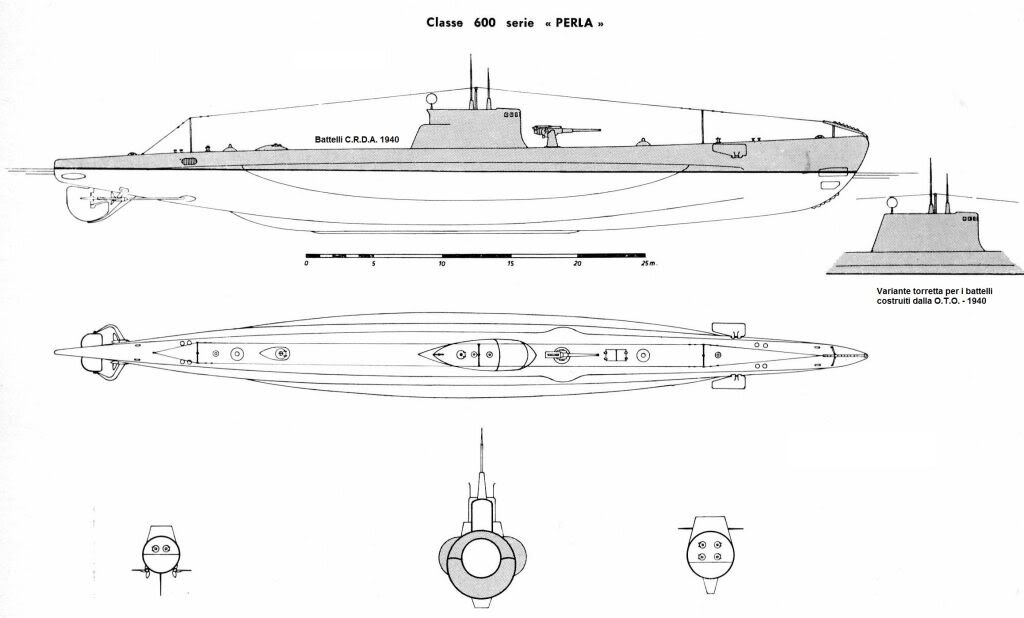
Otherwise the hull was pretty much the same as before, with marked blisters over the outer hull, a coupled of anchors in recesses forward, followed by the main folding upwards forward diving planes, aft exhausts, and the rear propellers protected by not only the side aft diving planes, part of the frame supporting the shafts with struts, anti-collision bars, and one extension acting as underkeel protection bar for the main axial rudder, connected on its axis. On deck, there were two main hatches, with the largest one located aft, also acting with a submersion chamber for evacuations. Another was located in the CT as well.
There was the usual net-cutting saw at the nose, and supports for the wireless radio cables, anchored on two T style masts on deck fore and aft and supported on a portico in the CT amidship. The radiogonometric antenna was located aft of the CT, which also had two frames to mount a tarpaulin in summer, and a small spotting platorm aft of the two periscopes, long watch type and short attack types fore and aft. Here is a nice 3D rendition for more details, with a cutaway as a bonus, courtesy of Andrea Venier, 2006.
Appearance and Camouflage

As for the appearance, they shows a uniform dark grey under hull paint replacing the former usual copper-base green (made of acetoarceniate of copper) whereas the upper hull surfaces were all painted with the usual “Grigio Generino Chiaro” for vertical ones, and the “Griogio Piombo Ponte” for the deck (ponto), which was basically lead grey. The light grey looks often on photos to have a bluish hue, which is the result of the blue sky reflection typical of the Mediterranean light. However during the war, these submarines were often painteed with an spotted camouflage, either using the military “Verde Scuro” or a mix between it and the Grigio Plombo to make it less vivid and darker in tone. Unlike ships, Italian submarines never sported the deck’s white-red markings of surface ships, used for recoignition, for obvious reasons given the British naval air patrols. 1

However during the war, not only some were added extra AA guns, they also received a variety of new conning tower (CT) shapes like seen here, source in the list below. Malachite and Onice from the start lacked the stepped tail of the others and had an extra wave breaker on the forward face. Turchese in 1941 had her aft bulwark removed and a U-boat style barrier fitted instead, and apparently two twin Breda 13.2 mm AA mounts side by side. She also had a forward wave breaker running all along the upper deck post. Turchese in 1942 had her helmman’s post relocated lower, with a recessed, open bridge with wavebraker and two twin Breda HMG but solid bulwark with openings for the ladder.

Corallo had a variation of it but without the helsman’s post, a raised step, reduced bulwark and barriers, single HMG post. Malachite in 1942 had the stepped foot, but German type open bridge and barrier aft. Ambra sported a version of Corallo’s CT, but with a lower step forward, Perla was like Ambra, as Turchese, Onice and Disapro in 1943, all having a clearly “German style” U-Boat CT. Long stoty short, they all had open CTs like German U-Boats at some point in wartime overhauls. They were also camouflaged.
Powerplant
The boats shared the similar diesels in power, albeit there were differences between shipyards as usual: Two Diesel FIAT for Perla, Gemma, Berillo, Onice, Iride. Two CRDA diesels for Diaspro, Turchese e Corallo and two Tosi diesels for Ambra e Malachite dirving each a shaft and usual bronze fixed pitch 3-bladed propeller. This was for 1,400 hp total or 1000 Kw. (2x 700 hp) and 14 knots (26 km/h; 16 mph) surfaced and a range of 5,200 nmi (9,600 km; 6,000 mi) at 8 knots (15 km/h; 9.2 mph) based on 80 tonnes of diesel oil. Thus Corallo, Diaspro, Turchese were the only ones combining both “in-house” CRDA diesels and electric motors.
When underwater, the shafts were clutched to either CRDA electric motors (for Perla, Gemma, Berillo, Onice, Iride, Diaspro, Turchese, and Corallo) or MEP Marelli for Ambra and Malachite. They were rated for 800 hp or 500 Kw (400 hp each), making for a top speed underwater of 7.4 knots or 7.5 knots (13.9 km/h; 8.6 mph) submerged and a range of 74 nmi (137 km; 85 mi) at 4 knots (7.4 km/h; 4.6 mph) submerged. The service depth, tested, was 80 m (260 ft), which was good for their size, and with a possible crush depth twice that number. 14 knots was not stellar in WW2 for a surfaced submarine, but there were limitations in power output compared to German diesels, which also introduced turbocompression. See also a more detailed engine, ballasts and battery cutaway 1.


Armament of the Perla class
Cannone da 100/47 Mod. 1931

Placed on the forward deck, on a raised platform or bandstand well integrated into the hull, acting as wave breaker, to avoid sea spray. This 100 mm/47 (3.9″) Modello 1931 benefited from developments and improvements made on the earlier Modello 1928, as manufactured by OTO. It would later evolved into the Modello 1935 and 1938 retofitted on the next Perla, Adua, Argo, Acciaio and Flutto classes. The boats carried either 144 or 152 rounds.
Specs
Gun Length oa: 194.5 in (4.940 m), 8-10 rpm.
Fixed Ammunition (HE) 30.4 lbs. (13.8 kg) 2,756 fps (840 mps)
Range: 35° 13,800 yards (12,600 m), OTO 1932
Weight 4.6 tons (4.7 mt) -5 /+32 or 35°.
To compare the previous Cannone da 100/43 modello 1927 had the following specs:
170 in (4.300 m) long, 8-10 rom. HE shells: 30.4 lbs. (13.8 kg), muzzle Velocity 2,625 fps (800 mps)
Elevation -5/+35°. Range: 30.4 lbs. (13.8 kg) HE Elevation/35° 12,000 yards (11,000 m).
AA: Breda Breda Mod. 31

The anti-aircraft defence counted on one or two twin Breda M1931 13.2 mm L/76 heavy machine guns, placed aft of the conning tower. Each mount weighed 695 kg, but ensured an elevation of -10° to 90°. They fired 125 g unitary rounds, with a muzzle velocity of 790 m/s, maximum range of 6,000 meters and effective range of 2,000 meters. Their rate of fire was 500 rounds/min, so 2,000 rounds when both twin mounts fired in concert, however. They carried a total of 3,000 rounds. It seems before or during the war, this progressed to two twin mounts for extra AA firepower according to many sources.
12x 533 mm (21 inches) torpedoes
The Sirna class submarines repeated the previous class for the stabndardized torpedo armament, six overall including four in the bow, and two in the stern, all reloadable for the pressure hull, and a reserve of 12 torpedoes including the six already in the tubes.
Models available in 1936:
-W 270/533.4 x 7.2 Veloce: 1,700 kg, 7.2 m WH 270 kg, 3,000-4,000 m/50 knots or 12,000 m/30 knots.
-W 270/533.4 x 7.2 “F”: 1,550 kg, 6.500 m, WH 250 kg, speed 3,000 m/43 knots or 10,000 m/28 knots
-W 250/533.4 x 6.5: 1,550 kg, 7.200 m, WH 270 kg, 4,000 m/48 knots or 12,000 m/30 knots.
-Si 270/533.4 x 7.2 “I”: 1,700 kg, 7.2 m, WH 270 kg, speed 3 km/42 kts or 7 km/32 kts, 9,2km/30 knots, 12km/26 kts
-W 250/533.4 x 6.72: 7.2m, WH 270 kg speed 4km/49 kts or 8km/38 kts.
-Si 270/533.4 x 7.2 “M”: 1,7 ton, 7.2 m, WH 270 kg speed 4km/46 kts, 8km/35 kts or 12km/29 kts.
They were also given also a pair of hydrophones.

Profile: Perla class, differences between OTO and CRDN conning towers

Profile: Perla 1942

Profile: Onice 1943
⚙ specifications as built |
|
| Displacement | 695 tonnes surfaced, 855 tonnes submerged |
| Dimensions | 197 ft 6 in x 21 ft x 15 ft 5 in (60.2 x 6.4 x 4.70 m) |
| Propulsion | |
| Speed | 14 kts (26 kph; 16 mph) surfaced, 7.5 kts (13.9 kph; 8.6 mph) submerged |
| Range | 5,200 nmi (9,600 km; 6,000 mi) at 8 kts surf., 74 nmi (137 km; 85 mi) at 4 kts sub. |
| Max depth | 80 m (260 ft) |
| Armament | 1x 100mm deck gun, 6x 533mm TTs, 13.2mmm AA |
| Crew | 45 |
Evaluation of the Perla class
In Spanish Service
Service started even before the Second World War with covert actions in the Spanish Civil War. Iride and Onice were just not simply sent to try to spot and sink cargo ships carrying ammunitions and other goods for the Republicans, they were directly “loaned” to the Nationalist navy, renamed Gonzáles López and Aguilar Tablada respectively. This part of the Mussolini’s help to the Franco regime almost broke peace and were close to create a major international incident. Errors from Nationalist aircraft on Royal Navy ships, which looked like many Spanish cruiser and Destroyers, had been frequent, already, but in that occurence, this came from submarines.
Iride, aka Gonzáles López was very close to sink a British H-class destroyer, HMS Havock underway from Valencia to Gibraltar, believing she was part of the Churucca class. Lookouts on the bridge spotted the trail and the destroyer promptly dodged the torpedo. The sonar operator started work. Other ships went on for the chase, until she surfaced by accident and was identified.
Now let’s recap from the start: Iride, after her cruises in the Dodecanese, Mediterranean and North African coasts, was the first to be sent to Spanish waters, from 24 August to 5 September 1937 under the command of Junio Valerio Borghese (a famous commander, later at the head of X-Mas flotilla). On 26 August, Iride arrived in a patrol area between Ibiza and Cape San Antonio, making no less than eight attack attempts, but only fired on two occasions and missed each time.
By the evening of 29 August, she spotted a cargo heading towards Valencia, attacked her twice, the second time from just 600 m (1,969 ft). At 20:45 on 30 August while surfaced she spotted HMS Havock, steaming from Valencia to Gibraltar. On her book however she looked suspiciously like a Churruca class destroyer. So he decided, being under a short timeframe, to launch in doubt, a 450mm torpedo from 700 m (2,297 ft) at 20:52. Havock’s spotters saw the bubble trails and the skipper managed to dodge the first in a sharp turn to starboard. He imediately ordered a chase, going up to the expected launch point, and once there, using the sonar, which showed a different position.
Havock proceeded there to launch depth charges on the new sonar location, soon joined by HMS Active, HMS Hyperion and HMS Hotspur, as well as the cruiser HMS Galatea. Iride was pumelled by this “pack” for a guelling nine hours, forved at some point to reach a great depth (past her max test depth) and cut the engines. She managed to survive the ordeal without a scratch (just minor parts breaking from distant detonations). However at some point she did accidentally surface and was identified by the British as an Italian submarine.
Following this serious incident by September 1937, France and Britain called a conference in Switzerland, at Nyon, to address this blatant breach of international waters rules, neutrality and put an end to “underwater piracy” against merchant traffic. On the 14th, an agreement was signed, establishing British and French patrol zones around Spain. Both mobilized a total of 60 destroyers and aircraft. Italy was not directly accused but complied with it, suspending these covert operations.
However Franco was deseperate to stop the flow of supplies (now mostly from USSR) to the Republicans and asked the Duce to resume submarine activities. Italy agreed to transfer four more submarines, in addition to Archimede and Evangelista Torricelli already there, and used by the Spanish Legion (Legión Española or Tercio de Extranjeros), the Naitonalist’s answer to the Internaitonal brigades. Iride was chosen and arrived on 23 September at Soller, Mallorca, just a week after Italy agreed to the Nyon conference. She was placed under direct command Admiral Francisco Moreno, and renamed Gonzalez Lopez to avoid any troubles with the British and French in case she would be fored to the surface. She was assigned the pennant number L3 but retained her commander, still Junio Valerio Borghese, senior officers and crew, albeit to make illusion all were provided with Spanish uniforms and insignia and the had also a Spanish liaison officer for HQ coordination work.
The other three Italian submarines transferred to the “Tercio” were Onice, renamed Aguilar Tablada, Galileo Galilei renamed General Mola II, and Galileo Ferraris renamed General Sanjurjo II. All four were based at Soller. Iride howeber only made two sorties, one in from 24 October 1937, lasting eight day and a second from 14 January 1938, nine days. In the latter she patrolled along the Spanish coast, attempted two attacks on 19 and 22 January, launching four torpedoes, but missed. In February 1938 she was recalled home, as Italy withdrew its activity due to international pressure. She was very near co-belligerence indeed and in displomatic dedlicacy at the League of Nations. Iride was assigned to 14th Squadron back home at La Spezia.
On her side, Onice departed on August 12, 1937 from Naples under command of captain Mario Ricci to join a patrol area off Tarragona. She spotted and fired two torpedoes at a tanker off Salou, on August 17, but missed. On the 27th she was recalled to Naples after the Nyon conference. However she was recalled and transferred to the Spanish Legion and left on September 17, La Maddalena to Soller, Mallorca, arrived there on the 23rd, placed under direct command of Adm. Francisco Moreno, as Aguilar Tablada, pennant L4. From October 8 through the 18th, Onice made a first patrol between Benidorm and Alicante until the 12th and the off Cartagena. She had occasions, all wasted for various reasons, like failing torpedoes. Captain Ricci was furious, and complained about the later report about his apparent lack of expertise.
From November 2 to the 11st, Onice made a second patrol, this time off Tarragona under commander Alfredo as Ricci was dismissed. She attacked one steamer, but lost her echo sounder and hydrophones, forced to return to Cagliari for repairs. Her third and last patrol was from January 31 through February 4 1938 under command of captain Manlio Petroni (as Criscuolo was also dismissed) off Tarragona, but without spot or attack. On February 5, 1938, she left Soller aback to Italy as international tension grew and both French and British admiralties showed they were ready for more aggressive ASW measures.
In Italian Service
Once commissioned, the Perla class were assigned to complete the “600” series from La Spezia in the 12th and 13th Squadrons, and Messina in the 34th and 35th Squadrons. They started training and exercises in home waters, before all undergoing endurance cruises, mostly to the Dodecanese and coast of North Africa so see if in wartime they could be rapidly deployed. These endurance exercises of 1936-1937, took place after initial training and qualifications, taking the role of shakedown cruises to notably test hard their engines and determine their general behaviour by making underway dives as well. Iride and Onice were “lent” to the Nationalist side during the Spanish Civil War as Gonzales Lopez and Aguilar Tablada (see above) keeping their Italian crews but with a Spanish liaison officer, both returned in 1938.
In 1938 Perla and Gemma were sent to the Red Sea at Massawa but returned, to be replaced by Onice, Berillo and Iride, in turn returned to Italy. Ambra and Malachite were remained until 1940 based outside Italy, mainly in Tobruk. In June 1940, four were at La Spezia, three in Cagliari, two in Augusta. Perla was however in Massawa. In the first 20 days, Italy lost no less than ten submarines. The Italian command (supermarina) decided to requisition to boats for the new experimental SLC technology. In July 1940 Iride was thus modified as a motheship for four “Maiale” manned torpedoes. All were placed in watertight containers on deck, however she was sunk while conducting tests, deployment. Ambra was also converted as such to an SLC in March 1942, carrying three SLC on deck. Each weighted 2.8 tons, but the cylinders were able to withstand 90 meters pressure, three times more than those installed on Iride, hence why one was deleted to compensate their extra weight. In December 1942, Ambra managed to penetrate Algiers and they collectively sank or damaged several merchant vessels for over 20,000t GRT.
Overall, the Perla class submarines proved to be quite successful, showing good maneuverability, a stong hull, well designed to withstand extra depth pressure and clsoe depth charge explosions exceeding their test values and tonnage. They fully confirmed the excellent qualities of the “600” class, even in tropical climates, with appreciable performances. Aside the fitting of smaller conning towers in 1942–43, Iride and Ambra were completely modified in 1940 and 1942 respectively, to carry underwater assault crafts of the “pigs” or SLC “Maiale” type. Modifications made to them slightly different, but they sported identical canisters located forward and aft of the conning tower and no deck gun (removed). Their different CT indeed made them more suitable for special operations.
Career of the Perla class
 Ambra (1936)

Ambra (amber) was ordered from OTO, Muggiano, laid down on 28 August 1935, launched 28 May and commissioned on 4 August 1936. After delivery, Ambra was assigned to the 34th Squadron (III Submarine group) based at Messina. She was commanded by captain Cesare Corrado. After a brief training, in 1937 she made a first endurance cruise in the Dodecanese, followed by visits to Libya. She performed a secret patrol off Alicante on August 29, made an aborted attack as she could not identify the target’s nationality, back on September 6, 1937. She was not selected for the Legion. In 1938–1940 Ambra had long training patrols, notably off Tobruk. In 1940 with Rubino and Malachite she joined the 47th Squadron, IV Submarine Group, at Taranto. In June 1940 and following, she performed defensive patrols in the Gulf of Taranto and off Alexandria. On September 23, she patrolled south of Crete with Serpente and Goffredo Mameli. On the 28th, she attempted an attack on a British convoy (Operation MB5). By December 12–21, she was southwest of Corfu with Antonio Sciesa, protecting convoys between Italy and Albania. On December 16, at dawn, she was detected by two British ships, hunted down and depth-charged for 12 hours, but she evaded unscaved.
On year’s eve 1940 until January 12, 1941 seh patrolled the Strait of Otranto with Turchese and Filippo Corridoni. On January 19, 1941, captain Mario Arillo took command and by March 5, 1941, she was sent off Crete to prey on convoys to and from Alexandria and Piraeus, Operation “Lustre”. On March 24, with Ascianghi and Dagabur she was off Alexandria at Cape Krio. She took part in Operation “Gaudo”, for an anticipated sortie by the Regia Marina into the Aegean (leading to the Battle of Cape Matapan). On March 27, she returned to fix her broken hydrophones. At 2:37 PM on March 31, she spotted a large escorted ship at 10 knots and launched two torpedoes at 2:44 pm, observed hit amidship, assumed the tanker sank. Actually this was British light cruiser HMS Bonaventure escorting convoy GA8 from Greece, with HMAS Stuart, HMS Griffin and HMS Hereward. Both engine rooms were flooded and she quickly sank (in perhaps 6 minutes) carrying with her 139 men, Hereward picking up 310 survivors. Ambra moved away, with two DDs in hot pursuit. She as detected with ASDIC and had to endure several depth charge attacks for hours until c6:30 PM, suffered damage (notably her gyroscopic and magnetic compasses) but survived and surfaced, using Celestial Navigation to sail back to Augusta. Captain Arillo received the Medaglie d’Oro for his performance. This remains the best kill of any sub in class.
On May 1, 1941, Perla sailed from Augusta to Alexandria and on the 5th she aborted and came back home after one torpedo tube was discovered leaking. Cdr. Arillo was criticized for this. She was back on May 12–20, southeast of Malta. On September 23–24 she patrolled the Strait of Messina with Albatros. On October 3, she left Augusta for Cape Zebib, south of the Strait of Sicily. She was recalled a day later, but experienced diesels failures. Captain Junio Valerio Borghese (Decima Flottiglia MAS) requested Ambra to be converted to an SLC (Siluro a Lunga Corsa) and to operate with Scirè. Captain Arillo was retained. She had three SLC fitted. Her first missio was on April 11–19, 1942, off the western coast of Sardinia. On April 29, she left La Spezia for a mission at Alexandria, based on aerial phot recc showing HMS Valiant and HMS Queen Elizabeth had been already badly damaged by the prvious SLC attack on December 18, but not sunk. The new attack was to “finish the job” and complete this by sinking HMS Medway, supporting British subs of the base.
On May 5, 1942, Ambra arrived at Lero, to embark SLC and crews and on the 9 or 12 she left Leros, arrived in the evening of May 14, in view of Alexandria’s harbor. At 20:50 pm, she surfaced and released all three SLCs, heading for the port while she submerged quickly. Strong currents saw Ambra drifting during preparation, and it was realized she had released the SLCs at the wrong spot. They SLC units wandered along the coast looking for port access but could not find it and after running out of fuel they were all abandoned, the crew swimming to shore. At 21:05 Ambra left the area and reached La Spezia on the 24th. This was the last of such operations against Alexandria. In between the bulk of the RN was transferred to Palestine or to the Red Sea.
With Operation Torch, and Vichy-held Algeria switching sides, Algiers was now a preimary target for the Decima Flottiglia MAS, ordered to organize a raid there. Ambra sailed from La Spezia on December 4, reached the coast of Algeria on the 7th, fighting bad weather delaying operations for days. On December 11 as it improved she approached at great depth due to constant aviation patrols. Captain Arillo then penetrated the harbor, litterally scrapping the bottom, and at 19:40 reached the best point to launch an attack, from 18 meters. No ships were spotted so the approach continued until 21:45, until she stopped in a middle of six merchant ships. The SLC units were sent between 22:50 and 23:20, charges loaded, placed, all went off as expected. The tally was remarkable: SS Ocean Vanquisher (7,174 GRT) SS Berto (1,493 GRT) were sunk, SS Empire Centaur (7,041 GRT) and SS Harmattan (4,558 GRT) were badly damaged and practically written-off. At 2:54, Arillo left to reach oopen sea befoore daylight hours. Ambra surfaced at 19:45 on December 12, after 36 hours under water, made it back to La Spezia on December 15. Commander Arillo was awarded the Gold Medal of Military Valor.
In March 1943 Ambra was damaged by an overnight air raid. With the invasion of Sicily on July 10, she was tasked to enter Siracusa and destroy as many ships as possible, now under captain Renato Ferrini, former commander of Axum. On the 14th, she left La Spezia. The night of the 17th she arrived close, surfaced at 3:20 on July 18, almost immediately detected by a low-flying British Vickers Wellington of No. 221 Squadron RAF (Petty Officer Austin). After identifying her she came for an attack, dropping six depth charges. Ambra was so much shook by near misses she lost power, remained immobilized for half an hour, twith the crew managed to restart her diesels and sail trip back to Messina. On July 19 she was towed by Partenope to Naples. After temporary repairs, she was sent to La Spezia, arrived on July 27, undergoing repair work, until the Armistice was announced so she was scuttled to avoid capture on Sept. 9. Later refloated by the Germans, never repaired, she was sunk in Genoa in an air raid (449th and 450th Group, 15th AF) by September 4, 1944.
Berillo (1936)
Berillo (Beryl) was ordered from CRDA, Monfalcone, laid down on 14 September 1935, launched on 14 June 1936 and completed on 5 August 1936. Assigned to the 35th Squadron in Messina she was sent to Augusta and started an intensive endurance training cruise to Tobruk, Benghazi, Marsa el Hilal, Bardia, Leros and back to Naples.
January-September 1937 saw her performing three missions to Spain, starting on 1 January under Captain Vittorio Prato off Cartagena. On 5 August she left from Augusta, under captain Andrea Gasparini, northwest of Pantelleria for 11 days with many attack attempts and on 14 August two torpedo missed a steamer. On 28 August she made her 3rd off Cartagena but returned on 6 September without results. In 1938 Berillo she was transferred with Iride and Onice Massawa. In May 1939 she returned to Taranto , then Augusta and in January 1940 was under command of Captain Camillo Milesi Ferretti. In June, with Gemma and Onice, she was assigned the 13th Squadron, I Submarine group; La Spezia but from Augusta. On 13 July she was deployed with Morosini, Nani, Comandante Faà di Bruno east of Gibraltar, then off Malta.
On 18 September she was off Sidi Barrani and Marsa Matruh but needed onging repairs after the breakdown of her her stern pump, then aft hydroplane. On 25 September she was north of Ras Ultima. On 27 September, after surfacing, her diesel engines died and the crew only could restart her port side engine partially. Sge mostly continued with her electric engines and at 21:30 on 29 September she was signalled an enemy battle group and managed to get close at just 5 knots off Sidi Barrani, but she ended 60 miles (97 km) further north. On 30 September her starboard engine restarted and on 1 October, she remained at periscope depth. However in the evening, one oil pump failed and the port-side engine. At 03:00, enemy ships were spotted; HMS Havock and HMS Hasty were just 6,000 meters (6,600 yd) away, back to to Piraeus with Convoy AN-4. Still surfaced, Captain Ferretti continued his approach until about 800 meters (870 yd) but the torpedo electric launch system failed, backup turn to manual launch, she missed, but was detected so at 600 m, another launch of two was ordered, missing again, so he ordered hard to starboard to launch from the stern tubes, when she was caught in four searchlights, and guns started barking.
Ferretti ordered a crash dive as one DD attempted to ram her. She managed to 90 meters (300 ft) in 32 seconds, soon experiencing multiple depth charge attacks. Soon, she lost electricals, intercom, pressure gauges, diving planes, followed by issues with buoyancy, and she showed how strongly she was built when reaching 135 meters (443 ft), until she popped up to 40 meters (130 ft) afte compressed air was blown. Other explosions rocked shut the the engines, propellers, and started a fire in the aft compartment, plus multiple water leaks. She alternated this yo-yo from 50-100 meters (160 and 330 ft), ten 120–130 meters (390–430 ft) and went down to 170 meters (560 ft) or perhaps more when it was decided to blow all air to sahev his boat and crew. At 05:30 on 2 October, she she emerged, already listing at 45° Two crewmen tried to open the hatches, which were jammed due to damage. British destroyers closed in firing, destroying her deck gun, penetrating the conning tower, but also dislodged its hatch so the crew rushed out, abandoning ship. She sank 120 nautical miles (220 km) north of Sidi Barrani. The crew was made POW, inc. Captain Ferretti.
Corallo (1936)

Corallo was built by CRDA Monfalcone, laid on 1 October 1935, launched on 2 August 1936 and completed on 26 September 1936, then assigned to the 34th Squadron, III Submarine Group at Messina. After training and the usual long endurance cruise to the Dodecanese and Adriatic she trained in 1937 large scale manoeuvers, same in 1938 and by October 15, was temporarily assigned to the Flotilla Submarine school. In 1939 she was assigned to the 72nd Sqn. VII SubGrp at Cagliari, until the end of her career. In June 1940 she was in Monfalcone under maintenance, completed by late August 1940. On September 3 under captain Loris Albanese she was sent 60 miles south of Crete, between Gaudo and Alexandria and at 18:00 the 17th she spotted a zigzagging British column (HMS Illustrious, HMS Valiant five destroyers) returning to Alexandria after bombarding Derna-Benghazi. 30 min. layer she launched two torpedoes from 1,500 m against HMS Illustrious and made a dive to 80 m. She recorded two loud explosions (likely premature explosions) but had to endure depth charge attacks for 3 hours. She had to returned to Tobruk the next day for repairs, loosing 2 sailors. On November 5, with Topazio, Fratelli Bandiera, Pier Capponi and Goffredo Mameli she was sent in a line 90 miles south-east of Malta for Operation “Coat”. There was still 20-30 miles between them and no enemy ship was spotted.
On January 21, 1941, Corallo and Diaspro patrolled off the northern Tunisia but had failures and returned to base. By February 1941 she was sent north of Cape Bougaroun, but again, suffered from engine problems. By April 1941 she as sent south of Sardinia, but returned due to bad weather conditions. By May 1941 she was sent 50 miles west La Galite (no spot), samed in July 1941 southwest of Sardinia, October 1941 off Cap Zebib, November 3, 1941, (under command of captain Andreani) west of Malta as a picket to cover the passage of the large Italian “Beta” convoy to Libya. On November 9, the convoy was intercepted by Force K (Battle of the Duisburg Convoy). Corallo never detected it. Next she was sent off Algeria and Tunisia, by January 1942 between Malta and Capo Passero, by March 1942 off Malta, by April 1942 off Cape Bon. At 4:10 on April 28, she stopped Tunisian sailboats for inspection (Dar es Salaam, 138 GRT, Tunis, 41 GRT) but they were protected by their Vichy France flag albeit without special permit required by the axis, so thei crews were interned and the boats sank. By May-June 1942 she patrolled east of La Galite. At 2:00 on June 7, she arrested the Tunisian sailboat Hady M’Hammed 26 GRT, also sank by gunfire. She then patrolled northwest of Algiers. Back home she had a new Cdr, Guido Guidi.
On June 11, she was sent with Onice, Ascianghi, Aradam and Dessiè to patrol between Malta, Pantelleria and Lampedusa to counter Operation Harpoon. No spot. In October 1942 she was sent off the Balearic Islands. In November 1942 after Operation Torch she patrolled off Bizerta and entered even Philippeville harbor (no ships to attack), then by early December with Alagi, Argento, Bronzo, Galatea, Porfido, Volframio, Mocenigo, Diaspro and Malachite she formed a defensive screen protecting Axis convoys to Tunis. By December 10, she left Cagliari for Bona and Bizerta, also ordered to penetrate Bougie harbor by night to atack whatever was there, but was never heard from again. Postwar British records established she was spotted 14 miles from Bougie and attacked by HMS Enchantress, Fleetwood, Velox, Venomous (KMS-4 convoy Gibraltar-Algiers). Depth charged she was forced to surface and possibly rammed by HMS Enchantress and apparently sank with all hands.
Diaspro (1936)

Diaspro was built by CRDA Trieste, laid on 29 September 1935, launched on 5 July 1936 and completed on 22 August 1936. She was assigned to the 35th Squadron, III SubGroup in Messina, had training and endurance cruise. In the Spanish Civil War she made two sorties under captain Giuseppe Mellina, the first from Trapani on August 5, 1937, north of Cape Bon, noted 25 attack attempts, one missed on August 13, 1937 (assumed 2,423 GRT French cargo ship SS Paramé) back to Cagliari on August 15, 1937. Second from Naples, August 25, off Cape Oropesa. On September 1, she attacked a tanker off Benicarló, surfaced, launched two, spotted and dodged. She then attempted to ram Diaspro, whoch fired two more torpedoes, hit her amidship, sank. Assumed to be the 6,987 GRT Republican tanker to Alicante under the presumably false name SS Woodford, crew appeared to be Romanian. In reality she was under a British-based operator from Constanta to Valencia. This of course created a scandal. She was back to Naples on September 5, 1937. In June 1940 she was part of the 72nd Squadron, VII SubGroup at Cagliari. She sailed to the Tyrrhenian Sea. By July, northwest of Asinara and La Galite. August, off Cap Bougaroûn. September during Operation “Hats”, between Cape Spartivento and La Galite. Unable to attack Force H, detected, attacked by Swordfish from hms Ark Royal, forced to dive. On November 9 she sailed for La Galite with four other submarines for Operation “Coat”. No spot. On November 14, with Alagi and Aradam she was deployed to counter Operation “White”, and 315 miles off La Galite, she spotted a steamer from the British force was too far to attack.
On January 21, 1941 she operated off the northern Tunisian coast. In February, May and June she was deployed east of La Galite, 20 miles north of Cape Blanc, south of Sardinia, no success.
On July 21, under captain Antonio Dotta she left Cagliari to reach 55 miles off Cape Bougaroun. At 22:58, she detected a British naval group, closed in to within 1,000-1,300 m and launched torpedoes at 23:07, turned and 2 minutes later fired two stern ones. HMAS Nestor detected the first four torpedoes, warned all ships and the column made a starboard turn, dodging them. The two stern torpedoes went under the DD hulls (set to run deeper for larger ships). HMAS Nestor depth charged Diaspro but she escaped. Until early August 1941, Diaspro was sent southwest of Sardinia to counter Operation “Style”. No spot. Sent to La Galite. By September La Galite again and on the 28th she was sent east of the Baleares, southeast of Menorca to counter Operation Halberd. She was ordered south and at 6:17 on September 29, spotted ships 40 miles northwest of Philippeville, launched two torpedoes on HMS Gurkha, which spotted their wake, and dodged them. On October 20 she was off Cape Fer, spotted Force K but was too far away. From April 1 to September 10, she was sent to he sub School at Pola (32 training missions) and back to Cagliari.
On November 8, 1942 she had an underwater collision with Alagi near Cape Bougaroun as she entered her patrol sector. Alagi was more damaged than Diaspro. She was ordered to enter Bougie harbor. At 1,000 meters she launched four torpedoes at a transport, which dodged them all. A fifth stern one exploded but likely prematurely. Later Alberto Donato took command. In December she was sent off Bona, entered the harbor on the 14th, but no attack. In May 1943 she patrolled west of Sardinia. In July from Cagliari, she was sent southwest of Sant’Antioco and on the 13th near near Cape Fer, she spotted a large merchant ship and two corvettes, launched four, heard two explosions (no hit reported). She was depth charged by the Flowers, no damage. On August 18 off Stromboli she launched two torpedoes on two British destroyers which dodged them. On the 19th underway to Naples, she spotted two destroyers, launched four electric torpedoes (German provided) at 23:23. Observed a probably hit on one destroyer, but ran out of torpedoes. On September 7, she was deployed in the Tyrrhenian Sea, Gulf of Salerno, off Gaeta to counter the landing in southern Italy. On September 8 she heard the war was over. Post-Armistice she remained at sea without orders. She decided to go to Cagliari to solve issues with her diesels. By March 1944 she was sent to Taranto as a training sub. On July 17, under Emilio Botta she transported and landed spies in two groups in Zante and Kefalonia, before heading back to Brindisi on July 22. From April to August 1945, she was back to training in Malta. She was disarmed at Taranto, struck on February 1, 1948 and BU.
Gemma (1936)
Gemma was built by CRDA at their shipyard in Monfalcone, laid on 7 September 1935, launched on 21 May 1936 and completed on 8 July 1936. Assigned to the 35th Sqn. III Sub. group at Messina. Training was followed by a long long endurance cruise in the Dodecanese late 1936 and 1937. From August 27 through September 5 under captain Carlo Ferracuti she was sent to the Strait of Sicily, trying to intercept suspected traffic to Spain, making three attempted attacks but no identification was possible so she returned to Augusta. In 1938 she was sent to Massawa. Spring 1939 with Perla she cruised to the Indian Ocean as a performance/operational test in the monsoon but this proved a failure. It was reported issues with the deck gun, staying at periscope depht, broken air conditioning, leaks of chloromethane. By the fall of 1939 she was assigned to the 14th SubRon, I Sub. group) based at La Spezia. In 1940 Gemma was reassigned to the 13th Submarine Squadron (I Sub. Group) from Leros. By June 1940 under Cpt. Guido Lanza Cordero di Montezemolo she operated off Chios. From June 30 through July 8, she was off Sollum, and August 7-16 patrolled off Crete, then on September 30, in the northern section of the Strait of Kasos east of Crete with Amethyst, then south close to Tricheco area. Sge was supposed to report on October 8, and on the 3th ordered further between Rhodes and Karpathos. On the 6th, she was recalled to base, but this was never received so she remained on her station. On the 7th, she had sick men and had to return to Leros, via eastern coast of Karpathos but was never made aware of Tricheco which spotted her at 1:15 on Oct. 8 (dark silhouette reported, surfaced, not recognize, 1:21 two torpedoes launched at short distance) Gemma was hit amidship and sank with all hands. The Italians at first attributed the kill ot nearby carrier HMS activity’s Swordfishes, but the mystery was resolved postwar.
Iride (1936)
Iride was built by OTO Muggiano, laid on 3 September 1935, launched on 30 July 1936 and completed on 6 November 1936, assigned to the 12th SubRon, I SubGroup at La Spezia and after training had a long endurance cruise in the Dodecanese and North Africa but also took part in the Spanish Civil War (two incidents straining Italo-British relations) she later returned under pressure from Franco as Gonzalez Lopez (see above). She was back in February 1938 and in 1939 stationed at Massawa with Onice and Berillo but returned home and to SubRon 13, I SubGroup at La Spezia. Under captain Francesco Brunetti from 14 June 1940 she was deployed off Toulon and back. Next, from 23 June, the Gulf of Lion, spotted a ship, launched two but missed. In July she was chosen for conversion to an SLC submarine to target Alexandria. Work was completed by early to have the SLCs loaded on deck, having a test navigation the next morning but she was spotted by a FAA reconnaissance plane and at noon, they were attacked by three Fairey Swordfish from HMS Eagle based at Maaten Baggush airfield, while the Italians were performing a diving test. A torpedo was dropped from 200 m (656 ft) and Iride was hit amidships, broke in two, and sank in 15 meters. Monte Gargano also was hit but survived. Flight leader Capt. Oliver Patch was attributed the kill of Iride, John Wellham and Lt. Neville Cheesman attacked the other two (DSO, DSC). Patch and Wellham would also perform the attack on Taranto. The wreckage or iride was rediscovered later, 2 NCO and 7 sailors were still trapped in the aft compartment, slowly flooding, escape door jammed. 7 managed still to get to the surface with the help of Italian divers, but two later died of embolism. All four SLCs were recovered, sent to La Spezia by Calipso.
Malachite (1936)
Malachite was built by OTO Muggiano, laid on 31 August 1935, launched on 15 July 1936 and completed on 6 November 1936, assigned to the SubRon 13 La Spezia. In 1937 she trained near the Greek coast, cruised to the Dodecanese and off Tobruk and in the Spanish Civil War, she patrolled from 24 August to 4 September 1937 (depht charged on 29 August). From 1938 and 1940 Malachite made several training cruises off Tobruk. She joined SubRon 47th, IV SubGroup at Taranto but in June 1940, joined the X Submarine Group at Augusta under captain Renato d’Elia. 20-27 June saw her north of Mallorca. On 24 June she spotted a convoy but was too far. After upgrades and repairs under captain Enzo Zanni she patorlled in the night on 18-21 December northeast of Derna but on the 15th she was attacked by a British aicraft but repelled it with AA. In the night 27 January 1941 she was in the Strait of Messina. 9-18 February 1941 saw her off Bardia. On 14 February she torpedoed but mised an unidentified warship. On 15-22 March she wa sin the Kythira Strait. On the 19th she spotted a cruiser and several destroyers and at 01:19, launched two torpedoes but missed. The DDs spotted the trailed and attacked, she made a crash dive and had to survived a lonf DC attack. On 10-18 April she was sent northeast of the Gulf of Sollum. At 23:37 on 14 April she spotted a large convoy but, one escort came close and she had to abort. On 20 May she was deployed in a line between Crete, Alexandria and Sollum in support of Operation Merkur. Malachite was placed south of Gaidaro. On 19 June while off Crete, she spotted a British cruiser escorted by a destroyer, launched two torpedoes but missed her stern.
3-14 July saw her north of Ras Azzaz. At 20:00 on 3 July she spotted possibly HMS Phoebe and two destroyers, launched a torpedo, but no damaged reported. Patrols followed: 25 September-5 October off Ras Aamer, 20-27 January 1942 Ras Aamer, 11-23 Feb. 1942 Cyrenaica as 8-21 April, then 1-9 and 15-18 June northwest of Algiers then off Cape Blanc 22-24 June. On 16 July she was sent off the Tunisian coast, but back after an engine failure. Under captain Alpinolo Cinti she was deployed on 20-26 November along the Algerian coast after Operation Torch. At 4:11, 24 Nov. she raided Philippeville’s harbor, she launched two torpedoes at three merchants one detonation heard. At 04:15 she launched two more on a big tanker, explosions, heard, but British post-war records no damage. She was back to Cagliari. 16-24 December saw her off La Galite and Cape de Fer, as well as 4-5 January 1943. On 21 January she was sent between Cape Carbon and Cape Bougaroun. At 4:55 on the 22th she spotted a convoy to Bona, and at 05:18 launched four torpedoes, dove (2 explosions heard, but no reported hit). On 2 February she left Cagliari with 11 commandos from “San Marco” to blow up a railway bridge in El Kejur in Algeria. She landed them on the 6th at Cape Matifu, remained on station waiting for them, reported an explosion, spotted a signal rocket but soon after gunfire on the beach (all presumed killed). She waited until 6:30 on 7 February and left. Back to Cagliari, while off the Sardinian coast she was spotted by HNLMS Dolfijn on the 9th and torpedoed at c11:00, (4 torpedoes), managed to avoid three but had one hit at the stern, she sank in a minute with all but Commander Cinti and three other officers, nine NCOs and sailors on deck and the CT. She was located in September 1999 under 117-124 m.
Onice (1936)

Onice (onyx) was built by OTO Muggiano shipyard, laid on 27 August 1935, launched on 15 June 1936 and completed on 1 September 1936 and assigned to the 34th Squadron, III Submarine group at Messina. After training in 1937 she performed an endurance cruise to the Dodecanese, Tyrrhenian Sea and Ionian Sea. On August 12, 1937 she left Naples for a patrol off Tarragona (see above for details of her “spanish carrer”). She was sent back to Italy and retook her former original name on February 5, 1938. In 1939 she was based at La Spezia, and moved to the Red Sea, Massawa, with Iride and Berillo, but returned to Italy in 1940, to Messina. Assigned to the 13th Squadron, I Submarine Group with Gemma and Berillo she trained under her new captain, Gustavo Lovatelli (until October 1942). She operated in the Strait of Sicily, no spot. On September 28, 1940 she collided with Diana close to port and needed repairs. Next she was deployed to Leros. By November 1940 she patrolled NW off Alexandria. She made a patrol from December 21, to 1 January 1941 in the Aegean Sea. On March 7, 1941, she was sent north of Crete to prey on convoys between Alexandria and Piraeus (Operation Lustre, transfer of 58,000 British soldiers to Greece). On the night of March 8, she spotted one, through the Strait of Kasos, launched two torpedoes at the cruiser but missed. On March 9, she was back home.
In May 1941 she patrolled south of Kasos. On May 21 she was ordered to support the German invasion of Crete (Operation “Merkur”) and at 13:15 spotted three destroyers south of the Strait, launched three but missed. On September 25 near midnight, while off Benghazi with the patrollers Zuri and Zirona, she detected by sonar diesel engines, possibly HMS Thrasher, surfaced at 1:50, warned the patrollers and went on search but lost contact. The convoy (Iseo, Capo Faro Orione at 2:40 was warned of the British presence). On September 28, she remained off Benghazi for anti-submarine patrols. The night of October 1, she expected a German convoy from Naples to Benghazi (Savona and Castellon, Calliope and Pegaso) and worked as always with Zuri and Selve. However they missed at 10:12 on October 2 HMS Perseus, which sank Castellon. On October 10 she reported a short exchanged torpedo attack and gunfire with a British submarine (inconclusive). On the 14th she was was reassigned to Messina, and made several patrols in the Strait of Sicily. On January 3, 1942 she was sent SW of Malta to prevent an attack on the convoy M. 43 to Libya. On March 11-27, under captain Bruno Zelik she patorlled the Eastern Mediterranean, notably Cape dell’Armi, when attacked by HMS P-36, dodging her torpedoes. Herself also launched and opened fire with her deck gun, and the latter dived.
At 17.45 on March 21, southwest of Cape Krio, she spotted ships underway north-northwest but rough seas prevented an attack or identifications and she radioed them at 17:47 to the HQ, communicated 4h later (This was MW10 convoy to Malta with urgent supplies) leading to the Second Battle of Sirte. At 13:42 on March 23, with hydrophones she detected Force B returning to Alexandria after the battle, closed in and at 14:33 launched two torpedoes from 3,000 m, with two explosions heard, no hit. On April 28, 1942 off Cape Bon, she attacked an unidentified “large submarine”. At 21:15 on May 9 she spotted HMS Welshman, disguised as the French destroyer Léopard underway to Malta with supplies, 100 Rolls-Royce Merlin aircraft engines and RAF personnel. The attack was aborted when British aircraft approached, as reported.
On June 11, 1942 Onice sortied with Ascianghi, Aradam, Dessiè and Corallo to patrol between Malta, Pantelleria and Lampedusa and intercept the convoy of Operation Harpoon. After the Allied invasion of Sicily, she was transferred to Taranto, but no kills from her sorties. By September 3, 1943 under the Zeta Plan, she was deployed in the western Ionian Sea, from the Gulf of Squillace and the Straits of Messina. After the Armistice she was ordered to Augusta and on the 16th she left for Malta, interned until October 6, then leaving for Naples. After an alklied air raid she remained as an electricity generator for the city. Next she moved to Augusta and Taranto, for maintenance. On June 10, 1944, under captain Ferdinando Boggetti she left for Gibraltar and Bermuda and by July 16, she started a new career as training sub for the Allies, taking part in 50 exercises until January 1945. On January 20 she left Bermuda for New London, Portland for 54 more and on May 13, 1945 she had maintenance at Portsmouth, leaving on September 20, for Bermuda and arrived to Taranto on November 3. Mothballed she was struck on February 1, 1948 in BU the next year.
Perla (1936)

Perla was built by CRDA Monfalcone, laid down on 31 August 1935, launched on 3 May 1936 and completed on 8 July 1936, assigned to the 35th Squadron, III Submarine group in Messina, but based at Augusta. After a training cruise to Tobruk, Benghazi, Bardia, Leros, Rhodes, and the Dodecanese and later in 1937 same with domestic ports and ended in Taranto. In 1938 she was sent to Massawa and until 24 January 1939 she cruised with Glauco off the coast of Somalia. In the spring of 1939 with Gemma she cruised the Indian Ocean in the monsoon season. Later she was back home for repairs and maintenance and this summer 1939 she tested a “bubble-free” torpedo system in Naples. In June 1940 she was in Massawa, 82nd Squadron under captain Mario Pouchain. Viceroy Amedeo de Aosta wanted her redeployed by Rear Admiral Carlo Balsamo (Massawa Commander) so Perla joined Archimede on 19 June 1940 in the Gulf of Tadjoura, close to Ras-El Bir, until 9 July. On 20 June she had troubled with her malfunctioning air-conditioning system so she surfaced for inspection and maintenance in the next night, submerged at dawn, with several crew members falling ill. More piled up from chloromethane poisoning so on 24 June she was ordered to return to Massawa. The next day the commander fell ill also, half the crew suffering from poisoning and hallucinations. Perla was forced to submerged through the Bab-el-Mandeb Strait, and inside temperature rose to 64 °C so a sailor died. At sunset she surfaced only to meet the British sloop HMS Shoreham, forced to crash dive and stay at the bottom for hours under depth charges. On the 26th she surfaced again and continued back to Massawa. While off 20 miles from Sciab Sciach lighthouse, she ran aground, requesting help. Leone, Pantera, Acerbi arrived by Leone turned back due to engineissues. The other two met HMNZS Leander, HMS Kingston and Kandahar. Kingston approaching Perla and opened fire. Perla replied with her deck gun until it jammed on the second shot. Captain Pouchain ordered to abandon ship, burn secret documents and codes. However the arrival of eight SM-81 bombers saved the day.
On 15 July a rescue ship arrived, she was hastily repaired and towed to Massawa on 20 July for major repairs. In January 1941, with the fall of the Italian East Africa close, it was decided to send all submarines to Bordeaux via the African coast, an immense cruise. Perla was modified with enlarged fuel tanks and fuel drums replacing torpedoes, ammunition and non-critical items. She departed on 1 March under command of captain Bruno Napp. Soon after she was spotted and attacked by a Bristol Blenheim with depth charges, traveled submerged through the Red Sea, Bab-el-Mandeb Strait, surfaced in the Indian Ocean and east of Madagascar she met KMS Atlantis ato be refueled and supplied. Bernhard Rogge advised Lt. Bruno Napp to instead be interned to Brazil or Argentina. Perla still had to make 4,000 nm until her next meeting with the German KMS Northmark. She went to the Cape Verde Islands, Canary Islands, Azores, and entered the Bay of Biscay, reaching Bordeaux on 20 May after a 13,100 nm trip in 81 days, quite a feat for such small submarine. After 4 months repairs at Betasom, Perla left on 20 September 1941 for the Mediterranean through Gibraltar and on 3 October arrived in Cagliari. Her first patrol was off Cyrenaica on 12-23 February 1942 and others on 29 March-9 April 1942, 16-28 April near Crete, southwest of Gaudo. On 10 May she was sent off Kelibia, Tunisia, spotting HMS Welshman east of La Galite, launched two torpedoes but missed. On 6 July 1942 under captain Gioacchino Ventura, she was sent off Cyprus. On the 9th she she troppedoed but missed the corvette HMS Hyacinth off Beirut and was damaged by her depth charges, forced to surface and later abandoned, scuttled by opening the Kingston valves. However one malfucntioned so she sank slowly enough for boarding party from Hyacinth to close the valves and tow her to Beirut whe she was examined by intel officers. The crew was rescued and made POW until V-day. Perla became P-712 in the Royal Navy to assess Italian submarines. In 1943 she was transferred to the Hellenic Navy as Matrozos (Υ-7), until 1947, struck and scrapped.
Turchese (1936)
 Turchese was built by CRDA Monfalcone, laid down on 28 September 1935, launched on 19 July 1936, and completed on 21 September 1936, assigned to the 34th Squadron, III Subgroup at Messina, having her long endurance cruise in the Dodecanese and 1937 training in the same areas as well as in 1938. On October 15, she was sent to the Flotilla Submarine school and in 1939 entered the 72nd Squadron, VII SubGroup, Cagliari with Diaspro, Corallo and Medusa. In June 1940 under Gustavo Miniero she patrolled off Cap de Creus by June 17–19. She made more patrols in the Strait of Sicily and North African coast and by July 7, south of Sardinia. On July 12 while back she spotted a ship laying mines, launched three torpedoes, one missed, the two passed under the hull. On August 1, with Scirè, Argo, Neghelli, Medusa, Axum and Diaspro she was sent north of Cape Bougaroun to intercept British Force H for operations “Crush” and “Hurry” until August 9. On December 31, 194. to January 12, 1941 she was in the Strait of Otranto along with Ambra and Corridoni. By September 1941 she took par tin operation “Halberd”, from south-southwest of Ibiza with Adua and Dandolo. On October 17, with Serpente, Alagi and Diaspro sh was sent north of Cap de Fer. On November 10 this was east of Gibraltar with Aradam, Squalo, Narvalo, Onice and Bandiera.
On October 28, with Brin, Corallo, Emo, Topazio and Axum she was sent south of the Balearic Islands to intercept Force H for Operation “Baritone”. On November 8, 1942, with Operation Torch underway she was detached to the southern Mediterranean, made uneventful sorties. On September 7, 1943, with Zeta Plan, she was sent to the Tyrrhenian Sea to intercept an anticipated Anglo-American landing in southern Italy and patrolled the Gulf of Gaeta and Gulf of Paola, but after the Armistice, sent to Bona to surrender, albeit on the 11th however, she was attacked by a German aircraft and hit, towed by a British vessel to Bona. After repairs, she left Bona on the 27th but her engines stopped and she returned for rrpairs, then sailed to Bizerta, then Malta, by October 6. On November 27, she was towed by the Italian corvette Chimera to Augusta and Taranto, then Brindisi but never returned to service. Stricken February 1, 1948, and BU.
Read More/Src
Books
Bagnasco, Erminio (1977). Submarines of World War Two. Annapolis, Maryland: Naval Institute Press. ISBN 0-87021-962-6.
Chesneau, Roger, ed. (1980). Conway’s All the World’s Fighting Ships 1922–1946. Greenwich, UK: Conway Maritime Press. ISBN 0-85177-146-7.
Frank, Willard C. Jr. (1989). “Question 12/88”. Warship International. XXVI (1): 95–97. ISSN 0043-0374.
Giorgerini, Giorgio (2002). Uomini sul fondo. Storia del sommergibilismo italiano dalle origini ad oggi (Second ed.). Mondadori. ISBN 88-04-50537-0.
Pollina, Paolo (1963). I Sommergibili Italiani 1895–1962. Rome, Italy: SMM.
Rohwer, Jürgen (2005). Chronology of the War at Sea 1939–1945: The Naval History of World War Two (Third Revised ed.). Annapolis, Maryland: Naval Institute Press. ISBN 1-59114-119-2.
Links
pietrocristini.com
uboat.net
betasom.it
sommergibili.com
navypedia perla class
navypedia aguilar class
it.wikipedia.org
en.wikipedia.org
Model kits
3D
None found. Want one ?