
 Coastal Submersibles (1930-47): Luigi Settembrini, Ruggiero Settimo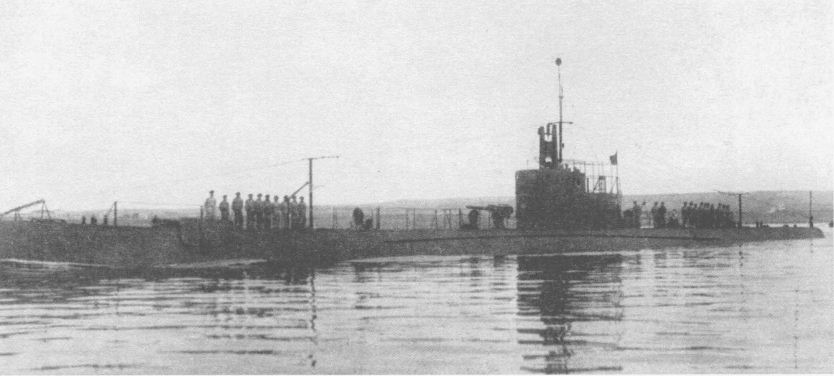
The Settembrini-class were a pair of submersibles designed by engineer Cavallini and built for the Regia Marina in 1928-31 by Cantieri navali Tosi di Taranto shipyard. They were a development of the previous Mameli class of partial double hull saddle tank type that made for a simpler construction. But the Admiralty wanted them faster than the Mameli with new diesels and 56 cell storage batteries, but same armament as before. Luigi Settembrini was sunk in November 1944 by collision with DDE USS Frament off Bermuda in ASW manoeuvres. Her sister Ruggiero Settimo survived the war and was scrapped in 1947 after her co-belligerence and short postwar career.

Design of the class

Development
The base design goal when planned in 1927 was to take the Mameli class as base, and correct its insufficient stability, give it more sped and twice its endurance as well as carrying more torpedoes. This Cavallini was however of the same partially double-hulled type. But the shape of the hull and blisters were modified to increase stability, notably by increasing the beam and adding more efficient keeling and fixed ballasting system, the shape of the outer hull, placement of the diving planes and tail. They were approved and ordered o,ce after the other at the Taranto shipyards in 1928. Construction proceeded until 1930 and 1931, named after a Naples man of letters and senator (17 April 1813, Naples – 3 November 1877 Florence) which played a part in the unification. Ruggero Settimo (19 May 1778 – 2 May 1863) was an Italian politician, diplomat, and patriotic activist, counter-admiral of the Sicilian Navy, also a great figure of the Unification.
Hull and general design
The Settembrini class displaced 953 metric tons (938 long tons) surfaced and 1,153 metric tons (1,135 long tons) submerged, that is 130t more than the Mameli (823t/1,009t). They were also larger, with an overall lenght going from 64.6 to 69.11 meters (226 ft 9 in) overall, and a greater beam from 6.51 to 6.61 meters (21 ft 8 in), greater draft as well from 4.3 to 4.45 meters (14 ft 7 in). Their operational diving depth was however a bit less impressive at 80 meters (260 ft) versus 90 meters for the Mameli. Their crew was however comparable at 56 officers and enlisted men.
Externally, they had about the same general hull shape as the Mameli, same diving plane close to the upper deck, same rudder shape, same propeller struts arrangement, however the narrow prow had a hard chin, versus the Mameli’s round bow and sloped stern. It had however the same droppable emergency lead keel (larger), same general overall shape for her blisters, same series of water scoops in two rows above, same two-tier belly aft shape and rounded stern. However the hull shape was made for better surface and underwater stability. The straight deck was gradually sloped until the prow. There were two short cable support either side the conning tower and a protection cable running from a horse-type structure to the portico across the CT, protecting the persicope wells and doubling as wireless cables. The cable then met the midget mast aft and was secured at the poop by a bracket.
The standard long CT had an enclosed helmsman post with windows forward, then an open bridge, bulwarked, with the proper conning tower housing the watch and attack periscopes. Then cape the aft platform with two pintle-mounted AA HMGs. There were also a hatch aft and forward and a large loading deck hatch close to the two diving planes. There wre two anchores in recesses forward of the diving planes. The latter were generally folded upwards in surface navigation and the aft propellers were protected by a welded guard bar either side. The sail was later changed in wartime for a German style CT.
Powerplant
On surface the Settembrini were powered by two Franco Tosi 1,500-brake-horsepower (1,119 kW) diesel engines. Each drove a propeller shaft. These were the same four-stroke motors with a primary crankshaft, to which were connected the pistons as in the Mameli. No reverse. They were then directly connected to a four-stage air compressor produced air at 70 Kg/cm2 m (995.6 psi) that can be reversed to start the engines. They were also used for the ballast pumps and pressure hull ventilation. When submerged, the Settembrini were driven by Ansaldo 550-horsepower electric motor (not 700 hp as seen in some sources notably wiki). Each time the engines had to be connected to the primary axles via a clutch joint, and to the propeller shafts by a geared joint that could be decoupled and connected to the electric motors to load them instead. The diesels received their supply of fresh air from an intake in the conning tower, protected by a large valve sealed each time the boat started to dive. The exhausts however were aft of the hull on either side and had also valves shut when diving.
Amazingly the “Settembrini” reached 18 knots versus 17.2 for the “Mameli” on trials (15 kts service) even though they shared the same power plant. However this was on trials, as in service it was at best 17.5 knots (32.4 km/h; 20.1 mph) surfaced, 7.7 knots (14.3 km/h; 8.9 mph) underwater. Normal range was 6,200 nautical miles (11,500 km; 7,100 mi) at 7.3 knots (13.5 km/h; 8.4 mph) which was better than the Mameli at 4,360 nmi at 8 knots surfaced. Howver it was worse underwater at 100 nmi (190 km; 120 mi) at 3 knots (5.6 km/h; 3.5 mph) versus 110 nm for Mameli. So in the end, surface speed was better, underwater speed was inferior, surface range was better (nit twice as much as expected) and underwater range lower as well as the diving limit. Not yet the perfect design for Cavallini.
Armament
It was a repeat of the Mameli class, the Settembrini with six internal 53.3 cm (21 in) torpedo tubes, four bow, two stern and eight torpedoes in store, less the six already preloaded in the tubes. That was one more than the Mameli. They were also armed with the same single 102 mm (4 in) OTO m1931 deck gun for surface attacks, with an anti-aircraft defence of two 13.2 mm (0.52 in) Breda heavy machine guns, no change.
OTO 100mm/47 modello 1931
Derived from the Škoda 10 cm K1, but with loose liners. A tube, jacket and loose liner with a breech ring that screwed to both the A tube and jacket. Barrel shortened to 4.94 m (16 ft 2 in). Single, hand-worked and unshielded, pedestal-mounts fore and aft of the CT. The Settembrini had a lowered platform, to the deck level, instead of the breakwater style of the Bandiera, and carried 150 shells in store, either 22 kg AP or smaller 13.8 kg conventional HE shells.
Specs:
Shell: 100 millimetres (3.9 in), fixed 13.75 kilograms (30.3 lb) QF 100 x 892R
Breech: Horizontal sliding breech block
Elevation/Traverse: -5° to +45° for 360°
Rate of fire: 8-10 rpm
Muzzle velocity: 880 meters per second (2,900 ft/s)
Max range: 15.2 km (9.4 mi)
AA: 2x Breda Modello 31

The anti-aircraft defence counted on two twin Breda M1931 13.2 mm L/76 heavy machine guns, placed on a rear platform of the conning tower. Each mount weighed 695 kg, but ensured an elevation of -10° to 90°. They fired 125 g unitary rounds, but through clips containing 30 rounds each. Muzzle velocity of 790 m/s, maximum range of 6,000 meters and effective range of 2,000 meters. Their rate of fire was 500 rounds/min, so 2000 rounds when both twin mounts fired in concert, however. These were retractable mounts, receding into a water-tight tube and protected by a small hatch. Upon emerging, gunners released the hatch, lift the guns out and install a clip to be ready.
533 mm torpedoes
Model unknown. When completed they probably had the Silurificio Whitehead di Fiume common A140/450 (1921). Capable of 29-32 knots, 6,000-4,000 m range settings, 1,140 Kgs, TNT warhead 140 kg, air tank loaded to 170 atmospheres. It was however quite visible due to the compressed air bubble trail, especially in calm waters.
Later in 1933-36 it was probably given the following wet-heater models:
-W 270/533.4 x 7.2 Veloce: 1,700 kg, 7.2 m WH 270 kg, 3,000-4,000 m/50 knots or 12,000 m/30 knots.
-W 270/533.4 x 7.2 “F”: 1,550 kg, 6,500 m, WH 250 kg, speed 3,000 m/43 knots or 10,000 m/28 knots
-W 250/533.4 x 6.5: 1,550 kg, 7,200 m, WH 270 kg, 4,000 m/48 knots or 12,000 m/30 knots.
-Si 270/533.4 x 7.2 “I”: 1,700 kg, 7.2 m, WH 270 kg, speed 3 km/42 kts. or 7 km/32 kts., 9,2km/30 knots, 12km/26 kts
-W 250/533.4 x 6.72: 7.2m, WH 270 kg speed 4km/49 kts. or 8km/38 kts.
-Si 270/533.4 x 7.2 “M”: 1,7 ton, 7.2 m, WH 270 kg speed 4km/46 kts., 8km/35 kts or 12km/29 kts.
Dedicated illustration planned
⚙ Settembrini specifications |
|
| Displacement | 953t surfaced, 1,153t submerged |
| Dimensions | 69.11 x 6.61 x 4.45 m (226 ft 6 in x 21 ft 8 in x 14 ft 7 in) |
| Propulsion | 2 shafts diesel Tosi 3,000 bhp (2,200 kW) total, 2 Ans. electric motors 1,400 bhp (1000 kW) |
| Speed | 17.5 knots surfaced, 7.7 knots submerged |
| Range | 6,200 nmi at 7.7 kts surfaced, 100 nm at 3 kts underwater |
| Armament | 6× 533 mm TTs (4 bow, 2 stern), 102 mm deck gun, 2× 13.2 mm AA |
| Max test depth | 80 m (260 ft) |
| Crew | 53 |
Career of the Settembrini class
Luigi Settembrini (1930)

Photo: Godfredo Settembrini in 1943 with her new German-style CT.
Luigi Settembrini was laid down at Tosi, Taranto in April 1928, launched first on 28 Sept. 1930 and completed also first in January 1932. On 11 September 1933, she set sail from Taranto with her sister Settimo to the Red Sea via Tobruk, Port Said, Massawa, Aden, Assab, Massawa. They stayed on station to resupply and sailed back via Ismailia, Port Said and Alexandria, back to Taranto on April 4, 1934 to test that deployment in case of war (from there they could block Indian Ocean trade and the Suez canal southern entranve, vital to both the French and British). She was ordered for a clandestine deployment in the Spanish Civil War, but in the Aegean. On 3 September 1937 under command of Lieutenant Beppino Manca she surfaced, fire at the bow and stopped for inspection the Soviet steamship Blagoiev (3,100 GRT) off Psara loaded with 4,480 tons of coal bound for Ceuta from Mariupol. The crew abandoned ship, but Settembrini needed three torpedoes to have sink in half an hour.
As the Second World War started she patrolled the Gulf of Taranto. On August 7, 1940, she was sent to the Jericho Channel and missed two allied destroyers but missed. She was back on August 13. By September she was assigned to the Messina Submarine Group and in November, took part in the submarine barrage between the Ionian and Aegean Seas (no spot, no kill).
On April 23, 1941, on patrol she launched three torpedoes but missed an unidentified British cruiser. By July she was deployed on the coast of Libya and on the 10th at at night while surfaced, Lieutenant Commander Alcide Baldi spotted two large unknown motorboats followed by two destroyers, too fast to be attacked. On the 13th she attacked a destroyer, but missed. Two days later she damaged British motorboats that withdrew. At 1:35 a.m. on July 16 she missed a 700 GRT tanker, then surfaced and start to shell her after her first torpedo passed under the hull without exploding. She launched two more torpedoes but missed again and the Tanker survived. On 8-9 November under Lieutenant Commander Mario Resio, she had an hydrophones contact 20 away of the passing by British Force K (HMS Aurora, Penelope, destroyers Lance and Lively) underway to attack the Duisburg convoy. She shadowed them for four hours but was distanced at 6:15 and abandoned the chase. On 1 October 1942 her age and conditions force the admirakty to have her assigned to the Submarine School in Pola. In all she performed ten training cruises.
On 30 November, she had her first transport mission to Libya, torpedoes replaced by storage, notably fuel and ammo from and bacl to Pola. She then performed 80 more training missions. With the invasion of Sicily, she was sent to defend the coast of Sicily and Calabria, but made no kills. With the armistice proclaimed, she was found patrolling the Ionian Sea and was ablt to surrender to the Allies in Augusta, Sicily. From there she departed on September 16 with five other submarines for internment in Malta the other day, submerged in daily hourse to avoid German or allied accidental air attacks (those who don’t got the memo). On October 13, 1943, she departed Malta with 14 other submarines for Mainland Italy. Now under allied supervision she started her co-belligerent carrer by being sent like most her sister to Bermuda for anti-submarine exercises. On 15 November 1944 at 2.23 am however while surfaced, she was accidentally rammed by the Buckley-class USS Frament (DE-677/APD-77) and sank in the Atlantic, 685 miles west of Gibraltar, with almost her crew but 8 men survived, jumping overboard from the CT and deck.
Ruggero Settimo (1931)
Ruggiero Settimo was also ordered at Tosi, but later in June 1928. She was launched on 29 March 1931 and completed by april 1932. From September 11, 1933, to April 4, 1934, like her sister she made a long cruise to the Red Sea, and colonial port of Massawa from and back to Taranto which demonstrated their overall performances as quite satisfactory. Like her sister she was also deployed in the Aegean Sea trying to interept Soviet Cargoes bound for Spain duing the Civil War but unllike her sister had no success. On June 13th, 1940, under command of Lieutenant Giovanni Cantù she had an surface engagement with an unidentified enemy submarine, both firing several torpedoes at each other, none hitting and the moved away of the engagement. Postwar records varies between a chance enocunter with another Italian sub that failed to identify itself. On July 12, while near Capo Passero, sge was attacked and bombed by a Short Sunderland that missed and only shook her hull, causing minor damage.
At 10:22 PM on January 10, 1941 under Command of Lieutenant Commander Mario Spano she took part in Operation Excess, she sighted two light cruisers of the British 7th Division, attacked them with two torpedoes from 1,400 meters, and moved away submerged. The crew heard an explosion but there is no confirmation of a hit. It posible the torpedo exploded prematurely. On July 1941, she was sent between Pantelleria and Malta this time in ambush of Operation Substance, but spotted no target. She then had a serie of seven supply transport missions to Libya. During one of these, while returning from Derna, she launched two torpedoes at destroyers but missed. After 28 combat missions, 17 patrols, 7 transport, 14 transfer she was caught by the armistice of September 8, 1943 in Taranto. From January 4 to April 21 1944 she remained under command of Lieutenant Commander Rino Erler but her co-belligerence records are unknow. She was scrapped after the war in 1947.
Read More/Src
Books
Giorgio Giorgerini, Uomini sul fondo. Storia del sommergibilismo italiano dalle origini a oggi, Mondadori, 2002
Bagnasco, Erminio (1977). Submarines of World War Two. NIP
Brescia, Maurizio (2012). Mussolini’s Navy: A Reference Guide to the Regina Marina 1930–45.NIP
Chesneau, Roger, ed. (1980). Conway’s All the World’s Fighting Ships 1922–1946. Greenwich, Conway Maritime Press.
Frank, Willard C. Jr. (1989). “Question 12/88”. Warship International. XXVI (1)
Rohwer, Jürgen (2005). Chronology of the War at Sea 1939–1945: The Naval History of World War Two. Annapolis NIP
Links
archive.org xmasgrupsom.com Settembrini.html
on navypedia.org/ships
regiamarina.net/
en.wikipedia.org Settembrini-class_submarine
it.wikipedia.org Classe_Settembrini
web.archive.org/ archeologiaindustriale.it/
web.archive.org archeologiaindustriale.it/
trentoincina.it Settembrini
trentoincina.it Delfino
alamy image