
 Svenska Marinen 2 fleet destroyers: Klas Horn, Klas Uggla 1930-58.
The Klas class, most often “Klas Horn” class as it less odd to pronounce, were two fleet destroyers in service with the Svenska Marinen from 1932 to 1958 and a development of the preceding Ehrensköld-class. Built in 1930-1932, they shared many similar characteristics. HSwMS Klas Uggla and HSwMS Klas Horn were part of the neutral patrols from 1939, and were involved in the Hårsfjärden disaster in 1941, in which both were damaged. Klas Uggla was raised and decommissioned, but Klas Horn was repaired and remained in service until 1958.
Development

The Ehrensköld-class destroyers (Jagäre in Swedish) has been the first Swedish Destroyers built since a decade, to be precise since the Wrangel class launched in 1917. Preliminary work started in 1920 and in 1922 the Admiralty retained a tender from a US shipyard (part of the Ford network) that produced the Clemson class destroyers, on a 1,100 tons displacement. The Swedish class was modified but retain that particular look and inspiration. The Kokcums yad was in charge of the plans, which were ready in 1926 when the two ships were built, Ehrensköld laid down at Kockums in Malmö in late 1924 and launched on 25 September 1926 and Nordenskjöld laid down at Götaverken, launched on 19 June 1926.
 However as soon as these ships were in service, the Swedish Navy started work on a successor class, largely based on this design: The Klas class. They were slightly larger, but armed the same and often considered a sub-class of the Ehrensköld-class. Even Swedish sources are not very helpful on this, just stating the ship were “improved versions”. They were indeed objectively larger, from 974 to 1020 tonnes standard, with a lightly greater length but same beam and stability. The powerplant was the same, and top speed was setup the same at 36 knots. Armament was identical. They were likely approved as early as 1928, a year after the commission of her earlier sisters, with Klas Horn being ordered at Kockums and laid down in 1929, launched on 13 June 1931 and commissioned in 1932. Klas Uggla was ordered from Karlskrona Navy Yard, laid down in 1929, launched on 18 June 1931 and completed also in 1932. A long delay, with the next Göteborg class laid down after another delay, laid down from 1934 onwards and further improved, built until WW2 started (last commissioned in 1941).
Design of the Klas Horn class
Hull and general design
The Klas destroyers were very much a repeat of the Ehrensköld-class, but they displaced 1,020 long tons (1,040 t) at standard load instead of 974, quite a symbolic step. They measured 92.4 meters (303 ft 2 in) long overall, versus 91 m (300 ft) (o/a) on the previous class, for a beam of 8.9 meters (29 ft 2 in), versus 8.88 m on the previous ships, and a draft of 2.6 meters (8 ft 6 in) versus 3.8 m (12 ft 6 in) mean. Looking at these numbers it seems they had a better buoyancy for the same beam. As for the general outlook, it was similar to the previous ships, flush deck with some flare at the bow, a rounded, streamlined bridge, a taller mainmast and short aft mas, both poles, not tripod, and two funnels, raked and capped. The US designs had four funnels indeed. Othr wide since the armament did not changed, the remainder of the design was the same. The bridge was however different, and instead of a serie of rectangular windows, showed portholes. The shape of the bridge seems also different, not a perfect rounded shape but a more compact and faceted one.
Powerplant
No change there. The Klas Horn and Klas Uggla had the same arrangement as before, three Penhoët boilers providing steam to two de Laval geared turbines, on two propeller shafts with 3-bladed fixed pitch bronze propellers. This was rated at 26,000 shaft horsepower (19,000 kW) like the previous class, all for a top speed of 36 knots (67 km/h; 41 mph) as contracted. Trial speeds are not known. They carried 150 long tons (150 t) of fuel oil, for a range of 1,600 nautical miles (3,000 km; 1,800 mi) at 20 knots (37 km/h; 23 mph), also as contracted, the same as their predecessors. The crew amounted to 130, a bit more than the 106 of the earlier ships.
Armament
Repeat here too: Three Main 120 mm Bofors guns, one forward on the forecastle deck, under mask, one amidship between funnels, and one aft on the quarterdeck, all also under masks. This was completed by two single 40 mm (1.6 in) 2-pdr Vickers pompom AA guns for AA defence, located either side of the main light projector aft amidship. The two triple 533 mm (21 in) torpedo tubes were located either side of this projector and AA platform. The tubes were not aligned at the same level, the central one was taller. Mine rails were installed on the quartedeck for 20 mines total. The also had two Y-Guns for ASW depht charges installed.
M24 12cm/46 Bofors
These were common to both Swedish and NL destroyer. They were called the 12 cm/50 (4.7″) Models 1924, 1924B and 1924C. The Bofors M1924 and 1924B were slightly different, but the Model 1924C introduced a loose barrel construction. The Dutch called them the Mark 4 guns and they were licenced to Hollandsche Industrie-en Handelsmaatschappij (HIH) later as Mark 5 guns, but still interchangeable with the Mark 4. Munitions were produced by Bofors and Artillerie-Inrichtingen. True bore size was 4.724 inches. After scrapping all interwar Swedish DDs, their guns ended in thirteen fortifications in northern Sweden, with new ammunition for ground use until they were gradually demilitarized after the end of the cold war.
⚙ Bofors M24C Specs
2.95 tons barrel alone, lenght 251.6 in (6.39 m), bore 236.2 in (6 m).
Shell: HE L/4,2 94.1 lbs. (42.67 kg) or Starshell L/4,2: 74.0 lbs. (33.57 kg).
Muzzle Velocity HE L/4,2: 2,952 fps (900 mps), Starshell L/4,2: 1,640 fps (500 mps)
Rate Of Fire: 10 rounds per minute
Range: +30°: 21,300 yards (19,500 m), on the Bofors 8.56 tons mount (with shield).
Recoil 22.8 in (58 cm). Traverse 120° either side.
40mm/22 Vickers Pompom AA M22
Initially two 40 mm luftvärnautomatkanoner m/22, a local name for the Vickers 2-pdr AA gun of WWI, the first “pompom”, installed on a platform in between the torpedo tube banks aft amidship. They were replaced by 40mm/56 K/60 M32 AA guns in the 1930s, albeit most sources points out they were replaced in turn in 1939 by two twin 25 mm lvakan M/32 light AA guns and two 8 mm lvksp M/14-29 AA machine guns.
40mm/56 K60 m/36 Bofors AA (1942)
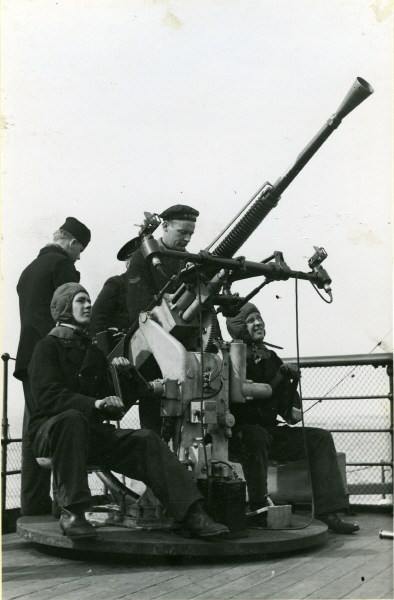 In 1942, their armament was revised. They kept their main guns, but the two old “pom-pom” were replaced in 1938 by the far better Bofors K60 m/36 of the same caliber and locations. The Swedish model was precisely coming from an official request to replace the British 2-pdr AA in the 1920s. It was funded by the Navy. The prototype barked first, testing its automatic loader on 17 October 1930. Design and manufacturing of the first model followed for more tests and fixes on 10 November 1931. By 25 November 1931 trials showed it was capable of eight rounds in 7.58 seconds, Bofors created an amazing autoloader design concept for “heavy” AA rounds but more effort was needed to meet the Navy’s 130 rpm requirement.
A new official test was a success on 21 March 1932. In 1933-34 with a watchful eye of the Navyn the model was further refined with 30,000 hours of drawing board work as well as producing all the machine tool necessary to create the masterpiece that was the 40 mm L/60 (In sweden L56, K60) Model 1934. Export success wa simmediate, but strangely the Navy did not adopted it, ordering instead in 1934 was a short-barrel version for submarines, the 40 mm L/43 M1932. Some sources argues that was the model installed on the Psilander class, but it’s doubtful. The model the Navy finally adopted was the 40 mm L/60 Model 1936, the base for the legendary WW2 allies Bofors gun, still in service to this day.
The Bofors 40 mm/60 (1.57″) Model 1936 is the least known variant over the web, so data is scarce. Bore lenght was 88.578 in (2.250 m), full 76.1 in (1.933 m), and as asked by the Svenska Marinen, a rate of fire of 120 rounds per minute per barrel nominal. It slowed down with gravity and elevation and practical if could fell below 80 rpm, especially with a worn out barrel (life 9,600 to 10,000 Rounds). It used an AB 40 mm L/60 HE-T – 2.05 lbs. (0.93 kg) round, complete Bofors 1936 HE – 4.63 lbs. (2.1 kg) with a 17.60 in (44.7 cm) busting charge of 0.150 lbs. (0.068 kg) TNT. It had a Brass cartridge of 40 x 311R, 1.93 lbs. (0.88 kg) filled with 0.661 lbs. (0.300 kg) propellant charge. Muzzle velocity was 2,789 fps (850 mps), bezst range at 42°, 11,019 yards or 10,076 m.
Depth Charges
These were m/24 depth charge racks (seemingly 8 charge per rack, 16 m/24 total) and two m/24 depth charge throwers. The m/24 were replaced by m/33 throwers on the next classes. The topic of Swedish depth charges is also in research. They also carried presumably hydrophones.
Mines
Likely the Kontaktmina m31. No info yet, topic in research. It seems according to source the supply was between 20 and 40-46 mines depending on the type.

⚙ specifications (1932) |
|
| Displacement | 1,020 tonnes standard |
| Dimensions | 91 x 8,9 x 3,7 meter (298 ft 7 in x 29 ft 2 in x 12 ft 2 in) |
| Propulsion | 2x De Laval steam turbines, 3x Penhöet boilers, 36K hp. |
| Speed | 36 knots (67 km/h; 41 mph) |
| Range | 1,600 nm at 20 kts |
| Armament | 3x 120mm/46, 2x 2-pdr pompom, 2×3 533mm, 20 mines, see notes |
| Crew | 130 |
Career of the Klas Horn class
 HSwMS Klas Horn (3)

Klas Horn underway
Klas Horn was launched on 13 June 1931 by Kockums Mekaniska Verkstad at its shipyard in Malmö and commissioned on 16 September 1932. Klas Horn was named after admiral Klas Kristersson Horn (1517-1566). The ships had the pennant 3 and 4, following the two Ehrensköld-class (1 and 2). No logs for her interwar career though both were mmodernized in the mid-1930s, loosing their 40mm/39 (2 pdr pompom) for two 40mm/56 K/60 Bofors M32. In 1939 they had new boilers installed and the two Bofors 40mm replaced by two twin 25mm/55 K/58 M32 Bofors light AA guns.
The Klas-class destroyers were sometimes used to escort Swedish ore carriers and German troop transports from 1939 onwards. She was committed in neutrality patrols at the start of World War II. Famously she was sunk by an explosion on 17 September 1941. Refloated, returning to service in December 1943. This unsolved explosion at Hårsfjärden Naval Base was then known as the Hårsfjärden disaster.
This dramatic event in the Swedish Navy saw series of accidental explosions, causing by greatest damage to Swedish Navy in that war, despute neutrality. On this 17 September 1941, three Swedish Navy destroyers were berthed in Hårsfjärden fjord near Stockholm when the torpedoes or oil tanks of HSwMS Göteborg exploded. The exact cause was never elucitaed and Swedish naval Historians still debates about it today. The first destroyer erupted in flames and the fireball also enveloped Klas Horn and Klas Uggla berthed immediately next. The fire was so severe as being uncontrollable, causing the explosion of amunitons and depth charges, causing all three destroyers to sink. In total, thirty-three sailors did that day.

This was a major blow to the Swedish Navy. All three were later raised but a commission examined their general state, deciding what to do given their level of devastation. Klas Uggla never saw service again due to the level of destruction, she was considered a “total constructuve loss” The other two were repaired for a long time but amazingly resumed service. The investigation notably investigated a possible sabotage, or it was believed to be a bomb dropped accidentally by a Swedish plane on training maneuvers, or a torpedo manipulation gone wrong. Whatever the cause, this was the end of the line for Klas Uggla, but not Kla Horn that resumed service in December 1943 and until the end of the war.

Klas Horn camouflaged in 1943 src digitaltmuseum.se CC
After this, her records are foggy. It seems she was kept in service but likely never modernized as an ASW frigate. She was eventually decommissioned and later sold for BU on 15 August 1958.
HSwMS Klas Uggla (4)

Klas Uggla berthed close to Ehrensköld
Klas Uggla was named after Claas Johansson Uggla, born 1614 in the parish of Ölserud in Värmland, died 1 June 1676, Swedish naval officer, admiral and baron. She was ordered as yard N°298 at Örlogsvarvet, Karlskrona, laid down in 1929, launched on 18 June 1931 and completed in August 1932. No logs for WW2. Like her sister in 1935-36 she had her pompom AA replaced by 40mm m36 Bofors, only to be replaced in turn in 1939 with two twin 25 mm 55 caliber K/58 M32 AA guns. She also had her boilers modernized. From 1939 like her sister she started escort missions of Iron Ore to Germany, then from 1940 started neutrality patrols in Swedish Waters. She was present on 17 September 1941 in Haarsfjärden naval base near Stockholm when an explosion occurred, traced back to HSwMS Göteborg but she was immediately the closest of the two sisters and took the brunt of the explosion. Likely her own torpedoes, mines or depht charges exploded in turn and she was completely wrecked.
See above for the incident. Long story short, she was declared a total constructive loss given the level of devastation. It was deemed uneconomical to repair her. Klas Uggla was thus gradually stripped of usable parts for her sisters, and her wreck was scrapped in situ to clear the way.
Read More/Src
Books
Borgenstam, Curt; Insulander, Per; Kaudern, Gösta (1989), Jagare : med svenska flottans jagare under 80 år (2:a), Karlskrona: Västra Frölunda CB Marinlitteratur
von Hofsten, Gustav; Waernberg, Jan (2003), Örlogsfartyg: Svenska maskindrivna fartyg under tretungad flagg (1:a), Karlskrona: Svenskt Militärhistoriskt Bibliotek
lackman, Raymond V. B. (1960). Jane’s Fighting Ships 1960–61. London: Sampson Low, Marston & Co. Ltd.
Campbell, John (1985). Naval Weapons of World War II. Annapolis, Maryland: Naval Institute Press.
Parkes, Oscar (1973) [1931]. Jane’s Fighting Ships 1931. London: David & Charles (Publishers).
Westerlund, Karl-Eric (1980). “Sweden”. In Chesneau, Roger (ed.). Conway’s All the World’s Fighting Ships 1922–1946.
Whitley, M. J. (2000). Destroyers of World War Two: An International Encyclopedia. London: Cassell & Co.
Lagvall, Bertil (1991), Flottans Neutralitetsvakt 1939-1945, Karlskrona: Marinlitteraturföreningen nr 71
Hammargren, Henning (1981), Vapenköp i krig: svenska krigsmaterielinköp i Italien under andra världskriget, Stockholm: Marinlitteraturföreningen.
Links
navypedia.org
Hårsfjärden disaster
hhogman.se
sv.wikipedia.org
en.wikipedia.org
digitaltmuseum.org
navweaps.com