
 Svenska Marinen Two destroyers: Psilander, Puke, acquired Jan. 1940.
Second entry in a new cycle started in 2025, about Swedish Destroyers from the interwar to the end of WW2: The Psilander class. Sweden had experie,ce building its own destroyers since a decade, with notably the Wrangel class being the latest launched in 1917. Modest, it was realized that larger destroyers on par with foreign designs was needed in the 1920s, leading to the construction of the Ehrenskjöld class, strongly influenced by the 1918-19 US Navy’s Clemson class. However when WW2 broke out in 1939, the Swedes feared an invasion and needed a rapid beefing-up, Swedish Yards already at full capacity. So after an agreement was reached with the Italian Government still neutral at that point in March 1940, the Italian Navy agreed to sell two of its Sella class destroyers, two Spica class TBs and four MAS boats. However their fate, transferred from Italy but interned by the British, is almost worthy of a comedy. The Pislander class was devlivered, modified but however never satisfactory in service. They were discarded in 1947. Here is that story.
Development

Romulus seen from Remus in formation underway to Ireland in April 1940
In 1924, Sweden maintained its neutrality, partly also thanks to a generous fleet of torpedo-boats, interwoven with a network of coastal battleships and naval fortifications, that appeared deterrent enough along with other factors. But the Navy detemined also a rapid increase in capacity with two independent flotillas based around cruisers and modern destroyers to intervene rapidly any threatened area of territorial waters, something coastal battleship were incapable of. For this plan, many destroyer classes were built in succession, the Ehrenskjöld (1926), Klas Horn (1931) and Göteborg class (1935-40) with a new class (Visby) started also in 1940. However since 1939 Sweden was fearful of a possible German invasion, acquisition from Italy was agreed upon by the diet, of four new ships the Italian Government agreed to sell: Two elderly destroyers of the Sella class, two torpedo boats of the Spica class and four MAS-Boats (Motor Torpedo Boats). The agreement was reached in March 1940.
Design of the Pislander class
Hull and general design
The Psilander class were former Sella-class destroyers, which were in essence, enlarged and improved versions of the preceding Palestro and Curtatone classs of late WW1 until 1924. They had an overall length of 84.9 meters (278 ft 7 in), a beam of 8.6 meters (28 ft 3 in) and draft of 2.7 meters (8 ft 10 in) for a displacement of 970 metric tons (950 long tons) standard, 1,480 metric tons (1,460 long tons) deeply loaded, plus a crew of 8–9 officers and 144 ratings. The hull was designed with a forecastle that extended over almost half the length and between the two funnels stood a superstructure housing the wheelhouse and three faceted bridge, with an enclosed and an open level above. The ships had simple raked pole masts supporting wireless radio cables. It’s well possible the radio sets were removed and replaced by Swedish ones in service.
They were still Mediterranean destroyers, with a light hull structure, relatively low freeboard, especially at the forecastle. When they finnaly arrved in Sweden after the “Pislander affair”, they were modified for Northern waters service, notably with better insulation, a better heating system in and out (notably hot steamy seawater to de-ice the decks, fixtures and guns). All Italian indications were changed to Swedish.
Powerplant

Puke repairs in Lisbon
The Psilander inherited the British machinery purchased from the Sellas, two Parsons or Thornycroft geared steam turbines driving a propeller shaft each, fed by steam coming from three Yarrow boilers. These turbines were rated at 36,000 shaft horsepower (27,000 kW) for a nominal 33 knots (61 km/h; 38 mph) in service albeit they proved capable to reach 37 knots (69 km/h; 43 mph) on forced heat unladen in sea trials. However by 1940 these engines, well maintained, were still on the worn out side and top speed was not that stellar, probably around 31-32 in service at best, and certainly not in winter’s choppy waters. However these Mediterranean vessels made sense in the maze of islands and coastal waters of the Swedish Baltic coast. A sea that saw galleys and galley-derived vessels fightin,g each other under the Russian and Swedish flag in these same waters. The Psilander had c260 tonnes of fuel oil for a range of 1,800 nautical miles at 14 knots (26 km/h; 16 mph), but in 1940 it’s likely these performances were also slightly degraded.
Armament

The Swedes decided to keep their armament intact. Extra torpedoes and ammunitions arrived by train and ship. This comprised four 120 mm or 5-in guns/45 caliber OTO in wo twin mounts fore and aft, the latter at the same level on a superstructure on the aftdeck. Theh had also two single 40mm/39 Vickers Terni “pom-pom” AA guns amidships, two twin 13.2mm/76 Breda heavy machien guns and two twin- 45.7mm torpedo tubes banks, plus two 2 Depth charge racks and rails on deck fo 30 or 40 mines (swapped to the Swedish model). Note that the remaining Sella class in Italy were rearmed by two 40mm/56 K/60 M32.
Indeed one of the changes was to remove the original 533 mm (21 inches) twin banks, the first destroyers sporting these in Italian service, for the Swedish 45.7 mm (18 inches) standard according to some Swedish sources. The original Italian models were the 53.3 cm (21″) Si 270/533.4 x 7.2 “M” model but they could have been swapped for Swedish equivalents. Most anglo-saxon sources seems to point out they kept their 533 mm tubes.
OTO 120mm M1926
On the original ships three guns were installed, with a single one Modello 1919 Schneider-Canet-Armstrong forward, two aft. However a twin mount was added later in 1929 with the modello 1926 on all mounts. The twin mount weighted 16.6 tons (16.9 mt). Each barrel weighted 4,354t (9600 ibs), 4.98 meters (196.3 in) long with a barrel 5.4 meters (212.6 ft). They fired a HE 48.5 lbs. (22 kg) or AP: 51.0 lbs. (23.15 kg) shells at 7 rpm, 2,460 fps (750 mps), 16,950 yards (15,500 m) at 33°.
40mm/39 Vickers/Terni AA (as delivered)
M1930 1,878 lbs. (852 kg), +80 degrees manual mount, with five operators, steel-link belts. The barrel weighted 550 lbs. (249 kg) including cooling water, 96 in (2.438 m), bore 62 in (1.575 m). It had a 200 rpm cyclical, 50-75 rpm practical firing an HE or CP rounds of 2.95 lbs. (1.34 kg) at 2,000 fps (610 mps) at a max range of 1,200 yards (1,100 m). It seems their 13 mm Breda heavy machine guns were kept as well until 1942, replaced by 8 mm light machined guns afterwards.
40mm/56 K60 m/36 Bofors AA (1942)
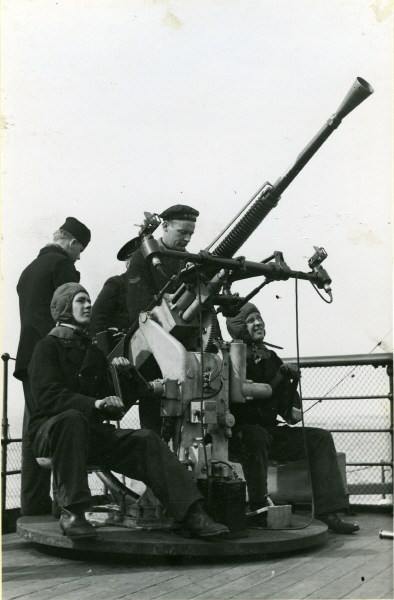
In 1942, their armament was revised. They kept their main guns, but the two old “pom-pom” were replaced by the far better Bofors K60 m/36 of the same caliber and locations. The Swedish model was precisely coming from an official request to replace the British 2-pdr AA in the 1920s. It was funded by the Navy. The prototype barked first, testing its automatic loader on 17 October 1930. Design and manufacturing of the first model followed for more tests and fixes on 10 November 1931. By 25 November 1931 trials showed it was capable of eight rounds in 7.58 seconds, Bofors created an amazing autoloader design concept for “heavy” AA rounds but more effort was needed to meet the Navy’s 130 rpm requirement.
A new official test was a success on 21 March 1932. In 1933-34 with a watchful eye of the Navyn the model was further refined with 30,000 hours of drawing board work as well as producing all the machine tool necessary to create the masterpiece that was the 40 mm L/60 (In sweden L56, K60) Model 1934. Export success wa simmediate, but strangely the Navy did not adopted it, ordering instead in 1934 was a short-barrel version for submarines, the 40 mm L/43 M1932. Some sources argues that was the model installed on the Psilander class, but it’s doubtful. The model the Navy finally adopted was the 40 mm L/60 Model 1936, the base for the legendary WW2 allies Bofors gun, still in service to this day.
The Bofors 40 mm/60 (1.57″) Model 1936 is the least known variant over the web, so data is scarce. Bore lenght was 88.578 in (2.250 m), full 76.1 in (1.933 m), and as asked by the Svenska Marinen, a rate of fire of 120 rounds per minute per barrel nominal. It slowed down with gravity and elevation and practical if could fell below 80 rpm, especially with a worn out barrel (life 9,600 to 10,000 Rounds). It used an AB 40 mm L/60 HE-T – 2.05 lbs. (0.93 kg) round, complete Bofors 1936 HE – 4.63 lbs. (2.1 kg) with a 17.60 in (44.7 cm) busting charge of 0.150 lbs. (0.068 kg) TNT. It had a Brass cartridge of 40 x 311R, 1.93 lbs. (0.88 kg) filled with 0.661 lbs. (0.300 kg) propellant charge. Muzzle velocity was 2,789 fps (850 mps), bezst range at 42°, 11,019 yards or 10,076 m.
Mines

Likely the Kontaktmina m31. No info yet, topic in research.
⚙ specifications (1942) |
|
| Displacement | 1,250 tonnes standard |
| Dimensions | 84,9 x 8,6 x 2,6 meter |
| Propulsion | 2x Parsons steam turbines, 3x Thornycroft boilers, 36K hp. |
| Speed | 35 knots |
| Range | 1800 nm at 18 kts |
| Armament | 2×2 120mm/45, 2×1 40mm m/36 AA, 2×2 8mm m/36 AA, 2×2 533mm, 32 mines |
| Crew | 120 |
Career of the Psilander class
 Psilander (18)

HMS Psilander in 1942 with a new northern camouflage and neutrality bands
In Italian service as part of the Sella class built in 1926-1927 they were the first class designed and built post World War I and in 1929 they were modernized, replacing the three original 12 cm guns with four more modern ones, leading to the forward turret receiving a twin mount. In September 1939 as World War II, Swedish insurance companies and the Swedish business community offered the Sweidish state, worried about a possible invasion frm Germany or incursion by the British, an interest-free loan to build new destroyers.
However, the Minister of Defense Per Edvin Sköld considered that the need for new destroyers was so urgent that it was better to buy them abroad rather than to build them in Sweden (in addition local the yards being already at full capacity). This led to an agreement being signed on 21 January 1940 with the government of Italy, still neutral at the time, to purchase two Sella class destroyers Giovanni Nicotera and Bettino Ricasoli (later renamed Pislander and Puke respectively). In addition, two Spica class torpedo boats (soon to be renamed the Romulus class) and four motor torpedo boats of the Baglietto MAS type were purchased as well as ammunitions, and other military equipments, not only for the Navy. However the settlement took time to materialize.
It’s only on 14 April, that all four destroyers departed together from La Spezia… To arrive on 10 July in Gothenburg. The MAS-boats were transported on a cargo. So what happened between 14 April and 10 July ? That’s the start of the infamous “Psilander Affair”. And as we all know, in troubled times, timing is everything…
Psilanderaffären

Commander Hagman on board HMS Puke ready to depart on 14 April 1940 from La Spezia.
The “Pislander Affair”, was a major incident in Sweden, hence the litterature and contents about it in Swedish Language, but not much in the Anglosphere. So, how it unfolded ?
This incident occurred in Skálafjørður (Danish: Skaalefjord), near Tórshavn in the Faroe Islands, on 20 June 1940. While stopping to refuel before the final leg of their trip to the Baltic, HMS Psilander, Puke, Romulus and Remus were seized by the British Navy, out of concern that the German navy would have forcibly seize them underway when leaving the North Sea. This was indeed a critical time for Great Britain in June 1940, due to the urgent need for combat hardware from Sweden at the outbreak of the Second World War in September 1939. Italy was the only non-belligerent nation ready to sell the ships Sweden just gained funds for, and a quick purchase agreement was carried out.

Pilander and Romulus at Cartagena
The ship were tested in La Spezia in March and April 1940, with the Swedish crews training on board, explaining why they took so long to depart after the contract signing in January. After a long and dramatic homeward journey delayed already by hasty repair and difficulty of obtaining fuel along the way. At noon on 20 April indeed, Puke suffered an engine failure, left the formation without communicating her intention to the following Psilander which did not have time to veer away and hit Puke’s stern with her bow. Puke had a propeller guard torn off, water flooded the stern until contained. On Psilander, rivets came loose on dented plates in the bow causing a minor leak. The watertight bulkheads held, and both destroyers resulmed their trip at 12 knots until forced to stop at Cartagena, Spain, for repairs the next day.
In Cartagena, Spanish workers worked quickly and efficiently despite the extensive damage after the civil war but only Psilander was drydocked, Puke was repaired berthed. Much of the secrecy surrounding their journey was broken and aft replenishing they departed on 26 April for Lisbon, where the Tanker Patricia, sent in advance supplied them with oil. On 23 April, the Italian naval chief, Admiral Cavagnari phoned the Swedish naval attaché the ships were on their way home as soon as possible:
…less than three weeks, but be careful not to let the Germans harm the ships in the Kiel Canal
This statement was caught by the British and interpreted as the admiral’s agreement with Hitler’s plans to attack in the west at the beginning of May. British radio broadcasts from Malta and Gibraltar were already clear about British weariness, the ships were tracked already on their way to Lisbon. They arrived in Lisbon on 28 April, dropped anchor in the Tagus River, to quickly refuel and continue on to Cobh in Ireland. However no oil could be obtained, only fresh water oso the flotilla was trapped there while Puke’s damage was finally repaired by repairs in drydock at Lisbon in turn.
The destroyers’ journey was now being closely followed in London. In a memo to the Swedish Naval Forces Command, the Swedish Foreign Ministry announced:
The mission in London informs that the British Foreign Office has recommended that the destroyers be ordered to remain in Lisbon until further notice and that under the current circumstances, repatriation must be strongly discouraged.
The formation had the accompanying passenger ship Patricia, tanker Castor, halting notaby aafter this in Portugal, and ending up in the Faroe Islands. Indeed, combat in part of the Atlantic, the channel and North sea forced that long route around British Isles. On 26 May the fleet left Lisbon, on 27 May they arrived at Vigo, Spain, Castor and Patricia fully refuelled in order to refuel the four destroyers later underway, as they were about to enter a combat zone. The crews were on short leaved but recaled as on 10 June, Italy entered war on the sode of the axis. The ships were already paid for, and the Swedish Navy found itself in a very delicate situation. Instructions were given to the tanker Castor to stay with the destroyer force, albeit she was limited to eight knots, the flotilla commander, Hagman, doubted they would have enough fuel to make ot to Cobh in Neutral Ireland. He therefore detached Castor while the destroyers and Patricia left Vigo at their most economical speed of 12 knots, for their trip into the Atlantic towards Cobh, on 29 May.
Castor was later intercepted by the French and forced back to Casablanca, but negociations freed her under two days so she headed back to Cobh. By late May, the war on the continent took a dramatic turn, with the Dunkirk evacuation under the bombs of the Luftwaffe, this confirmed the only possible route along the western Coast of Ireland. The Danish Faroe were in fact occupied by the British military since April 1940 after Denmark’s surrender, but the government did not formally acknowledge this, so the arrival of these ships was still a valid bet before their last leg to Sweden. On 1st June, Patricia already detected a periscope. A day later she managed to resupply the destroyers en route, now able to reach the Faroe after departing Cobh. Later on 22 June France capitulated so Britain stood alone and under imminent threat of a German invasion. While the German navy, which lost ten of its most modern destroyers in the Battle of Narvik were likely to need these passing by destroyers, neutrality be damned. The British were thus anxious this would happen.

Internement of all four DDs
On 19 June as the Destroyers arrived in the Feroe Islands, Prime Minister Churchill considered their seizure of the utmost importance, and after the flotilla entered the Skaalefjord near Torshavn, they were assigned an anchorage at the far end of the fjord. The following day in a motorboat, the British squadron commander Captain C. Caslon arrived with a Lieutenant-Commander to meet the Swedish squadron commander on HMS Puke. Caslon then gave an ultimatum with the intention of the British government to seize the destroyers and that the destroyers were to be evacuated within two and a half hours, the crews transferred to Britain and then to Sweden. Patricia and Castor were free to resume their journey home. If the Swedish crew were seen attempting to scuttle their ships, this would be met with “appropriate countermeasures”. Commander Hagman rejected the demands, stating he he would fight or sink his ships and Caslon pointed out it was only a temporary internment, and that the ships would remain Swedish property. Hagman wanted to communicate with the Swedish government, but Caslon refused, so Hagman requested an official written note from the British government and Caslon promised to comply.
Long story short, the situation was defused, the crews interned and just over a week later, Sweden recovered the seized destroyers after intense diplomatic activity, and the ships were finally able to sail to Gothenburg. Commander Torsten Hagman, having to surrender armed Swedish warships to a foreign power without a fight, he was court martialled back home, with preliminary hearings held at the West Coast Marine Command. He was not condemned, nor never publicly acquitted.
In Swedish Service
After arriving in Sweden, in July, both were assigned to the Gothenburg Squadron. However after a number of neutrality patrols, especially after the winter 1940-41, captains reported how much they were poorly built, rolled heavily in sea conditions and were quite wet, not improved by icing. Back in harbour they were sent straight to the only available shipyard to have reinforcements built in, plus sling keels mounted on the hulls for extra stablity. In addition, the low stern freeboard, often washed over in bad weather had to be better protected, notably against water rushing below through the hatches.
They returned for a short time into service, but in 1941–1942, their armament was modified, with their original anti-aircraft guns replaced with two 40 mm m/36 Bofors automatic guns plus two twin 8 mm m/36 anti-aircraft light machine guns. What became murky was about their torpedo tubes. Swedish sources claimed they came with 45.7 mm tubes, replaced with 53 cm torpedoes. Otherwise, Swedish depth charge launchers and depth charge racks were installed.
After a very short service, seeing that their main issues were still there, both were placed in “material readiness” from 1943 and 1944, berthed with a reduced care crew, ready to depart in case of a crisis. Postwar, they remained in “reduced service”, just a step above the reserve, and by 1947 they were decommissioned, stricken and scrapped. They ended as target ships, disposed of by gunfire and and explosion tests, but survived, only for their wreck to be towed back to Karlskrona in 1949 for BU.
Puke (19)

Puke was built at Pattison shipyard, Naples originally as Bettino Ricasoli when launched on 29 January 1926, commissioned on 11 December (named after a former Italian Prime Minister). In 1929, she was modernized like her sister with two pairs of M1926 12 cm guns. By December 1939 after a Swedish commission departed for Italy to investigate a purchase of warships, she was inspected and selected for acquisition, signed on 14 April 1940. Like her sister she departed La Spezia in March but was interned along the way (see above) and only arrived on 10 July in Gothenburg. She joined the Gothenburg squadron but soon after the winter, her captain reported how she rolled heavily in rough seas, was abornmally “wet” and her hull groaned a lot and seemingly lacked rigidity. She had to be drydocked and reinforcements built, as well as new counter-keels fitted, plus measures take to tame seawater floding on the aft deck in bad weather. In 1941–1942, Puke retunred at berth to have her armament modified, standardized to Swedish norms, with her anti-aircraft guns rpelaced by the 40mm m/36 and two twin 8 mm AA machine guns m/36 and apparently 53 cm torpedo tubes as well as new depth charge racks and launchers installed. Service afterwards was short. She remained inactive with a nucleus crew in “material readiness” in 1943 and 1944. Decommissioned on 13 June 1947, Puke was used ifor gunnery and explosion tests, then scrapped at Karlskrona in 1949.
Read More/Src
Books
Borgenstam, Curt; Insulander, Per; Kaudern, Gösta (1989), Jagare : med svenska flottans jagare under 80 år (2:a), Karlskrona: Västra Frölunda CB Marinlitteratur
von Hofsten, Gustav; Waernberg, Jan (2003), Örlogsfartyg: Svenska maskindrivna fartyg under tretungad flagg (1:a), Karlskrona: Svenskt Militärhistoriskt Bibliotek
lackman, Raymond V. B. (1960). Jane’s Fighting Ships 1960–61. London: Sampson Low, Marston & Co. Ltd.
Campbell, John (1985). Naval Weapons of World War II. Annapolis, Maryland: Naval Institute Press.
Parkes, Oscar (1973) [1931]. Jane’s Fighting Ships 1931. London: David & Charles (Publishers).
Westerlund, Karl-Eric (1980). “Sweden”. In Chesneau, Roger (ed.). Conway’s All the World’s Fighting Ships 1922–1946.
Whitley, M. J. (2000). Destroyers of World War Two: An International Encyclopedia. London: Cassell & Co.
Lagvall, Bertil (1991), Flottans Neutralitetsvakt 1939-1945, Karlskrona: Marinlitteraturföreningen nr 71
Hammargren, Henning (1981), Vapenköp i krig: svenska krigsmaterielinköp i Italien under andra världskriget, Stockholm: Marinlitteraturföreningen.
Links
navypedia.org
en.wikipedia.org/
hhogman.se
sv.wikipedia.org
digitaltmuseum.org
Model Kits
Modelik 06_13 Psilander Szwedzki Niszczyciel Z II Wojny Światowej (paper model)