

 Soviet Navy Series I (D-1 to D-6): Dekabrist, Narodovolyets, Krasnovgardeyets, Spartakovets, Revolutsyoner, Yakobinets
 The Series I, also known as the “Dekabrist” class were the first submersibles designed and built for Soviet Navy after Revolution of 1917. They were authorized in the Soviet Naval Shipbuilding Program of 1926, influencved by Italians designs such as the Balilla, and started their sea trials in 1930, after submarine construction stopped in Russia for almost a decade. The last were the Bars class in 1917. Of the six built, two survived World War II, one submarine was preserved as a museum ship. They were invaluable despite their issues to quickstart a brand new lineage and ultimately were replaced by the excellent German-designed S-type (Series IX) prior to WW2.

Development
The story of Soviet Submarines starts with already some knowhow inherited from Imperial Russia, albeit in the long storm between the start of the revolution in 1917 and when the civil war ended around 1922, engineers many specialist were either killed of fled the country. Prior to this, the last class entirely designed and built in Russia (see the previous AG class for more) were the standard Bars (bear) class. These twenty-four 650 tonnes boats built between 1914 and 1917 were capable of 18 knots surfaced, which was excellent at the time, and armed with two decks guns and four internal tubes plus eight drop-collar torpedoes, also sporting a ram bow. They were really uniquely Russians, but compared to 1918 German U-Boats they looked from a much earlier generation. Some survivors contrinued to be active in the interwar and even WW2 mostly as instruction boats.

The really last Russian subs were the AG type or “Amerikanski Golland”, a Canadian-built Holland 602GF/602L type that was shipped to Russia for assembly, which was done over time, the last being completed in 1921-22. This was a comparative input of US/British design and were considered excellent boats, still active in WW2 for many, including in combat patrol roles. However, a new type of submarine was formulated as soon s the civil was over, in 1923, for a С (S) type (for средняя (srednyaya, “medium”)) submersible. There were discussions about what new type would be ideal on the standpoint of taking part in the defence of the motherland from the Black sea or Baltic, but it was not started before an official request, and ultimately were authorized by Soviet Naval Shipbuilding Program of 1926.
This plan was approved by the Labour and Defence Council in 1926, including twelve submarines, the first six being the recently designed Dekabrist class. True development started in January 1926. By September 19, two designs, with displacements of 910 and 1,440 tons were submitted to the RKKA commander for consideration. The first design was selected as the most preferable for the Baltic sea, in which submarines were intended for defensive operations in the Gulf of Finland. To oversee technical management and construction at the Baltic Shipyard, B.M. Malinin was entrusted for the working drawings and technical documentation. From 4 November 1926, Technical Bureau Nº 4 (formerly the Submarine Department, under the leadership of B.M. Malinin, organized submarine construction works at the Baltic Shipyard. The Series I quickstarted a lineage of 133 submarines designed under Malinin’s management. He also took part in the formation of the Pacific Fleet in 1932 and the Northern Fleet in 1933.
About Boris Malinin
 Boris Mikhailovich Malinin (13 February 1889 – 27 September 1949) was a Soviet shipbuilding scientist and graduate of Saint Petersburg Polytechnical Institute. Born from Opera singers. In 1913 at just 24, he took part in the construction of the the Bars-class Volk Wolf) and in May 1916, under command of Captain Ivan Messer, Volk destroyed three German transports, so he had a real experience and was one of the rare Russian submarine engineers that embraced the revolutionary cause. From November 4, 1926, he created the Technical Bureau No.4 tasked of the design and construction of submarines at the Baltic Shipyard. The “Technical Bureau No.4” started on the same floor as the former Russian Imperial Submarine Department, a secret department at the time. From 1926 to 1940 he was its chief designer and designed the majority of Soviet interwar submarines, the Dekabrist, Leninets, Shchuka and Malyutka-class.
In the 1950s his son K.B. Malinin, as a naval officer provided sketches of the Golf class, the first Soviet ballistic missile submarines with fellow officers B. F. Vasilyev, V. V. Bashenkov, and N. I. Petelin. Their work went into TsKB-16 (Volna) bureau that looked at the conversion of six Zulu-class attack submarines for Scud missiles and ultimately designed the Golf-class.
Disputed Origins

Albeit the origins of the Series I or “Dekabrist” (Decembrist) is still disputed, most historians are certain it started in Italy, with hypothesis that varied over time and are certainly to take with a safe pinch of salt. What is certain is that a commission was sent in Europe by Boris Malinin, based on a set of performance and design called the “operational-tactical requirement” (TTZ) that had been formulated in 1923-24. The Red Navy in 1923 indeed had a submarine fleet and practical skills in maintenance and assembly, but lacked of recent designs experience. The lastest built were very dated, like the Bars class (designed in 1911-12), to 1914 for the Holland/AG class, and until 1918 all navies improved much their own submarines designs, especially the Germans, ending with very advanced concepts like their cruiser subs and UB-III that would be the basis for their Type VII decades later. Due to the revolution of 1917 and early peace with the Germans, then full support of the White Russians or direct fighting against the Bolsheviks, the west denied to postwar Soviet Russia any access to war reparation U-Boats unlike the US, UK, France or Japan.
In an attempt to obtain up-to-date design knowledge, Boris Malinin created a Soviet naval mission which started a tour of shipyards in Western Europe in 1925.
Hypothesis 1:
Some informations were obtained from Germany’s socialist (Weimar Republic) government that pushed the former Imperial Navy to share some older designs from 1914-15 with them.
Hypothesis 2:
Sketches of the Italian Balilla class were obtained -either the 1913 or 1924 one- (from the memoirs of Sergei Bazilevsky, a dedsigner that later joined Malinin’s team on the Dekabrist project in 1927) from a second-hand bookshop in Rome.
Hypothesis 3:
Plans from the CRDA (dubious, not even involved in the Balilla design) but rather plans for the Pisani class at previous CNT.
Hypothesis 4:
Plans or sketched from STT credited with involvement in the underlying design work on the double hull of the Ballila class.
Italian Influence
 Whatever the exact origin, a simple look at the Dekabrist class clearly showed Italian influences. This was not an isolated case, that influence started even already prior to WWI when the Gangut class battleships (the first Russian dreadnoughts) took inspiration in the 1912 Dante Aligheri. Also in the interwar France, the US and UK looked at the Soviets with great suspicion and were wary of sharing sensible tech, but this was neither the case for Italy or Nazi Germany after 1933 based on the “socialist” nature of their authorarian regime, shared a lot a tech with USSR. This was true for tanks and aircraft for the latter, and ships for the former. Italy had a very string influence in the design of the Kirov class cruisers, and Soviet interwar destroyers, even building one directly for the Black sea fleet.
As for submarines, one clue was the “single-hull” construction in whichs ballast tanks were contained inside the pressure hull, as Italians pioneered double–hull construction. Equipment was placed around the pressure hull outer skin, enclosed by a separate external fairing, the “light hull” in Italian, allowing a more streamlined outer hull and a more spacious interior. This was typical of the new Balilla class but not the Pisani class. The TTZ however precised a diving depth limited to 50 metres (160 ft) whereas the Italians had stronger hulls for 100 metres (330 ft) for the Balilla and Pisani. The Soviet design was also smaller, with a surface displacement no more than 700 tons, while the Italians aimed at larger submarines. Plus Soviet boats filled the ballast tanks mechanically when diving wheras for the Italians these were flooded via seacocks.
The Dekabrist design had however a clearly influenced Italian hull structure and ballast arrangements:
-The hull was of riveted construction using left over high-quality steel from pre-revolutionary reserves.
-The pressure hull was able to withstand 90 meters (300 ft) pressure, built with high-quality armour plate from scrapped Izmail (Borodino) class battlecruisers*
-The double-hull design which enclosed pressure hull in a separate “light hull”, housing the main ballast tanks
-The interior division into multiple watertight compartments. Here, the concave-convexe bulkheads at both ends were replaced with thicker, flat circular ones
-Italian-style ballast tanks to speed up diving time
-Crash dive tank amidships from periscope depth rather from the surface (Bazilevsky). They were also reduced in size compared from Italian ones.
Names
Immediately, without waiting for official an approval from the Military Council on February 17, 1927, documents were transferred to the Baltic Shipyard for immediate construction. On March 5, 1927, the official keel-laying ceremony for the first of the first three submarines of the Series I took place, later classified as the D-type after the first letter of the lead boat. Later the Soviet Navy retroactively called them the Series I.
“Decembrist” (Декабрист) is an homage to December 1825 coup against the Tsar by liberal officers and political dissidents that failed. They were considered as early revolutionaries in the 1920s USSR.
“Narodovolets” was a member of Narodnaya Volya or “People’s Will”, created as a revolutonary socialst organization active 1879-1887 until the Tsarist crackdown
“Krasnogvardyeyets” or “Red Guardsman”. The “red guards” kept their elite, party-bound status until after WW2.
“Revolutsioner” “Revolutionary” is self-explanatory, generic as an homage to all revolutionaries.
“Spartakovets” was a follower of Spartacus, the leader of a large slave revolt at the time of the late Republic.
“Yakobinets” was an homage to the French Jacobins, of the 1789 revolution.
Design of the class

At 76 metres (249 ft) long for a displacement of around 1,000 tons, the Series I were indeed larger than any submarine built in Imperial Russia, albeit smaller than the Balilla class. The official range of over 7,000 nautical miles (13,000 km; 8,100 mi) was a radical departure over the Bars class (400 nmi/740 km) and AG types (1,750 nmi/3,240 km). If they had strong Italian design influences, they were rather a synthesis of Italian concepts and Soviet knowledge at the time from practical experience with distinct native features not strictly necessary for the new design. The pressure hull was much larger than the Bars class, which was previously a benchmark for reliability with its simple shapes. The extra ballast tanks beneath the deck casing also went from the Bars design. They were unnecessary when compared to the Italian-inspired diving system that enabled better, faster dives from the surface. Also their relatively large ballast tanks at the bow and stern used as trim tanks, or placing of the batteries in fully sealed compartments in the forward hull. Components were also all borrowed from existing Russian submarines, or newly designed at home.
Hull and general design
Internals

The Dekabrist-class submarines had a double-hull design with a pressure hull spindle-shaped, following the outer hull shaped. and was divided by spherical bulkheads into seven compartments:
First Compartment: The forward torpedo, living quarters, and largest compartment. It housed six forward torpedo tubes, six spare torpedoes, a torpedo loading device, a forward emergency buoy, and a log tank in the hold. This compartment also housed most of the crew’s berths, a dining table, a latrine, and a provision tank.
Second Compartment:
One battery bank, a radio room, a galley, and a latrine.
Third Compartment:
Battery room with two battery banks, wardroom, and the commander’s and commissioner’s quarters.
Fourth Compartment:
Central control room, center of the ship’s control instruments, refuge compartment, and an artillery magazine in the hold. The anti-aircraft periscope was also located here, and above the compartment was the conning tower with an attack periscope.
Fifth Compartment:
Battery room, living quarters. Gyrocompass.
Sixth Compartment:
Engine room, view forward
Engine room, two diesel engines, oil system, fuel tank, access hatch.
Seventh Compartment:
Electric propulsion, living quarters, aft torpedo room. Main control room, aft emergency buoy. Armament
design Specifications

The Series I displaced 933 tons surfaced and 1,354 tons submerged, for an overall length of 76.00 m (249 ft 4 in), a beam of 6.5 m (21 ft 4 in) and draught of 3.80 m (12 ft 6 in). The size of the pressure hull was close, with a diameter or 4.76 m amidship. Plating had to be manufactured using hot hammering with spatial templates. The frame spacing was set at 500 mm. For the first time in
Russian shipbuilding, the hull was divided into seven watertight compartments, combining flat and hemispherical, 9 kgf/cm pressure resistant watertight bulkheads. The largest was the first, with the torpedo reserves. Circular manholes, 80 cm large, were cut into the bulkheads using rack-and-pinion closing doors.
The hull shape was conventional, with a knife-edge like prow, two forward folding dive planes, two aft dive planes combined wth the propeller guards and rudder. The hull was well profiled, but had initially no sponsoned gun position since the gun was integrated into the initial Conning Tower, 1.7 m in diameter, quite long and fitted with an enclosed helmsman post (customary on Italian subs and most subs at the time in nealy all navies). The forward part support a platform for the main gun. It seems the sides were fixed and the gun barrel could traverse over the guard rail at nearly c300°. This CT was initially attached to the pressure hull with a flange and bolts, later replaced with rivets and had an upper and lower hatch for egress from the submarine on to the watch deck.
The Dekabrist class had series of water scoops placed along the nose, at the base of the flooded deck, and along the outer hull close to the waterline for rapid flooding in two series. The hull was reinforced on four sections, the tail was standard and “Italian style”. Unlike contemporary designs, she lacked a net-cutter at the nose, but had a cable guard anchored at the bow, supported by a strut forward on deck and attached to a portico in front of the two periscopes, then attached mi-dway on the aft deck. The conning tower was completely rebuilt in 1936-40, since the gun interfered with the bridge watch it was relocated on deck, at the foot of the new CT, which the extant helmsman’s post followed by an open platform for a 45 mm AA gun. Both the deck gun and AA gun had a sponsoned platform.
As for the ballasts, it included two end tanks, six pairs of inter-hull and midship main ballast tanks, a strong rapid diving tank, and air lines for the high and low-pressure pumps, Brown-Boveri types. The ventilation valves in the central compartment had pneumatic and manual actuators, while the sea chest valves were manual only. Two deck tanks used as extra trim ballast tanks were used. The Brown-Bowveri V4-03 low-pressure pumps with a capacity of 45 m³ per minute. The main water ballast, in addition to being blown through with low-pressure air (normal ascent) or high-pressure air (emergency ascent), could also be pumped overboard by the main bilge pumps.
Powerplant
The first two ships had German MAN diesel engines purchased for the first Soviet diesel locomotives, as main propulsion engines when surfaceed. Production of these was organized at the V.V. Kuibyshev Kolomna Plant. Capacity was two times 1100 shp combined at 425 rpm, with a compressor that had no-reverse. These engines powered the first four in the Ist series. The last two had Kolomna diesels. They could be decoupled from the propeller shafts using Bamag friction clutches, with a dog clutch installed between the diesels and propeller shaft to be coupled with the electric motors. The latter were a pair of PG-20 electric unit rated at 500 hp for full speed, and two creeping motors rated for 25 hp each, used for siment approach. When submerged, a battery made of four groups for 60 bettery cells housed in fully sealed pits below the main deck wete used. They themselves had a ventilation system and hydrogen afterburner to avoid cookups, but still could be easy to service.
Performances-wise, the Dekabrist class could reach 14 knots (26 km/h) surfaced and 9 knots (17 km/h) submerged. As for range, total fuel capacity was c128 tons, 39 tons contained within the pressure hull and 89 tons in the side 5, 6, 7 and 8 ballast tanks. Some submariners considered this a drawback in case the outer hull was damaged releasing a fuel trail betraying her presence on the surface. However, this was the only way to ensure high underwater performance, the Italian way. The Dekabrist class was designed for a maximum diving depth of 90 meters but the depth gauge was graduated to 100 meters or 330 feet.
Steering
The rudder and planes were powered by electric systems, with manual control backup. The rudder drive used a Davis screw and Fedorisky differential clutch, providing quick switch from electric to manual, the latter being located in the control center. The electric motor powering it was located in the aft compartment. The forward horizontal planes, folding the Italian way, also had electric motors. Those at the stern had controls located in the control center, near the rudder control stations. For switching from electric to manual control, there was a clutch built into the steering column. This rudder had the peculiarity of having its axis inclined forward by 7°, assuming if shifted full it would act as a horizontal rudder shifted to the submerged position to brake the submarine, prevent it from surfacing while underwater during a turn. This assumption proved unfounded in practice, and it was never repeated.
Internal Arrangements
The great height of the battery pits, helping for maintenance, also reduced the height of service and living quarters. However, habitability was keeping with the standards of the time. The command staff had shared cabins (but the Captain), half of the sailors lived in the largest first compartment. Others slept where they could, and obviously not in the machinery spaced. They had also the first air regeneration systems installed on any Russian submarines, allowing them to remain submerged for 72 hours. Communication between compartments used old fashioned speaking tubes.
The only equipments purchased aboard were the diesel engines (MAN) with friction clutches (Bamag), main bilge pumps (Rato), Brown-Boveri turbo-air pumps, Mitchell thrust bearings for the propeller shafts, Manesman for the high-pressure air receivers, the electric galleys, electrical measuring instruments, and others. A significant portion were supplied to the shipyard directly by the Marine Technical Directorate (Mortehuprom) like the high-strength ship steel, torpedo tubes, artillery armament, main diesels with clutches, batteries, a high-pressure compressor, periscopes, navigation instruments, communications equipment, and air regeneration system.
Armament
Torpedoes
Armament was a clear departure over the Bars and AG types, with six torpedo tubes in the bow, two at the ster for the 21-inch model, now standard international calibre. However its development took time in Russian and it was not ready. Thus, the rubes were given internal cradles reducing their diameter to stabilize and fire older 18-inch torpedoes. These special inserts holding them in place were available for other submarine or even ships designs for the same reason. See below for the specs. The pneumatic tubes were developed alongside the submarines. Machined in bronze, they extended from the pressure hull through special seals. The Dekabrist class carried 14 torpedoes: Eight preloaded in the tubes and six spares in the first compartment only to make the aft one smaller.
Specs 18-in model 1910 (later 45-36)
Like the prewar 18″ (456 mm) Model 1910. It weighted 1,466 lbs. (665 kg) for 205 in (520 cm) long, carrying a 212 lbs. (96 kg) TNT warhead with precussion cap, and was able to reach 3,280 yards (3,000 m) at 29 knots. Usable with special inserts inside the larger tubes. The model was still used notably by MTBs and airplanes in the interwar and WW2 as the model 45-12 and later 45-36 as modified and modernized. The 450-mm torpedoes were still retained for combat training. The original design called for bubble-less torpedo tubes, but these hydraulic bladderless system only existed at the time on paper, they had been not tested yet. K. Marx Shipyard was tasked of tests and manufacturing, under designer V. A. Skvortsov. But they were not planned to avoid delays in construction.
Specs 21-in type 53-27
The story of the first 21-inches Soviet torpdoes started under Imperial Russia, as a model called the pattern 1917 designed to carry a warhead of 476 lbs. (216 kg) at 3,280 yards (3,000 m) and 45 knots or 10,940 yards (10,000 m) at 30 knots thanks to its Wet-heater. It never entered service due to the Revolution but formed the basis for the first Soviet torpedo, the “53-27” project. It is interesting to point out the simple type identifier, rather than “model and the year”, precising the caliber 53 cm and year (1927) was judged more compact, precise and efficient.
The first model adopted was the 533 mm 53-27 type. It was universal, designed to be used from large surface combatants down to MTBs and submarines. Design started likely in 1923 and was accepted in 1927, about the tilme the Dekabrist class were completed, so they were obtained probably in 1928-29 as production ramped up given their urgent need in the whole fleet.
They weighted 3,770 lbs. (1,710 kg) for a body that was 22.97 feet (7.0 m) long, carrying a 584.2 lbs. (265 kg) warthead, with simple percussion cap for the detonation mechanism, and thanks to their Wet-heater they reached 3,700 m at 45 knots. The dual setting mode was abandoned as too complicated. It was produced en masse until 1935 and really became widespread.
Deck Gun: 102mm/45 B-2 pattern 1930

The original design also included two 4-inch guns, the 102 mm 60 caliber Pattern 1911 in streamlined gun shields that looked like fairings either side of the conning tower. However, the British L-class submarine condifuration was preferred, and a ultimately a single forward-facing gun on a raised platform, protected by a high bulwark was preferred as a way to mitigate seawater splashes disturbances in heavy seas. A new anti-aircraft version was envisioned for it as well and the final deck gun adopted was the 100 mm/50. The fairing was so originally integrated in the CT like the British models, but after the CT were rebuilt in 1935-1940, the gun was relocated at the foot of the CT behind a lightly built frame than can be covered with a tarpaulin.
The B-2 gun was a submarine designed gun with a wet mount and a modification of the 4″/60 (10.2 cm) Pattern 1911 that was initially fitted, but unsuitable for subemrged operation. It needed to be fully protected byy tightly wrapped tarpaulins making operations complicated. The B-2 gun design was started in 1927. It was accepted into service in 1930 and replaced the pattern 1911 on all Dekabrist class submarines, and installed on the next Leninets (Series II), Pravda (Series IV) classes and the next improved pattern 1934 B-18 model on river monitors with their low deck. The mounting was the same, and still unbalanced, but its muzzle, breech and all openings were designed to be closed up quickly and made waterproof. This design however had numerous design defects. The complicated breech system ended in a low rate of fire and difficult loading above 45 degrees elevation due to the weight of the shells. These problems were never resolved, production was thus terminated in 1933. Production at the “Bolshevik” only reached 24 guns. Actual bore diameter was 101.6 mm (4.0″).
Specs B-2 (1930)
2.087 tons (2.120 mt), lenght 179.92 in (4.570 m) bore 172.21 in (4.374 m), rifling 140.28 in (3.563 m), 24 grooves.
Full mount 6.4 tons (6.5 mt), elevation -5/+60 degrees, at 5° sec. and traverse at 6° sec. recoil 27.95 in (710 mm).
Rate Of Fire: 4-6 rounds per minute. Reserve 120 rounds. Working pressure 2480 kg/cm2, barrel life c500 shots.
66 lbs. (30 kg) or 54.01 lbs. (24.5 kg) Shells: HE mod 1915, FRAG mod 1915, Shrapnel, Star. Cartridge: 27 lbs. (12.3 kg)
Muzzle velocity average 2,477 fps (755 mps).
Shells carried: 118 rounds, 91 stored in fenders on the bridge, remainder under fairings on the upper deck.
Range 18,010 yards (16,470m).
AA Gun: 37mm/30 Maxim HMG
This was the WWI 2-pdr “pompom”, an up-scaled version of the legendary 1883 Maxim MG adtopted as standard by the Tsarist Army and still widely used in WW2. The 37mm/30 was just an up-scaled version of the 7.62 mm model, on a pintle mount. For submarines, the advantage was its water-cooled barrel that could withstand the pressure. It was already present in 1894 on most Black Sea battleships. Production was decided during the war at Obukhoff but delayed until 1918 and limited. Ammunition was supplied in 25 or 50 round belts.
Specs Obukhoff 37mm/30 Maxim (M1917)
Weight 549 lbs. (249 kg), bore Length 43.5 in (1.105 m), rifling 39.1 in (0.992 m).
Mount 796 lbs. (361 kg), elevation -10 / +85 degrees
Rate Of Fire: 250 rounds per minute cyclic 1
Shell (Iron HE): 1 lbs. (0.454 kg), bursting Charge 0.038 lbs. (17 g)
Upgrades
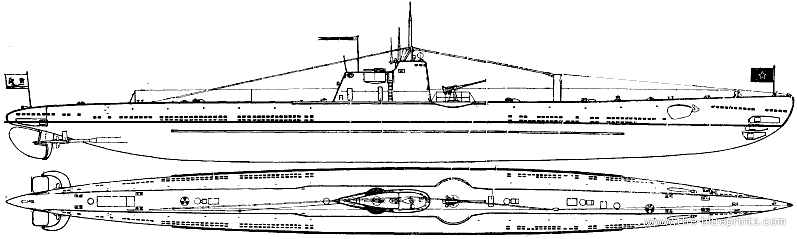
Initially deployed and trialled with 45 cm torpedoes, 53 cm were obtained as soon as available.
In 1935-1936, D-4, D-5, D-6 had their CT rebuilt with a large platform and their 37mm/30 removed and replaced by a 45mm/43 21K
In 1937, D-1 also had her CT rebuilt the same and her 102mm/43 was removed (as her 37mm/30 AA gun). She obtained instead the 100mm/49 B-24 gun and the 45mm/46 21K AA gun.
In 1940-41 D-3 and D-2 had the same modifications. All hed their Atlas Werke hydrophone replaced by a Mars-16 hydrophone.
In 1941 D-4 was modified again, her CT was rebuilt and she had the new 100mm/49 B-24 deck gun, but in the CT her heavy AA gun was replaced by the 12.7mm/79 DsHk.
In 1945 D-5 obtained the British type 129 sonar, she was the first and only in class to have it.

B-24 102mm/49 deck gun pattern 1936 (1936)
After the failure of the B-2 wet gun, in 1932 the “Bolshevik” factory was tasked to create a new 100 mm (3.9″), ready in 1935 for trials, that lasted until 1936, accepted in to service. In 1937 it was improved and produced as the B-24-IIc and in 1938 appeared the 56 calibers version accepted into service in 1939, but it had a gun shield intended for small combatants. In 1941 only 76 guns had been made, 5 more until 1945, but a further 63 in 1946-50 notably for the new Whiskey class subs. The B-24 gun had a loose-liner, casing and breech, the latter being semi-automatic and pneumatic, with an horizontal sliding breech-block prior to 1942, spring-driven, semi-automatic breech afterwards. B-24 PL was the designation for submarines, present virtually on all large models, the L class (series II, XI, XIII, XIII-38), S class (series IX, IXbis, XVI), K class (series XIV) D class (series I) as rearmed, and cancelled MZ class (Project 99). Illustration.
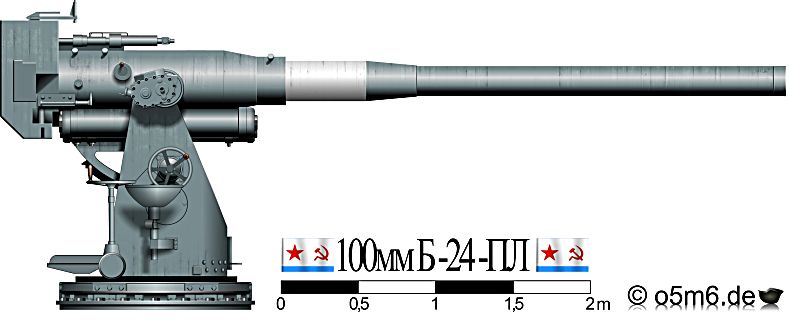
Specs
Gun Weight 2.387 tons, 5.1m barrel, bore 5.1m, rifling 4.12m.
Mount B-24PL: 5.414 tons, recoil up to 680 mm.
Rate Of Fire: 12 rounds per minute.
Shells: full round 28 kg, AA grenade AA ZS-56, ZS-56P HE mod 1928 F-56, diving shell, star. avg 15.6 kg.
Muzzle velocity: AA grenade 872 mps, HE mod 1928 804 mps, diving shell 250 mps.
Provision D-class likely 122 rounds, barrel life 800 rounds
Elevation 45°, range 22,314 m HE, 9,648m AA with max timer setting.
45mm/46 AA gun 21K (1934)
Installed from 1936 onwards on the Series I to replace the 37mm/30 Maxim.
This was a navy version of the Army 45 mm Pattern 1932 anti-tank gun. The navalized mount had a semi-automatic breech. Tested in 1934, accepted in 1935 after tests with the originally intended automatic breech mechanism failed. Standard AA mount until 1941-42, replaced by the 37 mm/67 but in production until 1947. Not efficient, semi-automatic, no time fuze. Total prod. 2,799 guns. It was largely used on submarines either as AA gun or main deck gun on small Schchuka types.
Specs
Gun Weight: 107 kg, length 2.3975 m, bore 2.0725 m, rifling 1.650 m
Rounds FRAG-Tracer OT-033 2 kg, HE O-240 2.89 kg, FRAG-Tracer OR-73A 2.32 kg
Muzzle velocity: FRAG-Tracer 880 mps and OR-73A 760 mps HE O-240 335 mps and F-73 760 mps.
Rate Of Fire: 25-30 rounds per minute
Single pivot Mount 21K 507 kg, -10 / +85° at 10-20°/sec. Recoil 27-30 cm.
Range (FRAG-tracer): 45°: 9,200 m, 85° 6,000 m. With HE at 45° 5,000 m.
Rounds provision c500, barrel life 4000 rds.
Sensors
Initial subs had likely the same types of hydrophones used on the Canadian Holland origin AG types, but they obtained the Atlas Werke hydrophone at completion, one of the items purchased in the friendly Weimar Republic. Later this was updated on two boats, D-2 and D-3 to the Mars-16 hydrophone. D-5 was the only one fitted with the Type 129 sonar.
Atlas Werke hydrophone
No info for now, in research. note
Mars-16 Hydrophone
A locally produced version of the Atlas Werke model, which proved ineffective for speeds above 3 knots due to noise interference. It was less a problem for a submarine underwater, which could ran at 4 knots on more discreet electric engines.
Type 129 Sonar
An excellent British sonar, obtained as part of the Northern Fleet for D-5. It was keel-fitted. 10 KhZ standard deployed also on the T Class, U Class, and V Class.
It should be added that the two periscopes, one for the commander and one for night anti-aircraft use, were assorted by a noise direction finder, and underwater communication. The radio range was approximately 200 miles. The navigational system included a Sperry-type gyrocompass and Forbes log system. Soon after arriving in the North, all three Baltic D-class submarines had their truss antenna masts replaced by a single, permanent antenna at the bow as the old designs proved too fragile. They were also shifted to the starboard side.
Final appearance in 1940-41. CC licence.

From Pinterest.
⚙ specifications |
|
| Displacement | 933 tons surfaced, 1,354 tons submerged* |
| Dimensions | 76 x 6.5 x 3.80 m (249 ft 4 in x 21 ft 4 in x 12 ft 6 in) |
| Propulsion | 2 shafts 1,100 hp Kolomna diesels, 2x 525 hp PG-20 EM, creeping motors 50 hp, batteries |
| Speed | 14 knots (26 km/h) surfaced, 9 knots (17 km/h) submerged |
| Range | 13,900 km/9 kn surfaced, 244 km/2 kn submerged |
| Armament | 8x 533 mm TTs (6 bow, 2 stern, 14), 100 mm/51 deck gun, see notes |
| Depht | 295 ft (90 m) |
| Sensors | Hydrophones (Atlas Werke) |
| Crew | 53 officers and crew |
*see below for variations
Appearance and Differences
D1, 2 and 3 had the same basic specs:
Displacement: surface 932.8 tons, underwater 1,353.8 tons, draught 3.81 m. Surface speed 14 knots, underwater 9 kts. Range at 8.9 kts 7,500 nm/ 2.9 kts 132 nm.
D4 had the following specs:
Displacement: surface 945 tons, underwater 1,355, draught 4.3 m. Top speed surface 12.5 knots, underwater 8.22 knots range 4,700/135 nm.
D5-D6 had the following specs:
Displacement: surface 989 tons, underwater 1,384.6 tons, draught 3.8 m. Surface speed 11.3 knots, underwater 8.7 knots, range 4,700/125 nm.
Career and evaluation of the Dekabrist class
Chief builder, responsible for the delivery of the Series I at the Baltic Shipyard was K.F. Terletsky, an experienced submariner, former officer before the Revolution. G.M. Terletsky was appointed as delivery engineer. The design team was led by Trusov, a very experienced mechanical engineers that worked on the Minoga, Pochtovy, Vepr, Tur, Yersh. He took part in the ice voyage of the Baltic Fleet ships from Helsinki to Kronstadt in 1918. At Nikolaevsky Plant No. 198, G.M. Sipitsyn was at the head of the Submarine Bureau, appointed responsible contractor, and the yard’s directors were Pevinsky and
Medvedev.
These submarines were developed entirely in the USSR and represented a significant advance over the submarine designs of the Russian Empire. The double-hull architecture, installation of intermediate watertight bulkheads, placement of the battery in a sealed pit, provision of a fast-diving tank, air regeneration systems were all inaugurated by this class. As well as the crew rescue system, all made “in the style of the Dekabrist class submarine”. However, they still suffered from a significant number of design flaws. The most serious problems were insufficient diving speed, poor underwater stability, shared with Italian designs. Furthermore, the use of a spindle-shaped pressure hull which was difficult to manufacture, was discontinued for subsequent designs, with simpler truncated cones and flat ones except for both ends, and the shelter compartments.
Almost immediately after their entry into service in the Black Sea, the boats received a lightweight removable canopy behind the cmain gun in the CT to protect the watch. Forward visibility was unsatisfactory due to the presence of the gun that high up. This necessitated more extensive modifications. In 1935–1936, Black Sea submarines D-4, D-6, D-5 receobed a new bow modeled after the Leninets and their conning tower was radically redesigned with the gun relocated down to the deck, not fixed but on a rotating open barbette, while the bridge was enclosed and its platform was adapted for a 45mm 21-K gun mount. The commander’s periscope was moved to a solid conning tower, and the combat periscope pedestal installed above it. Their appearance was close to the Series II submarines afterwards.
 D-1 Dekabrist (1928)
D-1 Dekabrist (Декабрист) was ordered from Ordzhonikidze Yard, Leningrad and launched on 3 November 1928. She entered service with the Northern Fleet under commissioning captain A.G. Shishkin, a renowned submariner, former assistant commander of the Panther. Her debut were not smooth: In the spring of 1930, three years after her keel-laying, Dekabrist and Revolyutsioner started trials, March 1930, for Revolyutsioner in Sevastopol and by ate May for Dekabrist in Kronstadt. The first dives were conducted in drydock. During the first for both, the simultaneous filling of the side ballast tanks caused them to significant list, quite suddenly, and it only increased, deemed unacceptable as well wehen simultaneously blowing air from the onboard ballast tanks when surfacing. This phenomena had never been observed on older submarines. It was first observed on March 16 on Revolyutsioner, reaching 7° and continuing to increase rapidly, forcing suspension of the tests. During subsequent dives of the submarine on March 22 and April 1 this time with B.M. Malinin on board, these issues repeated. This, on June 12, 1930, Dekabrist made her first dive in the Mitrofanov dock of Kronstadt, but as a precaution, her mooring lines were attached to the bollards of both dock walls. During the dive, her own list reached ana amzing 21°, leading to suspend tests. From then on, instruction was passed on to fill tanks in sequence, never simultaneously.
In addition, an overload was discovered. The D class were not designed to carry 20 tons of extra weight, significantly increasing their center of gravity compared to the initial project. What complicated the resolution of these problems, the head of Technical Bureau No. 4, B.M. Malinin, and two of his closest aides had been arrested by the GPU on charges of “sabotage”. A working committee at the Baltic Shipyard was tasked to eliminate issues on the Dekabrist-class and proposed to install separate ventilation valves for the main ballast tanks. They were urgently manufactured and installed using drawings from the Technical Bureau No. 4. One-way valves were also installed on the pumps pipes leading to the side ballast tanks. This ensured no listing during the filling and draining of the main ballast tank, and ability to navigate with open seacocks. After this, stability when diving or surfacing of the Dekabrist-class radically improved. Also, seven buoyancy cylinders were installed in the superstructure, and by removing top loads like submarine anchor, stern capstan, and others, the situation further improved. Including reducing the fuel bunkerage inside the pressure hull.
Maintaining the cylinders’ watertight integrity in case of a ramming or shell hit as also a concern, so the amidship tank was reinforced to 9 kgf/cm² to enable submerged navigation with a partially filled middle tank and closed seacocks at all diving depths. The submarines built by Nikolaev in the Black sea did not needed overload compensation measures due to the water density being significantly higher than in the Baltic, notably the buoyancy cylinders were omitted. Speed tests also showed Dekabrist was slower than anticipated, 0.7-1 knots surfaced less, 1.2-1.5 knots sumgered less than guaranteed specification, explained by the initial model testing methodology. Tests revealed also the poor design of the quick-dive tank’s seacock valve: The plate was forced back by seawater pressure. This was critical fault that could have condemned the sub to sink if an emergency blowdown was not possible. Seacocks were redesigned with plates pressed down by seawater pressure and the tanks’s scuppers were redesigned to speed up filling, another issue. To betetr stabilize them, longitudinal bulkheads were installed in deck tanks, and ventilation was modified.
Other teething issues included the failure of the Mitchell thrust bearings, installed on the shaft lines as oil temperature in the bearings suddenly rose sharply. After investigation, traces of sand in the oil chambers of the bearing housing were discovered. This was due to the poor design of the chambers, which made cleaning difficult. Knocking sounds were heard in the propulsion and it was discovered that the brackets maintaining the diesels had become loose. The fastening structure was reinforced, causing extra delay in completion.
On 18 May 1933, D-1 departed Leningrad via the White Sea-Baltic Canal and on 05 August, upon arrival in Murmansk, she entered service with the Northern Fleet. On 11 May 1937, she was still in the Northern Fleet but from September 23, 1936 to November 8, 1937, she was rebuilt an modernized in Leningrad. On November 13, 1940, she was lost in an accident 13 November 1940 in Motovsky Gulf, near Murmansk and was stricken from the Navy on December 31, 1940.
D-2 Narodovolets (1929)
D-2 Narodovolets (Народоволец as renamed on 21.08.1934 and from 1949 B-2, then in 1956 UTS-6) was laid down on 05.03.1927 at the Baltic Shipyard No. 189 in Leningrad, launched on 19.05.1929, entered service on 06.09.1931 and on 20.11.1931 she joined her combat unit. On 18 May 1933, she departed Leningrad via the White Sea-Baltic Canal. On 5 August 1933, upon arrival in Murmansk, she joined the Northern Fleet. On 11 May 1937, she started exercisese with the Northern Fleet. On 22 September 1939, she arrived from Polyarny to Leningrad for modernization and refit and on 17 August 1941, transferred to back the Baltic Fleet.
In WW2 she started actions against German communications lines in the Baltic. She made four combat sorties, for 12 attacks and firing 19 torpedoes, sinking the transport Jacobus Fritzen (4090 GRT) on 14 October 1942 and damaging the train ferry Deutschland (2,972 GRT) on 19 October 1942. Records are silent afterwards. She was likely interned. From 15 February 1946 to 24 December 1955 she resumed service with the 4th Fleet. On January 12, 1949 as B2, she was became part of the “large submarines” type on June 20, 1956, decommissioned, disarmed, converted into a damage control training station (UT6). On March 5, 1987, she was stricken from the Navy. On on July 8, 1989, after restoration she became a memorial submarine and a branch of the Central Naval Museum at the Shkipersky Channel near the Maritime Station in Leningrad. Still visible today.
D-3 Krasnogvardyeyets (1929)
 D-3 Krasnogvardyeyets (Красногвардеец from 21.08.1934) was laid down on 05.03.1927 at the Baltic Shipyard No.189 in Leningrad, launched on 12.07.1929, and she entered service on 01.10.1931. On 14.11.1931, she joined her unit. On 26.07.1933, she departed Leningrad via the White Sea-Baltic Canal, and on 21 Sept. 1933, upon arrival in Murmansk, she joined the North Sea Fleet. From 11 My 1937, she was part of the Northern Fleet. In February 1938, she took part in an expedition to rescue personnel and property of the North Pole scientific station from an ice floe.
From October 1938 to April 1940, she underwent modernization and refit in Leningrad. She took part in patroled against axis communications off the coast of Northern Norway, completed eight sorties, carried out 11 attacks and firing 29 torpedoes, (ships kills in research). On 17.01.1942, she was awarded the Order of the Red Banner and on 03 April 1942, she was awarded the Guards title. In June 1942, she vanished in off Tanafjord, after bundering into a German defensive minefield and on 08.08.1942 stricken.
D-4 Revolutsioner (1929)
 D-4 Revolutsioner (Революционер) was ordered from Marti Yard, Nikolayev yard No. 27/192, Laid down on 14.04.1927 at plant No.198 A. Marti, Black Sea Shipbuilding Nikolaev, launched on 16.04.1929, commissioned on 30.12.1930. She diverged from her sisters by some aspects (see above). On 05.01.1931, she joined her unit. From 11 Jan .1935 she multiplied training exercises with the Black Sea Fleet. From 18 to 21 October 1933, she visited Istanbul like her sisters. From December 1938 to 27 September 1941, she started a long refit and modernization at Sevmorzavod, Sevastopol. No more records for her interwar career.
In WW2, she operated along the coast of Bulgaria and Crimea, taking part in the defense of Sevastopol in May-June 1942 and makin 16 sorties for 6 attacks. These were actions against enemy communications off the coast of Romania, Bulgaria, and Crimea, and the defense of Sevastopol in May–June 1942. In these 6 attacks she launched 19 torpedoes, sinking the Bulgarian steamer Rodina (4,158 GRT) on 20 March 1943, the transport Boy Peddersen (former Soviet Kharkov, 6,689 GRT) on 10 August 1943, Bulgarian steamer Varna (2,141 GRT) on 20 August 1943, the transport Santa Fe (4,627 GRT) on 23 November 1943. On 4 December 1943 she was lost in Kalimdzhi Gulf either from attacks by axis anti-submarine vessels, off western Crimea, or “after 1 December 1943” possibly due to mines. On 29 December 1943 she decommissioned and stricken.
D-5 Spartakovets (1930)
D-5 Spartakovets (Спартаковец) was laid down on 12 October 1929 D-5 (until 15.09.1934 – “Spartakovets”), from 16 June 1949 she became B-32. She was ordered as yard number 28/193. Laid down on 14.04.1927 at No.198 A. Marti, Black Sea Shipbuilding in Nikolaev, she was launched on 28 Sept. 1929, and entered service on 05 April 1931. On 17 May 1931, having hoisted the Naval Ensign, she entered service with the Black Sea Fleet. From 11 January 1935 she started training with the Black Sea Fleet. On 18-21 Oct. 1933 like her sisters she visited Istanbul. In World War II she started patrols against axis lines of communications off the coast of Romania, Bulgaria and Turkey, including artillery shelling of positions near Alushta on 19 November 1941, and support of the Kerch-Feodosia landing operation from 25 Dec. 1941 to 02 January 1942, defense of Sevastopol in June 1942. She performed completed 16 combat patrols, carried out one attack (launched one torpedo, missed) sinking the Turkish sailing and motor schooner Kociboglu (100 GRT) with gunfire on 08 Dec. 1942. On 23 March 1942 while moored in Tuapse, she received serious damage to her hull from near-misses of an air attack, but managed to limp back to port, but leaving her out of action for a long time, in facct until the end of WW2. From 1946 she was at the disposal of the Navy’s Mine and Torpedo Research Institute. On October 2, 1948 she was rebranded as an experimental submarine. On January 12, 1949 she was reassigned as a subclass of “large submarines”. On December 29, 1955 she was decommissioned, stricken, delivered for dismantling and sale on January 18, 1956, BU at Glavvtorchermet base Sevastopol.
D-6 Yakobinets (1930)
D-6 Yakobinets was ordered as yard No. 29/194, laid down on 14.04.1927 at No. 198 A. Marti, Black Sea Shipbuilding Yard of Nikolaev. She was launched on 12.05.1930, completed on 15.06.1931 and commissioned on 20.11.1931 with the Black Sea Fleet. From 11.01.1935 she started training in the Black Sea Fleet. On 18-21 October 1933 she visit Istanbul like most of her sisters. She was undergoing modernization and a major refit at Sevmorzavod shipyard, Sevastopol when the war stated for her in the summer of 1941 and by June 26, 1942, due to the impossibility of evacuation with her hull cut open and engines removed and party dismantled, she was blown up and destroyed by her crew by command order, just before the Soviet troops abandoned the city. On July 11, 1942, she was officially decommissioned from the Navy. In the spring of 1945, she was raised by the Black Sea Fleet emergency rescue service. On June 7, 1945, due to the impracticality of restoration,she decommissioned officially from the Black Sea Fleet for a second time, stricken and delivered from scrapping for metal.
Read More/Src
Gallery

Narodolovets as preserved, St Petersburg

Same

5th room, crew’s berthing

Engine room

Stern room

Torpedo Room

Control Room
Books
Building Submarines for Russia in Burrard Inlet by W.Kaye Lamb published in BC Studies No.71 Autumn, 1986
Polmar, Norman & Noot, Jurrien (1991). Submarines of the Russian and Soviet Navies, 1718–1990. Naval Institute Press.
Trusov G.M. “Submarines in the Russian and Soviet Fleets,” GSISP, Leningrad, 1957.
Shirokorad A.B. “Ships and Boats of the USSR Navy 1939-1945,” Minsk, “Harvest,” 2002.
Berezhnoy S.S. “Ships and Vessels of the USSR Navy 1928-1945”, Moscow, “Military Publishing House”, 1988.
Gusev A.N. “Soviet Submarines 1922-1945”, Part 2, St. Petersburg, “Galeya Print”, 2004.
Taras A.E. “Submarines of World War II 1935-1945”, Minsk, “Harvest”, 2004.
Rimkovich V.P. “Submarines in the Black Sea”, Odessa, Isma-Invest, Astroprint, 2000.
Dmitriev V.I. “Soviet Submarine Shipbuilding”, Moscow, “Military Publishing House”, 1990.
Morozov M.E. “Submarines of the USSR Navy in the Great Patriotic War of 1941-1945”, Part 2, Moscow, “Strategy KM”, 2003.
Brescia, Maurizio (2012). Mussolini’s Navy: A Reference Guide to the Regina Marina 1930–45. NIP
Breyer, Siegfried (1992). Soviet Warship Development: Volume 1: 1917-1937. Conway Maritime Press.
Budzbon, Przemysław (1980). “Soviet Union”. In Chesneau, Roger (ed.). Conway’s All the World’s Fighting Ships 1922–1946. Conway Maritime Press.
Budzbon, Przemysław & Radziemski, Jan (2020). “The Beginnings of Soviet Naval Power”. In Jordan, John (ed.). Warship 2020. Osprey.
Budzbon, Przemysław; Radziemski, Jan & Twardowski, Marek (2022). Warships of the Soviet Fleets 1939–1945. Vol. I: Major Combatants. NIP
Fontenoy, Paul E. (2007) Submarines: An Illustrated History of Their Impact. ABC-CLIO.
Polmar, Norman & Noot, Jurrien (1991). Submarines of the Russian and Soviet Navies, 1718–1990. NIP
Rohwer, Jürgen & Monakov, Mikhail S. (2001). Stalin’s Ocean-Going Fleet: Soviet Naval Strategy and Shipbuilding Programs 1935–1953.
Westwood, J. N. (1994). Russian Naval Construction, 1905–45. Macmillan.
Yakubov, Vladimir & Worth, Richard (2008). Raising the Red Banner: A Pictorial History of Stalin’s Fleet. Spellmount.
Links
The Fleet Reborn rusnavy.com/
morflot.tsi.ru
102mm/45 M1931
45mm/46 AA
37mm/30 Maxim AA
4-in/45 B2 wet deck gun
53-27 torpedoes
uboat.net
uboat.net (full list)
deepstorm.ru: The real Deal
Navypedia
Dekabrist-class wiki
Dekabrist-class wiki
Video
Model Kits
Scalemates: Politechnika, Maquette, Encore models, Bum (Barcelona Universal Model) 1:400 and Combrig 1:700
sdmodelmakers.com 30cm long model
D-2 kit review on steelnavy.com
3D
https://embed-3dwarehouse-classic.sketchup.com/model/1c250b04a5a3b8af8141b488a44e65e2/DEKABRIST