
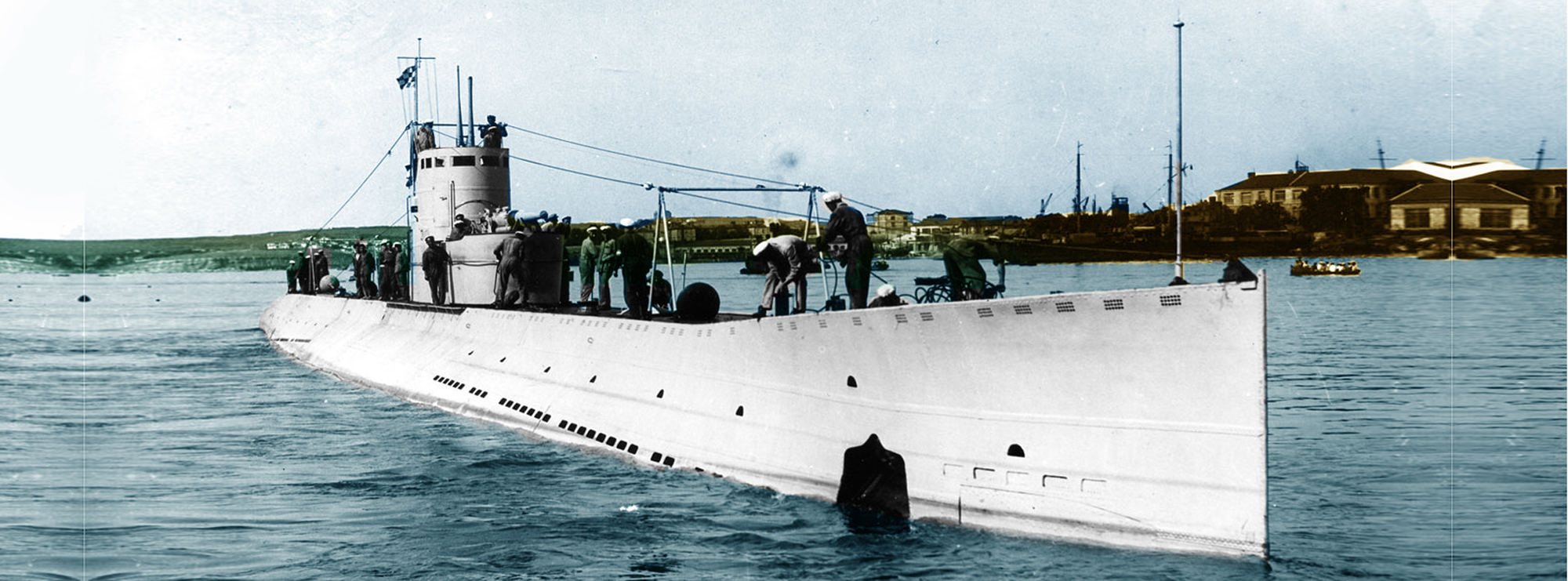
 Soviet Navy Series II (L-1 to L-25), Four groups 1930-41.
The Series II, also known as the “Leninets” or “L” class were the second medium submersible design for the Soviet Navy after the Dekabrist or D class of the late 1920s. They were the first also mass built to an extent, as part of the Soviet Naval Shipbuilding Naval Programs of 1930, 1936 and 1940, constantly improved in four successive, iterative groups. The first group (L1 to L6) (Leninets), all received names and were assigned to the Black sea Fleet. The second group (Vorochilovets or L-7 to L-12) were for the Pazcific, as Group III boats (unnamed, L-13 to L-19) and the last group (L-20 to 25) were divivded between the Baltic and Black sea. They improved on the Dekabrist class on many ways and the design improved continuously until the last completed in late 1941.
Development
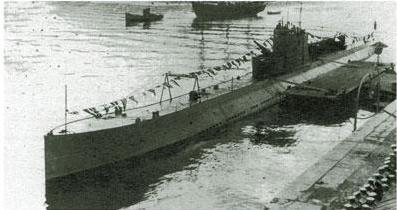
The development story of Soviet Submarines at large started with inheritance from the Imperial Era, well before the revolution in 1917, with the very first designs worked on an deployed in 1878 already. In 1914, Russian already had one of the largest submarine fleets. However civil war ended around 1922, engineers and specialist of that era had fled the country, or had been killed in the events, and apart the Bars (bear) class 650 tonneers, the only recent experience were AG type or “Amerikanski Golland”, Canadian-built Holland 602GF/602L types shipped to Russia for assembly befire the revolution, completed in 1920-23 and still active in WW2 as training subs for many. The young Soviet naval Command was well aware a new type was needed, and in 1923 plans were made for a С (S) type (for средняя (srednyaya, “medium”)) submersible, with discussions about the ideal type for the Black sea or Baltic. It was authorized by Soviet Naval Shipbuilding Program of 1926. The final design was polished at the Baltic Shipyard by B.M. Malinin.


Long story short this became the Series I or “Dekabrist” (Decembrist) class, with strong influence from in Italy, after a commission was sent in Europe by Malinin already in 1925, to help drawing the first specifications. Naval Historians today still debate about the foggy origin of this first design, varying from designs of the former Imperial Navy, Balilla or Pisani class plans, but in the end a mixed “single-hull” construction, a diving depth limited to 50 metres (160 ft). Eventually this first design ended with a surface displacement of c700 tons, a hull in riveted construction using left over high-quality steel from pre-revolutionary reserves, a pressure hull withstanding 90 meters (300 ft) pressure, using high-quality armour plate from scrapped battlecruisers, now a proper double-hull design with internal watertight compartments and flat circular bulkheads, rapid-filling Italian-style ballast tanks revised for a better diving time by adding specific trim tanks, among others.
The design was approved on February 17, 1927, and the Baltic Shipyard started construction. On March 5, 1927 the first Series I, Dekabrist was laid down leading to six boats of the D-type (retroactively called Series I). The first boat was completed in early 1929, tested that year, bringing crucial information to alter a successor design that was already planned in 1927. The Baltic Shipyards still though they could improve on this first set of plans. But the Soviet Navy already planned in 1926 a minelaying submarine instead for the next type.
The first Soviet Minelayer Submarine
The concept was not unknown in Russia, far from it. In fact it was claimed as Russian in origin. The idea came from Russian inventor M. P. Naletov. He was the first writing about the concept of a an “underwater minelayer”, an idea that was embodied years later, in the submarine “Krab” (1912). It inspire conversion of two Bars-class submarines, “Yorsh” and “Forel” in WWI. In the 1926 naval shipbuilding program thus, alongside with six patrol oceanic submarines, was epxressed the need for six combined mine and torpedo medium submarines, three for the Baltic Fleet and three for the Black Sea Fleet. Many minelaying experts were involved in the development of what was known retrospectively as the Series II submarine.
The design was worked out from a modified design proposed by naval architect B. M. Malinin from the Baltic shipyard. He recycled the configuration of the WWI minelaying subs, with two horizontal mine tubes, each carrying 10 mines, but innovated. They were now dropped from the stern, stored in the pressure hull and closed by shutters. This design allowed for dry storage until the mines were laid, when the tubes were flooded, in contrast to the first submarines in which mines were in “wet” storage on frail deck tubes, and could detonate in a depth charge attack.
Structurally, Malinin (see his bio on the previous post) created a base design similar to his Dekabrist-class submarines (series I) but applied all its technologically advanced developments, notably with a new new pressure hull shape usin a cylinder with conical ends instead of a spindle-shaped one, sparing the construction of complicated double-curved surfaces using a heated press, enabling instead cold steel sheet rolling. This simplified construction greatly and improved reliability. Inside the Series II, Black Sea submarines differed from the Baltic submarines by the presence of a tall, straight flagpole at the bow and absence of additional scuppers above the anchor well. The paint job was also different, with a green hull, dark grey for the Black sea boats, light grey, dark red primer for the Baltic boats.
Design of the class
Designing new “dry” Mine Tubes
One of the major headaches designing this class was the proper type of mine storage and laying system for these new submarines; Krab had been successful in operations but its minelaying system left much to be desired and was outright danderous in contested waters. One serious drawback of the design proposed by A.N. Shcheglov was the large cross-section of the mine tube and its non-circular shape. Plus filling the tube required a special, large-capacity tank, but the non-circular shape necessitated heavy reinforcement of tube and adjacent pressure hull. Surfacing to lay mines or sailing with a constantly filled tube robbed concealment and the advantages of dry storage, so the whole design process started with a wide range of reports directly from Baltic and Black Sea submariners and minelayer crews, shortcircuiting the top brass or yard’s engineers. It was a first.
They were involved in developing more rational technical specifications for the Series II. Minelayer experts A.E. Brykin and P.P. Kitkin proved notably instrumental for the design of the drydo storage mine tubes, and there were meetings in December 1928 and September 1929 on the legitimacy of a separate Black Sea Fleet Minelaying submarine division with B.M. Malinin, and Black Sea Fleet flagship minelayer skipper B.A. Denisov, naval engineer P.I. Serdyuk, NTMK underwater navigation section director A.N. Garsoyev, added to compillations of collective experience of the submariners and minelayers.
The improved version of this underwater minelaying tube was proposed by B.M. Malinin and differed from A.N. Shcheglov’s design by its separate 912 mm diameter, and circular tube for each of the two mines rows, ten for each. Most was built within the pressure hull, exiting through the aft end bulkhead. This reduced the annular gap in tubes and volume of the corresponding replacement tank. Longitudinal stability remained sufficient while submerged when filling these, thus, the mines could remain dry until laid. A real-scale model of this underwater minelaying tube was transferred to the Baltic Shipyard for tests before construction.
The L class also benefited from the study of the refloated British L-55 submarine, sunk on June 4, 1919 in Koporye Bay. This was done on August 14, 1928, and the hull was towed for study at the Technical Bureau No.4. This helped making an objective comparison with the D class, establishing its displacement was 14% less but reserve buoyancy and number of compartments were the same.
It was seen as single-hull type with external and fully circular main ballast tank, a design seeminlgy irrational as it increased width, affecting performances. The use of a vertical stem was understandable, contributing to less drag, unlike the yacht-like stern of the Dekabrist-class. B.M. Malinin however wanted the same D-class stem shape for the L class, as providing better maneuverability through nets, and booms tied by horizontal cables, something confirmed during WW2 operations. It’s “cutter” appearance was even more marked on the Leninets.
Hull and general design

The Leninets class were still largely reminiscent of the Dekabrist-class but taking into account the most recent experience. A simplified pressure hull design was used, with its prssure hull cylinder having inner conical ends instead of more complicated spindle shapes, with plates made in steel rolling mills, instead of cast double-curved plates unsing hot presses. The “L” type pressure hull became a new benchmark, divided into six compartments by seven bulkheads. There were five internal bulkheads, four hemispherical (pressure 6 atm), one flat (1 atm), with communication through oval-shaped hatches insted of round on the D-class submarines. The end bulkheads were cast, hemispherical 40 mm thick, with their convex side facing outward. Thius made for three refuge compartments also housed emergency ballast blowdown stations and rescue equipment.
The pressure hull saw three compartments equipped as crew shelters with an emergency ballast purge systems and crew rescue equipment, but the use of a foreign-designed ventilation system for the battery led to explosions and fires in service, including four killed on L-2, five on L-4. It was later replaced by the older but proven design, insulated battery pits with metal flooring. A special “K-5” device was used to burn off the resulting hydrogen as well for extra safety. The distribution of the pressure hull’s volume was significantly altered. The forward one became the largest, the central control station remained in the third compartment but was larger, and the fourth compartment was also increased to make torpedo reloading forward a bit easier. The sixth, aftermost compartment lost their torpedo tubes, replaced by the the mine tubes essentially.
The dedicated radio compartment that existed on the D-class was eliminated, relocated in the second compartment on the port side, immediately behind the bulkhead alongside the navigation station and his cabin, then a wardroom and seven berths. Starboard saw the commander’s and the political officer’s cabins. Further forward was now the galley, radio room, and right next to the bulkhead the sonar station. But the commander’s cabin was still tiny, 2 meters per 1.5 meters with a small table and drop-down board, pull-out drawers for linen and personal belongings, a small locker for classified documents and small wardrobe while oxygen tanks supported a berth with a bookshelf overhead, and internal telephone.

L3 Conning Tower, preserved.
The L-class submarines were not fouble hulled but “one-and-a-half-hulled” with an outer hull running the entire length of the pressure hull, but not along its entire perimeter as its lower part remained open. This new shape significantly improved stability when surfaced. The vertical keel was replaced by a box-shaped structure independent of the outer hull to be dropped in erlmegency from the pressure hull, containing solid ballast. The bow like the one of the D class was still showing a streight stem, but was significantly widened for extra buoyancy and made surface seawothiness better but at the same time, complicated control while submerged. Pitching when surfaced was also more abrupt. Attempt was made to increas forward hydroplanes, but for little effect.
The conning tower was reworked, narrowed for less drag, resulting in a smoother pitching motion with less amplitude. The outer minelaying hull tubes ends at the stern were integrated in a vertical transom initially, but this shape created unacceptable levels of drag, and the first boats instead were designed with a permeable and pointed, or flattened fairing. However to manufacture its large recesses for mine release, it proved to be very complex and the design was abandoned for later series. Back to the CT, and it was initially designed as a repeat of the one on the D-class with its main command post located in the control room, and the conning tower shaped as a vertical cylinder, a support for the periscope pedestals as well as airlock.

However, during trials of the D-class already it had been noted that even in moderate seas, the upper periscope guides and radio masts were often exposed while submerged and could be tirned off. It was decided for the L-class to move the main command post away from the conning tower but countering positive buoyancy with horizontal rudders while diving at 5-10 knots proved impossible. Thus a second version of the conning tower led to an horizontal cylinder housing the main controls, for a reduction in the rigidity of the periscope pedestals and its vibration, also reducing noise when diving.
While in construction, sealing the deck tanks proved difficult due to the amountf of pipine and drives. Thus, deck tanks were eliminated, and to compensate for this, the upper roof of the double-hull tanks were raised almost to the level of the upper edge of the pressure hull, when surfaced, reduced water pressure when filling the tanks when diving. This made of a slight increase in the cross-section around the seacocks. Full submersion however took approximately three minutes. There was also an increased compressed air supply compared due to the increased use of pneumatic systems, with the first remote pneumatic controls for the main ballast tank ventilation valves and seacocks. So more double-hull tanks, could be built and the cross-section was reduced while simplifying seacock design. The aft ballast tank’s seacock was manually operated, remaining free flowing and open at all times, only closed when necessary. The quick-dive tank’s vent valve had a single pneumatic actuator.
Powerplant
The L-class submarines swapped to the upgraded Russian 42-BM-6 diesels, located side by side in the 5th compartment. These compressor-less engines (natural aspiration) proved more reliable while still providing a surface speed of up to 14.5 knots. At a cruising speed of 9 knots, this made for a range of 7,400 miles thanks to 102 tonnes of fuel oil. Other sources pioints out 6000 nautical miles at 10 knots.
Instead of the four battery banks like in the previous D-class, so 240 cells, the Leninets-class had three banks of 112 LS-type batteries each, but this made for 336 as they were smaller in size and capacity and enabled more intensive cooling as well as accelerated discharge modes, at a higher current in 1.3 hours versus two hours. Less battery compartments also meant less bulkheads, saving weight. It was possible also to switch them to a series connection under a constant voltage of 220 V.
For submerged speed, the PG84/50 electric motors located side by side in the 6th compartment were designed for an output of 325 hp each at 340 rpm and allowing easy switching between parallel and series connection (to the batteries or diesels). At full speed the connections were in parallel for 1300 hp total and 8.45 knots underwater, and at low speed, in series. The cruising engines mounted on the previous D-type on the main propeller shaft were replaced with separate cruising engines rated for 30 hp at 800 rpm and pluggable transmission to the propeller shaft. Underwater range was on average 135 nautical miles at 2.5 knots.
Also, unlike the D-class using tilting bow hydroplanes to reduce drag, those on the Leninets class were fixed. Indeed the previous system seems too complex and unnecessary. However in the later years, the next series returned to a simplified, non elevating but fully retractable type to reduce drag underwater. Performances diverged among boats however. L-6 was the slowest at 11.3 knots surfaced, 8 knots submerged. The first three Baltic Boats were the fastest at 14.8 knots surfaced and 8.5 submerged. The L class boats managed to dive at 90 meters, like the D-class.
Armament
Torpedoes
First off, the forward torpedo compartment (still six tubes) was unchanged from that of the D-class with the exception of steel torpedo tubes instead of cast bronze ones. The main change was the absence of stern tubes due to the mines shafts, but they still had the same 100mm deck gun and 45mm semiautomatic anti-aircraft gun, which was quite powerful as an AA defence for any submersibles at the time. Albeit initial drawings had the gun mounted in the forward bridge, like British subs, visibility issues disctated its relocation from the start in front of the conning tower, on a bandstand and protected by a forward-sloping bulwark protecting it from oncoming waves. It was still considered a bulky system and was modified again later.
Armament however diverged between boats: Leninets, Stalinets had the 102mm/43 B-2 gun and a 45mm/43 21K AA gun, six 533mm TT at the bow with 12 spares but 17 mines whereas a Frunzevets and Chartist had 20 mines and Garibaldiets, Karbonariy dispensed with the AA gun entirely.
21-inches type 53-27
The story of the first 21-inches Soviet torpdoes started under Imperial Russia, as a model called the pattern 1917 designed to carry a warhead of 476 lbs. (216 kg) at 3,280 yards (3,000 m) and 45 knots or 10,940 yards (10,000 m) at 30 knots thanks to its Wet-heater. It never entered service due to the Revolution but formed the basis for the first Soviet torpedo, the “53-27” project. It is interesting to point out the simple type identifier, rather than “model and the year”, precising the caliber 53 cm and year (1927) was judged more compact, precise and efficient.
The first model adopted was the 533 mm 53-27 type. It was universal, designed to be used from large surface combatants down to MTBs and submarines. Design started likely in 1923 and was accepted in 1927, about the tilme the Dekabrist class were completed, so they were obtained probably in 1928-29 as production ramped up given their urgent need in the whole fleet.
They weighted 3,770 lbs. (1,710 kg) for a body that was 22.97 feet (7.0 m) long, carrying a 584.2 lbs. (265 kg) warthead, with simple percussion cap for the detonation mechanism, and thanks to their Wet-heater they reached 3,700 m at 45 knots. The dual setting mode was abandoned as too complicated. It was produced en masse until 1935 and really became widespread.
Deck Gun: 102mm/45 B-2 pattern 1930

The original design also included two 4-inch guns, the 102 mm 60 caliber Pattern 1911 in streamlined gun shields that looked like fairings either side of the conning tower. However, the British L-class submarine condifuration was preferred, and a ultimately a single forward-facing gun on a raised platform, protected by a high bulwark was preferred as a way to mitigate seawater splashes disturbances in heavy seas. A new anti-aircraft version was envisioned for it as well and the final deck gun adopted was the 100 mm/50. The fairing was so originally integrated in the CT like the British models, but after the CT were rebuilt in 1935-1940, the gun was relocated at the foot of the CT behind a lightly built frame than can be covered with a tarpaulin.
The B-2 gun was a submarine designed gun with a wet mount and a modification of the 4″/60 (10.2 cm) Pattern 1911 that was initially fitted, but unsuitable for subemrged operation. It needed to be fully protected byy tightly wrapped tarpaulins making operations complicated. The B-2 gun design was started in 1927. It was accepted into service in 1930 and replaced the pattern 1911 on all Dekabrist class submarines, and installed on the next Leninets (Series II), Pravda (Series IV) classes and the next improved pattern 1934 B-18 model on river monitors with their low deck. The mounting was the same, and still unbalanced, but its muzzle, breech and all openings were designed to be closed up quickly and made waterproof. This design however had numerous design defects. The complicated breech system ended in a low rate of fire and difficult loading above 45 degrees elevation due to the weight of the shells. These problems were never resolved, production was thus terminated in 1933. Production at the “Bolshevik” only reached 24 guns. Actual bore diameter was 101.6 mm (4.0″).
Specs B-2 (1930)
2.087 tons (2.120 mt), lenght 179.92 in (4.570 m) bore 172.21 in (4.374 m), rifling 140.28 in (3.563 m), 24 grooves.
Full mount 6.4 tons (6.5 mt), elevation -5/+60 degrees, at 5° sec. and traverse at 6° sec. recoil 27.95 in (710 mm).
Rate Of Fire: 4-6 rounds per minute. Reserve 120 rounds. Working pressure 2480 kg/cm2, barrel life c500 shots.
66 lbs. (30 kg) or 54.01 lbs. (24.5 kg) Shells: HE mod 1915, FRAG mod 1915, Shrapnel, Star. Cartridge: 27 lbs. (12.3 kg)
Muzzle velocity average 2,477 fps (755 mps).
Shells carried: 118 rounds, 91 stored in fenders on the bridge, remainder under fairings on the upper deck.
Range 18,010 yards (16,470m).
B-24 102mm/49 deck gun pattern 1936 (1936)
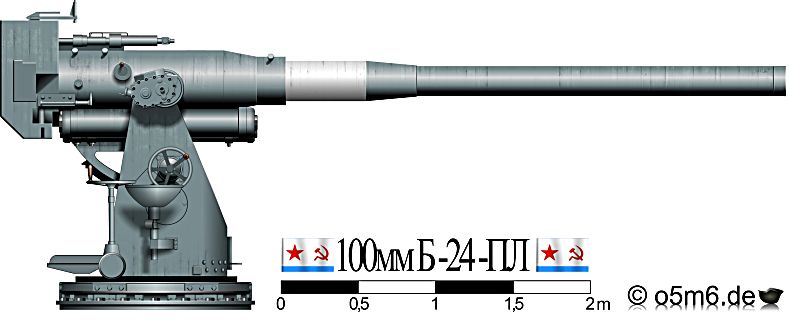
After the failure of the B-2 wet gun, in 1932 the “Bolshevik” factory was tasked to create a new 100 mm (3.9″), ready in 1935 for trials, that lasted until 1936, accepted in to service. In 1937 it was improved and produced as the B-24-IIc and in 1938 appeared the 56 calibers version accepted into service in 1939, but it had a gun shield intended for small combatants. In 1941 only 76 guns had been made, 5 more until 1945, but a further 63 in 1946-50 notably for the new Whiskey class subs. The B-24 gun had a loose-liner, casing and breech, the latter being semi-automatic and pneumatic, with an horizontal sliding breech-block prior to 1942, spring-driven, semi-automatic breech afterwards. B-24 PL was the designation for submarines, present virtually on all large models, the L class (series II, XI, XIII, XIII-38), S class (series IX, IXbis, XVI), K class (series XIV) D class (series I) as rearmed, and cancelled MZ class (Project 99). Illustration.
Specs
Gun Weight 2.387 tons, 5.1m barrel, bore 5.1m, rifling 4.12m.
Mount B-24PL: 5.414 tons, recoil up to 680 mm.
Rate Of Fire: 12 rounds per minute.
Shells: full round 28 kg, AA grenade AA ZS-56, ZS-56P HE mod 1928 F-56, diving shell, star. avg 15.6 kg.
Muzzle velocity: AA grenade 872 mps, HE mod 1928 804 mps, diving shell 250 mps.
Provision D-class likely 122 rounds, barrel life 800 rounds
Elevation 45°, range 22,314 m HE, 9,648m AA with max timer setting.
Note that this main gun was replaced by the 100mm/49 B-24 on the last boat L-6 (Carbonari) in 1941, after L-1, L-2, L-3 and L-5 in 1939. Only L-5 and L-6 had their CT rebuilt and the main gun dispensed of its bulwark to reduce drag.
45mm/46 AA gun 21K (1934)
Installed at completion on the Series II. This was a navy version of the Army 45 mm Pattern 1932 anti-tank gun. The navalized mount had a semi-automatic breech. Tested in 1934, accepted in 1935 after tests with the originally intended automatic breech mechanism failed. Standard AA mount until 1941-42, replaced by the 37 mm/67 but in production until 1947. Not efficient, semi-automatic, no time fuze. Total prod. 2,799 guns. It was largely used on submarines either as AA gun or main deck gun on small Schchuka types.
Specs
Gun Weight: 107 kg, length 2.3975 m, bore 2.0725 m, rifling 1.650 m
Rounds FRAG-Tracer OT-033 2 kg, HE O-240 2.89 kg, FRAG-Tracer OR-73A 2.32 kg
Muzzle velocity: FRAG-Tracer 880 mps and OR-73A 760 mps HE O-240 335 mps and F-73 760 mps.
Rate Of Fire: 25-30 rounds per minute
Single pivot Mount 21K 507 kg, -10 / +85° at 10-20°/sec. Recoil 27-30 cm.
Range (FRAG-tracer): 45°: 9,200 m, 85° 6,000 m. With HE at 45° 5,000 m.
Rounds provision c500, barrel life 4000 rds.
Mines
The Leninets class had twenty mines, located as seen above in internal, horizontal dry tubes exiting aft. Iitially this was for the 1924 PL-150 mine, a modernization of the PL-100 of the Krab submarine. However it no longer met required standards, and a new type of submarine tube anchored percussion-mechanical mine with a warhead weight of 300 kg was developed, specifically for the new L-type submarines.
PLT 1930 Mines
Cylinder shape, 2,10 m long, 0.85 m diameter, composed of a hull and an anchor. The first house a loading chamber, percussion mechanism and detonator, plus an hydrostatic box.
Dropped aft eliminated laying incident. After the laying it turned verftically and submerged at the desired depth using the preset hydrostatic box.
Mechanically within the tubes they were moved by a collet system similar to naval artillery elevators, comprising longitudinal rods with ratchet heads moving back and forth, with the thrust teeth of the collets engaging those of racks supporting the mines. A sort of conveyor belt, it worked reliably.
Sensors
This chapter is rather foggy. They wcould have been equipped either with a Merkuriy, Mars-A, Mars-DM or Mars-ShM hydrophones.
Mars-16 Hydrophone
A locally produced version of the Atlas Werke model, which proved ineffective for speeds above 3 knots due to noise interference. It was less a problem for a submarine underwater, which could ran at 4 knots on more discreet electric engines. It replaced the Mars-A, DM and ShM models on all boats in 1940-41.
Type 129 Sonar
An excellent British sonar, obtained from the british for L-3, keel-fitted. 10 KhZ standard deployed also on the T Class, U Class, and V Class.
Series II Group 1 Construction
The first three Soviet submarine minelayers were laid down on September 6, 1929 under the supervision of S.L. Kirichenko, with assistance by the commissioning commander was A.G. Shishkin, and commissioning engineer was G.M. Trusov. The other two were Marxist and Bolshevik. During construction, they were renamed Stalinets and Frunzovets respectively, freeing the names for earlier AG class subs. Then on March 15, 1930, Garibaldiets and Chartist were laid down in Nikolaev, then Karbonari laid down on April 15, 1930. The Series I Group 1 were named Leninets (Follower of Lenin), Stalinets (Follower of Stalin), Frunzenets (Follower of Frunze), Garibaldets (Follower of Garibaldi), Chartist (Adherent of Chartism in the XIXth Cent.) and Carbonari (The informal network of secret revolutionary societies active in Italy from about 1800 to 1831), continuing the revolutionary names tradition started with the first class and the AG types prior. As wanted, tthe first three went to the Baltic and the next three to the Black Sea Fleets. The first, L-1, was laid down in 1930 and the last, L-6, was completed in 1933.
There were sub-distinctions between boats however:
In tonnage, Leninets and Stalinets had the same figures of 1,040t light, surfaced, and 1,335t submerghed, but this was 1051t/1327t for Frunzovets, the third Baltic boat. The first two Black Sea fleet boats built at 198 Yd (Marti Yd), Nikolayev, Garibaldiets, Chartist, and Karbonariy displaced 1038t surfaced and 1,330t submerged. For dimensions as well, Garibaldiets measured 78.50 versus 78 meters for all others. In beam (outer and inner hull) they also diverged, with the first two Baltic boats at 7.30 meters (outer) and 4.01 (inner), the last Baltic and two Black sea boats at 7.20 meters (outer) and 4.2 (inner), and Chartist at 7 meters for the outer, and 4.25 meters for the inner hull. They were still a bit of prototypes, like the previous D class.

CC profile, Lenintets as completed, note the new initial gun bulwark arrangement.

CC profile, L5 in 1939 with its modified deck gun..
⚙ specifications Group Series II Group 1 |
|
| Displacement | 1051 tons surfaced, 1,327 tons submerged |
| Dimensions | 81 x 6.6 x 4.08 m (265 ft 9 in x 21 ft 8 in x 13 ft 5 in) |
| Propulsion | 2 shafts 2×1,100 hp diesels, 2×708 hp EM, creeping motors 50 hp, batteries |
| Speed | 14 knots (26 km/h) surfaced, 9 knots (17 km/h) submerged |
| Range | 13,900 km/9 kn surfaced, 244 km/2 kn submerged |
| Armament | 8x 533 mm TTs (6 bow, 2 stern, 14), 100 mm/51 deck gun, see notes |
| Depht | 295 ft (90 m) |
| Sensors | Hydrophones (Atlas Werke) |
| Crew | 53 officers and crew |
Upgrades
Shortly before the war, the L-class were modernized:
-New periscopes installed, one for the AA gun, one for the commander.
-The commander’s station was elevated, 2 meters away from the central control room to the conning tower.
First reports however complained about cluttered interior spaces, especially living quarters, exacerbated by the change of rectangular/trapezoidal pipes to round ones for easier manufacturing. The battery ventilation system proved also unreliable.
Evolution
On August 13, 1933, decision was made to build the same for the Pacific Fleet. Six extra Leninets-class, receiving extra modifications by Malinin were approved for constrtuction and laid down between April 10 and June 10, 1934. They had been optimized for disassembly and transport by rail until the Komsomolsk-on-Amur depot, then sent to the Far East in 1935, reassembled and commissioned in 1936 at Plants No. 189 and No. 198 but eventually No. 199 Komsomolsk-na-Amure was chosen, and capacity constraints led to “hire” also Plant No. 202 “Dalzavod” in Vladivostok to complete assembly, and the latter even assembled four of the six boats. Group 2 boats had their aft compartment divided into two parts, bringing seven compartments to the pressure hull. Habitability was improved and length increased to 80 meters. The battery compartments were also fully sealed. These Group 2 boats were retrospectively named the Series XI and will be treated in a future post.
The next iteration, L class Group 3, was also for the Pacific Fleet, six boats retrospectively named Series XIII (L-13 to L-19, unnamed). Decision to build them was taken in 1935. They featured a mixed riveted and welded construction for extra simplicity and efficiency. They were a redical departure over the former Series XI, and completely redesigned, significantly modernized, but at a cost of two mines less, 18. However they gained in exchange two torpedo tubes with spares in the stern, whereas their artillery ammunition was increased from 122 to 150 100mm shells, and from 250 to 500 45mm shells for AA. They also introduced a new raked stem, retractable horizontal rudders, and habitability was improved as well as the cruising range and the emergency diving time reduced to 60 seconds.
The last iteration, L class Group 4, also called later Series XIII-1938 or model 1938 were the most advanced series of the “Leninets-class” at large. Malinin shortened them by 2 meters to prevent torpedoes from hitting the wavebreaker shield, noise was reduced by an early type of “rafting”, mounting engines on rubber shock absorbers. Mine tubes were slightly lenghtened to return to 20 mines, and the more modern and powerful 1-D diesel engines gave them 2,000 horsepower for a top surface speed of 18 knots. Like the original 1930s boats, three were intended for the Baltic and three for the Black Sea, unnamed, L-20 to L-25. The first was laid down in 1939 but construction was almost delayed by the summer 1941 invasion. L-25, the last boat, was indeed launched in February 1941 and completion was sped up in the spring. The Type II, XI and XIII were all very close and will be the object, due to their varied career, the object of separate articles, with probably the last two rolled into one.
Career of the Leninets class
 L-1 Leninets (1928)
The submarine was laid down at Shipyard No. 189 (Baltic Shipyard, Ordzhonikidze) as N°195 in Leningrad on September 6, 1929, serial 202/32. She was launched on February 28, 1931, in negative temperatures of -14 degrees Celsius (-53 degrees Fahrenheit) a first in such weather conditions. After the usual shakedown training and fixes with her first crew, she spent a decade training and validating the concept of minelayer submarines for the Soviet Navy. She performed several test minelaying without incidents. Fast forward and we find her in action in the Soviet-Finnish War (“winter war” in the west) in 1939. L-1 made several patrols in the Baltic and Åland Seas. On December 1, after laying a minefield in ger designated area, she spotted an enemy vessel in the skerries. Not in position for a torpedo attack, mines deployed earlier, L-1 remained in observation until recalled to base on December 13.
When the Germans invaded in the summer 1941, L-1 was in overhaul at Shipyard No. 196 in Leningrad. In August repairs were rushed up and half-way completed and the boat was not recommissioned, but mothballed, the crew sent to the form a naval infantry unit to defend the city. On November 8, 1941, while in the Leningrad commercial port, L-1 was badly damaged by near-misses from German artillery. On December 27, a routine inspection revealed she had run partially filled and sank due to the damage. In 1944, she was raised by the Baltic Fleet rescue service, but not repaired, instead she was mothballed again and on July 7, 1945, she was stricken from the lists, BU from 1949.
L-2 Stalinets (1931)

L2 in Konstadt
“Marxist”, renamed later “Stalinets” in 1932, was laid down as No. 189 at Shipyard No. 189 (Baltic Shipyard, Ordzhonikidze)in September 6, 1929. She was launched on May 21, 1931 and commissioned on October 24, 1933. On September 5, 1934, “Stalinets” made her first long-term training mission in the Baltic when Divisional mechanical engineer K. L. Grigaitis, detected a dangerous concentration of hydrogen in the battery compartment. Ddivision commander G. G. Taube, drawing on his experience on “Dekabrist” and “Bars” rejected the proposition to surface, as this would interrupt the mission. An explosion followed, killing six, including Taube, injuring four more, such as commander, G. A. Ivanov. XO Grigaitis took command, surfaced, reported the incident to base, and sailed toward Gogland to meet the rescue ship dispatched there. She was then towed to base. It was discovered later that the hydrogen emission was caused by low-quality lead red lead used in the batteries, instead of the the purer pre-war red lead from Brazil. The design of the battery pits was improved, they were now open and just covered by light plywood panels just like the captured British L-55. Platinum flameless catalytic hydrogen afterburners were installed on all submarines and no such incident ever occured again.
On September 15, 1934, the submarine was listed simply as “L-2” in accordance to the new regulation (no more name). But the crew somewhat continued to call her “Stalinets” informally. From December 7, 1938 to November 11, 1941, she was in her major mid-life overhaul in Leningrad. By June 22, 1941 recommissioned, she was under command of A.P. Chebanov, assigned to the 14th Division, Baltic Fleet Submarine Training Brigade, but still in post-trials fixes, not fully operational. On November 12, 1941, at 6:00 PM, she departed Kronstadt for a minelaying mission in Danzig Bay, as part of Convoy No. 4, bound for the Hanko Peninsula. On the night of November 14-15, at approximately 12:35 AM, she struck a mine; later determined to be a “D.46” model, laid earlier by KMS Kaiser. It detonated at the stern, flooding the aft torpedo compartment, and she started a fighting for survival. She also lost propulsion but remained afloat. At approximately 1:00 AM, while drifting she struck another mine this time severing her stern entirely.
The bulkheads held however. The commander managed to anchor her to avoid further drifting, and the destroyer “Surovy” which also struck a mine and was also dead in the water, collided with her while dirfting. A rescue boat arrived to rescue the destroyer’s crew, but refused to approach the submarine itself, leaving the men stranded. A Finnish port-war analysis revealed L-2 remained afloat the following day, flew over by reconnaissance aircraft, awaiting rescue. A day after, she struck another mine and sank with the entire crew, except for engine mechanic Vasily Shcherbina, electrician Boykov, and radio operator Petty Officer Nikolai Kvaskov, previously trabnsferred for liaision duties on the destroyer Surovy. Officially decommissioned on November 19, 1941, L-2 disappeared with 49 crew members remembered by marine poet Alexei Lebedev, former helmsman group commander (BC-1) on Stalinets. Her wreck was discovered in Estonian territorial waters in 2010, with a positive identification made in 2012. In May-August 2019, an international expedition documented her condition and damage and she was pronounced a war grave, with a plaque deposed, lying under 87 meters on an even keel, pointing south and partially submerged in the mud, with a trim by the stern.
L-3 Frunzovets (1931)
The L3 “Frunzovets” was laid down on September 6, 1929, at Baltic Shipyard No. 189 in Leningrad, with yard number 197. She was launched on July 8, 1931, and commissioned into the Baltic Fleet on November 5, 1933. In 1934 she was listed simply as “L3”. From 1939 to February 24, 1941, she had her major mid-life overhaul. On February 24, 1941, she was recommissioned. She had the time to performed seven sorties in the summer of 1941, launched 16 torpedo attacks (46 torpedoes) laying 11 minefields. She claimed tow ships with a total displacement of 10,743 GRT, confirmed sunk by torpedoes, with two more unconfirmed. Her minefields ciamed 9 ships for a total displacement of 15,423 or 15,488 GRT and one damaged, making L3 one of the most successful Series II.
On June 22, 1941, L-3, under command of Captain 3rd Rank Pyotr Denisovich Grishchenko, she arrived in Libau. On June 26, she was sent in a minelaying area off Memel and the following day on June 27, she laid 20 mines. On July 4, underway between Kikhelkona Bay to Trigi, she spotted, attacked but missed the surfaced U-145. On July 28, she was detected, tracked and depht charged buut survived a long attack by German minesweepers. By late September, L-3 joined the Baltic Fleet’s “advanced detachment” based at Gogland, staying there for a month. On October 1, while anchored in Suurkylä Bay, she was attacked by two Finnish torpedo boats. They missed but one detonated 15 meters from her, shaking her pressure hull. On October 16 in a storm, her ballasts tanks were damaged by nearby Shch-310, colliding with her. Two days later she departed for Kronstadt for drydock repairs. She spent the Leningrad winter siege of 1941-1942 moored to the floating base Irtysh.
On August 9, 1942 she departed Kronstadt for for an area west of Bornholm Island. While underway she spotted a convoy of twelve transports escorted by destroyers near Öland on the 18th. She managed to break through the escort line and sank the transport ZF Liljevalsh with two torpedoes. An escort dropped 38 depth charges but she experienced no damage and escaped, heading south to Pomeranian Bay to lay her minefield. On August 25-26, L-3 laid two small mine fields of seven and thirteen mines in known waterways west of Bornholm Island. On August 26 in the evening she spotted four transports, fired four torpedoes while surfaced and sank two. On September 1, she spotted another convoy near Öland, fired two torpedoes at an escort ship and then four torpedoes at the transport, badly damaging the escort and sinking one transport. While returning to base on September 6 in the Gulf of Finland, she struck a mine but limped back to base on September 10 for repairs. 15 crew members were awarded the Order of Lenin, 24 the Order of the Red Banner, 15 the Order of the Red Star. Captain Aleksandr Ilyich Zonin was awarded the Order of the Red Star.
On November 13, 1942, she was spotted and rammed by a transport while surfaced, managed to dive but had her periscopes bent, forcing her back to base. On March 1, 1943, she was awarded the title “Guards” with the emblem painted on her CT with her kills (7). On March 9, 1943, Lieutenant Commander Vladimir Konstantinovich Konovalov was appointed commander. On November 13, 1942 she spotted a convoy of four transports escorted by minesweepers, maneuvered to attack the largest twin-funnelled transport. But with deteriorating visibility she maneuver based on sonar and found herself in middle of the convoy. The skipper decided to rise at periscope depth of 9.5 meters when a transport passing overhead ben these. Her hull also tilted the guardrail post to starboard by 30 degrees, the presicope was bent to 90 degrees to starboard, rotated aft by 135 degrees and port antennas were torned down as well. On November 18 she was back to base for repairs.
 On the night of April 16-17, 1945, L-3, while patrolling near the entrance to Danzig Bay, north of the Rixgaft lighthouse, she spotted a convoy consisting of three transports and two escort ships, attacking the largest ship, Goya, chasing the convoy while surfaced. She sent two torpedoes at 11:52 PM at the Goya, both hitting. She sank seven minutes later. She was a troopship carrying that day many refugee from eastern prussia, making between 6 to 7,000 victims.

According to M. Morozov, Goya was a justified war taregt as also having 1,500 Wehrmacht’s 4th Panzer Division men on board, of which 157 were rescued by escort ships, 28 by other ships later. But she would remain the biggest naval tragedy of 1945 with Wilhelm Gustloff. Escort ships managed to drop five depth charges, but she escaped to base in April 21. Commander P.D. Grishchenko was congratulated when back to base. L-3 was repeatedly damaged by mines but also managed to get back to base, showing the ruggedness of her pressure hull construction and bulkhead design. Her crew were the most decorated of any Soviet submarine crews in WW2, being awarded 423 orders and medals. Her conning tower, when sold for BU in 1949, was saved and is on display in Victory Park on Poklonnaya Hill in Moscow since 1995, moved from the headquarters of the 22nd Submarine Fleet Brigade in Liepaja. In fact in terms of the number of ships sunk she holds the first place in the Soviet Navy, albeit in terms of total tonnage, she was beaten by S-13 (Captain A.I. Marinesko) with 44,100 GRT.
L-4 Garibaldiets (1931)

Laid down on March 15, 1930, at Marti Shipyard No. 198 in Nikolaev, hull number 201, L-4 was named “Garibaldiets” in Homage to Italian revolutionary patriots of the 1850s. She was launched on August 31, 1931, commissioned on October 8, 1933, and the first in class to join the Black Sea Fleet, accepted on October 14, 1933. L-4’s first commander was P. I. Boltunov, XO was I. A. Burmistrov. On August 28, 1934, an explosion in the second compartment happened while submerged, caused by inadequate ventilation in the battery and building up hydrogen. 5 sailors were killed and 11 injured. The commander and second prevented the boat’s destruction, rapidly surfacing and ventilating, thena ssessing the damage and sail back to base. No logs for her interwar career.
On March 15, 1940, as a result of a navigation error L-4 rammed a floating boom, for minor damage to nearby moored S-31 submarine still under completion. On June 22, 1941, L4 was was in her major overhaul in Sevastopol.
This was hastily completed and she joined the 1st Division, 1st Submarine Brigade, Black Sea Fleet after combat training, starting minelaying mission in August. For the remainder of 1941, seven minefields were laid. War correspondent Konstantin Simonov was on board in one of her patrols in September 5-10 and wrote a poem about it. On September 15, she sank the Bulgarian transport Shipka (2,304 GRT). In October 10, she sank the Romanian minelayer Regele Carol I (2,653 tons) and on November 19, 1941 the minesweeper D-2.
By December 12, L-4 struck a small mine near Varna but damage was contained to the outer hull, and she continued patrolling, inspected after returning to base but repaired over four months. By May 1942, L4 supplied the besieged Sevastopol making seven such trips, brining 160 tons of ammunition, 290 tons of food, 27 tons of gasoline, and 7 personnel as well as evacuating 243. In August-September 1942, she made two more minelaying missions off the Crimean coast. On October 23, L-4 was awarded the Order of the Red Banner.
Albeit her early 1943 records are scarce it seems she mostly made supply missions, but had combat occasions. In July 29, 1943, she sank the axis barge EL-74 (139 GRT). Fast forward towards the end of the year in November 23, 1943 she sank the transport Santa Fe (4,627 GRT) and surfaced to sonk by artillery on May 23, 1943, the self-propelled barge F-329 (220 tons), on July 22 the Turkish schooner Tayari-Bahri (409 GRT) and a day later the Turkish schooner Gurpinar (~40 GRT) suspected to carry goods for the axis. On May 11, 1944, L-4 torpedoed the transport Fredericks, en route to Sevastopol. It lost propulsion but survived, towed back to Constanta, a blow to the evacuation of German troops from Sevastopol. She ended the war unharmed. This was her last victory.
On June 16, 1949, L-4 was renamed B-34 and on November 2, 1954, she was decommissioned for training, transferred to the Sevastopol Higher Naval Engineering School. On February 17, 1956, she was disarmed, handed over to the construction department for scrapping. Main commander Yevgeny Petrovich Polyakov performed 23 combat missions, launched 15 torpedoes in 4 attacks, laid 200 mines and considered among the most successful submariners of the USSR. Signalman Ivan Stepanovich Perov was awarded the title Hero of the Soviet Union.
L-5 Chartist (1932)
 L-5 was laid down on March 15, 1930 at Marti Shipyard in Nikolaev, serial number 202/32. She was launched on June 5, 1932, and commissioned on October 10, 1933, named in honor of the Chartist movement. No interwar records. From July 22 to 26, 1941, L-5 was in demagnetization, the first submarine of the Black Sea Fleet to underwent that procedure. Between July 31, 1941, and November 1, 1942, she made 12 sortiues, a total of 87 days as well as six supply trips to a besieged Sevastopol over 20 days. On November 5, 1942, she was laid up in Poti for repairs, but resources were lacking and she remained mothballed, the crew sent to the front. She was recommissioned only by August 5, 1945 and active until December 29, 1955, when disarmed and decommissioned. In 1956, she was scrapped at Glavvtorchermet, Sevastopol. She surfaced 11 times to gun down ships and performed 10 minelaying missions for 178 mines laid but never performed torpedo attacks. She was attributed in October 15, 1942 the damage of LDB F-138 and on February 17, 1943 of LDB F-473 but no kills.
L-6 Karbonariy (1932)
L-6, last submarine in class and a bit different from her sister, was laid down on March 15, 1930, at Andrei Marty Nikolaev Plant, factory number 201/33, launched on November 3, 1932, with an acceptance certificate signed on May 9, 1933. Her Büchi diesel supercharger however broke down and was found faulty, so L-6 was not actually commissioned until two years later in May 1935. On June 22, 1941, L-6 was in overhaul like her sisters, rushed out and completed four months later on October 19. On January 10, 1942, while underway from Novorossiysk to Poti, an inexperienced navigator sent her on a rock shoal near Cape Doob at Rybatskaya Bay. She ran aground at full speed and divers were sent to investigate damage.
She was eventually refloated with the help of tuges and repaired, but a military tribunal sentenced commander S. P. Bul, to 10 years labor camp, the navigation commander to 8 years, divisional navigator on board at the time to 7 years labor camp. But the sentences were deferred until the end of the war and they were soon reinstated. Damage to the hull amounting to approximately 1.5 million rubles and rsulted in Fleet Commander-in-Chief N. G. Kuznetsov’s Order No. 0511 “On the adoption of measures to eliminate navigational accidents on Navy ships,” on June 14, 1942.
Nevertheless, L-6 made 12 sorties over 177 days, one supply trip to Sevastopol. In an April 1944 patrol, after her long repairs, she went missing, fate and location unknown. Naval Historiuans postwar looked after several hypothesis. On April 16, 1944, the German patrol ship UJ (U-Boot-Jäger) 115 Rosita and a BV 138 seaplane reported a contact and attack, probable kill. On April 18, 1944, same from UJ 104 and the Romanian gunboat Sublocotenent Ghiculescu Ion. In all, L-6 carried made only four torpedo attacks (11 torpedoes) three minelaying missions (60 mines) with one kill, on November 25, 1943, the ex-Russian German transport Wolga-Don, Elpidifor-class landing barge in a small convoy carrying aviation ammunition. She remained afloat until she sank 16 hours later while being towed near Yevpatoria. This was under captain 3rd rank Boris Vasilyevich Gremyako.
Evaluation of the Leninets class
Overall, the L class or Leninets design marked a success for the Soviet Fleet, as the second Soviet-designed submarine class, and first minelaying one since WWI, they innovated for their new internal tubes and dry minelaying system while keeping almost intact their torpedo capabilities. Performances were not stellar, but range was good enough for the restricted waters of the Baltic and Black sea, and they dived deep, surving many depth charge attacks. They also proved extremely robust, with good quality steel and thick enough bulkheads to make them survive many mishaps, surviving mines detonations and groundings.
Their operational results were a mixbag, but some ended as the top killers of the Soviet Navy, especially L-3 Frunzovets, making commander Zonin and Konovalov among the most decorated submariners in Soviet naval history, L-3 being the second top scorer by tonnage, first by the number of ships destroyed either indirectly by mines or directly by gunfire and torpedoes. The L class led to a successful serie of mid-oceanic minelayer submarines that were constantly improved afterwards, the Type XI and XIII/XIII-38, the last being operational in 1941. Their versatility definitively anchored the idea that any submarine should carry mines, and to this day, Russian SSNs are given that capability, through the torpedo tubes.
Read More/Src
Books
Building Submarines for Russia in Burrard Inlet by W.Kaye Lamb published in BC Studies No.71 Autumn, 1986
Polmar, Norman & Noot, Jurrien (1991). Submarines of the Russian and Soviet Navies, 1718–1990. Naval Institute Press.
Trusov G.M. “Submarines in the Russian and Soviet Fleets,” GSISP, Leningrad, 1957.
Shirokorad A.B. “Ships and Boats of the USSR Navy 1939-1945,” Minsk, “Harvest,” 2002.
Berezhnoy S.S. “Ships and Vessels of the USSR Navy 1928-1945”, Moscow, “Military Publishing House”, 1988.
Gusev A.N. “Soviet Submarines 1922-1945”, Part 2, St. Petersburg, “Galeya Print”, 2004.
Taras A.E. “Submarines of World War II 1935-1945”, Minsk, “Harvest”, 2004.
Rimkovich V.P. “Submarines in the Black Sea”, Odessa, Isma-Invest, Astroprint, 2000.
Dmitriev V.I. “Soviet Submarine Shipbuilding”, Moscow, “Military Publishing House”, 1990.
Morozov M.E. “Submarines of the USSR Navy in the Great Patriotic War of 1941-1945”, Part 2, Moscow, “Strategy KM”, 2003.
Brescia, Maurizio (2012). Mussolini’s Navy: A Reference Guide to the Regina Marina 1930–45. NIP
Breyer, Siegfried (1992). Soviet Warship Development: Volume 1: 1917-1937. Conway Maritime Press.
Budzbon, Przemysław (1980). “Soviet Union”. In Chesneau, Roger (ed.). Conway’s All the World’s Fighting Ships 1922–1946. Conway Maritime Press.
Budzbon, Przemysław & Radziemski, Jan (2020). “The Beginnings of Soviet Naval Power”. In Jordan, John (ed.). Warship 2020. Osprey.
Budzbon, Przemysław; Radziemski, Jan & Twardowski, Marek (2022). Warships of the Soviet Fleets 1939–1945. Vol. I: Major Combatants. NIP
Fontenoy, Paul E. (2007) Submarines: An Illustrated History of Their Impact. ABC-CLIO.
Polmar, Norman & Noot, Jurrien (1991). Submarines of the Russian and Soviet Navies, 1718–1990. NIP
Rohwer, Jürgen & Monakov, Mikhail S. (2001). Stalin’s Ocean-Going Fleet: Soviet Naval Strategy and Shipbuilding Programs 1935–1953.
Westwood, J. N. (1994). Russian Naval Construction, 1905–45. Macmillan.
Yakubov, Vladimir & Worth, Richard (2008). Raising the Red Banner: A Pictorial History of Stalin’s Fleet. Spellmount.
Links
deepstorm.ru
ckb-rubin.ru
morflot.tsi.ru
book.uraic.ru
sovboat.ru
navypedia.org
102mm/45 M1931
45mm/46 AA
37mm/30 Maxim AA
4-in/45 B2 wet deck gun
53-27 torpedoes
uboat.net
deepstorm.ru: The real Deal
Navypedia
Dekabrist-class wiki
RU wiki
Video
Model Kits
Scalemates: Lenints class kits, Politechnika/Maket/Encore Models/Revell 1:400, Combrig 1:700.