
 German Cargo/Cruiser Submarines (1916-18): U-151, 152, 153, 154, 155, 156, 157.
SMS Deutschland was born SS Deutschland, a civilian registered, blockade-breaking German merchant submarine optimized for cago in World War I. Developed with private funds like Bremen, they were operated by the North German Lloyd Line, and became the first of six more U-151-class. After the two, used as unarmed cargo submarines for two voyages each as unarmed merchantman to the US they were converted by the German Imperial Navy on 19 February 1917 into U-155 and U-156 with torpedo tubes and deck guns, five more following, starting a raiding career far from home, including to the US shores. They were the first of the “U-Kreuzer” abbreviation for “submarine cruisers” a new and quite influential design.
Development
The blockade of Germany
The country name was carried by many generations of ships. In 1914, there was already an SMS Deutschland, and she was a German ferry commissioned as a minelayer during World War I. But also in 1914, it was clear that the British naval blockade of Germany, made easier by the Skagerrak strait and limited passages to the Atlantic from the north sea, all closely monitored, was established from the start and would last until November 1918, having grave effects on the population on the long run. Germany had blockade runners, standard cargo ships using other nationalities as disguise, but ships were often controlled in international waters. Blockades had been used in naval warfare since antiquity (and are more absolute than quarantines), so Germany tried out every possibility in its book. For ships, the most successful was “Marie” that successfully ran the British North Sea blockade and docked, albeit heavily damaged, in Batavia, Dutch East Indies on May 13, 1916. In 1917 Germany also tried unsuccessfully to supply their forces in Africa by sending the Zeppelin LZ104.
The blockade of Germany (1914–1918) was a major strategy of Allies led by the Royal Navy mostly, weakening Germany by cutting off its access to food, raw materials, and trade. Ships were controlled and prevented from reaching German ports via the North Sea. Germany still depended heavily on imports for food, fertilizer, and industrial materials so that strategy was aimed at crippling both its economy and civilian morale. The British navy controlled key sea routes, especially around the North Sea and ships heading to neutral countries like Netherlands or Denmark were still inspected to prevent goods from being re-exported to Germany, including for exampl ecotton, metals, and chemicals, all highly restricted ad confiscated if found after boarding.
Effects on Germany on the long run had severe consequences, especially for civilians with widesperad food shortages causing malnutrition and disease in particular in the harsh winter of 1916–1917, the infamous “Turnip Winter”. It is estimated by modenr historians that hundreds of thousands of German civilians died due to starvation and related illnesses. The blockade overall weakened Germany’s ability to sustain a long war, contributed to growing public unrest and declining morale and helped push Germany toward surrender in 1918. But it remained controversial as it targeted civilians as well as the military and continued even after the armistice in November 1918 for a time. Germany later cited it as an example of “unfair” Allied tactics. This fuelled also the resentment that pushed Hitler to power in 1933.
Germany tried out surface blockade runners desperately, usually fast merchant ships, sometimes disguised or sailing under neutral flags and equipped to be quickly converted into others if needed. Notable examples included SS Möwe, originally a merchant ship later turned armed raider, both blockade runner and attacking Allied shipping, captured or sinking dozens of ships, also bringing prizes back to Germany. Also SS Marie, seen above, one of several merchant vessels used to try to evade the blockade. She attempted to carry goods through neutral waters, often disguised. SS Rubens also attempted to run supplies, including war matériel to German East Africa but was intercepted by British forces and scuttled off the coast, though much cargo was salvaged.
They were Painted in neutral colors or disguised as foreign ships, used false flags and forged papers, had entire stocks of other flags and cloth colors to make more, a printing press and all the equipment to create bogus documentation, fake cargo on top on more strategic ones for inspections, but they also relied on speed, surprise, and weather conditions so captains were picked-up. They often sailed to or from neutral ports like those in Scandinavia close by, but had limited success compared to the submarines that were developed, as most, if not all, were intercepted by the Royal Navy. The very few that succeeded carried critical materials and boosted morale still, but it was a forlorn hope.
The Submarine Solution
It was clear in late 1914 that the early attempts at surfaced blockade running met a wall imposed by the Royal Navy. Crossing the Skaherrak or trying to slip to the North Sea was already problematic, so only Baltic destinations were realistically possible. At the time, many merchant ships of the large 1914 German merchant Marine rated at c5 million GRT, well below Britain at nearly 20 million GRT. Fast passenger liners and efficient cargo steamers with a strong global trade expansion until 1914 through major companies such as the Hamburg America Line and Norddeutscher Lloyd, but many were trapped in neutral ports once war began, including major liners in New York.
Some German merchant ships used as blockade runners still managed to elude Northern Patrol in poor visibility, heavy fog especially in the winter 1914-15 whereas foreign, neutral shipping was tempted by high prices offered by Germany to smuggle strategic materials such as rubber, cotton or metals, that could be hidden from inspection or listed as personal luggage. Some neutral ships collided aso by allowing themselves to be arrested by the Germans in Danish waters for bogus inspections. However, the desperation in Germany grew to provike a radical idea from the North German Lloyd Line.
One of the solutions discussed by late 1915 were already the U-Boat campaign in retaliation, and some thought an U-Boote could also carrying goods, and might be an ideal solution, provided it was large enough to make the transport of the most highly valued items worthwile, and had a solid underwater endurance to evade RN ships when spotted. So albeit this new naval weapon seemed well in the hand of the Kaiserliche Marine, it’s a trade company, the North German Lloyd Line, that first had the idea of a submarine used as cargo. The goal was to reach the United States, by then in good terms with Germany and with a large, sympathetic German-origin population on the west coast and hinterland.
However, designing a submarine to carry cargo between the United States and Germany and through the naval blockade of the Entente Powers, seems complicated and costly. But it could solve for German companies their major issues when trying to acquire raw materials that could not be found in quantity within the German sphere of influence, hindering the German war effort. Deutschland and Bremen were thus imagined and designed in early 1916 for the German Ocean Navigation, Deutsche Ozean-Reederei (DOR). This private shipping company was created specially for this enterprise, as a subsidiary company of the North German Lloyd shipping company (now Hapag-Lloyd) and financially backed by the Deutsche Bank.
To not be bothered by the Navy, and not having any issues entering neutral ports, they would not included any armament but the master specification would be their very wide beam to provide space for cargo, at first symbolically setup at 1,000 tonnes, until designers came to the conclusion that for the technology of the time, 700 tons was more realistic. Still, they could carry for example 230 tons of rubber in the free-flooding spaces between the inner and outer hulls, and other precious goods, making good their return on investmeent after just a few trips. There was relatively small space compared to surface ships, so only the most highly valued cargo would be considered. Investors believed they could recoup the boats’s construction after just two or three trips.
Order was passed on as early as 27 October 1915. Construction started at Flensburger Schiffbau for SS Deutschland, and Bremen in December 1915. It was not under military secret unlike Naval construction, but still, every effort to hide this construction was taken. This apparently never leaked to entente local contacts that Germany was building cargo submarines. Only when they became public, making their first trips, Britain and France protested, arguing that they could not be stopped and inspected for munitions. The US under diplomatic pressure for supposed German favoritism while neutral, later rejected the argument when the two made their first trip. For them, even submarines, if kept unarmed, could to be regarded as regular merchant vessels accordingly to treaties of the time (silent on this unforeseen development), permitting trade.
Construction of SS Deutschland led to a launching on 28 March 1916 and she was completed in late May or early June 1916, SS Bremen on 8 July 1916. Both soon departed for the US. Bremen however was lost on its maiden voyage to the United States. Deutschland made two trips, which were indeed profitable. But this was short lived. With the US entry into the war in April 1917 the other five submarine freighters planned, were all seized by the Kaiserliches Marine and converted into long-range cruiser submarine (U-kreuzers) with 150mm and 88mm deck guns, torpedo tubes and large torpedo reserves. Deustchland was the first converted, recommissioned on 15 February 1917, now registered U 151, leading of her own class of seven.
Design of the class
design and Construction at Flensburger Schiffbau
The following part will dwelve on both the civilian and military sides of the design. The company behind was obviously not Germaniawerft or Dantzig NyD and thus, had never build submarine before. Flensburger Schiffbau-Gesellschaft (Fensburg) was founded in 1872 by five shipowners and the yard delivered some 700 cargo ships, sail and steam, over decades. It ceased activity in 1990 and was resold. So by November 8, 1915, the Bremen merchant Alfred Lohmann (Lohmann & Co.), and shipping company Norddeutscher Lloyd (NDL), with agreement by the Deutsche Bank, founded the new Deutsche Ozean-Reederei GmbH (DOR) headquartered in Bremen.
They were to operate new cargo submarines and Flensburger Schiffbau was untrusted to the design and construction led by Chief Engineer Rudolf Erbach. The cost was enormous compared to a regular cargo shop, approximately 4 million marks including outfitting. Construction was maintained under some secret still, under the codename U 200, and in two stages to try to maintain secrecy as much as possible: First, the pressure hull was built under subcontract at the Flensburger Schiffbau-Gesellschaft shipyard, launched there on March 28, 1916 under the hull number 381. Since it still looked like conventional single hull, that did not attracted much attention. The final phase was under hull number 263 for the lead boat, SS deutschland, completed at the Friedrich Krupp Germaniawerft shipyard in Kiel, thus a military shipyards, with some experience with submarines.
Deutschland was to be the first of three merchant submarines. Bremen soon followed, then Oldenburg, built the same way. Only the first two of these three merchant submarines as delivered entered the regular German merchant registry under the tonnage certificate listed 791 GRT or 414 NRT. More were ordered, but all except Bremen, sunk underway, were taken over by the Navy and converted before their first deployment as merchant submarines. The more intense naval blockade, entry of the USA into the war and resumption of unrestricted warfare put and end to a commercial application for these grounbreaking submarines. So, in the end, three were built at Flensburg SB and completed at Germaniawerft, Kiel and the remaining five at Reiherstieg in Hamburg but completed also at Germaniawerft, Kiel. The first two were ready in mid 1916, but SS Oldenburg, later U-151 in January 1917 and the others from July to December the same year.
Hull and general design
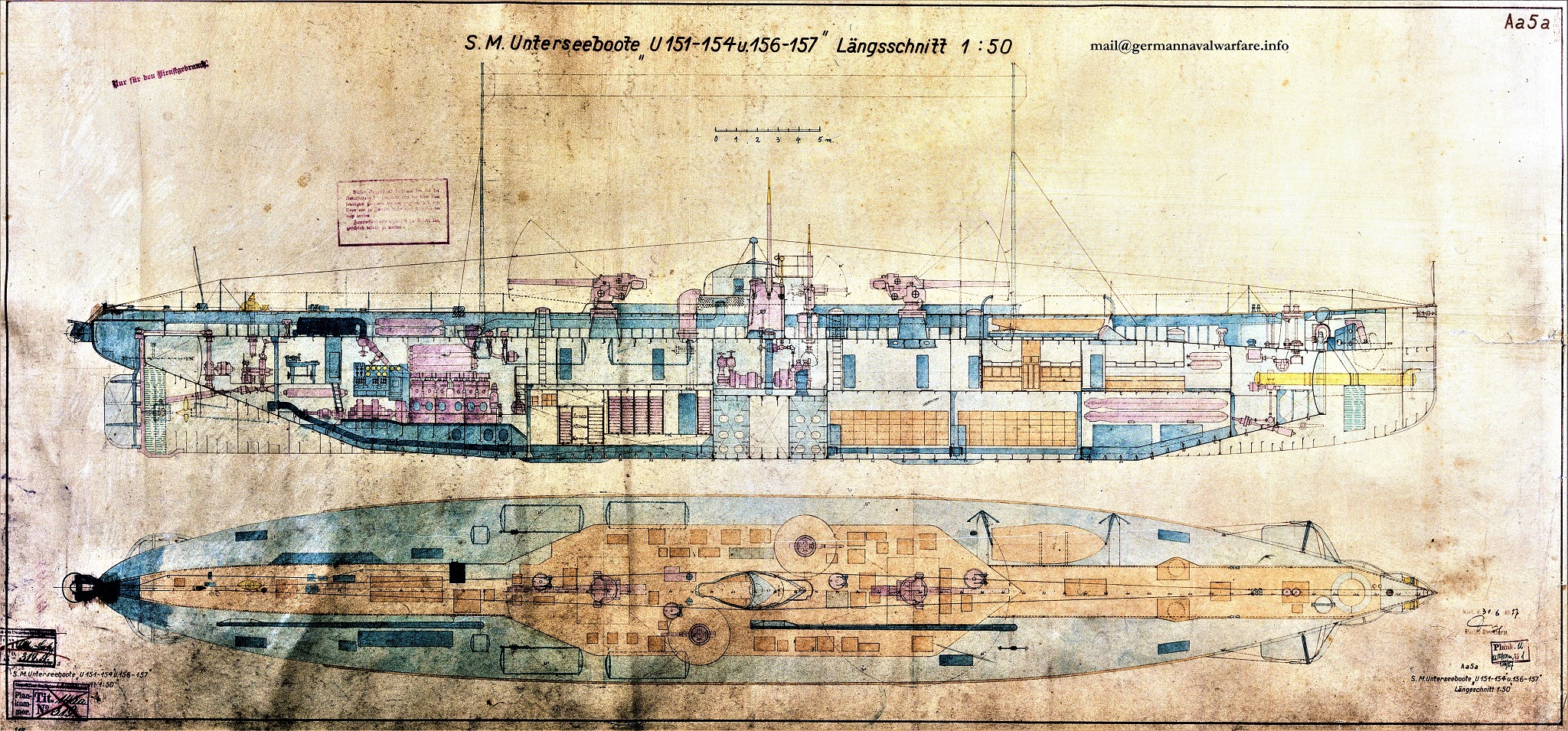
The Deutschland class indeed were the largest submarines ever built in Germany, also in the world at the time (summer 1916). The next largest were the infamous British K-class “steam submarines” (1,980/2,566 tons) in late 1917 and further down the line the M-class of 1918 (1,594 tons/1,946 tons). It’s possible their tonnage differed before military conversion, but the final data accepted by all authors are the following: Deutschland displaced 1,512 t (1,488 long tons) surfaced and 1,875 t (1,845 long tons) submerged for a total of 2,272 t (2,236 long tons) when submerged and fully loaded.
Dimensions were unchanged after conversions. They were moderately long indeed at “just” 65 m (213 ft 3 in) overall, when the contemporary U-81 class measured 65.80 meters (225 ft). The pressure hull was standard for the time, with a spindle shape at both ends, 57 m (187 ft) in lenght, and 5.80 m (19 ft) wide. The magic happened with the unusually large outer hull that contained the cargo space at 8.90 m (29 ft 2 in) overall. The submarines had a draft of 5.30 m (17 ft 5 in) and a total height of 9.25 m (30 ft 4 in) from the keel to the top of the CT.
Apart the very large bulges either side, the upper deck was narrow and shaped like a standard U-Boat, and met forward a straight stem as customary for the time. The deck ended short before the well rounded tail. The CT was conventional as well for U-Boats, with the central bell containing the main hatch and a single spotting persicopes. Around was a wing-shaped fairing pierced by water scoops for rapid submersion. The helsman post was the same, open and forward of the platform, followed by a bulwarked position for the officers in watch and a protective portico. The hull had two more deck hatches communicating to their respective main compartments, protected by watertight bulkheads. The later were however conventional, flat.
The cargo compartments were located for the first, forward of the crew’s living berth space, over two decks. The standard, central crew living spaces had man-tall battery compartments below. There was another large two-deck cargo space aft of the command post below the CT, and the engine compartment aft of it. Another smaller cargo compartment and berthings were located in the forwardmost compartment and more in an equally cramped spaced past the engine room aft. Of course, all these spaces will be converted for military use later. The large cargo spaces remained, but they now contained extra ammunitions for the main and secondary guns plus extra torpedoes.
The boats also had massive built-in fuel tanks (see below) between the inner and outer hulls. Being civilian vessels, the crew was reduced to just 29 men (36 on a standard U-Boat). It grew however to a record 6 officers and 50 ratings after military conversion, thus part of the former cargo space was also used as living spaces. Large merchant grade two-door hatches above the cargo compartments were completed by others, smaller, to access the extra payload stored in waterproof sacks or drums in the upper deck above the pressure hull fore and aft.
Powerplant
The Deutschland class was conventionally powered, with two six-cylinder, four-stroke Germaniawerft diesel engines, each producing 400 hp for total of 800 PS (590 kW; 790 bhp). Maximum surface speed was moderate however, to just 10 knots due to the massive beam and drag, since speed was not in their initial requirement. As a reminder, the contemporary Dantzig Project 25 (U 87) were capable of 15.6 knots surfaced. Later during their military conversion, the diesels were improved to the latest Germaniawerft models, enough to reach 12.4 knots (23.0 km/h; 14.3 mph).
Their maximum submerged speed was just 6.7 knots at best (compared to 8.6 kts on U 87) based on two equally powerful 400 hp electric motors, Siemens (SSW), for 800 PS (590 kW; 790 bhp). They had several rows of ten, two-stage battery cells their main battery compartment. The diesels were eshausted into a raised “funnel” on the deck aft, close to the aft air aspiration mast. Another was located close to the CT. During the 1917 conversion, a military periscope was added.
Later it was reduced to 5.2 knots (9.6 km/h; 6.0 mph) submerged to preserve batteries on the next boats. The range at 10 knots cruise surface speed was impressive at approximately 12,000 nautical miles. In its final military form, with increased fuel storage, it was pushed to 25,000 nmi (46,000 km; 29,000 mi), but at 5.5 knots (10.2 km/h; 6.3 mph) surfaced. To compared it was 8000 nm on an average attack U-Boat like the U-87 medium type. It was down to 65 nmi (120 km; 75 mi) at 3 knots (5.6 km/h; 3.5 mph) submerged (to compared again, c50-56 nm on average).
Indeed, the first two (Bremen, Deutschland) carried 200 tonnes of fuel oil, but the next miliary subs carried instead 285 tonnes of fuel oil. To compare, this was around 100 tonnes on a standard contemporary U-Boat. So they could in theory be used to refuel other subs, albeit the poor communication at the time made any change to meet a fellow U-Boat quite slim in the Atlantic. No milkshücke in WWI.
The water scoops helped, but still these submarines were quite slow to dive, and not very agile. They could safely dive to 50 metres (160 ft). They had classic feartures for an U-boat, with forward low-mounted dive planes, and aft same height tail planes plus classic rudder. The propellers measured 1.60 m (5 ft 3 in) in diameter, initially tailor-designed to be efficient at low revolutions. It is not known if they were changed later. There was a solid keel with two jettisonable ballast under the keel.
Armament
After requisition in 1917 and conversion, later made systematic at completion for all other boats, the now renamed U-151, former SS deutschland, was instantly the most heavily armed submarine in the world, justifying the term of “cruiser submarine”: Given their very wide beam, they happened to be surprisingly stable gun platforms, thus quite well suited to received heavy guns. SS Deustchland as U-155 received indeed two 15 cm (5.9 in) SK L/40 C/97 deck guns, with 1,688 rounds in storage. Her deck was modified to support six 50 cm (20 in) torpedo tubes, in three deck banks.
The internal space was large enough to accomodate a record 24 torpedoes. A standard U-Boat only carried 12.
Later for the next U151 to 154, 156, and 157 (and U 155 after 1918) it was revised to a more manageable pair of 105mm/42 Utof L/45 C/16 deck guns and two 88mm/27 TK L/30 C/08 as complement plus two 500mm TT bow tubes and “only” 18 torpedoes. In german nomenclature the were called “artillery boats”. In fact they had been recast as surface raiders, and the cargo space was usable to carry POWs, for a crew of 56 and 20 men for the prize crew.
14.9cm/37 SK L/40 C/97

If installed, these 1908 guns were protected by bulwarks for and aft. These 15 cm SK L/45 were classic light cruiser guns also used as secondaries on many ships, from armoured cruisers to battleships and battlecruisers, made for both casemates and turrets. They were constructed of an A tube and two layers of hoops, a Krupp horizontal sliding-wedge breech block.
Specs
Mass: 5,730 kgs (12,630 lb) for 6.71 m (22 ft), barrel 6.32 m (20 ft 9 in)L/45.
Shell: Separate loading quick fire 149.1 mm (5.87 in) diameter.
Breech: horizontal sliding-wedge, Hydro-spring recoil
Elevation 20°, 5-7 rpm, MV 840 mps (2,800 ft/s), range c14 km.
10.5 cm SK L/45 naval gun C16 (1916)

There is no data on the 105/42 Utof L/45 C/16, so here is the one taken as reference: As planned from the start, the Germaniawerft U81 clas sboats were designed with a reinforced forward deck to accept a single 105mm deck gun with between 140 and 240 rounds. The crew was planed to manage it, with four officers, and a proper gunnery officer. Built by Meddinghaus, this heavy deck gun was designed specially for deck use, low, with many sensible elements protected from corrosion.
Specs 10.5 cm SK L/45
1,450 kg (3,200 lb), 4.725 m (15 ft 6.0 in), 6.8 mm (0.27 in) wide.
Shell 10.5 cm (4.1 in) 25.5 kg (56 lb) fixed Brass Casing 17.4 kg (38 lb)
Breech: Horizontal sliding-block, MPL C/06: -10° to +30° mount
Rate of fire: 15 RPM
Muzzle velocity 710 m/s (2,300 ft/s)
Effective range 12,700 m (41,700 ft) at 30°
8.8 cm Schnelladekanone Länge 30 naval deck gun
The 8.8/27 TK L/30 C/08 gun used the Krupp horizontal sliding block, or “wedge” and the submarine deck version was on either a retractable or fixed pivot mount. The Krupp mount retracted vertically through a hatch, and the Erhardt version folded down onto the ship’s deck. They avoided underwater drag and turbulences. When combined with the heavy 15 cm guns, they were located in echelon either side of the conning tower with 764 rounds each. Four deck gun was an unprecedented number for a submarine, really making true their “cruiser submarine” concept.
8.8cm specs
Weight: 644 kgs (1,420 lb) oa 2.64 m (8 ft 8 in).
Breech: Krupp horizontal sliding block.
Shell: fixed 7 kg (15 lb) cal 88 mm (3.5 in)
Elevation: -10° to +30°
Rate of fire: 15 RPM
Muzzle velocity: 590 m/s (1,900 ft/s)
Maximum firing range: 7,3 km (8,000 yd) at 20° or 10,5 km (11,480 yards) at 30°.
Torpedo Tubes
Either they carried six tubes in pairs over the deck (Deustchland only) whereas Oldenburg aka U 155 and U 151 had two classic bow tubes. But all had the same 50cm tubes made for the standard G7 torpedo. The G7 was designed in 1910 and entered service in 1913. Originally designed for surface ships, but in 1917 it started to be used on U-boats. The first two boats had 24 in store, the latter 18. The way the torpedo system worked on U-155 (former Deustchland) is somewhat foggy. It seemes these were traversing banks which inspired the French postwar. In any cases, they had to be reloaded when surfaced, making this impractical. Later in 1918, they were removed and she had the same two bow tubes as her sisters.
50cm G7 torpedo specs
Specs: Weight: 3,009 lbs. (1,365 kg), Overall Length: 276 in (7,020 m).
Explosive Charge: 430 lbs. (195 kg) Hexanide warhead
Range/Speed settings: 4,370 yards (4,000 m)/37 knots and 10,170 yards (9,300 m)/27 knots
Power: Decahydronaphthalene (Decalin) Wet-Heater.
⚙ Specifications U-151 class 1917 |
|
| Displacement | 1,512 tonnes surfaced, 1,875 tonnes submerged, 2,272 tonnes FLS |
| Dimensions | 65 x 8.90 x 5.30m (213 ft 3 in x 29 ft 2 in x 17 ft 5 in) |
| Propulsion | 2 shafts diesels 790 bhp surf. 2EM 790 bhp sub. |
| Speed | 12.4 ks surfaced, 5.2 knots submerged. |
| Range | 25,000 nmi (46,000 km) 5.5 ks surfaced, 65 nmi (120 km) 3 kts submerged |
| Armament | 2x 50 cm (20 in) bow TT (18), 2× 15 cm SK L/45, 2× 8.8 cm Uk L/30. |
| Mex depth | 50m+ (160 ft) |
| Crew | 6 officers, 50 enlisted |
Career of SMS Deutschland and the U-151 class
 SS Deustchland/U 155 (1916)
SS Deutschland was laid down in November or December 1916 as N°381 FSG yard number at Flensburg and launched March 28, 1916, completed at Germaniawerft in June. After her two commercial trips she was requisitioned, modified under N°263 ar Germaniawerft and recommissioned as U-155 on February 18, 1917. Her first commercial/blockade run was on June 16, 1916, from Wilhelmshaven. After being loaded she started her trip under escort on June 23, with with officers from Norddeutscher Lloyd under Captain Paul König and with a cargo of vital importance to the United States: 163 tons of dyes (including alizarin) and pharmaceutical preparations (Salvarsan) worth 60 million marks, from Meister Lucius & Brüning AG dye works and diplomatic mail.
She thus became the first submarine ever to cross the Atlantic. She arrived in Baltimore on July 9, 1916, with a crowd of onlookers and soon the press. After a reception and diplomatic work, she took on her equally precious return cargo, 348 tons of rubber (commissioned by Nordmann, Rassmann & Co., Hamburg but officially for Hungary), 341 tons of nickel, 93 tons of tin, all urgently needed. She was back in Bremerhaven on August 25, 1916 after 8,450 nautical miles, 190 submerged to dodge British patrols. The cargi yielded a profit of 17.5 million marks, four times the ship’s construction costs.
The American chemical industry was however unable to produce the delivered substances at that time and was dependent on supplies from Germany. The return cargo covered the needs of the German war industry but still, it had little overall impact on the German economy, still starting to suffer badly from the British blockade. For her second trip on October 10, 1916, Deutschland sailed again with dyes, chemicals, pharmaceuticals and others, but from Bremen, reaching New London in Connecticut to draw less attention, on November 1, 1916. As she was about to start her planned return trip on November 17, 1916, an incident happened: In a maneuver by one of the assisting tugs (T. A. Scott) she was rammed and sank by the submarine, with five crew members drowning.
There was a port commission on enquiry as she was stopped, but her innocence was established, she had to pay a security deposit of 348,000 marks. Her bow damage was repaired, and she was free to sail on November 21 with a cargo of 378 tons of rubber, 188 tons of nickel, 146 tons of iron alloy, 76 tons of tin, silver ingots worth $140,000. She made it at Wesermünde (now Bremerhaven) on December 10, 1916. This was her last trip. The US port authorities later reimbused the security deposit. Her 3rd blockade run was planned for January 1917, but cancelled due to the impending entry of the United States into the war. So by February 10, 1917, she was struck from the ship register and formally purchased for the Kaiserliches Marine. She was modified into a proper military boat at the Imperial Shipyard in Wilhelmshaven, and recommissioned as U 155 on February 19, 1917, now displacing 1,503t submerged, capable of 12.4/5.2 knots surfaced and submerged, for a better range at 25,000 nautical miles at 5.5 knots and 65,000 nautical miles at 3 knots, a fuel capacity of 328 t like later boats, and could dive to 50 m in 50–80s.
She also sported these three twin torpedo tube on the upper deck until 1918 but also had two 15 cm SK L/40 from the battleship SMS Zähringen until 1918, then two 15 cm Utof C16 L/45 and a larger crew of 6 officers and 50 Petty officers or enlisted men. There was enough provisional capacity for a prize crew of 1 officer and 19 ratings. From the start, her captains complained she was underpowered and could not catch fast merchant ships. Still, for her three patrols, she managed to sink 42 ships for 121,328 GRT, damaged one (1,338 GRT). She indeed venture far out at sea. Her service ended on November 13, 1918. She was surrendered to Great Britain on November 24, 1918, scrapped in Morecambe in 1922.
SS Bremen (1916)
Bremen was laid down as yard N°381 (later N°262 in Germanwerft) at Flensburg SB in December 1915, launched on 8 July 1916 and ready by late 1916 at Germaniawerft, Kiel. After delivery, she was handed over to the German Ocean Shipping Company (DOR) on July 8, 1916, registered in the Bremen ship register, baptised by wife of Bremen’s mayor, Carl Georg Barkhausen. Her first and onlyu captain was Karl Schwartzkopf, naval reserve officer trained on submarines, discharged from active duty for this. Walter Dähn was the chief engineeer. She received a cargo of approximately 750 tons of aniline dyes and pharmaceuticals, and polio medication expected in the United States. She departed from Kiel on August 21, 1916, and after taking more cargo in Bremen she stopped in Heligoland, and started her transatlantic blockade run, destination New London, Connecticut. Her last radio message was a short signal with news she was approaching Orkney. No further reports about her whereabouts. Speculation was high. After weeks without news she was announced lost. The cause remained uncertain for years. In fact she has vanished without a trace and her wreck still has not been found. So perhaps future will tell about her fate.
SS Oldenburg/U 151 (1916)
U151 (ex-Oldenburg) was laid down in 1916 as N°294 yard number at Flensburg SB (last of the three merchant subs), launched 4.4.1917 and completed like the others at Germaniawerft, Kiel in July 7 1917 directly as U-151 and militarized. From 21 July to 26 December 1917 she was commanded by Waldemar Kophamel. Her first long-range cruise eventually covered a total of 12,000 miles. On 19 September 1917 U-151 she claimed her first victim, the 3,104 GRT French sailing ship Blanche in the Atlantic. On 2 or 12 October 1917 she collided with the Royal Navy Q-ship HMS Begonia off Casablanca (French Morocco), sinking her. On 20 November 1917 she captured the steamship Johan Mjelde, scuttled her on 26 November after transferring 22 tons of copper on board. For her second patorl she left Kiel on 14 April 1918 under Korvettenkapitän Heinrich von Nostitz und Jänckendorff. She was to rampage American shipping close t shore, as the latter still not took any measures like blackout and shore patrols or convoys. She arrived on 21 May, laid mine (tubes models) off the Delaware Capes, cut the submerged telegraph cables connecting New York City with Nova Scotia. On 25 May she stopped three American schooners off Virginia and took (the released) their crews, sinking all three by gunfire.
On 2 June 1918, in what some historians called “Black Sunday”, U-151 sank six American ships, damaged one off the coast of New Jersey in a few hours. The next day she claimed the tanker Herbert L. Pratt, by ne of her mine, albeit she salvaged. On 9 June 1918, U-151 stopped the Norwegian cargo ship Vindeggen off Cape Hatteras in North Carolina, crew evacuated, ships scuttled Capt. Von Nostitztransferred 70 tons of copper ingots. On 14 June she sank the Norwegian barque Samoa from Walvis Bay (SW Africa) with copper by gunfire. It happened 90 miles off the Virginia coast. On 18 June, she sank the steamship SS Dwinsk. She remained close to lifeboats hoping to lure in Allied shipping and managed to spot and launch torpedoes an an auxiliary cruiser and the troopship USS Von Steuben (missed both) and escaped under depth charges. By 28 June, U-151 she captured SS Dictator from Newfoundland. She was back to Kiel on 20 July 1918 after 94-day over 10,915 nmi (20,215 km; 12,561 mi), 23 ships and 61,000 tons. The war ended before she could started her next patrol.
S.M. U 152

U152 underway, note her camouflage.
U152 was the first military derivative of the Deutschland design, ordered as hull N°295 from Reiherstieg, Hamburg and laid down in late 1916 launched on 20.5.1917 and complted at Germaniawerft, Kiel in October 1917. She entered the U-Kreuzer Flotilla with all her sisters under Kptlt. Constantin Kolbe from 20 October 1917 to 3 May 1918 and later KrvKpt. Gerhard von Zitzewitz until 24 August 1918, and completed her career under Kptlt. Adolf Franz, making 2 patrols, sinking 19 merchant ships (37,505 GRT) and damaged three (11,406 GRT).
She roame the Atlantic, and claimed her two first victims, American schooners Julia Frances (sunk on 27 January 1918) and A.E. Whyland (sunk on 13 March 1918). Later she sank the Norwegian barque Stifinder (boarded and scuttled 13 October 1918) and Spanish Giralda (sunk 25 January 1918), as well as the U.S. Navy cargo ship USS Ticonderoga, sunk, after a two-hour gun battle (as she was armed). There were heavy casualties among her crew and passengers and this was on 30 September 1918. The next day she also fought a gun battle with the oiler USS George G. Henry but she escaped. She was back home on November 1918, surrendering soon after to the Allies at Harwich, 24 November following the Armistice. She was for a time exhibited at the Tower Bridge in December 1918, then laid up at Portsmouth, towed on 30 June 1921, and sank in the Channel.
S.M. U 153
U153 was laid dwn as Hull N°296 at Reiherstieg, Hamburg in 1916, launced on 19.7.1917 and completed, fitted out at Germaniawerft, Kiel in November that year. She was assigned to the U-Kreuzer Flotilla under KrvKpt. Gernot Goetting until 31 July 1918, making a single patrol, with 3 merchant ships sunk (9,428 GRT) and an auxiliary warship (3,314 GRT), then under KrvKpt. Paul Pastuszyk from August it is not sure she made another cruise. She surrendered to the allies on 11 November 1918 and was conducted to Harwich for internment on 24 November 1918. Exhibited at Greenwich in December she was to allocated to France, but was swapped with U-162 and laid up at Portsmouth, until towed into the Channel on 30 June 1921 and scuttled.
S.M. U 154
U154 was ordered as hull n°297 from Reiherstieg, Hamburg in 1916, launched on 10.9.1917 and completed at Germaniawerft, Kiel in December the same year. She entered the U-Kreuzer Flotilla under KrvKpt. Hermann Gercke until 11 May 1918, making a single patrol, sining 5 merchant ships (8,132 GRT) and damaging four (18,220 GRT). On 11 May 1918, she was torpedoed and sunk in the Atlantic by the Royal Navy submarine HMS E35 lost with all hands (77).
S.M. U 156
U156 was ordered as hull n°151 at Atlas Werke, Bremen unlike her sisters, and launched on 14.4.1917. She was completed however as hull n°298 in Germaniawerft, Kiel and commissioned in August 8.1917. She was arguably the second mot successful in class after U-155 aka the former SS Deutschland. As part of the U-Kreuzer Flotilla under Kptlt. Konrad Gansser from 22 August 1917 to 15 June 1918 she made a first patrol, then another until 25 September 1918, and ended her career under Kptlt. Richard Feldt from 16 June to 25 September 1918. For two patrol she managed to sink 44 merchant ships (50,471 GRT), 2 damaged (638 GRT) and the 13,680 tons armoured cruiser USS San Diego on 19 Jul 1918. She nearly shared the fate of her sister U 154 when thanks to British intel she was localized in the Canary Is. and was ambushed by the British submarine HMS E48. One torpedo hit but was a dud. To be updated in 2027.
S.M. U 157
U157 was ordered from Stülcken, Hamburg unlike her sister under the hull n°299. She was launched on 23.5.1917 and was sent to be completed at Germaniawerft, Kiel and commissioned in September that year. She joined the U-Kreuzer Flotilla until 20 July 1918 under Kptlt. Max Valentiner, then KrvKpt. Ortwin Rave until 30 November 1918 making a patrol each, sinking 15 merchant ships sunk for 15,905 GRT. On 11 November 1918 she surrendered to the entente and was Interned at Trondheim, Norway, then she was surrendered to France on 8 February 1919 and broken up at Brest in July 1921.
Read More/Src
Books
Gröner, Erich; Jung, Dieter; Maass, Martin (1991). U-boats and Mine Warfare Vessels. German Warships 1815–1945. Vol. 2. Translated by Thomas, Keith; Magowan, Rachel. London: Conway Maritime Press.
Jung, Dieter (2004). Die Schiffe der Kaiserlichen Marine 1914-1918 und ihr Verbleib [German Imperial Navy ships 1914-1918 and their fate] (in German). Bonn: Bernard & Graefe.
Voyage of the Deutschland. The First Merchant Submarine König, Paul; Bischof, Ernst 2001, NIP
Links
uboat.net U 151 type
history.co.uk
laststandonzombieisland.com
jstor.org Is the Deutschland a Merchant Ship? – Rear Admiral Degouy
history.state.gov Sub activity US coast ww1
theleansubmariner.com
yarmouthmuseums.wordpress.com
sakhalianet.x10.mx
commons.wikimedia.org
en.wikipedia.org Deustchland
navypedia.org
de.wikipedia.org Deustchland
en.wikipedia.org blockade of Germany
wiki Type_U_151_submarine