
 Svenska Marinen Two coastal destroyers: Remus, Romulus 1940-1958.
HSwMS Romulus and Remus were former Italian Torpedo Boats Spica and Astore, of the namesake class already in service in the Regia Marina from 1935. They were purchased alongside as two Sella class destroyers in January 1940 but only departed from La Spezia in April 1940 after training the Swedish crews. They arrived only by July in Sweden after the “Psilander Affair” since Italy became belligerent in June, while they were underway, and forced internment and seizure by the British Royal Navy under orders of Churchill in the Faeroe Island. They were modified in Swedish Service and were found quite satisfactory, unlike the Psilander class. They inspired the next Mode class coastal destroyers, were modernized as ASW frigates in 1953 and remained active until 1958.

Romulus underway seen from Remus underway to Ireland in May 1940. Part of the “Pislander Affair”.
Design of the Romulus class
The Romulus-class had been ordered as a plan for the Swedish Navy to rapidly expand after the start of the war in September 1939 as Sweden was fearful of a possible German invasion. Svenska Marinen’s top brass concluded they needed both standard and coastal destroyers. This led to the purchase of four ships in Italy, after the US was cold-footed about it, as Italy the only close non-belligerent country willing to sell some of its ships at a bargain price. The first two were the Psilander class, agreed to be funded by the diet. They were former Sella-class destroyers, which were in essence, were enlarged and improved versions of the preceding Palestro and Curtatone class of late WW1. Not the latest kit, but they were affordable. However their light Mediterranean structure was a concern.
The second class was more recent, these were two Spica-class torpedo boat, the Swedes considered they were well suited to be used as coastal destroyers. They were also purchased from the Royal Italian Navy in March 1940 and had been originally built in Italy as Spica and Astore. They departed all four on 14 April 1940 and their trip is worthy of a novel.
Hull and general design

Romulus and Remus in their neutraluty camouflage in 1945.
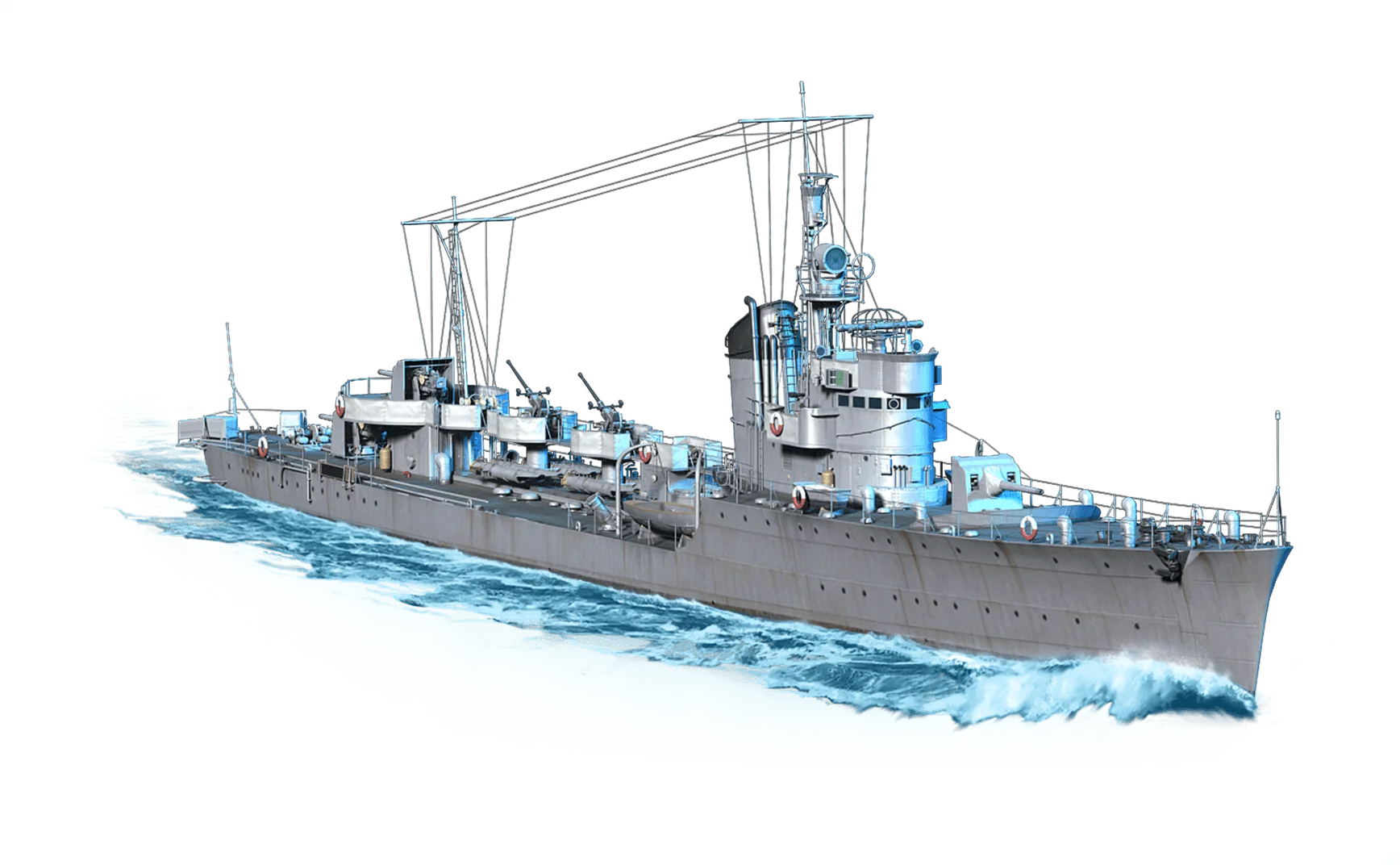
Being “stock” Spica class, these ships displaced 630 long tons (640 t) at standard loadn 900 tonnes (890 long tons) at deep load. They measured 81.4 meters (267 ft 1 in) long overall with a beam of 8.2 meters (26 ft 11 in), and a draft of 2.3 meters (7 ft 7 in). Design-wise, they were typical of these early torpedo boats, with a long forcastle, about 1/2 of the total lenght like destroyers, but a more compact silhhouette with the single raked funnel close to the bridge. The latter had a streamlined, rounded face, with an enclosed section dotted with windows and an open bridge above on top of which was installed a fire control system.
The raked foremast partly supported a derrick on top of which was installed a searchlight platform. The remainder of the structure was low, with supporting structures for AA guns and a flying bridge running all the way to the small quertdecxk house aft, supporting “X” gun, while “Y” was on deck. The four torpedo tubes on some of the class could be single, placed either side but with large space but a few pillars for cross-deck fire. But in the Swedish case, they were in twin mounts in the axis. The ships also had paravanes at the poop but lacked ASW racks. Stability was a concern though. This was improved on the next classes that Italy developed. The crew reached just 99 officers and ratings.
Powerplant
 The Romulus class were powered by two Tosi geared steam turbines. Each drove a single propeller shaft, fed by steam from two Yarrow boilers. The Tosi turbines had been tailored for these torpeod boats and could deliver a rather modest 9,500 hp each or a total of 19,000 shaft horsepower (14,000 kW). This was calculated for a top speed of 34 knots (63 km/h; 39 mph) on trials. They also carried 207 tonnes of fuel oil for a range of 1,700 nautical miles (3,100 km; 2,000 mi) at 16 knots (30 km/h; 18 mph) albeit other sources points out 1,900 nm at the same rate.
Armament

“Spica” the dog mascot of HMS Romulus, in front of “A” main gun.
All armament was “stock” Italian, that is three single 100 mm (3.9 in) 100/47 DP guns, three single 20 mm (0.8 in) AA guns, two twin 457 mm (18 in) torpedo tubes (2 × twin mounts) and two depth charge throwers, and they could carry 28 mines. Their original 1936 AA was quite reduced. Modifications were asked by the Royal Swedish Navy, and three 20-millimeter (0.8 in) Breda AA guns in single mounts were added as well as a pair of 13.2-millimeter (0.5 in) M/31 heavy machine guns.
100 mm (3.9 in) 100/47 DP
The main armament of the Romulus class consisted of three 100-millimeter (3.9 in) dual-purpose guns in single mounts, “A” located at the forecastle, “X” and “Y” on superfiring mounts at the stern.
For data see the Italian Spica class. In Swedish service they were named “100mm/47cal. kanoner M/40”. One, “Y” mount was removed in 1953 to make way for a Squid 305 mm ASW mortar when converted as frigate.
Breda 20 mm/65 mod. 35

Thes three single mounts were located aft of the funnel, in a single and then a pair of mounts linked by a flying bridge, over the torpoedo tubes for a good fire arc. For data see the Spica class.
This was completed by two 13.2-millimeter (0.5 in) M/31 heavy machine guns located abaft the bridge. In Swedish service they were called lvakan M/38 (Flak-30). After refit and modernization in Sweden, the ships carried three twin 20 mm overall with their caracteristic staggered barrel.
M/31 heavy machine guns
Breda 13.2 mm made as transferred. Most Swedish sources points out they were removed entirely, and replaced by the three extra 20 mm Breda.
Torpedo Tubes
The ships were equipped with four 533-millimeter (21 in) torpedo tubes in two rotating, twin-tube mounts located between the rear funnel and the stern gun.
DC Throwers & Racks
Two depth charge throwers were fitted aft close to the quarterdeck house. In Swedish service however they gained two racks at the poop as well, and the paravanes were removed. In Swedish service they were called respectively sjunkbombskastare M/33 and sjunkbombsfällare M/33.
Mines
The ships could also originally carry 28 mines. Likely they were Kontaktmina m31 in Swedish service. Swedish sources tends to confirm that possibility.
⚙ specifications (1940) |
|
| Displacement | 630 tonnes standard |
| Dimensions | 81,4 x 8,2 x 2,3 meter (267 x 26 x 7 ft 7 in) |
| Propulsion | 2 x Tosi steam turbines, 3 x Yarrow boilers, 19,000 hp. |
| Speed | 34 knots (63 km/h; 39 mph) |
| Range | 207t oil, 1,700 nm (3,100 km; 2,000 mi) at 16 kts |
| Armament | 3x 100mm/47, 3x 20mm m/65 AA, 2x 13.2mm m/31 AA, 2×2 533mm, 2 DCT, 28 mines |
| Crew | 94-99 |
Gallery

After view of Romulus underway in May 1940.

The Swedish destroyer Remus alongside a British Tribal-class destroyer, while a British crew is starting the engines. On 20 June 1940, the destroyers HMS Tartar (F43) and HMS Mashona (F59) seized the Swedish destroyers Romulus and Remus at the Faeroes. These ships had been purchased from Italy and were on passage to Sweden. After intense diplomatic activity they were later returned to Sweden after having been sailed to from Scapa Flow, Scotland (UK).

Internment in the Faeroe islands, June-July 1940

On board the “Scottish”: Swedish crews are transferred out at gunpoint for internment in June 1940.

Swedish destroyers of the Romulus class, HMS Romulus (27) and HMS Remus (28) in 1944 or 1945. Marinmuseum
Career of the Romulus class
 HSwMS Romulus

HSwMS Romulus upon arrival, still not camouflaged with neutal bands
Spica was launched on 11 March 1934, as the lead ship of her class, the first modern Italian torpedo boats after decades at Bacino e Scali of Naples, a completely new spin on a genre that was neglected by the Washington teraty and left available, provided they did not reach more than 600t standard. All three axis powers embarked on this bandwagon. The Spica class had issues and the Italians imroved the recipe and built three more classes, the last completed in 1942-43. Spica was commissioned on 30 May 1935, and entered service with the Regia Marina, helping defining a new standard.
In December 1939, a Swedish commission flew to Italy in order to purchase some warships and expand the fleet, fearing a German attack. This led to the acquisition of four vessels, with a contract signing in January, including the Spica and Astore. On 14 April 1940, all four ships left La Spezia for Sweden under supervision of commander Hagman, watching over the training of his crews between March and their departure. Swedish crews continued training on board, with some Italian advisors on board. They were delayed already by hasty repair and fuel shortages along the way. The Pislander class Puke indeed suffered an engine failure and left the formation, colliding with Psilander so they had to stop at Cartagena for repairs, and the two Romulus stayed with them.

Romulus and Remus in Cartagena
In Cartagena, Spanish workers worked efficiently despite the extensive damage so they could leave on 26 April for Lisbon, bein refuelled by the Swedish Tanker Patricia, sent in advance, warned already by the Italian naval chief, Admiral Cavagnari via the naval attaché to make their way home as soon as possible in order to escape capture by the Germans while in the Kiel Canal. This was caught by the British which prepared an operation against their transfer in May. The ships were in Lisbon by 28 April, dropping anchor in the Tagus to refuel and sail to Cobh, Ireland, the long route to avoid the Germans. No oil could be obtained but fresh water so they ended trapped in Lisbon. Puke was finally repaired in drydock at Lisbon however.
They resumed the trip on the 26th of May with Patricia and Castor to the Faroe Islands via Vigo, for a new refuelling. Italy entered war and of the ships were already paid for, this was now a very delicate situation. Instructions were given to Castor to stay with them, and they proceeded northwards at 8 knots. Hagman, doubted they would have enough fuel to reach Cobh, in Neutral Ireland. Her detached Castor. Patricia left Vigo at 12 knots and erached Cobh on 29 May. Castor was intercepted by the French, forced back to Casablanca. Negociations freed her after two days. By late May they still sailed for the western Coast of Ireland and learned that the Danish Faroe had been occupied by the British by April 1940 after Denmark’s surrender. On 22 June France capitulated and by fear the Germans would take any opportunity to seize the Swedish vessels underway, on 19 June as the flotilla made it in the Feroe Islands, PM Churchill considered their seizure.
RN ships rushed to Skaalefjord near Torshavn, and a motorboat was sent with British squadron commander Captain C. Caslon to meet his counterpart on HMS Puke. Caslon then gave an ultimatum to be evacuated within 2.5 hours. Patricia and Castor resumed their journey home. Commander Hagman rejected the demands, stating he would fight or sink his ships and continued to communicate with the Swedish government, then he requested an official written note from the British government, Caslon complied but the crews were peacefully interned and a week passed with intense diplmomatic efforts to release them. They were able to sail again on 1 July to Gothenburg, but Torsten Hagman was later court martialled back home, not condemned, but never publicly acquitted. Romulus entered service later that year after she was modified to suit Arctic conditions and with Swedish armament. Like her sister she was modenrized as a frigate in 1953 and stricken on 15 August 1958.
HSwMS Remus

HSwMS Remus upon arrival, still not camouflaged with neutal bands
HSwMS Remus (28) was a Romulus-class destroyer purchased from the Royal Italian Navy in March 1940 for the Royal Swedish Navy and boost its rank. She had been originally being built as Astore at BS Napoletani (Naples), and launched on 22 April 1934, completed on 30 May 1935 and commissioned for the Regia Marina. She served under that flag (see th Spica class for more) until by December 1939, a Swedish commission flew to Italy departed to investigate the possibility for Sweden to buy Italian vesses. Both Spica and Astore, the first of their namesake class were retained as well as two Sella class destroyers. Astore like her sister departed on 14 April 1940 from La Spezia for Sweden under a Swedish commander and with Sweedish crews.
The journey was quite dramatic (see above) as they had been impounded underway by Britain on their way on 20 June in the Faroe Islands, after Italy went at war against the allies in between. The “Psilander affair”. The British then released her on 1 July, and Remus entered service later that year but modified on arrival by the Swedes to withstand Arctic conditions and with Swedish gear and weapons.
The career of HSwMS Remus then become murky. She was appreciated, like her sister, inspiring the Mode class, and remained useful in Swedish service, especially after partial conversion and reclassement as “frigates” for the cold war. Like her sister in 1953 she lost one 100mm/47 main gun as well as her torpedo tubes fpr a British triple ASW 305mm Squid Mk 4 mortar, as well as modern radars and sonar. This enabled her a further few years until she was stricken from the navy list on 15 August 1958.
Read More/Src
Books
Borgenstam, Curt; Insulander, Per; Kaudern, Gösta (1989), Jagare : med svenska flottans jagare under 80 år (2:a), Karlskrona: Västra Frölunda CB Marinlitteratur
von Hofsten, Gustav; Waernberg, Jan (2003), Örlogsfartyg: Svenska maskindrivna fartyg under tretungad flagg (1:a), Karlskrona: Svenskt Militärhistoriskt Bibliotek
lackman, Raymond V. B. (1960). Jane’s Fighting Ships 1960–61. London: Sampson Low, Marston & Co. Ltd.
Campbell, John (1985). Naval Weapons of World War II. Annapolis, Maryland: Naval Institute Press.
Parkes, Oscar (1973) [1931]. Jane’s Fighting Ships 1931. London: David & Charles (Publishers).
Westerlund, Karl-Eric (1980). “Sweden”. In Chesneau, Roger (ed.). Conway’s All the World’s Fighting Ships 1922–1946.
Whitley, M. J. (2000). Destroyers of World War Two: An International Encyclopedia. London: Cassell & Co.
Lagvall, Bertil (1991), Flottans Neutralitetsvakt 1939-1945, Karlskrona: Marinlitteraturföreningen nr 71
Hammargren, Henning (1981), Vapenköp i krig: svenska krigsmaterielinköp i Italien under andra världskriget, Stockholm: Marinlitteraturföreningen.
Links


navypedia.org
forum.warthunder.com
marinmuseum.se
Romulus wiki
commons.wikimedia.org Romulus
commons.wikimedia.org Remus
Model Kits
Not found, but the existing 3D model should be printable. Otherwise a standard Spica class kit would do.